Bidding on Competitor Brand Names: Strategy, Risks, and How to Do It Right
Bidding on competitor brand names is one of the most debated tactics in pay-per-click (PPC) advertising. It can help you gain brand awareness in a crowded market, but it can also waste ad spend, provoke competitors, and create potential legal implications if handled poorly.
This guide explains how bidding on competitor keywords works in Google Ads, what is allowed, where the risks are, and how to build competitor campaigns that are clear, ethical, and measurable.
Key Takeaways
- Google allows competitor keyword bidding, including on trademarked competitor brand names, but trademark rules still apply.
- Do not casually use competitor brand names in ad copy, ad headline fields, display paths, or dynamic keyword insertion, because trademark complaints can create legal and Google Ads account risk.
- Use competitor campaigns selectively, because competitor brand terms may bring high-intent search users but also lower quality scores, higher costs, and a potential bidding war.
- Defend your own brand first, especially your own branded keywords, before you start bidding on competitor terms.
- Get legal and PPC expertise involved early, especially if you operate in finance, health care, pharma, legal services, or another regulated competitive market.
What Is Bidding on Competitor Brand Names?
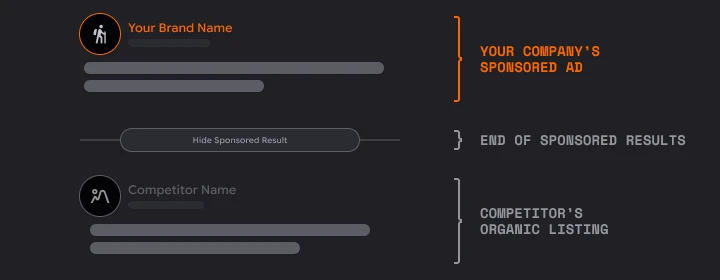
Bidding on competitor brand names means adding a competitor’s brand, product, or company name as a keyword in your paid search campaigns. If you are a CRM company, for example, bidding on “Salesforce,” “Salesforce pricing,” or “Salesforce alternative” would be competitor keyword bidding.
Inside Google Ads, the keyword is not automatically visible to the user. It simply tells Google that your search ads may enter the auction when a user’s search query matches that keyword. You only pay when someone clicks.
- Own brand keywords: Searches for your own brand, own brand name, product names, and key misspellings.
- Generic category keywords: Non-branded keywords such as “CRM software,” “project management platform,” or “Nike running shoes.”
- Competitor brand keywords: Searches that include competitor names, a competitor’s brand, or competitor brand terms.
- Modifier keywords: Searches like “competitor alternative,” “competitor pricing,” or “competitor vs your brand,” where potential customers are comparing options.
Bidding on a competitor can mean bidding on a pure brand name or bidding on a competitor brand plus intent. The second option is often more strategic because the searcher is already considering alternatives.
Is It Legal to Bid on Competitor Brand Names?
Yes, but legal does not mean risk-free. Bidding on competitor brand keywords is generally legal, and bidding on competitor brand keywords is legal since 2004 in the sense that early U.S. cases helped separate hidden keyword bidding from visible consumer confusion.
In the U.S., cases such as 1-800 Contacts v. Lens.com and 1-800 Contacts v. Warby Parker clarified that buying a competitor’s trademark as a keyword is different from using that trademark in a way that confuses consumers. The primary legal threshold for trademark infringement is the likelihood of consumer confusion.
Trademark law generally cares most about what search users see: ad text, ad headline language, display URLs, and the landing page. Competitive advertising must be truthful and supported by evidence under the Lanham Act. Using comparative advertising can lead to lawsuits if deemed false.
The rules are stricter in some jurisdictions, including parts of the EU, where courts may look closely at whether the ad clearly identifies the advertiser. In practical terms, bidding on a competitor’s brand is usually safer when your ad makes a clear distinction from competitors and does not imply affiliation.
Bring in your legal team before large-scale competitor bidding, especially in regulated industries. Bidding on competitor keywords can lead to potential legal implications, and trademark owners can file complaints against misleading ads.
Google Ads Rules for Competitor Keyword Bidding
Google’s policies generally allow keywords in Google Ads to include registered trademarks, including competitor brand terms. The problem usually starts when those trademarks appear in visible ad assets.
Core policy points:
- Google allows bidding on competitor brand terms, including registered trademarks, but polices how those terms appear in ad text.
- Ads must not use competitor trademarks in their copy unless you have permission or fit a narrow exception.
- Advertisers cannot use a competitor’s trademarked name in ad copy without permission, and using competitor trademarks in ad copy is illegal without permission in many contexts.
- From 2023 onward, trademark complaints must identify specific advertisers and specific ads, not entire industries.
- Google maintains restricted-brand lists in some categories, such as auto, medical, and pharma, where keyword targeting may be blocked or limited.
- Google Ads may suspend accounts for trademark policy violations, and repeated misuse can cause disapproval, limited serving, or full account suspension.
Bidding on the Brand vs. Using the Brand in Ad Copy
There is a major difference between brand bidding and visible brand use.
- Usually allowed: Bidding on a competitor’s brand name as a keyword.
- High-risk: Putting that competitor’s trademark in an ad headline, description, display URL, or path field.
- Safer copy angle: Lead with your own name, benefits, and positioning.
- Example: Use “Top CRM for Mid-Market Teams” instead of “Better than Salesforce.”
- Avoid: Display paths that include competitor names unless your legal team explicitly approves.
Ad text using competitor trademarks can lead to legal risks and ad disapprovals. Transparency in advertising requires a clear distinction from competitors, so ads mimicking a competitor’s visual identity can be considered unethical even when the keyword strategy itself is allowed.
Dynamic Keyword Insertion and Competitor Terms
Dynamic keyword insertion can be useful in ordinary search engine campaigns, but it is dangerous around competitor terms. DKI can automatically insert the matched keyword into your ad headline or description.
That means dynamic keyword insertion can lead to trademark violations if a competitor’s trademark appears in your ad. Dynamic keyword insertion with competitor names can lead to trademark violations, and you are still responsible even if the system inserted the term automatically.
Avoid DKI and automatically created assets in any dedicated campaign that targets competitor keywords. Use static ad copy, curated asset feeds, and pre-approved messaging instead.
Strategic Pros and Cons of Competitor Keyword Bidding
Competitor bidding is high-intent, but it is not always high-ROI. Searchers who type branded terms are usually familiar with the category, and competitor keywords often have higher click-through rates due to search intent. At the same time, your ad relevance may be weaker because the user searched for someone else.
Major benefits include:
- Increased visibility in search results when potential customers are researching alternatives.
- A chance to present a compelling alternative before the buyer commits.
- More brand recognition in a competitive landscape.
- In some cases, bidding on competitor keywords can lower cost-per-click rates versus expensive broad category terms.
The downsides are real:
- Competitor keywords typically have higher cost-per-click rates than your own brand, and competitor brand keywords typically have higher cost-per-click rates.
- Bidding on competitor keywords can result in lower quality scores because your ad and landing page may not match the original intent.
- Search engines may penalize ads that are not relevant to the keyword through lower quality scores and higher CPCs.
- Competitor bidding may trigger retaliatory actions from competitors.
- A bidding war can inflate costs for both sides.
Ethical competitor bidding focuses on highlighting a product’s unique features rather than attacking a rival. The goal is to show unique selling points, not damage a brand’s reputation.
When Bidding on Competitor Brand Names Makes Sense
Competitor brand bidding makes sense when you can honestly compete. If your offer is stronger on price, service, support, implementation speed, or features, you may have a valid reason to appear beside competitor ads.
Good use cases include:
- B2B SaaS products with clear comparison demand.
- Legal, home services, and DTC subscription categories where shopping around is common.
- Searches like “competitor alternative” or “competitor vs your brand.”
- Campaigns where you can create dedicated landing pages for competitor traffic.
Start with a limited test. A common bidding strategy is to allocate 10–20% of non-brand budget for 60–90 days and define a stop-loss before launch.
When to Avoid Competitor Keyword Bidding
Avoid bidding on competitor if:
- Your product is clearly weaker on the buyer’s most important criteria.
- Your positioning is unclear or your offer is not differentiated.
- You have a very small budget and have not yet funded own brand and best generic terms.
- You operate in a sensitive regulated category.
- Your support, reviews, or public perception are fragile.
If you cannot explain why a searcher should choose you in one sentence, competitor keyword bidding will probably create clicks instead of conversions.
How to Set Up Competitor Brand Campaigns Safely
A safe setup starts with separation. Build a dedicated campaign for competitor campaigns so budget, performance, and risk do not blend with own brand or generic campaigns.
Use this checklist:
- Create one ad group per major competitor brand name.
- Use separate ad groups for pure competitor brand terms and modifier terms.
- Start with exact match and phrase match, not broad match.
- Add negative keywords to block irrelevant or risky searches.
- Keep your own brand campaigns from matching the same competitor terms.
- Use Manual CPC or Max Clicks with a capped max CPC.
- Set budget caps to prevent overspending in bidding wars.
Track impression share, top impression share, CPC, conversion rate, and lead quality weekly. If an ad group produces clicks but no qualified pipeline, pause it.
Crafting Compliant Ad Copy Without Competitor Names
Your ad copy should sound confident without borrowing the competitor’s trademark.
Write ads that:
- Lead with your own brand name.
- Emphasize your strongest benefit.
- Use social proof, guarantees, or support advantages.
- Address pain points with phrases like “Switch in days, not months” or “All-in-one platform, no hidden fees.”
- Use extensions to highlight demos, free trials, integrations, pricing pages, or service levels.
Run at least 3–4 variants per competitor ad group. Do not optimize only for clicks. Optimize for qualified leads, revenue, and sales feedback.
Building Comparison-Focused Landing Pages
Create dedicated landing pages for competitor traffic. Dedicated landing pages improve conversion rates for competitor ads because the page can answer the comparison question directly instead of sending users to a generic homepage.
A strong landing page should include:
- Clear “Your Brand vs Competitor” framing.
- Factual feature comparisons.
- Pricing transparency where possible.
- Use-case examples that explain switching value.
- Testimonials, review snippets, client logos, or third-party proof.
The page must match the ad promise. If the ad suggests an alternative, the landing page should explain that alternative clearly and avoid bait-and-switch language.
Budgeting and Bidding Strategy for Competitor Campaigns
During initial testing, consider allocating 10–25% of your non-brand google ads budget to competitor campaigns.
Expect different economics than your own branded keywords:
| Campaign type | Typical pattern |
|---|---|
| Own brand | High quality score, low CPC, high conversion intent |
| Generic category | Broader reach, variable CPC, mixed intent |
| Competitor terms | High intent, lower quality scores, higher risk |
CPCs on competitor brand terms can be 1.5–3x higher than own brand keywords and sometimes comparable to broader category terms. Use bid caps and daily limits so a potential bidding war does not drain your account.
Defending Your Own Brand Keywords From Competitors
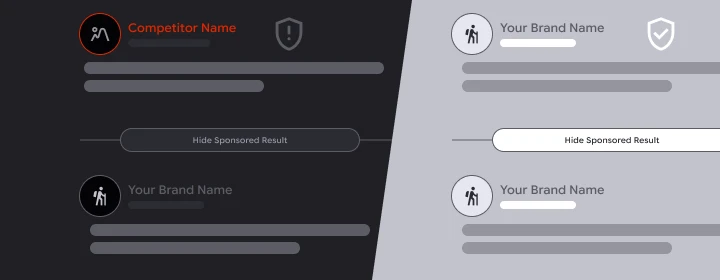
Offense is optional. Defense is not. Competitors bidding on your brand names is common and generally allowed, even when your brand is a registered trademark.
Bidding on your own brand name increases ad visibility and helps protect branded search results from competitor ads. In fact, 93% of agencies run branded PPC campaigns for clients, and 93% of agencies run branded PPC campaigns for clients because brand defense is usually efficient.
Defensive steps include:
- Run a branded search campaign on your own brand terms.
- Monitor search results regularly to detect competitor bidding.
- Review the auction insights report to see overlap rate, outranking share, and impression share.
- Check desktop and mobile google search results at least monthly.
- Capture screenshots when competitor ads appear misleading.
Owning and Optimizing Your Brand Terms
Bid on your core brand name, product names, own name variations, and misspellings. Strong branded campaigns usually earn high quality score because ad relevance is naturally strong.
Your ads should reinforce:
- Your brand promise.
- Direct calls to action such as demos, consultations, quotes, or pricing.
- Differentiators that make your brand pop in the search results.
- Trust elements such as awards, reviews, or years in business.
Use negative keywords to prevent your brand campaign from accidentally matching competitor + brand searches you do not want to pay for.
Trademark Protection and Complaint Options
Trademark registration strengthens your brand protection efforts. Trademark registration strengthens your ability to challenge misuse of your brand in competitor ad copy and display URLs, but it does not automatically stop competitors from keyword bidding on your brand.
Trademark holders can file complaints that may restrict trademark use in ads. A complaint usually requires registration details, the trademark owner information, specific example ads, and evidence of misuse.
Even with trademark protection, competitors may still bid on your brand as a keyword. Coordinate with your legal team to decide whether to file trademark complaints, send a demand letter, improve your defensive campaign, or respond with reciprocal paid search.
Avoiding Bidding Wars and Long-Term Pitfalls
Mutual competitor bidding can become expensive fast. When two brands keep increasing bids on each other’s branded keywords, CPCs rise while incremental conversions often fall.
To avoid this trap:
- Target a small set of priority rivals, not every competitor in the category.
- Focus on competitor + modifier searches where intent is clearer.
- Pause campaigns with no revenue-backed conversions after 60–90 days.
- Use budget caps and bid caps.
- Treat competitor campaigns as one part of broader PPC campaigns, SEO, CRO, and analytics.
Do not let sunk-cost bias turn a test into an arms race. Sometimes the best move is to stop bidding and invest in stronger content, better landing pages, or improved offer positioning.
Ethical and Brand-Reputation Considerations
Competitor keyword bidding is not just a legal or financial decision. It is also a marketing strategy decision.
Keep these standards in place:
- Be transparent about who is advertising.
- Do not copy a competitor’s colors, wording, layouts, or visual identity.
- Do not make unsupported claims.
- Focus on your strengths instead of disparaging competitor brands.
- Create internal rules for what your marketing team can and cannot say.
Short-term clicks are not worth long-term damage to trust. In many industries, relationships, reputation, and credibility matter more than winning one search auction.
How a Paid Search Agency Approaches Competitor Brand Bidding
A digital marketing partner can help decide whether competitor brand bidding is worth the risk before you start bidding. Timmermann Group evaluates goals, budget, competitive landscape, legal sensitivity, and conversion readiness before recommending bidding on competitor brand names.
Timmermann Group also looks beyond paid search. Competitor traffic will not help if the landing page is weak, tracking is incomplete, or the offer is unclear. That is why our team connects PPC, SEO, UX, CRO, analytics, and digital marketing strategy so traffic has a real path to conversion.
When needed, Timmermann Group coordinates with a client’s legal counsel to align campaigns with trademark protection, industry rules, and internal risk tolerance. If you want help auditing competitor campaigns or building a safer competitor brand bidding plan, schedule a consultation with Timmermann Group.
FAQ: Bidding on Competitor Brand Names
Can I bid on competitor brand names if I’m a reseller of their products?
Authorized resellers may be allowed to use the manufacturer’s brand names in Google Ads, but reseller status does not automatically allow confusing ads. Review your partner agreement and have your legal team confirm what is allowed in ad copy and landing pages.
Is competitor brand bidding worth it for small budgets?
If your Google Ads account spends under about $3,000 per month, prioritize your own brand and high-intent generic terms first. You can test competitor campaigns with small pilots, but each ad group needs at least a few dozen clicks before performance data is useful.
Do these rules also apply on Microsoft Ads or other search platforms?
Microsoft Ads and other search platforms follow similar principles on competitor bidding and trademark use, but each platform has its own policies. Review each platform’s current trademark and advertising rules before copying campaigns from Google.
Can I put competitor names on my landing pages even if I don’t use them in ads?
Many brands create “Your Brand vs Competitor” or “Competitor alternatives” pages, but the content must be factual and non-misleading. Get legal review if the page heavily references competitor names, logos, pricing, or regulated claims.
What should I do first if I discover a competitor bidding on my brand name?
Capture screenshots, review the competitor’s ad copy and landing page, and check Auction Insights to estimate activity. Then strengthen your branded campaigns immediately and consult your legal team if the competitor is using your trademark in ad text or confusing users.