# Timmermann Group
> Timmermann Group
> Generated by All in One SEO Pro v5.0.3, this is an llms-full.txt file, used by LLMs to index the site.
## Posts
### [Blog](https://www.wearetg.com/blog/)
**Published:** October 19, 2018
**Author:** Erik Brolaski
---
### [AI SEO for Elder Law Firms: How to Compete with Larger Firms](https://www.wearetg.com/blog/ai-seo-for-smaller-elder-law-firms/)
**Published:** October 8, 2026
**Author:** Mallory Buchheit
**Content:**
For many small and mid-sized elder law firms, competing with the biggest firms in their market can feel like an uphill battle.
Larger firms may have bigger advertising budgets, more aggressive PPC campaigns, prominent billboards and the resources to seemingly be everywhere at once. Trying to compete with them dollar-for-dollar is rarely a winning strategy.
But how people search for elder law information is changing, creating an opportunity for smaller firms to get more qualified leads and clients without blowing up their budget.
Traditional search engine optimization remains an important part of elder law marketing, but ranking on Google is no longer the only goal. Seniors and their adult children are increasingly turning to AI-powered search platforms and assistants to ask detailed questions about Medicaid planning, long-term care, asset protection, powers of attorney and other complicated issues.
**AI SEO for elder law firms** focuses on ensuring your firm can be found in this new search environment.
For smaller firms, it may offer a way to compete on expertise and relevance rather than marketing dollars.
## What Is AI SEO for Elder Law Firms?
[AI SEO](https://www.wearetg.com/services/ai-seo/) is the process of creating and structuring your website and content so that both traditional search engines and AI-powered platforms can understand your expertise and connect your firm with the questions potential clients are asking.
Traditional SEO has often focused heavily on keywords such as “elder law attorney near me” or “Medicaid planning attorney.”
Those searches still matter. But AI has made search increasingly conversational.
Instead of entering a short keyword phrase, someone might ask:
- “My dad is going into a nursing home. Can my mom stay in their house?”
- “My mom had an accident and will require long-term care. Is it too late to protect her assets?”
- “Dad is in the hospital. Who can make decisions about his medical care and make sure his bills get paid?”
- “Do I need both medical and financial powers of attorney?”
- “What is the Medicaid look-back period?”
- “How do I protect my assets from Medicaid cost recovery?”
- “Do I need to spend down my assets to qualify for Medicaid?”
Those questions reveal something important about elder law marketing: **your prospective clients aren’t necessarily searching for legal services. They are searching for answers to problems. Often, they ask these questions under duress, when time is of the essence**.
An effective AI SEO strategy builds your firm’s online presence around those questions and the topics behind them.
## AI SEO Goes Beyond Ranking for Keywords
Rather than replacing traditional SEO, utilizing AI SEO expands it.
A strong strategy still requires the fundamentals: a technically sound website, local optimization, relevant practice area pages, quality content and clear signals about who your ideal clients are and where you practice.
But AI SEO adds another layer.
Instead of focusing primarily on whether a page ranks for a particular keyword, firms need to consider whether their content clearly demonstrates expertise around an entire subject.
That means developing useful, authoritative content around topics such as Medicaid planning, nursing home costs, asset protection, long-term care planning, guardianship, powers of attorney and related elder law concerns.
Over time, interconnected content around these subjects can help establish topical authority, making it easier for search engines and AI platforms to understand what your firm knows and which questions your content can help address.
Content should also be structured so the answers and expertise within it are easy to identify, understand, cite and reference.
The goal isn’t simply to rank. **The goal is to become a trusted source of information wherever your potential clients are searching.**
## Elder Law Is Particularly Well Suited for AI Search
Although AI SEO has potential across many legal practice areas, elder law presents a particularly strong opportunity because of how people search for help.
Elder law often has two very different audiences:
- **A senior or family member planning ahead. They may be researching Medicaid eligibility, asset protection, powers of attorney or long-term care years before they expect to need assistance. These searches give an elder law firm a chance to build a relationship early in the decision-making process.**
- **An adult child responding to something that’s already happened. A parent fell, someone was admitted to the hospital, a nursing home suddenly became necessary, or a family discovered that documents they thought were in place aren’t sufficient. These people aren’t necessarily thinking, “I need an elder attorney,” but are asking highly specific questions about what to do next**.
Understanding the difference between these audiences, and the questions each one asks, is an important part of an effective AI SEO strategy.
## Your Content Can Demonstrate More Than Legal Knowledge
Understanding these questions is also crucial as you write content.
Consider the difference between a page optimized around a phrase such as “Medicaid planning attorney” and content addressing a question like:
“My dad is going into a nursing home. Can my mom stay in their house?”
The second query contains far more context.
There is a legal issue, but there is also fear, urgency and uncertainty.
That creates an opportunity for elder law firms to demonstrate something that’s hard to communicate through conventional advertising: empathy.
Your website can show prospective clients that your attorneys understand not only the legal issues families are facing, but also the circumstances that brought them to your website in the first place.
For elder law firms, that show of empathy makes all the difference.
Families don’t want to feel like they are just another case to process or another box to check. They want confidence that the people advising them understand what is at stake and are genuinely concerned about guiding them through a difficult time.
Content that combines legal authority with a genuine understanding of the client’s situation can help establish that connection before the first phone call.
## AI SEO Can Help Smaller Elder Law Firms Compete Differently
A smaller elder law firm may never want or be able to match the advertising budget of the largest firm in its market. The good news is it doesn’t have to!
A firm that deeply understands the questions prospective clients are asking can build content around those needs and create visibility at multiple stages of the client journey.
Instead of trying to win every broad, expensive search term, an AI SEO strategy can focus on more specific, conversational and long-tail searches.
That can give smaller firms more opportunities to appear when someone is researching a particular problem.
Because organic and AI search visibility can create additional paths for potential clients to discover your firm, a stronger search presence may also reduce your dependence on paid advertising over time. PPC can remain an important part of the marketing mix, but it doesn’t have to carry the entire burden of generating new leads.
## What Does an AI SEO Strategy for an Elder Law Firm Look Like?
Effective AI SEO isn’t about publishing dozens of generic articles or stuffing more keywords onto your website. It starts with understanding your audience. As you build the foundation of a broader content strategy for your firm, ask yourself:
- What are seniors asking before they need an attorney?
- What are adult children searching after a parent experiences a health crisis?
- What questions repeatedly come up during consultations?
- Where do prospective clients misunderstand Medicaid, long-term care, asset protection or powers of attorney?
From there, your website should organize that information into clear topic areas, connect related content, provide useful answers in language potential clients understand, and consistently demonstrate the firm’s expertise across the issues it wants to be known for.
The result is a website designed not simply around **keywords**, but around **questions, topics and intent**.
## Traditional SEO + AI SEO + PPC
Despite the potential effectiveness of AI SEO, combining it with traditional digital marketing strategies is an even stronger approach. Elder law firms should think of [traditional SEO](https://www.wearetg.com/services/seo/), AI SEO and [pay-per-click (PPC)](https://www.wearetg.com/services/pay-per-click-marketing/) as three strategies that can (and should) work together.
- **Traditional SEO** helps establish visibility in conventional search results and local searches.
- **AI SEO** expands that visibility into conversational searches and AI-powered discovery while strengthening topical authority.
- **PPC** can provide immediate visibility for high-value searches and targeted campaigns.
The opportunity is to build a marketing strategy in which paid advertising isn’t the only reliable source of leads.
For a small or mid-sized elder law firm competing against firms with much larger advertising budgets, that can make a big difference.
## You Don’t Have to Outspend the Biggest Firm in Town
The biggest firm in your market may have more billboards. It may spend more on Google Ads. It may even have a larger marketing department. But those advantages don’t automatically mean it understands prospective clients’ questions better than you do.
AI-powered search is creating new opportunities for elder law firms that can demonstrate expertise, answer the right questions and develop authoritative content around the issues seniors and their families actually care about.
That’s where **AI SEO for elder law firms** can become a competitive advantage.
At Timmermann Group, we help elder law firms build search strategies designed for how people search today and how search is evolving. By combining traditional SEO fundamentals with AI-focused content and optimization strategies, we help firms strengthen their authority, increase their visibility and compete for prospective clients without simply trying to outspend the biggest firm in the market.
Ready to drive more conversions from AI-powered search for your elder law firm? [Schedule a conversation](https://www.wearetg.com/contact/) with Timmermann Group today.
**Categories:** SEO
---
### [Managing Up: Becoming a Better Partner at Work](https://www.wearetg.com/blog/managing-up/)
**Published:** August 5, 2026
**Author:** Shawn Baldwin
**Content:**
Managing up is one of those phrases that gets tossed around on LinkedIn alongside words like “synergy” and “thought leadership.” It sounds like corporate speak. It might even sound a little disingenuous, like you’re trying to game your way into your boss’s good graces.
**Strip away the buzzword packaging, and managing up is actually one of the most practical, career-shaping skills you can develop.**
At its core, managing up is the proactive practice of working effectively with your manager or team lead. It means building a proactive partnership with that enhances collaboration, keeps you both on the same page, and helps the people around you (teammates, clients, leadership) win alongside you. It means taking an active role in your own career (whether it’s [a career at Timmermann Group](https://www.wearetg.com/careers/) or elsewhere) so that you bring ideas and perspectives to your manager rather than waiting for instructions for every move.
**At Timmermann Group, we believe this skill is foundational.**
Our “Conversions, not Diversions” mindset means we want everyone focused on high-impact work, transparent problem-solving, and meaningful outcomes. Managing up is the mechanism that makes all of that possible. This article is about what managing up actually looks like in practice, why it matters, and how it can make you more effective, more communicative, and more successful in your career-here and beyond.
### Key Takeaways
- Managing up is the proactive practice of working effectively with your manager by understanding their goals, adapting your communication, and making decisions easier for them-not flattery, not politics.
- A shared understanding of priorities, paired with proactive updates, eliminates surprises, reduces friction, and keeps client work on track in a fast-moving agency.
- Managing up is how you get what you need to succeed: clarity, feedback, resources-while building trust that compounds into career growth over time.
- This skill travels with you everywhere: it works at Timmermann Group, at your next role, and in any professional relationship where alignment matters.
## Why Talk About “Managing Up” in a Digital Agency Anyway?
You’ve probably scrolled past a dozen articles about managing up. Most of them are vague, stuffed with advice like “understand your boss” without explaining what that means when you’ve got three client deadlines converging on a Thursday.
If you’ve worked in an agency environment before, our work moves quickly across a number of distinct but in-sync services: SEO, Paid Search, Paid Social Media, UX & CRO, Website Development, and Analytics. That’s a lot of moving parts. Shifting client priorities, tight timelines, and cross-functional collaboration are the norm, not the exception. When an Account Manager needs a decision on scope and a Paid Search Strategist needs clarity on budget allocation and a developer needs sign-off on a design direction –– all in the same week–– managing up is the mechanism that keeps projects on track without burning people out.
Consider this: directors and department leads are people too. They’re juggling their own projects, other stakeholders, and the bigger picture while also trying to support their teams. Managing up isn’t just helpful in this environment––it’s how you help your manager help you.
## What Is Managing Up?

Managing up means deliberately shaping how you and your manager work together so both of you can do your best work.
A[ 2025 study published in the Journal of Vocational Behavior](https://www.sciencedirect.com/org/science/article/pii/S1362043625000297) defined it as two things happening together: understanding your manager’s goals, communication preferences, and decision style –– and then adapting your own behavior to align with those expectations. The researchers found that managing up improves communication and reduces misunderstandings, which directly reduces role ambiguity and increases engagement.
In simpler terms, here’s what it actually looks like: instead of waiting for your manager to have the capacity to ideate, delegate, and check in with you, you step up and say, “I think we should do X, and here’s why.” You bring your own views. You take ownership of your work and projects. You don’t passively wait for instruction –– you own your role, demonstrate agency and build momentum in your work and your career.
**Here’s what managing up is:**
- Building a strong relationship with your boss based on shared understanding of goals
- Tailoring your communication style to make it easier for your manager to absorb and act on what you share
- Anticipating what they need from you and surfacing risks early
- Offering solutions alongside problems
**Here’s what managing up is not:**
- Brown-nosing or flattery
- Gossiping upward about teammates
- Hiding problems to look good
- Passive-aggressively “managing around” a manager you disagree with
- Trying to control your boss
**This is not a magic “productivity hack.” It’s a shift in behaviors that set you and your manager up for short- and long-term success.**
It’s about transparency, honest feedback, and aligned goals. Political performance is image management, surface-level agreement, and hiding real problems.
Managing up is a core professional skill you can use at Timmermann Group and in any role where you report to someone. It highlights your ideas and leadership abilities, which are exactly what help you advance in your career. The better you manage up, the more your manager sees your judgment, reliability, and strategic thinking-all of which open doors.
## Managing Up vs. Managing Down: Two Directions of the Same Skill
Managing down is how you lead people who report to you-delegating appropriate work, setting expectations, and creating the conditions for your direct reports to succeed. Even if you don’t have direct reports yet, you manage down anytime you act as a lead on a project: setting priorities, communicating scope, and ensuring quality of output.
Great leaders do both. They manage up to give executives and clients a bird’s-eye view of what’s happening and what decisions are needed. They manage down to create clarity, trust, and engagement for their teams.
Here’s a quick example. Think of a Timmermann Group account manager leading a multi-channel client engagement. They manage up to leadership on budget and scope changes-flagging a client’s request to expand into a new paid social platform, for instance. Simultaneously, they manage down to the team on priorities and expectations for output quality, ensuring the SEO strategist and the paid search team are aligned on what matters this sprint.
A[ McKinsey study](https://www.mckinsey.com/featured-insights/leadership/why-effective-leaders-must-manage-up-down-and-sideways) found that behaviors associated with managing upward and sideways predicted business impact nearly 50% more strongly than managing subordinates alone-and more than twice as strongly for career success. That’s a significant impact on both the organization and the individual.
Early in your career, you may only “officially” manage up. But how you do this is training for leading teams later. The habits are the same: clear communication, honest feedback, follow-through, and focus on outcomes.
One important note: managing up is not a substitute for good leadership. Even if your manager struggles, you still deserve reasonable support. Leadership still owns their part. Managing up doesn’t mean you must compensate for bad bosses indefinitely-it means you’re doing your part to make the relationship work.
## Know Your Manager and Know Yourself
Treat the relationship with your manager like an important client relationship. It deserves curiosity and intentionality.
**Start by learning what makes your manager tick:**
- Communication style: Do they prefer Teams messages, email, or live meetings? Knowing their preferred communication style saves both of you time.
- Information format: Do they want headlines first or detailed analysis? Anticipate your manager’s questions and have answers ready.
- Decision style: Do they like to think overnight, or do they prefer making calls in the moment?
- Non-negotiables: What are the things that matter most to them-accuracy, speed, creativity, client responsiveness?
Respecting a manager’s time and setting appropriate boundaries is critical. Learning your manager’s priorities aligns your objectives with theirs. When you understand what your manager likes and needs, you can anticipate their needs and provide better support.
Now match that with self-awareness. What’s your own default communication style? What triggers stress for you? How do you tend to react when you feel pressured? Be honest about your blind spots and biases so you can correct for them or lean further into your strengths.
Use recurring 1:1s to trade “working preferences” and bring forward ideas to advance the workflow between you. Talk about what helps you do your best work, what derails you, and how you both prefer delivering feedback and receiving feedback. Clarifying expectations early can prevent confusion and enhance productivity on both sides.
Managing up isn’t about changing who you are. It’s about learning to be flexible-stepping out of your comfort zone into a growth zone-without losing your values or boundaries. You’re not abandoning your personal preferences; you’re expanding your range.
## Create a Shared Understanding of Goals, Success, and Priorities
Managing up starts with clarity. What does success look like this week, this month, or this quarter-for you, your manager, your team, and your clients?
Only 23% of U.S. employees feel informed about company goals. That’s a staggering gap, and it means most people are operating with incomplete context. You can close that gap by asking direct questions in your 1:1s:
- “What can I do that would make the biggest impact this month?”
- “How does my role support the team’s goals right now?”
- “What are you being asked to deliver to your boss’s boss, and how can I help?”
Regularly confirm your manager’s top priorities for the quarter. Regularly clarifying priorities enhances workplace performance because it keeps everyone moving in the same direction. Proactively clarifying expectations prevents miscommunication before it takes root.
Tie your daily tasks to bigger outcomes. If you’re working on a website launch, connect it to the client’s lead volume goals. If you’re running paid search optimizations, link your work to revenue targets. If you’re tracking outcomes with analytics, show how that data informs the next decision. This is how your manager sees the bigger picture of your contributions and how your work fits into agency growth.
**Practical habits that help:**
- Restate priorities back to your manager in writing after meetings
- Use shared docs or project boards to keep focus aligned
- Ask for buy-in on your priorities early in the week, not at the deadline
A shared understanding is the foundation for a career-advancing relationship with your boss. When they can clearly see your impact, they can advocate for you with higher-ups, in performance reviews, and in conversations about career development.
## Communication Style: Calibrating How You Share Information Upward
You can’t control your manager’s reactions, but you can control how you package information so it’s easy for them to absorb and act on.
Start by observing. Does your manager ask for the bird’s-eye view first, or do they dive into line-item detail? Do they prefer async docs or quick calls? Do they want a summary with recommendations or raw data to draw their own conclusions?
Adapting to your manager’s communication style improves effectiveness. Adjust communication to match the preferences of your supervisor-not because you’re performing, but because it shows respect for their time and attention. It usually gets you faster decisions and better support.
**Here are a few examples of calibrating your preferred style:**
| Manager’s style | How to adapt |
|---|---|
| Wants headlines first | Start with a one-line summary and KPI impact, then offer detail below. |
| Prefers deep analysis | Show the data breakout first (e.g., ROAS per channel), then your recommendation. |
| Likes verbal discussion | Prep a brief agenda, have the conversation, then follow up with a written recap. |
| Skims written updates | Use bullet points, bold the action items, and keep it under 200 words. |
Different communication styles require different approaches. Anticipate your manager’s questions and have answers ready before they ask. This doesn’t mean you’re getting inside your boss’s head-it means you’re thinking one step ahead.
Keep communication open by flagging risks early, sharing progress before you’re asked, and never letting a big surprise hit your manager or a client meeting unprepared. When you keep information flowing, your manager can focus on removing obstacles for you instead of chasing updates.
## Using 1:1s as Your Primary Tool for Managing Up
Recurring 1:1s are the single best place to practice managing up at Timmermann Group, whether you’re remote, hybrid, or in-office.
The most important advice here: own the 1:1. Bring topics, decisions, and questions. Don’t wait for your manager to drive the entire conversation. When you show up prepared, you signal that your voice matters and that you’re invested in the working relationship.
**Here’s a simple structure that works:**
1. Progress since last time: Quick wins, completed deliverables, decisions made
2. Priorities coming up: What’s on deck, where you need input, what you’re focusing on
3. What I need from you: Approvals, resources, air cover, feedback
Start with a bird’s eye view of all your active projects-website launches, paid search sprints, social calendars-before zooming into the one or two items that truly need discussion. This gives your manager context without drowning them.
1:1s are also your space to talk about career growth, not just tickets and timelines. Talk about skills you want to build, areas where you want feedback, and longer-term paths at the agency. At Timmermann Group, every role has a[ path for advancement](https://wearetg.com/careers/), and this mindset-actively managing your development conversations-is how you move forward. Encourage your manager to share what they see as your strengths and growth areas. That’s a productive working relationship in action.
## Proactive Communication: No Surprises, Especially on Client Work
In agency life, surprises are trust killers. Late deliverables, unanticipated budget overages, scope creep-these are what make managers and clients lose confidence fastest. Proactive communication builds trust and reduces surprises before they become emergencies.
**Build a rhythm of lightweight, proactive updates:**
- Short Teams check-ins at the end of the day
- Concise emails with bulleted key info for bigger updates
- Brief notes on project boards highlighting status, risks, and next steps
Regular concise updates keep supervisors informed without overwhelming them. Proactive updates can help build trust and reduce the need for close supervision-which means more autonomy for you over time.
**Learn to calibrate urgency in your phrasing:**
- “FYI-no action needed” → keeps your manager informed without adding to their plate
- “Heads up-we may miss this date unless we do X or Y by Friday” → gives them time to help unblock you
- “Decision needed by Wednesday to keep the dev queue moving” → clear ask, clear timeline, clear consequence
This phrasing also helps you communicate to your manager what you need from them, so they are clear on what you need, when, and why it matters. Remember, 62% of managers say their workload feels unreasonable. The clearer your requests, the faster they can support you.
Proactively alert managers to risks and offer solutions. Proactively share potential challenges before performance reviews or client meetings-not after. Regular updates help avoid last-minute surprises for managers, and proactive communication helps avoid last-minute situations that erode trust and waste everyone’s energy.
## Building Trust Upward Through Follow-Through and Ownership

Trust with your manager is built less by big moments and more by repeated follow-through: doing what you said, when you said, and being transparent and direct when that’s not possible.
**Simple behaviors that compound:**
- Confirm action items after meetings in writing
- Hit small deadlines reliably-the ones nobody’s watching
- Own mistakes early (misconfigured tracking, missed website standards, campaign errors)
- Follow up without being asked
Reliability builds credibility and earns flexibility over time. The more consistently you deliver, the more autonomy you earn and the more weight your recommendations carry in strategy conversations. Your manager starts to trust your judgment, and that trust translates into bigger responsibilities, better projects, and a seat at tables you weren’t at before.
Employees under high-performing leaders are 4.5× more likely to excel-and part of what makes a leader high-performing is having team members who build trust through consistency. You help make your boss succeed, and they help you grow. It’s reciprocal.
At Timmermann Group, we care deeply about learning from mistakes. Our[ Value Cards peer recognition program](https://wearetg.com/blog/value-card/) is one example of how we celebrate doing the right thing-including taking responsibility and being honest about what went wrong. Managing up well means bringing the full context and what you’ll do differently next time, not hiding the problem.
Trust is essential for effective upward feedback and collaboration. It’s the backbone of a healthy relationship with your boss and what allows direct, un-defensive feedback in both directions. Constructive feedback should be treated as data for improvement, not as a personal attack-and that goes both ways.
## Using Managing Up to Get What You Need to Do Great Work
Here’s the reframe that matters: managing up isn’t just something you “do for your boss.” It’s how you secure the clarity, time, and resources you actually need to succeed.
**Concrete examples of what this looks like:**
- Asking for clearer scope from a client before starting a website design
- Requesting more realistic timelines on a multi-channel campaign
- Flagging when your plate is overfull and asking your manager to help you prioritize
- Saying: “To hit this launch date, I’d need X and Y removed or pushed”
- Saying: “I need a decision on this website design by Wednesday to keep the dev queue moving”
These aren’t complaints; they’re problem-solving. Bring solutions to problems instead of just highlighting issues. When you frame asks clearly, your manager can advocate upward for budget, headcount, or timeline shifts with leadership and clients. They become your ally, not your bottleneck.
This ties directly to our “Conversions, not Diversions” mindset. Managing up is how you reduce busywork and focus your time on the work that actually moves results. It’s how you ensure your own work is aligned with what matters most, rather than getting pulled into low-impact tasks that don’t serve the team or the client.
When you manage up effectively, you build a relationship where both sides are clear on expectations, and your manager can actually help you instead of guessing what you need.
## What If Your Manager Is Missing the Mark? The Limits and Power of Managing Up
Not every manager will be a great leader all the time. Stress, bandwidth, and experience gaps are real-even in healthy cultures. Great managers are still human, and sometimes even the best ones drop the ball.
**Here’s what managing up can do in this situation:**
- Create structure where there isn’t any (e.g., proposing a weekly check-in format)
- Clarify murky expectations by asking direct questions and summarizing answers
- Reduce friction by proactively offering solutions and keeping your own work organized
**Here’s what managing up cannot do:**
- Fix repeated disrespect or chronic dishonesty
- Compensate for a refusal to engage in two-way feedback
- Replace the need for actual leadership from your manager
If you’re in a tough spot, document your efforts. Recap decisions in writing. Summarize agreements after conversations. Keep a record of patterns-both for your own clarity and for escalation if needed.
At Timmermann Group, we want people to raise patterns that are getting in the way of healthy work. Managing up does not mean you must quietly tolerate weak leadership or a bad relationship. Your voice matters, and leadership shares responsibility for creating a workable, respectful environment. If you’ve done the work of managing up with integrity and the relationship still isn’t improving, it’s time to engage internal support-skip-levels, HR, or another trusted leader.
## Is Managing Up Just Kissing Up? In Brief, No.
Let’s address this perception head-on. Many people hear “managing up” and think politics, flattery, or gaming the system to look good. That’s not what we’re talking about.
**Here’s the contrast:**
| Kissing up (political performance) | Managing up (supportive partnership) |
|---|---|
| Performative late nights to look busy | Consistent, reliable delivery |
| Constant agreement with everything | Honest, respectful pushback when needed |
| Public praise without substance | Clear communication about real outcomes |
| Hiding problems | Surfacing risks early with options |
Great leaders don’t actually reward empty flattery in the long run. They reward people who make better decisions easier, who are candid when things are off, and who deliver results consistently.
Within Timmermann Group, we evaluate contributions based on impact on client results, reliability, and constructive behavior in the team-not who flatters whom and pays lip service. It’s about outcomes. You can learn more about[ what drives our culture](https://wearetg.com/blog/timmermann-group-company-culture/) to see how this plays out in practice.
You can manage up with integrity. Be honest. Be transparent about constraints. Align with shared goals, not personal image. That’s a better relationship for everyone involved.
## Everyday Behaviors That Add Up to Managing Up Well
Theory is useful. Practice is what changes things. Here are concrete behaviors you can apply this week on live projects:
Daily Wrap and On Deck updates: At the end of each day, send a brief update highlighting work that’s been completed and what’s on deck for tomorrow. This doesn’t need to be long-three to five bullets. It keeps your manager informed, reduces Teams messages asking for status, and builds a rhythm of accountability.
Summarize client calls: After any client meeting, send a quick recap with clear decisions made and open questions that need answers. Tag the right people. This creates a written record and makes sure everyone is on the same page.
Give a bird’s-eye view before details: In any update-written or verbal-start with the overall picture: “Here’s how the campaign is trending overall; here are the two to three metrics that matter this week.” Then dive into specifics.
Speak up in meetings: Offer transparent feedback that improves the work. If you see a potential issue with a strategy, say so. If you have an idea that could improve a deliverable, raise it. This is where managing up meets real leadership.
Normalize asking for feedback: After a client meeting or a presentation, ask your manager: “Anything I could have done differently?” Use the SBI model for clear upward feedback too-describe the Situation, the Behavior you observed, and the Impact it had. This works in both directions.
Follow through visibly: When you say you’ll do something, do it. When you can’t, say so early.
Consistency matters more than heroics. Small, predictable acts of managing up are what build a strong relationship with your boss over quarters and years. They’re what turn a decent working relationship into one where you both do your best work.
## How Managing Up Supports Your Long-Term Career
Managers who trust you and understand your goals are far more likely to invest time, resources, and their own credibility into you. They’ll sponsor you for bigger projects and advocate for your advancement with the organization. That’s the career development payoff of managing up.
Frame this as a transferable leadership skill. Whether you become a Director of Conversions, a Lead SEO, a Senior Paid Search Strategist, or move on to a product leader role somewhere else-these habits travel with you. The ability to communicate clearly upward, build trust through follow-through, and align your priorities with your manager’s goals is valuable in every industry and every job.
People who manage up well often get pulled into higher-level conversations: quarterly planning, strategy discussions, bigger client pitches. Why? Because their managers trust them to add value, not just execute tasks. They’ve proven they can see the bigger picture and contribute to it.
Use your 1:1s to articulate your own career direction. Tell your manager what you want to learn, what roles interest you, and what experiences would help you grow-whether that’s new platforms, certifications, or cross-functional exposure. At Timmermann Group, every role has a path for advancement, and managing up is how you ensure your manager sees what you’re working toward.
Employees under high-performing leaders are 4.5x more likely to excel, and the same is true in reverse: when you manage up well, you help your leader perform at a higher level, creating a cycle of success for the whole team.
## Managing Up at Timmermann Group: How It Fits Our Culture
Timmermann Group is a digital marketing agency with a workplace culture that rewards clarity, reliability, and the willingness to speak up when something isn’t working.
We expect people at every level-from interns to directors-to manage up. That means asking for more clarity when you don’t have it, bringing solutions rather than just highlighting issues, and surfacing risks before they become problems a client can see and feel.
This connects directly to psychological safety. We want people to raise tough issues and trade-offs honestly, not silently grind behind the scenes hoping things work out. When you manage up well, you make it safe for your manager to trust your judgment, and that trust flows both ways.
Think of managing up as a way to reduce friction in our internal flywheel. Clearer decisions lead to fewer misunderstandings among the account, strategy, and production teams, resulting in faster learning loops and better outcomes. Building a proactive partnership with your supervisor means the whole team fits together more efficiently.
For potential hires considering a career at Timmermann Group, comfort with managing up is a strong signal you’ll thrive with our pace, autonomy, and expectations. It’s not about being told what to do-it’s about taking responsibility for how you show up in your working relationship with your manager and your team.
## Managing Up: A Simple Playbook
Here’s what it all comes down to: managing up is about shared understanding, calibrated communication, proactive updates, building trust through follow-through, and having realistic expectations about imperfect humans-including your manager and yourself.
If you’re a new hire in your first 90 days at Timmermann Group, here’s a playbook to start with:
1. **Week 1–2:** Learn your manager’s preferred communication style and working style. Ask how they like updates and what their non-negotiables are.
2. **Week 3–4:** Start owning your 1:1 agenda. Bring priorities, questions, and at least one idea or observation each session.
3. **Month 2:** Begin sending regular proactive updates-Daily Wraps, client call recaps, risk flags. Build the habit before it’s needed in a crisis.
4. **Month 3:** Ask for feedback on how the working relationship is going. Share what’s working for you and where you’d like more clarity or support.
5. **Ongoing:** Keep refining. Managing up is not a one-time setup; it’s a practice you sharpen over your entire career.
Don’t try to overhaul everything at once. Pick one or two behaviors from this article and try them this week. The compound effect over months and years is what separates people who are good at their jobs from those who are great at their careers.
Managing up well doesn’t just make your job smoother-it makes our work for clients sharper and [Timmermann Group’s work culture](https://wearetg.com/blog/timmermann-group-company-culture/) more honest and supportive.
If you’re reading this and thinking, “this is how I already work,” we’d love to hear from you. [Check out our open roles](https://wearetg.com/careers/) and bring these habits with you.
## Frequently Asked Questions
These are common, practical questions we hear from team members and candidates about managing up. Here are straight answers grounded in how things actually work in agency life.
### How soon is “too soon” to start managing up with a new manager?
You can start from week one with low-stakes behaviors: ask how your manager likes to receive updates, recap meetings in writing, and clarify priorities. These are never seen as overstepping-they’re appreciated. Wait until you’ve built a bit of rapport (a few weeks) before offering upward feedback or pushing on bigger process changes. Thoughtful questions and clear summaries are always welcome for new hires at Timmermann Group.
### What if my communication style is very different from my manager’s?
Have an open conversation about it. Admit your defaults and ask where you can meet in the middle-for example, combining brief headlines with linked detail so your manager can skim or dive deeper depending on their preferred style. Use written updates to bridge gaps between different work styles. Flexing your communication approach is part of professional growth, but you should never feel forced to abandon clarity or honesty in the process. A better manager will meet you halfway.
### How do I manage up effectively in a remote or hybrid environment?
Lean on async tools: shared status docs, Teams channels, and short Loom-style walkthroughs for complex SEO, PPC, or website work. Consistency matters even more remotely. Maintain regular 1:1s, send weekly written check-ins, and set clear expectations about response times. In remote work, silence is easily misread, so over-communicating context and intent is key to keeping communication open and trust high. Don’t assume your manager knows what you’re working on just because you’re busy.
### Can I manage up if I’m still early in my career or new to the industry?
Absolutely. Managing up is not reserved for senior people. Asking smart questions, summarizing your work, and surfacing blockers are valuable at any level and demonstrate real skills that managers notice. Focus on clarity and follow-through first; influence will naturally grow as you consistently deliver. At Timmermann Group, curiosity and proactive communication from junior team members is seen as a strength, not as being “too big for your boots.” It’s one of the strongest strategies for standing out.
### What should I do if managing up isn’t improving the relationship?
First, check your assumptions. Ask your manager directly how they feel the relationship is going and what would help them support you better. If issues persist, use internal support systems-HR, another leader, or a skip-level conversation with your boss’s boss where appropriate-to get perspective and guidance. You’re not expected to “fix” a fundamentally unhealthy dynamic alone. Leadership shares responsibility for creating a workable, respectful environment, and sometimes the lead has to come from above.
**Categories:** Culture
---
### [Local Services Ads Moving to Google Ads: What This Means for Your Business](https://www.wearetg.com/blog/local-services-ads-moving-to-google-ads/)
**Published:** August 13, 2026
**Author:** Rob Timmermann
**Content:**
Google is moving its standalone Local Services Ads experience into Google Ads. Existing Local Services Ads campaigns will progressively migrate to the Google Ads interface as a specialized Performance Max campaign type focused on pay-per-lead goals.
Here is what changes for [paid search marketing](https://www.wearetg.com/services/pay-per-click-marketing/), what stays the same, and what your business should do now.
### Key Takeaways
- Google is moving Local Services Ads into Google Ads as specialized Performance Max campaigns optimized for pay-per-lead goals. The pay-per-lead model stays intact, and ads continue to appear on Google Search and Google Maps.
- Google is rolling out the migration progressively rather than moving every advertiser at once.
- Google recommends backing up historical Local Services Ads performance reports before migration.
- Bidding shifts away from manual Max Per Lead and service-level target CPA settings toward campaign-level target CPA bidding.
- Weekly budgets transition to average daily budgets.
- New pay-per-lead campaigns cannot currently be created directly in Google Ads. Advertisers still use the Local Services Ads onboarding process when creating additional campaigns.
Timmermann Group’s position is that this consolidation should benefit local businesses in the long term by simplifying campaign management, reporting, and budget allocation. However, businesses whose LSAs are currently in a separate account from their primary Google Ads account may face additional complexity during the transition.
## Overview: Why Google Is Bringing Local Services Ads Into Google Ads
Google Local Services Ads are pay-per-lead advertisements designed for service-based businesses targeting local customers.
Unlike traditional Google Ads, which generally charge per click, LSAs charge advertisers for eligible leads, such as phone calls, messages, and booking requests from potential customers.
Local Services Ads support a wide range of service-based industries, including plumbing, HVAC, electrical, legal, real estate, pet care, wellness, and other professional and home services.
Historically, LSAs have been managed separately from traditional Google Ads. Advertisers could manage LSA budgets and leads separately while operating search, Performance Max, display, and YouTube campaigns inside Google Ads.
Google is now bringing those experiences closer together.
Existing LSAs will progressively move into [Google Ads as Local Services-focused Performance Max campaigns](https://www.wearetg.com/blog/google-local-service-ads/) while retaining the pay-per-lead model.
These campaigns remain different from traditional Performance Max campaigns.
Local Services campaigns remain keywordless and continue relying primarily on service categories, service areas, and business information rather than traditional keyword targeting.
They also remain focused on placements such as Google Search and Maps rather than expanding across the full Performance Max inventory available through YouTube, Display, Gmail, Discover, and other Google properties.
This change affects local service businesses that depend on LSAs for lead generation, including plumbers, electricians, lawyers and home improvement contractors.
## Timeline: When LSAs Will Move Into Google Ads
The rollout is progressive, and not every Local Services advertiser will migrate at the same time.
Google has indicated that existing Local Services Ads campaigns will be automatically migrated over the coming months.
Individual advertisers should watch for communications from Google regarding their specific accounts and migration timing.
Before your account migrates, make sure the appropriate internal team members and agency partners have access to both your Local Services Ads setup and Google Ads account so important notices are not missed.
## What Changes Inside Google Ads: Campaigns, Budgets, and Lead Management
Here is what advertisers can expect to change.
#### Campaign type
Migrated LSAs appear as a specialized Performance Max subtype focused on pay-per-lead goals.
Despite the Performance Max label, these campaigns remain focused on Google Search and Maps rather than running across the full Performance Max network.
#### Bidding
Manual Max Cost Per Lead bidding is being replaced by automated target CPA bidding.
Google is also moving away from setting separate target CPA amounts for individual business categories within a single campaign. Instead, bidding is managed at the campaign level.
If substantially different services require different acceptable acquisition costs, advertisers may need separate campaigns to maintain different bidding strategies.
#### Budgets
Local Services Ads transition from average weekly budgets to average daily budgets inside Google Ads.
Advertisers should pay close attention to this change because daily spend can fluctuate with available demand, even when the overall budget remains controlled over time.
#### Lead management
Lead management becomes more integrated with Google Ads as Local Services campaigns move into the platform.
Advertisers should review their existing lead management processes and confirm how calls, messages, bookings, lead statuses, and CRM workflows behave after their account migrates.
#### Business details
Local Services campaigns continue using business information associated with the advertiser’s Google presence, including information from its Google Business Profile.
Because Local Services Ads rely heavily on accurate business information, advertisers should review their business name, address, hours, service areas, categories, phone number, and other important profile information before migration.
Major profile changes may trigger additional verification or review, so businesses should avoid unnecessary structural changes around their migration period when possible.
## Pros and Cons of Moving Local Services Ads Into Google Ads
Timmermann Group views this consolidation as a net positive for local services advertisers over the long term, but the transition period carries real risks that require planning.
#### Pros:
- More centralized campaign management across Local Services Ads and other Google advertising campaigns
- Easier visibility into budget allocation across LSA and traditional paid search
- More unified reporting and attribution
- Better integration with existing Google Ads conversion tracking and analytics
- Less duplication between Local Services advertising and other Google advertising workflows
- Ability to evaluate LSA performance alongside other paid acquisition channels
#### Cons:
- Loss of some granular LSA-specific bidding controls
- Transition from weekly to daily budgeting
- Potential performance volatility while campaigns adjust to the new structure
- Additional complexity for businesses whose Local Services Ads and primary Google Ads campaigns currently live under different account structures
- New workflows and reporting requirements for teams accustomed to the standalone Local Services Ads experience
Most of these downsides should be manageable with structured planning, pre-migration performance baselines, and experienced campaign management.
## Account Structure: Handling Separate LSA and Google Ads Account Numbers
Some local businesses currently have Local Services Ads associated with a different Google Ads account structure than the account being used for paid search and other campaigns.
That creates an important question during migration:
#### Where should Local Services Ads ultimately live?
Google currently does not allow advertisers to simply create new pay-per-lead campaigns directly from the standard Google Ads campaign creation workflow. Additional Local Services campaigns still go through Google’s Local Services onboarding process.
Because of that, advertisers should not assume that account consolidation will be as simple as manually recreating an LSA campaign inside an existing Google Ads account.
Timmermann Group recommends reviewing your account structure before migration and determining whether consolidation makes sense based on your existing billing, permissions, Google Business Profile connections, campaign history, and reporting requirements.
**For businesses with fragmented account structures, our recommended approach is to:**
1. Document the Google Ads account ID associated with your existing Local Services Ads campaigns.
2. Document the primary Google Ads account used for search, Performance Max, and other advertising.
3. Confirm billing profiles, administrator access, and Google Business Profile connections for both environments.
4. Back up historical LSA reporting before migration.
5. Review Google’s migration options for the account once the migration notice is received.
6. Avoid shutting down an established LSA setup until the replacement structure and lead flow are confirmed.
Depending on how Google handles a specific account, advertisers may eventually decide to consolidate Local Services campaigns with their primary advertising structure.
However, this should be treated as an account-specific strategy rather than an automatic requirement of the migration.
Timmermann Group manages this process for clients by reviewing account structure, mapping historical results, coordinating migration strategy, and minimizing potential gaps in lead flow.
## Data and Reporting: Historical Reports, Lead Quality, and Measurement
Data is one of the biggest considerations in this migration.
Google recommends advertisers back up their previous Local Services Ads performance reports before migration.
Do not assume every historical report, metric, or legacy reporting view will remain available in exactly the same format once campaigns move into Google Ads.
**Before your migration date:**
- Download your available historical Local Services Ads reports
- Preserve at least 12 to 24 months of data when possible
- Document cost per lead by service and market
- Save lead volume and budget trends
- Combine Local Services data with CRM, scheduling, and accounting information
- Establish baseline close rates, revenue per job, customer acquisition cost, and profitability
This gives you an apples-to-apples benchmark for measuring performance after migration.
**After migration:** Google Ads will provide reporting around campaign spend, lead activity, cost per lead, and other Local Services performance metrics.
Deeper funnel metrics such as revenue per job, profit margin, customer lifetime value, and close rate will still depend on CRM and sales data.
Timmermann Group clients use unified reporting that tracks performance from the initial lead through revenue and profitability so campaign performance can be evaluated based on actual business outcomes.
## Campaign Management and Structure in the New Local Services Setup
The Local Services campaign structure should reflect service-line economics rather than simply mirroring every service a business offers.
Because target CPA bidding is handled at the campaign level, services with dramatically different lead values may deserve separate campaigns.
For a [plumbing company](https://www.wearetg.com/blog/plumbing-leads/), for example, an emergency plumbing lead can have very different economics from a lower-value installation or repair service.
Putting services with substantially different economics under the same bidding target can create inefficiencies.
At the same time, advertisers should avoid creating so many narrowly segmented campaigns that each campaign lacks sufficient lead volume for Google’s automated bidding systems to optimize effectively.
**Campaign segmentation should balance:**
- Lead value
- Close rate
- Lead volume
- Acceptable acquisition cost
- Geography
- Operational capacity
- Available budget
Daily budgets should also reflect how many calls, appointments, estimates, and completed jobs the business can realistically handle.
Timmermann Group coordinates Local Services target CPA settings, budgets, service areas, campaign structure, staffing capacity, and business economics.
Conversions, not diversions.
## Google Business Profile, Google Reviews, and the Google Verified Badge

Your [Google Business Profile](https://www.wearetg.com/blog/google-business-profile-guidelines/) remains an important part of your Local Services presence.
Before migration, review your business information and confirm:
- Business name
- Address
- Phone number
- Business hours
- Primary and secondary categories
- Service areas
- Photos
- Website information
Major changes to your business profile may trigger additional Google review or verification.
Because verification timing can vary, businesses should avoid making unnecessary major changes immediately before migration or during important peak demand periods.
Customer feedback also remains important to Local Services performance.
[Google reviews](https://www.wearetg.com/blog/google-business-profile-reviews/), including rating, review volume, and recency, can influence how customers evaluate your business and are among the factors associated with Local Services Ads performance.
Positive reviews can help establish credibility when potential customers compare advertisers directly in Google’s search results.
Local Services advertisers must also satisfy Google’s applicable screening and verification requirements.
Eligible businesses can receive the Google Verified badge, which signals that the advertiser has completed Google’s applicable verification requirements.
The exact screening requirements vary depending on the business category and market.
## Strategic Impact on Digital Marketing: From Channel Tactics to Acquisition Flywheel

LSAs capture high-intent demand from customers searching for services such as “emergency plumber near me” or “electrician near me.”
Traditional Google Search campaigns also capture existing demand, while channels such as paid social, Display, and YouTube can support demand creation, remarketing, and brand awareness.
Bringing Local Services campaigns into Google Ads makes it easier to evaluate these investments together.
Timmermann Group treats LSAs as one component in a broader marketing strategy designed to create, capture, convert, and cultivate demand.
**That includes:**
- Local SEO
- Organic SEO
- Google Ads
- Local Services Ads
- Website UX and CRO
- Paid social
- Remarketing
- Analytics
- CRM and revenue reporting
Leadership teams should review Local Services ROI alongside organic search, paid search, paid social, referrals, and other acquisition channels.
Timmermann Group builds reporting that connects LSA data, Google Ads metrics, Google Analytics, and CRM revenue so advertising decisions are based on business outcomes rather than isolated platform metrics.
## Future Outlook: Hypotheses About How Local Services Ads May Evolve Inside Google Ads
The following points are informed hypotheses based on Google’s historical product evolution, not confirmed roadmap items.
- **Expanded placements:** Google could eventually test additional placements for Local Services campaigns while maintaining a lead-based billing model.
- **Granular bidding returns:** Service level bid adjustments, seasonality modifiers, or profitability-based bidding could eventually become available.
- **Deeper Google Business Profile integration:** Google could expand automated use of business photos, services, reviews, and profile information within Local Services campaigns.
- **Lead management evolves:** Google could introduce additional follow-up, lead scoring, automation, or integration capabilities within its lead management tools.
- **Industry-specific features:** Additional scheduling, intake, and booking capabilities could emerge for verticals such as healthcare, automotive, legal, and [HVAC companies](https://wearetg.com/hvac-ppc).
These possibilities should not be interpreted as announced Google features.
---
## FAQs: Local Services Ads Moving Into Google Ads
#### Will my Local Services Ads stop running during the migration to Google Ads?
Google is automatically migrating existing campaigns into the new structure.
Advertisers should nevertheless monitor campaign status, business verification, budgets, lead flow, and business information during the transition.
Avoid making unnecessary major changes to your account or business profile while your campaign is migrating.
#### Do I need a website to keep using Local Services Ads once they’re in Google Ads?
Local Services Ads do not inherently require advertisers to drive customers through a traditional website landing page.
Customers can generate leads through mechanisms such as calls, messages, and bookings directly from Google.
However, a conversion-ready website still plays an important role in establishing credibility and supporting other Google Ads and organic search efforts.
#### What happens to my Google Verified badge during the move?
Google has moved eligible Local Services advertisers toward its Google Verified branding.
Advertisers still need to satisfy the screening and verification requirements applicable to their business category.
The specific requirements can vary by industry and location.
Keep licenses, insurance, business information, and any other required verification documentation up to date to reduce the risk of verification-related interruptions.
#### Can I create a new Local Services pay-per-lead campaign directly in Google Ads?
Not yet.
Google currently directs advertisers to the Local Services Ads onboarding experience when creating additional pay-per-lead campaigns.
The migration brings existing campaigns into Google Ads management, but it does not yet mean every Local Services campaign creation workflow starts directly inside Google Ads.
#### How will this change affect agencies managing multiple Local Services Ads accounts?
Agencies should ultimately benefit from having more Local Services campaign management and reporting integrated into Google Ads.
The immediate challenge is preparation.
Agencies should document account structures, preserve historical reporting, verify administrator access, review billing and Google Business Profile connections, and monitor each client’s migration individually.
Separate Google Ads account structures may require additional planning.
#### How can Timmermann Group help my business navigate the Local Services Ads migration?
Timmermann Group audits your current Local Services Ads setup, reviews account structure, preserves historical performance data, develops migration recommendations, and aligns Local Services Ads with SEO, PPC, CRO, and broader customer acquisition efforts.
[Schedule a free consultation](https://www.wearetg.com/contact/) to build a tailored migration and growth plan for your Local Services advertising.
**Categories:** PPC
---
### [Why Is My Website Not Converting? Critical Issues Killing Your Sales](https://www.wearetg.com/blog/why-is-my-website-not-converting/)
**Published:** May 26, 2026
**Author:** Rob Timmermann
**Content:**
Your website is not converting because something is quietly blocking website visitors from taking the next step. It usually boils down to a few systemic culprits: the wrong audience, unclear messaging, weak trust signals, a poor mobile experience, slow page speed, distracting landing pages, or a confusing call to action.
If your digital storefront already has steady traffic but you are seeing few leads, sales, calls, or form submissions, the problem is rarely resolved by simply chasing “more traffic.” Instead, issues with [conversion rate optimization](https://www.wearetg.com/services/cro/) lie in the quality of that traffic and the friction visitors encounter upon arrival.
### Key Takeaways
- Low website conversions often stem from systemic issues such as unclear messaging, poor audience targeting, weak trust signals, slow page speed, distracting landing pages, and ineffective calls-to-action.
- Conversion rate benchmarks vary by industry, with a typical B2B site converting between 1.5% and 3%, making rates below 2% a good starting point for deeper analysis.
- High-quality, targeted traffic combined with a user-friendly experience and a compelling reason to act is essential for boosting conversions.
- Search Engine Optimization (SEO) plays a critical role in driving relevant traffic, but must be paired with conversion optimization to maximize results.
- Key conversion drop-off points include homepage clarity, product/service page messaging, landing page focus, form ease, mobile experience, and visible, urgent calls-to-action.
- Building trust through testimonials, clear About pages, and social proof significantly improves visitor confidence and conversion likelihood.
- Diagnosing conversion issues with real data—via analytics, heatmaps, and speed tests—enables targeted fixes that improve performance without unnecessary redesigns or ad spend.
- Prioritizing fixes based on impact and difficulty helps achieve faster, measurable improvements in conversion rates.
## Understanding Website Conversion Fundamentals
Website conversions are the specific, measurable actions that move a visitor closer to becoming a customer. For an e-commerce store, a conversion means a completed purchase. For a service provider or B2B enterprise, it might mean a demo request, a phone call, a consultation booking, a quote form submission, an email signup, or a PDF download.
Traffic without action does not generate revenue, build qualified leads, or fill your sales pipeline. Many websites rank well in search engines, run paid ads, and publish quality content, yet completely fail to convert visitors because the core offer, the user experience, and user intent are misaligned.
The formula for digital growth is straightforward:
> The Right Traffic + A User-Friendly Experience + A Compelling Reason to Act = High Website Conversions
If any single variable in this equation is weak, low conversions will inevitably follow.
### Conversion Rate Basics
Your conversion rate is the percentage of website visitors who complete a desired action relative to your total traffic. The standard formula is:
> Conversion Rate = (Conversions ÷ Total Visitors) × 100
For instance, if 5,000 visitors come to your website in a month and 100 submit a lead form, your conversion rate is 2%. Different conversion types carry vastly different expectations:
- **Lead Generation:** Form submissions, consultation requests, demo bookings, and quote requests.
- **Sales:** Completed e-commerce purchases, subscriptions, and renewals.
- **Engagement Conversions:** Email newsletter signups, webinar registrations, and resource downloads.
- **Contact Conversions:** Direct phone calls, live chat conversations, and map clicks.
### Is a 3% Conversion Rate Good?
As a practical benchmark, many B2B websites convert around 1.5% to 3% of visitors into leads, while top-tier sites can reach 5% to 10% or more, depending on traffic quality and offer intent. B2B SaaS demo requests commonly hover around 1% to 3%, with top performers pushing closer to 4% to 7%. Meanwhile, B2B e-commerce averages around 1.8% to 3.0% session-to-purchase.
A conversion rate below 2% does not automatically mean your entire site is broken, but it serves as an excellent starting point for investigation. If your website has a conversion rate below 2%, it may indicate underlying issues such as poor traffic quality, unclear messaging, or a distinct lack of trust signals.
| Channel | TOMA Impact | Key Tactics |
|---|---|---|
| PPC Advertising | Immediate visibility | Branded campaigns, competitor targeting |
| Social Media | Ongoing engagement | Consistent posting, community building |
| Email Marketing | Direct relationship | Regular newsletters, personalized content |
| Local SEO | Geographic awareness | Local listings, location-based content |
Optimizing this rate drastically improves your digital marketing ROI because it extracts more value from the traffic you already have. Before you spend more money trying to increase traffic through Google search engines or paid ads, you must verify that your current visitors can easily understand your offer and take action.
### The Role of Search Engine Optimization (SEO)
Search Engine Optimization (SEO) remains a cornerstone of modern digital marketing, commanding an estimated global market size of $80 billion as businesses aggressively invest in making their websites highly visible on major search engines like Google.
Visibility is incredibly powerful: approximately 28% of Google searchers click on the very first organic result they see, highlighting why ranking high in search results is vital for driving initial website traffic.
However, raw visibility is only half the battle. To truly optimize a website for search engines while setting the stage for high conversions, you must create precise keyword alignment within your content, provide deep, high-quality information, and ensure your site structure is fully conducive to search engine crawling.
An effective SEO strategy begins with understanding how much traffic your website currently receives and which keywords are driving that traffic. Tools like Google Analytics and Google Search Console allow you to monitor these metrics, helping you identify opportunities to attract more qualified visitors who are more likely to convert.
Moreover, SEO is not just about attracting any visitors but about attracting the right visitors. This means aligning your content with the intent of your target audience, ensuring your messaging meets their needs and expectations. For instance, if your website targets B2B clients seeking specialized services, your SEO efforts should focus on keywords and content that resonate with those decision-makers.
Another critical aspect is ensuring your website is reader-supported, meaning your content is designed to engage and assist visitors effectively. This includes clear headings, concise and relevant information, and a logical flow that guides readers toward your conversion goals.
Finally, **SEO works hand-in-hand with conversion rate optimization (CRO).** While SEO brings visitors to your site, CRO ensures those visitors take the desired actions once they arrive. Together, they form a powerful combination that maximizes the return on your digital marketing investments.
## The Conversion Funnel and Common Drop-Off Points
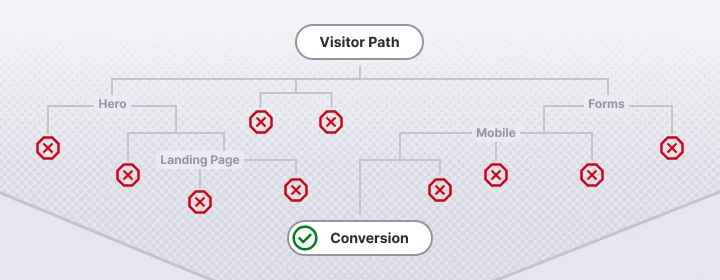
A conversion funnel maps the non-linear path visitors take from first discovering your business to completing an action. A visitor might discover you through Google search results, click on a helpful blog post, navigate to a service page, compare options, read online reviews, and finally submit a contact form.
Most users do not move through this journey in a straight line. They pause at critical decision points, evaluate your credibility, and determine whether the next step is worth their time. Common friction points where conversions go to die include:
- **The Homepage Hero:** When visitors cannot tell what you actually do within the first 5 seconds.
- **Service or Product Pages:** When the core benefits are vague and fail to speak directly to your target audience.
- **Landing Pages:** When there are too many distractions or the offer fails to match what the visitor expected based on the referring traffic source.
- **Forms:** When the submission process feels intrusive, overly long, or technically buggy.
- **Mobile Pages:** When the site does not load fast or proves difficult to navigate with a thumb.
- **Calls-to-Action:** When the next logical step is visually hidden, weakly phrased, or entirely generic.
Understanding these structural fundamentals reveals exactly where your conversion problem is occurring, helping you separate a traffic shortfall from a conversion issue after visitors arrive. Once you know where visitors hesitate or bounce, and what your bounce rate says about those drop-off points, you can systematically dismantle the exact issues killing your sales.
## The 7 Critical Conversion Killers (And How to Fix Them)
If your website boasts healthy traffic but suffers from an empty pipeline or zero sales, the cause usually points directly to one or more of these seven critical conversion killers.
### 1. Unclear Value Proposition and Messaging
Visitors leave instantly when they cannot quickly decipher what you offer, who it is for, and why it is better than the competition. Within seconds of landing on your page, your website copy must clearly answer:
1. What do you do?
2. Who do you help?
3. What specific result do you help them achieve?
Vague messaging is a primary reason a website isn’t converting. Many companies try to sound overly broad or highly sophisticated, relying on empty filler phrases like “We provide innovative, end-to-end solutions for modern enterprises.” That tells your ideal client absolutely nothing about why they should care. If your copy is written to appeal beyond your ideal audience, it ultimately connects with no one.
Your website should be guiding visitors based on where they are in the buying journey. Cold leads arriving via educational blog posts require helpful content and soft social proof. Conversely, high-intent visitors landing on your pricing or bottom-of-funnel landing pages need a highly visible, cta specific to booking a demo, requesting an immediate quote, or starting a purchase.
### 2. Misaligned Target Audience and Traffic Quality
A common reason websites fail to convert is that attracting more visitors does not help if they are the wrong fit, which inevitably triggers low engagement metrics and high bounce rates across the board. Targeting the right audience with surgical precision is crucial for improving conversion rates, as misaligned goals often cause businesses to measure the wrong conversions or waste money attracting irrelevant traffic.
A severe lack of deep market research can result in highly ineffective targeting, causing qualified and unqualified visitors alike to abandon a website without converting because they simply do not find the content relevant to their immediate needs.
To fix this, you must invest time in building data-backed buyer personas. Creating buyer personas helps businesses understand their target audience on a psychological level, making it easier to build a tailored marketing strategy that resonates profoundly with potential customers. A highly functional buyer persona must clearly outline:
- The ideal audience’s core pain points and daily frustrations.
- The exact buying triggers that prompt them to look for a solution.
- Common objections they hold regarding your product or service.
- Budget expectations and preferred procurement processes.
- Their preferred clear next step (e.g., calling, texting, or filling out a form).
### 3. Lack of Trust and Credibility Signals
Web visitors are naturally skeptical. They will rarely hand over personal information or credit card numbers if they do not trust your business. This trust deficit is amplified if you are operating a brand-new website, selling a high-ticket service, running a healthcare or financial company, or managing a professional services firm.
Customer testimonials and online reviews are an excellent way to build trust, as extensive studies prove that users are much more likely to respond positively to explicit recommendations from their peers. If your website isn’t converting, missing testimonials, reviews, or basic company details are often part of the problem. Utilizing social proof, such as genuine testimonials and data-driven case studies, establishes ironclad trust with potential customers by demonstrating that real people have had highly positive experiences with your business.
A clear About page that talks directly to your industry experience, verified qualifications, and the measurable results you secure for clients can significantly strengthen trust and credibility signals across your entire site. This matters because buyers routinely check who is running the business before making first contact. Featuring a co-founder, owner, or leadership team bio can humanize your company and build trust, provided it highlights relevant experience rather than generic personal trivia—for example, a certification, published speaking engagement, or industry award.
Strategic Placement of Trust Signals for Maximum Impact:
- **Homepage Hero Section:** Place recognizable client or partner logos directly below the main header.
- **Service Detail Pages:** Embed a verifiable case study featuring tangible metrics mid-page.
- **Contact & Checkout Forms:** Position customer star ratings and clear security guarantee badges directly adjacent to the input fields.
### 4. Distracting Landing Pages (Too Many Choices)
Having too many distractions on a landing page can significantly hinder conversion rates, as it completely overwhelms visitors and makes quick decision-making difficult for the user. When a page presents a user with standard navigation links, social media icons, secondary blog links, and multiple competing offers, cognitive overload sets in.
Simplifying landing pages by removing unnecessary distractions can significantly improve conversion rates, as restricting choices prevents visitors from falling into analysis paralysis or experiencing indecision. Keep your landing pages hyper-focused: one clear audience, one singular message, and one distinct action to take, because simplifying choices can make a big difference in conversion rate.
### 5. Absence of Urgency
A complete lack of urgency on a landing page frequently leads to lower conversion rates, as visitors may not feel compelled to act immediately without a clear, logical reason to do so. Without an incentive to act now, visitors tell themselves they will “come back later”—and they rarely do.
Using honest urgency in your calls-to-action, such as showcasing limited-time promotional pricing, displaying remaining cohort seats, or highlighting real-time inventory limits, can powerfully motivate visitors to take action immediately rather than delaying their final decision, helping hesitant users start converting instead of waiting. However, ensure this urgency is entirely genuine; fake countdown timers destroy credibility instantly.
### 6. Weak or Missing Calls-to-Action (CTA)
Websites that do not provide a clear and compelling call-to-action (CTA) risk losing potential conversions daily, as users may simply not know what specific action they are supposed to take next.
A clear and concise call-to-action (CTA) is essential for converting visitors, as it provides users with a frictionless opportunity to take action the exact moment they feel ready. Furthermore, a clear and compelling call-to-action (CTA) provides users with specific, explicit instructions on what to do next, such as filling out a short form or finalizing a purchase.
To maximize efficacy, CTAs should be placed prominently on the page and be incredibly easy to find, as users are significantly less likely to convert if they have to hunt through a page to find the action they need to take. Use contrasting button colors, whitespace, and action-oriented text (e.g., “Claim Your Free Audit” instead of “Submit”).
### 7. Poor Mobile Experience and Technical Performance
Even the most beautiful messaging and irresistible offers will fail if your site is slow, broken, or physically frustrating to navigate on a phone.
Optimizing your website for speed is absolutely crucial, as slow loading times can lead to high bounce rates and lost conversions. Every additional second of load time reduces conversions, with historical performance studies showing that most users will quickly exit digital sites that take longer than 3 seconds to fully load. If your specific landing page takes longer than 2–3 seconds to load, most people simply won’t wait around, which severely impacts your conversion rates.
Your site’s mobile-friendly experience must be audited on physical devices, not just simulated inside desktop web browser preview tools. Mobile visitors demand highly readable text sizes, thumb-friendly button dimensions, rapid load times, and streamlined forms that don’t require endless zooming and scrolling.
## Diagnosing Your Conversion Issues with Real Data
Before rewriting headlines, redesigning layouts, or increasing your paid ad spend, you must diagnose your website conversion problem using real data. A strategic conversion optimization audit looks at the entire multi-page ecosystem, tracking how users navigate from blog posts to service pages, and onto your final contact forms.

### The Conversion Audit Checklist
1. **Analyze Conversions in Google Analytics:** Set up explicit tracking for form submissions, e-commerce transactions, click-to-calls, and demo requests. Segment this data by traffic source, device type, and specific ad campaigns to see if mobile users or paid ads are underperforming.
2. **Review User Behavior via Heatmaps:** Use tools like Microsoft Clarity or Hotjar to watch session recordings. Look for where users hesitate, scroll past key points, or perform “rage clicks” on non-clickable design elements.
3. **Run Technical Speed Performance Tests:** Use PageSpeed Insights and Lighthouse to evaluate your mobile optimization and page load speeds. Fix unoptimized images, bloated scripts, and server lag.
4. **Audit Message Alignment:** Ensure the exact promise made in your paid ads or search meta-descriptions matches the headline on the landing page. If an ad promises “Same-Day HVAC Repair Pricing” and points to a generic homepage, you have a conversion-killing alignment mismatch.
### Conversion Problem Priority Matrix
Use this strategic framework to determine which fixes to implement first based on impact, difficulty, and speed to results.
| Problem Type | Impact Level | Fix Difficulty | Time to Results |
|---|---|---|---|
| Slow Page Speed | High | Low / Medium | 1–3 Days |
| Unclear Messaging | High | Medium | 1–2 Weeks |
| Missing Trust Signals | Medium | Low | 1 Week |
| Poor Mobile UX | High | High | 2–4 Weeks |
| Wrong Traffic Targeting | Medium | Medium | 2–6 Weeks |
## Common Challenges and Solutions
### Why am I getting clicks but no conversions?
If you are generating healthy search engine traffic or ad clicks but zero conversions, you generally have a mismatch between expectations and reality. This happens because your marketing is targeting a broad audience rather than your ideal customers, your landing page takes longer than 3 seconds to load, or your value proposition is completely obscured by too many distractions. Review your search terms in Google Search Console and ensure your landing page perfectly fulfills the exact intent behind those clicks.
### Why isn’t your website converting and how to fix it?
Your website isn’t converting because of user friction, a lack of perceived trust, or poor technical execution. To fix it, systematically step through your funnel:
- Speed up your pages to under 2 seconds.
- Add prominent customer testimonials near your call-to-action buttons.
- Condense your contact forms down to the absolute minimum required fields to create a frictionless user experience.
### How to make your website convert?
To make your website convert effectively, you must transform it from a passive company brochure into an active, guided journey.
- Diversify Offers: Not everyone is ready to buy immediately. Provide low-friction options like downloadable guides, checklists, or webinars for cold leads alongside high-intent CTAs like booking calendars.
- Guide the Visitor: Use a single, crystal-clear call to action on each landing page so users know exactly what step to take next.
- Nurture Long Cycles: For B2B firms with long sales cycles, deploy automated email marketing sequences to nurture visitors who read your blog posts but aren’t ready to speak to sales today.
## Conclusion and Next Steps
A low-converting website is entirely fixable. By shifting your focus away from simply buying more traffic and toward your core messaging, mobile experience, speed, and social proof, you can turn your website into a highly predictable revenue driver.
Your Immediate Next Steps:
1. Check your baseline conversion rate inside Google Analytics over the last 90 days.
2. Run your top 3 highest-traffic landing pages through PageSpeed Insights to uncover mobile speed bottlenecks.
3. Move your best customer review or testimonial to a prominent position right below your homepage hero section.
#### Need a partner in solving your conversion issues?
[Schedule a 30-minute consultation](https://www.wearetg.com/contact/) with a marketing consultant from Timmermann Group. We have over 20 years of experience helping our clients achieve the conversions they need to grow their businesses.
**Categories:** CRO
---
### [St Louis Marketing Conferences: A Guide to the Best Events in the Region](https://www.wearetg.com/blog/st-louis-marketing-conferences/)
**Published:** July 13, 2026
**Author:** Shawn Baldwin
**Content:**
St Louis hosts several notable marketing conferences that draw professionals, business owners, and students from across the region. Whether you’re just starting your career as a marketer or a seasoned veteran at a [St Louis marketing agency](https://www.wearetg.com/st-louis-marketing-agency/), these events are a great way to sharpen your skills, connect with peers, and explore emerging strategies.
Successful marketers master both creativity and data, and they increasingly blend the two for better results. The events on this list reflect that reality, offering everything from half-day keynotes to weekly innovation gatherings. Here’s how we evaluated them, what each offers, and which one fits your goals.
## How We Chose the Best St. Louis Marketing Conferences
We evaluated each event using six criteria:
- **Quality of speakers and educational content:** Are sessions led by proven industry experts?
- **Networking opportunities:** Can attendees build meaningful relationships with professionals, agencies, and brands?
- **Relevance to current trends:** Does the event cover digital marketing, AI, and modern strategies?
- **Value for money and accessibility:** Is the cost justified by what you gain?
- **Career stage appropriateness:** Does it serve students, mid-career marketers, and executives?
- **Track record and reputation:** How long has it been running, and what do past attendees say?
## Top 5 Marketing Conferences in St. Louis for 2026

### 1. AMA St. Louis Annual Marketing Conference
The [2026 AMA St. Louis Conference](https://amasaintlouis.org/events/ama-2026-conference-the-art-science-of-marketing/) takes place on April 9, 2026, at Webster University. This half-day experience focuses on “The Art & Science of Marketing,” featuring TED-style talks and panel discussions designed to help effective marketers balance intuition with evidence-based decision-making.
Why It Stands Out: The conference features keynote presentations and expert-led sessions on marketing strategies by speakers like Katie Martell, whose session tackles the trend of “woke-washing,” which challenges brand authenticity today. An optional agency tour follows the AMA St. Louis conference, giving attendees a behind-the-scenes look at how local agencies blend creativity with analytics. Networking breakfasts and a networking lunch are typical at AMA conferences, creating space for meaningful customer connections. Emotional experiences are crucial for memorable marketing events, and this one delivers.
Best For: Marketing leaders and senior professionals seeking data-driven strategies that lead to measurable business results. Creativity and analytics are essential for effective marketing, and this event addresses both.
Pros: Established AMA reputation, compact format (~$40 tickets), strong focus on measurable results, and a unique agency tour as a bonus.
Cons: The half-day format limits the depth of deep-dive sessions. Professionals seeking specialized PPC or CRO training may find the scope too broad. Smaller attendance (~150+) means fewer random connections, though the intimate setting makes each conversation count.
### 2. Midwest Digital Marketing Conference (MDMC)
The [Midwest Digital Marketing Conference](https://bestmarketingconference.com/) is the largest digital marketing conference in the Midwest, backed by the University of Missouri-St. Louis (UMSL). The 2026 edition will be held on April 29-30 at the Renaissance St. Louis Airport Hotel, drawing roughly [625 attendees and 75 speakers](https://blogs.umsl.edu/news/2026/05/04/midwest-digital-marketing-conference-2026/).
Why It Stands Out: MDMC features speakers from major companies like Google and LinkedIn, and attendees can expect 12 masterclasses, 6 roundtables, and 27 breakout sessions. The Digital Marketing Summit in Saint Louis focuses on practical digital strategies, and MDMC delivers exactly that. Emerging digital trends are a primary focus, with sessions covering social media strategy, email marketing, SEO, data analytics, and AI applications. Most marketing-focused conferences emphasize AI and marketing automation, and MDMC leads the way here. AI is transforming how marketers approach data and creativity. MDMC also includes a partnership with the UMSL Accelerator Demo Day, connecting attendees with innovators and entrepreneurs.
Best For: Digital marketers, agency leaders, and companies seeking comprehensive [education on digital marketing trends](https://www.wearetg.com/blog/digital-marketing-trends/) at scale.
Pros: The two-day format allows for deep immersion. Multiple tracks let your team split up by discipline. Strong for recruiting and benchmarking. Perry Drake and the UMSL team have built a conference with real credibility.
Cons: Large crowds may limit personal networking. Some sessions skew introductory. Travel and lodging costs add up if you’re sending a full team.
### 3. Social Media Club St. Louis Events
[SMCSTL](https://smcstl.com/about-smc) has operated since 2009, hosting regular workshops, speaker series, and session-based events focused on social media marketing throughout the year. Most events are free or low-cost.
Why It Stands Out: Regular programming means continuous learning, which is critical as platforms like Instagram, TikTok, and LinkedIn constantly evolve.
Best For: Social media managers, content creators, and mid-level marketers who need to develop platform-specific skills. Pairs well with a broader [social media marketing](https://www.wearetg.com/services/social-media-marketing/) strategy.
Pros: Low cost, frequent events, strong local community, great for building relationships over time with St Louis professionals.
Cons: Narrow focus on social media means no coverage of search, PPC, or analytics. Smaller events generate fewer business leads. Less relevant for senior leadership.
### 4. Venture Café St. Louis Weekly Meetings
[Venture Café](https://venturecafestlouis.org/) hosts free weekly Thursday gatherings as part of the Cambridge Innovation Center network. These innovation-centered events attract entrepreneurs, startup founders, students, and technology professionals.
Why It Stands Out: Weekly frequency is unmatched. Special themed events like “Collide” and “TechEXP” draw 200+ attendees and connect marketing with broader innovation and technology trends.
Best For: Marketing entrepreneurs, startup marketers, and anyone wanting to explore ideas at the intersection of marketing and technology.
Pros: Free to attend, excellent for meeting innovators, creates consistent networking touchpoints and exposes your team to tools and platforms before they go mainstream.
Cons: Less formal education structure, sessions are often casual. Content skews broader than marketing. Lower ROI per hour compared to focused conferences. Average weekly attendance (~125) is modest.
### 5. Midwest Ecommerce Summit
The [Midwest Ecommerce Summit](https://www.midwestecommercesummit.com/), organized by Blayzer Digital since 2020, is the region’s primary eCommerce-focused event. In 2026, it joined STL TechWeek, expanding its reach. Topics span payments, ERP, shipping, and eCommerce marketing strategy.
Best For: eCommerce marketers, retail professionals, and agencies with commerce clients seeking platform-specific strategies and vendor connections.
Pros: Highly specialized, actionable content on conversion optimization and technology stack decisions. TechWeek integration brings cross-sector exposure.
Cons: Very narrow niche-if eCommerce isn’t your focus, sessions feel peripheral. One-day format compresses content. Sponsorship costs can be high relative to impact.
## Quick Comparison of the Best St. Louis Marketing Conferences
| Event | Best For | Format | Cost |
|---|---|---|---|
| AMA St. Louis | Senior marketers seeking strategic insights | Half-day | ~$40 |
| MDMC | Broad digital marketing education at scale | Two-day | Varies by tier |
| Social Media Club STL | Ongoing social media professional development | Multiple per year | Free/low cost |
| Venture Café | Marketing entrepreneurs and startup founders | Weekly | Free |
| Midwest eCommerce Meetup | eCommerce and retail specialists | One-day | Varies |
Note that beyond these five, events like the PCMA Annual Club Membership & Marketing Conference educate on membership growth and retention-worth exploring if that’s your niche.
## How to Choose the Right Marketing Conference
### Choose Based on Your Career Stage
Students and entry-level employees benefit most from SMCSTL and Venture Café (low cost, frequent exposure) and MDMC (student tracks, speakers from the world’s top companies). Senior leaders and agency leaders get stronger ROI from the AMA Annual Conference and MDMC’s masterclass tracks, where the focus is on strategy and the future of marketing.
### Choose Based on Your Marketing Focus
If your plan centers on [SEO and content](https://www.wearetg.com/blog/components-of-seo/), MDMC’s search and media tracks are the strongest fit. Social media specialists should register for SMCSTL events. eCommerce professionals should plan for the Midwest Ecommerce Summit. For storytelling and brand strategy, AMA delivers.
### Choose Based on Your Budget and Time Commitment
The most effective marketers don’t just attend-they plan. Sending your PPC lead to MDMC, your content person to AMA, and your social team to SMCSTL distributes knowledge without pulling everyone away. Free events like Venture Café let you create ongoing education without budget pressure.
## Which Conference Is Best for You?
- Choose AMA St. Louis if you need strategic marketing leadership insights and want to build stronger brands through evidence-based approaches.
- Choose MDMC if you want comprehensive digital marketing education and large-scale networking-an amazing kickoff for your spring learning.
- Choose Social Media Club if your priority is ongoing social media development that drives meaningful impact.
- Choose Venture Café if you’re focused on marketing innovation and want to connect with entrepreneurs building the future.
- Choose eCommerce Meetup if you specialize in online retail and need platform-specific insights that drive meaningful impact for commerce clients.
## Final Thoughts
St. Louis marketing conferences offer one hell of a lineup for marketers at every level. The landscape offers opportunities to develop skills, meet speakers shaping the industry, and gain insights that translate into marketing campaigns with measurable results. Whether marketing brings your team to a single flagship event or you attend multiple gatherings throughout the year, the key is matching each event to your goals.
The most successful marketers don’t wait for education to come to them. They register, show up, and apply what they learn to build stronger brands and deliver measurable business results. If you’re ready to create a digital marketing strategy that turns conference insights into real growth, start with the event that fits-and build from there.
**Categories:** Culture
---
### [Unassigned Traffic in Google Analytics 4: What It Means and How to Fix It in 2026](https://www.wearetg.com/blog/unassigned-traffic-in-google-analytics/)
**Published:** April 6, 2026
**Author:** Rob Timmermann
**Content:**
If you’ve ever opened your Google Analytics 4 traffic acquisition report and spotted a mysterious row labeled “Unassigned,” you’re not alone. For businesses relying on multi-channel marketing efforts to drive growth, this ambiguous bucket can undermine ROI analysis and obscure where your best conversions actually come from. Let’s break down exactly what Unassigned means, why it happens, and how to fix it.
### Key Takeaways
- Unassigned traffic appears when Google Analytics 4 cannot match a session’s source/medium to any default or custom channel rule—it’s GA4’s catch-all bucket for traffic it can’t classify.
- The most common controllable causes are bad or missing UTM parameters, tag firing order issues in Google Tag Manager, cross-domain setup problems, and Measurement Protocol misconfigurations from server-side tracking.
- Some Unassigned traffic is expected and not fully fixable, including recurring subscription payments without active sessions, consent-related gaps, and certain bot traffic patterns.
- Normal Unassigned levels hover around 3-10% for typical B2B and B2C sites in 2026; sudden jumps (e.g., from 5% to 25%) usually signal implementation issues requiring immediate attention.
- TG helps established businesses audit GA4 properties, standardize UTMs across marketing campaigns, and redesign tracking architectures to turn Unassigned into actionable, conversion-focused channel data.
## What Is “Unassigned” Traffic in Google Analytics 4?
Unassigned is a default channel group value that GA4 uses when its channel rules cannot classify website traffic based on the available session source data. Think of it as GA4’s way of saying, “I received this traffic, but I don’t know which marketing channel it belongs to.”
Under normal circumstances, GA4’s session default channel group places traffic into recognized categories like Organic Search, Paid Search, Paid Social, Direct, Referral, and others. But when a session’s source/medium combination doesn’t match any of these predefined rules, GA4 drops it into the Unassigned bucket.
This is fundamentally different from Direct traffic. Direct is a valid, recognized channel—it represents user visits where someone typed your URL directly, used a bookmark, or came from an untrackable source. Unassigned, on the other hand, is a catch-all for traffic GA4 simply cannot categorize based on its rule-based matching system.
Here’s a concrete example: if you tag a campaign URL with utm\_medium=pdf (for a downloadable PDF link) or utm\_medium=sms\_blast\_march2026 (for an SMS campaign), that traffic will likely fall into Unassigned. Why? Because GA4’s default channel grouping rules don’t include “pdf” or “sms\_blast\_march2026” as recognized medium values.
Google’s ruleset for default channel grouping is documented and periodically updated—with notable refinements in 2024-2025—but these updates haven’t eliminated Unassigned issues. The rules are strict, and any deviation from expected values pushes traffic into this ambiguous category.
For established businesses relying on multi-channel marketing campaigns, high Unassigned traffic is more than an analytics nuisance. It actively undermines budget decisions, attribution data accuracy, and your ability to identify which traffic sources actually drive conversions.
## How to See and Diagnose Unassigned Traffic in GA4 Reports
Finding Unassigned traffic in your reports is straightforward once you know where to look. Here’s how to locate it and start understanding what’s actually behind that mysterious bucket.
#### Step 1: Navigate to Traffic Acquisition
In your GA4 property, go to Reports > Acquisition > Traffic acquisition. By default, this report shows sessions grouped by Session default channel group.
#### Step 2: Locate the Unassigned Row
Scroll through the table until you find the “Unassigned” row. Note the session counts, users, engagement metrics, and conversions associated with this traffic.
#### Step 3: Apply Secondary Dimensions
This is where diagnosis begins. Click the “+” icon to add a secondary dimension and select options like:
- Session source/medium
- Session campaign
- Session default channel group (First user)
- Landing page
These dimensions reveal the underlying patterns—you’ll often see recurring (not set) values or custom mediums like “newsletter,” “pdf,” or platform-specific tags that don’t match GA4’s rules.
#### Step 4: Exclude Recent Data
Exclude the most recent 24-48 hours from your date range. GA4’s data processing delays can temporarily inflate Unassigned and (data not available) values as sessions await full attribution. Looking at data from 48+ hours ago gives you a more accurate picture.
#### Step 5: Create an Exploration Report
For deeper analysis, build an Exploration report filtering Session default channel group equals Unassigned. Segment by source/medium, landing page, device category, or event count to identify clusters. You might discover all your Unassigned traffic comes from a specific email platform (like MailerLite), payment webhooks, or SMS partners.
#### Step 6: Maintain a Running List
Keep a document logging recurring Unassigned patterns you discover—traffic with medium values like “app,” “bot,” or certain partner platforms. This list becomes your roadmap for targeted fixes or custom channel rules.
## How GA4 Classifies Traffic—and Why It Falls Into Unassigned

Understanding GA4’s classification logic is essential before you start changing UTMs or tag setups. Otherwise, your fixes might simply move traffic from Unassigned to another incorrect channel.
GA4’s acquisition model populates traffic source dimensions at the session\_start event. These dimensions include source, medium, campaign, and the session default channel group. Once assigned, subsequent events within that same session inherit this attribution unless explicitly overridden.
The classification relies on strict rule-based matching where medium takes precedence:
| Medium Value | Default Channel |
|---|---|
| organic | Organic Search |
| cpc, ppc | Paid Search |
| email | Email |
| paid\_social | Paid Social |
| display | Display |
| affiliate | Affiliates |
| referral | Referral |
| |
| |
| |
| |
When a session’s source/medium combination doesn’t match any rule—or when these values are missing entirely at session\_start—the session gets labeled Unassigned in the default channel group.
**Common edge cases that trigger Unassigned include:**
- Server-side events sent via Measurement Protocol without proper client identification
- AI/chatbot referrals that lack referrer data
- Non-browser platforms like mobile apps without correctly configured tracking
- Consent-restricted partial sessions where initial hits lack marketing parameters
- Traffic from internal links on microsites or tools that strip UTM parameters
The critical insight: GA4 evaluates channel grouping primarily at session\_start. If that event is missing, delayed, or arrives without proper attribution data, the entire user session lands in Unassigned.
## UTM Parameters: The Most Common Driver of Unassigned Traffic
In most GA4 properties TG audits, inconsistent or non-standard UTM parameters are the number one controllable cause of Unassigned traffic. The good news? This is also the easiest issue to fix.
Google’s baseline recommendation requires every campaign URL to include utm\_source, utm\_medium, and utm\_campaign (with utm\_content and utm\_term as optional additions). But the values matter just as much as the presence of these parameters.
### Bad vs. Good UTM Examples
| Bad UTM Medium | Why It Fails | Good Alternative |
|---|---|---|
| utm\_medium=pdf | Not a recognized GA4 medium | utm\_medium=email (if from email) |
| utm\_medium=blast | Custom value, no matching rule | utm\_medium=email |
| utm\_medium=mailerlite | Platform name, not channel type | utm\_medium=email |
| utm\_medium=igpaid | Abbreviation for Instagram paid | utm\_medium=paid\_social |
| utm\_medium=fb-ad | Custom naming convention | utm\_medium=paid\_social |
| utm\_medium=newsletter | Legacy term | utm\_medium=email |
Using custom mediums like these pushes traffic into Unassigned unless you create custom channel groups to handle them—which adds ongoing maintenance complexity.
### Building UTM Governance
The most effective fix we’ve seen is creating a shared, dated UTM naming convention document. This typically lives as a spreadsheet (started in 2024 or earlier and updated quarterly) that everyone in marketing, sales, and external agencies must follow.
**Tools that help enforce consistency:**
- Google’s Campaign URL Builder
- Internal UTM builder tools with dropdown selections
- Spreadsheet templates with validation rules
TG frequently starts GA4 clean-up projects by auditing 3-6 months of campaign URLs, then re-standardizing UTMs so new traffic immediately flows into the correct channels. In e-commerce audits, we’ve seen 20-30% reductions in Unassigned traffic post-standardization.
## Quick Fixes for Unassigned Traffic Your Team Can Apply This Week
You don’t need a full analytics rebuild to reduce unassigned traffic. Here’s a practical checklist of quick wins a marketer or analytics owner can implement immediately:
#### 1. Standardize UTMs for all active campaigns
Review every live campaign URL and ensure medium values align with GA4 channel rules: email, cpc, paid\_social, display, affiliate, referral, etc.
#### 2. Fix obvious typos
Search your traffic data for typos like “utm\_soruce” (instead of utm\_source) or “piad\_social” that prevent proper attribution.
#### 3. Verify GA4 tags on all production pages
Confirm that your Google tag fires on every page receiving traffic—including landing pages from third-party tools, older microsites, and payment confirmation pages that often feed Unassigned traffic.
#### 4. Set proper tag firing order in GTM
Configure your GA4 configuration/Google tag to fire on “Initialization – All Pages” in Google Tag Manager. Delay non-essential event tags to DOM Ready or Window Loaded so the configuration runs first and establishes the session properly.
#### 5. Audit top 10 Unassigned source/medium pairs
Pull your most common Unassigned combinations from Explorations. Either fix their UTMs or map them into custom channel groups if they represent intentional channels (SMS, partner platforms).
#### 6. Review Reporting Identity settings
Test Device-based reporting (with Google Signals enabled when appropriate) to see if it reduces unexplained Unassigned or (not set) spikes in your attribution data.
#### 7. Schedule recurring reviews
Set a monthly calendar reminder to check the traffic acquisition report specifically for Unassigned trends. Monitor over 30+ day periods to distinguish noise from structural issues—don’t wait until quarter-end when budgets are already spent.
#### 8. Document changes
Keep a changelog of every UTM, tag, or configuration change you make. This proves invaluable when troubleshooting future spikes.
## Technical Causes of Unassigned: Tags, Sessions, and Measurement Protocol
Many stubborn Unassigned issues originate from implementation details rather than marketing mistakes. This section dives deeper into technical causes that often require developer involvement.
### Missing or Delayed session\_start Events
GA4’s attribution depends on the session\_start event to establish traffic source dimensions. In custom or server-side setups, this event sometimes fails to fire or arrives late. When that happens, subsequent event data inherits (not set) values for source/medium, landing the entire existing session in the Unassigned channel group.
### Tag Firing Order Problems
If GA4 event tags fire before the main Google tag or configuration tag, those events lack proper session attribution. The event tag fires, generates event data, but has no session context to attach to—resulting in Unassigned classification.
The fix: ensure your configuration tag fires first (on Initialization trigger), and event tags fire after (on DOM Ready or later).
### Measurement Protocol Issues
Events sent from back-end systems—subscription billing, CRMs, CDPs—via Measurement Protocol require valid client\_id, session\_id, and timestamp\_micros to join an existing session. Without these identifiers, measurement protocol events create standalone sessions attributed to Unassigned, even if they represent legitimate revenue.
**This is particularly common when:**
- CRM platforms like Segment or Amplitude stream events without session identifiers
- Subscription services send renewal transactions without user context
- Custom data pipelines omit required session data fields
### Server-Side GTM Pitfalls
Server side tracking through a server side container introduces additional complexity:
- Inconsistent server\_container\_url usage across pages
- Mixing hard-coded gtag.js with server side tagging
- Misaligned consent handling between client and server managed implementations
These misconfigurations fragment sessions and generate Unassigned traffic even when client-side implementation looks correct.
Recommendation: Development teams should log and test Measurement Protocol requests in a staging property first, validating that server side events join existing sessions rather than initiating new, unattributed sessions.
TG typically includes a technical audit phase in analytics engagements specifically to review GTM containers, server-side setups, and MP payloads for these Unassigned-related issues.
## Cross-Domain, Identity, and Consent: When Unassigned Is a Symptom of Fragmentation
After July 2023’s full GA4 rollout, session fragmentation became a major driver of Unassigned traffic. Privacy protections and multi-domain user journeys complicate what used to be straightforward session tracking.
### Cross-Domain Tracking Problems
If user visits jump between www.example.com, shop.example.com, and a third-party checkout domain without proper cross domain tracking configuration, GA4 often starts new sessions with missing or Direct attribution. These fragmented sessions surface as Unassigned in channel reports.
For businesses operating across multiple domains—main site, shop, payment processor, booking engine—correctly configured cross-domain linking is essential.
### Misconfigured Referral Exclusions
Your own domain or payment processors (Stripe, PayPal, Shopify checkout domains) can break sessions if not properly excluded. When a user returns from a payment gateway without referral exclusion, GA4 treats it as a new session from that domain—often appearing as Unassigned or incorrectly categorized traffic.
**Maintain a current referral exclusion list including:**
- All your own domains and subdomains
- Payment gateways
- Authentication providers
- Internal tools that redirect users
### Reporting Identity Options
GA4 offers three Reporting Identity settings: Blended, Observed, and Device-based. Some properties see fewer mysterious Unassigned sessions after switching to Device-based reporting, even though underlying data collection doesn’t change. This is because Device-based avoids blending across multiple identifiers that can cause attribution confusion.
### Consent Mode Gaps
Advanced consent mode and stricter browser privacy features (Safari’s ITP, Firefox’s ETP) lead to partial sessions where initial hits lack identifiers or marketing data. These partial sessions often contribute to Unassigned and (data not available) in data streams.
For regulated industries or EU-focused businesses, some Unassigned traffic will always persist due to legally-required tracking limitations. Your analytics strategy should account for this reality rather than chase a 0% Unassigned goal.
## Recurrence, Bots, and Unavoidable Sources of Unassigned
Not all Unassigned traffic represents a problem you can fix. Understanding which portions are “working as designed” helps set realistic expectations with stakeholders.
### Recurring Revenue Events
Subscription businesses often see revenue attributed to Unassigned because billing systems trigger purchase events without concurrent user sessions. When your SaaS platform processes a monthly renewal at 3 AM, there’s no active user’s current session to attribute that transaction to.
Even when merchants send recurring measurement protocol events with user id, GA4 cannot retroactively attach these to the original marketing channel without custom logic or data warehouse processing.
### Bot Traffic
**Automated hits from bots and crawlers often have:**
- No valid referrer
- Broken or missing parameters
- Non-standard user agents
This yields Unassigned or strange (not set) patterns in reports. Bot traffic frequently exhibits telltale signs: 100% bounce rates, zero engagement time, or concentrated hits on specific pages.
Filtering recommendations:
- Use GA4’s built-in bot filtering in data settings
- Implement firewall rules or WAF/CDN tools
- Monitor for sudden spikes in Unassigned sessions with extremely low engagement
### Predictive and Audience Triggers
GA4’s audience trigger features and predictive capabilities may generate events outside active sessions. Some of these inherently carry (not set) or Unassigned attribution until Google refines the behavior.
The goal isn’t eliminating all Unassigned traffic—it’s minimizing the preventable share while documenting the remaining unavoidable slice so stakeholders understand its origin.
## Creating Custom Channel Groups to Reclaim Unassigned Traffic
Custom channel groups let you “rescue” meaningful traffic that will never match Google’s default channel rules—without changing your raw data.
### What Custom Channel Groups Do
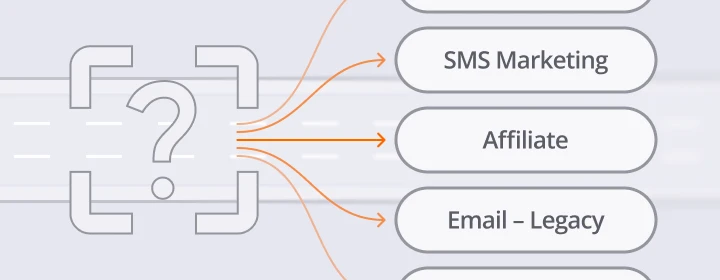
GA4 allows you to create your own channel groupings where you define rules mapping source/medium combinations to channel names you choose. For example:
| Your Custom Rule | New Channel Group |
|---|---|
| medium = “sms” | SMS Marketing |
| medium = “affiliate\_network” | Affiliate |
| source = “attentive” | SMS – Attentive |
| source = “klaviyo-sms” | SMS – Klaviyo |
| medium = “newsletter” | Email – Legacy |
| |
| |
| |
| |
### Setting Up Custom Groups
Navigate to Admin > Data display > Channel groups in your GA4 property. Create a new channel group and define conditions based on source, medium, campaign, or combinations of these traffic source dimensions.
The key benefit: custom channel grouping doesn’t alter how GA4 stores original hits—it changes how they appear in analysis. This makes it especially helpful for years of historical Unassigned traffic that you can’t retroactively fix at the collection level.
### Practical Examples
Consider mapping non-standard email mediums from legacy campaigns (utm\_medium=drip, utm\_medium=newsletter) into a single “Email – Legacy” custom channel. This separates intentional legacy tracking from truly Unassigned noise.
**For organizations with unique go-to-market structures, custom groups can reflect:**
- Trade show and event traffic
- Partner portal referrals
- AI chat assistants
- Affiliate sub-networks
Document these custom rules and keep them synchronized with your UTM governance document. Otherwise, new campaigns will revert back to Unassigned over time as teams forget the custom medium values they should use.
TG often builds custom channel groups for clients to accurately represent their actual marketing channel mix—including channels that simply don’t exist in GA4’s default taxonomy.
## How TG Helps Brands Turn “Unassigned” Into Clear, Conversion-Focused Insights
At TG, we approach Unassigned traffic as a symptom of broader analytics health—not just a number to minimize. Our role as a B2B full-service digital marketing partner means we combine strategy with hands-on implementation.
A typical engagement starts with a comprehensive GA4 audit: reviewing acquisition reports, GTM/gtag setups, server containers, and Measurement Protocol flows to map all sources of Unassigned traffic. We document every specific traffic source contributing to the problem.
**From there, we collaborate with internal marketing, development, and sales teams to:**
- Standardize UTM governance across all marketing campaigns
- Fix tag firing sequences and ensure correct configuration
- Implement cross-domain tracking aligned with actual user journeys
- Create custom channel groups that reflect your real go-to-market structure
Our broader services—SEO, PPC, UX & CRO, social media, and local search optimization—all depend on accurate attribution. Reducing Unassigned traffic isn’t a side project for us; it’s central to delivering “Conversions, not Diversions.”
Fixing Unassigned shouldn’t be a one-off cleanup. We position it as part of a long-term analytics and optimization flywheel that supports continuous growth. When your traffic data accurately reflects reality, every marketing decision gets sharper.
### Ready to audit your Analytics?
[Schedule a consultation ](https://www.wearetg.com/contact/)with TG to review your current Unassigned traffic, identify the largest drivers, and build a prioritized remediation plan.
---
## Frequently Asked Questions
#### How much Unassigned traffic is “normal” in GA4?
As of 2026, 3-10% Unassigned traffic is common for typical B2B and B2C sites. This baseline accounts for privacy limitations, bot traffic, recurring revenue events, and other unavoidable sources.
Sudden jumps—say, from 5% to 25% within a week—usually signal a new implementation issue: a broken tag deployment, a new campaign launched without UTMs, or changes in cross-domain behavior that fragment sessions.
Monitor trends over at least 30 days before deciding whether a spike is structural or temporary noise from processing delays. Single-day spikes often resolve themselves; sustained increases require investigation.
#### Does switching Reporting Identity to Device-based change historical Unassigned data?
Yes, but not through reprocessing. Reporting Identity is a reporting-layer setting, so switching to Device-based can instantly change how historical data appears in reports without re-collecting anything.
In some properties, this reduces Unassigned and (not set) counts because GA4 stops blending across multiple identifiers (like user id and device fingerprints). The underlying traffic data remains unchanged—only how it’s stitched and displayed shifts.
Document any identity setting changes with dates so stakeholders understand why historical numbers may differ when comparing pre- and post-switch periods.
#### Can Google Ads auto tagging alone prevent Unassigned traffic?
No. Auto tagging via gclid improves attribution for Google Ads campaigns specifically, but it doesn’t address Unassigned issues from other channels—email, organic social, SMS, third-party ad platforms, or affiliate networks.
You still need proper UTMs for non-Google platforms and a correctly configured GA4 implementation to prevent Unassigned across your full marketing mix. Even auto-tagged clicks can appear as Direct or Unassigned if misconfigured redirects or landing page templates strip the GCLID parameter before the Google tag fires.
#### Should I retroactively reprocess historical Unassigned data in GA4?
GA4 does not allow reprocessing of historical hits, so you cannot truly “fix” old Unassigned data at the collection level. The traffic is stored as it was originally captured.
Instead, use custom channel groups to recategorize historical sessions for analysis purposes. For deeper analysis, export data to BigQuery and apply SQL logic to reclassify Unassigned sessions based on patterns you’ve identified.
Focus engineering and tagging effort on getting future data right while using derived models or custom groupings to make past Unassigned traffic categorized and interpretable in reports.
#### Is it worth investing in server-side GTM or CDP streaming if I’m already struggling with Unassigned?
Server-side setups and CDP integrations can improve data control, bypass ad blockers, and increase tracking resilience—but they also add complexity. Implemented incorrectly, they can actually increase Unassigned traffic through misaligned session identifiers and fragmented measurement protocol events.
The pragmatic approach: stabilize your basic GA4 + GTM implementation and UTM standards first. Once your client-side tracking setup produces clean attribution data, layer in server-side tracking or CDP streaming with a clear Measurement Protocol plan that includes proper client id and session id handling.
TG often helps clients phase these upgrades systematically—starting with clean client-side implementation, then adding server-side capabilities once attribution fundamentals are solid and teams understand the maintenance requirements.
**Categories:** Analytics
---
### [The 5 Cs of Content Marketing: Drive Profitable Action for Your Business](https://www.wearetg.com/blog/5-cs-of-content-marketing/)
**Published:** June 29, 2026
**Author:** Rob Timmermann
**Content:**
Attempting to drive your company’s profitability online can be overwhelming. The market is massive, your potential reach is limitless, and the competition is fierce. Not only that, but your customers are being overwhelmed by ads and messages vying for their attention, often causing users to become disengaged with marketing messages unless they truly strike a chord. Creating content with a strategic approach and the right balance of meaningful connections and usable information is known as the 5 Cs of content marketing.
[Content marketing](https://www.wearetg.com/services/content-marketing/) requires more thought than simply posting regularly to your blog or social media page. All your content must be Clear, Consistent, Creative, Credible, and Customer-Centric. Let’s explore how each of these can work independently and together to create content that resonates with your target audience, generates quality leads, and promotes the conversions you want. Today, these same principles also help businesses create content that performs across modern search experiences, including AI-powered search and evolving user expectations.
## What are the 5 Cs?
### Clarity
The first thing you always want to ensure about your content is that it is clear and understandable. Trying to get ahead of your competition means your target audience needs to be able to fully understand what you’re trying to say and quickly obtain that information. You should create meaningful content that resonates with users, but if they don’t even know what point you’re trying to get across or clarify what actions they should take, your content will not act as a valuable marketing tool in your digital toolbelt.
#### Why Clarity Matters
- **Enhances Understanding:** Clear content helps your audience easily understand your message, reducing confusion and ensuring your key points are effectively communicated. Clarity also helps keep your audience engaged, as they can quickly grasp the value of your content without deciphering complex or ambiguous language.
- **Improves User Experience:** Clear content is easier to read and digest. This improves overall user experience, making your audience more likely to stay on your site and explore more of your content. Clear, concise navigation instructions and calls to action (CTAs) guide users smoothly through your website, enhancing their interaction with your brand.
- **Boost SEO Performance:** Clear, well-structured content focused on specific keywords helps search engines understand and index your pages more effectively. This can[ improve your search rankings](https://www.wearetg.com/services/seo/) and drive more organic traffic to your site. Clear, relevant content also reduces bounce rates by keeping visitors on your site longer, as they find the information they need without frustration.
- **Builds Trust and Credibility:** Clear and well-organized content reflects professionalism and attention to detail, which helps build trust with your audience. Providing clear information about your products, services, and policies also demonstrates transparency, which enhances your credibility and fosters long-term customer relationships.
- **Facilitates Action:** Clear, direct CTAs guide your audience toward the desired actions, whether it’s signing up for a newsletter, making a purchase, or sharing your content. By removing ambiguity and making the next steps obvious, you improve conversion rates and drive profitable actions for your business.
#### Implementing Clarity in Content Marketing
Every piece of content you create should offer a clear point and be simple for your audience to digest the information. Refrain from using any jargon, or industry-specific insider language, or any complex terms that require users to pull out their dictionaries constantly. Clarity applies to longer content, like blogs or email marketing messages, and shorter text, such as an article headline or social media post. If a user reads your article and leaves thinking, “What was the point?” (if they even reach the end), or automatically delete your digital marketing messages without even looking, you obviously aren’t giving them a clear reason to pay attention.
For example, let’s take a look at one of our Timmermann Group blogs, “[Humanizing Your Brand: 13 Innovative Ways to Humanize Your Brand](https://www.wearetg.com/blog/humanizing-your-brand/).” The headline already tells you what you can expect to find: 13 different tactics you can use to add a more relatable human element to your business’s brand. If this were simply titled “Humanize Your Brand,” readers would not be able to tell what they’ll get from the article just at a glance. What can they expect from it should they decide to read it? Is it useful for them?
Users should be able to scroll through the content easily to find the necessary information. Break up your sections with relevant headers that offer context to what they’ll find there. If you have to use any industry language, make sure you offer a definition. Spell out the acronym the first time it’s mentioned. Link to a relevant resource for more information. Your target audience may know much about what you’re sharing, but it’s dangerous to assume they know everything. Additionally, if you offer tips such as, “The goal is to make a personal connection with your reader,” you need to provide actionable ways to do so (you can tell a new baseball pitcher they need to pitch strikes, but if they don’t know how and you never show them your advice won’t go very far).
### Consistency
Being consistent in content marketing means maintaining a uniform voice, tone, and frequency across all content. Ultimately, you want your target audience to easily recognize your brand and trust the reliability of your message, whether it’s a blog post, social media update, or email newsletter. Consistency builds a cohesive brand identity.
#### Why Consistency Matters
- **Builds Trust and Credibility:** Consistent content shows that your brand is reliable and professional. When your users see regular updates and consistent messaging, they are more likely to trust your expertise and return for more.
- **Enhances Brand Recognition:** Repeating your brand’s voice and visuals across different platforms makes it easier for your audience to recognize and remember your brand. This kind of recognition is crucial for long-term brand loyalty and customer retention.
- **Improves SEO Performance:** Search engines favor websites that consistently publish high-quality content. Regular updates help signal to these search engines that your website is active and authoritative, which can improve your search engine rankings and drive more organic traffic.
#### Being Consistent in Content
Achieving consistency in your content marketing strategy is done in a few ways. Whatever content you’re publishing, make sure you follow a consistent calendar. Plan ahead with a content calendar and wherever possible, schedule posts ahead of time. This helps maintain a regular schedule that your audience can expect.
Examine the existing content on your website and determine where you can repurpose any into different formats. For example, you can turn a blog post into an infographic or series of social media posts. This saves time in strategizing and ensures consistent messaging across platforms.
You should also work to[ create brand guidelines](https://www.wearetg.com/services/branding/) that define your voice and tone and maintain visual consistency. Understanding and adhering to a consistent voice and tone maintains a uniform brand personality. Working with consistent colors, fonts, and imagery across all content reinforces brand identity to your users.
One excellent example of content and brand consistency is with our client,[ Boom Pilates](https://www.wearetg.com/portfolio/boom-pilates/). Their fun, bold colors and visuals of happy instructors and students stay consistent from their website to their social media posts and more. The upbeat, positive tone of voice is used throughout their content creation, ensuring they are relatable to their audience and offer insight into what students can expect when visiting the studio. Boom has created an online presence that is trustworthy, credible, and easy to engage with, helping turn interested users into long-term clients and boosting class purchases.
### Creativity
Creativity in content marketing is how you can capture your audience’s attention and differentiate your brand from the competition. Being creative requires thinking outside the box to deliver content that is informative, engaging, entertaining, and memorable. It requires originality and innovation, which can sometimes be challenging in an overcrowded market but definitely not impossible.
#### Why Creativity Matters
- **Captures Attention:** When the digital marketplace is crowded, the most creative content is what stands out. It grabs the audience’s attention and encourages them to engage with your brand. Creative, visuals, compelling headlines, and unique presentation formats can make a strong first impression that entices users to explore further.
- **Enhances Engagement:** Incorporating interactive elements like quizzes, polls, and interactive infographics can boost user engagement and time spent with your brand and on your site. Additionally, creative storytelling helps you connect with audiences on an emotional level, making your content more relatable and memorable so customers return to your brand time and again.
- **Encourages Sharing:** Offering creative, original content is more likely to be shared across social media platforms to increase your reach and visibility. Unique and interesting content can also generate buzz amongst your users, encouraging word-of-mouth promotion for organic growth.
- **Builds Brand Identity:** Creativity plays an important role in establishing your distinctive brand voice and personality, making it easier for your audience to recognize and relate to you. Although creativity introduces new and exciting elements, remember your consistency; maintain a consistent brand theme to ensure all creative efforts align with your overall brand identity.
- **Drives Innovation:** Taking a more creative approach allows you to experiment and adapt your content to changing trends and audience preferences, keeping your strategy fresh and relevant. Creativity also encourages you to look at challenges from different perspectives, leading to innovative solutions and new opportunities.
#### Showcasing Creativity Through Content
A successful content marketing strategy requires creativity, and there are several ways to approach it. Encourage those in your company to collaborate and participate in brainstorming sessions. Welcoming the thoughts of others helps generate diverse ideas and perspectives, giving you new ways to show your brand to the audience. Mind mapping techniques may also be used to explore different angles and connections related to your specific content.
Creativity in content marketing is more than the written word. Using[ graphic design](https://www.wearetg.com/services/graphic-design/), create infographics to present complex information in a visually appealing, easy-to-understand format. Creating engaging videos and animations can help tell stories, explain concepts, or showcase your products.
Where possible, play around with different content presentation formats. Develop quizzes, calculators, and interactive guides to engage users actively. Write in-depth articles and create whitepapers and e-books that offer comprehensive insights and valuable content for the audience. Leverage any user-generated content you have, highlighting testimonials and reviews that will add to your authenticity with a personal touch. Run various contests or challenges on social media to encourage users to create and share content related to your brand.
Keep your creative spark alive by staying up-to-date on industry trends and emerging technologies that can help inspire new content ideas. Analyze your competitors’ creative approaches and find ways to differentiate your approach while drawing inspiration.
### Credibility
Credibility in content marketing refers to the trustworthiness and authority your brand conveys through its content. It’s about ensuring your audience sees your content as reliable, accurate, and worthy of their trust. Establishing credibility is essential for building long-term relationships with your audience and influencing their decision-making processes.
#### Why Credibility Matters
- **Builds Trust With Your Audience:** When your content consistently provides accurate and valuable information, your audience will trust your brand as a reliable source. Creating transparent and honest content fosters a sense of authenticity, which is crucial for building trust and loyalty.
- **Enhances Brand Authority:** Demonstrating deep knowledge and expertise in your industry positions your brand as a thought leader, enhancing your authority and influence. Presenting credible content can sway opinions and decisions, making your audience more likely to consider your recommendations and take desired actions.
- **Improves SEO and Organic Reach:** Search engines favor high-quality, credible content. Backlinks from authoritative sites and high user engagement can boost your search rankings. Trustworthy content keeps visitors on your site longer, reducing bounce rates and signaling to search engines that your content is valuable.
- **Supports Customer Retention:** Customers who trust your brand are more likely to return for future purchases and recommend your products or services to others. Credible content encourages ongoing engagement, as your audience feels confident in the information you provide.
- **Drives Conversions:** When potential customers trust your content, they’re more likely to feel confident in making purchase decisions based on your recommendations. Credible content also enhances the overall perception of your brand, leading to increased conversions and sales.
#### How to Ensure Your Content is Credible
There are several ways you can be credible in digital marketing. Use credible research, backing up your claims with tangible data. Citing credible sources enhances your content’s trustworthiness. If you are able, you can conduct and publish your own research studies and surveys. Sharing original data can help position your brand as an industry authority.
Feature expert opinions in your content through interviews and guest posts. Collaborate with industry experts to gather insights to add authority to your content. Hosting webinars and podcasts with thought leaders is another way to provide users with valuable information and establish your brand’s credibility.
Regardless of the type of content you create, be sure to provide detailed, accurate information. Ensure your content is comprehensive and dives deeply into the topic, as detailed information demonstrates expertise and reliability. Be sure to double-check all your facts and figures to avoid sharing inaccuracies that could damage your credibility.
Being credible also means maintaining transparency and honesty with your audience. If an error occurs, address them openly and correct them quickly. Being transparent in handling mistakes builds trust. If you offer product reviews or comparisons, be honest and balanced to help customers make an informed decision.
### Customer-Centricity
Customer-centricity in content marketing means creating and delivering content that focuses on your audience’s needs, preferences, and interests. It’s about putting the customer at the heart of your content strategy, ensuring that every piece of content you produce provides value and addresses your audience’s pain points, questions, and desires.
#### Why Customer-Centricity Matters
- **Enhances Customer Engagement:** By addressing your audience’s specific needs and interests, you can create content that resonates deeply with them, leading to higher engagement rates. Customer-centric content fosters a personal connection with your audience, making them feel understood and valued.
- **Builds Loyalty and Trust:** Providing useful and relevant information helps build trust, as customers see your brand as a helpful resource. Regularly addressing customer needs in your content reinforces their trust and loyalty over time.
- **Improves Conversion Rates:** Content that speaks directly to customer pain points and provides solutions is more likely to convert readers into customers. Focusing on customer-centric content improves the overall user experience, making it easier for potential customers to make informed purchasing decisions.
- **Drives Customer Advocacy:** When customers find your content valuable and helpful, they are more likely to become advocates for your brand, sharing your content and recommending your products or services to others. Happy customers are more likely to leave positive reviews and testimonials, further enhancing your brand’s reputation.
- **Informs Product and Service Development:** Content that encourages feedback and interaction provides valuable insights into what your customers want and need, informing your product or service development. Understanding your audience’s preferences helps you stay ahead of market trends and adjust your offerings accordingly.
#### How to Focus on Customers with Content
Compelling content marketing focused on your customers can be achieved by ensuring you fully understand your audience. Develop detailed customer personas to understand your target audience’s demographics, behaviors, and needs. Regularly conduct surveys and gather feedback to stay informed about your customers’ evolving needs and preferences so you can ensure your content remains focused on them.
Once you know who your audience is, segment them based on their interests, behaviors, and stage of the sales funnel to deliver personalized content. Tailored messaging in your content ensures each customer feels unique and valued, bringing your brand to the top of their minds when they require your services or products.
Produce content that educates your audience, like how-to guides, tutorials, and informative articles that address their common questions or challenges. Ensure your[ website is designed](https://www.wearetg.com/services/website-design/) with the customers’ best interests in mind, from friendly navigation to content that answers their questions. Focus your content on solutions to their problems and showcase how your products or services can help.
Always be sure to monitor your customers’ behaviors and adapt your strategy accordingly. Use analytics tools to track the performance of your content and understand what resonates most with your audience. Continuously refine your content strategy based on insights and feedback to meet your customers’ needs better.
Amazon is an excellent example of a customer-centric marketing strategy. It uses data and information to understand its audience and create content that addresses their specific needs and interests, sharing relevant products and information directly with customers. Showing only what customers are likely to be most interested in promotes more sales as the messages are tailored directly to them and what appeals to them most.
## How Content Marketing Following the 5 Cs Drives Revenue
You can create a powerful content strategy that drives revenue by following the 5 Cs of content marketing — Clarity, Consistency, Creativity, Credibility, and Customer-Centricity. Each element is crucial in attracting, engaging, and converting customers, ultimately leading to increase sales and business growth.
- **Clarity** drives revenue through increased conversion rates and reduced bounce rates. Clear content guides customers through the buyer’s journey effortlessly. When potential customers easily understand your products or services, they are more likely to make a purchase. Clear, concise content also reduces confusion and keeps visitors engaged, reducing bounce rates to increase the chance of conversion.
- **Consistency** drives revenue by fostering brand trust and loyalty while supporting steady traffic to your website. By regularly publishing valuable content, you build trust with your audience, and trustworthy brands are more likely to retain customers and encourage repeat purchases. Consistently publishing content keeps your audience coming back for more, maintaining a steady flow of traffic to your site, leading to more potential sales opportunities.
- **Creativity** drives revenue through differentiation and viral potential. Creative content sets your brand apart from the competition, and the more unique and innovative it is, the more it attracts attention to drive higher engagement and conversions. The more creative you are, the more likely it is to be shared, increasing your reach to bring in new customers who can contribute to revenue growth.
- **Credibility** drives revenue by establishing customer trust and promoting higher conversions. Credible content builds trust, making customers more likely to purchase from a brand they believe is knowledgeable and reliable. Customers are also more likely to convert when they trust the information provided, especially for high-value or complex purchases.
- **Customer-centricity** drives revenue through customer satisfaction and targeted marketing. Content that addresses your audience’s specific needs and pain points enhances customer satisfaction, leading to repeat business and referrals. Understanding and targeting your customers’ specific needs can create more effective marketing campaigns that drive higher conversion rates and revenue.
Implementing these principles ensures your content resonates with your audience, builds trust, and encourages them to take profitable actions, driving sustainable revenue for your business.
Businesses that consistently create clear, credible, and customer-focused content are better positioned to earn trust, improve visibility, and support long-term growth. Regularly reviewing and refreshing your content helps ensure it continues to deliver value for both your audience and search engines.
## Create Effective Content Marketing Strategies Following the 5 Cs with Timmermann Group
Content marketing is a driving force for profitability, and mastering the 5 Cs can help your business achieve sustainable revenue growth. At Timmermann Group, we understand the power of strategic content marketing. Our experts are dedicated to helping you implement the 5 Cs in a way that aligns with your brand’s goals and resonates with your target audience. Whether you’re looking to enhance your brand’s voice, create shareable and compelling content, or build a trustworthy reputation, we have the skills and experience to guide you every step of the way.
Don’t leave your content marketing to chance.[ Contact Timmermann Group](https://www.wearetg.com/contact/) today to start creating content that makes a difference. Let’s transform your content marketing strategy and unlock your brand’s full potential, turning your content into a powerful tool for growth and success.
**Categories:** Content Marketing
---
### [Leads for Contractors: How to Get More Qualified Construction Jobs](https://www.wearetg.com/blog/leads-for-contractors/)
**Published:** May 29, 2026
**Author:** Rob Timmermann
**Content:**
Getting more jobs is not just about getting more names, phone numbers, or form fills. The real goal is finding leads for contractors that match your trade, service area, schedule, and profit targets.
This guide for [contractor marketing](https://www.wearetg.com/industry/contractor-marketing-agency/) breaks down the major sources of contractor leads, from lead generation websites and paid advertising to local seo, referrals, reviews, and long-term search engine optimization. You will also see how to compare platforms, avoid wasted spend, and build a construction lead generation strategy that produces better opportunities over time.
### Key Takeaways
- Not all construction leads are created equal; qualified leads with clear project details, budget fit, and local relevance matter more than raw volume.
- The best lead generation websites can help fill gaps, but shared leads, high competition, and weak follow-up can reduce profitability.
- The strongest lead generation strategies combine local search, reviews, website conversion, paid ads, referrals, and CRM follow-up into one measurable system.
## Why Leads Matter for Your Construction Business
Most homeowners do not hire a contractor the first time they come across one; they spend time researching and comparing companies before making a decision. Developers, property managers, and commercial buyers do the same thing, often reviewing portfolios, permits, online directories, and reviews weeks before making phone calls.
That means your construction business needs to be visible before someone is ready to ask for an estimate. If potential clients search for “roofing contractor near me,” “kitchen remodeler in \[city\],” or “commercial concrete contractor,” and your company is absent, another contractor enters the conversation first.
Relying only on word of mouth, repeat business, or previous clients can work during busy seasons, but construction industry demand moves in cycles. Weather, interest rates, permitting delays, and local development activity can all change your pipeline quickly.
This article is for general contractors, residential contractors, residential construction specialists like roofing, remodeling, HVAC, and plumbing companies, plus subcontractors looking for more construction leads. We will cover lead generation services, best lead generation websites, and owned channels such as SEO, PPC, website design, social media, and referrals.
## Types of Contractor Lead Generation Services
Lead generation services help connect potential customers with service providers by using various marketing strategies to attract and qualify leads. For contractors, these generation services differ from traditional advertising because the goal is not just awareness; the goal is to generate leads from people with specific projects.
Most lead generation companies fall into two main categories: directory lead generation companies and agency lead generation companies, each serving different needs for contractors. Directory lead generation companies build platforms where homeowners can search for contractors and other local service providers, generating leads by attracting traffic to their websites. Directory lead generation companies create platforms where homeowners can search for contractors and other local service providers, generating leads by attracting traffic to their websites.
The two primary models are:
| **Model** | **How It Works** | **Best Fit** |
|---|---|---|
| Directory lead generation websites | Contractors create profiles and receive leads from homeowners browsing the lead platform | Smaller jobs, review-driven trades, local homeowners/td> |
| Agency or partner lead generation companies | A partner runs SEO, PPC, landing pages, paid advertising, or call campaigns | Contractors wanting more control, tracking, and high quality leads |
Common pricing structures include pay-per-lead, pay-per-call, monthly subscription, and commission or revenue-share models. Pay-per-lead can be simple, but it can get expensive if the lead sources produce leads that are outside your project scope or service area.
Shared leads are sent to many contractors at once. Many contractors then race to respond, which can create price pressure. Exclusive leads usually cost more, but they often create better conversations, stronger margins, and fewer “lowest bid wins” situations.
## Top Directory Lead Generation Websites for Contractors
Directory sites often rank well in search engines, which gives contractors visibility without waiting months for their own SEO to mature. One of the main advantages of directory lead generation is increased visibility, as these websites often rank well in search engines, allowing businesses to gain exposure without relying solely on their own marketing efforts.
Directory lead generation platforms can provide a built-in audience, as homeowners actively visit these sites to research contractors, review project photos, and gather ideas before hiring. While directory lead generation can streamline lead capture by making it easy for potential clients to request quotes, many users are still in the research phase and may not be ready to hire, leading to lower-intent leads.
A significant drawback of directory lead generation is heavy competition, as many contractors in the same area are listed on the platform, making it challenging to stand out and consistently win leads. The right lead generation website depends on your trade, budget, reputation, and local area.
Create optimized profiles on platforms like Houzz, Angi, Yelp, and Nextdoor to tap into active buyer intent.
### Houzz
Houzz is especially useful for residential construction, remodeling, kitchens, bathrooms, additions, and design-build contractors. A Houzz profile can act like a mini portfolio website with project photos, reviews, ideabooks, service descriptions, and request-a-quote options.
To generate qualified leads on Houzz, treat every project like a case study. Add strong before-and-after images, explain the project scope, list materials when useful, and collect reviews from satisfied clients.
Houzz Pro paid plans can add boosted visibility and tools to manage leads, but the platform works best when your visual proof is strong. High-end remodelers and custom builders should use Houzz to show quality construction work, not just list services.
### BuildZoom
BuildZoom is built around serious construction projects, including major remodels, additions, and custom homes. It uses contractor data, permit history, and project background to help match potential customers with local contractors.
Because BuildZoom can operate with performance-based referral fees after a contractor wins work, it differs from standard pay-per-lead directories. That can be appealing for established contractors who know their close rates and have a strong estimating process.
BuildZoom may be best for companies pursuing the best projects instead of the highest number of new leads.
### Angi Ads
Angi combines directory listings, reviews, and paid placement for homeowners looking for construction services. Free listings can provide visibility, while Angi Ads can place a contractor more prominently in search results and category pages.
The challenge is competition. Angi and similar platforms often involve shared leads, so speed-to-lead matters. Statistics show that responding to a web lead within 5 minutes makes you more likely to convert it into a sale. Responding to web leads quickly enhances conversion rates.
Set tight controls around ZIP codes, service categories, budgets, and job types. If you receive leads for work you do not want, pause, dispute bad leads where appropriate, and track ROI by category.
### Thumbtack
Thumbtack uses a pay-per-contact model, so most contractors pay when a homeowner reaches out. This can help smaller construction businesses control spend and fill schedule gaps between larger jobs.
A strong Thumbtack profile should include service descriptions, price ranges, project photos, reviews, and fast response times. It can be especially useful for handyman work, repairs, painting, landscaping, and minor remodeling.
For larger jobs, use qualification questions carefully so potential leads understand your minimum project size before contacting you.
### Yelp
Yelp works as both a review platform and a local lead source, especially in dense urban markets and higher-income residential areas. Yelp Ads can help gain visibility for searches like “kitchen remodeler near me” or “roofing contractor \[city\].”
Social proof through customer reviews is a strong selling tool for businesses. 87% of homeowners read online reviews before hiring a contractor, making reviews a critical factor in the decision-making process.
Contractors who respond to reviews, both positive and negative, demonstrate professionalism and engagement, which can enhance their reputation and attract more clients. Businesses with verified reviews receive 35% more inquiries than those without, highlighting the importance of actively managing online reputation through customer feedback.
### Bing Places for Business
Bing Places is Microsoft’s version of Google Business Profile, feeding Bing Search and Bing Maps. Search volume is smaller than Google, but Bing can still reach homeowners who are older, affluent, or using Microsoft default search tools.
Complete your listing with categories, service areas, photos, business hours, phone number, and website link. Contractors sometimes search “business bing places” when claiming or updating this free listing.
Position Bing Places as an easy complement to Google Business Profile and local search optimization, not as a standalone marketing strategy.
## Top Agency & Partner Lead Generation Companies for Contractors
Agency and partner lead generation companies actively run marketing campaigns or route inquiries to contractors. Some specialize in restoration, solar, disaster mitigation, home improvement, or commercial bidding.
Common program structures include exclusive phone calls, shared online form leads, branded landing pages, and managed paid ads. These partners can help more construction companies receive leads faster, but they work best when connected to your own website, CRM, and follow-up system.
### HomeAdvisor
HomeAdvisor is one of the largest home improvement lead generation services, covering roofing, HVAC, plumbing, landscaping, remodeling, and other residential trades. Contractors can target ZIP codes and project categories, but most leads are shared with multiple providers.
To make HomeAdvisor profitable, you need speed, scripts, and disciplined qualification. Ask about project details, timeline, budget, and location immediately.
Track cost per lead, appointment rate, close rate, and profit per job. Pause when crews are full, dispute invalid leads, and avoid paying for categories that do not fit your contracting business.
### Porch
Porch connects homeowners with contractors through retailer, real estate, move-in, repair, and remodel channels. It can offer shared leads, preferred programs, or vetted pro packages depending on the market.
Porch can work well for contractors who want a steady stream of smaller jobs, especially repair or move-related work. Test Porch in a limited geographic service area before expanding across an entire metro.
### CraftJack
CraftJack focuses on real-time homeowner inquiries sent to local contractors. It uses pay-per-lead pricing, instant notifications, call credits, and sometimes discounts for fast follow-up.
A clear phone script matters. Know what to ask first, how to qualify project scope, and how to book an appointment before the prospect calls the next contractor.
Set monthly caps so lead purchases match crew capacity and cash flow.
### EverConnect
EverConnect includes brands such as 3 Mile Radius and focuses on home services, restoration, and disaster mitigation leads. Its exclusive phone lead programs can route incoming calls to one contractor instead of several.
Exclusive calls may cost more than shared form leads, but they can produce better close rates when urgency and job value are high. Before signing, ask about average close rates, lead age, refund policies, call recordings, and contract terms.
### ConstructConnect & Commercial Bidding Platforms
ConstructConnect and similar tools focus on commercial construction lead generation. They publish project data, bid opportunities, plan information, and contacts for upcoming projects.
General contractors and subcontractors can use these systems to find opportunities in pre-bid, design, and active bid stages. According to ConstructConnect, its database includes hundreds of thousands of active projects across the U.S. and Canada.
For example, an electrical subcontractor could expand beyond one metro by filtering projects by county, building type, and bid date. But estimating capacity is critical; a platform that generates too many bid invitations can waste time if your team cannot respond well.
## Free & Low-Cost Lead Generation Channels Contractors Shouldn’t Ignore
Paid lead sources can help, but effective lead generation requires multiple channels working together, as relying on a single source can lead to unpredictable results and potential business downturns.
Free leads are not truly free because they take time, process, and consistency. Still, Google Business Profile, local SEO, social media platforms, networking, referrals, and reviews can reduce dependence on third-party lead generation sites.
### Google Business Profile & Local SEO
A strong Google Business Profile is essential for local SEO, helping contractors appear in search results when homeowners look for services in their area. Businesses that optimize their Google Business Profile can significantly improve their local search visibility, making it easier for potential clients to find their services when searching for contractors nearby.
Fill out your profile completely with categories such as “General Contractor,” “Kitchen Remodeler,” or “Roofing Contractor.” Add service areas, hours, services, photos, website links, and regular updates.
Local seo supports construction lead generation by helping service pages rank for “\[service\] + \[city\]” searches. Build local backlinks from chambers, suppliers, associations, and community partners.
Consistent and accurate information across various online directories helps improve search rankings, which is crucial for contractors looking to enhance their online visibility and attract new clients.

### Website Design, UX, and Conversion Optimization
Your website turns attention into action. Even leads from online directories often double-check your website before deciding who to hire.
Core pages should include home, about, services, service area pages, portfolio or case studies, FAQs, and a contact page with a short quote form. Your site should load quickly, work well on mobile, include click-to-call buttons, and show licenses, insurance, badges, testimonials, and positive reviews.
The goal is simple: remove friction. If future clients cannot understand what you do, where you work, and how to request an estimate, your marketing efforts will leak revenue.
### Content Marketing & Blogging
Blogging helps attract homeowners researching specific projects. Examples include “kitchen remodel costs in \[city\],” “flat roof replacement timeline in \[city\],” and “how long does a bathroom remodel take?”
Keep articles practical. Explain process steps, realistic price ranges, timelines, common pitfalls, and what affects cost. Add calls to action such as estimate forms, phone numbers, or downloadable planning guides.
Content supports search engine optimization, email marketing, social media, and paid campaign landing pages. It also helps potential clients trust you before they call.
### Social Media & Review Platforms
Having a strong online presence through social media and review platforms can enhance a contractor’s visibility, as homeowners often research and compare contractors based on online reviews and project photos before making a hiring decision.
Local visibility can be built by posting high-quality photos of recent work on social media. Use Facebook, Instagram, LinkedIn, Nextdoor, and Facebook Groups to share before-and-after photos, in-progress videos, seasonal tips, company news, and finished work.
Request reviews on Google, Yelp, Houzz, and Facebook after each completed job. Make the process simple with direct links and short instructions.
### Email Marketing & Follow-Up Systems
Every estimate is an asset, even if you do not win the job. Add past clients, previous clients, lost estimates, and active prospects to a CRM or email list with permission.
Send monthly or quarterly updates with project spotlights, FAQs, seasonal reminders, and useful maintenance tips. Automated follow-up sequences can turn “not yet” into booked jobs months later.
A CRM also helps you tag lead sources, manage leads, schedule reminders, and see which tactics generate the most profitable work.
## How to Choose the Right Lead Generation Service for Your Contracting Business
Not every lead generation company is right for every contractor. Fit depends on trade, ticket size, geography, crew capacity, and sales process.
Treat paid lead generation as an investment, not a magic bullet. Before you buy more leads, define what a qualified lead means for your company.
### Evaluate Digital Marketing & Local SEO Expertise
Ask whether a partner understands SEO, paid search, local search optimization, and construction buyer behavior. A serious partner should be able to explain how they attract traffic and how they measure performance.
Look for case studies tied to phrases like “home addition contractor \[city\]” or “emergency water damage repair \[city\].” Transparent analytics, call tracking, form tracking, and clear reporting are good signs.
Avoid vendors that cannot explain their tactics, data sources, or lead qualification process.
### Consider Industry Experience and Project Fit
A provider familiar with residential construction, restoration, or commercial bidding will usually produce more relevant leads. Ask for references from a roofing firm, design-build general contractor, mitigation company, or subcontractor similar to your business.
Clarify project size. A $15K bathroom remodel, $250K addition, and multimillion-dollar commercial build require different messaging, timelines, and qualification criteria.
Niche experience in solar, multifamily, restoration, or disaster mitigation can be a major advantage in competitive markets.
### Align Budget, Goals, and Lead Volume
Start with the math. For example: “We need 15–20 new leads to close 3–4 jobs worth $200K+ each month.”
Compare pricing models carefully:
| **Pricing Model** | **Advantage** | **Risk** |
|---|---|---|
| Flat retainer | Predictable planning | Results may take time |
| Per-lead | Easy to measure volume | Quality may vary |
| Commission/referral fee | Lower upfront risk | Can reduce margin |
| Paid ads management | Scalable targeting | Requires active optimization |
Test for 60–90 days with clear KPIs: cost per lead, appointment rate, cost per booked job, and profit per job. Set caps so more construction lead volume does not exceed your crews, estimators, or cash flow.
### Understand Tactics, Competition, and Exclusivity
Ask exactly how a service will produce leads: SEO, PPC, social ads, directories, third-party data, landing pages, or calls. Then ask how many contractors receive the same inquiry.
Exclusive leads generally cost more per inquiry, but they may deliver better margins and fewer tire-kickers. Some saturated ZIP codes and categories require stronger differentiation, better offers, and faster follow-up.
Read contract terms around refunds, disputes, lead age, resale, and “exclusive window” language before signing.

## Building a Long-Term Construction Lead Generation System
The most successful contractors do not chase one silver bullet. The most successful strategies blend a strong digital presence with active community networking, systematic referral generation, and strategic paid advertising.
A balanced broader marketing strategy might include some paid directory leads, strong local SEO, a conversion-focused website, referral programs, email nurturing, and social proof. Track every source in a spreadsheet or CRM so you can double down on what produces profitable jobs.
Think in 12–24 month horizons. Reviews, content, portfolio pages, and relationships compound, making each new lead easier and cheaper to acquire.
### Offline Strategies: Networking, Trade Shows, and Partnerships
Networking with general contractors, designers, architects, HOAs, property managers, and suppliers can create steady qualified construction leads. Local home shows and builder association events can also produce high-intent prospects when followed up quickly.
Building partnerships with other trades can create high-quality leads through mutual referrals, as these relationships often lead to recommendations based on trust. Implementing a referral program can incentivize existing customers to refer new clients, effectively using satisfied customers to generate leads.
Offline reputation and online presence now work together. Prospects from events still vet contractors through Google, websites, project photos, and reviews.
### Systems, CRMs, and Response Speed
Homeowners expect fast responses. Many will hire the first contractor who replies professionally, asks the right questions, and sets a clear next step.
Use a CRM or job management system to capture phone calls, form fills, directory inquiries, and referrals in one place. Automated email and text replies can keep leads warm while you are on-site.
Track close rates by source. More leads are only useful if they become profitable, well-fit jobs.
## How Timmermann Group Helps Contractors Generate More Qualified Leads
Many contractors do not have time to master SEO, PPC, UX, analytics, social media, and website optimization while running crews, estimates, and job sites.
Timmermann Group is a conversion-first digital marketing agency founded in 2003, partnering with contractors and construction businesses nationwide. The agency focuses on “Conversions, not Diversions,” building systems that turn traffic into estimated requests, phone calls, and signed contracts.
#### Ready to generate more qualified construction leads?
[Schedule a Consultation with Timmermann Group](https://www.timmermann.com/contact) to discuss how SEO, PPC, website optimization, and local search can help your contracting business attract better opportunities and win more profitable jobs.
[](https://www.wearetg.com/contact)
## Frequently Asked Questions (FAQs)
### What are quality construction leads?
Quality construction leads are potential clients whose project needs, budget, location, and timeline align well with your contracting services. These leads have a higher likelihood of converting into profitable jobs because they match your trade and service area.
### How can I improve my lead generation efforts?
Improving lead generation efforts involves combining multiple marketing channels such as optimizing your Google Business Profile, maintaining active social media profiles, managing online reviews, running targeted paid advertising, and building referral partnerships to grow your client base.
### Why is building relationships important in construction lead generation?
Building relationships with clients, other trades, and industry partners helps generate high-quality leads through trust and referrals. Strong relationships encourage repeat business and positive word-of-mouth, which are invaluable for sustainable growth.
### How do directory lead generation websites help contractors?
Directory lead generation websites increase your visibility by connecting you with homeowners actively searching for contractors. They provide a built-in audience and streamline lead capture, but competition can be high, so these platforms work best when integrated into a broader marketing strategy.
### What role does Timmermann Group play in helping contractors grow their business?
Timmermann Group specializes in digital marketing strategies tailored for contractors, focusing on driving conversions through SEO, PPC, website optimization, social media, and analytics. TG helps contractors build long-term client bases and improve lead quality by creating data-driven, conversion-focused marketing systems.
**Categories:** Social Media, SEO, PPC, LSO
---
### [Bidding on Competitor Brand Names: Strategy, Risks, and How to Do It Right](https://www.wearetg.com/blog/bidding-on-competitor-brand-names/)
**Published:** May 28, 2026
**Author:** Rob Timmermann
**Content:**
Bidding on competitor brand names is one of the most debated tactics in [pay-per-click (PPC) advertising](https://www.wearetg.com/services/pay-per-click-marketing/). It can help you gain brand awareness in a crowded market, but it can also waste ad spend, provoke competitors, and create potential legal implications if handled poorly.
This guide explains how bidding on competitor keywords works in Google Ads, what is allowed, where the risks are, and how to build competitor campaigns that are clear, ethical, and measurable.
### Key Takeaways
- **Google allows competitor keyword bidding**, including on trademarked competitor brand names, but trademark rules still apply.
- **Do not casually use competitor brand names in ad copy**, ad headline fields, display paths, or dynamic keyword insertion, because trademark complaints can create legal and Google Ads account risk.
- **Use competitor campaigns selectively**, because competitor brand terms may bring high-intent search users but also lower quality scores, higher costs, and a potential bidding war.
- **Defend your own brand first**, especially your own branded keywords, before you start bidding on competitor terms.
- **Get legal and PPC expertise involved early**, especially if you operate in finance, health care, pharma, legal services, or another regulated competitive market.
## What Is Bidding on Competitor Brand Names?
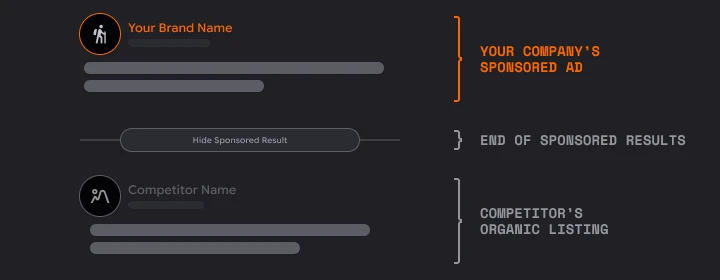
Bidding on competitor brand names means adding a competitor’s brand, product, or company name as a keyword in your paid search campaigns. If you are a CRM company, for example, bidding on “Salesforce,” “Salesforce pricing,” or “Salesforce alternative” would be competitor keyword bidding.
Inside Google Ads, the keyword is not automatically visible to the user. It simply tells Google that your search ads may enter the auction when a user’s search query matches that keyword. You only pay when someone clicks.
- **Own brand keywords**: Searches for your own brand, own brand name, product names, and key misspellings.
- **Generic category keywords**: Non-branded keywords such as “CRM software,” “project management platform,” or “Nike running shoes.”
- **Competitor brand keywords**: Searches that include competitor names, a competitor’s brand, or competitor brand terms.
- **Modifier keywords**: Searches like “competitor alternative,” “competitor pricing,” or “competitor vs your brand,” where potential customers are comparing options.
Bidding on a competitor can mean bidding on a pure brand name or bidding on a competitor brand plus intent. The second option is often more strategic because the searcher is already considering alternatives.
## Is It Legal to Bid on Competitor Brand Names?
Yes, but legal does not mean risk-free. Bidding on competitor brand keywords is generally legal, and bidding on competitor brand keywords is legal since 2004 in the sense that early U.S. cases helped separate hidden keyword bidding from visible consumer confusion.
In the U.S., cases such as 1-800 Contacts v. Lens.com and 1-800 Contacts v. Warby Parker clarified that buying a competitor’s trademark as a keyword is different from using that trademark in a way that confuses consumers. The primary legal threshold for trademark infringement is the likelihood of consumer confusion.
Trademark law generally cares most about what search users see: ad text, ad headline language, display URLs, and the landing page. Competitive advertising must be truthful and supported by evidence under the Lanham Act. Using comparative advertising can lead to lawsuits if deemed false.
The rules are stricter in some jurisdictions, including parts of the EU, where courts may look closely at whether the ad clearly identifies the advertiser. In practical terms, bidding on a competitor’s brand is usually safer when your ad makes a clear distinction from competitors and does not imply affiliation.
Bring in your legal team before large-scale competitor bidding, especially in regulated industries. Bidding on competitor keywords can lead to potential legal implications, and trademark owners can file complaints against misleading ads.
## Google Ads Rules for Competitor Keyword Bidding
Google’s policies generally allow keywords in Google Ads to include registered trademarks, including competitor brand terms. The problem usually starts when those trademarks appear in visible ad assets.
Core policy points:
- Google allows bidding on competitor brand terms, including registered trademarks, but polices how those terms appear in ad text.
- Ads must not use competitor trademarks in their copy unless you have permission or fit a narrow exception.
- Advertisers cannot use a competitor’s trademarked name in ad copy without permission, and using competitor trademarks in ad copy is illegal without permission in many contexts.
- From 2023 onward, trademark complaints must identify specific advertisers and specific ads, not entire industries.
- Google maintains restricted-brand lists in some categories, such as auto, medical, and pharma, where keyword targeting may be blocked or limited.
- Google Ads may suspend accounts for trademark policy violations, and repeated misuse can cause disapproval, limited serving, or full account suspension.
### Bidding on the Brand vs. Using the Brand in Ad Copy
There is a major difference between brand bidding and visible brand use.
- **Usually allowed**: Bidding on a competitor’s brand name as a keyword.
- **High-risk**: Putting that competitor’s trademark in an ad headline, description, display URL, or path field.
- **Safer copy angle**: Lead with your own name, benefits, and positioning.
- **Example**: Use “Top CRM for Mid-Market Teams” instead of “Better than Salesforce.”
- **Avoid**: Display paths that include competitor names unless your legal team explicitly approves.
Ad text using competitor trademarks can lead to legal risks and ad disapprovals. Transparency in advertising requires a clear distinction from competitors, so ads mimicking a competitor’s visual identity can be considered unethical even when the keyword strategy itself is allowed.
### Dynamic Keyword Insertion and Competitor Terms
Dynamic keyword insertion can be useful in ordinary search engine campaigns, but it is dangerous around competitor terms. DKI can automatically insert the matched keyword into your ad headline or description.
That means dynamic keyword insertion can lead to trademark violations if a competitor’s trademark appears in your ad. Dynamic keyword insertion with competitor names can lead to trademark violations, and you are still responsible even if the system inserted the term automatically.
Avoid DKI and automatically created assets in any dedicated campaign that targets competitor keywords. Use static ad copy, curated asset feeds, and pre-approved messaging instead.
## Strategic Pros and Cons of Competitor Keyword Bidding
Competitor bidding is high-intent, but it is not always high-ROI. Searchers who type branded terms are usually familiar with the category, and competitor keywords often have higher click-through rates due to search intent. At the same time, your ad relevance may be weaker because the user searched for someone else.
**Major benefits include:**
- Increased visibility in search results when potential customers are researching alternatives.
- A chance to present a compelling alternative before the buyer commits.
- More brand recognition in a competitive landscape.
- In some cases, bidding on competitor keywords can lower cost-per-click rates versus expensive broad category terms.
**The downsides are real:**
- Competitor keywords typically have higher cost-per-click rates than your own brand, and competitor brand keywords typically have higher cost-per-click rates.
- Bidding on competitor keywords can result in lower quality scores because your ad and landing page may not match the original intent.
- Search engines may penalize ads that are not relevant to the keyword through lower quality scores and higher CPCs.
- Competitor bidding may trigger retaliatory actions from competitors.
- A bidding war can inflate costs for both sides.
Ethical competitor bidding focuses on highlighting a product’s unique features rather than attacking a rival. The goal is to show unique selling points, not damage a brand’s reputation.
### When Bidding on Competitor Brand Names Makes Sense
Competitor brand bidding makes sense when you can honestly compete. If your offer is stronger on price, service, support, implementation speed, or features, you may have a valid reason to appear beside competitor ads.
**Good use cases include:**
- B2B SaaS products with clear comparison demand.
- Legal, home services, and DTC subscription categories where shopping around is common.
- Searches like “competitor alternative” or “competitor vs your brand.”
- Campaigns where you can create dedicated landing pages for competitor traffic.
Start with a limited test. A common bidding strategy is to allocate 10–20% of non-brand budget for 60–90 days and define a stop-loss before launch.
### When to Avoid Competitor Keyword Bidding
Avoid bidding on competitor if:
- Your product is clearly weaker on the buyer’s most important criteria.
- Your positioning is unclear or your offer is not differentiated.
- You have a very small budget and have not yet funded own brand and best generic terms.
- You operate in a sensitive regulated category.
- Your support, reviews, or public perception are fragile.
If you cannot explain why a searcher should choose you in one sentence, competitor keyword bidding will probably create clicks instead of conversions.
## How to Set Up Competitor Brand Campaigns Safely
A safe setup starts with separation. Build a dedicated campaign for competitor campaigns so budget, performance, and risk do not blend with own brand or generic campaigns.
**Use this checklist:**
- Create one ad group per major competitor brand name.
- Use separate ad groups for pure competitor brand terms and modifier terms.
- Start with exact match and phrase match, not broad match.
- Add negative keywords to block irrelevant or risky searches.
- Keep your own brand campaigns from matching the same competitor terms.
- Use Manual CPC or Max Clicks with a capped max CPC.
- Set budget caps to prevent overspending in bidding wars.
Track impression share, top impression share, CPC, conversion rate, and lead quality weekly. If an ad group produces clicks but no qualified pipeline, pause it.
### Crafting Compliant Ad Copy Without Competitor Names
Your ad copy should sound confident without borrowing the competitor’s trademark.
**Write ads that:**
- Lead with your own brand name.
- Emphasize your strongest benefit.
- Use social proof, guarantees, or support advantages.
- Address pain points with phrases like “Switch in days, not months” or “All-in-one platform, no hidden fees.”
- Use extensions to highlight demos, free trials, integrations, pricing pages, or service levels.
Run at least 3–4 variants per competitor ad group. Do not optimize only for clicks. Optimize for qualified leads, revenue, and sales feedback.
### Building Comparison-Focused Landing Pages
Create dedicated landing pages for competitor traffic. Dedicated landing pages improve conversion rates for competitor ads because the page can answer the comparison question directly instead of sending users to a generic homepage.
**A strong landing page should include:**
- Clear “Your Brand vs Competitor” framing.
- Factual feature comparisons.
- Pricing transparency where possible.
- Use-case examples that explain switching value.
- Testimonials, review snippets, client logos, or third-party proof.
The page must match the ad promise. If the ad suggests an alternative, the landing page should explain that alternative clearly and avoid bait-and-switch language.
### Budgeting and Bidding Strategy for Competitor Campaigns
During initial testing, consider allocating 10–25% of your non-brand google ads budget to competitor campaigns.
Expect different economics than your own branded keywords:
| Campaign type | Typical pattern |
|---|---|
| Own brand | High quality score, low CPC, high conversion intent |
| Generic category | Broader reach, variable CPC, mixed intent |
| Competitor terms | High intent, lower quality scores, higher risk |
CPCs on competitor brand terms can be 1.5–3x higher than own brand keywords and sometimes comparable to broader category terms. Use bid caps and daily limits so a potential bidding war does not drain your account.
## Defending Your Own Brand Keywords From Competitors
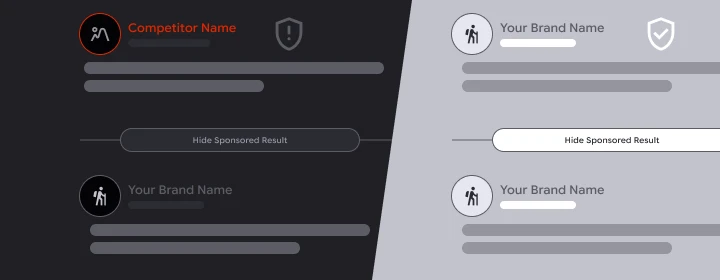
Offense is optional. Defense is not. Competitors bidding on your brand names is common and generally allowed, even when your brand is a registered trademark.
Bidding on your own brand name increases ad visibility and helps protect branded search results from competitor ads. In fact, 93% of agencies run branded PPC campaigns for clients, and 93% of agencies run branded PPC campaigns for clients because brand defense is usually efficient.
Defensive steps include:
- Run a branded search campaign on your own brand terms.
- Monitor search results regularly to detect competitor bidding.
- Review the auction insights report to see overlap rate, outranking share, and impression share.
- Check desktop and mobile google search results at least monthly.
- Capture screenshots when competitor ads appear misleading.
### Owning and Optimizing Your Brand Terms
Bid on your core brand name, product names, own name variations, and misspellings. Strong branded campaigns usually earn high quality score because ad relevance is naturally strong.
Your ads should reinforce:
- Your brand promise.
- Direct calls to action such as demos, consultations, quotes, or pricing.
- Differentiators that make your brand pop in the search results.
- Trust elements such as awards, reviews, or years in business.
Use negative keywords to prevent your brand campaign from accidentally matching competitor + brand searches you do not want to pay for.
### Trademark Protection and Complaint Options
Trademark registration strengthens your brand protection efforts. Trademark registration strengthens your ability to challenge misuse of your brand in competitor ad copy and display URLs, but it does not automatically stop competitors from keyword bidding on your brand.
Trademark holders can file complaints that may restrict trademark use in ads. A complaint usually requires registration details, the trademark owner information, specific example ads, and evidence of misuse.
Even with trademark protection, competitors may still bid on your brand as a keyword. Coordinate with your legal team to decide whether to file trademark complaints, send a demand letter, improve your defensive campaign, or respond with reciprocal paid search.
## Avoiding Bidding Wars and Long-Term Pitfalls
Mutual competitor bidding can become expensive fast. When two brands keep increasing bids on each other’s branded keywords, CPCs rise while incremental conversions often fall.
To avoid this trap:
- Target a small set of priority rivals, not every competitor in the category.
- Focus on competitor + modifier searches where intent is clearer.
- Pause campaigns with no revenue-backed conversions after 60–90 days.
- Use budget caps and bid caps.
- Treat competitor campaigns as one part of broader PPC campaigns, SEO, CRO, and analytics.
Do not let sunk-cost bias turn a test into an arms race. Sometimes the best move is to stop bidding and invest in stronger content, better landing pages, or improved offer positioning.
### Ethical and Brand-Reputation Considerations
Competitor keyword bidding is not just a legal or financial decision. It is also a marketing strategy decision.
**Keep these standards in place:**
- Be transparent about who is advertising.
- Do not copy a competitor’s colors, wording, layouts, or visual identity.
- Do not make unsupported claims.
- Focus on your strengths instead of disparaging competitor brands.
- Create internal rules for what your marketing team can and cannot say.
Short-term clicks are not worth long-term damage to trust. In many industries, relationships, reputation, and credibility matter more than winning one search auction.
## How a Paid Search Agency Approaches Competitor Brand Bidding
A digital marketing partner can help decide whether competitor brand bidding is worth the risk before you start bidding. Timmermann Group evaluates goals, budget, competitive landscape, legal sensitivity, and conversion readiness before recommending bidding on competitor brand names.
Timmermann Group also looks beyond paid search. Competitor traffic will not help if the landing page is weak, tracking is incomplete, or the offer is unclear. That is why our team connects PPC, SEO, UX, CRO, analytics, and digital marketing strategy so traffic has a real path to conversion.
When needed, Timmermann Group coordinates with a client’s legal counsel to align campaigns with trademark protection, industry rules, and internal risk tolerance. If you want help auditing competitor campaigns or building a safer competitor brand bidding plan, [schedule a consultation](https://www.wearetg.com/contact/) with Timmermann Group.
---
## FAQ: Bidding on Competitor Brand Names
#### Can I bid on competitor brand names if I’m a reseller of their products?
Authorized resellers may be allowed to use the manufacturer’s brand names in Google Ads, but reseller status does not automatically allow confusing ads. Review your partner agreement and have your legal team confirm what is allowed in ad copy and landing pages.
#### Is competitor brand bidding worth it for small budgets?
If your Google Ads account spends under about $3,000 per month, prioritize your own brand and high-intent generic terms first. You can test competitor campaigns with small pilots, but each ad group needs at least a few dozen clicks before performance data is useful.
#### Do these rules also apply on Microsoft Ads or other search platforms?
Microsoft Ads and other search platforms follow similar principles on competitor bidding and trademark use, but each platform has its own policies. Review each platform’s current trademark and advertising rules before copying campaigns from Google.
#### Can I put competitor names on my landing pages even if I don’t use them in ads?
Many brands create “Your Brand vs Competitor” or “Competitor alternatives” pages, but the content must be factual and non-misleading. Get legal review if the page heavily references competitor names, logos, pricing, or regulated claims.
#### What should I do first if I discover a competitor bidding on my brand name?
Capture screenshots, review the competitor’s ad copy and landing page, and check Auction Insights to estimate activity. Then strengthen your branded campaigns immediately and consult your legal team if the competitor is using your trademark in ad text or confusing users.
**Categories:** PPC
---
### [Google Business Profile Guidelines: What You Need to Know](https://www.wearetg.com/blog/google-business-profile-guidelines/)
**Published:** April 10, 2025
**Author:** Rob Timmermann
**Content:**
Are you looking to enhance your Google Business Profile but are unsure of the rules? Understanding Google Business Profile guidelines is crucial for boosting your online presence and avoiding penalties. In this article, we’ll walk you through the essential guidelines you need to know to create and maintain an effective profile to support [your Google Business Profile optimization efforts](https://www.wearetg.com/services/google-business-profile-optimization/) and successfully rank your business locally.
### Key Takeaways
- A Google Business Profile enhances visibility and customer engagement, enabling businesses to manage their online presence across Google services.
- Accurate representation of information, including business hours, name, address, and phone number, is critical; errors can lead to profile suspension and diminished customer trust.
- Regular updates and compliance with Google’s guidelines are vital for maintaining a positive online reputation and maximizing the effectiveness of a Google Business Profile.
### What is Google Business Profile?
A Google Business Profile is a free resource that helps businesses establish their online presence across Google Search, Google Maps, and Google Shopping. As the initial point of contact for many potential customers, this virtual storefront plays an essential role in digital marketing strategies.
Providing current and precise information about your business not only attracts more consumers but also promotes both online engagement and in-store visits. By optimizing a Google Business Profile effectively, companies improve their chances of appearing in local search engine results.
Beyond improving discoverability, Google Business Profiles are vital channels for companies to engage with clients by conveying updates and highlighting their offerings. Essentially serving as effective promotional tools with no cost implications, these profiles provide substantial benefits to businesses aiming to maximize their reach on the internet.
### Eligibility Criteria for Google Business Profile
Eligibility for a Google Business Profile requires businesses to have direct, in-person interactions with their customers during the hours they claim to operate. This stipulation is designed to allow only businesses that either have a physical location or offer services at customer locations to establish a profile, thus safeguarding the accuracy and trustworthiness of the information provided.
A business can secure its spot on Google Business if it engages directly with local clients or companies, whether or not it has an established storefront presence. Such accessibility enables various companies, including local businesses, service businesses, and even companies with multiple locations, to leverage the enhanced exposure and customer interaction facilitated by having a GBP.
On the other hand, companies operating exclusively via virtual channels or from post office boxes are ineligible for listing as official business profiles on Google. The reason for this restriction is twofold: preventing false business representations while ensuring people can genuinely engage with actual businesses. Some exceptions apply, such as ATMs and seasonal ventures, which must adhere to specific standards, including permanent signage throughout the year.
Lastly, co-working spaces and delivery-only food establishments face unique guidelines before being featured. For instance, an enterprise stationed in a co-working space qualifies if unmistakable signs are posted and staff are present during designated working hours. Similarly, stringent criteria exist when considering delivery-centric food operations for inclusion among legitimate commercial entities presented by Google.
### Accurate Representation of Business Information
Maintaining accurate business information on Google is essential. Businesses must display their name exactly as it appears on the physical establishment across all platforms to help customers recognize and locate their business.
Incorrect details in a business profile or an erroneous business name may result in suspension from Google, thereby affecting both visibility among potential customers and their trust. To maintain the accuracy of your Google Business Profile, routinely check the business name, address, and phone number for accuracy. Utilizing tools like Semrush’s Listing Management can be effective in swiftly pinpointing and rectifying discrepancies in NAP (Name, Address, Phone) data.
It is important to consistently monitor and adhere to Google’s guidelines, as they are subject to change over time. Not following these specific individual guidelines could lead not only to modifications of your listed business information but also potentially lead to removal from Google listings altogether.
#### Business Name Guidelines
The business name on your Google Business Profile must match how it appears on physical signage, official websites, and legal paperwork. This uniformity across different mediums makes it easier for customers to identify the business. The key guideline here is that your Google Business Profile should mirror your official business name as recognized in non-digital contexts.
Presenting an incorrect or misleading business name can lead to customer confusion and potentially result in the suspension of the profile. To keep things clear and adhere to Google’s policies, refrain from adding superfluous details into the business name field. For professional service providers like physicians or attorneys, their given names, consisting of just a first and last name without additional descriptors, are all that should be included within their business’s listing.
While shortening a brand’s title might seem appealing for brevity purposes, utilizing its complete official moniker on GBP helps eliminate vagueness. Adhering to this approach guarantees accurate representation of your enterprise online, which plays an important role in establishing and sustaining a robust digital footprint.
#### Address and Service Area Rules
A correct business address maintains credibility and helps customers find your location easily. Google’s address rules are designed to prevent situations where customers show up at a nonexistent location, which can damage trust and reputation.
Service-area businesses, which do not require a physical address, must accurately define their separate service areas. These businesses should hide their address if there is no clear signage and specify the service area by entering streets, cities, and states served. Google Maps allows up to 20 service areas to be added to a profile, ensuring comprehensive coverage without creating multiple profiles for different areas. Typical service businesses can make great use of this.
Hybrid businesses operating with a storefront and service area must include both in one listing. Co-working spaces must meet specific requirements, such as having official signage and staff present during listed hours, to qualify as a business address. Following these guidelines maintains the integrity and visibility of a business’s online presence across various locations.
#### Phone Number and Website Requirements
For a business listing on Google Business Profile, it’s best to use a local phone number that directly reaches the specific business location. This not only improves search visibility but also ensures efficient communication with customers.
Including a direct link to the website allows customers to access accurate information swiftly and boosts the trustworthiness of the business profile.
### Choosing the Right Business Categories
Selecting appropriate business categories is crucial for the effectiveness of your Google Business Profile, as it informs Google about the nature of your services. Opting for a primary category that closely aligns with your core business can activate useful features specific to your industry, like booking buttons for eateries or scheduling options for beauty salons.
It’s important to keep additional categories relevant without saturating your profile. Choose only what’s essential to represent all aspects of your operations accurately. In cases where an exact match isn’t available, using a broader category may be advantageous.
Picking the right categories not only enhances visibility but also guarantees that when potential customers are searching, they find precisely what they’re looking for: your business. This intersection of user searches and your business profile is key to attracting more visitors and increasing customer engagement, making careful selection of categories an important aspect of effectively maintaining your Google Business Profile.
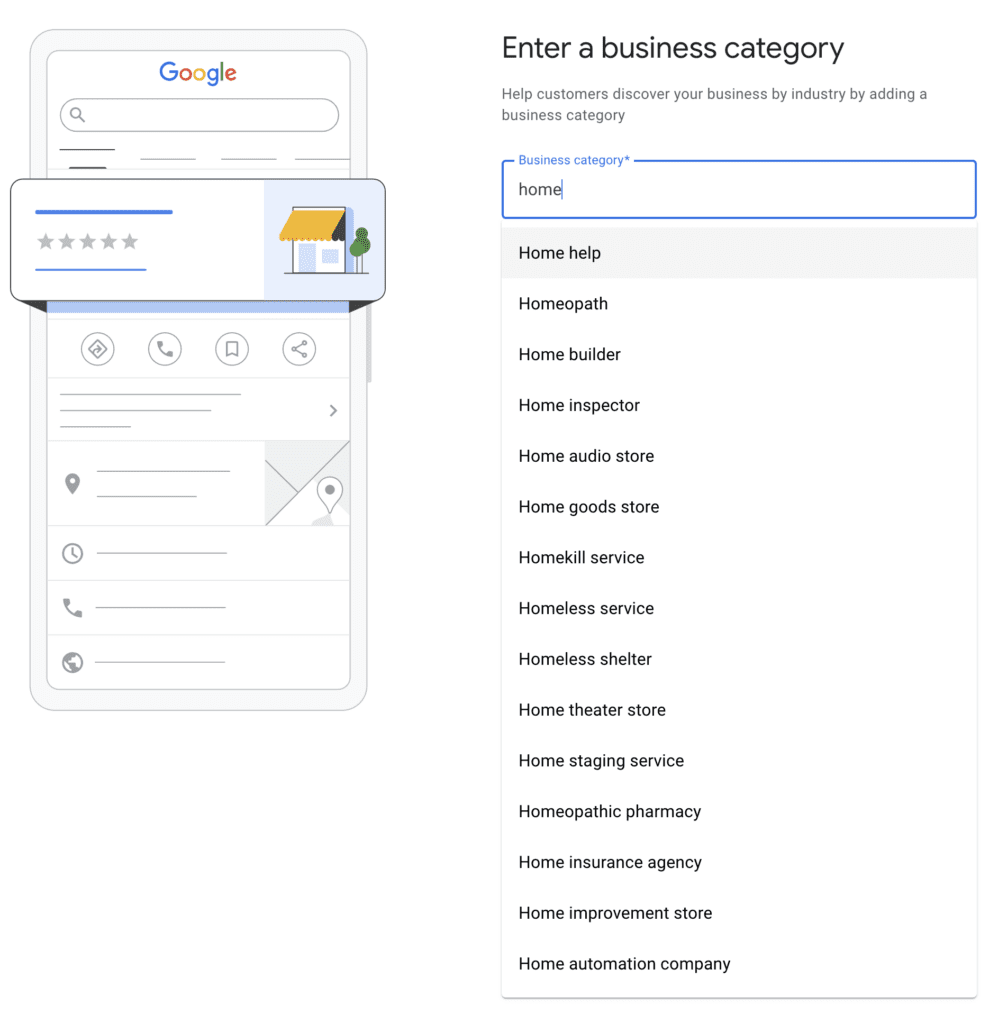
### Setting and Managing Business Hours
Accurately providing regular business hours allows customers to know when they can patronize your establishment. Being transparent and clear with these timings is key in upholding trust and satisfaction among patrons, as well as meeting Google Business Profile guidelines.
It’s essential that businesses adjust their posted hours to align with seasonal fluctuations and noteworthy occasions, ensuring clientele remain well-informed of any adjustments to service availability. Designate exceptional operating periods during holidays or unique happenings so that expectations are managed appropriately.
Whenever there is a change in operational schedules, notifying customers helps them stay aware of any updates regarding accessibility. Should there be intervals within working days where the business ceases operation temporarily, these timeframes must be clearly and accessibly shared.
### Content Policies for Photos and Videos
Google Business Profile mandates that images and videos be high quality and relevant to your listing. Images must be in JPG or PNG format, have a size ranging from 10 KB to 5 MB, and be well lit, in focus, and free from excessive digital manipulation or filters.
For video content submitted to Google Business Profile, each clip should not exceed 30 seconds and should have a minimum resolution quality of 720p. Prioritizing top-notch, relevant visual media also improves the attractiveness of your business profile.
By adhering strictly to these prescribed standards regarding image and video submissions on Google Business Profile, you can significantly enhance your profile’s appeal while effectively showcasing what you offer potential customers.
### Posting Updates and Offers
Consistently updating your Google Business Profile with the latest offers and news can significantly boost your business’s online presence, attracting more virtual and physical traffic. Keeping up-to-date in an ever-evolving digital world is crucial for maintaining relevance.
Engage with customers by sharing timely posts about new developments, special promotions, or upcoming events on social media platforms. Crafting these updates makes your profile engaging and dynamic while ensuring that potential clients are well-informed about what’s happening. Remember to detail any promotional terms, including the validity period of specific deals.
To really captivate your audience’s attention, incorporate images, videos, and detailed descriptions into your updates. When posting about events, ensure you include essential details such as the name, location, and date alongside visually appealing multimedia content. Attach a ‘View offer’ button to promotion posts to streamline customer interaction with these specials, as well.

### Responding to Reviews
Addressing customer feedback is instrumental in strengthening the bond between your business and its customers. Reacting to reviews demonstrates that you value their opinions and are dedicated to enhancing your offerings.
Expressing gratitude for positive reviews acknowledges a customer’s endorsement while simultaneously reaffirming the positive aspects of their experience, thereby promoting repeat business. Quick replies signify a company’s commitment to accepting consumer input, further improving its reputation.
While confronting negative feedback may be daunting, it also offers a chance for development. Exhibiting understanding and readiness to address problems can leave a positive impression on prospective patrons by showcasing dedication towards consumer contentment. Keep responses professional and pertinent.
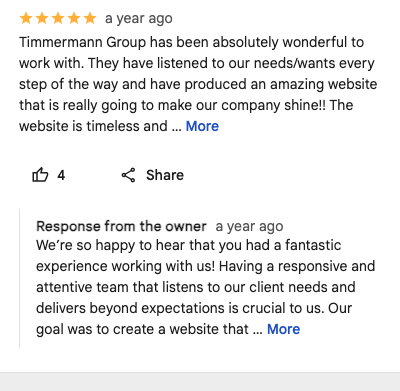
### Compliance with GBP Policies
Adhering strictly to Google Business Profile policies is essential for keeping your profile visible and fully functional. If these guidelines are not followed, you could face serious repercussions such as limited access to certain features or even suspension of your business profile.
If any content on your profile goes against established policies, it may negatively affect how your business appears online. To prevent these types of penalties from occurring, it’s critical to observe Google’s rules closely. Not only do these guidelines help you improve the reach of your business’s digital presence, but they also improve the user experience of potential customers.
### Summary
To thrive online, businesses must keep their Google Business Profile accurate and fully optimized. This entails complying with eligibility criteria and ensuring that all business details are precisely depicted on the profile. Managing your GBP is key to improving visibility and engaging customers effectively. Consistently updating business hours, selecting appropriate categories, and following guidelines for photo and video content contribute significantly to a strong web presence.
Adhering to these practices not only makes businesses appear more credible but also enhances their competitiveness in local search results. It’s imperative to follow Google’s policies as failing to do so can result in harsh outcomes like profile suspension or limited access. Strict adherence is required without compromise. By remaining aware and vigilant, companies can maximize the benefits offered by their Google Business Profile in gaining new customers while maintaining current ones.
Mastering your Google Business Profile might be complex, but the advantages are substantial. Compliance with established guidelines will ensure your enterprise stands out amidst digital competition, capturing customer attention while building enduring connections.
---
#### Is Your Google Business Profile Helping You Rank — or Holding You Back?
Your Google Business Profile isn’t just a listing. It’s one of the most powerful local ranking tools you have. But small mistakes in categories, service areas, naming, or policy compliance can quietly hurt your visibility. If you’re unsure whether your GBP is fully optimized — or you want to improve rankings, engagement, and local conversions — let’s take a strategic look at it together.[ **Schedule a 30-minute consultation** ](https://www.wearetg.com/contact/)with Timmermann Group to start turning your Google Business Profile into a true local growth engine.
[](https://www.wearetg.com/contact)
---
### Frequently Asked Questions
#### What is a Google Business Profile?
A Google Business Profile is a free tool from Google that allows businesses to share information and manage how they appear across Google platforms, such as Google Search, Google Maps, and Google Shopping. It helps you control your business information, engage with customers through reviews and messages, share updates, and showcase your products or services, all in one place. An optimized profile improves local visibility and makes it easier for potential customers to find and connect with your business.
#### Who is eligible for a Google Business Profile?
To be eligible for a Google Business Profile, your business must engage with customers in person during operating hours, whether at a physical location or by traveling to meet them.
However, online-only businesses or those operating from a P.O. box do not qualify.
#### How do I ensure my business information is accurate?
To ensure your business information is accurate, regularly verify your Google Business Profile and check for discrepancies in your name, address, and phone number (NAP).
Utilizing tools like Semrush’s Listing Management can effectively help identify and rectify NAP inconsistencies.
#### What are the guidelines for posting photos and videos?
To ensure a compelling business profile, photos should be in JPG or PNG format, clear, and well-lit, while videos must not exceed 30 seconds and should have a resolution of 720p or higher.
Following these guidelines will enhance the quality and relevance of your content, as well as improve the user experience of potential customers.
#### How should I respond to negative reviews?
Responding to negative reviews with empathy and a commitment to resolving issues is essential for positively influencing potential customers. Always maintain courtesy and relevance in your responses while refraining from sharing personal information about the reviewer.
**Categories:** LSO
---
### [Google Business Profile Verification: How to Verify Your Business on GBP](https://www.wearetg.com/blog/google-business-profile-verification/)
**Published:** May 20, 2026
**Author:** Rob Timmermann
**Content:**
If your local listing is not verified, your customers may not find you when they search. Google Business Profile verification proves that your business exists, operates where you say it does, and is managed by someone authorized to update it. Verification is just one element of your overall [Google Business Profile optimization](https://www.wearetg.com/services/google-business-profile-optimization/) strategy, which can help increase your business’s visibility, reputation, and customer engagement. Here’s what you need to know as of 2026.
### Key Takeaways
- **Essential for Local SEO:** Google Business Profile verification is essential for local SEO because, without verification, your business will not appear publicly on Google Maps or local Search results. Verifying your Google Business Profile (GBP) is crucial for enhancing your business’s visibility in local search results, as only verified listings appear in the Local Pack and on Google Maps.
- **Video-First Approach:** Video is now the primary business profile verification method for many new listings, address changes, and higher-risk categories; phone and email are secondary options when available.
- **Processing Timelines:** Most verification process reviews take a few business days. Instant verification can happen immediately, while video verification and live video call reviews often take 1–5 business days.
- **Complete Administrative Control:** A verified Google Business Profile gives you full control over business information, reviews, posts, photos, and insights while protecting your brand from fraud or incorrect business info.
- **Professional Troubleshooting:** If you see “No more ways to verify,” repeated denials, or a re-verify request, Timmermann Group helps businesses and agencies troubleshoot, document evidence, and work with Google’s support team.
## What Is Google Business Profile Verification and Why It Matters
Google Business Profile verification is how Google confirms that a business exists, is connected to a real business location or service area, and is managed by an authorized representative. This business profile verification step is required before you can fully manage your business on Google.
Only verified Google Business profiles can fully update business information such as business name, business address, business hours, phone number, website, and business category. Verification of your GBP ensures that you have control over your business information, preventing unauthorized changes and maintaining the accuracy of your listing, which is essential for attracting potential customers.
##### Verification also matters because:
- Verifying your Google Business Profile (GBP) is crucial for enhancing your business’s visibility in local search results, as only verified listings appear in the Local Pack and on Google Maps.
- Your profile can show for searches like “plumber near me,” “dentist in Chicago,” or nearby businesses in your category.
- Businesses with a verified Google Business Profile are twice as likely to be considered reputable by users, which significantly boosts customer trust and credibility.
- Verification protects your Google Business Profile listing from impersonation, spam edits, and fake locations.
At Timmermann Group, we treat a verified, optimized profile as a foundation for local search optimization. It fits our “Conversions, not Diversions” philosophy because visibility only matters when it leads to calls, visits, bookings, and revenue.

## How to Check Your Google Business Profile Verification Status
Many businesses assume their Google Business Profile is verified because it appears somewhere in Google Search. That is not always true. An unverified or partially verified business profile may have limited visibility and locked features.
##### To check your verification status:
1. Sign into the correct Google account.
2. Search your business name on Google.
3. Look for in-search controls such as “Edit profile,” “Get verified,” or “Verification required.”
4. Open your profile in the GBP dashboard or Google Maps app.
5. Look for messages such as “You manage this Business Profile,” “Get verified,” or “Verification required.”
You can also use Google’s verification status tool or in-product prompts to see whether the verification process is pending, complete, or failed. If your verification screen says someone else owns the listing, use “Own this business?” or “Request ownership” and follow Google’s transfer process.
If a former employee, past agency, or franchise team owns more than one business listing, do not create duplicates. Request access first.
## Step-by-Step: How to Verify Your Google Business Profile
The exact verification process depends on your business type: storefront business, service area business, or hybrid. To successfully verify your Google Business Profile, you must log into your profile dashboard and complete the specific method assigned to you by Google.
##### Follow these steps:
1. Create or claim your Google Business Profile listing.
2. Confirm whether you have a physical location where customers visit, a service area where you travel to customers, or both.
3. Enter accurate business details: business name, business address or service area, phone, website, business hours, and category.
4. Click “Get verified.”
5. Follow the on-screen instructions exactly.
If you travel to customers, such as plumbers, electricians, HVAC companies, landscapers, or mobile dog groomers, indicate a service area instead of showing a public business address. Online-only businesses are not eligible for local Google Business listings unless they have direct in-person customer contact that meets Google’s rules.
As of 2026, postcard verification is rare or deprecated in many regions. Google now leans on video, phone, and email after you click “Get verified.” Verification methods may vary based on your business type, public information, region, or business hours, and Google will present the appropriate options once you claim your listing.
Don’t make the mistake of assuming you can choose any different verification method. Google decides which verification option to offer based on trust signals, category, history, and location.
## Current Google Business Profile Verification Methods
Google offers several methods for verifying your Google Business Profile, including postcard, phone, email, video recording, live video call, and bulk verification for multiple locations. These business profile verification methods vary by profile.
Video verification, including live video and recorded video, is now the most common approach for new profile verification and major edits. Email and phone are more likely when Google already trusts the number or domain on the profile. Instant verification through Google Search Console and bulk verification are special cases that can speed up verification for qualified businesses.
For official requirements, review [Google’s Business Profile verification](https://support.google.com/business/answer/7107242?hl=en) guidance.

### Video Recording Verification
Video recording is the primary method for many storefront and service-based businesses. To verify your business via video recording, you must create a continuous, unedited video that showcases your business location, operations, and proof of management. Video verification requires a stable internet connection and must be completed using the Google Maps app on your mobile device.
##### For storefronts and hybrid businesses, your verification video should show:
- Exterior of the building.
- Nearby street sign, intersection, or recognizable surroundings.
- Permanent business signage matching the profile of the business name.
- Entrance to the location.
- Interior workspace where you serve customers.
- Proof you control the space, such as unlocking the door, accessing a storage room, showing a cash register, or entering staff-only areas.
##### For a service area business, show:
- Branded vehicles.
- Tools, equipment, uniforms, and inventory.
- Workspace, garage, or office used by the business.
- Marketing materials.
- Non-sensitive business documents, such as a business license, utility bill, or invoice with private details covered.
The video must be recorded and uploaded directly through Google Maps or the Google Business interface. Do not pre-record a file and upload it later. Aim for 60–90 seconds. Keep the camera steady, avoid cuts, and do not switch networks during upload. Common failures include no signage, a mismatched business name, an unclear location, showing only a home interior, missing proof that the business operates, or technical issues.
### Live Video Call Verification
Live video call verification is a scheduled video call with a support representative or Google representative. During the call, the representative may ask you to show signage, exterior surroundings, interior workspace, tools, equipment, vehicles, and proof that you can access the location.
This video call verification method is often used when a profile is stuck or when other methods are not enough. Support availability depends on region and language, so plan a specific time window.
Before the call, prepare documents, uniforms, vehicles, POS systems, industry software, and access to locked areas. Timmermann Group can help script and rehearse the live video walkthrough so your team knows what to show and what to avoid.
### Phone and Email Verification
Phone and email verification are now most common for older, unclaimed listings where Google already trusts the contact information.
With phone verification, Google calls or texts the number on the profile with a short verification code. You enter that code immediately in Google Business Profile Manager.
With email verification, Google sends a verification code and link to a business email, often at your website domain. If the phone or email belongs to a past owner, you may need ownership recovery or supporting documentation first.
Automated phone trees can block verification codes, so use a human-monitored line during verification.
### Instant and Bulk Verification
Instant verification can happen when the same Google account manages your profile and a domain already verified in Google Search Console. To qualify, your website, citations, and NAP information need to be consistent.
Bulk verification is for chains, franchises, or brands with 10 or more locations. You submit location data through the Verifications or Chains section of the dashboard and may need documentation proving control over all locations.
Bulk review can take several business days because Google checks business information across multiple locations. Timmermann Group supports multilocation brands with NAP cleanup, structured location data, location group planning, and local SEO strategy across markets.
## How Long the Verification Process Takes (and What to Expect)
Verification timing depends on the method, region, and how much Google already trusts your business details. Once you submit your video or enter your code, it can take Google a few business days to process and fully verify the account.
Typical timelines:
- **Video recording and live video:** Usually 1–5 business days.
- **Phone and email:** Often same day, but manual review can still happen.
- **Instant verification:** Immediate if eligible.
- **Bulk verification:** Several business days or longer.
- **Verification postcard:** Often 5–14 days when still available.
Avoid heavy edits while your profile is under review. Changing your name, address, category, or service area during review can reset the process or raise trust concerns. Timmermann Group can monitor verification status, coordinate with the support team, and align verification with launches, rebrands, or new market campaigns.
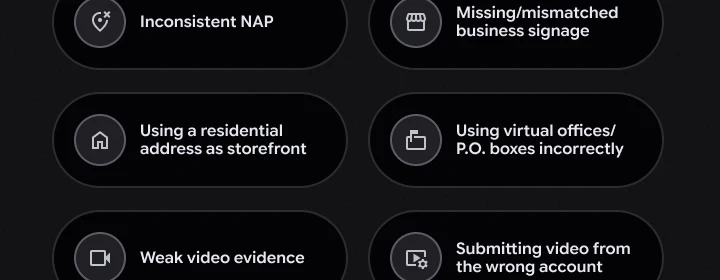
## Common Google Business Profile Verification Problems and How to Fix Them
Many legitimate businesses run into denials, repeated prompts to verify your business, or “No more ways to verify.” Google is more aggressive about fake listings, lead-gen profiles, virtual offices, and spam.
Common reasons for Google Business Profile verification failures include inaccurate business information, missing proof of business details, and technical issues. Other common causes include:
- Inconsistent NAP across your website, directories, and state records.
- Missing, temporary, or mismatched business signage.
- Using a residential address as a walk-in storefront.
- Using coworking spaces, virtual offices, or P.O. Boxes incorrectly.
- Weak video evidence for service area businesses.
- Submitting a video from the wrong account.
If your verification attempt fails, Google will typically allow you to try again or provide instructions on what to change before attempting verification again. Before resubmitting, fix your website, update citations, gather documents, and make sure your profile matches real-world evidence.
### “No More Ways to Verify” and Stuck Profiles
“No more ways to verify” means Google has exhausted standard options and still cannot confirm profile verification. Use the verification status tool or in-product “Contact us” links to open a support case.
Include:
- Screenshots of the verification screen.
- Website and social profile links.
- Photos of signage, vehicles, tools, or office space.
- Non-sensitive business documents.
- A clear explanation of how and where you serve customers.
Google’s support team may respond with other methods, a scheduled live video call, or a request for more proof. Timmermann Group can assemble evidence, write the support submission, and manage follow-up.
### Suspensions, Mismatched Info, and Other Edge Cases
Repeated failed verifications, policy violations, or mismatched data can lead to suspension. Before reinstatement, audit your website, social profiles, local directories, business registry, category choices, and business info.
Here are different [types of GBP suspension](https://www.wearetg.com/blog/google-business-profile-suspension/) that may require you to re-verify your account.
| Suspension Type | Public Visibility | Management Access | Primary Trigger Severity |
|---|---|---|---|
| **Soft Suspension** | Profile remains visible on Google Search & Maps | Business owner loses ability to manage or edit the profile | Minor issues or minor details that Google finds suspicious |
| **Hard Suspension** | Profile is completely removed from Search and Maps | Total loss of management and public visibility | Severe guideline or policy violations |
Home-based and service-area businesses should usually hide their street address if customers do not visit. Listing a home as a public storefront is likely to fail. Appeals usually require a detailed form, photos, documents, and several business days of manual review. Incorrect appeals can create more friction, so consider involving a specialist before submitting.
### Service Area Businesses: Special Verification Considerations
Service area businesses travel to customers. Examples include HVAC, roofing, pest control, landscaping, and cleaning companies. For these businesses, Google business verification relies heavily on proof that the company has a real local presence.
Show vehicles, tools, uniforms, equipment, job materials, and official documents. Do not show a storefront you do not control. If you use an admin office that customers never visit, avoid presenting it as a public storefront.
Correct setup helps you avoid suspension and improves your chances of ranking across your target service area in Maps and local search results. Timmermann Group works with field-service brands to structure categories, service areas, and verification assets for stronger local search performance.
## What to Do After Your Business Profile Is Verified
Verification is only the starting point. A business verified status gives you access, but optimization turns visibility into leads.
##### After you have a verified GBP listing:
- Confirm business hours, phone, website, service area, and category.
- Add high-quality photos and videos. Businesses with photos on their Google Business Profile are 42% more likely to receive requests for directions and 35% more likely to receive click-throughs to their websites.
- Write a clear business description.
- Add services, products, menus, booking links, or messaging where relevant.
- Adding relevant categories to your Google Business Profile helps improve visibility in local searches, as Google’s algorithm uses these categories to determine when to include your business in search results.
- Enable attributes such as accessibility, online appointments, or service options.
- Use UTM tags on website links to track performance.
- Responding to customer reviews on your Google Business Profile can enhance your business’s reputation and increase customer trust, as studies show that businesses that engage with reviews tend to have higher ratings.
## Why Google May Ask You to Verify Again
Google may require businesses to re-verify their profiles if there are changes to business details such as name, address, or category, or even without an obvious trigger as part of their efforts to maintain accurate listings.
##### **Re-verification can also happen after:**
- Moving to a new city.
- Changing from storefront to service area business.
- Long inactivity.
- Suspicious activity.
- Policy updates.
A notice like “Updates to how we verify your business details” is not automatically a penalty. Google may also call, text, or WhatsApp your verified phone number. Train staff to handle these messages carefully.

## How Timmermann Group Helps Businesses Navigate Google Business Profile Verification
Timmermann Group is a conversion-focused, digital marketing agency founded in 2003. We help businesses get Conversions, not Diversions by connecting local SEO, analytics, web design, UX, PPC, content, and conversion strategy.
For verification, Timmermann Group helps with:
- Auditing your current Google Business Listing, website, and citations.
- Identifying incorrect business type selection.
- Cleaning inconsistent NAP data.
- Coordinating video verification process steps.
- Coordinating bulk verification for franchises and multilocation brands.
- Supporting suspension and reinstatement cases.
- Turning a verified listing into a measurable local SEO engine.
If you are stuck in the verification process, facing re-verification, or trying to turn your Google Business Profile into a reliable source of leads, schedule a strategy call with Timmermann Group.
---
## Frequently Asked Questions About Google Business Profile Verification
#### **Can I verify my Google Business Profile if I run my business from home?**
Yes, home-based businesses can qualify if they travel to customers or legally serve customers by appointment. Most service area businesses should hide their home address and verify with tools, vehicles, uniforms, and documents instead of public storefront signage. A home used only as a registration address for an online-only business will not qualify for local Google Business listings.
#### **What happens to my listing while I’m waiting for verification?**
Your profile may appear in a limited way or not at all. Some edits are restricted until verification finishes. You can prepare photos, descriptions, and services, but full Maps and Local Pack visibility begins after approval.
#### **Why is Google asking to verify my business?**
Google requires verification to establish that a business is legitimate, operates exactly where it claims, and is controlled by an authorized individual. This protective step secures your company data and shields search users from fraudulent profiles.
#### **How long does it take to get a Google Business Profile verified?**
Once you complete your designated process track (such as submitting a video or logging an incoming code), it typically takes Google a few business days to process and approve the documentation. Certain verified assets can occasionally unlock immediate access.
#### **What happens if your business is not verified on Google?**
Without successful verification, your listing remains locked down internally and will not appear publicly on Google Maps or local Search queries. This completely removes your brand from high-visibility spaces like the Local Pack.
**Categories:** LSO
---
### [Content Strategy vs Copywriting: Key Differences and Benefits Explained](https://www.wearetg.com/blog/content-strategy-vs-copywriting/)
**Published:** October 20, 2025
**Author:** Rob Timmermann
**Content:**
Creating a successful digital presence can feel overwhelming, especially when deciding where to focus your efforts. Often, many marketers will use content strategy and copywriting interchangeably, but they serve very different purposes when it comes [website design](https://www.wearetg.com/services/website-design/) and digital marketing.
**Content strategy** builds the long-term framework for engagement, helping your brand attract, educate, and retain your target audience. **Copywriting**, on the other hand, delivers the words that inspire immedate action and drive measurable results.
So, when should your brand prioritize content strategy and when should you focus on content writing? Understanding how these two disciplines complement each other is essential for creating marketing campaigns that connect authentically and convert effectively.
In this guide, we’ll break down the key differences between content strategy and copywriting, how each supports your business goals, and why your marketing is strongest when they’re perfectly aligned.
## Key Takeaways
- **Content strategy focuses on long-term engagement,** often performing content writing to align every piece of content with your brand’s goals and audience needs.
- **Copywriting drives immediate actions and conversions** through persuasive, results-driven messaging.
- The most effective marketing strategies combine both, ensuring a consistent brand voice, stronger SEO performance, and measurable business results.
## Understanding Content Strategy
**[Content strategy](https://www.wearetg.com/services/content-marketing/)** is the blueprint behind every successful marketing initiative. It defines what content should be created, why it matters, and how it connects to business goals.
A skilled content strategist balances creativity with data-driven marketing insight. They research audience behaviors, define goals, and develop editorial calendars, distribution plans, and performance metrics, all to turn content into an engine for long-term growth.
When executed well, a content writer transforms one-off posts into a cohesive brand story, nurturing relationships, builds trust, and guides potential customers down the sales funnel, from awareness to action.
## Defining Copywriting
Copywriting is the craft of using words to move people. Whether it’s an ad headline, a landing page, or a social post, great copywriting captures attention, stirs emotion, and compels the audience to take the next step.
While content strategy looks at the big picture, copywriting zeroes in on moments of decision. The content writing process is about clarity, persuasion, and intent, helping your target audience say “yes” to your offer, subscribe to your newsletter, or request a quote.
A skilled copywriter blends creativity with marketing psychology, ensuring every line reflects your brand voice (including across platforms) and drives tangible results.
## Key Differences Between Content Strategy and Copywriting
Both content strategy and copywriting are essential to effective digital marketing strategies, but their goals and functions differ.
- Content strategy is about planning and positioning; defining what content to create and why.
- Copywriting is about execution; delivering the message that turns strategy into measurable action.
Let’s break down how each fits within your marketing ecosystem.
### Goals and Objectives
The goal of content strategy is to cultivate long-term trust and engagement. Strategists identify audience needs, develop relevant content to solve those problems, and map that content to each stage of the buyers journey, from awareness to advocacy.
Copywriting focuses on immediate results to achieve short-term marketing goals. Its purpose is to inspire quick action, like clicking “Buy Now,” scheduling a demo, or submitting a contact form. The copy’s success is measured through direct-response, conversion-based metrics like clicks, inquries, form fills, and purchases or conversions.
In short: content strategy builds relationships; copywriting drives action.
### Types of Content
Though these tactics work hand-in-hand, strategy and copywriting shape different types of content.
**Content strategists** oversee the big picture, determining what kinds of content best support each stage of the customer journey. Strategists ensure a healthy mix of formats that attract, educate, and engage audiences, which may include:
- **Blog posts and articles:** Designed to educate, inform, and drive organic SEO traffic.
- **Ebooks and whitepapers:** In-depth resources that establish thought leadership and generate leads.
- **Case studies:** Real-world success stories that reinforce credibility and demonstrate value.
- **Videos, infographics, and podcasts:** Visual and multimedia formats that make complex topics more engaging and shareable.
**Copywriters** focus on persuasive messaging that moves users to act right now. The work of a content writer typically includes:
- **Website content copy:** Headlines, service pages, and CTAs that guide users toward conversion.
- **Landing pages and sales pages:** Focused on specific offers or campaigns, optimized for conversions.
- **Ad copy:** Short, compelling text for search, display, and social media ads that drive clicks.
- Email campaigns: Promotional messages and drip campaigns built to prompt responses.
- **Social media posts:** Engaging, concise copy that sparks conversation and encourages engagement.
While strategists determine what content to create and why, copywriters bring that strategy to life through powerful words that capture attention and convert. Together, both copywriting and strategy ensure your brand’s message is seen, felt, and acted upon.
### Role in Marketing Funnel
Once content types are defined, it’s time to map them to the marketing funnel.
**Content strategists** focus on the upper and middle stages: building awareness and nurturing consideration. They develop educational, valuable content that introduces your brand and builds credibility.
**Copywriters** excel at the lower stages of the funnel: decision and conversion. Their persuasive calls-to-action turn interest into intent, moving prospective customers to complete a purchase, request a quote, or contact your team.
When strategy and content writing work together, they create a seamless path that guides your audience from curiosity to commitment.
## How Content Strategy and Copywriting Work Together
Think of content strategy and copywriting as vision and voice. Strategy defines the direction; copy brings it to life.
Strategists collaborate with SEO specialists, designers, and developers to ensure all content aligns with business goals. Copywriters use that framework to craft messaging that resonates and motivates.
Together, they create a balanced, effective marketing approach, with strategy providing the “why” and copy delivering the “how.” Essentially, each role is responsible for ensuring all content adheres to the[ 5 C’s of Content Marketing](https://www.wearetg.com/blog/5-cs-of-content-marketing/): clarity, consistency, creativity, credibility, and customer-centricity.
### Creating a Consistent Brand Voice
A consistent brand voice is essential to bringing all of your entire marketing strategy together. **Content strategists** and **copywriters** must work together to maintain a unified brand tone across all content, continually reflecting the brand’s unique position and goals. Your brand voice and tone should be consistent whether writing for branded content, a blog, social media posts, email communications, and more.
Consistency builds brand loyalty, but the brand’s voice also needs to be compelling across all platforms. Copywriters have a deeper understanding of psychological principles and marketing strategies to craft messages that resonate emotionally with the target audience to foster long-term relationships.
### Enhancing SEO Practices
Both copywriting and and strategy are vital to improving visibility in search engines and search engine optimization (SEO) success. Both must integrate various SEO principles into their work to enhance content visibility and drive organic traffic, but through specific tasks:
- Strategists identify opportunities through keyword research, topic planning, and content audits.
- Copywriters transform those keywords naturally into engaging, high-performing content that ranks well and reads authentically.
Focusing on high-quality content and strategic keyword placement ensures the content ranks well on search engines and reaches its intended audience. When strategy and copywriting are aligned and creating content, SEO efforts are more impactful, earning visibility and driving meaningful engagement.
## Skills Needed for Effective Content Strategy and Copywriting
Both disciplines demand creativity, empathy, and data-driven thinking, but their skill sets differ.
**Content strategists excel in:**
- Research and data analysis
- Audience mapping and buyer journey development
- Aligning creative ideas with measurable goals
- Long-term planning and editorial management
**Copywriters thrive with:**
- Concise and persuasive writing skills
- Emotional intelligence and storytelling
- Marketing psychology and conversion principles
- Adaptability to different writing styles, including tone, platform, and format
- Showcase their writing style and how they differ from other copywriters
When these skill sets intersect, your brand gains a content engine that informs, inspires, and converts.
## Measuring Success: Content Strategy vs Copywriting
Success looks different for each discipline, but both rely on data to measure effectiveness.
Establishing metrics for success is crucial for content strategy, requiring relevant key performance indicators (KPIs) for measuring the success of long-term engagement strategies and audience trust-building efforts. Content strategy success is typically evaluated through metrics such as:
- Organic traffic growth
- Time on page and bounce rate
- Repeat visits and email engagement
- Keyword rankings and backlinks
Copywriting, with its focus on immediate actions, uses sales metrics to measure success. KPIs relevant for measuring copywriting effectiveness include::
- Click-through rates
- Form fills, demos, phone calls, and purchases
- Revenue generated from campaigns
Analyzing both sets of metrics together helps brands pinpoint what’s working and where to optimize messaging for maximum ROI.
## Emerging Trends in Content Strategy and Copywriting
As technology changes, so do the tools that shape these two disciplines.
AI-driven content creation and content ideas are improving efficiency, allowing strategists and copywriters to focus more on creativity and storytelling. Meanwhile, personalized marketing continues to dominate, demanding that brands deliver content tailored to individual needs and intent, indicating a greater need for adaptability in both content strategy and email marketing to remain competitive.
The future of content marketing lies in the balance between automation and authenticity. The best results come from pairing data-driven insights with the human touch that only experienced strategists and copywriters can provide.
## Ready to Elevate Your Content Strategy & Copywriting? Partner with TG
Understanding the differences between content strategy and copywriting is just the first step. The real results come from knowing how to make them work together.
At Timmermann Group, we blend strategic thinking with creative execution to help brands tell their story, reach their audience, and drive measurable growth. Whether you need a long-term content roadmap or persuasive messaging that converts, we can help you build a content marketing approach that delivers results.
[Schedule a conversation](https://www.wearetg.com/contact/) with Timmermann Group today to learn how a unified content strategy and copywriting approach can strengthen your brand and accelerate your success.
## Frequently Asked Questions
### What is the primary goal of content strategy?
The main goal of content strategy is to build long-term audience trust and guide users through the buyer’s journey. This approach keeps engagement consistent and sustainable.
### How does copywriting differ from content strategy?
Copywriting is focused on persuasion and conversion, driving actions like sales or clicks, while content strategy aims to inform, educate, and nurture audiences over time. A content strategist can also act as a content writer, but their goal is the same as strategy—to educate and engage, but not to persuade. Understanding this distinction can enhance your marketing strategy.
### How do copywriting and content writing differ?
Although these terms also are often used interchangeably, they do differ some. Content strategy often includes content writing, like blog posts, guides, and videos. This content writing aims specifically at educating and engaging audiences.
Copywriting, by contrast, focuses on crafting persuasive language to drive immediate coversions.
### What skills are essential for a good copywriter?
Great copywriters master persuasive writing, marketing fundamentals, creativity, and audience awareness. They know how to write copy that both engages and converts.
### How do content strategists measure success?
Strategists use engagement metrics such as traffic, bounce rate, and session duration to assess how well their content attracts and retains their target audience.
### What are some emerging trends in content strategy and copywriting?
AI-driven tools, content personalization, and data-backed optimization are leading trends. These innovations help brands create content that’s both efficient and deeply engaging.
**Categories:** Content Marketing, Content Strategy
---
### [Digital Marketing Strategy: What It Is, Why You Need It, and How To Create It](https://www.wearetg.com/blog/marketing-strategy/)
**Published:** May 16, 2025
**Author:** Rob Timmermann
**Content:**
In today’s hyper-connected business world, having a solid marketing strategy is a prerequisite for success. But what exactly is a digital marketing strategy, why is it so important, and how can you create one that works for your business?
## What Is a Digital Marketing Strategy?
Digital marketing strategies outline how you intend to leverage virtual channels to engage and convert your target audience into customers. Think of it as direction for your marketing efforts, providing guidance on how to better connect with your audience, enhance visibility, and [help drive conversions](https://www.wearetg.com/blog/b2b-website-conversion-rates/).
While the primary focus is on mediums like social media, email marketing, and content creation, every good digital marketing strategy should also synergize with your offline marketing initiatives.
## Why Do I Need a Digital Marketing Strategy?
In today’s fiercely competitive marketplace, the notion of “build it, and they will come” is… well, outdated. Without a clearly defined digital marketing strategy, it’s all too easy to get lost and overshadowed by your competitors who already know how to capture the attention of your target audience.
In short, that’s why you need a robust digital marketing strategy, as it helps ensure that your brand stands out amidst the noise.
## Four Elements of a Robust Digital Marketing Strategy
### Search Engine Optimization (SEO)
When it comes to increasing visibility, [investing in SEO](https://www.wearetg.com/blog/in-house-seo/) is a tried-and-true tactic. It’s the cornerstone of any successful digital marketing strategy and aligns your content with the search queries of your audience. There are three areas of focus within SEO:
- **On-page SEO:** Optimizing the content on your website—including page titles, product descriptions, and [blog posts](https://www.wearetg.com/blog/increase-blog-traffic/)—with [relevant keywords](https://www.wearetg.com/blog/long-tail-vs-short-tail-keywords/) to improve your search engine visibility.
- **Off-site SEO:** Building external credibility and authority for your brand or product through backlinks from reputable sources such as publications and bloggers, boosting your website’s credibility and visibility.
- **Technical SEO:** Technical SEO lays the foundation for an efficient and user-friendly website experience, addressing the technical aspects of your site, such as loading speed and indexation of product pages.
### Pay-Per-Click (PPC)
PPC advertising helps you reach potential customers through digital marketing campaigns, consisting of paid ads on search engines and other digital platforms. It’s exactly as it sounds: you bid a certain amount of money to show up in search results, essentially “[paying for clicks](https://www.wearetg.com/blog/ppc-costs/)” to your website.
### Social Media Marketing
[Social media marketing](https://www.wearetg.com/services/social-media-marketing/) has emerged as a powerful way to build brand awareness, foster customer engagement, and drive conversions. There are four elements that, when incorporated, can go a long way toward pushing your overall marketing efforts in the right direction:
- **Strategy:** You know the saying, *“Fail to plan, plan to fail”?* Well, that rings true for social media, too. To really make waves, set clear goals, decide what content works best, and curate posts that resonate with your audience.
- **Consistency:** Think of social media like a marathon, not a sprint. Consistency is key! Set up publishing calendars—monthly, weekly, or even daily—and stick to them to see the best returns.
- **Engagement and Analytics:** Don’t just skim the surface—dive deep into the analytics. Use that data to see how well your brand is recognized, which campaigns are hitting the mark, and where you can improve.
- **Paid Ads:** Paying for clicks isn’t “just” a search engine thing. Different platforms, like Instagram, Facebook and Amazon, [have their own version of paid ads](https://www.wearetg.com/blog/ppc-advertising-prices/), and when used correctly, they can be a very profitable investment.
### Email Marketing
Despite the rise of new digital marketing channels, email still remains one of the most effective means of connecting with your audience. Although you can capture emails at the point of checkout, you’ll ultimately want them collected early on in the buyer journey. The sooner you reach customers, the easier it will be to build a connection, create value, and promote your product.
## How to Create a Digital Marketing Strategy: Your Step-By-Step Guide
### Step 1 – *Get Your Goals Straight*
Any effective digital marketing strategy starts with defining what success looks like for your business. Are you aiming to boost brand awareness or drive website traffic? Generate leads or increase sales? Be crystal clear about both your long-term and short-term objectives and make sure they are measurable, achievable, and time-bound.
### Step 2 – *Know Your Audience*
Dig deep into your target audience and explore their demographic profile, preferences, online behavior, and pain points. Be sure to take advantage of free tools like Google Analytics, organic social media insights, and, of course, good old-fashioned surveys.
### Step 3 – *Watch the Competition*
Pay attention to your competitors’ marketing strategies. What are they doing well? Where are their weak spots? Chances are, they’ve left gaps that you can use as an opportunity to stand out and gain a competitive edge.
### Step 4 – *Pick Your Battles*
Select the digital channels and tactics that perfectly align with your customers’ preferences. Whether it’s content marketing, social media, email campaigns, or SEO, invest time and resources only in the channels that best connect with your audience.
### Step 5 – *Craft Great Content*
Develop a content strategy that speaks directly to both your digital strategy and your audience’s needs and desires. From blog posts and videos to infographics and podcasts, use these mediums to create good content that educates, inspires, and calls attention to your products.
### Step 6 – *Stay Consistent*
Once you’ve started releasing new content, keep the message consistent across all channels and touchpoints. Watch your digital marketing campaign performance in real-time, and make tweaks as necessary to keep things on track.
### Step 7- *Measure, Analyze, Repeat*
Numbers don’t lie, and you need to analyze data to gauge the performance of your digital marketing strategy. So why not start with what you already have? Your website. Google Analytics is a free tool that provides real-time insights into your website traffic, conversion rates, and engagement metrics. Over time, you’ll be able to learn from what’s working and what’s not and then use these insights to fine-tune your strategy for even better results.
## Let the Experts Handle Your Digital Marketing Strategy
Still unsure about how to craft your digital marketing strategy? Need some guidance on which channels to focus your time and energy on? [Schedule a call](https://www.wearetg.com/contact/) with Timmermann Group. As a [full-service digital marketing agency](https://www.wearetg.com/services/), we specialize in getting you in front of the *right customers* at the *right time*. Our success stems from our [holistic approach](https://www.wearetg.com/approach/), which encompasses every stage of the customer journey. From igniting curiosity to fostering long-term loyalty, we have the experience and resources to take your digital marketing efforts to the next level.
**Categories:** Strategy, Advice For Business Owners
---
### [Semantic Keywords for SEO Success](https://www.wearetg.com/blog/semantic-keywords/)
**Published:** February 13, 2026
**Author:** Rob Timmermann
**Content:**
In the ever-evolving world of [search engine optimization](https://www.wearetg.com/services/seo/), semantic keywords have emerged as a cornerstone for achieving better rankings and improving the overall search experience. By understanding and strategically implementing semantically related terms, businesses can align their content with user intent, making it more visible and relevant to their target audience. Whether you’re optimizing a landing page or planning your next blog post, using semantic keywords effectively is key to staying competitive in modern search engines.
As search algorithms become more sophisticated, integrating semantic SEO into your content strategy helps ensure your site delivers high-quality content tailored to specific queries. This approach not only boosts organic traffic but also enhances user satisfaction by matching search queries with relevant answers. Let’s dive into how semantic keywords can revolutionize your SEO performance and transform your content marketing efforts in 2026.
#### Key Takeways
- **Search engines prioritize intent, not just exact keywords.** Semantic keywords help your content align with how users actually search.
- **Context drives rankings.** Using related concepts strengthens topical authority and improves visibility across a broader range of queries.
- **Comprehensive content wins.** Pages that cover supporting ideas naturally perform better than pages optimized around a single phrase.
- **Semantic SEO future-proofs your strategy.** As AI and vector-based search evolve, context-rich content becomes even more important.
- **Better alignment leads to better engagement.** When content matches intent, you improve satisfaction, dwell time, and long-term organic growth.
- **Tools accelerate the process.** AI-powered keyword research and SERP analysis tools make identifying semantic opportunities more efficient and scalable.
## What Are Semantic Keywords and Why Are They Important?

Semantic keywords are more than just a collection of related words; they represent a shift in how modern search engines interpret and match user queries with relevant content. These keywords are designed to provide context and meaning to your content, helping it align with the search intent behind a user’s query. Rather than focusing solely on exact match keywords, semantic keywords delve deeper into the intent and related concepts, offering a more nuanced way to optimize content for search engine results pages.
The importance of semantic keywords lies in their ability to enhance the overall search experience. When users search for a specific term or phrase, they expect to find information that goes beyond just an exact match. By using semantically related keywords, web pages can deliver higher-quality, more comprehensive content, improving their chances of ranking on top pages. This approach also allows your site to cater to a wider audience, as it incorporates various ways people might phrase their queries.
### Understanding Semantically Related Keywords
Semantically related keywords are terms and phrases that are conceptually linked to your main keyword. These connections are often drawn from the knowledge graph, which helps search engines understand the relationships between different keywords and their meanings. For example, if your main keyword is “content marketing,” semantically related terms might include “seo strategy,” “target audience,” and “blog post.” These related concepts provide additional layers of context, making it easier for search algorithms to deliver relevant results.
The role of semantically related keywords extends beyond simply boosting SEO rankings. They also play a crucial part in enhancing user intent alignment. By incorporating these keywords, your content can address a user’s search query more effectively, ensuring it answers their questions or solves their problems. This alignment not only improves the quality of your content but also increases user satisfaction, as it meets their expectations more accurately.
Moreover, semantically related keywords improve the user’s search query experience by offering content that feels natural and comprehensive. When search engines analyze a page, they assess not just the main keyword but also the context provided by related keywords. This allows them to present more accurate search engine results pages, ultimately benefiting both users and content creators.
### Benefits of Using Semantic Keywords
One of the most significant benefits of using semantic keywords is their ability to boost SEO rankings and drive organic traffic to your site. Unlike traditional keyword stuffing, which often leads to penalties, semantic keywords allow for natural keyword density that aligns with modern search engine optimization practices. By focusing on related concepts, you can create content that feels more natural and engaging, which search engines reward with better rankings.
Another advantage is how semantic keywords contribute to page SEO by enhancing the relevance and context of your content. When you use semantic keywords, you provide search engines with additional clues about the topic and purpose of your content. This helps them classify your page more accurately, increasing its chances of appearing in related searches and gaining visibility in the search results page.
In addition to improving rankings, semantic keywords also support the creation of a robust knowledge base for your site. By covering a wide range of related topics and keywords, your site becomes a comprehensive resource for users seeking information on your subject matter. This not only strengthens your site’s authority but also encourages repeat visits, as users recognize it as a reliable source of high-quality content.
## How Semantic Keywords Differ From LSI Keywords
While semantic keywords and LSI (Latent Semantic Indexing) keywords may seem similar, they are not interchangeable. Both concepts involve related keywords, but their purposes and methods of implementation differ significantly. Understanding these differences is crucial for developing an effective SEO strategy that leverages the full potential of semantic SEO.
### Key Differences Between Semantic and LSI Keywords
The primary difference between semantic keywords and LSI keywords lies in their focus. Semantic keywords emphasize understanding related concepts and the broader context of a user’s query, while LSI keywords are more focused on identifying exact phrase matches and synonyms. For example, a semantic keyword strategy for “artificial intelligence” might include related topics like “ai tools,” “vector search,” and “ai search,” whereas an LSI keyword approach would focus on synonyms like “machine intelligence” or “ai technology.”
Modern search engines, powered by artificial intelligence and advanced algorithms, have largely moved beyond the limitations of LSI. They now prioritize understanding search intent and the relationships between different keywords. Semantic SEO focuses on how web pages address the intent behind search queries, rather than just matching specific terms. This evolution reflects the need for higher quality content that meets the diverse ways users search for information.
### Why Semantic SEO Is the Future
Semantic SEO is set to dominate the future of content optimization because it aligns perfectly with advancements in AI content generation and vector search technologies. These technologies allow search engines to process queries in real-time, offering more accurate and contextually relevant results. By using semantic keywords, you can ensure that your content remains competitive in an era where search algorithms are becoming increasingly sophisticated.
Another reason semantic SEO is the future lies in its ability to adapt to real-world changes and user behavior. Unlike traditional keyword strategies, which rely heavily on exact match keywords, semantic SEO is more flexible. It allows for real-time adjustments based on emerging trends and user preferences, ensuring that your content stays relevant over a long time. This adaptability is crucial for maintaining better rankings and delivering user satisfaction in a competitive digital landscape.
Ultimately, the focus on semantic keywords reflects a broader shift toward understanding user intent and delivering relevant content. By embracing semantic SEO, you can future-proof your content strategy, improve your seo performance, and build a stronger connection with your target audience. With the right keywords and a clear understanding of search intent, you can create content that not only ranks well but also resonates with your readers.
## How to Find Semantic Keywords for Your Content Strategy
Finding semantic keywords is a critical step in developing a successful content strategy. By identifying the right keywords, you can ensure that your content is relevant to your target audience while aligning with search intent. Fortunately, there are a variety of tools and techniques available to help you uncover semantically related terms and related concepts that can enhance your SEO performance.
### Best Tools and Resources
Several tools are available to help you discover semantic keywords effectively. Google Keyword Planner is one of the most widely used free tools for keyword research. It provides keyword suggestions, search volume data, and insights into keyword difficulty, making it an excellent starting point for your content optimization efforts. By analyzing keyword ideas and related searches, you can identify a wide range of terms that align with your main topic.
Another valuable resource is AI tools like LSI Graph, which specialize in identifying semantically related keywords. These tools use artificial intelligence to analyze your seed keyword and generate a list of related words and phrases that can improve your content’s context and relevance. AI tools are particularly useful for uncovering long-tail keywords and related topics that might not appear in traditional keyword research tools.
In addition to these tools, exploring people also ask sections and related searches on search engine results pages can provide valuable insights into what users are looking for. These features highlight common questions and related topics, offering a deeper understanding of user intent. By incorporating these insights into your content, you can create pages that address a wider range of user queries, ultimately improving your SEO rankings and organic traffic.
### Keyword Research for Social Media and Web Pages
Keyword research isn’t limited to optimizing your blog posts or landing pages; it’s also crucial for social media strategies. Social media platforms often have their own search algorithms, which prioritize content based on specific keywords and user engagement. By identifying keyword ideas that resonate with your audience on platforms like Twitter, Instagram, or LinkedIn, you can improve your visibility and reach a wider audience. AI search tools can help you uncover new keywords that perform well on these platforms, ensuring your social media content aligns with current trends.
For web pages, the focus should be on finding keywords that match the user’s search query and align with your site’s overall topic. By using tools like Google Trends, you can track the popularity of specific terms over time, identifying seasonal trends or emerging topics. This data allows you to adjust your content strategy in real-time, ensuring your site stays relevant and competitive.
Ultimately, finding the right semantic keywords requires a combination of tools, research, and creativity. By leveraging free trials of SEO tools, analyzing related searches, and using AI-powered solutions, you can identify a comprehensive list of keywords that support your content marketing goals. The key is to focus on user intent and create content that addresses their needs in a meaningful way.
## Optimizing Your Content With Semantic Keywords
Once you’ve identified the right semantic keywords, the next step is to optimize your content to ensure it aligns with your SEO strategy. Effective content optimization goes beyond simply inserting keywords into your text; it involves creating high-quality content that resonates with your target audience and provides value. By following a strategic approach, you can improve your page SEO and achieve better rankings on search engine results pages.
### Steps for Effective Content Optimization
The first step in optimizing your content is to maintain a focus on high-quality content. This means creating articles, blog posts, and web pages that are informative, engaging, and aligned with the user’s query. Start by identifying your main keyword and its semantically related terms, then structure your content around these topics. A well-organized table of contents can help guide readers through your page while signaling to search engines the relevance of your content.
Incorporating anchor text is another important aspect of content optimization. When linking to other pages on your site or external resources, use anchor text that includes semantically related keywords. This not only improves the user experience by providing context but also supports link-building efforts, which can enhance your SEO rankings over time.
Improving landing pages with relevant keywords is another key step. Landing pages often serve as the first point of contact for users visiting your site, so it’s essential that they align with the user’s search query. By naturally incorporating semantic keywords throughout the page, you can ensure your content aligns with user intent and improves its visibility in search results. Be sure to avoid keyword stuffing, as this can harm your rankings and reduce user satisfaction.
### Enhancing SEO Performance Through Semantic SEO
Semantic SEO is all about aligning your content with the latest search algorithm updates and user behavior trends. By strategically using related words and keyword lists, you can signal to search engines that your content is comprehensive and relevant. This not only improves your seo rankings but also ensures that your site remains competitive in an increasingly sophisticated digital landscape.
Another way to enhance your SEO performance is by focusing on content optimization techniques that prioritize user satisfaction. Modern search engines prioritize high-quality content that addresses the user’s query in a meaningful way. By incorporating semantic keywords, you can create pages that are not only informative but also engaging and easy to navigate. This improves user satisfaction and increases the likelihood of repeat visits.
Finally, consider leveraging AI tools to refine your keyword strategy and optimize your content in real-time. AI visibility tools can analyze your content for gaps and opportunities, helping you make data-driven decisions that improve your rankings. Many of these tools offer free trials, allowing you to explore their features and determine which ones best meet your needs. By embracing artificial intelligence and semantic SEO, you can future-proof your content strategy and ensure long-term success.
## How Semantic Keywords Impact User Intent and SERP Features
Semantic keywords play a pivotal role in aligning content with user intent, a critical factor in achieving success on search engine results pages. Modern search engines prioritize user satisfaction, and to meet this goal, they analyze not only the specific keywords in a user’s query but also the broader context and intent behind it. By incorporating semantically related terms, your content can better address the nuances of a user’s query, leading to greater relevance and a higher-quality search experience.
One of the key ways semantic keywords impact user intent is by allowing your content to cater to different ways users phrase their queries. For example, someone searching for “how to start a blog” might also find value in content optimized for terms like “blogging tips” or “creating a blog.” By addressing these variations, you can create a more comprehensive resource that satisfies a wider range of search queries, ultimately improving user satisfaction and your SEO rankings.
### Matching Content to the User’s Query

Matching your content to the user’s query is essential for providing relevant content and ensuring better rankings. This involves understanding the intent behind the search, whether it’s informational, navigational, or transactional. For example, if a user is searching for “best SEO tools,” they’re likely looking for product recommendations or free trials. In this case, your content should include relevant keywords like “SEO tool,” “free tool,” and “AI tools” to meet their expectations.
Another effective way to match content to user queries is by leveraging insights from the search bar and SERP features. The search bar often suggests keyword ideas and related searches based on real-time trends, while SERP features like “people also ask” provide valuable clues about what users want to know. By incorporating these insights into your content strategy, you can create pages that address common questions and related topics, further enhancing their relevance.
Keyword matching is also an important aspect of aligning content with user intent. While exact match keywords still have their place, semantic keywords allow you to go beyond rigid phrasing and focus on the broader context. This approach not only improves the user experience but also helps your content stand out in competitive niches where exact keywords alone might not be enough to secure top rankings.
### AI Tools and Free Trials for Better SEO Strategy
The rise of artificial intelligence has transformed how we approach SEO and content optimization. AI tools are now indispensable for developing a better SEO strategy, as they provide real-time insights and recommendations based on the latest search algorithm updates. Tools like LSI Graph, Google Keyword Planner, and other AI-powered solutions can help you uncover semantic keywords, analyze keyword density, and identify opportunities for improvement.
Free trials of these tools offer an excellent opportunity to explore their features and determine which ones align best with your needs. For instance, an AI tool might analyze your content and suggest related words or semantically related terms that could improve its relevance. By taking advantage of these free trials, you can experiment with different approaches and refine your keyword strategy without committing to a long-term investment upfront.
AI tools also help improve AI visibility by optimizing your content for SERP features such as featured snippets, knowledge graphs, and other rich results. These features often dominate the search results page, making them critical for driving organic traffic and capturing user attention. By leveraging artificial intelligence and semantic keywords, you can position your content to appear in these highly visible areas, ensuring it reaches your target audience effectively.
## Using Semantic Keywords Effectively
Mastering semantic keywords is essential for creating high-quality content that aligns with search intent and delivers value to your audience. By leveraging tools like AI-powered keyword planners and incorporating semantically related terms, you can improve your SEO rankings and create a content strategy that remains competitive in modern search engines. Always prioritize user satisfaction by crafting content that comprehensively addresses their needs and queries.
To achieve long-term success, combine semantic SEO with social media strategies and real-time keyword analysis to reach a wider audience. Use AI tools and free trials to refine your approach and stay ahead of search algorithm updates. With a clear focus on relevant content and user intent, your content marketing efforts will yield sustainable results in 2026 and beyond.
#### Turn Search Intent Into Real Traffic
Semantic SEO helps your content connect with how people actually search. If your site isn’t capturing that demand, it may be time to refine your strategy. [Schedule a 30-minute consultation](https://www.wearetg.com/contact/) to evaluate your SEO, content structure, and opportunities for stronger organic visibility.
[](https://www.wearetg.com/contact)
---
## Frequently Asked Questions
#### 1. Do semantic keywords replace traditional keyword research?
No. Semantic keywords expand traditional keyword research rather than replace it. Your primary keyword still anchors the page’s focus, but semantically related terms provide depth and context. Think of it as building a topic ecosystem instead of targeting a single phrase. Modern search engines evaluate topical relevance, meaning they assess whether your content demonstrates subject expertise across related ideas, not just repetition of one term.
#### 2. How many semantic keywords should I include on a page?
There’s no fixed number. Instead of aiming for a quota, focus on covering related subtopics naturally. If your content fully answers the user’s question and explores supporting ideas, you’re likely including semantic terms organically. Forced insertion or artificial density can harm readability. Quality, structure, and contextual relevance matter more than volume.
#### 3. Can semantic SEO help with AI-driven search and featured results?
Yes. AI-powered search systems analyze meaning and relationships between concepts. Content that clearly connects related topics is more likely to surface in featured snippets, knowledge panels, and AI-generated overviews. Structuring content logically, using descriptive headings, and addressing related questions increases the likelihood of being selected for enhanced SERP features.
#### 4. Is semantic SEO only important for blog content?
Not at all. Landing pages, product pages, service pages, and even category pages benefit from semantic optimization. Any page designed to rank in search should reflect a clear understanding of user intent and supporting concepts. In fact, commercial and transactional pages often gain the most when they clearly connect benefits, use cases, related solutions, and supporting information within a cohesive structure.
**Categories:** SEO
---
### [Squarespace SEO: Tips to Boost Your Website Traffic](https://www.wearetg.com/blog/squarespace-seo/)
**Published:** January 30, 2026
**Author:** Rob Timmermann
**Content:**
Want to improve your website’s search engine ranking using Squarespace? This article covers essential tips and techniques to optimize your Squarespace site for better Squarespace SEO. Learn about built-in features and advanced customization options to drive more traffic and enhance your online presence.
### Key Takeaways
- Squarespace has enhanced its built-in SEO features, simplifying indexing and improving search visibility for users.
- Customizing on-page SEO elements such as keywords, page titles, and meta descriptions is essential for improving traffic and engagement.
- Ongoing monitoring and updating of content, along with the use of tools such as Google Analytics and Search Console, are crucial for maintaining and enhancing SEO performance.
## Understanding Squarespace SEO
Squarespace sites have undergone significant development, particularly in search engine optimization (SEO), to help site owners gain better visibility in search results. Despite early user concerns about its SEO effectiveness, Squarespace has made significant improvements since 2019, positioning itself as a practical choice for small enterprises.
The integration of sophisticated SEO strategies and user-friendly options has empowered Squarespace sites to achieve prominent positions for business-related keywords in search results. This progress solidifies Squarespace’s reputation as a formidable player in search engine optimization.
### Built-in SEO Features
Squarespace integrates SEO capabilities to improve search engine indexing. It automatically creates an XML sitemap that helps Google’s crawlers index your site effectively. By visiting yourdomain.com/sitemap.xml, you can locate this sitemap and submit it to the Google Search Console, which can speed up the process for new updates or content. Squarespace enhances user trust and improves search engine rankings by offering free SSL certificates.
Responsive design is standard across all Squarespace themes, so content looks great on any device – a key factor for mobile searching experience. Clean HTML markup, along with well-structured URLs, helps make the site easier for search engines to digest. These integrated features lay a solid foundation to support ongoing SEO efforts on your website through Squarespace.
### Customizable SEO Settings
Squarespace allows extensive customization of its SEO settings, boosting the site’s visibility in search results. By adjusting page titles, meta descriptions, and alt text in these settings, users can ensure their Squarespace site is indexed accurately and stands out to attract clicks in search results. Crafting well-structured headings with main keywords prominently placed in H1 tags not only augments content organization but also enhances navigation for visitors. These modifications can be easily made through the SEO tab on a Squarespace page and are very beneficial.
It’s essential to refine page titles and meta descriptions as they play a vital role in communicating your content both to search engines and potential visitors. This leads to higher click-through rates on search pages, positively impacting your site’s online presence. Utilizing these adjustable SEO features effectively optimizes your Squarespace website’s exposure and overall performance in search results.
## Essential On-Page SEO Techniques for Squarespace Sites
Optimizing on-page SEO elements such as keywords, meta descriptions, headers, and page titles is an essential aspect of a robust SEO strategy for Squarespace sites. By implementing these techniques effectively, you can boost your site’s ranking and drive more traffic.
### Keyword Research
Keyword research is fundamental to an effective SEO strategy, helping you discover related topics and user questions to guide content creation. Implementing keywords in title tags, headings, and main content aligns your site with potential customer searches. This approach enhances both search engine optimization and content relevance.
Analyzing the popularity, authority, and social signals of your chosen keywords helps you understand how to position your content and which keywords to target. By focusing on keywords that match searcher intent, you can create content that meets your audience’s needs and improve your ranking in Google search results.
### Optimizing Page Titles and Meta Descriptions
It is essential to refine your site’s page titles and meta descriptions to effectively communicate the essence of each page both to search engines and potential visitors. With Squarespace, you can embed these crucial meta tags to improve visibility in search results. To ensure they are fully displayed within the confines of search engine results and remain effective as SEO title elements, it’s best practice to limit them to 60 characters or fewer.
Tailoring title tags and meta descriptions for each page can significantly improve their relevance and appeal. Although meta descriptions don’t directly impact a site’s position on SERPs (Search Engine Results Pages), they play a pivotal role in influencing user click-through rates by offering concise previews that encourage clicks into your website. Using tools like Moz’s complimentary title tag preview tool helps refine these components to optimal performance levels, thereby supporting your overall SEO strategy.
### Using Headers and Subheaders Effectively
Utilizing headers and subheaders efficiently organizes your content, making it easier to read. When working with Squarespace, you may need to adjust your page design to optimize the use of headings.
By slightly adjusting the font sizes of Heading 1 and Heading 2, you can create a more defined structure for your content. Well-structured headings not only improve the browsing experience but also help search engines better understand your page’s content.
## Enhancing Content for Better SEO Performance
To boost your SEO effectiveness, focus on refining your content. Ensure you deliver high-quality material, properly optimize images for search, and avoid duplicate content to achieve better search engine results.
### Creating Quality Content
Creating quality content is crucial for improving search rankings. Instead of concentrating on the quantity of your output, prioritize crafting material that addresses user inquiries and aligns with their intentions. By consolidating pages of lower quality into fewer, higher-quality pages, you can significantly improve your site’s performance.
Leveraging Google Analytics provides valuable data on how well your content resonates with users, enabling you to tailor your strategy to better suit audience preferences. Regularly updating your site’s content ensures it stays relevant and attracts more traffic – this approach is considered a best practice for generating content.
### Image Optimization
Image optimization is crucial for on-page SEO. Correct use of alt text enhances both SEO and accessibility. Alt text should be distinct from image captions to accurately describe the image for search engines.
Compressing image files before uploading significantly improves page speed, benefiting mobile users. Tools like TinyIMG can help optimize image sizes, filenames, and alt text for better SEO performance. Fast-loading images enhance user experience and positively impact search engine rankings.
### Avoiding Duplicate Content
To maintain a robust, efficient SEO approach, it’s crucial to avoid duplicate content. When pages are duplicated, they vie for identical search queries, weakening their collective impact. It is important that every page offers distinctive, worthwhile content. Employ the ‘noindex’ directive on categories and tags when they do not exhibit uniqueness.
Eschew copying material from other websites or resorting to dishonest methods as these can lead to penalties for having duplicate content.
## Technical SEO Considerations for Squarespace
Implementing schema markup, optimizing for mobile, and activating SSL to secure connections are crucial technical SEO practices that significantly improve the visibility of your Squarespace website.
### Implementing Schema Markup
By applying schema markup, a form of coding, to a page, search engines are given detailed data that aids in comprehending the content more effectively. While it may not secure top rankings, this code improves page visibility by generating rich snippets that enhance user search results.
### Ensuring Mobile Optimization
Mobile optimization is crucial for higher search rankings. Use online tools to compress image files to improve mobile page load times. As of Q1 2024, enabling AMP settings is still recommended to enhance site performance and user experience.
For mobile and voice searches, focus SEO efforts on user intent, addressing relevant questions, and solving user problems. Optimizing your site for mobile devices is crucial for both user experience and search engine optimization.
### Enabling Secure Connections with SSL
SSL ensures a secure connection on your Squarespace site, which is crucial for user trust and search rankings. To enable SSL, navigate to the ‘Settings’ panel, select ‘Advanced’, and then ‘SSL’, choosing ‘Secure’ to enable HTTPS for your domain.
Google rewards secure sites with better rankings, making SSL an essential SEO step.
## Advanced SEO Strategies for Squarespace
Advanced SEO strategies boost your Squarespace site’s visibility and traffic. Focus on internal linking, Google Search Console, and local SEO for brick-and-mortar businesses.
### Internal Linking
Internal linking distributes page authority, enhancing navigation and user experience. By linking relevant content within your site, you can create a well-structured site that enhances both user engagement and search engine optimization.
### Utilizing Google Search Console
The Google Search Console is indispensable for monitoring SEO effectiveness, tracking indexing progress, improving online visibility, and detecting issues.
It helps submit requests to index fresh pages on Google Search and address issues that might affect performance.
### Local SEO for Brick and Mortar Businesses
Local SEO is essential for physical location businesses. Ensure your business’s address, contact number, and communication details are clearly visible to boost visibility in local search results.
To improve customer interactions and enhance local SEO, establish a Contact page that includes all necessary information.
## Monitoring and Adjusting Your SEO Efforts
Continuously monitor and tweak SEO practices by tracking performance via Google Analytics, refreshing content regularly, and repairing broken links to uphold and enhance search engine optimization.
### Using Google Analytics
Google Analytics tracks visitor data and site performance. Squarespace integrates seamlessly with it, enabling traffic trend and user behavior monitoring without extra scripts. As of July 2023, Google Analytics 4 is the standard, requiring users to use its Measurement ID for integration.
Site statistics may take up to 24 hours to appear. For accurate tracking, avoid Ajax loading as it may prevent Google Analytics from recording all visitor traffic. You can also create filters to exclude your own IP address from analytics data, ensuring that your personal visits do not skew the data.
### Regularly Updating Content
Continuously updating content not only keeps it in line with contemporary trends and user preferences but also helps build a favorable rapport with search engines, bolstering your search rankings. By refreshing or adding new material, you sustain audience engagement and draw additional traffic to your site.
By consistently reviewing your content, you can ensure it addresses the evolving needs of both your audience and search engine algorithms, effectively meeting their demands.
### Analyzing and Fixing Broken Links
It is essential to repair broken links for seamless navigation. When a page cannot be found, resulting in a 404 Not Found error, it suggests a broken link or that the page has been removed. If you modify an existing URL, set up URL redirects so both users and search engines can find the updated location.
Regularly monitoring and fixing broken links helps preserve your site’s integrity and improve its SEO performance.
## How Timmermann Group Approaches Squarespace SEO
To enhance your Squarespace site’s visibility in search engines, leverage the platform’s built-in features, customize SEO settings, and implement essential on-page optimization strategies. Prioritizing high-quality content, properly optimizing images, and avoiding duplicate content can markedly improve your site’s search performance. Technical elements such as implementing schema markup, ensuring mobile-friendliness, and securing connections with SSL certificates are also key to enhancing both the user experience and the online presence.
That foundation is exactly how Timmermann Group approaches SEO: starting with the fundamentals, then tailoring strategy to the platform and business model. As a [Squarespace SEO agency](https://www.wearetg.com/services/squarespace-seo-agency/), we focus on maximizing what the platform does best while addressing its limitations through thoughtful content architecture, internal linking, and ongoing optimization. For ecommerce brands on Shopify, that same SEO discipline is applied at a deeper level, accounting for product structure, collections, and buyer intent. Regardless of platform, our goal is the same: turn organic visibility into measurable growth through SEO that’s actively managed, continuously refined, and aligned with business outcomes.
#### Your Squarespace Site, Optimized for Results
If your site isn’t attracting the right traffic—or converting it—your SEO strategy may need a reset. [Schedule a 30-minute consultation](https://www.wearetg.com/contact/) to learn how Timmermann Group can help your business turn organic visibility into measurable growth.
[](https://www.wearetg.com/contact)
---
## Frequently Asked Questions
#### Can a Squarespace website really compete in search results?
Yes, but success depends on how intentionally you use the platform. Squarespace removes many technical barriers, but rankings are driven by content quality, structure, and consistency. Businesses that treat SEO as an ongoing effort—not a one-time setup—can absolutely compete in meaningful search results.
#### Is Squarespace SEO “good enough” for growing businesses?
Squarespace works well for small to mid-sized businesses when paired with a clear SEO strategy. The platform handles the basics, but growth comes from smart keyword targeting, strong content, and regular optimization. For competitive industries, Squarespace SEO often benefits from expert guidance and deeper customization.
#### Do I need third-party tools to succeed with Squarespace SEO?
Not necessarily. Squarespace includes solid SEO fundamentals, but third-party tools can add insight and efficiency. Platforms like Google Analytics and Search Console help you understand performance, uncover issues, and prioritize improvements—especially as your site grows beyond basic pages.
#### How long does it take to see SEO results on Squarespace?
SEO is a long-term investment. Most sites begin seeing early movement within a few months, but meaningful results typically take 6–9 months of consistent optimization. Factors like competition, content depth, and how often you update your site all influence the timeline.
**Categories:** SEO
---
### [Google Business Profile: The Complete Guide (2026)](https://www.wearetg.com/blog/google-business-profile/)
**Published:** May 20, 2026
**Author:** Rob Timmermann
**Content:**
Having a strong online presence is crucial for businesses aiming to attract local customers. A Google Business Profile (GBP) serves as a powerful, free tool that helps businesses manage how they appear on Google Search and Maps. By providing essential information, engaging with customers, and showcasing your offerings, [a well-optimized GBP](https://www.wearetg.com/services/google-business-profile-optimization/) can significantly boost your local visibility, build trust, and drive more conversions. This comprehensive guide will walk you through everything you need to know about Google Business Profiles, from setting one up and optimizing it to managing reviews and understanding its benefits for your local search strategy.
### Key Takeaways
- **Local Visibility Engine:** Google Business Profile is a free tool that controls how your business appears in Google Search, Google Maps, and the Local Pack. Setting up a Google Business Profile (GBP) is a free way to appear on Google Maps and Search, which is essential for local visibility in 2026.
- **An Absolute Requirement:** A verified business profile on Google with accurate business hours, business information, photos, services, and Google Business Profile reviews is now a core local SEO requirement rather than a optional feature.
- **Comprehensive Profile Control:** This complete guide covers how to create, claim, verify, manage, optimize, and close a listing. It also addresses complex management scenarios such as adding users, resolving duplicates, handling suspensions, tracking multiple locations, and configuring Google Ads integrations.
- **Driven by Strategy:** From the perspective of Timmermann Group , a well-managed Google Business Profile supports conversions over diversions. It unifies local search, SEO, PPC, UX/CRO, data analytics, and brand reputation into a singular, highly measurable growth engine.
## What Is a Google Business Profile?

A Google Business Profile is a free, interactive directory listing provided by Google for local establishments. Formerly branded as Google My Business, this feature powers how your company name, business location, contact details, user reviews, photos, and unique operational details appear to the public across Google Search, Google Maps, and local search queries.
A fully developed profile displays your business name, physical address, primary phone number, website link, designated business category, opening hours, business description, product catalogs, specific services, real-time posts, community Q&As, and online customer reviews. Essentially, a Google Business Profile makes your business far easier to discover when prospective customers search for the precise solutions you offer.
While the Google Business Profile dashboard remains the central control station, modern business profiles are primarily managed directly inside Google Search and Google Maps via inline dashboard controls such as “Edit profile,” “Add photo,” and “Performance.” Think of your business profile as your structured digital business card, whereas your company website acts as your primary conversion hub. To maximize performance, both platforms must be perfectly aligned.
For example, a Denver home services provider can display a physical address, a phone number, a 4.7-star overall rating derived from over 220 customer reviews, an explicit service area, emergency repair categories, high-resolution photos, a direct appointment booking link, and active promotional offers before a customer ever clicks through to their main website.
## Why Your Business Needs a Business Profile on Google
Google processes approximately 5.4 billion searches each day, cementing its position as the world’s most heavily utilized search engine. Market research from StatCounter routinely indicates that Google commands roughly 90% of the global search market share. For local businesses looking to capture regional traffic, having an optimized presence on this network is critical.
### Key Benefits of an Active Profile:
- **Enhanced Local Placement:** Helps ensure your business shows in Google Maps, Google Search, and the high-converting Google Local 3-Pack.
- **Direct Lead Generation:** Drives immediate actions, resulting in more phone calls, website visits, direct bookings, quote requests, and physical direction requests.
- **Established Digital Trust:** Fosters consumer confidence through aggregate star ratings, positive written feedback, and authentic Google reviews.
- **Cross-Platform Consistency:** Ensures your primary commercial data remains uniform across the search engine ecosystem.
- **An Ongoing Digital Storefront:** Functions as a free, 24/7 digital storefront where your team can publish updates, active promotional offers, and high-quality photography.
A Google Business Profile helps rank in the “Local 3-Pack,” which displays the top three localized map listings prominently at the very top of Google search engine results pages. Local SEO research indicates that approximately 46% of all Google searches carry clear local intent, and nearly 28% of those localized queries culminate in an official purchase within 24 hours. Furthermore, nearly 90 percent of consumers who perform a local search on their smartphone call or visit a related storefront within a single day.
This data highlights the reality that a Google Business Profile is not a passive branding asset. It ensures that ready-to-buy consumers can easily locate your physical location, active phone number, opening hours, and service lists at the exact millisecond they are prepared to make a purchasing decision. From the strategic viewpoint of Timmermann Group, this asset functions at its peak when fully integrated with your broader SEO, Google Ads, social media marketing, conversion rate optimization (CRO), and web analytics framework.
## How to Claim or Create Your Google Business Profile
Before launching a new business profile from scratch, perform a detailed search for your exact company name alongside your operating city. Google’s automated index frequently generates unclaimed placeholder profiles based on aggregated web data. If your establishment appears in the search results, simply select the option that asks “Own this business?” or “Claim this business” to begin the verification process.
### Step-by-Step Creation Process:
1. **Log In to Your Google Infrastructure:** Sign in using an existing Google Account. To [create a Google Business Profile](https://support.google.com/business/answer/7039811?hl=en), you must utilize a Google Account, which can be easily mapped to your corporate email address for streamlined oversight. If necessary, establish a fresh account using your preferred email address.
2. **Access the Setup Portal:** Navigate directly to google.com/business or open Google Maps and choose the “Manage now” option.
3. **Input Your Core Identity:** Type in your exact business or company name. Ensure this text matches your physical building signage, official legal documentation, and website copy perfectly.
4. **Select Your Primary Business Category:** Choose an accurate primary business category from the drop-down menu. For example, a plumbing firm should select “Plumber” as their primary designation, while assigning specialized tracks like “Drainage service” to secondary slots.
5. **Establish Your Geographic Boundaries:** Add your physical business address if clients visit your brick-and-mortar storefront. If your company operates strictly as a service-area business—meaning you deliver solutions directly to a customer’s property—you should choose to hide your physical address and define a realistic, accurate service area map instead.
6. **Publish Critical Touchpoints:** Enter your direct phone number, primary website URL, and standard operational hours.
When setting up your Google Business Profile, you must enter your business name, address, phone number, website, and hours of operation, ensuring that this information is accurate and consistent across all platforms. Maintaining rigid Name, Address, and Phone number (NAP) consistency prevents search engine confusion and ensures local customers never experience a poor user journey.
## Verifying Your Business Profile: Methods and Best Practices
The verification process is a mandatory security step required by Google to prove that you are the legally authorized person permitted to manage the public listing. [Verification of your Google Business Profile](https://www.wearetg.com/blog/google-business-profile-verification/) can be done through a phone call, text, or postcard, and is essential for establishing trust and visibility in search results; local rankings are not shaped by verification alone, just that by relevance, proximity, and prominence.

### Available Verification Formats:
- **Postcard Verification:** Once the standard for physical storefronts, this method has become increasingly rare in favor of video verification. When used, Google dispatches a physical card containing a unique verification code, which typically arrives at your listed address within 5 to 14 business days.
- **Phone or SMS Verification:** Available for selected businesses with highly trusted, historically established phone records. This provides near-instant profile activation if offered.
- **Email Verification:** Granted in limited scenarios, typically contingent upon the underlying authority and historical domain trust of your linked website.
- **Video Verification:** Increasingly required for service-area businesses and sensitive commercial categories. This requires uploading a single, continuous video clip proving your company’s physical operations are real. The footage should showcase permanent building signage, professional equipment, active workspace areas, physical inventory, or clearly branded corporate vehicles.
- **Google Search Console Verification:** Offers instant profile activation if your managing Google Account is already recognized as the verified owner of the linked website inside Google Search Console.
Before requesting a physical postcard, ensure your business address, suite number, and mailbox labels are fully optimized to avoid delivery failure.
## Inside the Google Business Profile Dashboard
The Google Business Profile dashboard allows businesses to manage their information and keep it up to date, including name, address, phone number, and hours, as well as edit other details across the profile, which automatically updates across all Google services when changed. It serves as a unified digital ecosystem where you can maintain control over how the public perceives your operation.
### Core Management Areas:
- **Business Information:** Update core company data, categories, descriptions, and location parameters.
- **Visual Media Assets:** Upload your corporate logo, customized cover imagery, and real-time storefront photographs.
- **Product & Service Catalogs:** Showcase physical products and distinct operational service tracks.
- **Posts & Updates:** Share timely announcements, promotional discounts, and seasonal events.
- **Customer Communication Channels:** Oversee inbound telephone metrics, real-time instant messaging, and direct appointment bookings.
- **Reputation & Engagement:** Read and reply to customer reviews, and manage the public Q&A module.
- **Performance Analysis:** Monitor comprehensive user engagement insights and interaction data.
- **Collaborative Settings:** Manage authorized user permissions and seamlessly integrate Google Ads campaigns.
For enterprise operations overseeing multiple locations, this ecosystem allows you to smoothly toggle between individual business profiles and monitor each unique business location from a single, centralized account layout.
## Optimizing Core Business Data for Maximum Local SEO

[Local search engine optimization](https://www.wearetg.com/services/local-search-optimization/) is an iterative process. Google constantly evaluates local search queries based on three foundational pillars: **Relevance**, **Distance**, and **Prominence**.
- **Relevance:** How closely your business details match what a user is actively searching for. Your primary categories, descriptions, service lists, product inventories, Q&As, and posts must accurately reflect user intent.
- **Distance:** How far your physical location or service area boundary is from the user or the geographic terms used in their search query.
- **Prominence:** The overall authority, credibility, and digital footprint of your business. This is determined by your Google reviews volume, photo frequency, local directory citations, backlink profile, and foundational organic website SEO.
To enhance a Google Business Profile, businesses should ensure profile strength says ‘Looks good!’ by filling out descriptions, services, and special attributes, and maintain a steady growth in reviews rather than a sudden spike.
#### 1. Business Description & Structural Attributes
Your business description should clearly articulate what your company does, the core demographics you serve, where you operate, and what makes your business unique so consumers understand why they should choose your brand over local alternatives. Including relevant keywords in your business description and info section can improve your profile’s visibility in search results, but avoid keyword stuffing as it may lead to penalties from Google.
Furthermore, make full use of profile attributes to inform potential customers about your specific operational characteristics, such as wheelchair accessibility, minority ownership status, accepted payment methods, delivery options, curbside pickup availability, or outdoor amenities. These fine details help your target audience make rapid, well-informed purchasing decisions.
#### 2. Photos, Logo, and Visual Content
Visual documentation is a massive driver of consumer action. Data indicates that businesses that add photos to their Google Business Profile receive 42% more requests for directions on Google Maps and a 35% higher click-through rate to their website compared to those that do not.
Aim to regularly upload a crisp company logo, an attractive cover photo, exterior and interior building shots, team member portraits, and clear imagery of real-time job sites or completed projects. For best results, utilize high-resolution JPG or PNG assets formatted around 720×720 pixels. Make it a habit to audit user-generated images uploaded by customers, and quickly flag any irrelevant or misleading photography for removal.
#### 3. Products and Services Listings
The Products module functions exceptionally well for traditional retailers, while the Services section is vital for law firms, marketing agencies, home contractors, medical providers, and B2B operations. Ensure you publish explicit service titles, concise summaries, and realistic pricing frameworks where applicable. Ensure these sections mirror the structure of your website landing pages and Google Ads campaigns to send strong relevance signals to Google’s indexing algorithm.
#### 4. Posts, Updates, and Offers
Google Business Profile includes a Posts feature that allows businesses to share updates, promotions, and events, which can enhance customer engagement and visibility. Google Business Profile allows businesses to post updates, offers, and events, which can engage customers and improve visibility; posts remain visible for seven days and can include call-to-action buttons.
Publish updates once or twice per week highlighting seasonal discounts, upcoming events, new product rollouts, or operational adjustments. Always embed compelling call-to-action (CTA) triggers such as “Call now,” “Book online,” “Learn more,” or “Get offer” to maximize click-through traffic.
#### 5. Calls, Messages, and Customer Communication
Potential customers can contact, book appointments, request quotes, or get directions directly from Google search results. Inbound calls and profile direct messages should have dedicated internal owners, strict response-time protocols, and pre-saved templates for handling frequently asked questions.
Analyzing missed-call trends within your dashboard can highlight exactly when you need to expand your customer service coverage. For many small business owners, this interaction data reveals operational adjustments that can capture more customers without requiring you to spend money on extra advertising or paid traffic campaigns.
## Reviews and Reputation Management
Profiles display social proof through star ratings, customer reviews, and positive reviews, enhancing customer trust. [Google Business Profile reviews](https://www.wearetg.com/blog/google-business-profile-reviews/) are public star ratings and written feedback left by customers on Google Search and Google Maps. Research shows that 84% of people trust online reviews as much as personal recommendations, making them a significant factor in influencing potential customers’ decisions.
Responding to reviews, both positive and negative, is crucial for maintaining a good online reputation, as it shows customers that you value their feedback and are willing to engage with them, while strong review activity also creates visible positive feedback that influences future customers.
### Best Practices for Handling Feedback:
- **Engage All Customers:** Openly replying to both positive and negative reviews helps avoid hurting brand perception over time.
- **Personalize Your Responses:** Personalizing replies and expressing genuine gratitude can improve customer relationships. When responding to reviews, it is important to thank the customer by name and address specific points raised in their feedback to avoid generic responses.
- **Manage Conflict Calmly:** When dealing with negative feedback, acknowledging feedback and apologizing for a **poor experience** when appropriate are important in response management. Avoid public arguments. Move sensitive operational disputes to private channels by providing a direct phone number or email address, and post a concise public follow-up once the matter has been constructively resolved.
- **Optimize Operations:** Review common themes in customer feedback to improve operations or staff training based on negative reviews.
- **Be Prompt:** Aim to reply within 24–48 hours to reviews to show potential customers that you are engaged and value your audience.
Businesses that actively manage their reviews can improve their visibility in local search results, as the quantity and quality of reviews are key factors in local SEO rankings. Systematically solicit user feedback using your profile’s unique, short review link across your email signatures, digital receipts, and follow-up sequences. Always ensure review acquisition remains completely voluntary; offering bribes or financial incentives for positive remarks strictly violates Google’s core terms of service.
## Insights and Performance Metrics
The Insights feature in Google Business Profile provides analytics on how customers find and interact with a business, helping owners understand their audience better.
#### Key tracking data includes:
- **Branded vs. Discovery Traffic:** Branded metrics identify users searching for your exact corporate name, whereas discovery searches show whether new customers are finding your profile via generic category terms.
- **Search Query Reporting:** The exact phrases and keywords users type into the search engine before arriving at your business profile.
- **Profile Views & Actions:** Comprehensive counts of total listing views alongside direct website clicks, phone calls, and direction requests.
Consistently cross-reference these operational data trends against your active marketing campaigns, seasonal shifts, and business updates to gauge real-world ROI.
## Advanced Management: Roles, Duplicates, and Suspensions

#### User Permissions & Collaboration
Profile roles are strictly segmented into Primary Owner, Owner, and Manager. A business should always retain absolute primary ownership within a secure, corporate-controlled Google Account rather than a single employee’s personal Gmail profile. Use the “Add users” feature to securely invite digital marketing agencies, internal staff, or external partners via email, and promptly revoke access tokens whenever personnel transitions occur.
#### Connecting to Google Ads
Linking a Google Ads account to your Google Business Profile enables location assets and advanced local ad placements across Google Maps. Once linked, you can execute targeted local PPC strategies, such as concentrating your ad spend around specific ZIP codes that generate high volumes of direction requests.
#### Resolving Listing Conflicts
- **Duplicate Profiles:** Duplicate listings frequently occur due to automated map pins or historic rebranding efforts. Duplicates fracture your review volume, confuse buyers, and degrade your local SEO authority. Claim the rogue variants, select your primary, most reviewed profile as the survivor, and submit a formal request to Google to merge the redundant listings.
- **Profile Suspensions:** [Google Business Profile suspensions](https://www.wearetg.com/blog/google-business-profile-suspension/) are typically triggered due to deceptive address patterns, the use of virtual offices, keyword-stuffed business titles, or repeated guideline infractions. If your profile is suspended, systematically audit your settings against Google’s guidelines, gather verified utility bills or business licenses, and submit a formal reinstatement appeal.
## How and When to Close or Delete a Profile
Completely deleting a profile from the web is highly unusual. Most scenarios require marking a listing as temporarily closed, permanently closed, or removing the profile from an individual account dashboard.
Apply a permanent closure status when a specific branch permanently shuts its doors, or when an entirely separate business entity takes over the physical address. Reserve temporary closure settings for deep renovations, seasonal business models, or temporary pauses due to unexpected events. Never close or delete a profile as a tactic to escape negative customer reviews. Doing so destroys your historical trust signals and fails to address the operational issue. Reputation repair and proactive management are always superior to hiding your profile.
## How Timmermann Group Optimizes Google Business Profiles
Timmermann Group is a full-service digital marketing agency dedicated to helping businesses secure conversions rather than diversions. When auditing a client’s local search presence, the team analyzes profile completeness, category accuracy, structural NAP consistency, review health, photography velocity, post engagement, and technical website alignment.
By connecting local listings directly into the broader Google ecosystem—including optimized Google Ads campaigns and advanced organic search frameworks built to perform across search engines—Timmermann Group transforms your Google Business Profile into a consistent driver of qualified local calls, direction requests, and real-world revenue.
#### Ready to optimize your Google Business Profile for Local Search?
[Schedule a 30-minute consultation](https://www.wearetg.com/contact/) with one of our local search strategists to learn how a properly optimized GBP can help people find your business and become loyal customers.
---
## Frequently Asked Questions
#### How do I find Google business reviews?
To locate your business reviews as an owner, log into the Google Account associated with your listing, search for your business name on Google Search or Maps, and select “Read reviews” from the merchant management menu. As a consumer, simply search for any business on Google Maps or Search, click their active profile listing, and navigate to the dedicated “Reviews” tab to view public ratings and feedback.
#### Is Google My Business profile worth it?
Yes, a Google Business Profile is completely worth it because it serves as the anchor of your local visibility and is a free service for building local visibility. Without an active, optimized listing, your business cannot appear in the Google Maps interface or the Local 3-Pack, causing you to forfeit valuable local traffic to your direct regional competitors.
#### How to set up a Google Business Profile for reviews?
To set up your listing to receive reviews, claim and verify your profile through the official Google Business gateway. Once your profile is verified, navigate to your management menu to copy your unique, short review link. You can then distribute this direct link to your clients via post-purchase emails, digital invoices, or physical QR codes.
#### Is there a fee for a Google Business Profile? / Is Google My Business Profile free?
No. Google Business Profile is free to create, claim, optimize, and manage. It is an entirely free tool provided by Google to support local businesses across Google Search and Maps.
#### How do I access my Google Business Profile?
You can access your profile by logging into your managing Google Account and searching for your exact company name directly within Google Search or the Google Maps mobile application. This action will immediately surface your advanced merchant edit panel.
#### Can I tell if anyone has Googled me?
While Google’s privacy guidelines prevent you from seeing the specific names or personal identities of individuals who search for your business, the built-in Insights feature provides aggregate analytics. This tracking reporting details exactly how many people viewed your profile, the search terms they entered, and whether they clicked your website, called your phone line, or requested directions.
**Categories:** LSO
---
### [Google Business Profile Reviews: How to Get More Reviews and Turn Them Into Revenue](https://www.wearetg.com/blog/google-business-profile-reviews/)
**Published:** May 20, 2026
**Author:** Rob Timmermann
**Content:**
Google Business Profile reviews are not just reputation signals. They actively influence how people find you, whether they trust you, and whether they ultimately call, visit, or buy. Managing your digital footprint effectively means knowing how to get more Google reviews, manage them well, and turn customer feedback into measurable growth.
### Key Takeaways
- **Local SEO Visibility:** Google Business Profile reviews directly influence local rankings in Google Search and Google Maps, as well as click-through and conversion rates.
- **The Competitive Edge:** In 2026, businesses with a 4.3+ average star rating and 50+ recent Google reviews typically outperform local competitors in overall lead volume.
- **Comprehensive Integration:** [Google Business Profile optimization](https://www.wearetg.com/services/google-business-profile-optimization/) helps businesses earn and manage Google Business Reviews as part of an overarching digital strategy that encompasses local SEO, PPC, CRO, and analytics. Working with an agency can be a great way to ensure your profile is optimized.
- **Fast Wins First:** Accelerated success usually begins with a fully optimized Google Business Profile and a structured, automated review request system.
- **Sustainable Growth:** Consistent, authentic reviews beat one-time bursts for long-term local search visibility.
## What Are Google Reviews and Where Do They Appear?
Google Business Profile reviews are public star ratings and written feedback left by customers on Google Search and Google Maps. When a customer leaves a rating, they have the option to write detailed comments, upload photos, and post under their verified name and profile image, alongside the publication date.
Google Business Reviews are prominently displayed in the Local Pack, Knowledge Panel, map search results, and your dedicated business profile page. Anyone with a standard Google account, including specialized Local Guides, can publish them.
For example, a Chicago plumbing business may appear when someone searches “emergency plumber city near me.” Before a user ever visits the website, its listing can showcase an overall rating, recent review text like “fast leak repair,” a direct phone number, website link, logo, physical location, and service details.
## How Do I Find Google Business Reviews?

Finding your Google business reviews is straightforward, whether you are looking at your own company or searching for a local service provider.
### For Business Owners
To find and manage reviews left for your business:
- Log into the Google account associated with your business profile.
- Search for your exact business name on Google Search or open the Google Maps app.
- You will see a merchant management menu. Click on Read reviews or Reviews to view, track, and reply to customer feedback.
### For Customers and Searchers
To find reviews for any local establishment:
- Open Google Search or Google Maps.
- Enter the business name or industry category (e.g., “boutique clothing store”).
- Click on the business listing to open its profile page, then scroll down or click on the Reviews tab to see what other customers wrote.
## Why Google Business Profile Reviews Matter for Growth
Reviews create revenue because they dramatically reduce consumer doubt. Studies indicate that roughly 80% to 90% of consumers read online reviews before trusting a local business. Online reviews act as digital word-of-mouth, with 42% of people trusting reviews as much as personal recommendations from friends or family, influencing shopper confidence significantly.
### Building Trust and Confidence with Online Reviews
A high volume of positive feedback reassures searchers that a business is reliable and gives potential buyers helpful context when making decisions. Google reviews are an important tool for building trust with potential customers and standing out from competitors, as 63% of consumers lose trust after seeing negative feedback, which can also weaken confidence among other customers.
> **The Agency Advantage:** For Timmermann Group, reviews are never treated in isolation. They connect directly to your marketing flywheel, linking SEO, PPC, CRO, social media posts, landing pages, and the precise conversion path that turns searchers into new customers.
## Is a Google Business Profile Worth It?
If you want your business to be discovered online, a Google Business Profile (formerly known as Google My Business) is absolutely worth it. It acts as the anchor for your local digital marketing strategy.
Without an active profile, your business will not appear in Google Maps or the local map pack of Google Search, causing you to lose valuable traffic to local competitors. It provides immediate visibility, establishes baseline trust, offers critical operational details (such as your phone number, hours, and location), and serves as a free lead-generation tool that bridges the gap between discovery and conversion.
## How Google Reviews Influence Local SEO and Visibility
Google’s local search engine system evaluates three core parameters: relevance, distance, and prominence. Review signals, such as overall rating, review volume, and frequency of new reviews, are key factors in Google’s local search algorithm.
Google reviews are a local SEO ranking factor; a steady stream of positive reviews can help your business appear higher in local search results, making them essential for local SEO strategy.
### The Power of Customer Review Text in Search
The actual text in customer reviews helps Google better understand what a business provides. If customers regularly write phrases like “emergency HVAC repair,” those organic search terms may support your overall search relevance.
| Competitor Feature | Business A (Optimized Profile) | Business B (Static Profile) |
|---|---|---|
| **Review Volume** | High & Consistent | Low & Stale |
| **Keyword-Rich Feedback** | Yes (e.g., “fast delivery”, specific services) | Minimal or missing |
| **Response Habits** | Replies within 24–48 hours | Rarely responds |
| **Maps Visibility** | High Pack Placement | Low / Suppressed |
Consider two local stores offering the identical delivery area. The store with more reviews, newer feedback, better response habits, and clearer service keywords will consistently earn superior maps visibility and phone calls.
## How to Set Up a Google Business Profile for Reviews
Setting up your business profile properly ensures that customers can find you and easily leave feedback. Follow these essential steps on [how to claim or create a Google Business Profile](https://www.wearetg.com/blog/google-business-profile/#how):
- **Create or Claim the Listing:** Go to Google Maps or Google Search and search for your business. If it doesn’t appear, choose to create a new profile; if it does, click “Own this business?” to claim it.
- **Verify Your Business:** Follow Google’s verification prompts, which typically involve a phone call, text, email, or video verification.
- **Complete Your Operational Details:** Input your exact business name, address, phone number, website URL, hours, and primary/secondary categories.
- **Enhance Content Elements:** Add high-resolution photos, your company logo, current updates, delivery options, and unique attributes.
- **Align with Your Website:** Ensure your Name, Address, and Phone number (NAP) info matches your website exactly to help Google trust your profile data.
### Is There a Fee for a Google Business Profile?
There is absolutely **no fee** to create, claim, setup, or maintain a Google Business Profile. It is an entirely free tool provided by Google to help local businesses manage their online presence across Google Search and Google Maps. While you can choose to run paid Google Ads through your account, listing your store, showcasing reviews, and updating info costs nothing.
## How to Ask for More Google Reviews the Right Way
Getting more Google reviews requires proactive outreach. Because 70% of consumers have written reviews in the last year, most people are genuinely willing to leave feedback when asked.
### Actionable Tips to Earn More Reviews
When requesting Google reviews, it’s important to ask soon after the interaction while the experience is still fresh, keep the request polite and simple, and include a direct Google review link or QR code.
- **Timing is Key:** Ask within 24–48 hours of service completion while the positive experience is top of mind.
- **Simplify the Path:** Provide a direct link via email or SMS, or display a physical QR code at your store checkout.
- **Train Your Frontline:** Encourage customer-facing employees to politely ask for feedback in person upon a successful transaction.
### Staying Compliant with Google’s Guidelines
Google reviews must be honest and unbiased; businesses should not engage in [review gating](https://www.wearetg.com/blog/review-gating/) or offer incentives (like discounts, free products, or money) for positive reviews or post misleading content, as this violates Google’s review platform guidelines. Violating these policies can lead to your reviews being permanently deleted or your account suspended.
## Best Practices for Responding to Google Business Reviews

Your review response management strategy shows potential buyers that you value audience engagement. Data shows that 93% of consumers expect business owners to respond to reviews, with 81% wanting a response within a week. You should aim to reply within 24–48 hours to reviews to show potential customers that you are engaged and value your audience.
### How to Reply to Positive and Negative Feedback
Replying to both positive and negative reviews helps avoid hurting brand perception over time.
- **For Positive Reviews:** Personalizing replies and expressing genuine gratitude can improve customer relationships. When responding to reviews, it is important to thank the customer by name and address specific points raised in their feedback to avoid generic responses.
- **For Negative Reviews:** Acknowledging feedback and apologizing for shortcomings are important in response management. Do not argue. Move sensitive details privately via phone or email, provide constructive answers, and follow up publicly once the issue is resolved. Review common themes in customer feedback to improve operations or staff training based on negative reviews.
## Using Google Reviews Across Your Marketing to Drive Conversions
Reviews should not live solely on your local listing page. Feature your best customer feedback across your website homepage, target service pages, paid search ads, marketing emails, and sales proposals.
For instance, showcasing a message like *“4.8 stars on Google with 275+ reviews as of May 2026”* can instantly build confidence for a high-ticket B2B client or home service buyer. Timmermann Group continuously tests review blocks, testimonial layouts, and call-to-action details to determine which format generates the most leads for your brand.
## Monitoring, Reporting, and Scaling Your Review Strategy
To treat reviews like a core marketing channel, you must consistently track actionable performance metrics:
- Total review volume and average star rating.
- Review velocity (how fast you earn new reviews over time).
- Share of 5-star versus lower-rated feedback.
- Emerging keyword themes and recurring phrases.
- Multi-location performance comparisons.
Multi-location brands should utilize unified dashboards to efficiently manage reviews across every location, ensuring they are instantly notified whenever a customer leaves feedback so they can react in real time. Also, review common themes in customer feedback to improve operations or staff training based on negative reviews.
## Common Google Review Challenges
#### Can You Delete Reviews?
Businesses cannot delete Google reviews directly, but they can report reviews that violate Google’s official guidelines for potential removal. If you encounter hate speech, explicit spam, clear conflicts of interest (like a competitor posting a fake text), or completely irrelevant content, you can flag it for review through your account dashboard.
If legitimate positive reviews suddenly disappear, they may have been filtered erroneously during routine profile updates or automated system checks. Maintain an internal log containing dates, reviewer names, and info when possible. If standard removal appeals fail, the most effective path forward is simply outpacing the loss by generating more recent, authentic positive feedback.
## When to Partner with a Digital Marketing Agency Like Timmermann Group
DIY review management often stalls when your growth goals scale, local competition intensifies, or you manage multiple business locations. Timmermann Group connects your review strategy directly to SEO, PPC, web design, UX, CRO, and advanced analytics.
A typical engagement improves profile completeness, review velocity, response workflows, and landing page proof—while tracking whether visibility, calls, form fills, and revenue increase.
If you want **Conversions, not Diversions**, [schedule a 30-minute consultation](https://www.wearetg.com/contact/) with Timmermann Group to audit your current Google Business Profile and how you can improve its performance.
---
## FAQs About Google Business Profile Reviews
### How many Google reviews does my business really need?
Google has no official minimum. In competitive markets, 30–50 recent reviews from the past 12 months serve as a solid baseline. Many brands should aim for 5–20 new reviews per month, depending on their industry volume.
### Do Google reviews affect paid Google Ads performance?
Reviews do not directly change ad auction bids or lower your cost-per-click. However, strong reviews can substantially improve click-through and landing page conversion rates because searchers recognize and trust your brand across both paid and organic results.
### Can I copy reviews from other sites into my Google Business Profile?
No. Only customers can leave reviews directly on the Google platform using their own account. Copying, pasting, or fabricating reviews from platforms like Yelp or Facebook directly violates Google policies. Instead, invite those happy customers to share their honest feedback directly on Google.
### How long does it take to see results from a review strategy?
Conversion gains on your website or landing pages can appear within days of adding review widgets. However, local organic ranking and maps placement improvements usually take several weeks to a few months, depending on local competition and profile optimization strength.
**Categories:** LSO
---
### [Google Business Profile Suspension: Causes, Fixes & Reinstatement](https://www.wearetg.com/blog/google-business-profile-suspension/)
**Published:** May 20, 2026
**Author:** Rob Timmermann
**Content:**
When a Google Business Profile is suspended, your business can instantly disappear from Google search and Google Maps results without warning. This abrupt removal can immediately cut off phone calls, direction requests, and more leads from potential customers who were ready to buy. A Google Business Profile suspension typically results from violations of local business guidelines or suspicious spam activity. The good news is that a suspended Google Business Profile is often recoverable if you systematically identify and fix the underlying issue before you submit an appeal.
### Key Takeaways
- **Soft Suspension:** Your business profile remains visible to the public, but you lose access to management and administrative controls.
- **Hard Suspension:** Your entire business listing is completely scrubbed from Search and Maps, usually due to severe policy violations.
- **Primary Triggers:** Most sudden profile actions stem from keyword stuffing in the business name, using an unapproved virtual office, weak physical storefront verification, duplicate listings, or publishing inaccurate information.
- **The Reinstatement Path:** The fastest way to get your GBP reinstated is through [Google Business Profile optimization](https://www.wearetg.com/services/google-business-profile-optimization/), thoroughly correcting every compliance issue first, then submitting a single, well-documented appeal using Google’s official appeals tool.
- **Expert Assistance:** Timmermann Group can comprehensively audit your suspended profile, gather required supporting evidence, and manage the entire appeal process for both a single location and multi-location operations.
## What Happens When Your Google Business Profile Is Suspended?

When a business profile suspension occurs, your local search rankings can plummet to zero overnight, calls originating from Google Maps dry up, and your backend performance reporting stops updating. Most owners discover the issue when they log in and encounter a stark red warning in their dashboard, or find an automated email notification sent directly to the owner’s Google account or associated Google account.
Google Business Profiles can be suspended for various reasons, including policy violations , suspicious activity, or spam-like behavior, often without clear explanations from Google. In 2026, algorithmic filters heavily scrutinize legal, medical, HVAC, locksmith, garage door, and similar high spam industry categories, occasionally auto-flagging a perfectly legitimate business.
At Timmermann Group, we treat a business profile suspension as both a compliance crisis and a visibility emergency. While your reinstatement request is being processed by Google, our team deploys multi-channel optimization strategies —including organic SEO, targeted PPC, and website conversion rate optimization (CRO)—to maintain your lead flow and protect your revenue.
## Types of Google Business Profile Suspension: Soft vs. Hard
Not all suspensions are created equal. There are two main types of Google Business Profile suspensions: soft suspensions and hard suspensions. Knowing the distinction helps set realistic expectations for the appeals tool, tracking your appeal status, and preparing for an additional review.
| Suspension Type | Public Visibility | Management Access | Primary Trigger Severity |
|---|---|---|---|
| **Soft Suspension** | Profile remains visible on Google Search & Maps | Business owner loses ability to manage or edit the profile | Minor issues or minor details that Google finds suspicious |
| **Hard Suspension** | Profile is completely removed from Search and Maps | Total loss of management and public visibility | Severe guideline or policy violations |
### Soft Suspension
A soft suspension occurs when a business’s profile is still visible on Google but the owner cannot manage it. In this state, the listing may display as unverified or present an owner conflict. This vulnerability allows unverified user edits to overwrite your official business information and may prompt a mandatory review of primary ownership. For instance, a retail chain that accidentally creates multiple listings for the same business may receive a soft suspension while Google waits for the conflict to be resolved.
### Hard Suspension
A hard suspension means the profile is completely removed from Google search and Maps. Hard suspensions are often the result of severe guideline violations, while soft suspensions may occur due to minor issues that Google finds suspicious. A classic example is an off-site home services provider or locksmith caught using an unstaffed coworking address, which quickly triggers a hard removal.
## Common Reasons Your Business Profile Is Suspended
Google rarely discloses the precise trigger behind an enforcement action. Most notifications rely on broad catch-all phrases like “deceptive content” , generic “policy violations” , or a failure to follow gbp guidelines. To fix it, you have to reverse-engineer the most common compliance pitfalls:
- **Business Name and Keyword Stuffing:** Appending local city names, promotional slogans, or extra service descriptions to your official name (e.g., *“Roberts Plumbing – Best 24/7 Emergency Plumber St. Louis”*) directly violates google’s guidelines. Keyword stuffing in the business name is one of the fastest ways to get a business profile suspended.
- **Address and Location Discrepancies:** Common triggers for Google Business Profile suspensions include using a PO box or virtual address, making multiple changes to key information at once, and being in high-spam industries like law or home services. Always use a real address for your Google Business Profile, avoiding PO boxes, coworking spaces, and virtual offices, as these can lead to suspensions.
- **Service Area Business (SAB) Violations:** A service area business must hide its physical address if it operates from a home location and provides services to customers at their locations. Your designated service area must accurately reflect the realistic boundaries of where you travel to serve clients, rather than claiming an entire state or country.
- **Signage and Legitimacy Issues:** For physical storefronts, Google expects permanent, high-quality outdoor signage, regular staff presence, and accurate business hours. Real-world photos must clearly demonstrate an exact address match between your online profile details and the physical facility.
- **Multiple Profiles and Duplicates:** Maintaining multiple profiles, multiple listings, or duplicate listings tied to a single physical location or phone number triggers automated spam filters. Never create separate standalone profiles for minor sub-services under the same business.
- **Frequent or Bulk Edits:** Make changes to your Google Business Profile gradually; avoid making multiple edits at once, as this can trigger a suspension. Modifying your primary categories, address, telephone number, and website URL simultaneously looks highly anomalous when Google catches patterns that resemble automated spam.
Additionally, suspensions can occur if a business profile is reported by users through the ‘Suggest an Edit’ feature on Google Maps, leading to automatic suspension if the report is deemed credible by Google.
## How to Confirm Your Suspension and What to Check First
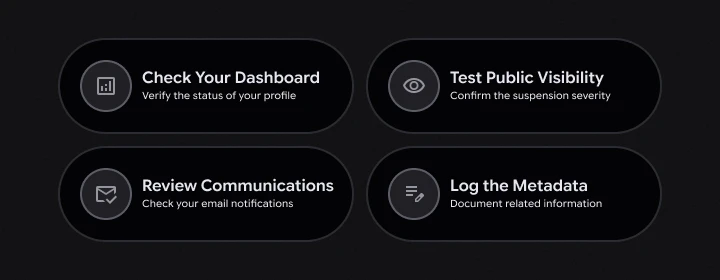
Before rushing to fix things, gather your diagnostic facts calmly:
1. **Check the Dashboard:** Sign into the correct Google account and open the Business Profile Manager. Verify whether the notification banner explicitly reads “business profile is suspended” or “business profile suspended”.
2. **Test Public Visibility:** Run a manual query for your exact business name in Google search and Maps. If your listing is entirely missing, you are dealing with a hard suspension; if it appears but remains locked out from editing, it is a soft suspension.
3. **Review Communications:** Search your primary inbox and spam folders for the formal email notification from Google. Note any specific references to policy violations, deceptive content , or broader account anomalies.
4. **Log the Metadata:** Carefully document the initial suspension date, your profile URL, associated case IDs, past appeal decision histories, and traffic drops. Determine if a secondary manager’s google account or the profile’s primary owner credentials have been compromised or restricted.
> ### ⚠️ Security Reminder
>
> Regularly audit your access list to ensure that only trusted partners have access to your Google Business Profile, as a suspended account can affect your profile too.
## Step-by-Step: How to Fix Violations Before You Appeal
Filing an appeal immediately without fixing the underlying errors is the most common mistake made by businesses. When appealing a Google Business Profile suspension, it is essential to identify the specific policy violation and correct the profile information accordingly.
**Before you submit an appeal**, double-check that your data aligns with reality:
- Your business name perfectly matches your outdoor physical signage, your official business registration, and your website branding.
- Your listed address is eligible and completely free of PO boxes, unstaffed virtual offices, or mail drop locations.
- Your primary categories, phone contacts, business details, and core business information are fully accurate.
- Your website does not display deceptive location claims, non-existent branches, or falsified local awards.
- Your core NAP (Name, Address, Phone) data is completely uniform across your GBP profile, main website, local directories, and social handles.
Strip away unauthorized keyword stuffing , remove exaggerated service area parameters, and delete spammy “near me” landing page link tactics. Avoid any spammy tactics such as keyword stuffing, fake addresses, or duplicate listings, as these can lead to suspension of your Google Business Profile. Maintaining compliance with Google Business Profile guidelines can prevent future suspensions by avoiding known issues such as keyword stuffing and inconsistent information.
## Preparing Evidence: Documents and Photos That Help Your Case
Official documentation required for a Google Business Profile appeal includes business registration or licenses, utility bills , tax certificates, and photos of the business location. Gather clear, unedited copies of these official documents:
- Official business registration papers or articles of organization.
- A valid, locally issued business license.
- A signed commercial lease agreement or property deed.
- A recent corporate tax certificate or formal IRS correspondence letter.
- Utility bills (gas, electric, water, or internet) showing the exact same business name and physical address.
- High-resolution, geotagged photos of the building exterior, permanent street signage, interior offices, staff members, and branded company vehicles.
When you provide Google with supporting evidence, every document must perfectly match your suspended profile. Using clear filenames like front\_signage\_123-main-st.jpg and city\_business\_license.pdf helps human reviewers validate your business quickly.
Store these items in a shared Google Drive folder with public permissions enabled. If you operate a service area business , provide photos of your wrapped commercial vehicles alongside tools, equipment, or alternative proof that your business actively delivers services directly to customers within the specified region.
## Using Google’s Appeals Tool to Reinstate Your Business Profile
To appeal a Google Business Profile suspension , you must first ensure that your profile complies with Google’s guidelines and then submit an appeal through the Google Business Profile appeals tool. Click the “Appeal” button embedded within your original email notification or navigate directly through your Business Profile Manager dashboard to select the specific GBP profile facing enforcement.
The system will guide you through a series of verification questions regarding your business type, address eligibility, and recent edits. While legacy documentation often refers to a standalone web-based reinstatement form , the modern process is entirely contained within the interactive, step-by-step appeals workflow.
> ⏱️ Strict 60-Minute Window When submitting an appeal, you have exactly 60 minutes to upload any evidence that supports your case, and all documents must match the business name and address on your profile. Do not initiate the evidence form step until your compliance files are fully prepared and organized.
In the provided narrative field, write 2 to 4 concise, professional paragraphs clarifying:
1. What originally caused the policy violation or technical misunderstanding?
2. The specific corrective actions you have taken to resolve the issue.
3. How are your updated profile details now, strictly observing current GBP guidelines?
4. A list of the specific official documents you attached to prove you run a legitimate operation.
Google typically takes 1 to 3 weeks to process appeals, but this can vary based on local queue backlogs. While straightforward verifications may resolve in 3 to 10 business days, remember that duplicating requests during the Google Business Profile appeal process can delay reinstatement and reset the evaluation timeline. Avoid submitting multiple tickets or trying to create an entirely new business listing while your initial request remains under review.
## What to Do If Your Appeal Is Denied or Needs Additional Review
Not every business is eligible for local mapping features. E-commerce setups and online-only operations with no physical, in-person customer interactions do not qualify for a localized Google Business listing.
If your submission is rejected, carefully read the rejection notice and compare it against the original supporting evidence you compiled. If your appeal is denied, you may have the option to request an additional review by providing further evidence that was not included in your original appeal.
When initiating this escalation step, make sure to submit fresh, more evidence rather than re-uploading the exact same packet. Prioritize providing clearer outdoor signage angles, notarized address documentation, or updated localized business registries. Carefully track every unique case ID, communication date, and appeal decision entry so the Timmermann Group team can audit your history if professional escalation becomes necessary.
## Preventing Future Google Business Profile Suspensions

Proactive protection is much easier than navigating the reinstatement process after a suspension hits. Implement internal governance rules so only trained, authorized staff members have access to modify your listing, and document any major profile edits before making them live.
Keep your core business details stable across all directories, your website, and platform listings. Review this data quarterly to check for inaccurate information introduced by automated data aggregators or user-suggested edits. Cultivate strong trust signals by gathering authentic customer reviews, earning local citations, securing local PR coverage, and maintaining a professional website that mirrors your exact services and branch locations.
Timmermann Group offers local search optimization and proactive GBP monitoring to intercept suspicious third-party edits, abrupt ranking shifts, or compliance risks well before another profile suspension can disrupt your business.
## How Timmermann Group Helps Businesses Recover Their Profiles
Timmermann Group is a full-service digital marketing agency driven by a philosophy of “Conversions, not Diversions.” We handle getting your Google Business Profile reinstated as a core component of a broader growth strategy, rather than a temporary, isolated fix.
Our systematic recovery process includes:
- **Initial Assessment:** A strategy call to review compliance and identify risks.
- **Profile Audit:** A comprehensive deep-dive into your suspended profile.
- **Gap Analysis:** Evaluation of profile guidelines versus your current documentation.
- **Narrative Prep:** Drafting a clear, compliant appeal narrative.
- **Document Review:** Pre-submission verification of all supporting files.
- **Post-Reinstatement Monitoring:** Active monitoring to ensure your profile stays live.
Timmermann Group’s local search team deploys SEO, PPC, and data analytics to substitute for lost local visibility while your business profile is suspended. This multi-channel approach helps preserve inbound calls, form fills, and revenue while Google reviews your appeal.
We support small businesses managing a single location as well as large enterprise brands overseeing multiple profiles, aligning naming conventions, address structures, and user access across your entire footprint. If your listing is currently down, schedule a consultation to diagnose the root cause and map out a compliant path forward.
## Final Thoughts
In these final thoughts, remember that a Google Business Profile suspension is an operational hurdle, but it is entirely salvageable when you resolve the underlying policy violations and provide strong documentation. Relying exclusively on one GBP profile for your local revenue is a major vulnerability. Mitigate this risk by combining local maps with organic SEO, targeted PPC, strong landing pages, and owned marketing audiences. Treat recovery as an ideal opportunity to clean up your digital footprint and build a resilient local search ecosystem.
---
## Frequently Asked Questions (FAQ)
#### How long does it usually take to get a suspended Google Business Profile reinstated?
Most straightforward appeals take 3 to 10 business days, but Google typically takes 1 to 3 weeks to process appeals when local queue backlogs, high-risk business categories, or broader account restrictions are involved. Providing complete, matching evidence from the start is the best way to keep this timeline short.
#### Can I create a new Google Business Profile instead of fixing a suspended one?
No. Attempting to create a new profile for the same business while the original is experiencing a profile suspension mimics spam-like behavior and can worsen enforcement actions. Focus on correcting the violations on your original listing and utilizing the official appeals tool.
#### What if my entire Google account is restricted, not just one profile?
If your primary Google account is restricted, all associated business profiles may face a sweeping profile suspension, and new profiles will be blocked. You must resolve the root account restriction first, and then appeal each affected business profile individually.
#### Does a GBP suspension hurt my organic SEO rankings on my website?
A suspension directly impacts your placement on Google Maps, local map packs, and the standalone business listing itself. It does not penalize your website’s traditional organic search rankings. However, because a significant portion of local clicks start in Maps results, your total lead volume will likely experience an immediate drop.
#### How can I reduce the risk of getting suspended again after reinstatement?
Keep your core business details stable, avoid making bulk edits to your profile fields all at once, update your official documents promptly if you relocate, and regularly audit your user permissions. Partnering with Timmermann Group for ongoing local search management can help catch compliance issues before they trigger an automated suspension.
**Categories:** LSO
---
### [Manufacturing Lead Generation: How to Attract Quality Leads](https://www.wearetg.com/blog/manufacturing-lead-generation/)
**Published:** May 12, 2026
**Author:** Rob Timmermann
**Content:**
Manufacturers face a stark reality: sporadic RFQs from trade show business cards and occasional referrals aren’t enough to sustain growth. With buyers spending nearly 70% of their journey researching anonymously online before ever contacting your sales team, you need a predictable lead-generation system that continuously captures and nurtures ideal customers throughout those long sales cycles. This is where [a manufacturing marketing strategy](https://www.wearetg.com/industry/manufacturing-marketing-agency/ "Manufacturing Marketing") comes in. With the right strategy in place, you can generate leads with greater intention and predictability for better revenue outcomes.
### Key Takeaways
- **Effective manufacturing lead generation blends inbound and outbound tactics** (SEO, PPC, trade shows, email, LinkedIn) into one coordinated lead generation system
- **High-quality leads come from clearly defined ideal customers, buyer journeys, and offers** with clear next steps such as RFQs, engineering consults, or plant tours
- **Technology, including CRM, marketing automation, and analytics,** is now essential for tracking key prospects and improving conversion rates over longer sales cycles
- **Partnering with a specialized B2B digital agency** helps manufacturers implement these strategies faster and with less internal workload
## What Is Manufacturing Lead Generation?
Manufacturing lead generation means systematically attracting, qualifying, and nurturing buyers for parts, assemblies, and production capacity across 6–18+ month sales cycles. For job shops, OEM suppliers, contract manufacturers, and industrial equipment makers, this translates into generating RFQs, conducting plant visits, and engaging in engineering discussions with key prospects.
Lead generation in manufacturing requires a specialized approach due to long sales cycles, technical buyer personas, and high-value transactions. Manufacturing buying cycles are long and research-heavy, making it essential for companies to engage with potential customers early in their journey to build trust and influence their final decision.
Here’s where opportunities get lost: manufacturing buyers do most of their research independently *before* contacting sales. They compare suppliers globally online, evaluate certifications, and review capabilities, all before you know they are looking. This contrasts sharply with “random” leads, such as one-off RFQs or unqualified trade show contacts, which convert at less than 5%.
Manfacuterers need a marketing strategy with an emphasis on Conversions, not Diversions, emphasizing lead quality and fit over vague metrics like raw traffic or impressions.
## Clarify Your Ideal Customers and Key Prospects Before You Spend on Marketing
Every lead generation strategy starts with knowing exactly which manufacturing buyers you want more of in the next 12–24 months. Without this clarity, you’re chasing unqualified traffic that wastes your sales team’s time. This is where your Ideal Customer Profile comes in. By identifying your ideal customer, you can match (and map) their concerns and buying triggers.
Common manufacturing personas to target:
| Persona | Typical Triggers | Key Concerns |
|---|---|---|
| Design Engineers | DFM issues, new product development | Tolerances, materials, prototyping speed |
| Procurement Managers | Supplier failures, cost reduction mandates | Certifications, pricing and delivery reliability |
| Plant Managers | Capacity constraints, equipment breakdowns | Production timelines, quality consistency |
| Supply Chain Executives | Reshoring initiatives, new product launches | Risk mitigation, geographic proximity |
Define ideal customers by concrete attributes: annual spend range ($10M+ on components), specific industries (aerospace, medical device, heavy equipment), tolerances (±0.0005”), materials (titanium, PEEK), certifications (ISO 9001, AS9100, IATF 16949), geography, and minimum order quantities.
Mapping the buyer journey involves understanding how buyers move from recognizing a problem to making a final decision. Map real triggers that start the buyer’s search, such as machine capacity issues, supplier failures and reshoring initiatives. Clear ICPs let you choose the right channels and messages rather than broadcasting to the wrong audience.

## Design Your Website to Capture and Qualify Manufacturing Leads
In the past, you could get away with having a static website with basic info like phone number and a contact form. Today, your website can (and should) do so much more for your manufacturing business. Your website should function as a 24/7 sales engine that captures online demand and drives buyers to take action. Strategic marketing is proven to boost lead generation for 74% of companies by establishing trust in the manufacturing sector.
**Every core page needs clear next steps to drive action:**
- RFQ forms with minimal fields (part specs, quantity, timeline)
- Clear Call-to-Actions (CTAs) on key pages
- Downloadable spec sheets and tolerance guides
- Booking buttons for discovery calls or plant tours
Creating buyer-focused content that answers their most urgent and pertinent questions helps filter out poor-fit leads before sales involvement. Include detailed process pages covering CNC machining, injection molding, and metal fabrication capabilities. Add tolerance specifications, material capabilities, certifications badges, equipment lists, and your current case studies to showcase key projects.
For UX and CRO, maintain fast load times under 3 seconds, ensure mobile responsiveness (50% of industrial searches happen on mobile), create simple navigation by industry and process, and minimize form fields. TG tests different layouts, headlines, and CTAs using analytics and A/B testing to steadily improve website visitors’ conversion rates.
## Implement Inbound Lead Generation Strategies: SEO, Local Visibility, and Content Marketing
Inbound lead generation captures the demand of buyers who are already researching solutions and ready to discuss projects. Visibility at the moment of intent is critical for generating manufacturing leads.
#### SEO for Manufacturers
SEO should emphasize technical, long-tail keywords that indicate a high intent to buy. Focus on terms like:
- “Stainless steel CNC machining Springfield”
- “ISO 13485 injection molding Sedalia”
- “Custom aluminum die casting Kansas City”
SEO for industrial keywords should focus on high-intent terms rather than broad industry terms that attract unqualified traffic. While a marketing strategy might include a mix of top-of-funnel and bottom-of-funnel keywords and content, it’s those bottom-of-funnel keywords (like the examples above) that will generate leads and revenue.
##### Local Visibility
Local search engine optimization (also known as Local SEO or LSO) is achieved by optimizing your Google Business Profile, local landing pages, and reviews, helping you to capture regional demand that may not be captured nationally. This is due to how many people tend to search online. For many buyers, location matters when choosing a manufacturer, so you need to align your online presence with localized searches.
#### Content Marketing
The manufacturers that succeed online use content to answer technical questions at every stage of the buyer journey. Create application guides, tolerance and material selection articles, ROI calculators, and engineering-focused blog posts. These posts can be shared with buyers by your sales team, but also make great links for industry partners and associations. Educational resources, such as white papers and technical blog posts that address industry problems, are also essential for capturing leads from search engines.
Every piece of relevant content must also end with a CTA and clear next steps, whether it’s downloading a drawing checklist, scheduling a DFM review, or requesting a quote. When it comes to creating content for manufacturing buyers, think about the overall goal: not just the educational value but how this content can support your overarching marketing plan.
## Use Outbound Lead Generation Strategies to Reach Decision Makers Directly
Outbound remains essential for reaching decision makers who aren’t actively searching. Manufacturing companies should adopt a dual approach that combines inbound and outbound lead generation strategies to effectively attract potential clients.
#### LinkedIn for Industrial Outreach
LinkedIn generates over 80% of B2B social leads and is crucial for B2B manufacturing targeting. If you are not currently using LinkedIn as a lead gen tool, you’re likely missing out on some large opportunities. Of course, this still requires care and attention, with personalized outreach outperforming more general messages. This can require a mix of manual and automated outreach strategies, integrating sales and marketing to achieve the best results.
When used strategically and proactively, LinkedIn helps manufacturers connect with design engineers, share technical posts, run sponsored campaigns to promote case studies and webinars, and reach the right audience.
#### Trade Shows and Events
Treat trade shows like the Midwest Manufacturers Trade Show & Conference, FABTECH, and IMTS as part of a broader lead-generation system, with pre-show outreach lists and post-show email sequences. Traditional, in-person, and personalized strategies remain important for effective lead generation.
Implementing Account-Based Marketing (ABM) helps target specific stakeholders within key accounts through personalized campaigns. ABM focuses resources on a shortlist of high-value accounts with personalized messaging and custom content. TG helps manufacturing companies integrate outbound efforts with CRM and automation to ensure consistent follow-up systems and higher appointment-setting rates.
#### Targeted Email Outreach
Targeted email marketing can be an effective tactic when sending emails to buyers you’ve connected with at trade shows or through mutual contacts and partners. Build account lists around ideal customers. For example, you may build a list centered on Midwestern OEMs with >$10M in spend on machined components. Personalized email sequences to engineering and procurement contacts can boost open rates 20–30% when combined with intent data.

## Build a Lead Nurturing Process That Matches Long Industrial Sales Cycles
Manufacturing deals take months to close, necessitating continued engagement with prospects. Manufacturing buyers often take 3–18 months from first contact to final decision, requiring structured nurturing for your sales pipeline.
#### Lead Scoring
Establishing a scoring system for prospects helps manufacturers prioritize potential clients based on their engagement levels and readiness to buy. Score behaviors including:
- RFQ submissions (high priority)
- Downloads of tolerance guides or white papers (medium)
- Multiple visits to capabilities and product pages (engagement signal)
- Webinar attendance (active interest)
#### Segmented Email Nurture Campaigns
Creating email nurture sequences personalized to the specific needs and interests of prospects can significantly enhance engagement and conversion rates. Structure campaigns by buying stage:
| Stage | Content Type | Goal |
|---|---|---|
| Early | Educational guides, industry trends | Build trust |
| Mid | Application case studies, capability demos | Demonstrate fit |
| Late | ROI calculators, risk-reduction content | Drive final decision |
Industrial buyers take time to purchase; automated nurturing keeps brands top of mind with potential clients. Use marketing automation tools integrated with CRM to send timely follow-ups and automatically assign tasks to sales reps. Effective nurturing improves conversion rates from first inquiry to awarded business, compounding into significant revenue impact over 12–24 months.
## Leverage Technology and Analytics to Run a Lead Generation System
The shift from manual spreadsheets to integrated CRMs and analytics platforms defines manufacturing sales success. Utilizing Customer Relationship Management systems can automate follow-up emails and reminders, ensuring timely engagement with prospects and improving response times.
#### CRM Capabilities
A CRM records every touchpoint with key prospects, tracks open quotes, and helps prioritize follow-ups by opportunity size and close likelihood. This visibility is essential for managing a consistent pipeline across longer sales cycles.
#### Marketing Automation
Marketing automation tools can help manufacturers track engagement behavior, allowing them to understand which topics and asset types prospects care about most. Triggers include email sequences after content downloads, progressive forms that gather more information over time, and remarketing ads based on buyer behavior.
AI-driven lead generation is becoming the standard for manufacturing growth, allowing companies to build predictable, high-quality pipelines by identifying manufacturing buyers actively researching solutions.
#### Analytics and Measurement
Track which SEO pages, PPC campaigns, trade shows, and LinkedIn ads generate the most qualified leads and closed deals. TG builds dashboards for manufacturers so that leadership can see monthly trends in traffic, lead volume, conversion rates, and marketing-sourced revenue.
## Paid Advertising (PPC & Retargeting) to Accelerate Manufacturing Leads
Paid advertising accelerates results once your website, messaging, and follow-up systems are ready. Successful lead generation for manufacturing requires a blended approach focusing on high-intent searchers, technical content, and targeted relationship-building.
#### Google Ads
Google Ads remains one of the most significant tools manufacturers use for pay-per-click advertising. It can be a great way to capture demand for searches you do not yet rank for organically, or as a supplemental tactic to dominate search engine results against your competition.
Target high-intent industrial keywords with clear purchase signals:
- “Aluminum die casting supplier Missouri”
- “ISO 13485 injection molding partner”
- “Precision CNC machining aerospace certified”
Use negative keywords to exclude terms that waste budget on unqualified clicks.
#### LinkedIn Ads
As mentioned above, LinkedIn is a significant driver of B2B leads –– and that remains true for paid ads. One of LinkedIn’s most useful features is the ability to target specific job titles in narrow specific industries: for example, “Senior Mechanical Engineer” in medical device companies with 200–1,000 employees in North America. This precision allows you to reach decision-makers directly rather than crossing your fingers that your social post reaches them organically through the algorithm.
#### Retargeting
Choosing a manufacturer is not the same as buying a new leaf blower online. It can require multiple exposures to your brand and repeat visits to your website. Retargeting ads ensure that they connect with the exact information they need to take action.
Retargeting works by following previous website visitors and RFQ viewers, reminding them of your manufacturing services and keeping your brand visible during their research process. Research shows that B2B buyers are nearly 70% of the way through their buying process before they ever reach out, so staying visible matters.
As we’ll discuss later, working with a digital marketing partner experienced in digital ads can help manufacturers control cost per lead through disciplined testing of ad copy, landing pages, and bidding strategies, while improving lead quality.
## Turn Offline Relationships into Digital Lead Generation Assets
While online tools and spaces are critical, many important relationships begin offline. The goal is not to keep online and offline relationships siloed but to transform them into a hybrid relationship that maximizes their impact. Many manufacturers underutilize existing customers, suppliers, and trade show contacts for ongoing lead generation efforts. Your offline strengths can become digital proof that attracts new markets.
#### Referral Systems
Build a simple referral system with scheduled outreach to customers, incentives for introductions, and easy ways for partners to refer new projects. Research indicates that 70% of B2B purchasers are influenced by case studies in their buying decisions.
#### Content from Sales Conversations
Convert recurring sales questions into online articles, FAQs, and videos. Common objections and technical clarifications become discoverable lead magnets that capture potential customers searching for answers.
#### Event Capture
Use QR codes and simple landing pages at plant tours, lunch-and-learns, and distributor events to capture contact information with clear next steps. TG helps manufacturers transform offline strengths (reliability, craftsmanship, on-time delivery) into digital proof through testimonials, case studies, and review campaigns.

## How a Marketing Partner Helps Manufacturers Get Faster Results
For busy plant owners, sales leaders, and operations managers who lack time and in-house marketing capacity, outsourcing lead generation efforts makes strategic sense. Creating targeted content that addresses the specific challenges and interests of the target audience benefits from specialized expertise that most manufacturing companies don’t have in-house. Even if you have the expertise to develop and execute a marketing strategy, you likely do not have the time to achieve the kind of results you need at the pace you need. This is where a manufacturing marketing agency excels.
#### What Timmermann Group Handles
A digital marketing agency with expertise in manufacturing companies manages the heavy lifting: strategy, SEO, paid search, website conversion rate optimization, social media, and analytics setup. Timmermann Group develops a strong and strategic partnership with each of our clients, allowing us to act as an extension of your own marketing team and to deliver exceptional results.
Manufacturing companies that prioritize personalized communication and targeted content can effectively nurture potential customers and improve conversion rates.
**Concrete Examples**
- Creating an SEO strategy with high-intent keywords that target key industries and opportunities
- Building a new RFQ-focused website optimized for conversion
- Launching a PPC campaign within 30–60 days, targeting high-quality leads
- Create a B2B social campaign for LinkedIn to connect with decision makers
Working with TG provides access to proven lead-generation services, a suite of tools, and nationally-recognized talent that most manufacturing companies wouldn’t be able to hire individually. By working with an agency, Manufacturers can focus on producing buyer-focused information that answers real questions, filtering out poor-fit leads before sales involvement.
#### Ready to build a steady flow of qualified leads?
[Schedule a free 30-minute consultation](https://www.wearetg.com/contact/) with Timmermann Group to discuss how we can help your manufacturing business achieve continual growth and a consistent pipeline of ideal customers.
---
## Frequently Asked Questions About Manufacturing Lead Generation
#### How long does it usually take for manufacturers to see results from a new lead generation strategy?
Timelines for lead generation depend on your starting point. Outdated websites without an SEO foundation or analytics can require more setup than those from manufacturers with existing digital infrastructure.
Quick wins from paid search and technical SEO fixes on your website often appear within 30-60 days, while larger SEO movement and conversion rate optimization usually deliver the greatest results over 3-6 months as we align the entire strategy with the sales cycle. Full ROI in complex industrial sales cycles may take 9–18 months due to quoting, sampling, and qualification processes, but leading indicators like traffic quality, RFQs, and meeting volume show progress earlier. What is considered a “high-quality lead” for a manufacturing company?
High-quality leads are projects that match your capabilities, volume requirements, industry focus, and margin targets and come from roles involved in the final decision, such as engineering, operations, or procurement. They typically include detailed requirements covering materials, tolerances, quantities, and timelines, with a reasonable fit to your certifications and capacity. Part of a strong lead generation strategy is filtering out poor-fit requests so your sales team focuses on the right prospects and real opportunities.
#### Do small and mid-sized manufacturers really need marketing automation and a CRM?
Many smaller shops still manage leads via email and spreadsheets, which creates gaps in follow-up and poor visibility into pipeline health. Even a basic CRM and lightweight automation—such as simple email sequences and web-to-lead forms—can significantly improve response times and conversion rates. Timmermann Group helps manufacturers choose right-sized tools that match their team size and budget, rather than overcomplicated enterprise software.
#### Which lead generation channels usually work best for manufacturers starting from scratch?
The best lead generation channels for manufacturers are search engine optimization (SEO), paid search (such as Google Ads or LinkedIn Ads), which lead buyers to website landing pages that are optimized for conversion.
Begin with an SEO strategy and one or two paid campaigns focused on the highest-intent keywords or key industries. Once basic inbound and conversion tracking are in place, layer in content marketing, LinkedIn outreach, and trade show follow-up workflows. If you don’t have a website that is currently optimized for SEO and conversions, that may be your next investment, as owning a website with a strong SEO foundation is often a core piece to lead gen success.
#### How does working with Timmermann Group differ from other lead-generation services?
When manufacturers work with Timmermann Group, they receive over 20-years of experience in manufacturing marketing. TG has proven success with manufacturers across a number of sub-industries, so you can have confidence that you’re working with a partner that actually understands your business and what it will take to generate leads.
Our core services for manufacturing companies are SEO, Paid Media, and conversion-focused website design. That is not because these work for TG but because the results of these services work for our manufacturing clients with results that have proven themselves time and again. This contrasts with generic lead lists or off-shore vendors that might make sense on paper, but quickly demonstrate that you’re more of a number on a spreadsheet than a business *relationship*. TG focuses on long-term relationships, regular reporting, and continuous optimization to continually improve lead quality and marketing ROI, helping the most successful manufacturers build continual momentum and growth rather than chasing cold calls and random leads.
**Categories:** Strategy, Advice For Business Owners
---
### [Review Gating: What It Is, Why It’s Risky, and How to Get Reviews The Right Way](https://www.wearetg.com/blog/review-gating/)
**Published:** May 19, 2026
**Author:** Rob Timmermann
**Content:**
Review gating may look like a harmless customer-feedback shortcut, but in 2026, it poses major risks to your legal, SEO, and business reputation. If your brand depends heavily on online reviews, local search visibility, and cultivating long-term customer trust, your review-generation process must change. Instead of hiding flaws, you need an open system that actively invites honest reviews from every single client, regardless of their experience.
### Key Takeaways
Understanding the clear distinction between fair review solicitation and manipulative, selective filtering is essential for protecting your digital footprint. Here are the core insights every business owner must know:
- **Review Gating Defined**: Review gating is the practice of soliciting reviews only from satisfied customers, which skews the overall perception of a business’s reputation by filtering out negative feedback.
- **Platform Penalties**: Since 2018, Google has banned review gating on Google Business Profiles and may remove reviews, suspend profiles, or completely reduce your search visibility.
- **Legal Consequences**: The Federal Trade Commission (FTC) enforces strict guidelines against deceptive review practices under the Consumer Review Fairness Act, with financial fines reaching up to $44,000 per violation.
- **Compliant Strategies**: A compliant review generation strategy asks all customers for honest reviews, addresses negative reviews constructively, and uses authentic feedback to drive more customers and higher conversions without jeopardizing [your GBP optimization strategy](https://www.wearetg.com/services/google-business-profile-optimization/).
## What Is Review Gating?
When it comes to digital marketing, maintaining an excellent online reputation is vital for every growing business. However, some brands turn to shortcuts known as review gating to artificially manipulate their public scores. Review gating is any process that selectively encourages only satisfied customers to post public reviews while discouraging or preventing unhappy customers from doing so. In contrast to review gating, review *solicitation* encourages all customers to leave feedback, regardless of their experience, promoting transparency and authenticity.
When a business engages in review gating, it disrupts the natural balance of authentic reviews across the web. By implementing strict filtering based on expected satisfaction, the company creates a highly polished but fundamentally inaccurate picture of its actual customer experience. This manipulative approach ensures that only positive reviews reach public review platforms, effectively hiding any negative comments that could warn future buyers.
### Review Solicitation vs. Gating
To fully grasp why these unethical practices are heavily targeted by major tech platforms, it helps to look at review solicitation vs. gating. Research shows that review gating limits overall review count, while requesting feedback from everyone increases review volume significantly. When you open the floor to all customer reviews, you naturally earn more reviews over time. This transparent approach builds a stronger foundation for long-term customer trust and provides an accurate representation of your operations.
On the other hand, review gating relies on separating your happy customers from your unhappy customers before they ever have a chance to leave a review. Both the Federal Trade Commission (FTC) and Google prohibit review gating, emphasizing that businesses should not selectively solicit positive reviews or discourage negative ones, as this misrepresents consumer experiences. True review generation means treating every single transaction with the same level of openness and respect.
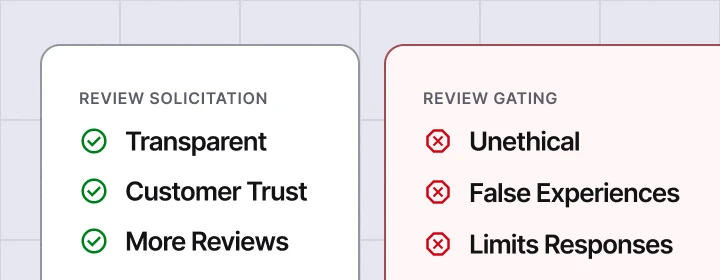
## What Is Considered Review Gating?
It is important to understand exactly what is considered review gating under the current platform guidelines. Many business owners unintentionally violate the rules because they use automated customer feedback software that handles filtering based on customer sentiment automatically. If your review requests contain conditional logic—meaning the next step changes based on whether the customer had a positive experience or a negative experience—you are likely gating reviews.
Google’s policies prohibit review gating, which involves selectively soliciting positive reviews while discouraging negative ones, to maintain consumer trust in online reviews. Google treats selectively soliciting positive reviews, discouraging submitting negative reviews, and trying to prohibit negative reviews as fake engagement under its Maps contributed content policy. If your system works to actively discourage people from sharing their true thoughts publicly, it violates the basic principles of fair consumer platforms.
### Filtering Based on Expected Satisfaction
Many local brands fall into the trap of filtering based on initial sentiment surveys or internal scorecards. For example, sending an automated Net Promoter Score (NPS) email to customers and only providing a link to Google reviews to those who rate the business a 9 or 10 is a textbook violation. The system acts as a deliberate barrier, preventing those with lower scores from easily accessing external review platforms.
This kind of systematic pre-screening means a business is only collecting positive ones while deliberately suppressing negative ones. This results in biased ratings that fail to provide an accurate representation of how the business actually treats its clients. True consumer trust can only be achieved when potential customers can see the full spectrum of customer reviews.
### Routing to a Private Feedback Form
Another common tactic that falls under what is considered review gating is routing dissatisfied users exclusively to an internal private feedback form. While collecting private feedback is an excellent way to resolve internal issues, it cannot be used as a substitute for allowing a public review. If your automated workflow forces unhappy customers to leave private feedback while guiding happy customers directly to a public review site, you are crossing an ethical line.
Forcing individuals to provide private feedback while letting others post openly creates a heavily biased online presence. It intentionally hides legitimate operational flaws from prospective customers who are trying to make an informed purchasing decision. To remain compliant, a business must give everyone the exact same freedom to choose whether they want to submit a public review or use a private feedback channel.
## What Is an Example of Review Gating?
To make this concept completely clear, let’s look at what is an example of review gating in a real-world scenario. Imagine a local dental practice that sets up an automated text message system to manage reviews. After an appointment, every patient receives an automated text prompt asking them to rate their visit from 1 to 5 stars. If a patient selects 5 stars, the system immediately pops up a message saying, “Thank you! Please leave a review on our Google Business Profile,” complete with a direct, clickable link.
However, if the patient selects 1 or 2 stars, the system displays a completely different screen: “We are so sorry to hear that. Please fill out this private feedback form so our management team can contact you immediately.” In this example, the dental practice is actively preventing negative reviews from reaching the public eye while systematically harvesting positive reviews. This classic flow is exactly what review platforms and regulatory bodies have strictly banned.
### The Automated Email or SMS Flow
Review gating often hides inside normal-looking email campaigns or sms messages sent right after a purchase. A customer buys a product, receives an automated email, and is asked to select a smiley face based on their experience. If they select the happy face, they are urged to leave positive testimonials on public sites. If they choose the sad face, they are routed to an internal customer support ticketing system with no mention of public platforms.
This layout ensures that the business receives only positive reviews publicly, while its actual operational problems remain completely hidden. Even if business owners believe they are simply trying to offer solutions to angry clients, the structural exclusion of negative feedback renders the system non-compliant. To fix this, the public review links must be clearly visible to all users, regardless of which face they click.
## Why Review Gating Is a Major Business Risk
Engaging in review gating does more than break platform guidelines; it introduces massive strategic risks that can completely derail your digital marketing efforts. Review gating can damage a company’s reputation by eroding consumer trust; potential customers may become skeptical of businesses that only display positive reviews, leading to decreased sales and loyalty. Consumers in 2026 are highly sophisticated and can easily spot a profile that looks entirely manufactured.
Strategically, hiding bad experiences through review gating results in a loss of vital, honest feedback needed to improve products or services. If your leadership team never sees the real negative comments from your customers, you cannot address the root causes of client dissatisfaction. This ultimately harms your long-term customer experience, reduces customer loyalty, and limits your business growth.
### Account Suspensions and Loss of Google Reviews
The immediate operational risk to your local SEO and online presence is severe. Businesses that engage in review gating risk having their reviews removed or their accounts suspended by platforms like Google, which strictly prohibits the practice to maintain trust in online reviews. Google’s policies strictly prohibit review gating, and businesses found to be engaging in this practice risk having their [Google Business Profile reviews](https://www.wearetg.com/blog/google-business-profile-reviews/) removed or facing account suspension, which can severely impact their online presence.
Imagine losing hundreds of hard-earned, genuine reviews overnight just because your review generation software used a forbidden filtering mechanism. A suspended Google Business Profile can devastate a local business, cutting off its primary source of inbound leads and organic map traffic. The temporary advantage of masking a few bad reviews is never worth the risk of total digital erasure from major search systems.
### Artificially Inflated Ratings and Flawed Operations
Review gating creates an artificially inflated rating that hides legitimate operational flaws. When your public scores are deceptively high, they mask deep-seated issues in your delivery, pricing, customer service, or product quality. This artificial shield prevents your business from evolving and fixing the friction points that drive clients away in the first place.
Over time, the gap between your online reputation and your actual customer experience will widen significantly. When real-world customers experience poor service from a business that boasts a perfect 5.0 rating, their disappointment is magnified. This often results in even harsher public backlash and severe, irreversible damage to your brand’s integrity.

## Is Review Gating Illegal?
A critical question many modern business owners ask is: Is review gating illegal? The short answer is yes. Review gating is considered illegal and unethical because it misrepresents a business’s true customer experience by soliciting only positive reviews and suppressing negative ones. In the United States, regulatory enforcement has intensified significantly to protect consumers from misleading online practices.
The legal landscape treats review manipulation as a form of deceptive advertising. When a business deceptively filters out negative experiences, it deprives the public of an accurate representation of its services. This means that using such practices to gain an unfair advantage over competitors is a direct violation of federal consumer protection laws.
### Federal Trade Commission Rules and Heavy Fines
The [Federal Trade Commission (FTC) guidelines](%2A%20https://www.ftc.gov/business-guidance/resources/featuring-online-customer-reviews-guide-platforms) state that businesses should not only ask for reviews from customers they believe will leave positive feedback, but they should also not incentivize reviews with rewards or discounts. The Federal Trade Commission (FTC) imposes penalties of up to $44,000 per violation for businesses that engage in review gating practices, as it violates the Consumer Review Fairness Act.
These are not empty threats; review gating can lead to significant legal consequences, including fines of up to $44,000 per violation from the Federal Trade Commission (FTC) for practices that mislead consumers, such as selectively soliciting positive reviews. Violating review guidelines set by platforms like Google and the FTC can lead to severe penalties, including fines up to $44,000 per violation under the Consumer Review Fairness Act. Furthermore, updated guidance under newer consumer review rules allows for even higher civil penalties depending on the scale of the violation, as seen in landmark settlements like Fashion Nova’s $4.2 million fine for hiding lower-star customer reviews.
### The Consumer Review Fairness Act
The Consumer Review Fairness Act protects the right of individuals to share honest reviews, including negative reviews, about businesses. Under this act, companies cannot use contract provisions, non-disparagement clauses, or technical barriers to prohibit negative reviews or punish clients who voice dissatisfaction.
Any system or strategy that deliberately works to suppress negative feedback or discourage people from posting honest accounts is a direct violation of this federal statute. To ensure your business stays on the right side of the law, your review solicitation methods must treat every customer equally, without any conditional barriers or hidden restrictions.
## The Hidden Upside of Negative Reviews
While every business owner prefers receiving positive reviews, there is a powerful, hidden upside to getting a few negative reviews. A healthy mix of positive and negative reviews looks far more credible to potential customers than a flawless wall of perfect scores. If a company has thousands of reviews without a single complaint, modern consumers immediately suspect that the brand is publishing reviews selectively or using fake reviews.
Authentic, resolved complaints can actually build credibility for businesses, while a profile without negative reviews can look suspicious. Prospective customers want to see how a business handles adversity. Seeing a business respond professionally to a mistake and offer solutions can actually convert a skeptical shopper into a loyal customer far faster than an unblemished, unrealistic 5.0 rating.
### Why Flawless Profiles Look Suspicious to Potential Customers
Data shows that profiles with a minor distribution of lower scores convert better than those with only perfect ratings. Potential customers are inherently skeptical of absolute perfection online. They recognize that no business is perfect, and a totally clean sheet often indicates unethical practices like review gating or buying fake reviews.
Having a realistic rating—typically within the 4.2 to 4.7-star range—demonstrates that your customer reviews are authentic and genuine. It provides an accurate representation of a real business operating in the real world. This transparency fosters genuine customer trust and strengthens your overall online reputation.
### Turning Bad Reviews into Valuable Insights
Every bad review contains valuable insights that can help your business grow. When customers take the time to leave detailed negative feedback, they are highlighting specific friction points in your customer experience. It could be an issue with slow delivery, a rude support interaction, or a confusing checkout process.
Instead of trying to suppress these comments through review gating, smart businesses use them as an essential diagnostic tool. By addressing the root causes of these negative experiences, you can optimize your operations, build deeper customer loyalty, and ultimately prevent future complaints from happening in the first place.
## How to Handle a Negative Review Constructively
When a bad review does appear on Google Reviews or other review platforms, the worst thing you can do is ignore it or react defensively. Instead, you should look at it as an opportunity to showcase your commitment to excellent customer service. Having a clear, professional playbook to address negative reviews is essential for protecting your online reputation.
Always respond professionally and promptly. Acknowledge the customer’s negative experience, apologize sincerely without making excuses, and offer solutions that can resolve the matter offline. A structured, calm response demonstrates to prospective customers that your business values honest reviews and is dedicated to making things right.
| Action Step | What to Do | What to Avoid |
|---|---|---|
| **1. Acknowledge** | Validate the customer’s feelings and thank them for the feedback. | Do not argue, get defensive, or blame the customer. |
| **2. Apologize** | Offer a sincere apology for the friction they experienced. | Avoid generic, robotic copy-pasted responses. |
| **3. Offer Solutions** | Provide a direct path (email/phone) to resolve the issue privately. | Never post sensitive customer details publicly. |
| **4. Follow Up** | Fix the internal flaw and confirm resolution with the client. | Do not pressure the customer to edit reviews aggressively. |
## How to Avoid Review Gating and Stay Compliant
The best way to safeguard your digital presence is to learn how to avoid review gating entirely. To build a compliant review collection strategy, businesses should automate review requests to all customers, ensuring that no filtering based on expected satisfaction occurs. Your review system must be completely blind to whether a client had a positive experience or a negative experience.
Review generation involves inviting all customers to leave feedback, regardless of their experience, which promotes transparency and fairness in the review process. When you build a system that opens the doors to everyone, you stay fully aligned with both Google policies and Federal Trade Commission guidelines. This compliant path removes the threat of legal fines and account suspensions while organically expanding your review volume.
### Building a Compliant Review Generation Strategy
To create a sustainable review generation strategy, you need to audit your current software and automated workflows. Check your email templates, SMS messages, and CRM triggers to ensure there are no conditional gates. Every single customer should receive the exact same messaging and the exact same public links after a transaction.
Encaging customers to leave reviews after a purchase can significantly increase the likelihood of receiving feedback, with studies showing that 70% of customers will leave a review when asked. By sending consistent, unfiltered review requests to every client, you will naturally generate more reviews. This balanced approach ensures a steady stream of authentic reviews that boost your local SEO and build genuine customer trust.

## How Timmermann Group Helps Businesses Stay Compliant
Navigating the complexities of platform guidelines and legal rules can be challenging for busy business owners. That is where Timmermann Group comes in. As a conversion-first digital marketing agency founded in 2003, Timmermann Group helps businesses build sustainable, compliant Google Business Profiles that comply fully with Google and FTC guidelines. By connecting your customer reviews to local SEO, PPC, and website user experience, we turn your online reputation into a powerful growth flywheel that naturally attracts more customers.
---
## FAQ: Deep Dive Into Compliant Review Practices
### What is considered review gating?
Review gating is considered the practice of pre-screening or filtering your customers based on their satisfaction level before allowing them to post a public review. If your system selectively directs happy customers to public review platforms while routing unhappy customers to a private feedback form or support channel, that structure is considered review gating.
### What is an example of review gating?
A classic example of review gating is an automated post-purchase email that asks, “Did you love your service?” If the customer clicks “Yes,” they are instantly given a direct link to leave Google reviews. If they click “No,” they are redirected to an internal text field to leave private feedback, completely hiding the links to public review platforms from dissatisfied users.
### Is review gating illegal, or just against Google’s rules?
Review gating is both strictly against Google’s platform guidelines and illegal under federal law. The Federal Trade Commission (FTC) considers review gating to be a deceptive practice that misrepresents consumer experiences, violating the Consumer Review Fairness Act and carrying civil penalties of up to $44,000 per violation.
### How to avoid review gating while protecting my online reputation?
To know how to avoid review gating, you must automate your review requests so that every customer receives the exact same link to public review platforms, regardless of their experience. Instead of hiding bad feedback, focus your energy on learning how to address negative reviews professionally and using that authentic feedback to fix internal operational flaws.
### Can I offer rewards or incentives for customers to leave reviews?
According to the Federal Trade Commission, incentivizing reviews with rewards, discounts, or free goods is highly restricted. If you do offer incentives, they must be offered to all customers equally, must be fully disclosed, and can never be tied to whether the user leaves positive reviews or negative reviews.
### Will a few bad reviews hurt my local SEO or conversion rates?
No, a balanced profile containing a mix of positive and negative reviews actually improves conversion rates because it looks far more credible to potential customers. Search engines and prospective buyers are suspicious of perfect scores; a realistic rating distribution proves that your reviews are genuine and provides an accurate representation of your customer experience.
**Categories:** LSO
---
### [SEO for Claude: Strategies to Boost Your Rankings](https://www.wearetg.com/blog/seo-for-claude/)
**Published:** October 7, 2025
**Author:** Rob Timmermann
**Content:**
Looking to improve your search rankings with SEO for Claude? Claude, an AI large language model made by Anthropic, leverages advanced natural language processing to understand user intent more precisely than traditional SEO tools. In this article, we’ll show you how to optimize your website for Claude and how Claude fits into a larger [AI SEO strategy](https://www.wearetg.com/services/ai-seo/), ensuring your web page content resonates with search algorithms, AI agents, and human readers.
### Key Takeaways
- **Authority and expertise matter more than keyword density.** Authority and expertise are critical factors that Claude prioritizes when evaluating content. Instead of focusing on how many times a keyword appears, Claude looks for signals that demonstrate genuine knowledge and trustworthiness. This includes clear author credentials, original insights, and well-researched information that establishes your site as a reliable source in its niche.
- **Clear structure and comprehensive answers help Claude extract and use your content effectively.** A well-organized content structure allows Claude to easily navigate and understand your information. Using descriptive headers, logical sectioning, and concise paragraphs ensures that the AI can quickly identify key points and answer user queries accurately. Comprehensive answers that fully address questions also increase the likelihood that Claude will utilize your content in its responses.
- **Original sources and primary research are heavily favored over aggregated content.** Claude values originality and authenticity, preferring content that is based on primary research or original data rather than summaries or aggregated information. Incorporating unique studies, expert interviews, or firsthand data enhances your content’s credibility and makes it more likely to be recognized as authoritative by Claude.
- **Technical optimization ensures Claude can efficiently crawl and understand your site.** Technical SEO elements such as fast page load speeds, mobile-friendly design, clean HTML markup, and proper schema implementation are essential for Claude’s efficient crawling and comprehension. These optimizations remove barriers that might prevent Claude from accessing your content fully, thereby improving your chances of being featured in AI-generated search results.
## How Claude Searches and Evaluates Content
Claude utilizes sophisticated natural language processing to comprehend user search intent and identify the most relevant and trustworthy sources. When a user asks Claude a question, it searches for content that can provide accurate, comprehensive answers. This process is fundamentally different from traditional search engines because Claude actually reads and analyzes your content, rather than simply matching keywords and analyzing link patterns.
The AI’s approach to content evaluation mirrors that of a knowledgeable researcher when evaluating sources for an academic paper. It looks for expertise indicators, evaluates the logic and coherence of arguments, and cross-references information against other sources to assess credibility. That same process can also support broader digital marketing work by helping teams evaluate content, sources, and messaging, and it can surface competitive analysis insights when comparing rival strategies. This means that traditional search engine optimization tactics, such as keyword stuffing or building low-quality backlinks, are not only ineffective but also potentially counterproductive when optimizing for Claude. Developing AI search strategies requires much more nuance and expertise.
### What Claude Looks For
Claude prioritizes several key factors when evaluating web content, and understanding these priorities is crucial for effective optimization. The AI system has been trained to recognize quality signals that indicate whether content is likely to be accurate, helpful, and trustworthy – the same qualities that make content valuable to human readers.
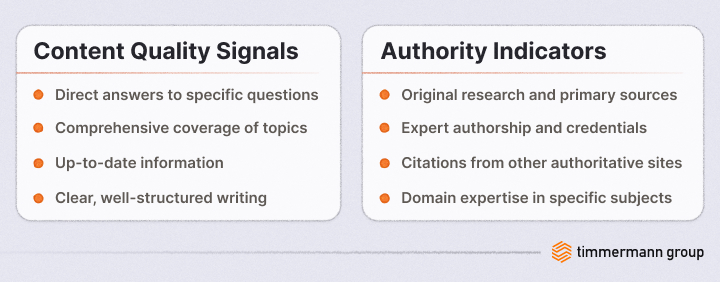
**Content Quality Signals**:
- Direct answers to specific questions
- Comprehensive coverage of topics
- Up-to-date information for time-sensitive subjects
- Clear, well-structured writing
**Authority Indicators**:
- Original research and primary sources
- Expert authorship and credentials
- Citations from other authoritative sites
- Domain expertise in specific subjects
Claude tends to avoid low-quality sources, such as forums or aggregator sites, unless they contain unique, valuable information that can’t be found elsewhere. This preference stems from the AI’s training to prioritize accuracy over popularity. It strongly favors original sources such as academic papers, government websites, company blogs, and expert publications because these sources are more likely to contain accurate, well-researched information. The AI has learned that content created by subject matter experts and published on authoritative platforms typically provides more reliable information than content that has been aggregated or summarized by non-experts.
## Content Optimization Strategies for Claude
Creating SEO content for Claude requires focusing on depth, accuracy, and clear communication rather than traditional SEO tactics. This means your writing needs to demonstrate genuine expertise while being structured in a way that allows AI systems to extract key information efficiently.
### Write Comprehensive, Keyword Research and Question-Focused Content
Claude excels at finding content that directly answers user questions, which means your content strategy should center around the questions your audience actually asks rather than the keywords they might search for, using Claude to generate content ideas before drafting. This approach requires a deeper understanding of your audience’s needs and pain points. Start each piece with a clear, direct answer to the main question, then provide supporting details and context. This structure allows Claude to quickly identify whether your content is relevant to a user’s query while also providing the depth needed to fully address complex topics.
The reason this approach works so effectively with Claude is that the AI has been trained to prioritize content that demonstrates a clear understanding of user intent. When creating content around authentic questions and providing comprehensive answers, you’re essentially speaking Claude’s language. Use natural language patterns that mirror how people actually speak and ask questions. Instead of stuffing keywords, focus on providing thorough, helpful answers that demonstrate your expertise through specific examples, detailed explanations, and practical insights that readers can actually use.
### Optimize for Topical Authority
Claude recognizes when websites consistently provide high-quality information on specific topics, and this recognition significantly impacts how likely the AI is to cite your content. Building topical authority isn’t just about publishing frequently – it’s about establishing yourself as a go-to source for reliable information in your field, which also means improving existing content as you expand coverage across adjacent topics. This process takes time and consistency, but the payoff is substantial when Claude begins to view your site as an authoritative source.
- Publishing regularly on your area of expertise
- Creating in-depth, well-researched content
- Citing credible sources and providing original insights
- Covering topics comprehensively rather than superficially
The key to building topical authority that Claude recognizes lies in demonstrating depth of knowledge across related concepts within your field. Rather than creating surface-level content on a wide range of topics, focus on becoming the definitive resource for a specific area of expertise. This approach allows you to build interconnected content that reinforces your authority, with related keywords and secondary keywords helping deepen topical coverage when used naturally across connected pages, while providing Claude with clear signals about your area of specialization.
### Structure Content for Easy Extraction
When Claude performs a web search, it needs to quickly understand and extract information from your content, which means your formatting decisions directly impact whether your content gets used in AI responses. The AI processes information hierarchically, so a well-structured piece of content is exponentially more likely to be understood and utilized than one with poor organization. Think of your content structure as a roadmap for artificial intelligence – clear signposts and logical flow make it easier for Claude to navigate and extract relevant information.
**Header Hierarchy**:
- Use H1 tags for main topics
- Break content into logical H2 and H3 sections
- Make headers descriptive and question-focused
**Content Organization**:
- Lead with key information in the first paragraph
- Use bullet points for lists and key concepts
- Keep paragraphs concise (2-4 sentences)
- Bold important terms and concepts
When creating SEO content, proper structure matters so much because Claude optimization goes beyond simple readability. Claude’s natural language processing algorithms are designed to identify and prioritize information based on structural cues, which means your formatting choices actually influence how the AI interprets the importance and relevance of different pieces of information within your content. When you use descriptive headers that clearly indicate what information follows, you’re essentially providing metadata that helps Claude understand the context and significance of each section.
### Structure Content for Easy Extraction
When Claude performs a web search, it needs to quickly understand and extract information from your content, which means your formatting decisions directly impact whether your content gets used in AI responses. The AI processes information hierarchically, so a well-structured piece of content is exponentially more likely to be understood and utilized than one with poor organization. Think of your content structure as a roadmap for artificial intelligence – clear signposts and logical flow make it easier for Claude to navigate and extract relevant information, and this is a core part of seo focused writing that helps it extract information efficiently.
**Header Hierarchy:**
- Use H1 tags for main topics
- Break content into logical H2 and H3 sections
- Make headers descriptive and question-focused
**Content Organization:**
- Lead with key information in the first paragraph
- Use bullet points for lists and key concepts
- Keep paragraphs concise (2-4 sentences)
- Bold important terms and concepts
Clear lists can also improve your chances of earning featured snippets and quick answers because search engines love concise, well-structured responses.
When creating SEO content, proper structure matters a great deal because Claude optimization goes beyond simple readability. Claude’s natural language processing algorithms are designed to identify and prioritize information based on structural cues, meaning your formatting choices influence how the AI interprets the importance and relevance of different pieces of information in your content. When you use descriptive headers that clearly indicate what information follows, you’re essentially providing metadata that helps Claude understand the context and significance of each section. Strong headers, title tags, and meta descriptions also reinforce on-page SEO while keeping the content SEO-friendly.
## Technical SEO Discovery for Claude
While content quality matters most, [technical optimization](https://www.wearetg.com/blog/technical-seo/) ensures Claude can efficiently find and understand your website. The technical foundation of your site acts as the gateway between your valuable content and Claude’s ability to access it. Poor technical implementation can prevent even the highest-quality content from being discovered and used by the AI, making technical SEO a critical component of any Claude optimization strategy.
### Site Performance and Accessibility
Claude’s web-crawling capabilities work best with fast, accessible websites, and there are specific technical reasons why performance matters more for AI crawling than for traditional search engine crawling. When Claude searches the web, it must process large amounts of content quickly to find the most relevant sources for user queries. Slow-loading websites create bottlenecks in this process, making it less likely that Claude will spend the time needed to fully evaluate your content. Strong technical foundations also help sites stay visible in a fast-changing digital landscape and improve performance in search results.
**Core Performance Metrics**:
- Page load speeds under 3 seconds
- Mobile-responsive design that works across devices
- Clean, semantic HTML structure
- Efficient image optimization and compression
**Crawlability Factors**:
- Clear site architecture and navigation
- XML sitemaps for better discovery
- Proper robots.txt configuration
- Internal linking that connects related content
In particular, the mobile-responsive requirement ensures that Claude can access your content regardless of how it approaches your site. AI systems don’t browse websites the same way humans do, and responsive design ensures that your content remains accessible and properly formatted regardless of the technical specifications of the crawling system. Additionally, clean semantic HTML provides crucial context clues that help Claude understand the meaning and structure of your content at a technical level.
### Structured Data Implementation
While also useful for traditional technical SEO, schema markup helps Claude understand your content’s context and meaning in ways that go far beyond what traditional search engines use structured data for. Although search engines primarily use schema markup to create rich snippets and rich results, Claude uses this structured information to better comprehend the relationships between different pieces of content and to understand the context in which information should be interpreted. This deeper level of understanding can significantly impact whether Claude views your content as authoritative and relevant for specific queries.
Implement relevant structured data for:
- Article and blog post content
- FAQ sections and Q&A pages
- Business information and contact details
- Product information and reviews
- Event and date-specific content
Testing schema with Google’s Rich Results Test helps validate markup before publishing.
Focus on Article schema and FAQPage schema, as these are particularly valuable for Claude’s content understanding. The FAQ schema is especially powerful because it directly aligns with Claude’s question-answering functionality, essentially providing a structured format that mirrors how Claude processes and responds to user queries. When you implement FAQ schema properly, you’re creating a direct pathway for Claude to extract and utilize your expert answers to common questions in your field.
## Building Authority and Trust Signals
Claude heavily weighs authority and trustworthiness when evaluating sources, but the AI’s assessment of these qualities differs significantly from traditional search engine algorithms. Rather than relying primarily on backlink profiles and domain age, Claude evaluates authority through content quality, expert credentials, and consistency of expertise demonstration. This creates opportunities for newer websites with genuine expertise to compete effectively against established sites that may have high domain authority but lack subject matter expertise.
### Establish Expertise, Authoritativeness, Trustworthiness (E-E-A-T)
The [E-E-A-T framework](https://www.wearetg.com/blog/google-eeat/) becomes even more critical when optimizing for Claude because the AI is specifically trained to identify and prioritize content that demonstrates genuine expertise. Unlike traditional SEO where E-E-A-T signals might be indirect, Claude can actually analyze the content itself to assess whether the author demonstrates deep knowledge of the subject matter.
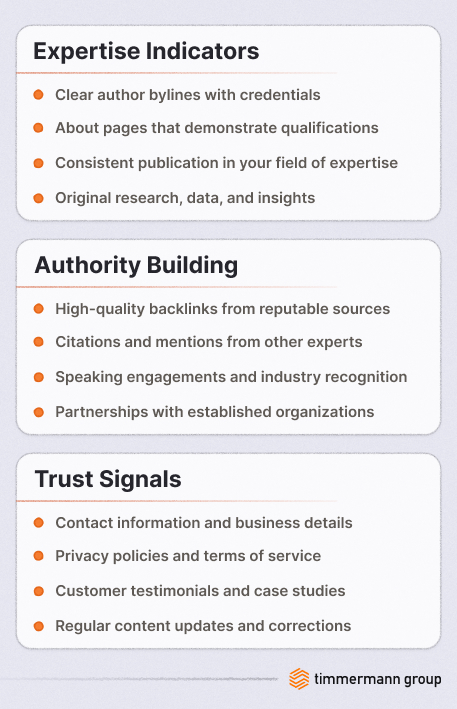
**Expertise Indicators**:
- Clear author bylines with credentials
- About pages that demonstrate qualifications
- Consistent publication in your field of expertise
- Original research, data, and insights
**Authority Building**:
- High-quality backlinks from reputable sources
- Citations and mentions from other experts
- Speaking engagements and industry recognition
- Partnerships with established organizations
**Trust Signals**:
- Contact information and business details
- Privacy policies and terms of service
- Customer testimonials and case studies
- Regular content updates and corrections
Building expertise that Claude recognizes requires demonstrating knowledge through your content rather than simply claiming expertise through credentials alone. While author credentials matter, Claude places equal weight on whether your content actually demonstrates the depth of knowledge that those credentials suggest. This means your content needs to include specific examples, detailed explanations, and insights that only someone with genuine expertise in the field would be able to provide. The AI can identify superficial content that lacks substantive insights, but an seo specialist still brings the judgment needed to separate authentic expertise from surface-level claims, making authentic expertise more valuable than ever.
### Optimize for Recency When Relevant
Claude considers content freshness, especially for time-sensitive topics, but the AI’s approach to evaluating recency is more nuanced than traditional search engines. Claude doesn’t simply favor the newest content – instead, it evaluates whether information has become outdated and whether newer information is more accurate or complete. Even with proper keyword research and satisfaction of search intent, this distinction is crucial because it means that well-maintained evergreen content can continue to perform well even when newer content exists on the same topic.
For topics where information changes frequently, such as technology, current events, regulatory changes, or local SEO, maintaining current information becomes critical for Claude optimization. The AI is trained to recognize when information might be outdated and to prioritize sources that demonstrate ongoing attention to accuracy and completeness. Regular updates to evergreen content with new statistics, examples, and developments show Claude that your content remains accurate and relevant.
Maintain content relevance by clearly publishing and updating content with last-modified dates, which provide important signals about information currency. Timely coverage of industry news and trending topics in your expertise area also demonstrates to Claude that you’re actively engaged with current developments in your field, which enhances your overall authority on related subjects.
## Content Formats Claude Prefers
Different content formats serve different purposes in Claude’s evaluation process, and understanding these preferences can help you structure your content strategy more effectively for improved search visibility. The AI doesn’t just randomly prefer certain formats – its preferences are based on how well different content types serve the goal of providing accurate, comprehensive answers to user questions.
### Long-Form Comprehensive Guides
Claude often uses detailed, [comprehensive content](https://www.wearetg.com/blog/long-form-content/) that thoroughly covers topics because this type of content is more likely to provide complete answers to complex questions. The AI has learned that longer, more detailed content typically contains more useful information and demonstrates greater expertise than shorter, surface-level pieces. However, length alone isn’t sufficient – the content must be well-organized and genuinely comprehensive rather than simply verbose.
Create in-depth guides that address topics from multiple angles, include practical examples and case studies that demonstrate real-world application, provide actionable steps and recommendations that readers can implement, and reference credible sources and data to support your points. The key is providing value density – every section should contribute meaningfully to the reader’s understanding of the topic.
### FAQ and Q&A Content
Structured question-and-answer content performs exceptionally well because it matches Claude’s goal of performing a web search for the purpose answering specific user questions directly. This format alignment makes FAQ content particularly valuable for Claude optimization. When you create FAQ content, you’re essentially providing Claude with pre-structured answers that can be easily extracted and used in responses to similar user queries.
The most effective FAQ content anticipates the full range of questions users might have about a topic and provides comprehensive answers rather than brief, superficial responses. This approach not only serves Claude’s needs but also demonstrates your deep understanding of your audience’s concerns and pain points.
### Data and Research Content
Original research, surveys, and data analysis are highly valuable to Claude because they represent primary sources of information that cannot be found elsewhere and support deep research. This uniqueness makes such content particularly authoritative in Claude’s evaluation process. The AI has been trained to recognize and prioritize original research over aggregated or summarized content, making this type of content especially powerful for building authority and expertise signals while supporting stronger content generation and helping generate articles grounded in original data.
## Measuring SEO Success with Claude
Traditional SEO metrics like rankings and click-through rates don’t directly apply to Claude optimization, which creates challenges for marketers accustomed to tracking specific performance indicators. The fundamental difference is that Claude optimization success isn’t measured by whether users click through to your website, but rather by whether Claude finds your content valuable enough to use when answering questions. This shift requires developing new ways to measure success and understand the impact of your optimization efforts.
The challenge with measuring Claude optimization success is that much of the impact happens behind the scenes – Claude may be using your content to inform its responses without directly citing or linking to your website. This means that traditional referral traffic metrics may not fully capture the value you’re receiving from Claude optimization efforts.
### Content Discovery and Usage Signals
Understanding whether Claude is discovering and using your content requires looking at both direct and indirect indicators of success. Direct indicators provide clear evidence of Claude engagement, while indirect signals suggest that your content is being recognized as authoritative and valuable by AI systems more broadly.
Stronger authority signals can give your content a competitive edge and, in some workflows, make Claude a secret weapon for identifying what competitors miss.
**Direct Indicators**:
- Increases in organic traffic from AI-driven search queries
- Mentions and citations in Claude responses (when trackable)
- Referral traffic from AI-generated content
**Indirect Quality Signals**:
- Improved search rankings for question-focused queries
- Increased backlinks from authoritative sources
- Higher engagement metrics and longer time-on-page
- More social shares and expert citations
The indirect signals are particularly important because they indicate that your content quality improvements for Claude optimization are also being recognized by other systems and human experts. When you create content that meets Claude’s standards for authority and expertise, that same content typically performs better across multiple channels and platforms.
### Monitor Content Performance
Use analytics tools like Google Search Console to track how well your content performs for question-based queries with Claude AI in mind, but remember that the metrics that matter for Claude optimization may differ from traditional SEO metrics. Look for increases in traffic from long-tail, conversational search queries that mirror how users interact with Claude – these queries often indicate that your content is being found through AI-powered search systems. Digital marketing professionals can use these patterns to refine reporting and optimization workflows.
Featured snippet captures and other rich result appearances can also indicate that your content is structured in ways that AI systems find easy to understand and extract from. Direct navigation traffic, meanwhile, indicates brand authority building that supports overall trustworthiness signals that Claude values. The key is to look for patterns that suggest your content is being recognized as authoritative and useful by both AI systems and human users.
---
## Frequently Asked Questions
#### What makes Claude different from other AI tools?
Claude stands out from other AI tools due to its advanced natural language processing capabilities, enabling it to understand user intent effectively and adapt to specific content creation needs. Claude adapts to different SEO and content workflows without requiring advanced technical skills, and Claude offers flexibility for different experience levels and use cases.
#### Which AI tool is best for SEO?
The best AI tool for SEO depends on your specific needs – Claude excels at research-based content, ChatGPT at creative writing, and Jasper at marketing copy. Choose based on your content type, budget, and integration requirements.
#### Is Claude or ChatGPT better?
Neither is universally better – Claude performs well for analytical and research-heavy content while ChatGPT excels at creative and conversational writing. Your choice should depend on your specific SEO content goals and writing style preferences.
#### What is the 80/20 rule for SEO?
The 80/20 rule means 80% of your traffic comes from 20% of your content. Focus optimization efforts on your highest-performing pages and keywords for maximum ROI.
#### Does Google penalize AI content for SEO?
Google doesn’t penalize AI content specifically, only low-quality content, regardless of source. AI content that demonstrates expertise, authority, and trustworthiness can rank well.
**Categories:** SEO
---
### [Digital Marketing Trends for 2026 and Beyond](https://www.wearetg.com/blog/digital-marketing-trends/)
**Published:** January 1, 2026
**Author:** Rob Timmermann
**Content:**
The digital marketing trends shaping 2026 are not just shiny platform updates. They are changing how brands get found, earn trust, collect data, measure growth, and convert attention into revenue.
### Key Takeaways
2026 digital marketing is defined by three forces: artificial intelligence, privacy shifts, and changing consumer behavior. From Timmermann Group’s perspective, the brands that win will not chase every tactic. They will build smarter systems that turn marketing efforts into measurable growth.
- **Successful marketing strategies now blend AI-driven efficiency with human creativity** across SEO, PPC, social media marketing, email marketing, and content marketing.
- **AI-native search and analytics are accelerating fast,** from Google AI Overviews in 2024–2025 to AI-powered Google Ads campaigns and predictive analytics in 2025–2026.
- **The post-cookie pivot is here:** Google’s phased retirement of third-party cookies forces brands to deploy first-party data strategies built on direct customer consent by 2026.
- **Short-form videos, interactive content, and immersive and interactive experiences** on TikTok, Instagram, YouTube, and LinkedIn are now core attention drivers.
- **Marketing teams must rethink marketing budgets and measurement,** shifting from clicks to qualified leads, pipeline, customer satisfaction, and customer lifetime value.
## Why Digital Marketing Trends in 2026 Actually Matter
The 2023–2026 period has brought the fastest shift in the digital marketing landscape in more than 20 years. In 2023, the core digital marketing landscape is defined by the rapid rise of Artificial Intelligence (AI) automation, dominance of short-form video content, and a pivot toward first-party data collection due to privacy shifts. Since then, those pressures have only accelerated.
The core digital channels still matter. Your website, search engine optimization, PPC, email, social media, local search optimization, and analytics remain essential. What has changed is how digital marketers use them. AI search changes discovery. Social commerce changes buying. Marketing automation changes execution. Privacy changes targeting. Data analytics changes accountability.
This article focuses on practical digital marketing trends for 2026 and beyond, especially for established B2B and B2C organizations that rely on measurable growth. Timmermann Group is a full-service digital marketing agency founded in 2003, so this perspective is built from real execution across websites, paid advertising, content creation, UX, CRO, analytics, and performance marketing.
Each trend below includes what it means for your marketing strategy, your marketing team, and your marketing budgets.
## Trend 1: AI-Driven Marketing Moves From Experiments to Everyday Operations
Generative AI and machine learning have moved from pilot projects in 2023–2024 to everyday marketing operations in 2026. Marketers are aggressively adopting AI tools for rapid copy generation, audience segmentation, and deep campaign optimization. AI tools can generate text, images, and video rapidly, significantly reducing production time for digital content.
The shift is not only happening in standalone AI tools. AI is embedded in the platforms marketing professionals already use: Google Ads automated campaigns, Meta Advantage+ creative, email platforms, CRM systems, and Google Analytics predictive metrics.
According to [HubSpot’s State of Marketing Report 2026](https://www.hubspot.com/state-of-marketing), 92 percent of marketers stated that AI has already had an impact on their role, with one in five marketers planning to use AI agents to automate their marketing strategies. Research by [McKinsey & Co](https://www.mckinsey.com/capabilities/quantumblack/our-insights/the-state-of-ai) found that organizations using AI in at least one business function has increased from 78% to 88% in just one year (2024-2025), indicating a significant rise in AI adoption across industries.
A modern digital marketing strategy should use AI at three levels:
| AI use case | What it helps with |
|---|---|
| Research and ideation | Audience insights, topic clustering, keyword research and competitive analysis |
| Production | Drafting ads, landing pages, emails, images, video scripts, and social posts |
| Optimization | A/B testing, bid strategies, send-time optimization, and campaign performance analysis |
Marketers utilize predictive analytics to forecast consumer behavior, enabling targeted ad campaigns. AI is transforming digital marketing by automating tasks, providing valuable insights, and personalizing campaigns, which enhances customer engagement and loyalty.
Personalization is a major part of this shift. Personalization enhances user experience, with 96% of marketers stating it leads to increased sales. AI-driven personalization allows brands to design user journeys that proactively meet customer needs, creating highly relevant interactions. Data collection and AI play a central role in personalizing marketing experiences, enabling brands to create more relevant and engaging interactions.
> The goal is not to remove humans from marketing. The goal is to remove bottlenecks.
## Trend 2: Search Marketing in the Age of AI Overviews and Answer Engines
Search is no longer only a list of blue links. Google AI Overviews launched globally in 2024–2025, Bing Copilot expanded AI-powered search behavior, and answer engines now summarize information before users ever click.
That matters because search engines are becoming answer engines. Research on Google AI Overviews found that they appeared in about 13.7% of trending queries overall and rose to roughly 65% for question-form queries in early 2026, according to an [arXiv study](https://arxiv.org/abs/2605.14021). Other industry analysis has found that AI summaries can reduce organic clicks, especially for informational searches.
This creates a new layer of search engine optimization: answer engine optimization, or AEO. Instead of only trying to rank, brands must structure content so AI systems can quote, summarize, and link to it.
##### Here are a few practical ways to adapt:
- Use clear headings and concise expert explanations.
- Add FAQ sections that answer natural language questions.
- Implement schema markup for products, FAQs, local business data, videos, and reviews.
- Strengthen entity signals around your brand, services, locations, and expertise.
- Optimize web pages, video, images, product feeds, and local listings together.
Voice search also belongs in this conversation. Voice search optimization is crucial as users increasingly rely on devices like Siri, Alexa, and Google Assistant to find information, necessitating businesses to optimize their content for voice queries. Voice searches are characterized by their conversational nature, leading users to ask longer, more natural questions, which requires businesses to optimize for long-tail keywords and natural language. Incorporating structured data markup can enhance visibility in voice search results, as it helps search engines understand the content better and provide accurate answers to voice queries.
PPC is changing too. Google Ads features such as AI Max-type campaigns and Performance Max-style automation can expand keywords, audiences, creatives, and placements. Paid search is becoming more automated, more conversational, and more dependent on clean conversion data.
That means marketing teams should connect Google Analytics 4, CRM platforms, call tracking, and ad platforms. The point is to optimize campaigns around real outcomes: qualified leads, opportunities, sales, and revenue. Clicks and form fills are still useful, but they are not the finish line.
For 2026 and beyond, SEO and PPC should work together as one search strategy. Organic content builds authority. Paid advertising captures demand. Web analytics shows what converts. CRM data shows what becomes the pipeline.
## Trend 3: First-Party Data, Data Security, and Privacy-First Personalization
Privacy is now a growth issue, not just a compliance issue. Google’s phased retirement of third-party cookies, rolling through 2025–2026, is forcing brands to prioritize first-party data, consent, and data security.
##### A strong first-party data foundation in 2026 includes:
- Consent-based email lists
- CRM records
- Loyalty and account data
- On-site behavioral data collected through privacy-compliant analytics
- Customer data from forms, purchases, calls, chats, and logged-in experiences
Interactive elements like quizzes, polls, and interactive surveys are being used to gather zero-party data in the absence of third-party cookies. That matters because zero-party data comes directly from the user, often in exchange for a better recommendation, offer, or experience.
Data security and trust must be part of the marketing strategy. Marketers should work closely with IT and legal teams to ensure encryption, role-based access, transparent privacy notices, consent records, and robust security measures. Mishandling data now directly impacts brand reputation, marketing effectiveness, and campaign performance.
##### Alternatives to third-party targeting include:
- Contextual targeting
- Lookalikes based on first-party audiences
- Server-side tagging
- Clean rooms and privacy-safe data partnerships
- Stronger segmentation inside CRM and email platforms
This does not mean personalization is dead. It means personalization must be earned. Brands can still deliver personalized marketing messages, tailored offers, and relevant customer journey experiences, but they must do it with clear consent and responsible data ethics.
## Trend 4: Short-Form, Interactive, and Immersive Content Dominates Attention
By 2026, video marketing will no longer be optional. Video content is now a central pillar of digital marketing strategies, with short videos becoming essential formats for quickly capturing consumers’ attention.
Short-form videos, particularly on platforms like TikTok, Instagram Reels, and YouTube Shorts, are effective in conveying clear, captivating messages in less than 60 seconds, aligning with the short attention span of modern consumers. These formats are powerful across B2C and increasingly B2B, especially when they are platform-native.
That means brands should not simply repost the same asset everywhere. A strong social media strategy adapts content for each environment:
- **TikTok:** fast hooks, creator-style editing, trends, explainers
- **Instagram Reels:** product moments, lifestyle, behind-the-scenes, UGC
- **YouTube Shorts:** educational clips, demos, myth-busting, highlights
- **LinkedIn video:** thought leadership, hiring, events, customer proof
Livestreaming is becoming increasingly important in digital marketing, allowing brands to create real-time interactions with their audience, which reinforces brand authenticity and stimulates engagement.
Interactive content also deserves more attention. Quizzes, calculators, product finders, polls, and live Q&A can improve customer engagement while collecting first-party or zero-party data. A B2B company might use an ROI calculator to qualify leads. A retailer might use a product finder to recommend the right item. Both formats help marketers understand user behavior while improving the experience.
Augmented reality and virtual reality are also moving from novelty to practical experimentation. Augmented reality (AR) and virtual reality (VR) are transforming the digital marketing landscape by offering immersive and interactive experiences that allow consumers to engage with products in a playful and engaging way. AR superimposes digital elements onto the real environment, enhancing perceived reality, while VR immerses users in a completely virtual world, creating interactive environments for product testing.
The integration of AR and VR in marketing campaigns can boost engagement, reduce product returns, and create unique experiences that leave a lasting impression on consumers. For ecommerce, that might mean try-before-you-buy experiences. For B2B, it might mean equipment visualization, trade show demos, or virtual product walkthroughs.
##### The practical approach is to build content calendars around three layers:
1. Short-form videos for reach and frequency
2. Interactive content for engagement and data collection
3. Longer anchor assets, such as guides, webinars, case studies, and comparison pages for SEO and sales enablement
This is how content marketing supports both attention and conversion.

## Trend 5: Social Media Shifts to Commerce, Communities, and Messaging
Social media in 2026 is less about vanity metrics and more about revenue, retention, direct conversations, and communities. Likes still tell part of the story, but they do not prove marketing success.
Social commerce has experienced phenomenal growth, transforming how consumers discover and purchase products online, particularly on platforms like Instagram, Facebook, and TikTok. On Instagram, businesses can create virtual storefronts that allow users to discover products and make purchases without leaving the app, enhancing the shopping experience. Social commerce reduces friction in the buying journey by making the purchasing process faster and more direct, allowing brands to target specific audiences through platform algorithms.
This is especially important for DTC and retail brands, but B2B companies should pay attention too. LinkedIn, niche communities, webinars, and private groups are becoming important parts of the customer journey.
##### Private and semi-private spaces are also growing:
- DMs
- WhatsApp
- Group chats
- Broadcast channels
- Customer communities
- Member-only content hubs
These spaces support nurturing, support, repeat sales, and customer loyalty. They also create stronger feedback loops between brand and audience.
User-generated content is another major piece of the social shift. User-generated content (UGC) is any type of content that users post about a product on their social media profiles, functioning similarly to word-of-mouth marketing. Over 80 percent of consumers believe that UGC improves product discovery, brand trust, and experience, making it a valuable asset for marketers. Brands are increasingly relying on UGC as a cost-effective way of promoting brand awareness in a manner that feels organic to the typical viewer.
Influencer marketing is changing as well. Influencer marketing is evolving towards more ethical practices as consumers increasingly demand transparency and accountability from brands and influencers. Brands are now prioritizing partnerships with influencers who align with their values, particularly those committed to social, ecological, or ethical causes, to enhance credibility and authenticity. The rise of the ‘de-influencer’ movement reflects a growing consumer backlash against excessive consumption promoted by influencers, pushing brands to adopt more responsible marketing strategies.
This connects directly to ethical and sustainable marketing. Consumers prefer transparency and social responsibility, leading brands that communicate their ethical practices and sustainability initiatives to see higher loyalty from eco-conscious demographics. Sustainable marketing is no longer a separate campaign theme. It is part of brand trust.
A balanced social media marketing plan should combine always-on organic content, performance-focused paid social, creator collaborations, community engagement, and clear measurement across various marketing channels.
## Trend 6: Full-Funnel, Integrated Measurement and Smarter Marketing Budgets
In 2026, leadership expects marketing teams to prove impact across the full funnel: awareness, engagement, leads, SQLs, pipeline, revenue, and lifetime value.
That requires better implementation of Google Analytics 4, Google Search Console, CRM platforms, call tracking, UTM standards, server-side tagging, and clean reporting. These tools can help measure campaign performance, but only when they are connected properly and governed consistently.
Marketing budgets are also changing. There is less tolerance for isolated vanity campaigns and more investment in multi-channel programs that connect SEO, PPC, paid social, email, CRO, and website design around clear revenue goals.
##### A useful marketing report should answer questions like:
- Which marketing channels are creating qualified leads?
- Which advertising campaigns influence the pipeline?
- Which landing pages convert best on mobile devices?
- Which content supports sales conversations?
- Which audiences have the strongest lifetime value?
- Where should we reduce waste and reallocate spend?
Brands should move beyond last-click attribution. Blended models, incrementality testing, and CRM-based reporting help show how channels like CTV, display, video, social media platforms, and online advertising influence lead quality over time.
This is where real-time data analysis can enhance campaign performance. Instead of waiting until the end of a quarter, teams can adjust bids, creative, landing pages, and audiences while campaigns are still active.
## How to Turn 2026 Digital Marketing Trends into a Cohesive Strategy
Chasing every new marketing trend is unsustainable. The better approach is to choose the trends that match your target audience, resources, sales cycle, and growth goals.
##### Here is a simple framework:
1. **Audit your current channels and data:** Review website performance, SEO visibility, paid media, CRM quality, email lists, analytics, CRO, and reporting.
2. **Identify 2–3 highest-impact priorities:** Examples include AI search optimization, a first-party data program, short-form video, interactive content, or improved conversion tracking.
3. **Run 90-day pilots:** Give each pilot a clear hypothesis, owner, budget, and key performance indicators.
4. **Scale what works:** Increase investment in proven campaigns, pause weak tactics, and update the roadmap monthly.
Upskill your marketing team in AI literacy, experimentation, analytics, and data ethics. The marketing industry will keep changing through 2027 and beyond, so the best advantage is adaptability.
You should also create an integrated roadmap that connects website UX and CRO, search engine optimization, PPC, social media marketing, email, analytics, and content creation under one measurement plan. The American Marketing Association often frames marketing around creating and delivering value; in 2026, that value must be measurable, privacy-conscious, and relevant across digital channels.
Timmermann Group partners with businesses to design and execute these roadmaps for Conversions, not Diversions. Schedule a 30-minute consultation to learn how TG can help you build sustainable momentum compounding growth.
---
## FAQ: Digital Marketing Trends for 2026 and Beyond
#### Which digital marketing trend should my business prioritize first in 2026?
Prioritizing digital marketing trends depends on your business goals, industry, and resources. However, a strong starting point is leveraging AI-driven marketing to enhance personalization and campaign optimization. Building a robust first-party data strategy is also crucial due to privacy shifts. Additionally, integrating short-form video content and interactive experiences can effectively engage modern consumers. Timmermann Group recommends assessing your current channels and focusing on 2–3 high-impact trends that align with your audience and growth objectives.
#### How can my business leverage AI to improve digital marketing campaigns?
AI can be leveraged to automate content creation, optimize ad targeting, forecast consumer behavior, and personalize user experiences. Using AI tools embedded in platforms like Google Ads and Meta can streamline campaign management and improve ROI. Predictive analytics helps tailor messaging based on consumer preferences, while AI-driven personalization creates relevant user journeys that boost engagement and conversions.
#### What role do emerging technologies like AR and VR play in 2026 marketing strategies?
Augmented reality (AR) and virtual reality (VR) offer immersive, interactive experiences that enhance consumer engagement. Brands can use AR for virtual product trials or visualization, reducing product returns and increasing satisfaction. VR enables virtual environments for product demonstrations or trade shows. Integrating these technologies into digital marketing campaigns helps brands stand out and create memorable customer interactions.
#### How is growing consumer demand influencing digital marketing trends?
Growing consumer demand for personalized, authentic, and seamless experiences is driving trends such as hyper-personalization, social commerce, and community-first marketing. Consumers expect brands to respect privacy while delivering relevant content and convenient purchasing options. Marketers must adapt by combining data-driven insights with ethical practices to meet evolving consumer preferences in the digital world.
#### Why is first-party data more important than ever in 2026?
With the retirement of third-party cookies and increasing privacy regulations, first-party data collected directly from consumers is vital for effective targeting and personalization. It enables marketers to build trusted relationships, deliver relevant content, and comply with privacy standards. Using interactive tools to gather zero-party data further enhances understanding of consumer preferences, ensuring marketing campaigns remain impactful and respectful.
**Categories:** Strategy
---
### [Best Fonts for Law Firms: The 2026 Guide to Legal Typography](https://www.wearetg.com/blog/best-fonts-for-law-firms/)
**Published:** May 15, 2026
**Author:** Rob Timmermann
**Content:**
Your law firm’s font choice sends a powerful message before a client reads a single word. Fonts significantly impact first impressions, influencing how seriously a document is taken and how a law firm is perceived by clients. Whether you are designing business cards, refreshing your website, or standardizing court filings, fonts matter in both formal filings and client-facing materials because the typography you select directly affects your professional credibility.
The choice of font in legal documents reflects professionalism and attention to detail, which are crucial for building trust with clients and making your [law firm’s marketing](https://www.wearetg.com/industry/law-firm-marketing-agency/) a success. Your typography works alongside your logo and color palette to establish clear brand recognition. Using a consistent font across all branding materials reinforces brand identity and helps clients recognize a law firm more easily.
This comprehensive guide breaks down the best fonts for lawyers, fonts for legal documents, legal document guidelines, and how to select the right font to balance tradition with modern digital demands.
### Key Takeaways
- **First Impressions Matter:** The right law fonts convey authority and attention to detail, shaping client perception before text content is even read, which is one reason legal fonts matter.
- **Medium Dictates Style:** Serif fonts excel in printed legal documents, while sans serif fonts dominate digital platforms and mobile devices.
- **Compliance is Mandatory:** Many courts mandate specific typefaces and font size rules; ignoring court rules can lead to formatting rejections.
- **Consistency Builds Brands:** Maintaining font consistency across websites, emails, and print strengthens the firm’s branding and recognition.
## Serif vs. Sans Serif: Structural Differences and Legal Value
Understanding font typography starts with the two primary typeface categories used by legal professionals.
#### Serif Fonts
Serif fonts have small decorative lines or strokes at the ends of each letter. Historically associated with printed materials like newspapers and books, they convey a deep sense of trustworthiness, authority, and reliability.
In printed legal documents such as contracts, legal briefs, and pleadings, serif fonts improve readability because the decorative “serifs” guide the reader’s eye smoothly along long lines of text. Classic examples include Times New Roman, Garamond, and Century Schoolbook.
#### Sans Serif Fonts
Sans-serif fonts lack decorative strokes, resulting in a cleaner, geometric, and more modern appearance. A sans serif typeface offers clean lines that enhance legibility on digital screens, particularly at smaller sizes or on mobile devices.
Fonts like Helvetica, Open Sans, and Calibri are favored for law firm websites, marketing materials, and legal emails because they minimize visual clutter in digital formats. While ideal for screens, sans-serif fonts tend to feel less formal in printed legal documents than traditional serif options.

## Top 6 Best Legal Fonts for Law Firms
### 1. Century Schoolbook
Century Schoolbook is the gold standard for formal legal writing and appellate work. This classic serif font was engineered for educational clarity and offers superior character tracking.
- **Why it stands out:** Under Supreme Court rules, Century family faces are treated as court-approved fonts for formal brief formatting in this United States Court context, which underscores how closely legal typography is tied to compliance. Century Schoolbook is highly recommended by typography experts for its exceptional clarity and institutional authority.
- **Best used for:** Legal briefs, supreme court filings, formal contracts, and high-stakes printed legal documents.
- **Limitations:** Its traditional layout can look heavy or dated in modern web design. It often requires licensing fonts rather than relying on universal system defaults.
### 2. Open Sans
Open Sans is a humanist sans-serif typeface designed by Steve Matteson that has become a premier choice for modern web design.
- **Why it stands out:** It balances an approachable tone with corporate professionalism. Optimized specifically for screen reading, it scales beautifully across desktop browsers and mobile devices without losing its shape.
- **Best used for:** Law firm websites, web fonts, digital newsletters, and client letters where formatting rules are flexible.
- **Limitations:** Because it is one of the common fonts used across the internet and on lawyer websites, it provides lower baseline brand recognition unless paired with a highly distinct custom font for headings.
### 3. Georgia
Georgia offers a perfect compromise for firms that want classic serif authority but operate primarily in digital formats.
- **Why it stands out:** Georgia is a serif typeface designed specifically for screen reading. While traditional print serifs like Times New Roman break down or pixelate on lower-resolution screens, Georgia maintains clarity and formality expected in professional legal writing.
- **Best used for:** Website body text, digital contracts, blog posts, and electronic client documents.
- **Limitations:** It may carry slightly less institutional weight than Century Schoolbook when printed for federal court filings.
### 4. Montserrat
Montserrat is a geometric sans serif font that brings contemporary sophistication to law firm branding.
- **Why it stands out:** Inspired by historic urban signage, its clean, wide letterforms project a progressive, confident corporate identity. It works beautifully in high-contrast layouts and pairs naturally with complementary fonts, whether that means serif headings or a serif body counterpart depending on the layout.
- **Best used for:** Law firm logos, business cards, presentation slides, and marketing materials.
- **Limitations:** It is far too stylized and modern for printed court filings or dense legal briefs.
### 5. Times New Roman
Times New Roman is the most widely recognized typeface in the legal industry, built for maximum space-efficiency and compatibility.
- **Why it stands out:** Times New Roman is widely accepted as a baseline best font for legal documents due to its historic readability and traditional appearance, and it remains one of the certain fonts commonly accepted for legal documents when local rules do not specify a different face, making it a default standard choice for court filings and legal briefs across the globe.
- **Best used for:** Traditional legal documents, standard contracts, and jurisdictions where older print standards remain mandatory.
- **Limitations:** It is frequently critiqued as generic and can look cramped on modern displays. In fact, some jurisdictions are stepping away from it—the U.S. Court of Appeals for the Seventh Circuit actively discourages Times New Roman for electronic documents, noting that its narrow structure hinders quick screen skimming. Acceptance still depends on jurisdiction because certain fonts are allowed in some courts and discouraged in others.
### 6. Helvetica
Helvetica is the pinnacle of minimalist modernism. It communicates stability, logic, and meticulous organization without unnecessary flair.
- **Why it stands out:** Helvetica is frequently used for its neutral, modern look. Font designers created fonts like Helvetica to favor clean, geometric neutrality, making it an excellent professional font for conveying pure competence.
- **Best used for:** Corporate law firm logos, firm signage, and clean print collateral, such as brochures or business cards.
- **Limitations:** It is not pre-installed on all operating systems, which can cause display inconsistencies unless properly licensed. It can also become difficult to read in extended blocks of text at a very small font size.
## Quick Font Comparison Table
| Font Family | Best Primary Use Case | Typeface Style | Cost & Accessibility | Court Compliance Insights |
|---|---|---|---|---|
| Century Schoolbook | Court documents & appellate briefs | Serif | Requires licensing | Mandated by the US Supreme Court |
| Open Sans | Law firm websites & digital copy | Sans-serif | Free (Google Fonts) | Generally accepted for digital formats |
| Georgia | Digital contracts & electronic briefs | Serif | Standard system font | Highly accepted for digital reading |
| Montserrat | Law firm branding & modern logos | Sans-serif | Free (Google Fonts) | N/A (Keep strictly to branding/marketing) |
| Times New Roman | General court filings & standard contracts | Serif | Standard system font | Widely accepted, though fading in some circuits |
| Helvetica | Firm logos, stationery, & signage | Sans-serif | Requires licensing | Generally accepted; preferred by specific circuits |
### Jurisdiction-Specific Variations
Always double-check your local court rules, as mandates vary widely by location:
- **Florida Supreme Court:** Explicitly requires Bookman Old Style (or Courier New) for computer-generated filings due to its high legibility.
- **Second and Seventh Circuits:** Frequently favor and utilize Palatino.
- **Connecticut Appellate Courts:** Mandate the use of Arial or Univers.

## Technical Typography Rules: Size and Spacing
Selecting the right font style is only half the battle; proper formatting ensures legal documents remain highly legible and professional.
#### Font Size Requirements
The industry standard font size for legal documents is typically 12-point. However, as courts transition to digital formats and electronic review, many jurisdictions now require a minimum font size of 14-point to reduce eye strain for readers.
#### Line Spacing (Leading)
Line spacing is crucial for structural readability. To enhance clarity and give dense text adequate room, a common recommendation—and often a strict court rule—is to set line spacing at 1.5 to 2.0 times the chosen font size.
#### Letter Spacing (Tracking)
Proper letter spacing is essential to keep characters distinct. If letter spacing is too tight, letters bleed together, hindering readability and causing confusion for the reader. Opt for font options with a balanced, natural tracking or a light, wide letter spacing for complex terms.
## How to Choose the Right Font for Your Practice
### 1. Match Your Primary Medium
When court rules do not specify a font, legal professionals typically choose between serif and sans-serif styles based on the medium. Use a consistent font family for headers, body text, and footnotes throughout a single document. The best fonts for legal work often depend on whether the piece is a filing, a website page, or another client-facing asset. For branding projects, establish complementary font pairings—such as a bold sans serif typeface for website headings paired with an elegant serif font for body text—but avoid using multiple fonts unless the hierarchy is intentional and consistent.
### 2. Align with Your Firm’s Personality
Choosing a law firm’s font should reflect its personality, market positioning, area of practice, and target legal clients, and typography is one of the key elements of its visual identity:
- **Traditional Practices:** Estate planning, criminal defense, and corporate litigation firms benefit from the heritage and institutional weight of classic serif fonts such as Garamond, Baskerville, and Century Schoolbook. Garamond is highly preferred when printing long documents because it fits more words per page while remaining exceptionally elegant and clear.
- **Modern or Tech-Forward Practices:** Firms dealing with venture capital, intellectual property, startup law, or digital entertainment look best when using clean, geometric sans-serif fonts like Open Sans or Montserrat.
A few examples of where that same font direction should stay consistent include the website, proposals, and other branding touchpoints.
### 3. Prioritize Accessibility
Legal writing must serve all readers equally. On mobile-optimized digital platforms, sans-serif fonts tend to perform better, as text wrapping is tight. In specialized instances, highly clear font choices like Verdana can be utilized because Verdana is specifically designed for legibility on small screens. Similar fonts with open counters and clear shapes are often safer accessibility choices than highly stylized alternatives.
## Sourcing and Licensing Fonts Legally
Fonts are legally protected as proprietary designs, and using them across your servers, sites, or apps without the proper license can lead to serious legal liabilities. Font licensing agreements outline strict rules and limits for use, including how many individual users or devices can install the files.
#### Where to Find Free Fonts
Many word-processing and document-creation software packages (like Microsoft Word) come pre-installed with standard fonts that can be used legally for standard document creation. For web design and marketing materials, platforms like **Google Fonts** offer an array of free, open-source, high-performance fonts (such as Open Sans and Montserrat) with permissive commercial licensing terms. Font Squirrel is another valuable database that curates certified free fonts for corporate use.
#### Where to Buy Premium Fonts
If your firm requires a highly specific visual identity or specialized typography designed specifically for legal work, you may need to purchase premium licenses. Marketplaces like **MyFonts** and **Fonts.com** offer extensive commercial licenses for premium typefaces, including complete font families with a range of weights and custom tracking profiles. For a truly elite brand identity, firms can also invest in custom font commissions to ensure their typography remains exclusive to their market presence.
---
## FAQs About Law Fonts
### What font do most lawyers use?
Historically and practically, Times New Roman remains the font most lawyers use out of sheer habit, due to its universal software availability, and because of widespread court acceptance. However, modern legal professionals are increasingly shifting toward Century Schoolbook for court submissions and Open Sans or Calibri for digital client communications.
### What font are laws written in?
There is no single global font for legislation. In the United States, public laws, bills, and federal statutes are typically typeset in highly legible, authoritative serif fonts such as Century Schoolbook or specialized variants of standard legal document fonts to ensure clean archival printing and scanning.
### What is the 3 font rule?
The 3 font rule is a foundational principle of typography that dictates that a designer should never use more than three different fonts within a single project, website, or document. Limiting your layout to a primary title font, a secondary body font, and an occasional accent font maintains a cohesive design and prevents visual clutter from undermining your professional authority.
### What is the classic font for lawyers?
The classic font for lawyers is Times New Roman or Century Schoolbook. These typefaces carry long historical ties to printing presses, appellate courts, and formal legal documents, making them universally synonymous with institutional trust and rigorous legal scholarship.
### Why should law firms avoid using Comic Sans?
Comic Sans should be strictly avoided because its casual, childlike design instantly breaks down professional credibility and authority. While it is sometimes praised for helping individuals with dyslexia read more easily due to its asymmetric shapes, legal professionals looking to accommodate clients with reading challenges should instead use a professional, open-source font option like OpenDyslexic, which provides specialized accessibility while maintaining a respectful corporate appearance.
**Categories:** Branding
---
### [SEO Pricing Packages: How Much Should You Spend on SEO in 2026?](https://www.wearetg.com/blog/seo-pricing/)
**Published:** May 19, 2026
**Author:** Rob Timmermann
**Content:**
Evaluating SEO pricing can feel incredibly confusing. You can put your project in front of two different vendors who both promise comprehensive search engine optimization, yet they return wildly different numbers. One automated proposal pitches a baseline tier at $500 per month, another quotes an integrated campaign at $8,000 per month, and a third recommends a one-time, deep-dive SEO audit before any baseline work begins.
Why is the gap so massive? This 2026 SEO pricing guide breaks down what companies actually pay, what factors directly impact SEO pricing, which SEO pricing models make strategic sense, and how TG approaches custom pricing for brands that want legitimate business outcomes over vanity metrics.
### Key Takeaways
- **The Baseline Investment Range:** In 2026, most businesses investing in professional seo services spend roughly $1,500 to $10,000+ per month. At a local level, a local SEO cost model usually ranges from $800 to $2,500 per month. National expansion models range from $3,000 to $12,000+ per month, while enterprise SEO systems scale from $10,000 to over $25,000 per month.
- **Core Price Drivers:** Final SEO cost metrics are never pulled from a hat. They are heavily influenced by your existing website complexity, regional footprint, business timelines, aggressive growth goals, and the competitive landscape of your industry.
- **Standard Business Mechanics:** A structured monthly retainer continues to dominate the industry as the most trusted pricing model. However, specific flat-fee milestone setups or fixed hourly seo structures are frequently deployed for standard setup tasks like platform migrations, localized setup initiatives, and standalone corporate training.
- **The Unified Growth Engine Framework:** At TG, we do not view search strategy through an isolated lens. True online expansion happens when you treat organic discovery as a unified ecosystem—interlocking organic search mechanics with PPC data, UX/CRO enhancements, structured content generation, and deep attribution modeling.
- **Evaluating ROI Over Initial Costs:** A business seeking real growth must assess long-term project viability based on transparent execution strategies and proven compounding returns, rather than hunting for an intentionally cheap SEO vendor or a massive legacy agency name.
## How Much Does SEO Cost in 2026?
For a modern business aiming to capture sustainable market share, real professional seo services generally require a monthly commitment between $1,500 and $10,000. When scaling across the country or managing thousands of indexable assets, the investment parameters naturally widen.
To look directly at the macroeconomic landscape, the overall average cost of SEO options in 2026 falls within the $2,500 to $3,500 per month range for a standardized monthly retainer, while independent project scopes range from $5,000 to $30,000, depending entirely on architectural scale and market friction. Industry platform studies published in early 2026 further reinforce this, reporting that the baseline average monthly retainer price across experienced SEO companies is right around $3,199 per month.
| Tier / Campaign Focus | Average Low Estimate (Monthly) | Average High Estimate (Monthly) |
|---|---|---|
| **Local SEO Campaigns** | $500 | $2,500 |
| **National SEO Initiatives** | $2,500 | $12,000+ |
| **Enterprise SEO Programs** | $4,000 | $25,000+ |
| **Hourly Consulting & Strategy** | $100 / hour | $350 / hour |
On a broad macroeconomic level, the average cost of **comprehensive SEO services** globally can range from a nominal $50 to $30,000 per month, depending on a variety of operational factors. That wide structural range explains why throwing out a general question like “*how much does seo cost?*” or “*how much seo costs?*” is virtually impossible to answer accurately without first evaluating your specific market vertical, site history, and growth targets.
> **A Warning on Discount Services:** Chasing an introductory retainer in the $200 to $500 per month range generally yields minimal operational returns. At that price point, providers cannot afford customized attention; you typically receive generic automated reports, shallow page optimization, and basic keyword research templates. They lack the resources to build a tailored SEO strategy, tackle technical fixes, or secure high-impact backlinks.
At TG, our full-service ongoing retainers typically range between $3,000 and $12,000 per month. This structural pricing is scaled to reflect an integrated approach that connects organic search visibility with targeted paid media, user experience refinements, and detailed analytics tracking.
## Key Factors That Drive SEO Pricing
The fundamental pricing model you choose sits directly atop real-world operational inputs. Total SEO service costs vary heavily based on market resistance, physical asset sizes, and the depth of execution required.
Before sketching out a proposal or recommending a monthly retainer, our team at TG digs deeply into six primary variables during our initial discovery and diagnostic phases.
### Competition and Industry
Industries subject to strict regulatory demands or high digital density—such as legal counsel, medical systems, financial institutions, and enterprise SaaS platforms—typically incur higher SEO costs and require substantially larger budgets. The underlying layer of industry competition fundamentally impacts overall SEO pricing structures; fighting for visibility against massive competitors requires more aggressive execution, larger content footprints, and greater long-term investment to achieve your ranking targets.
For example, a high-stakes personal injury firm fighting for market visibility in a major metro like Chicago will require relentless content publishing, advanced technical updates, and high-authority link acquisition. Conversely, an industrial custom fabrication facility based in a smaller midwestern hub like Des Moines can often capture valuable regional visibility with clean, intentional technical work and highly focused commercial content priced comfortably in the $1,000 to $4,000 monthly tier. We build a custom competitive gap analysis within the first 30 to 45 days of an engagement to map out where your competitors are vulnerable before assigning an exact investment scale.
### Geographic Scope: Local vs National vs International
The physical footprint of your target audience directly dictates your operational overhead; targeted local SEO footprints naturally demand fewer resources and lower budgets than scaling out nationwide or international search projects.
- **Local Footprints:** Local work focuses on a specific city or the immediate metro region. These projects rely heavily on a well-managed Google Business Profile, structured citation consistency, proactive localized reviews, and geo-targeted landing pages.
- **National Footprints:** Launching a national SEO project typically requires 2x to 4x the investment in resources. You are no longer competing against a handful of local businesses; you are fighting the entire country, which demands higher content velocity, a stronger off-page SEO presence, and serious site authority.
- **International Footprints:** Stepping into international markets introduces complex layers of architecture, such as hreflang deployment, localized international keyword research, and language-specific link building. These enterprise-level international setups often start in the mid-four figures per month and quickly scale beyond $25,000, depending on regional complexity.
Our strategic playbook focuses on sustainable scaling; we frequently guide brands from localized dominance into regional and national search markets over an intentional 12 to 24-month period to ensure your revenue supports the expansion.
### Website Size, Age, and Technical Health
The raw scale and technical design of your web property directly drive up the required labor hours. A pristine 20-page service site requires significantly less effort than a massive 2,000-page enterprise eCommerce store struggling with duplicate URLs, slow Core Web Vitals, tangled architecture, and deep crawl errors.
Executing deep technical SEO audits often reveals architectural issues that require development time to fix before your content can rank. This is why we kick off our engagements with an extensive technical review during the first 30 to 60 days, giving us the clarity needed to adjust ongoing retainer targets or recommend a one-time structural fix.
### Goals, Timeline, and Risk Tolerance
Your internal business goals and timeline will directly shape your strategic roadmap and seo cost profile. Aiming to double organic search revenue within a tight 9-month window requires a massive spike in content production, aggressive backlink acquisition, and rapid technical execution compared to an incremental 24-month roadmap.
True, high-value organic search expansion compounds naturally over time. Attempting to trick search engines through thin-content generation or questionable backlink tactics carries a significant risk of penalties that can cripple a brand’s long-term digital footprint.
Most businesses see initial momentum within 4 to 8 weeks, with clear, high-impact results crystallizing within months 6 to 12 months. The opening 60 days are overwhelmingly focused on cleaning up foundational elements and preparing your site for early ranking shifts.
### Scope of Work: What’s Actually Included
The specific services baked into your campaign directly shape your overarching seo services pricing model. Comprehensive, high-tier campaigns covering technical optimization, large-scale content creation, and strategic backlink acquisition naturally command a higher investment than basic metadata management packages.
An integrated, full-scale campaign covers a lot of ground:
- Continuous technical optimization and schema injection.
- Deep on-page optimization and search intent matching.
- Thorough content asset strategy and premium content execution.
- Modern link building and digital PR outreach.
- Conversion path analysis and user behavior tracking.
In modern search marketing, strategic content production represents a major line item, particularly when your vertical requires highly technical, authoritative, and deeply researched writing. Furthermore, a significant portion of major search budgets is allocated directly to content placement fees and to earning premium backlinks, which carry an industry-average cost of roughly $509 per high-tier link.
### Team Composition and Expertise
Working with solo seo freelancers can offer an accessible, budget-friendly entry point for specialized tasks or small-scale retainers. However, independent contractors often lack the broad bandwidth, diverse skillsets, and deep technical execution capabilities of a dedicated agency.
Both hourly rates and long-term retainers reflect the caliber of the seo professionals assigned to your account. When you partner with an agency, your budget funds a multi-disciplinary team: senior search strategists, deep technical specialists, specialized copywriters, front-end developers, and data engineers. At TG, we deploy an integrated team model to eliminate costly errors, speed up execution, and convert organic visibility into real business outcomes.

## SEO Pricing Models Explained
Modern SEO agencies typically operate across three core SEO pricing models: predictable monthly retainers, flat, fixed-fee projects, or specialized hourly consulting.
The ideal option depends entirely on your internal capabilities, site health, and ultimate growth goals. At TG, we tailor our structural engagement models to your unique needs rather than locking brands into restrictive plans before confirming a strong strategic fit.
### Monthly Retainer SEO
The monthly retainer is the definitive standard across the modern digital marketing landscape, with roughly 87% of established SEO agencies using this model. This setup gives businesses predictable, easily budgeted monthly costs while ensuring the continuous, rhythmic effort required to win at search.
Ongoing monthly tiers generally start around $3,000 for mid-market brands and scale to over $20,000 for large enterprise names. These ongoing agreements bundle ongoing strategy, on-page optimization, content production, backlink outreach, and performance visibility into a single operational monthly cost. Because search engine algorithms rarely reward short-term work, most experienced firms establish 6 to 12-month introductory commitments to allow the campaign’s compounding effects to take hold.
### Project-Based SEO
A project-focused pricing model isolates specific, highly defined deliverables tied to a strict timeline. This approach is ideal for companies that have clear, standalone technical needs or want a one-time optimization push rather than ongoing management.
Common examples of project-based work include:
- Completing comprehensive technical seo audits.
- Executing complex CMS site migrations or domain rebrands.
- Initial Google Business Profile optimization and local citation building.
- Auditing and recovering from a previous low-quality or cheap SEO penalty.
In 2026, standard strategic roadmaps and standalone audits typically range from $2,500 to $7,500. Enterprise site migrations, multi-domain overhauls, or intricate content strategy blueprints routinely command fixed project fees ranging from $15,000 to $30,000+, depending on architectural scale.
### Hourly SEO Consulting
Retaining an agency or specialist for hourly SEO work typically runs between $100 and $350 per hour in North America. This pricing scale is influenced by the consultant’s years of experience, past performance history, and niche technical specialization.
This model works exceptionally well for high-level CMO advisory sessions, training internal marketing departments, planning site redesign architectures, or getting a thorough second opinion following a sudden drop in search traffic. It provides a highly cost-effective way for internal corporate teams or DIY SEO operators to access senior strategic guidance without committing to a full-service agency execution contract.
## What You Get at Different SEO Investment Levels
The actual deliverables delivered can vary wildly, even when two providers show you identical price tags. To provide a clear macroeconomic context, here is what a business can expect to receive across the four standard investment tiers in 2026.
### Under $1,000/Month
At this budget tier, most domestic agencies can only afford to provide highly automated, minimal labor. It can provide a baseline value for very small businesses or ultra-local service businesses operating in low-density, quiet rural markets.
The operational risk here is high. You are frequently buying basic software-generated data exports, generic AI-spun content with zero editorial oversight, or low-quality backlink packages that can trigger search engine penalties. If your budget sits strictly within this tier, we typically advise using a fixed project fee to build a clean baseline strategy roadmap or leveraging targeted hourly advisory sessions to guide your internal **DIY SEO** work safely.
### $1,500–$3,000/Month
This range serves as a solid starting point for regional campaigns or competitive local seo programs. It provides the necessary resources to run a professional SEO campaign targeting real commercial opportunities.
Standard monthly deliverables in this tier generally include:
- Continuous foundational technical cleanup and monitoring.
- Google Business Profile optimization, review strategy, and local citation management.
- On-page optimization across core commercial service or product pages.
- Production of 1 to 2 high-quality, human-edited content assets per month.
- Foundational link building via relevant local associations and industry directories.
### $5,000–$10,000/Month
This investment tier represents the ideal operational sweet spot for mid-market B2B brands, multi-location companies, and expanding e-commerce operations competing across multiple cities, states, or regions.
At this tier, your campaign expands into an integrated growth engine:
- End-to-end technical support and seamless developer coordination.
- Deep content calendar production (4 to 8+ authoritative content assets monthly).
- Premium link building, digital PR outreach, and brand mention acquisition.
- Comprehensive UX/CRO evaluations to turn inbound search visits into leads.
- Advanced analytics attribution dashboards tying organic traffic to pipeline revenue.
### $10,000+/Month
This tier is standard for highly competitive national markets, massive e-commerce catalogs with tens of thousands of SKUs, and enterprise brands maintaining extensive digital footprints.
Your program secures dedicated search strategists, deep advanced technical optimization workflows, continuous high-velocity content production, scalable digital PR link acquisition, and comprehensive multi-touch attribution engineering. At this scale, sustainable long-term organic growth continues to build momentum over an 18- to 24-month period, with compounding returns driving down your blended cost-per-lead as your keyword footprint grows.
## Local, National, and International SEO: Cost and Scope Compared
The term “SEO” means drastically different things depending on whether you are fighting for local map visibility or expanding a global enterprise brand across multiple languages. We match the underlying strategy, content creation velocity, and backlink outreach directly to your geographic goals.
### Local SEO Cost and Deliverables
Local campaigns target queries with clear, immediate geographic intent—such as “*plumber in St. Louis*” or “*industrial supplier near me*“. The primary objective is securing top placement across local map packs, localized organic listings, and localized mobile search results.
In 2026, professional local campaigns average $1,000-$3,000 per month, depending on market density and vertical friction. While basic footprints in quiet markets can sometimes run between $500 and $1,000, high-stakes industries like personal injury law, dental networks, and competitive home services require a more aggressive investment. Deliverables focus heavily on localized schema, hyper-local landing pages, citation engineering, review generation playbooks, and localized backlink building.
### National SEO Cost and Deliverables
National campaigns target broad, non-geographic commercial search phrases—such as “*fleet management software*” or “*B2B payment platform*“. You are competing with every major brand in the country for high-volume informational and commercial keywords.
National programs in 2026 typically range from $5,000 to $10,000+ per month, with mid-market enterprise initiatives often falling between $5,000 and $15,000 per month. Deliverables shift toward deep thought leadership content creation, complex structural optimization, large-scale digital PR campaigns, and conversion rate optimization. Expect a realistic window of 9 to 18 months to fully carve out a dominant national position in high-value search results.
### International and Multi-Region SEO
International campaigns span multiple countries, cultures, and regional languages. This introduces complex technical frameworks, including advanced hreflang mapping, global ccTLD or subdirectory structures, regional search engine adaptations, and localized content translation.
Standard investments in 2026 start at $10,000 and scale well past $20,000+ per month, depending on the number of international markets you are entering. For example, a manufacturer expanding across the UK and Europe requires cultural search adaptations, localized product specifications, and country-specific backlink profiles. We build an international search strategy directly into a brand’s overarching digital marketing playbook, aligning seamlessly with sales priorities, global compliance rules, and engineering sprints.

## DIY SEO vs. Hiring an Agency: Cost, Time, and Trade-Offs
Many corporate leadership teams consider either managing search internally or executing basic **DIY SEO** workflows to save money. However, they often overlook the substantial internal labor costs, expensive tool requirements, and significant opportunity costs involved.
When an internal marketing manager commits 10 to 20 hours a week to search engine optimization, that amounts to roughly $4,000 to $8,000 a month in hidden salary costs alone. Additionally, equipping an internal team with a modern stack of enterprise-level seo tools, tracking dashboards, and premium indexing software adds another $300 to $800 a month in subscription overhead. Experienced SEO agencies already have these enterprise tools and possess the deep expertise to analyze data quickly.
While manual in-house management can keep a basic service site afloat, the risks of internal management include incomplete execution, outdated tactics, missed technical vulnerabilities, and content that fails to satisfy modern search engine algorithms or buyer intent. Partnering with an agency makes sense when organic search is a primary driver of company revenue, the underlying site architecture is technically complex, or your brand requires cross-channel integration across organic search, paid acquisition, conversion optimization, and analytics.
## How Timmermann Group Approaches SEO Pricing
Timmermann Group is a conversion-first digital marketing agency founded in 2003. Our operational philosophy centers entirely on *Conversions, Not Diversions*, which means our search engine optimization pricing models are built to drive verifiable pipeline expansion.
We are not a low-cost, automated high-volume fulfillment shop. We partner with ambitious, growth-oriented companies that want to build a long-term competitive advantage and are ready to integrate their organic search presence with modern user experience design, paid media tracking, and comprehensive digital marketing services.
### Our SEO Pricing Philosophy
We anchor our pricing models directly to business impact rather than charging flat hourly rates. Every engagement begins with an extensive review of your specific pipeline goals, target audience behaviors, current conversion paths, and baseline analytics. From there, we design the exact SEO strategy needed to achieve those targets.
We do not offer generic, pre-packaged SEO packages. Instead, we engineer an actionable roadmap for the initial 90 to 180 days, outline transparent project deliverables, and continuously refine our execution based on real data from Google Analytics, Search Console, keyword position shifts, and feedback from qualified leads. We are also completely comfortable telling a prospect if organic search isn’t their best growth lever right now—if your site suffers from poor conversion paths or tracking bugs, fixing those conversion issues should always come first.
### Typical TG Engagement Types and Ranges
- **Localized Growth Retainers:** Tailored for localized service brands or regional footprints, typically starting in the low thousands per month.
- **National B2B / E-Commerce Retainers:** Tailored for multi-state or country-wide visibility, typically ranging from the mid-thousands to low five figures per month.
- **Fixed Diagnostic & Migration Projects:** Deep-dive technical overhauls, compliance alignment, or site re-architecting projects priced between $5,000 and $15,000+, depending on database scale.
- **Hybrid Team Advisory Retainers:** Customized strategy direction, advanced QA testing, and technical guidance for organizations with an existing in-house content team.
## How to Set an SEO Budget That Makes Sense for Your Business
Building a highly profitable search budget requires looking closely at your internal revenue targets, market opportunities, and competitor footprints—not copying a competitor’s spend.
### Step 1: Clarify Goals and Time Horizon
Establish clear, numerical business outcomes. For example:
- Secure $1M in closed-won pipeline directly from organic channels within 18 months.
- Generate a 30% year-over-year increase in qualified product demo requests.
- Accelerate non-branded organic traffic growth while optimizing down lead acquisition costs.
Shorter growth windows require larger upfront investments and faster content deployment. Longer growth windows allow you to scale your budget more efficiently over time. When organic search is a primary customer acquisition channel, companies typically allocate 10% to 20% of their total digital marketing budget to search engine visibility.
### Step 2: Benchmark Current Performance and Competitors
Analyze your existing organic traffic baseline, primary landing page performance, keyword positions, and historical conversion metrics. Use your analytics stack and competitive intelligence tools to measure your content depth, backlink velocity, SERP feature ownership, and domain authority against your top industry competitors. This upfront benchmarking ensures you don’t underfund a campaign in a highly competitive market or overinvest in a channel where a different marketing tool would deliver faster leverage.
### Step 3: Align Budget With Expected ROI
Run a simple predictive model: calculate the volume of organic visitors required to meet your targets, factor in your current site conversion and sales close rates, multiply that by your average customer lifetime value, and project your expected returns across different investment levels.
Organic search strategy routinely delivers higher long-term financial returns than paid acquisition. Professional programs frequently generate a 3x to 5x return on your SEO investment within 12 to 18 months, while your paid media acquisition costs typically remain flat or rise over time. While PPC provides immediate visibility, organic search builds long-term value that compounds over time, lowering your long-term cost-per-lead as your keyword rankings improve and organic traffic expands. For an established brand, aiming for a 3x to 10x return over a 24-month horizon is a highly realistic benchmark.
## Red Flags in SEO Pricing (and How TG Avoids Them)
The search engine marketing space can sometimes be notorious for vague pricing models and unrealistic sales pitches. Protect your investment by keeping an eye out for these three major industry red flags.
### Guaranteed Rankings and Unrealistic Timelines
No marketing agency or consultant can promise guaranteed rankings or #1 positions within an arbitrary 30-day window. Organic search results are driven by dynamic search engine algorithms, competitive moves, user search behavior, and complex technical variables.
Any provider promising guaranteed keyword positions is likely using high-risk, automated tactics that can get your site penalized. At TG, we steer completely clear of hollow promises; we anchor our reporting to meaningful leading indicators, including indexing health, keyword footprint expansion, qualified traffic, on-site conversions, and closed-won revenue impact.
### Suspiciously Low Monthly Fees
Introductory offers like “*complete monthly SEO packages for $500*” are a major red flag. Running a high-value search campaign requires significant manual labor from experienced specialists.
Ultra-cheap retainers almost always rely on outsourced, low-quality spam techniques or automated software exports that can degrade your brand authority. Cleaning up your site architecture and domain authority after a low-quality penalty routinely costs far more than investing in a quality SEO partner from the very start.
### Opaque Deliverables and Reporting
Be highly cautious of any contract that bills for an undefined “SEO package” without detailing the specific monthly tasks, strategic outputs, transparency metrics, and clear data ownership boundaries. You should never have to guess what you are paying for each month.
A professional agency should provide clean performance dashboards, direct strategy review calls, and clear performance reports tied directly to your primary business metrics. Furthermore, your partner should be able to clearly explain how they are preparing your brand for modern search realities—including traditional SEO foundations, Google AI Overviews, and generative engine optimization. Winning at search today requires building real entity authority, deep topic utility, technical accessibility, and strong digital signals across the web.
#### Want clear SEO pricing tailored to your brand’s unique growth targets?
[Schedule a 30-minute strategy session](https://www.wearetg.com/contact/) with our team to map your current baseline, evaluate your competitive landscape, and design a custom search plan tailored to the business outcomes you actually need.
---
## FAQ: Common Questions About SEO Pricing
### Do I need to sign a long-term contract for SEO?
Many professional SEO agencies structure their agreements around 6- to 12-month commitments because search strategy requires a foundational runway to generate compounding returns. Rigid multi-year contracts are rarely necessary. At TG, we typically recommend an initial six-month commitment to build campaign momentum, transitioning into flexible, renewable terms tied directly to your performance goals and evolving business priorities.
### How often can I adjust my SEO budget?
While search campaigns thrive on consistency, your budget shouldn’t be set in stone. We recommend reviewing your investment level quarterly or semi-annually based on performance data, market shifts, or seasonal business trends. We regularly audit campaign costs and scopes alongside our clients, scaling investment when organic search outperforms other acquisition channels or reallocating resources when internal goals shift.
### Can I just pay for a one-time SEO audit and be done?
A one-time SEO audit is incredibly valuable for uncovering technical errors, mapping content gaps, and identifying immediate quick wins. It’s a smart step before launching a major site redesign, switching platforms, or migrating a domain. However, the real business value comes from consistently implementing those recommendations and adapting to algorithm updates over time—which is why we typically pair our deep-dive audits with ongoing execution support.
### How does SEO pricing compare to PPC costs?
Paid search campaigns can generate targeted traffic instantly, but each visitor incurs a direct cost per click that can rise as competition increases. Organic search requires more upfront strategy and investment, but your content assets, site architecture, and brand authority can compound to deliver long-term traffic with no direct cost per click. We often manage organic search and paid acquisition together, using paid insights to secure quick wins while building out long-term organic authority.
### What if I already have an in-house marketing team?
We love collaborating with internal teams. Many of our clients have in-house graphic designers, copywriters, or product managers, but lack deep search expertise. In these scenarios, we operate via a hybrid model—our team handles advanced technical SEO audits, keyword mapping, backlink outreach, and data engineering, while your internal staff manages content drafting and site updates under our guidance. This hybrid approach keeps your investment efficient while ensuring your strategy is executed correctly.
### What is the 80/20 rule of SEO?
The 80/20 rule (or Pareto Principle) of search marketing states that roughly 80% of your organic traffic, conversions, and revenue will be driven by 20% of your optimization efforts and content assets. Instead of trying to rank for every possible keyword, a high-value search strategy focuses on identifying and optimizing the critical 20% of high-intent keywords and core commercial pages that move the needle for your business.
By concentrating your budget on high-impact technical fixes, high-converting content assets, and high-authority backlinks, you maximize your ROI while eliminating wasted effort on search terms that don’t generate revenue.
**Categories:** SEO
---
### [Personal Injury Keywords for SEO and PPC](https://www.wearetg.com/blog/personal-injury-keywords/)
**Published:** May 14, 2026
**Author:** Rob Timmermann
**Content:**
Not all personal injury keywords make money. With the personal injury legal market exceeding $50 billion annually in the United States, law firms face fierce competition for visibility, and many waste thousands each month targeting phrases that generate traffic but not signed cases. The key to profitable keyword targeting lies in prioritizing high-intent, conversion-focused terms over vanity phrases with impressive search volume but poor conversion potential.
### Key Takeaways
- **Successful personal injury marketing blends SEO, local SEO, and Google Ads around a shared keyword strategy** rather than treating each channel separately.
- **The best personal injury keywords attract qualified, local prospects** ready to call, complete a form, or book a free consultation-not just those with big search volume numbers.
- **Some keyword types can drain budget and time** if they aren’t supported by a clear conversion plan.
- **Partnering with an experienced [personal injury SEO agency](https://www.wearetg.com/industry/personal-injury-seo/) helps law firms build a data-driven keyword plan** tied to cost per lead and cost per signed case, not just rankings.
## Why Personal Injury Keywords Can Make or Break Your Marketing
Personal injury is one of the most competitive spaces in Google search and Google Ads. By 2026, CPCs for top commercial keywords routinely reach $150 to $500+ in major metros, with some truck accident attorney terms pushing $800 per click in saturated markets.
This article focuses less on providing a long list of personal injury keywords and more on how to choose and deploy the right keywords that actually lead to signed cases and revenue.
#### What you’ll learn:
- How to evaluate personal injury SEO keywords by intent and difficulty
- Core keyword categories that drive revenue (and those that drain it)
- Channel strategy across SEO, local SEO, and PPC
- How to work with a marketing partner to maximize ROI
## What Makes a Personal Injury Keyword Worth It for Your Firm?
Rankings alone are a vanity metric. Worthwhile injury keywords are those that lead to consultations, signed cases, and profitable fees.
##### Evaluate keywords along four axes:
| Axis | What to Ask |
|---|---|
| User Intent | Does this searcher want to hire, or just research? |
| Relevance | Does this match your actual case mix (car accidents, premises liability, med mal)? |
| Difficulty | Can you realistically rank or afford to bid? |
| Case Value | What’s the potential fee in your jurisdiction? |
Use keyword research tools like Google Keyword Planner, Ahrefs, or SEMrush, combined with real intake data (call logs, forms, CRM) from your personal injury law firm, to see which search terms already correlate with qualified leads.
High-intent keywords signal a user’s readiness to hire a personal injury attorney, with phrases like “hire personal injury attorney” indicating immediate action compared to more general queries. Remember, every jurisdiction enforces a strict time limit, known as the statute of limitations, for filing a personal injury claim, making timely connections with potential clients critical.
The right personal injury keywords often include both practice area and geography (e.g., “car accident lawyer St. Louis”) and sometimes urgency language (e.g., “same-day free consultation”).

## Core Personal Injury Keyword Types that Drive Revenue
The strongest keyword strategies cover several “buckets” that mirror the client journey:
1. Commercial/transactional (bottom of funnel)
2. Local/geo-modified
3. Informational support (top/mid funnel)
4. Long-tail problem phrases
Law firms should not chase every possible variation. Instead, select a manageable set in each bucket based on practice focus and key markets. The goal is a balanced keyword portfolio capturing both bottom-of-funnel leads ready to hire and earlier-stage searchers who can be nurtured into consultations.
### High-Intent Commercial Keywords (Bottom of the Funnel)
These are the “money” queries-searches like “injury lawyer \[city\],” “car accident attorney \[city\],” or “truck accident lawyer free consultation” that indicate the user wants to speak with a lawyer now.
Commercial keywords, such as “best car accident lawyer \[city\],” or “free consultation for personal injury cases,” are high-intent search terms that convert searchers into clients and drive appointments.
#### These terms should drive your:
- Main service pages
- PPC ad groups
- Strongest calls to action on your law firm website
Commercial keywords typically have the highest competition and CPC (often $150–$500+), so law firms must track cost per consultation and cost per signed case to know which ones truly pay off. Align these keywords with fast-loading landing pages featuring phone numbers, simple contact forms, live chat, and clear “schedule a free consultation” CTAs.
Motor vehicle accidents are the most common personal injury claims, involving cars, trucks, or motorcycles where distracted, reckless, or intoxicated driving causes injury. Targeting terms like car accident lawyer, truck accident lawyer, and motorcycle accident lawyer connects you to this large case pool.
### Local and Geo-Modified Keywords for Law Firm SEO
Local keywords combine practice-area phrases with city, suburb, or neighborhood names, such as “personal injury lawyer Denver” or “slip and fall attorney in Queens.”
Nearly 70% of personal injury searches carry local intent. More than 75% of personal injury searches now happen on mobile devices, and “near me” queries have surged over 500% since 2015. Most personal injury clients prefer hiring locally, making geo-modified keywords like “Atlanta personal injury attorney near me” essential.
Using targeted local keywords improves conversion rates because people searching for specific legal services are more likely to contact a lawyer than those browsing general legal topics.
#### Build a location matrix:
- Major cities where you practice
- Office locations
- Key suburbs
Map specific keywords to dedicated, locally-optimized location pages instead of stuffing multiple cities on one generic page. Apply these keywords in your Google Business Profile, title tags, meta descriptions, H1s, and on-page copy, supported by real local proof (photos, reviews, case stories).
### Informational Keywords that Support Trust and Conversion
Informational personal injury keywords, like “how long does a car accident claim take in Texas” or “what does a personal injury lawyer do”-are top- or mid-funnel but still crucial.
Personal injury law allows victims to seek financial compensation for physical or psychological harm caused by another party’s negligence, recklessness, or intentional misconduct. The primary goal of personal injury law is to make the injured party whole again by covering damages like medical expenses, lost wages, and pain and suffering. Content answering these questions builds authority.
Informational keywords are used by individuals seeking knowledge about personal injury claims and legal rights, helping to build trust and authority for law firms.
##### Create blogs, guides, and FAQ sections that:
- Answer questions in plain language
- Link directly to related service or contact pages
- Include soft CTAs and internal links to case evaluation forms
While these searches may not convert on the first visit, they build E-E-A-T (Experience, Expertise, Authoritativeness, Trustworthiness) for your domain and support rankings for commercial terms.
### Long-Tail and Situation-Specific Personal Injury Keywords
Long-tail injury keywords are longer, specific phrases like “rear-end accident lawyer for Uber driver in Phoenix” or “what to do if insurance denies slip and fall claim.”
Long-tail keywords often convert 2-5 times better than head terms, as they capture specific queries from users who are closer to making a decision. These phrases encode detailed fact patterns and pain points that indicate high purchase intent.
Long-tail keywords are specific phrases that often contain four or more words, capturing detailed user intent and typically resulting in higher conversion rates compared to broader terms. For example, “who pays medical bills after hit and run in Texas” signals someone ready to contact a lawyer.
##### Mine real-world language from:
- Client intake notes
- Phone transcripts
- Email questions
Turn these into detailed FAQs, blog posts, and support pages. Long-tail keywords are excellent targets for both organic SEO (featured snippets, People Also Ask) and lower-cost PPC campaigns with tightly focused ad groups.
## Choosing the Best Personal Injury Keywords for SEO
SEO success in 2026 requires more than dropping “injury lawyer” into headlines-it demands deliberate keyword selection and content architecture.
**A repeatable process:**
1. Start with seed terms from main practice areas
2. Expand using keyword research tools
3. Filter by intent and difficulty
4. Group into content clusters
Map one primary commercial keyword per core page (e.g., “truck accident lawyer \[city\]”) with a small set of related secondary terms. Use internal linking between practice-area pages, location pages, and informational content to strengthen topical authority.
### Using Keyword Research Tools Without Drowning in Data
Tools like Google Keyword Planner, Ahrefs, and SEMrush provide search volume, competitiveness, and CPC data for personal injury terms.
> Don’t chase the biggest numbers automatically. Moderate-volume keywords with clear hiring intent and realistic difficulty often yield better ROI.
Use Google Search Console to find queries already bringing impressions and clicks to your personal injury website, then refine content to align better with those phrases.
Revisit keyword data quarterly. Search behavior and CPC in personal injury can shift as laws change, new case types emerge, and competitors adjust their strategies.
### Building Content Clusters Around Injury Keywords
A content cluster includes one authoritative pillar page for a practice area (e.g., car accidents) supported by related subpages and blog posts targeting narrower keywords (e.g., hit-and-run, uninsured motorist, whiplash claims).
Clusters help search engines understand your firm is an authority on a topic, improving search results for multiple injury keywords related to that practice area.
Each supporting piece should link back to the main service page using descriptive anchor text with variations of the target keyword. Include jurisdiction-specific nuances (state statutes, deadlines, local courts) to differentiate from generic national articles.
#### Consider covering diverse case types:
- Slip and fall accidents occur when property owners fail to maintain safe premises, resulting in injuries from hazards like wet floors, uneven pavement, or ice
- Medical malpractice involves complex cases where a healthcare professional provides substandard care that harms the patient, such as a surgical error or misdiagnosis
- Product liability claims hold manufacturers or sellers responsible for injuries caused by defective or dangerously designed products
- Dog bite cases can hold the pet’s owner liable for injuries caused by their animal
### On-Page Optimization: Putting Keywords to Work
Using personal injury keywords effectively involves placing them strategically in on-page elements like title tags, headers, and meta descriptions to enhance visibility and click-through rates.
Key placement locations:
- Title tags
- H1 and subheadings
- First 100 words
- Image alt text
- Internal link anchors
- Meta descriptions
Avoid keyword stuffing. Maintain natural language and prioritize clarity for a stressed, injured reader over rigid repetition of phrases.
Technical SEO elements like fast load times, mobile responsiveness, and schema markup (LegalService, LocalBusiness, FAQPage) multiply keyword effectiveness.
## Using Personal Injury Keywords in Google Ads and Paid Campaigns
Personal injury CPCs are among the highest in Google Ads, so keyword selection and negative keyword use are essential to avoid wasting budget.
The same strategic categories (high-intent commercial, local, long-tail) apply in PPC but with additional constraints like daily budgets, match types, and quality scores.
Law firm SEO and PPC should share a coordinated keyword strategy so data from one channel (e.g., top-converting ad keywords) informs optimization in the other. Align Google Ads keyword sets with matching, conversion-focused landing pages instead of sending all traffic to the homepage.
### Identifying High-Intent PPC Keywords for Injury Lawyers
Spot bottom-of-funnel keywords in Google Ads tools: phrases that include “lawyer,” “attorney,” “law firm,” specific accident types, and strong local modifiers like neighborhoods and “near me.”
Commercial keywords indicate a user is ready to take action, such as “hire a personal injury attorney,” and are crucial for converting searchers into clients.
##### Best practices:
- Create tightly themed ad groups (separate for car accident lawyer, truck accident attorney, motorcycle accident lawyer)
- Geotarget to specific service areas
- Mirror keyword language in ad copy
- Include strong offers: “no fee unless we win,” “24/7 response,” “free case evaluation” where bar rules permit
Track calls and form submissions back to individual keywords to know which phrases earn their CPC.

### Negative Keywords and Wasteful Clicks
Negative keywords filter out irrelevant searches. In personal injury campaigns, exclude terms like:
- “pro bono”
- “free legal advice”
- “jobs” / “salary”
- “DIY lawsuit forms”
- “definition”
- “examples for class”
- “template demand letter”
Review the Search Terms report regularly (weekly or monthly, depending on budget) to identify low-intent phrases that should be added as negatives. Systematic negative keyword management often reduces cost per qualified lead significantly without increasing overall budget.
### Aligning Ads, Keywords, and Landing Pages
Google rewards relevance when ads, keywords, and landing pages share the same themes and language-lowering CPC and improving ad position.
**Build dedicated landing pages for key commercial terms (e.g., “truck accident lawyer \[city\]”) that:**
- Repeat the core keyword in headings and copy
- Focus visually on clear CTAs
- Display proof elements (testimonials, verdicts, badges)
A/B test different versions of headlines, contact forms, and calls to action.
## How Local SEO and Google Business Profile Support Your Injury Keywords
For personal injury firms, appearing in the Google Map Pack is often as valuable as traditional organic rankings for high-intent local keywords.
Local signals-Google Business Profile optimization, citations, reviews, and proximity-work together with on-site injury keywords to determine visibility. Your keyword strategy should be reflected consistently across your GBP categories, descriptions, posts, and photos, not just on your website.
### Optimizing Google Business Profile Around Target Keywords
Use “Personal Injury Attorney” or the closest equivalent as the primary GBP category, with secondary categories aligned to key practice areas like “Car Accident Attorney” or “Trial Attorney.”
Weave target keywords naturally into:
- Business description
- Services list
- Google Posts
Regularly publish short updates (case outcomes, community events, FAQs) that reference priority phrases such as “injury lawyer in \[city\] offering free consultations.”
Real client reviews that mention practice areas and locations organically reinforce relevance signals for injury keywords.
### Citations, Directories, and Local Proof
Consistent NAP (name, address, phone) data across reputable legal directories and local business listings helps map your firm to the right geography and keyword categories.
Prioritize authoritative directories and community sites rather than chasing hundreds of low-quality listings. Include short, keyword-aware descriptions in profiles (e.g., “personal injury law firm representing car accident victims in Kansas City since 2003”) while staying compliant with bar rules.
Add local proof-photos of the office, staff and local landmarks to strengthen perceived relevance for geographic queries.
## Keyword Types and Practices Personal Injury Firms Should Treat with Caution
Not every term containing “personal injury” or “injury lawyer” is worth pursuing. Some are ethical risks, some are cost sinks, and some are simply misaligned with your business.
Focusing on the wrong keyword categories can delay ROI by months, especially in competitive markets where ranking or bidding is expensive.
### Low-Intent or Research-Only Keywords
##### Examples include:
- “personal injury law definition”
- “personal injury examples”
- Broad terms without implied action
These attract students, journalists, or casual researchers, not potential clients. They can be useful for top-of-funnel content only if you have a plan to nurture visitors into leads via email capture, remarketing, or educational sequences.
Avoid bidding on these in Google Ads for most firms. They generate expensive clicks with very low conversion rates. For SEO, pursue them selectively when they support an existing content cluster, and you have mid- and bottom-of-funnel assets to capture visitors later.
### Overly Broad, Non-Local Head Terms
Examples include “personal injury lawyer,” “injury attorney,” or “accident lawyer,” without geographic modifiers. These are dominated by national brands, directories, and long-established authorities.
For most local and regional personal injury firms, the cost and time required to compete on these head terms is rarely justified compared to more focused, local variations.
Use these broad phrases as secondary or supporting terms on key pages rather than standalone primary targets. Adding a city or specific case type (e.g., “boating accident lawyer \[city\]”) often yields a far better balance of difficulty and conversion value.
### Ethically Risky Superlatives and Promises
Phrases like “best personal injury lawyer in \[state\],” “#1 accident attorney guaranteed,” or keywords implying guaranteed outcomes can conflict with bar advertising rules in many jurisdictions.
While users do search for terms like best personal injury lawyer and rated personal injury lawyers, firms must use compliant language in both SEO copy and PPC ads. Substitute facts (years of experience, verdicts, recognitions) for unsupported claims.
> Consult state bar guidelines before embedding superlatives prominently in keyword-driven headings, ad copy, or Google Business Profile descriptions.
### Irrelevant Practice Areas and Mismatched Keywords
Bidding on or trying to rank for personal injury adjacent terms, such as workers’ compensation, SSDI, or medical malpractice attorney, when your firm does not handle those matters, leads to wrong-fit leads and ethical concerns.
Be honest about your bread-and-butter cases (e.g., motor vehicle accidents, premises liability, catastrophic injury like spinal cord injury attorney work) and focus your keyword strategy there. If planning to grow into new practice areas like wrongful death attorney services, phase in those keyword targets only after building real capabilities and relevant content.
An experienced agency can help segment campaigns and landing pages so each keyword group matches the right team and intake path.
## Measuring Keyword Success: From Rankings to Signed Cases
Keyword performance should ultimately be judged on consultations booked and matters opened, not just impressions or average position.
##### Track a simple funnel for each major keyword group:
| Stage | Metric |
|---|---|
| Impressions | How often your content appears |
| Clicks | Visits to your site |
| Calls/Forms | Initial contact |
| Consultations | Qualified conversations |
| Signed Cases | New matters opened |
| Fees Collected | Revenue generated |
Use Google Analytics, Google Search Console, call tracking platforms, and CRM systems to tie leads back to specific keyword themes. Effective strategies for personal injury claims include documenting damages, avoiding early settlement traps, and engaging legal expertise. Keywords that connect to these topics often perform well.
Review keyword performance at least quarterly. Reallocate SEO effort and PPC budget toward high-performing terms and prune underperforming categories. Maximizing personal injury compensation requires preserving immediate evidence and carefully managing interactions. Content supporting these topics often converts well.
## Choosing a Marketing Partner to Find and Leverage the Best Personal Injury Keywords
Most law firms don’t have the in-house bandwidth to conduct in-depth keyword research, build content, manage Google Ads, and track ROI across all campaigns.
A capable partner should go beyond handing over a spreadsheet of PI keywords. They should connect those keywords to a full strategy across search engine optimization, local SEO, PPC, UX & CRO, and analytics.
### What Timmermann Group Looks At When Designing Your Keyword Strategy
Timmermann Group has over 20 years of marketing experience, with proven results with attorneys. Our process begins by auditing the personal injury law firm’s website, Google Business Profile, and existing Google Ads to understand current keyword coverage and performance.
##### The process includes:
1. Reviewing intake data to identify which queries already drive signed cases
2. Using keyword research tools to expand around proven terms
3. Building integrated plans with SEO-focused content clusters, local SEO assets, conversion-oriented landing pages, and tightly structured PPC campaigns
Personal injury SEO keywords can be categorized into four major types: practice-area keywords, location-based keywords, long-tail and question keywords, and branded and competitor keywords. TG tracks results at the level of cost per consultation and cost per signed case, not just cost per click, and refines the keyword mix continuously.
### Questions to Ask Any Prospective Marketing Partner
**When evaluating agencies, ask:**
- How do you connect keyword research to revenue, not just rankings?
- How often do you report, and what metrics do you track?
- Do you manage both SEO and PPC for personal injury firms?
- Can you share examples where adjusting keyword focus improved lead quality?
- How do you handle bar compliance in copy and keywords?
#### Ready to stop guessing about which injury keywords deserve your budget?
[Schedule a free consultation](https://www.wearetg.com/contact/) to audit your current keyword portfolio and build a strategy that delivers signed cases based on the keywords that will actually deliver more revenue.
---
## Personal Injury Keyword FAQs
These FAQs address practical questions law firms ask after understanding the basics of personal injury keyword strategy. Answers are concise, actionable, and focused on real-world application.
#### How many personal injury keywords should a smaller law firm focus on at the start?
Start with a manageable set: 10–15 primary commercial keywords tied to core practice areas and locations, plus 20–30 supporting informational or long-tail phrases for blogs and FAQs.
Build deep, authoritative content around a few carefully chosen themes rather than scattering thin pages across dozens of unrelated keywords. Expand the keyword set only after the initial group shows traction in rankings, traffic, and lead generation.
TG can help prioritize those initial target keywords based on case value, competition, and existing website authority.
#### How long does it take to see results from new personal injury keywords?
Timelines vary by market size and competition. Many firms see early movement on long-tail and local phrases within 2–4 months if the site is technically sound.
Ranking well for competitive commercial keywords like “car accident lawyer \[city\]” can take 6–12 months or longer in large metros. PPC can generate leads much faster (days to weeks) if the right keywords, ad copy, and landing pages are aligned.
Measure progress not just by search engine results pages rankings but by month-over-month changes in leads tied to target keyword themes.
#### Do we need separate pages for each city and injury type?
Dedicated pages for major locations and high-value case types usually perform better than generic, catch-all pages. Each page should offer unique, locally relevant content and clearly target a specific keyword, such as “best motorcycle accident lawyer in Tampa.”
Avoid mass-producing near-duplicate city pages. Focus on real service areas and build depth first. Practice-area keywords specify the type of accident or injury, while location-based keywords include geographic modifiers to target local clients. Combining them effectively requires thoughtful page architecture.
#### Can we use the same personal injury keywords for both SEO and Google Ads?
Many high-value phrases (e.g., “truck accident lawyer \[city\]”) make sense in both channels, but PPC requires more granular grouping and the use of negative keywords.
Align SEO content and PPC landing pages around the same core themes so both channels reinforce each other. PPC data on which keywords drive calls and forms can inform SEO priorities and content planning.
TG routinely uses shared keyword frameworks across SEO, local SEO, and Google Ads to maximize cross-channel learning and ROI.
#### How do we know if our current personal injury keywords are underperforming?
**Signs include:**
- High traffic with few calls or form submissions
- Many impressions but low click-through rates
- Strong rankings for terms that don’t match your actual personal injury case mix
Audit top landing pages and Google Ads campaigns to see which keywords generate meaningful leads versus bounces. Segment performance data by keyword theme (car accidents vs. slip and fall) to identify areas deserving more investment or a strategy pivot.
Additionally, remember that maintaining medical records is essential; medical treatment should be timely and well-documented. Keeping a pain journal helps document the daily severity of pain and how injuries prevent normal activities. These details matter because insurance adjusters actively monitor social media, which can undermine the severity of claimed injuries if normal activities are posted. The first offer from an insurance company is usually a lowball offer; claimants should not rush to settle until they understand their full medical needs. These realities explain why the right personal injury lawyer cost considerations matter for clients searching and why your content should address these concerns.
**Categories:** SEO, PPC
---
### [Manufacturing Marketing Challenges (and How to Overcome Them)](https://www.wearetg.com/blog/manufacturing-marketing-challenges/)
**Published:** May 12, 2026
**Author:** Rob Timmermann
**Content:**
Manufacturers today face unique marketing challenges that require more than traditional tactics. With ever-evolving buyer behaviors, increased competition in the manufacturing sector, and longer, more complex sales cycles, manufacturing companies must adopt strategic marketing approaches to stand out in these uncertain times.
Embracing digital transformation and leveraging valuable insights are *essential* for manufacturers aiming to build trust, engage key decision-makers, and maintain continual momentum and growth in an increasingly crowded marketplace. In this article, we’ll outline some of the greatest challenges in [manufacturing marketing](https://www.wearetg.com/industry/manufacturing-marketing-agency/) and recommendations on how they can be overcome.
### Key Takeaways
- **Over 70% of the B2B buyer’s journey now takes place online before contacting a sales representative**, meaning trade shows and brochures alone can no longer sustain growth for manufacturing companies competing in a crowded global market.
- **The core manufacturing marketing challenges center on lead quality** (not volume), proving ROI, and a persistent knowledge gap around data-driven marketing, content marketing, and CRM systems.
- **32% of manufacturing marketers cite limited budget as a major constraint**, while 49% struggle to create enough high-quality content that actually converts.
- **Practical fixes include focusing on measurable lead generation**, building content around real customer problems instead of feature lists, and better use of existing tools and data.
- **Manufacturers struggle to find marketing agencies that focus on actual business growth metrics**, like leads and revenue, but they shouldn’t give up. Manufacturing marketing agencies do exist, and they produce real results.
## Why Manufacturing Marketing Feels Harder Than It Did 10 Years Ago
In 2016, manufacturing marketing followed a predictable rhythm. Trade shows drove leads, field sales reps built relationships, and budgets allocated 40-50% to in-person events and print collateral. Fast forward to 2026, and that playbook is broken. Engineers, procurement managers, and plant leaders now conduct extensive research via Google, LinkedIn, and specialized portals like ThomasNet before ever speaking with your sales team.
This shift has fundamentally changed the power dynamic. **Up to 80% of a vendor’s research is often completed before they ever contact a sales representative.** Buyers compare global suppliers on specifications, case studies, pricing, and sustainability metrics—all from their desk. Your digital presence matters more than your booth placement.
**Specific pressures compound the challenge for manufacturing businesses:**
- A crowded market with global competitors
- Price commoditization is putting pressure on margins
- Shrinking in-person events post-COVID
- Longer, committee-driven buying processes with multiple stakeholders
- Tariff volatility and supply chain uncertainty are forcing buyers to reconsider sourcing relationships
This article addresses seven core marketing challenges—budget, audience understanding, product complexity, lead quality, content, data/technology, and customer relationships—with practical solutions rooted in measurable, data-driven marketing. The goal isn’t flashy campaigns. It’s reliable, repeatable lead generation and stronger customer relationships.

## Challenge 1: Limited Marketing Budget in a High-Stakes, Long Sales Cycle World
In 2026, small manufacturing marketing teams (often just 1-2 people) handle everything from website maintenance to trade show coordination on limited budgets averaging 1-3% of revenue. Compare that to tech sector norms of 10-15%, and the resource gap becomes clear.
Industry data confirms 32% of marketers cite a limited marketing budget as a major challenge for manufacturing firms, which restricts their ability to implement new growth tactics and optimize marketing channels. This constraint hits harder in manufacturing because of long sales cycles. Sales cycles in manufacturing involve multiple stakeholders, high costs, and technical evaluations. One missed buying cycle can mean losing a customer for 5-10 years.
Tariffs add another layer of complexity to manufacturing marketing by tightening profit margins, making inefficient marketing spend even riskier. With reduced margins, every dollar spent on customer acquisition must deliver higher returns, emphasizing the need for targeted, high-intent opportunities rather than broad awareness campaigns. Manufacturers must focus their marketing tactics on attracting qualified prospects who are more likely to convert, ensuring that limited resources are invested where they generate the most measurable impact.
##### What to do instead:
Shift from “doing everything” to 3-4 core, ROI-driven digital marketing investments:
| Tactic | Why It Works |
|---|---|
| SEO around “money” keywords | Captures high-intent searches |
| Conversion-focused website | Turns visitors into leads, not just browsers |
| Targeted LinkedIn campaigns | Reaches job titles like “plant engineer” or “maintenance manager” directly |
| Paid search for high-intent keywords | Generates leads faster than organic alone |
**Quick win:** Reallocate 20% of trade show spend into paid search campaigns. Case studies show this shift can yield better ROI in qualified inquiries within quarters.
## Challenge 2: Understanding a Complex Target Audience
Many manufacturers sell to highly specific roles across multiple industries with different priorities: design engineers, maintenance managers, supply chain directors. An industrial pump maker might serve oil and gas, food processing, and pharmaceutical customers, each requiring tailored messaging.
Understanding the target audience is crucial, as 31% of marketers identify it as one of the greatest challenges when trying to grow in the digital space. When marketers don’t understand their audience’s digital behaviors, the consequences show up quickly: generic messaging, misaligned offers, and content that talks about features rather than addressing the target audience’s needs around production problems or compliance pressures.
#### How to close the gap:
1. Document what you hear as successes/challenges of existing customers
2. Align with sales reps on the most profitable segments
3. Build 3-5 detailed buyer personas, mapping pain points, buying triggers, and preferred content formats
##### Example persona:
> Maintenance Manager at a Tier 1 Automotive Supplier: 45-55 years old, manages Midwest plants, battles scrap rates above 5%, researches solutions via LinkedIn groups and Engineering.com. Key trigger: equipment failure at a competitor.
#### Questions to ask:
- What production bottleneck keeps you up at night?
- Where do you first research solutions?
- Who else influences the buying decision?
## Challenge 3: Demonstrating Product Value Without Losing Non-Technical Stakeholders
Manufacturing marketing is uniquely difficult because it involves selling technical products through long sales cycles with multiple decision-makers. Benefits show up in OEE improvements, scrap reduction, or compliance risk mitigation: metrics that don’t always translate easily into marketing copy.
Around 40% of marketers believe attracting high-quality leads is a significant marketing challenge, often due to a poor understanding of their products and a lack of effective tools and strategies for communicating value. Manufacturers often produce overly technical content that focuses on features rather than addressing the problems buyers care about and are actively searching to solve, resulting in marketing that fails to resonate.
#### The framework that works:
| Stage | What to Include |
|---|---|
| Problem | “18% unplanned downtime costs $2M/year” |
| Solution | Explanation of how your product solves that problem |
| Social Proof | “Client X achieved 22% uptime improvement, ROI in 9 months” – include a testimonial from an actual customer when possible |
**Formats that convert:**
- Application notes (50% download rates in some sectors)
- Before/after case studies with specific numbers
- ROI calculators that let buyers input their own data
- Short explainer videos under 2 minutes
The value proposition must speak to both engineers (specs) and financial stakeholders (cost savings). Creating educational content tailored to different customer personas can guide them through long sales journeys without alienating any member of the buying committee.
## Challenge 4: Attracting and Converting High-Quality Leads (Not Just More Leads)
By 2026, most manufacturing businesses aren’t starving for form fills. They’re frustrated by low-intent, unqualified leads that waste sales time and undermine trust between marketing and sales teams.
Industry data consistently shows lead quality ranking above volume as the primary concern. Specifically, 25% of [manufacturing marketers identify generating high-quality leads as their top challenge](https://www.wearetg.com/blog/manufacturing-lead-generation/), emphasizing that volume alone does not equate to success, as many leads lack buying intent or technical fit.
#### Why this happens:
- Generic RFQ forms with no education
- Targeting vanity metrics instead of buyer readiness
- Weak offers that attract researchers, not decision-makers ready to buy
#### Buyers Searching for Domestic Alternatives
Recent tariffs and trade tensions have prompted procurement teams to reevaluate their reliance on overseas suppliers. As a result, more buyers are actively searching for U.S.-based manufacturers that can offer reliable, timely, and compliant alternatives. This shift presents a valuable opportunity for domestic manufacturers to capture increased demand.
To capitalize on this trend, manufacturers should optimize their SEO strategies around keywords that highlight domestic production, “Made in USA” certifications, and tariff-free sourcing benefits. Paid media campaigns targeting procurement professionals with messaging focused on supply chain security and local manufacturing advantages can further amplify visibility.
By aligning marketing efforts with this growing buyer preference for domestic alternatives, manufacturers can differentiate themselves in a crowded market and generate high-intent leads ready to engage in the purchasing process.
##### Steps to improve lead quality:
1. **Define “sales-ready”:** What behavior indicates real buyer intent? (3+ page views, technical download, C-suite title)
2. **Score leads:** Use CRM systems to rank based on engagement and fit
3. **Segment nurtures:** Early-stage contacts get educational webinars; late-stage contacts get demos and pricing
4. **Track outcomes:** Connect website behavior to sales outcomes
Marketing automation platforms—even lightweight setups—can link website events to opportunity prioritization. **Nearly 70% of B2B buyers complete a significant portion of their decision-making process before engaging with sales representatives**, making early digital engagement critical.
## Challenge 5: Producing Enough High-Quality Content That Actually Drives Revenue
Despite AI tools, many manufacturing marketers in 2026 still struggle with content creation. The data confirms it: 49% of manufacturing businesses struggle to create enough high-quality content, which is considered a common marketing challenge.
The real issue isn’t just volume, which is where AI thrives. It’s the gap between technical expertise inside the company and the ability to turn that knowledge into buyer-friendly, quality content marketing. Effective content in manufacturing marketing must educate technically sophisticated buyers while building trust and authority, requiring a mix of blog posts, technical guides, case studies, and videos.
A typical purchase might involve 7 hours of content consumed across 11 touchpoints and 4 different locations. That’s a lot of relevant content to produce for one person or even a small team.
#### A focused strategy:
**Prioritize high-impact assets over shallow blog posts:**
- Pillar guides on core applications
- Case studies with stats related to ROI and value
- Comparison pages (your solution vs. alternatives)
- FAQ hubs answering real buyer questions
**Systematic sourcing:**
- Quarterly 45-minute SME interviews
- Plant walkthroughs (record for video content)
- Customer success stories
**Remember, repurposing content multiplies ROI.** One plant case study becomes a webinar, a short video, a technical article, and a sales enablement one-pager – all without additional research. Make the most of your customer successes by transforming that one case study into a full campaign of digital marketing.
## Challenge 6: Making Sense of Data, Technology, and the Knowledge Gap Around Digital
Many manufacturers adopted digital tools quickly during and after COVID-19, but few use them to their full potential. Manufacturing marketing teams often lack sufficient resources and expertise to effectively engage their audiences, leading to under-resourced departments that can’t extract value from their investments.
A typical scenario is one where leads are tracked in spreadsheets and disconnected CRM systems, with minimal reporting that makes it hard to prove which marketing efforts actually drive revenue. Nearly 74% of B2B marketers lack sufficient data to assess ROI, making it a significant challenge for manufacturing marketers.
Only 22% of manufacturers used marketing automation in the past year, indicating a significant opportunity to improve the adoption of modern marketing technologies. Meanwhile, 46% of manufacturing marketers are actively investing in SEO, which they see as foundational to improving visibility.
#### Step-by-step recommendations:
1. Consolidate leads into a single CRM
2. Define core KPIs, including MQLs, SQLs, pipeline value and cost per opportunity
3. Build dashboards showing marketing’s contribution to revenue over quarters
4. Set up website analytics and reporting before adding complexity
Effective measurement of ROI in manufacturing marketing requires a robust reporting infrastructure, tight CRM alignment, and closed-loop attribution models to connect marketing efforts to revenue outcomes.

## Challenge 7: Maintaining Strong Customer Relationships in a Digital-First Era
In 2026, manufacturing growth often comes more from existing customers than from net-new companies. Yet most marketing activities focus only on acquisition.
Traditional relationship-building (plant visits, lunches, trade shows) has become harder with travel cuts, hybrid work, and global footprints. It’s difficult to build these essential relationships in a complex landscape.
Maintaining customer relationships in industrial marketing requires ongoing engagement and support, particularly after the initial sale, to ensure customer loyalty and repeat business.
#### Digital touchpoints that work:
- Email sequences 30 days after commissioning (training content)
- Maintenance reminders tied to warranty timelines
- Customer-only webinars on new applications
- Personalized follow-ups based on purchase history
- Supply chain and pricing updates that proactively address tariff-related concerns
After-sales support is crucial for nurturing customer relationships, including dedicated support teams, regular check-ins, and personalized follow-ups to keep customers engaged. Effective customer relationship management in manufacturing involves using CRM tools to track customer preferences and needs, enabling personalized outreach and content delivery.
Strong post-sale communication creates advocates, referrals, and upsell opportunities, reducing reliance on cold lead generation and smoothing revenue over time.
## How to Turn These Challenges into a Revenue Engine
Manufacturing organizations don’t need to become media companies, and nothing can be expected overnight. They need a disciplined, conversion-focused approach that builds momentum quarter over quarter and year over year. That is about strategy *and* consistency. Here is a snapshot of one potential roadmap that manufacturers can use.
### Phased Marketing Roadmap:
| Phase | Timeline | Focus |
|---|---|---|
| Foundation | Weeks 1-2 | Align on business goals, audit current digital presence, and develop marketing strategy |
| Activation | Weeks 2-4 | Launch SEO and/or Paid Search, targeting high-intent keywords; implement tracking on website |
| Revise | Weeks 4-12 | Upgrade the website into a conversion-focused marketing hub, starting with technical SEO fixes, and then implementing larger improvements |
| Optimize | Weeks 12+ | Refine strategy based on data, streamline processes, scale what works |
Manufacturers increasingly view their websites not just as informational landing pages but as dynamic sales and lead-generation platforms that require continuous refinement. Implementing centralized Digital Asset Management (DAM) platforms can help ensure brand consistency across dealer networks and internal teams.
#### Challenge-to-solution checklist:
- Limited budget → Focus on highest-ROI channels and repurpose content
- Knowledge gap → Start with pilot programs and simple KPIs
- Lead quality → Define sales-ready criteria and score leads
- Customer relationships → Use CRM triggers for milestone communications
Effective strategies involve leveraging educational content and LinkedIn to drive B2B engagement and reach a broader audience. Transitioning from traditional to digital marketing is necessary for modern manufacturers to engage effectively with potential buyers. While trade shows are places to build important relationships, manufacturers should not miss out on the digital-first buying behavior that now dominates.
## Choosing the Right Marketing Partner for Manufacturing (Without Getting Burned Again)
Many manufacturers have had disappointing experiences with agencies: pretty websites that don’t generate leads, generic messaging that misses the nuance, or reports full of traffic numbers that don’t tie to their pipeline. That is because many marketing agencies either lack experience in the manufacturing industry or take a design-first approach that improves your visual brand but not your bottom line.
#### Risks of working with the wrong partner:
- No understanding of manufacturing or its sales cycles
- Focus on empty metrics (traffic, impressions) instead of lead quality
- Digital marketing strategies that don’t integrate with existing sales processes
- Cookie-cutter approaches that ignore the manufacturing industry’s unique dynamics
#### Criteria for choosing well:
| Requirement | Why It Matters |
|---|---|
| B2B manufacturing case studies | Proof they understand your world |
| Clear ROI methodology | MQL/SQL tracking, pipeline attribution |
| Comfort with complex buying committees | Experience with long sales cycles and multiple stakeholders |
| Integration with sales and operations | Marketing that supports your sales process |
Manufacturers face significant marketing challenges, including complex, long sales cycles and difficulty proving ROI. Your partner should address these directly.
### Timmermann Group’s conversion-first approach:
Timmermann Group is a digital marketing agency focused on Conversions, not Diversions. Every tactic—from SEO, Paid Search and Social Media, to Conversion-first Website Design—is evaluated based on its ability to produce qualified opportunities and revenue.
Our flywheel approach (adding force while removing friction) is well-suited to manufacturing because it centers around building a strong digital foundation, continuously optimizing channels, and using analytics to refine campaign performance so every quarter’s performance informs the next. This means your brand appears where it matters, with consistent messaging that resonates with industrial marketers and their buyers.
#### Ready to discuss what hasn’t worked and build something that does?
[Schedule a 30-minute consultation](https://www.wearetg.com/contact/) to review your current marketing challenges and outline a conversion-first roadmap tailored to your growth goals.
---
## FAQs About Manufacturing Marketing Challenges
### How long does it realistically take for digital marketing to generate leads for a manufacturer?
Timelines vary by industry and sales cycle, but most manufacturing businesses see early indicators—more qualified inquiries, higher-quality website traffic—within 60-90 days. More predictable lead generation typically emerges within 6-12 months.
SEO and content marketing are longer-term plays, often requiring 6+ months to mature. Targeted PPC or LinkedIn campaigns, paired with a conversion-optimized website, can generate leads faster when executed well. Evaluate progress against clear milestones (traffic quality, engagement metrics, form fills, pipeline created) rather than expecting overnight deals on complex capital equipment.
#### What marketing channels usually work best for B2B manufacturers with a limited budget?
Focus on a small set of high-impact channels: search-optimized website content (SEO), email marketing to nurture existing contacts, and selective paid search for high-intent keywords tied to specific products or applications.
For many manufacturing businesses, LinkedIn is more effective than social media platforms like Facebook or Instagram because it allows targeting by job title, industry, and company size. Online advertising on LinkedIn can reach procurement managers and engineers directly. Avoid spreading budget thin across too many channels; go deep on the few that map directly to how your buyers research solutions.
#### How can we create technical content if our internal experts don’t have time to write?
Short, structured interviews—30-45 minutes per month with engineers, product managers, or service technicians—can fuel multiple valuable content pieces when handled by a skilled marketing or agency team. Record plant visits, customer meetings, or internal training sessions (with permission) and turn those into articles, videos, and case studies.
Content creation doesn’t require engineers to become writers. Marketing teams can handle writing and editing with access to subject matter expertise and a clear brief. Customer testimonials and success stories from your service team often provide the most compelling proof points.
#### What metrics should manufacturing leaders watch to know if marketing is really working?
Core metrics include:
- Number of marketing-qualified leads (MQLs)
- Number of sales-qualified opportunities (SQLs)
- Pipeline value influenced by marketing
- Cost per qualified opportunity
- Close rate on marketing-sourced deals
Website engagement metrics like traffic and time-on-page are useful early indicators but must be linked to CRM data to show real opportunities and orders. Review these quarterly, not just monthly—manufacturing buying cycles are long, and performance measurement trends emerge over time. Many manufacturing companies struggle with performance measurement because they lack this connection between marketing activities and revenue.
#### How can manufacturers use marketing to navigate tariff uncertainty?
Tariff uncertainty poses a significant challenge for manufacturers, impacting profit margins and complicating supply chain decisions. Effective marketing strategies can help manufacturers not only survive but thrive amid these fluctuations by clearly communicating their value proposition and differentiators to buyers seeking reliable, cost-effective solutions.
One key approach is to emphasize domestic manufacturing capabilities and “Made in USA” certifications. Many procurement teams are actively searching for tariff-free alternatives to overseas suppliers to mitigate risks associated with international trade tensions. Highlighting local production advantages in your marketing content and campaigns can attract high-intent buyers looking for stability and compliance.
Manufacturers should also leverage targeted SEO strategies focused on keywords related to tariffs, supply chain security, and domestic sourcing. This ensures visibility in search engines when buyers research alternatives. Paid media campaigns on platforms like LinkedIn can further amplify messaging to procurement managers and supply chain professionals who influence purchasing decisions.
Content marketing plays a vital role in educating buyers about how your products help reduce costs and risks associated with tariffs. Case studies demonstrating how clients have successfully navigated tariff challenges using your solutions build credibility and trust. Interactive tools such as ROI calculators that factor in tariff impacts can also engage prospects and support their buying journey.
Finally, aligning marketing efforts with sales teams to identify and prioritize leads that show interest in tariff-related messaging ensures that resources focus on the most promising opportunities. Marketing automation and CRM systems can track buyer engagement signals and trigger timely follow-ups.
By integrating tariff-related messaging into a broader, data-driven marketing strategy that focuses on qualified lead generation and measurable marketing ROI, manufacturers can turn tariff uncertainty into a competitive advantage and drive sustainable growth.
**Categories:** Strategy, Advice For Business Owners
---
### [How to Improve SEO on a Manufacturing Website](https://www.wearetg.com/blog/how-to-improve-seo-on-a-manufacturing-website/)
**Published:** May 13, 2026
**Author:** Rob Timmermann
**Content:**
Industrial buyers start their supplier research on Google long before they ever pick up the phone. If your manufacturing website isn’t showing up when engineers and procurement teams search for your capabilities, you’re losing opportunities to competitors who’ve figured out search engine optimization. In this article, we’ll cover how to improve SEO on a manufacturing website, both in terms of ranking performance and how those rankings can produce higher-quality leads and better conversion rates.
### Key Takeaways
- **SEO for manufacturing websites should be built around capabilities, materials, industries, and locations** rather than one-size-fits-all “Services” pages that don’t align with how buyers search.
- **Winning search rankings in 2026 requires clean technical SEO, fast mobile performance, and quality content** structured for both humans and AI-driven search features.
- **Local SEO (for plants, service areas, distributors) and strong internal linking are critical** for capturing high-intent B2B buyers within your actual operating footprint.
- **Schema markup, rich FAQs, and detailed product pages help search engines** understand complex industrial offerings and improve organic search traffic.
- **Working with an experienced B2B-focused digital marketing partner can help** you rank faster and tie [manufacturing SEO](https://www.wearetg.com/industry/manufacturing-seo/) efforts to RFQs and qualified leads.
## Why Manufacturing SEO Matters More Than Ever in 2026
Engineers and procurement teams now begin supplier research on search engines before ever talking to sales. Approximately 40,000 Google searches occur every second, and a significant portion of industrial purchasing decisions begin with queries such as “precision machining supplier Midwest” or “ISO 13485 contract manufacturer.” For many manufacturing companies, 45–65% of new website visits can come from organic search when SEO is done correctly.
The problem is that most manufacturing websites lag behind due to outdated information architecture, heavy reliance on PDFs, and thin product pages that don’t give search engines enough content to work with. SEO for manufacturing companies is about improving search engine visibility for terms buyers use when researching suppliers, processes, materials, and production capabilities.
At Timmermann Group, we’re a manufacturing marketing agency focused on Conversions, not Diversions. We’ve spent years rebuilding manufacturing websites for better search results and lead generation. This guide distills our 20+ years of experience working with B2B companies to cover keyword research, information architecture, technical SEO, content strategy, local SEO, schema markup, and measurement: all tailored specifically to industrial firms looking to capture more qualified traffic.
## Understand Industrial Buyer Search Intent Before You Begin
Manufacturing SEO must reflect the reality that buying committees include engineers, quality assurance managers, procurement specialists, operations leaders, and finance decision-makers. Each searches differently. Engineers often search by part numbers, material types, or specific industrial processes, while procurement focuses on supplier location, capacity, and lead times.
**Consider these search examples that illustrate different intent levels:**
| Search Query | Intent Type | Buyer Stage |
|---|---|---|
| “ISO 13485 certified medical device manufacturing” | Supplier-shortlist | Near-RFQ |
| “aluminum die casting supplier Ohio” | Supplier-shortlist | Evaluating options |
| “stainless steel CNC machining 5-axis 0.001 tolerance” | Comparison | Technical evaluation |
| “aluminum vs. stainless for food processing equipment” | Research | Early exploration |
Keyword research for manufacturers involves identifying and targeting industry-specific search terms that potential customers use throughout their buying journey. This is crucial for aligning content with customer needs and improving search engine visibility.
Using specific, less competitive long-tail keywords helps attract more qualified leads. A term like “Inconel 718 turning Chicago” might only get 20 monthly searches, but those searchers are ready to request quotes. Effective keyword research should start with how buyers search when trying to solve a sourcing or production problem, grouping keywords by intent rather than simply sorting by search volume.
Tools like Semrush, Ahrefs, and Google Search Console help collect actual query data. Google Keyword Planner provides search volume estimates. Group your target keywords into capability clusters (CNC, injection molding, stamping), material groups (stainless, aluminum, Inconel), industry clusters (aerospace, medical, automotive), and location groupings.

## Design a Manufacturing-Friendly Site Architecture
Most manufacturing websites are built “inside-out”—using internal company language and org-chart thinking. But buyers search “outside-in,” using capability-driven language. A flat “Services” menu with vague headings like “Integrated Manufacturing Solutions” makes it nearly impossible to rank for specific terms.
### The solution is a hub-and-spoke architecture:
#### Hub Pages (targeting broad, medium-intent searches):
- CNC Machining
- Injection Molding
- Metal Stamping
- Sheet Metal Fabrication
#### Child Pages (targeting specific, high-intent searches):
- 5-Axis CNC Machining
- Stainless Steel CNC Turning
- Medical Device CNC Machining
- Aluminum CNC Milling – Tight Tolerances
Effective SEO strategies for manufacturers include creating individual pages for each product or service to enhance keyword targeting and user experience. Manufacturers should target a mix of capability, product, material, industry, certification, location, and problem-solution keywords, as these reflect real buying intent.
### Create dedicated pages for:
- **Capabilities:** Specific processes and equipment
- **Industries served:** Aerospace, medical devices, automotive, food processing
- **Certifications:** ISO 9001, AS9100, ISO 13485, ITAR
- **Locations/facilities:** Plant-specific capabilities
- **Case studies:** Real projects with data
Each page should target a distinct keyword cluster to avoid cannibalization. Keep important pages within three to four clicks from the homepage. Use breadcrumb navigation (Home > Services > CNC Machining > 5-Axis CNC) to help both users and search engines understand relationships.
## Optimize Core On-Page Elements for Technical and Non-Technical Buyers
Manufacturing websites must balance technical depth with scannable content. Engineers need detailed specifications, while procurement and operations need quick answers about lead times, costs, and compliance. **On-page content creation should focus on answering specific technical or commercial questions clearly, as pages that do so tend to perform well in search and align with buyer evaluation behavior.**
### Title Tags and Meta Descriptions
Your title tags should include capability, material modifier, and differentiators:
- ✅ “CNC Machining Memphis”
- ✅ “Medical Device Manufacturing Cincinnati”
- ❌ “Our Services” or “Manufacturing Capabilities”
Meta descriptions should address buyer concerns directly: “Custom stainless steel fabrication for food equipment. 48-hour lead times, food-grade certification, full traceability. Request a quote.”
### URL Structure
**Use buyer search language in permalinks:**
- ✅ /services/cnc-machining/stainless-steel-automotive/
- ❌ /page-2847/ or /services/solutions-overview/machining/cnc
### What High-Performing Capability Pages Need
Creating detailed product pages with specifications, images, and metadata improves SEO for manufacturing websites. Each page may include:
- Process overview (what, why, when)
- Equipment/machine list with capacities
- Tolerances and precision levels available
- Materials that can be processed
- Industries typically served
- Lead time expectations
- Relevant certifications
- High-quality photos of equipment and finished parts
- Clear RFQ or contact CTA
- Internal links to related materials, industries, and case studies
The goal is to provide the right context for users and search engines to understand the intent of that page. Without the correct content on the page, search engines like Google will either not index/rank the page –– or it will be unable to compete against competitors.
## Fix Legacy Technical SEO Issues That Hold Manufacturing Websites Back
Many manufacturing websites suffer from technical issues that hinder indexing and dilute their authority, including broken links, slow load times, and missing alt tags on images. **Technical SEO refers to the optimization of a website’s infrastructure and performance to improve its search engine visibility and indexability.**
### Priority Technical Fixes
- **Core Web Vitals and Page Speed:** A fast, secure, and mobile-friendly site is essential for ranking well in modern search results. Compress large plant and product images (use WebP format). Remove unused CSS and JavaScript. Implement lazy loading for images below the fold.
- **HTTPS Everywhere:** Enforce HTTPS across all pages. This is a confirmed ranking signal and critical for any site collecting RFQs or contact information.
- **Mobile Optimization:** Google employs mobile-first indexing, making mobile optimization crucial for search rankings. Engineers view drawings and specs on tablets and phones. Ensure specification tables render properly on mobile, tap targets are at least 48×48 pixels, and downloadable files are easily accessible.
- **PDF Content Strategy:** Critical specifications, tolerances, and materials should exist in HTML on the page—not buried in PDFs. Search engines can’t reliably index PDF content. Offer the PDF as a supplemental download, but put the searchable information in HTML first.
### Running a Technical SEO Audit
**Use tools like Screaming Frog or Sitebulb to identify:**
- Broken links and redirect chains
- Orphaned pages that waste crawl budget
- Duplicate content across product lines
- Pages missing title tags or meta descriptions
- Slow-loading pages
A technical SEO audit should prioritize the pages that matter commercially and have the greatest opportunity to produce leads. Focus on making important capability, product, and industry pages easier to crawl and understand. Proper technical SEO can lead to noticeable organic traffic improvements for manufacturers with existing content on their websites.
## Create High-Value Content for Industrial Searchers
For manufacturing companies, the best content centers on capabilities, design-for-manufacturability guidance, materials expertise, and application notes. Generic industry news is unlikely to support rankings, so focus on your expertise and answering the questions that buyers are asking online. Creating valuable content that addresses customer pain points and showcases expertise is essential for converting cold leads into warm, product-qualified leads.
### Priority Content Formats
- **Detailed Capability Pages:** Go deep on each process. Explain not just “we do CNC machining” but “how our 5-axis capability enables aerospace-grade precision on complex geometries.”
- **Material Guides:** Content like “Choosing Between 6061 and 7075 Aluminum: Strength, Machinability, and Cost Trade-offs” attracts engineers evaluating options. Include property tables, processing implications, and industry-specific recommendations.
- **Industry-Specific Pages:** Pages targeting “Contract Manufacturing for Medical Device OEMs” explain relevant certifications, quality standards, traceability requirements, and examples of components. High-quality content establishes a company as a subject-matter expert, which is critical to long-term B2B trust.
- **Comparison Content:** Topics like “in-house machining vs. outsourcing” or “aluminum vs. stainless for food processing equipment” capture early-stage search intent when buyers are still evaluating approaches.
- **Robust FAQ Sections:** Build FAQs from actual questions collected from sales and applications engineers. Questions like “What tolerances can you achieve with 5-axis CNC?” or “How do lead times vary by material?” address real buyer concerns. These FAQs provide structured data to enhance search engine results pages.
- **Process Videos:** Utilizing video content and optimizing it for search helps showcase manufacturing capabilities online. Host on YouTube or Wistia with keyword-rich titles and descriptions, then embed on capability pages.
Manufacturers who consistently produce high-quality, relevant content see improved engagement, increased organic traffic, and higher-quality leads, as it positions them as industry experts.
## Strengthen Local SEO for Plants, Service Areas, and Distributors
Local SEO is important for manufacturers, even those selling nationally, to maintain a strong local presence. Many buyers search with geography modifiers because proximity influences supplier selection for logistics, compliance, and relationship reasons.
**Local SEO for manufacturers focuses on optimizing online presence to attract customers in specific geographic areas where the company operates or serves.** Local SEO is crucial for manufacturing companies, especially when buyers prefer nearby suppliers, regional service teams, or domestic production.
### Google Business Profile Optimization
Optimizing Google Business Profile is part of effective local SEO for manufacturers. For each significant facility:
- Ensure accurate NAP (Name, Address, Phone) data
- Select appropriate categories (metal fabrication, contract manufacturer, etc.)
- Add high-quality facility and equipment photos
- Write detailed descriptions of location-specific capabilities
- Post occasional updates about new capabilities or certifications
### Unique Location Pages
Don’t just create duplicate pages with different city names. Each location page should describe:
- Which capabilities, materials, and industries are supported at that facility
- Equipment specific to that plant
- Certifications held at that location
- Proximity to transportation hubs (ports, interstates)
- Local customer testimonials, when available
### Citation Building
Build citations in relevant industrial directories (ThomasNet, MFG.com, Kompass) and regional business directories. Ensure consistent NAP data across all other websites that reference your business. Inconsistent data confuses search algorithms and dilutes the performance of local search results.
## Use Schema Markup and Structured Data to Help Search Engines Understand You
Implementing structured data (schema markup) helps search engines understand complex industrial content. Schema doesn’t change what visitors see—it adds semantic meaning that search engines and AI systems interpret to better categorize your pages.
### Recommended Schema Types for Manufacturing
| Schema Type | Use Case |
|---|---|
| Organization | Corporate identity, logo, contact info |
| LocalBusiness | Each plant or service location |
| Product | Specific manufactured items or SKUs |
| Service | Capabilities and services offered |
| FAQPage | FAQ sections on capability pages |
| BreadcrumbList | Page hierarchy and navigation |
| Review/AggregateRating | Customer testimonials |
### FAQ Schema Benefits
FAQ schema on capability and product pages can trigger rich snippet formatting in search engine results—displaying Q&A directly on the results page. This increases click-through rates and establishes authority for technical questions. Search engines rank sites higher when they are perceived as trustworthy and authoritative within their niche.
### Product Schema for Catalogs
Product schema can surface key specs (materials, dimensions, standards) directly in search results, which is particularly useful for catalog or OEM-focused manufacturers. This helps buyers compare options without visiting multiple sites.
Schema markup should always reflect information already visible on the page. Keep it updated as specs, certifications, or locations change.
## Earn Relevant Industrial Backlinks and Build Authority
Manufacturing SEO benefits more from a few highly relevant links from industry publications and associations than from hundreds of generic directory links. Building authority through industry-specific backlinks enhances credibility. Manufacturers should focus on building high-quality backlinks from relevant industry sources to improve domain authority and search rankings.
### High-Value Link Opportunities
- Trade association member directories and resource pages
- Industry journals and publications (online versions of trade magazines)
- Standards organizations (ISO, ASME) that may link to certified providers
- University manufacturing labs or engineering programs
- Technology partners and vendor resource pages
- Industry associations and professional organizations
### Content That Earns Links
Create authoritative content that other websites genuinely want to reference:
- Tolerance calculators or design tools
- Material property databases
- Design-for-manufacturability checklists
- Research or white papers on manufacturing processes
- Innovative solutions to common production problems
Avoid low-quality link schemes. In 2026, search engines are particularly aggressive about penalizing manipulative link patterns. Focus on outreach strategies like contributing technical articles to trade publications, presenting at virtual conferences, or sharing case studies that other websites want to cite.

## Connect SEO to RFQs and Revenue
For manufacturing companies, measuring SEO performance is crucial for understanding the effectiveness of digital marketing efforts, identifying areas for improvement, and demonstrating ROI. SEO success should be measured in qualified inquiries, RFQs, and opportunities generated – not just search rankings or website traffic.
### Analytics Setup for Lead Tracking
**Configure Google Analytics to track:**
- RFQ form submissions
- Quote request downloads
- Sample requests
- Phone calls from capability pages (using call tracking)
- Contact form submissions with capability interest
### Connecting Keywords to Pipeline
Align keyword groups and landing pages with CRM opportunities. When a prospect submits an RFQ from your “aerospace machining” page, track that lead through your CRM to closed deals. This reveals which search terms and pages influence pipeline and revenue.
Manufacturers should measure SEO success by tracking metrics such as quote requests, contact quality, landing-page conversion, and revenue influence, where possible.
### Core KPIs to Track
**Key performance indicators that manufacturers should track include:**
- Non-branded organic search traffic to commercial pages
- Quote-quality lead volume by capability segment
- Conversion rate per capability/product page
- Keyword rankings for priority terms
- Organic search revenue contribution (where trackable)
## Implement Analytics and Proper Tracking to Evaluate SEO Effectiveness
Measuring SEO effectiveness is crucial for manufacturing companies to understand how well their strategies are performing and to make data-driven decisions for continuous improvement. Proper analytics setup allows you to track key performance indicators (KPIs) such as organic search traffic, keyword rankings, conversion rates, and lead quality.
### Essential Analytics Tools and Metrics
Using tools like Google Analytics, Google Search Console, and SEMrush helps manufacturers collect valuable data on website performance and user behavior. Key metrics to monitor include:
- **Organic Search Traffic:** Tracks the number of visitors arriving via search engines, indicating improvements in visibility.
- **Keyword Rankings:** Measures how well your site ranks for targeted relevant keywords, including low competition keywords relevant to your niche.
- **Conversion Rates:** Measure the percentage of visitors who complete desired actions, such as RFQ submissions or contact form completions.
- **Lead Quality:** Assesses the relevance and readiness of leads generated through SEO efforts, ensuring traffic translates into business opportunities.
- **Bounce Rate and Engagement:** Helps identify content effectiveness and user experience issues.
### Connecting SEO to Business Outcomes
Manufacturers should link SEO performance to tangible business results by integrating analytics with CRM systems. Tracking quote requests, sample downloads, and phone inquiries tied to specific keywords or pages provides insight into ROI and highlights areas needing optimization.
### Avoiding Common SEO Tracking Mistakes
To accurately evaluate SEO effectiveness, avoid common pitfalls like relying solely on traffic volume without considering lead quality or neglecting to set up goal tracking. Regularly auditing analytics configurations ensures data accuracy and meaningful insights.
By implementing comprehensive analytics and proper tracking, manufacturing companies can continually refine their SEO strategies, identify common SEO mistakes early, and capitalize on opportunities to improve search engine rankings and generate qualified leads.

## Use Performance Data to Optimize User Experience and Conversion Rates
Improving your manufacturing website’s SEO is only part of the equation. To maximize the value of increased organic traffic, it’s essential to analyze rankings and user behavior data to refine the user experience (UX) and boost conversion rates.
### Leverage Ranking Performance to Identify Opportunities
Monitor keyword rankings regularly to spot which pages are gaining visibility and which keywords attract qualified traffic. Pages that rank well but have low engagement or conversion rates may need UX improvements or clearer calls to action (CTAs). Conversely, pages with high bounce rates might indicate mismatched search intent or usability issues.
### Analyze User Behavior with Analytics Tools
Use tools like Google Analytics and heatmapping software to understand how visitors interact with your site. Key metrics to track include:
- Bounce rate and average session duration
- Click patterns on CTAs and navigation
- Scroll depth on key pages
- Conversion funnels and drop-off points
This data reveals friction points where users may hesitate or abandon the site, guiding targeted UX changes.
### Optimize Site Structure and Content Flow
Based on insights, streamline navigation and content layout to help visitors find relevant information quickly. Ensure that technical details and benefits are easy to scan, especially on mobile devices. Test different CTA placements, button designs, and messaging to improve engagement.
### A/B Testing for Continuous Improvement
Implement A/B testing to experiment with page elements such as headlines, images, form fields, and CTAs. Measuring which variations lead to higher RFQ submissions or contact inquiries helps prioritize changes that deliver the best ROI.
### Align SEO and CRO Efforts for Maximum Impact
SEO brings qualified visitors to your site, but UX and conversion rate optimization turn those visitors into leads and customers. By integrating SEO performance data with UX analysis and CRO tactics, manufacturers can create a seamless journey that not only attracts traffic but also drives measurable business growth.
Manufacturers who invest in this combined approach see higher lead quality, improved engagement metrics, and ultimately stronger ROI from their SEO initiatives.
## When to Bring in an Experienced Manufacturing SEO Partner
Working with an SEO agency that specializes in manufacturing SEO can accelerate your digital growth by leveraging industry-specific knowledge and proven manufacturing SEO strategies. These agencies understand the unique challenges industrial manufacturing companies face, such as complex buyer personas, long sales cycles, and technical content requirements. They bring expertise in comprehensive keyword research tailored to niche keywords and buyer intent, ensuring your content attracts targeted traffic that converts.
##### Common inflection points for engaging specialized SEO help include:
- Legacy sites older than 5 years are lacking mobile optimization
- Multi-plant expansions requiring new location strategies
- New certifications (AS9100, ISO 13485) that need SEO support
- Entering regulated industries where compliance and SEO complexity spike
- Internal marketing teams are lacking industrial SEO expertise
A specialized manufacturing SEO agency will implement effective SEO strategies aligned with your manufacturing business goals, including optimizing technical SEO, creating detailed capability and material pages, and strengthening local SEO across multiple locations. They also focus on building valuable backlinks from relevant industry sources to boost your domain authority and improve SEO rankings.
By partnering with a manufacturing-focused agency, you gain access to advanced SEO tools, ongoing performance measurement, and data-driven insights that refine your SEO initiatives over time. This collaborative approach ensures your digital presence remains competitive and continuously attracts qualified leads within your target audience.
If your internal marketing team lacks the technical SEO expertise or bandwidth to manage complex manufacturing SEO campaigns, hiring a specialized agency can provide the strategic guidance and execution needed to elevate your online visibility and drive sustainable growth.
Manufacturing agencies like Timmermann Group can own the entire end-to-end process: strategy, content development, website edits, UX & CRO, paid search, and analytics setup. All of that value under the roof of a single marketing partner, coordinating SEO efforts with PPC, social media marketing, and ongoing web maintenance, ensures that all channels support the same industrial growth goals.
#### Ready to improve your manufacturing website’s SEO performance?
[Schedule a free 30-minute consultation](https://www.wearetg.com/contact/) with TG to identify quick wins and build a roadmap for capturing more qualified leads through search.
---
## Frequently Asked Questions
#### How long does it take for a manufacturing website to see SEO results?
Modest improvements—like indexing new capability pages or fixing broken links—can yield movement in 4–8 weeks, typically showing up as increased impressions in Google Search Console. However, meaningful growth in qualified RFQs usually takes 6–12 months because manufacturing decision cycles are long, and early research can lead to quotes over weeks or months.
Timelines depend on starting domain authority, competition in your niche, and how quickly content and technical changes can be implemented. We recommend setting quarterly milestones for organic search traffic and lead quality rather than expecting overnight jumps in keyword rankings.
#### Do manufacturers really need separate pages for every capability and material?
Most mid-sized and large manufacturers benefit from dedicated pages for major processes, key materials, and priority industries because each maps to a distinct search intent. Combining many capabilities on one generic “Services” page makes it difficult to rank well for specific terms like “brass CNC turning” or “food-grade stainless fabrication.”
That said, you don’t need thousands of pages immediately. Prioritize the 10–20 most commercially important capabilities and materials first based on sales volume, inquiry patterns, and keyword opportunity. Expand over time as resources allow and you gather data on what converts.
#### How should we handle PDFs, CAD files, and technical drawings for SEO?
Downloadable PDFs and CAD files are useful for engineers but should not be the only place where critical specs live. Put key information—dimensions, tolerances, materials, applicable standards—in HTML on the page, then offer the PDF or CAD as a supplemental download.
Name files descriptively (e.g., “stainless-steel-cnc-tolerance-chart.pdf” instead of “spec-v3.pdf”) and add descriptive alt text or captions where files are embedded. HTML content remains the primary driver of search rankings.
#### Is local SEO important if we sell nationally or globally?
Yes. Many buyers filter suppliers by region for logistics efficiency, compliance requirements, or the ability to visit facilities. Searches like “contract manufacturer in Texas” or “metal stampings supplier Indiana” represent real commercial intent. Well-optimized location pages and Google Business Profile listings help you appear in local maps and regional search results while still supporting national SEO efforts.
Align local SEO targeting with your real operational footprint—plants, service hubs, and key distributor territories where you can actually fulfill orders efficiently.
#### How does SEO for manufacturing interact with PPC and other digital channels?
PPC can cover high-value keywords immediately while SEO builds long-term organic visibility for the same queries and related long-tail terms. Search query data from PPC campaigns, combined with keyword research for SEO, reveals which specific phrases drive inquiries and which underperform.
High-converting SEO landing pages often make strong PPC destinations as well, reducing wasted ad spend. Integrated marketing—like the efforts at Timmermann Group—coordinates SEO, PPC, social media, and UX & CRO, so all channels work together. This comprehensive approach to digital marketing drives manufacturing leads and revenue more effectively than siloed efforts.
**Categories:** SEO, Web Design
---
### [SEO for Personal Injury Lawyers: Attract High-Value Leads](https://www.wearetg.com/blog/seo-for-personal-injury/)
**Published:** June 10, 2025
**Author:** Rob Timmermann
**Content:**
Today’s legal marketplace is more competitive and more digital than ever. For personal injury lawyers, simply having a website isn’t enough. If your law firm isn’t showing up in Google search results, you’re losing out on high-value clients who are searching for legal help online right now.
In fact, 95% of potential clients use search engines to find lawyers *(Google Consumer Survey, Nov 2013)*. That means if you’re not visible online, you’re not even in the running.
A single qualified lead in personal injury law can result in thousands of dollars in revenue, making search engine optimization (SEO) for personal injury lawyers more than just a marketing strategy; it’s a business requirement.
In this blog, we’ll explore the fundamentals of SEO for law firms, the implementation challenges, and how to decide whether to manage SEO in-house or hire professionals.
## What Is Personal Injury Lawyer SEO?
[SEO for personal injury](https://www.wearetg.com/industry/personal-injury-seo/) is the process of optimizing your law firm’s website to rank higher on search engines like Google when potential clients search for legal services in your area. However, it’s more than just trying to rank, but about showing up when it matters most.
Some critical components of personal injury lawyer SEO include:
- Targeted keywords related to your practice areas
- Optimized meta titles and descriptions
- Fast load times and secure browsing (HTTPS)
- Mobile-friendly design
- Informative, trustworthy content that addresses user intent
- Local SEO Strategies
Unlike traditional marketing and paid advertising (or search engine marketing – SEM), SEO for personal injury focuses on earning visibility organically. Think of SEO more like a marathon than a sprint—when done right, you’ll experience slow, steady, and sustainable growth that pays off over time.
## Why SEO Matters for Personal Injury Lawyers
When someone is injured, whether in a car accident, on the job, or due to negligence, their first instinct is often to search online for help. They’re in pain, overwhelmed, and urgently looking for a trustworthy advocate. This is where personal injury lawyer SEO becomes your law firm’s most powerful tool.
With the heavier saturation in the legal market, personal injury lawyer marketing is more competitive than ever. Hundreds of firms may be competing for the same clients within your region. A strong SEO strategy allows your practice to stand out, appearing at the exact moment when potential clients are searching for answers. Without SEO, your firm risks being invisible to the people who need you most.
Effective SEO for personal injury lawyers delivers more than just clicks, bringing:
- **Increased Visibility:** By targeting high-intent keywords and optimizing your site architecture, your firm can appear on the first page of Google, where the majority of users will stay.
- **Consistent Lead Generation:** Instead of relying on unpredictable referrals or expensive ads, SEO builds a steady stream of organic traffic made up of people actively seeking legal help.
- **Enhanced Credibility:** High-ranking websites are perceived as more authoritative. With helpful content, client reviews, and a strong presence in local listings, your firm earns trust before the first conversation.
- **A Local Advantage:** SEO ensures you’re connecting with the right clients. These are the individuals in your specific geographic area who are most likely to hire you. Tools like Google Business Profile, location-specific landing pages, and local backlinks make this possible.
When SEO for personal injury is done right, it gets your name in front of people and helps the right people find the right help, exactly when they need it. For personal injury lawyers, that visibility can be the difference between a missed opportunity and a multi-thousand-dollar case.
## Essential SEO Strategies for Personal Injury Lawyers
To rank well in search engine results pages as well as local search results and drive consistent client inquiries, personal injury law firms need a comprehensive, full-stack SEO strategy. Each element of your digital presence plays a vital role in helping potential clients find and trust your firm, from your website structure to your off-site activity. Here’s a closer look at the most essential components of personal injury lawyer SEO:
#### 1. Website Optimization
Your website is often the first impression a potential client has of your law firm, and it needs to work fast, look sharp, and run securely. Website optimization begins with a clean architecture, featuring intuitive page structures, well-organized URLs, and easily navigable menus.
Here are some additional items to implement to ensure your website is working the best it can for your firm:
- **Support Fast-Load Times:** Search engines favor websites with fast load times, so it’s crucial to optimize load times by compressing images, minimizing scripts, and utilizing efficient hosting.
- **Add Security:** SSL encryption (HTTPS) protects client data and is a key ranking factor in Google’s algorithm.
- **Build for Mobile Browsing:** Since most legal searches occur on smartphones or other devices, your site must be mobile-responsive to adapt seamlessly to any screen size.
- **Clear Calls-to-Action (CTAs):** Ensure your CTAs are clear and compelling, guiding users toward the desired next step, whether it’s making a call to your office, submitting a form, or scheduling a consultation.
#### 2. Keyword Research for PI Practice Areas
SEO starts with understanding how people search for legal help. Keyword research reveals relevant keywords and the exact phrases potential clients are typing into search engines, such as terms like “car accident attorney St. Louis” or “best personal injury lawyer near me.” Tools like Google Keyword Planner, SEMrush, or Ahrefs can help you uncover high-intent keywords that align with your practice areas and target geography.
Go beyond the broad terms. Long-tail keywords, like “what to do after a motorcycle accident in Missouri,” may have lower search volume but often signal higher intent and less competition. Incorporating these terms naturally into your site’s content, headers, meta tags, and image alt text ensures you’re attracting the right kind of traffic: people who are actively seeking your services.
#### 3. High-Quality, Authoritative Content
Content is the engine that powers every successful personal injury lawyer marketing strategy. In addition to volume, it’s about relevance, accuracy, and authority.
- Start by building dedicated landing pages for each of your practice areas (car accidents, medical malpractice, slip and falls, etc.) Each page should clearly explain the services you offer, who you serve, and why your firm is the right choice.
- Supplement these pages with blog content addressing common legal concerns and questions. Topics like, “What Should I Do After a Hit-and-Run?” or “How Long Do I Have to File a Personal Injury Claim in \[State\]?” provide value to your audience and give search engines more reasons to rank your site.
- Within relevant content areas, include frequently asked questions, case studies, and client testimonials to humanize your firm and build trust with readers.
#### 4. Local SEO Tactics
Because personal injury law is highly location-dependent, local SEO is one of the most powerful ways to attract nearby clients. Start by claiming and fully optimizing your Google Business Profile. The GBP is the listing that appears in local map results and the right-hand panel of branded searches. Include accurate business hours, services, and high-quality photos of your team or office.
Beyond Google, your Name, Address, and Phone Number (NAP) must be consistent across all directories and citation platforms. Discrepancies can hurt your local rankings. Finally, encourage happy clients to leave Google reviews. Reviews influence rankings and help future clients feel confident choosing your firm. Local SEO strategies don’t have to be perfect, but they are important to put into place.
#### 5. Backlink Building
Backlinks—links from other reputable websites pointing to your own—are a major factor in how search engines assess authority and trust. For personal injury lawyers, this means earning links from relevant legal sources, such as bar associations, attorney directories (e.g., Avvo, Justia), legal news outlets, and industry blogs.
You can also build authority through guest blogging. Writing thoughtful, informative posts for well-known legal blogs or community publications earns you quality backlinks and positions your firm as a thought leader in the space. If doing guest blogging, be selective. You’ll want to focus on relevance and domain authority, not just quantity, as this is going to be the most effective in boosting your firm on search engine results pages.
#### 6. Off-Site SEO
Off-site SEO extends your digital footprint beyond your website, and it’s especially important for brand recognition and authority building. Start by maintaining active and professional profiles on platforms like LinkedIn and Facebook. These SEO efforts can help humanize your firm and serve as additional entry points for potential personal injury clients.
You should also look for opportunities to contribute content to external sites. This could include guest articles in legal publications, interviews with local news outlets, or Q&A responses on platforms such as Quora or Reddit. Finally, ensure your firm is listed in top-tier legal and local directories. These citations not only boost your visibility but can also send referral traffic and valuable signals to search engines.
## The DIY Approach: Can You Do It Yourself?
Some personal injury law firms consider taking SEO into their own hands, especially early on when budgets are tight or internal resources seem available for use. In some cases, a DIY approach can yield decent results, but to be effective, SEO demands a blend of technical skill, strategic planning, and long-term consistency that goes far beyond the occasional blog post or plugin installation.
#### What It Takes to Do SEO Right
Successfully managing SEO requires a significant investment of time and effort across multiple disciplines. You’ll need to regularly research evolving search trends, write optimized and authoritative content, manage on-page and technical performance, and interpret data to adjust your approach. It’s not a one-time task, but a continuous process that builds on itself over time.
To do this well, you’ll also need a reliable SEO toolkit. At a minimum, expect to spend time inside platforms like:
- Google Analytics to track user behavior and conversions
- Google Search Console to monitor site indexing and keyword performance
- Yoast or Rank Math for on-page optimization in WordPress
- SEMrush, Ahrefs, or Moz for competitive research, backlink audits, and keyword tracking
Even with these tools, results don’t happen overnight. You’re looking at several months of consistent effort before you start seeing measurable movement, and ongoing maintenance is necessary to sustain and improve that growth.
#### Common Pitfalls of DIY SEO for Law Firms
Despite the best intentions, many law firms encounter roadblocks when attempting to handle SEO in-house:
- **Outdated Strategies:** SEO evolves quickly. Tactics that worked five years ago (or even last year) may now do more harm than good.
- **Inconsistent Execution:** Between managing caseloads, court dates, and client meetings, it’s hard to maintain regular publishing schedules, backlink outreach, or technical upkeep.
- **Low ROI:** Without a focused strategy, many firms invest hours into content or optimization that never ranks or never reaches the right audience.
#### The Real Cost: Time vs. Billable Hours
Perhaps the biggest challenge of DIY SEO isn’t technical but strategic. Every hour you or your team spends researching keywords or fixing site issues is an hour not spent representing clients, preparing cases, or billing time. In a competitive market like personal injury law, that opportunity cost adds up fast.
That’s why many firms eventually turn to SEO professionals, not because they can’t do it themselves, but because they recognize the value of focusing on their strengths and letting experts handle the rest.

## Working With SEO Professionals: The Value Proposition
For many personal injury law firms, there comes a point where managing SEO in-house becomes unsustainable or ineffective. That’s when partnering with an experienced SEO agency becomes not just helpful, but strategic. The right partner can help you compete with bigger firms, attract higher-quality leads, and reclaim your time so you can focus on practicing law.
#### Why Bring in the Experts?
Search engine optimization is more than just keywords and blog posts. As previously mentioned, it’s a sophisticated, ever-evolving discipline that blends technical know-how, strategic insight, and legal industry experience. Working with professionals accelerates results and eliminates the trial-and-error of doing it yourself.
Here’s what an experienced SEO partner brings to the table:
- **Expertise in Personal Injury Lawyer Marketing:** Agencies that specialize in legal SEO understand the nuances of your industry, like how potential personal injury clients search, what kind of content builds trust, and which technical strategies move the needle. They’re not guessing; they’re implementing proven tactics tailored to firms like yours.
- **Efficiency and Scale:** A dedicated SEO team can execute faster and more consistently than most internal teams can manage. While you’re in court or meeting with clients, your SEO team is publishing optimized content, securing backlinks, updating local listings, and fine-tuning your performance strategy.
- **Results that Translate to Revenue:** The real value of SEO isn’t just rankings, it’s leads, cases, and ultimately revenue. A well-placed organic listing can generate thousands of dollars in new client business. Compared to ongoing spend in paid ads, SEO can offer a higher long-term ROI, especially when it builds a steady stream of inbound traffic.
#### Choosing the Right Legal SEO Agency
Not all SEO agencies are created equal, especially when it comes to legal marketing. To find a professional agency partner that delivers, look for:
- **Proven Experience in[ Personal Injury Marketing](https://www.wearetg.com/industry/personal-injury-lawyer-marketing-agency/) & SEO:** Ask for case studies, references, or examples of successful campaigns in the personal injury space.
- **Transparent Reporting and Metrics:** Your agency should clearly explain what’s being done, why it matters, and how it’s impacting your business. You should have access to metrics like keyword rankings, organic traffic, conversion rates, and more.
- **Strategic Alignment:** Your SEO strategy should reflect your firm’s voice, values, and goals. A strong agency will work collaboratively to ensure your online presence matches your real-world reputation.
#### Balancing Internal Knowledge with External Support
Partnering with an SEO agency doesn’t mean handing off all control. The best results come from collaboration. Your firm brings the legal knowledge, brand voice, and client insight. The agency brings digital strategy, execution, and performance optimization. Together, you build a system that generates consistent, qualified leads while reinforcing your position as a trusted authority in personal injury law.
## Making the Right Decision for Your Firm
SEO isn’t a one-size-fits-all solution, and it shouldn’t be. Every personal injury law firm has different resources, goals, and levels of digital marketing expertise. Before deciding on a path forward, take a clear-eyed look at your capabilities and needs.
#### Ask Yourself the Right Questions
Use these self-assessment prompts to help determine whether DIY, agency support, or a hybrid approach makes the most sense for your firm:
- Do you or your team have the time to consistently research, implement, and monitor SEO?
- Are you familiar with current SEO best practices, tools, and algorithm updates?
- What’s the opportunity cost of doing it yourself? Are you giving up billable hours or other high-value work?
- Can you realistically allocate budget toward a trusted SEO partner, and what kind of return do you expect?
The answers to these questions can help shape not only your approach but also your expectations for results.
#### Hybrid Options Can Offer the Best of Both Worlds
You don’t have to go all-in on one direction. Many law firms find success by managing certain elements themselves, like writing blog posts, requesting client reviews, or sharing firm news on social media, while outsourcing the more technical, time-consuming, or strategic components to a professional agency.
This hybrid model gives you control over your brand voice and messaging while still benefiting from expert-level SEO implementation and performance tracking.
#### Set Realistic Goals and Stay Committed
Regardless of the path you choose, success in SEO requires patience, consistency, and a commitment to long-term growth. A solid strategy should be:
- **Goal-Driven:** Define what success looks like. Is it more website traffic, better keyword rankings, more qualified leads, or something else?
- **Measurable:** Use tools like Google Analytics and Search Console to track progress.
- **Sustainable:** Choose a plan that you can maintain month over month, whether you’re doing the work yourself or relying on outside help.
## Conclusion
In 2025, SEO for personal injury lawyers isn’t optional; it’s essential. A strong SEO strategy can mean the difference between steady growth and getting buried by competitors. Whether you’re diving into SEO on your own or bringing in professional support, the key is to take action. SEO rewards consistency, and the sooner you start optimizing your online presence, the sooner your firm will start seeing results. Evaluate where you are today, clarify where you want to go, and build the roadmap to get there with the right help, if needed.
Rather than adding SEO to your already full plate, consider working with a trusted agency that understands personal injury lawyer advertising and how to drive real ROI.
Let Timmermann Group help you turn your online presence into a consistent stream of qualified clients. [Schedule a conversation](https://www.wearetg.com/contact/) today and take the first step toward stronger visibility and more valuable leads.
---
#### Are You Visible When Injury Victims Are Searching for Help?
In personal injury law, one qualified lead can be worth thousands. But if your firm isn’t ranking when potential clients search, you’re handing those cases to competitors. A strategic SEO plan connects high-intent searches to real consultations, signed cases, and measurable revenue growth. [ **Schedule a 30-minute consultation** ](https://www.wearetg.com/contact/)with Timmermann Group to break down where your visibility is leaking value and how to turn higher rankings into measurable conversions.
[](https://www.wearetg.com/contact)
---
## Frequently Asked Questions
#### How competitive is SEO for personal injury law firms?
Personal injury is one of the most competitive practice areas in digital marketing. In most cities, dozens or even hundreds of firms compete for the same searches related to car accidents, slip and falls, and other injury claims. Because the value of a single case can be significant, firms invest heavily in search visibility. Ranking well requires a strong strategy that combines authoritative content, strong website performance, local search optimization, and credible backlinks. Firms that treat SEO as an ongoing investment consistently outperform those relying on occasional updates.
#### What factors influence whether a law firm ranks well in search results?
Search engines evaluate many signals when determining which law firms appear at the top of results. These include the quality and depth of your website content, page speed and mobile usability, keyword relevance, and the authority of other websites linking to your firm. Local signals also matter significantly, such as a well-optimized Google Business Profile, consistent business listings across directories, and strong client reviews. When these elements work together, search engines better understand your firm’s credibility and relevance for legal searches in your region.
#### What role does local SEO play for personal injury attorneys?
Local SEO is critical because most personal injury clients are searching for legal help near where they live or where the accident occurred. Optimizing for local search helps your firm appear in map results and geographically focused queries like “personal injury lawyer near me.” This typically involves maintaining an accurate Google Business Profile, earning positive client reviews, creating location-focused service pages on your website, and ensuring your firm’s name, address, and phone number are consistent across directories and legal listings.
#### Is it possible to combine in-house marketing with an external SEO agency?
Yes, many law firms benefit from a hybrid SEO approach. Internal teams often provide valuable legal expertise, contribute blog ideas, or help gather client testimonials and case insights. An external SEO partner can manage the technical strategy, competitive analysis, search optimization, and ongoing performance tracking. This collaboration allows your firm to maintain its authentic voice while leveraging specialized marketing expertise that ensures your website continues to improve in visibility and performance over time.
#### How should law firms evaluate the success of an SEO strategy?
SEO success goes beyond keyword rankings alone. While improved visibility is important, the ultimate goal is to generate qualified consultations and signed cases. Law firms should monitor metrics such as organic website traffic, calls from search results, contact form submissions, and the number of new clients originating from search engines. Over time, comparing these results against the cost of the SEO program helps determine whether the strategy is producing measurable business growth and a strong return on investment.
**Categories:** SEO
---
### [Cannabis Marketing: What You Need to Know in 2026](https://www.wearetg.com/blog/cannabis-marketing/)
**Published:** May 5, 2026
**Author:** Rob Timmermann
**Content:**
Cannabis marketing has shifted dramatically over the past few years, but the opportunity has never been greater. This comprehensive guide breaks down exactly what has changed, what remains the same, and how cannabis businesses can build sustainable growth through compliant, conversion-focused strategies.
Cannabis marketing in 2026 is shaped by the momentum for federal rescheduling, rapidly evolving state rules, and stricter platform policies. Effective marketing in 2026 requires a multi-layered approach that prioritizes owned media, dominance in search engine results, and community-based engagement. Here’s what you need to know.
### Key Takeaways
- While cannabis advertising on Google Ads, Meta, and programmatic networks remains heavily restricted in the U.S., organic channels like search engine optimization (SEO), content marketing, and UX-driven websites are not regulated in the same way and serve as the key growth engine for cannabis companies.
- The rescheduling of cannabis at the federal level will not automatically legalize consumer advertising nationwide; state and local regulations, as well as platform-specific cannabis advertising restrictions, will still govern what brands can say and where.
- [Cannabis-focused SEO](https://www.wearetg.com/industry/cannabis-seo-agency/), conversion-first website design, and compliant website content are now the most reliable drivers of dispensary foot traffic and ecommerce sales for cannabis products, especially in competitive adult-use markets like Missouri, Colorado, Michigan, and New York.
- Partnering with a cannabis marketing agency can help cannabis businesses increase leads and revenue by prioritizing conversion-driving tactics and avoiding costly missteps.
## The State of Cannabis Marketing in 2026
The cannabis industry has matured into a formidable economic force. U.S. legal cannabis sales are projected to surpass $40 billion annually, driven by expansion to approximately 24+ adult-use states plus Washington, D.C. For context, in North America, legal cannabis sales reached approximately $30 billion in 2022, surpassing sales of chocolate and craft beer, highlighting the competitive nature of the cannabis market and the necessity for effective marketing strategies to stand out.
This growth creates fierce competition among over 15,000 dispensaries and numerous cannabis brands vying for consumer attention in saturated markets. The federal government’s move to [reschedule cannabis from Schedule I to Schedule III](https://www.justice.gov/opa/pr/justice-department-places-fda-approved-marijuana-products-and-products-containing-marijuana), based on DEA and HHS recommendations, has expanded banking access, eased 280E tax burdens, and accelerated research opportunities. However, **this shift has not instantly opened the floodgates for mainstream cannabis advertising** on TV, radio, or national digital networks.
Despite broader legal access, most major ad platforms still restrict paid cannabis advertising. Cannabis marketing is subject to a complex structure of state and federal regulations, requiring hyper-localized strategies that vary significantly from market to market. This reality forces cannabis companies to lean into organic marketing, local search optimization, content, email marketing, and community presence to grow revenue.
A critical distinction exists between THC-focused cannabis products, hemp-derived CBD products, and emerging categories like Delta-8 and THCV. Each faces different, but overlapping, marketing constraints, with CBD sometimes permitted on platforms where THC is strictly prohibited.
This guide is designed for cannabis business owners, CMOs, and marketing leaders who need practical, compliant tactics rather than high-level theory. The sections that follow are highly tactical and example-driven.
## Understanding Your Cannabis Audience in 2026
By 2026, roughly half of U.S. adults will reside in states with legal recreational cannabis use. Currently, 44% of Americans have access to legal recreational cannabis, making it crucial to understand your target audience’s motivations and demographics before implementing marketing campaigns. However, the market remains fragmented across medical-only, adult-use, and gray-market regions, making audience research non-negotiable.
**Effective segmentation spans multiple dimensions:**
| Your Custom Rule | New Channel Group |
|---|---|
| medium = “sms” | SMS Marketing |
| medium = “affiliate\_network” | Affiliate |
| source = “attentive” | SMS – Attentive |
| source = “klaviyo-sms” | SMS – Klaviyo |
| medium = “newsletter” | Email – Legacy |
Segmenting customers by age, interests, preferences, and lifestyle is essential for tailoring marketing efforts to the specific needs and motivations of cannabis consumers. Gen Z tends to favor low-dose vapes and cannabis beverages (representing 25% market share growth), while Millennials prioritize wellness edibles and topicals.
To gather actionable data, use online surveys, in-store QR code polls, and Cannabis Consumer Insights Reports from reputable third-party research firms. Build 3-5 concrete buyer personas such as:
- **Medical Microdoser in Florida:** Daily low-THC tinctures, education-focused content preferences
- **Premium Recreational Shopper in Colorado:** Infused pre-rolls, lifestyle vibes, willing to pay for quality
- **Value-Driven New York Commuter:** Price-conscious, convenience-focused, delivery preference
An agency can assist cannabis brands with formal audience research, including digital analytics, survey design, and customer journey mapping to remove guesswork from your marketing strategy.
## User Experience & Website Foundations for Cannabis Businesses
With 40%+ of CBD purchases already happening online and a growing share of regulated cannabis transactions initiated via web or app, a high-performing website is the center of your cannabis marketing flywheel. For cannabis dispensaries and cannabis brands alike, your online presence directly impacts revenue.
##### UX and CRO best practices tailored to this space include:
- **Speed:** Fast loading times, passing Core Web Vitals (Largest Contentful Paint under 2.5 seconds)
- **Navigation:** Clear organization by product type, effects, and use case
- **Age gates:** Implemented without killing conversions (aim to retain 70%+ of visitors)
- **Accessibility:** ADA-compliant design elements
##### Design separate paths for key user intents:
| User Intent | Design Requirements |
|---|---|
| Find a nearby dispensary | Geolocation finder, map integration, hours display |
| Order pickup or delivery | Streamlined cart, clear delivery zones, order tracking |
| Research medical use | Educational hub, COA access, dosing guides |
| Explore new products | Filterable menus, strain comparisons, effect descriptions |
Trust signals carry particular weight in the cannabis space. Feature third-party lab results prominently, provide easy access to Certificates of Analysis (COAs), display product origin information, showcase verified reviews, and include clear education about potency and responsible consumption.
Implement analytics and CRO tools, such as Google Analytics 4, heatmaps, session recordings, and A/B testing, to better understand how people are engaging with your website and continuously optimize conversion rates.

## SEO for Cannabis: Building an Organic Growth Engine
Search engine optimization stands as the most scalable, regulation-resistant channel for cannabis businesses. Why? Organic search listings are not governed by the same explicit advertising policies as paid cannabis advertising. Organic and targeted digital strategies are essential to cannabis marketing due to restrictions on mainstream paid ads.
When someone searches for cannabis in their area or seeks answers to their THC-related questions, search engines deliver results based on algorithmic relevance. There is no “approval process” as you will experience with advertising. This distinction is crucial for cannabis related businesses navigating platform restrictions with paid channels.
##### Understand the difference between keyword types:
When conducting keyword research for your cannabis company, it’s important to understand the difference between informational and transactional keywords. Each serves a different purpose in the customer journey, but both can be helpful for marketing your business when used correctly.
| Keyword Type | Examples | Customer Journey Stage |
|---|---|---|
| Informational | “what is microdosing THC,” “indica vs sativa effects” | Awareness, consideration |
| Transactional | “dispensary Lincoln Park,” “buy edibles online Colorado” | Decision, purchase |
Both informational and transactional relevant keywords are critical to capture demand across the full customer journey. Thorough keyword research reveals the exact terms your target customers use.
##### On-page SEO fundamentals include:
- Optimized title tags and meta descriptions using cannabis-related terms
- Structured headings (H1, H2, H3) that organize content logically
- Internal linking between product pages and educational content
- Schema markup for local business and product data (THC/CBD levels, pricing)
Even with SEO, content must remain compliant. That means no unverified medical claims, proper disclaimers and 21+ only content. That said, you can (and should) still target rich long-tail queries around cannabis use, strain comparisons, dosage education, and state-by-state regulations.
### Local SEO for Cannabis Dispensaries
Most cannabis users prefer to purchase from local dispensaries; 60% of respondents indicated this as their preferred place of purchase, highlighting the importance of local targeting in marketing efforts. Additionally, **42% of users reported discovering a brand through Google search**, emphasizing the need for a strong local online presence.
##### Google Business Profile optimization is essential:
- **NAP consistency:** Accurate name, address, phone across all listings
- **Categories:** “Cannabis store” or “Medical marijuana dispensary”
- **Visual content:** High-quality photos of storefront and products
- **Q&A management:** Proactively answer common questions
- **Hours and attributes:** Keep up to date with current business information
Acquiring and responding to positive reviews in a compliant, non-incentivized way improves rankings and builds social proof. Encourage satisfied customers to leave positive reviews through follow-up emails or in-store signage—without offering incentives that violate state rules.
Local keyword research targeting strategies matter significantly. Target phrases like “dispensary in \[city\]” and “recreational weed near \[neighborhood\].” Maintain consistent citations across local directories and cannabis-specific platforms like Weedmaps, Leafly, and Jane, which can drive traffic that accounts for 20-30% of discovery in competitive locales.
Local search optimization services can be tailored to multi-location cannabis companies, ensuring each location ranks in its specific geographic radius while maintaining brand cohesion.
### Technical SEO for Cannabis Websites
Up to 90% of users will not use a website due to poor performance, making technical SEO crucial for cannabis brands to retain potential customers and improve user experience. When paid media options are limited, every visitor counts.
##### Key technical focus areas:
| Technical Element | Why It Matters |
|---|---|
| Mobile responsiveness | Majority of cannabis searches happen on mobile |
| HTTPS security | Trust signal for both users and search engines |
| Crawlable architecture | Ensures search engine bots can index all pages |
| Optimized images | Heavy visual menus slow load times |
| Age-gate implementation | Must use server-side rendering to avoid blocking bots |
Many cannabis eCommerce sites rely on third-party menus or iFrames from POS providers like Dutchie or Treez. Ensure these are implemented in SEO-friendly ways through server-side rendering, unique URLs for each product, and structured data markup.
#### Technical Audit Checklist:
-  Core Web Vitals passing on mobile
-  No broken internal links
-  XML sitemap submitted and updated
-  Robots.txt properly configured
-  Age gates don’t block Googlebot
### GEO and AEO: Cannabis and The Future of Search
Generative Engine Optimization (GEO) and Answer Engine Optimization (AEO) are forms of AI SEO that are rapidly reshaping how cannabis consumers find information and products online. GEO focuses on optimizing content for generative AI models such as ChatGPT and Gemini that produce dynamic, conversational responses to user queries. AEO, on the other hand, aims to optimize content so that it is favored by answer engines like Google’s Featured Snippets, voice assistants, and knowledge panels, which provide direct answers to user questions.
For cannabis marketers, GEO involves creating rich, authoritative, and compliant content that generative AI can use to deliver accurate, trustworthy information. This means developing well-structured educational resources, clear explanations of product effects, and localized information that complies with strict regulatory guidelines, while avoiding unverified medical claims.
AEO complements this by ensuring cannabis websites are optimized to be selected as direct answers by search engines.
##### Key tactics include:
- Using structured data markup to help search engines understand content context
- Crafting concise FAQs that address common user questions precisely
- Formatting content with clear headings and bullet points for easy scanning
- Optimizing for voice search and conversational queries used by smart speakers and mobile assistants
Together, GEO and AEO form a powerful combination for cannabis marketing in 2026. By aligning your content and SEO strategies with the demands of generative AI and answer engines, cannabis brands can capture diverse search intents, from educational inquiries to local purchase decisions, while navigating stringent advertising restrictions.
## Cannabis Advertising Regulations & the Impact of Rescheduling
Even with DEA rescheduling discussions and evolving federal policy, cannabis advertising remains primarily governed by state law plus self-imposed platform rules. The distinction between THC and hemp-derived CBD matters significantly in determining what’s permitted.
Cannabis advertising regulations vary significantly from state to state, making it crucial for businesses to understand the specific rules that apply to their location, including age restrictions and required disclaimers. Compliance in cannabis marketing mandates rigorous age verification methods and prohibits marketing methods that appeal to minors.
##### Typical state-level cannabis related advertising rules as of 2026 include:
- **Age-gating requirements:** Audience composition thresholds (often 71.6%+ adult)
- **Health claim prohibitions:** No curative or therapeutic claims without FDA approval
- **Placement restrictions:** Limits on outdoor advertising (e.g., 500 feet from schools in Colorado)
- **Required disclaimers:** “Keep out of reach of children,” potency warnings
##### Regulatory Timeline:
- **2012:** Colorado and Washington legalize recreational use
- **2018:** Farm Bill legalizes hemp-derived CBD federally
- **2024:** DEA rescheduling process advances
- **2025:** Federal legislation closes hemp loophole for Delta-8 and THCA
- **2026:** Final rescheduling rule (Schedule I to III)
Rescheduling acknowledges cannabis’s accepted medical use and lower abuse potential but deliberately excludes immediate liberalization of consumer advertising. Failure to comply with cannabis marketing laws can result in severe penalties, including fines and license suspension. Compliance officers and standard operating procedures are important in ensuring adherence to cannabis marketing regulations.
### Platform Policies: Google Ads, Meta, and Beyond
Major platforms like Google, YouTube, Facebook, Instagram, and TikTok treat cannabis differently depending on jurisdiction, product type, and ad format, but all remain conservative in 2026. Many popular advertising platforms, such as Google Ads and Facebook Ads, have strict policies prohibiting the promotion of cannabis products, so it’s essential to be familiar with platform-specific restrictions to avoid penalties.
**Current Google Ads policies:**
- Prohibition on paid ads promoting THC products in the U.S.
- Limited allowances for some hemp-derived CBD in select regions
- Strict wording and landing page requirements (COA access, no curative claims)
- Rigorous landing page audits
The FDA has issued strict guidance against marketing CBD as having any medical benefits, which they argue have yet to be proven, and has sent warning letters to companies that violate these guidelines.
**While full-funnel cannabis PPC on Google Ads is constrained, you can leverage compliant campaigns around:**
- Ancillary products and accessories
- Educational content and events
- B2B cannabis services
- Regions or products where advertising is explicitly permitted
Alternatives to mainstream platforms include cannabis-friendly ad networks, industry publications, local media outlets, and programmatic partners that work specifically with vetted cannabis companies.
Avoid “workarounds” or cloaking tactics that can lead to permanent bans: an area where an experienced cannabis marketing agency adds real risk mitigation.
## Content Marketing & Education for Cannabis Brands
Because many consumers are still new to cannabis use, especially in states that legalized after 2021, educational content is both a compliance-friendly marketing approach and a trust-building differentiator. Educational content marketing significantly influences consumer purchasing preferences, with 68% of consumers preferring brands that educate them first.
A strong brand identity is essential for standing out in the cannabis industry, and developing a unique brand story that conveys personality, values, and mission can create an emotional connection with the target audience. Incorporating storytelling into marketing can help cannabis brands connect with their audience on an emotional level and differentiate themselves from competitors.
**Build an editorial strategy focused on:**
- **Blogs and guides:** Dosing basics, indica/sativa/hybrid differences, terpene education
- **FAQs:** State law summaries, product format comparisons
- **Video content:** Cultivation tours, staff expertise spotlights
- **Downloadable resources:** Senior-specific guides, first-timer handbooks
Federal regulations prohibit unsubstantiated health claims for cannabis products, requiring evidence for any claims made. Content should reference credible research (NIH studies, peer-reviewed journals), include disclaimers, and focus on general wellness and harm-reduction perspectives rather than medical promises. Marketing must avoid using imagery or language that appeals to minors to comply with regulations.
Cross-link educational articles directly to relevant product categories. An article on sleep-friendly cannabinoids can link to a curated “Sleep” product collection, driving conversions while staying informative and transparent.
Consistency in branding across all marketing channels, including logo, color palette, fonts, and messaging, is crucial for building a recognizable cannabis brand.
### Leveraging Cross Promotions and Partnerships
Cross-promotions between complementary cannabis products and non-cannabis lifestyle brands represent a key growth tactic when direct advertising is limited. Strategic community engagement through sponsorships and events can enhance brand trust and visibility.
##### Compliant cross-promotions examples:
- Bundling accessories with flower or vape cartridges
- Partnering with local wellness studios for educational events (without on-site sales where prohibited)
- Co-marketing with food, beverage, or tourism partners
- “Evening relaxation” bundles combining multiple product categories
Engaging in community outreach activities, such as volunteering and sponsoring local events, can significantly enhance a cannabis brand’s reputation and foster customer loyalty. Demonstrating commitment to the local community through partnerships with other businesses can help cannabis brands build goodwill and encourage word-of-mouth marketing.
Participating in local events and hosting educational seminars can promote a cannabis dispensary while establishing it as a trusted community partner. This drives repeat business through brand loyalty rather than relying solely on discounting.
All cross-promotions must respect state rules on discounts, bundling, loyalty points, and public consumption. Local governments may have specific rules about pop-ups and free samples. Periodic legal review and support from a knowledgeable cannabis marketing agency is recommended.
## Email Marketing & Retention for Cannabis Companies
Since most major social media platforms either restrict cannabis advertising and can suspend accounts with little notice, owned channels like email marketing are critical for long-term stability and customer retention. Building first-party data strategies through loyalty programs and marketing is essential in a privacy-focused environment.
Email marketing offers a high return on investment, averaging between $38-$42 for every $1 spent, dramatically outperforming social media promotions.
##### Build an organic email list via:
- Website forms with value exchanges
- Loyalty program enrollment at the point of sale
- QR codes in-store
- Educational webinar sign-ups
Avoid purchased lists to prevent compliance and deliverability risks. Purchased lists can lead to more SPAM reports from recipients, which can result in your entire email marketing account being shut down.
**Segmentation strategies:**
| Segment Basis | Application |
|---|---|
| Purchase history | Product type preferences, spend level, visit frequency |
| Location | State-specific rules and promotions |
| Lifecycle stage | New customer welcome vs. lapsed customer re-engagement |
##### Recommended campaign types:
- Product education series explaining effects and usage
- Strain drops and new product announcements
- Holiday and 4/20 promotions (following state rules)
- Community event invites
- Policy updates affecting customers (new delivery zones, expanded hours)
### Honest, Compliant Messaging in Cannabis Email Campaigns
Mislabeling and overpromising—such as untested CBD potency claims—have damaged trust in parts of the cannabis space. Transparent, evidence-based communication is now a competitive advantage.
**Include in email content:**
- Lab testing references with specific results
- Clear potency and serving details
- Appropriate disclaimers
Avoid language suggesting cures or guaranteed outcomes for medical conditions. Making misleading claims violates federal regulations and erodes brand loyalty.
**Highlight your brand’s commitment to consumer safety:**
- Third-party testing partners
- Sustainable cultivation practices
- Child-resistant packaging
Keep calls to action simple and compliant: shop, learn more, find a dispensary near you. Ensure all emails comply with CAN-SPAM or CASL requirements, include opt-out mechanisms, and target age-appropriate audiences based on accurate subscriber information.

## Social Media & Influencer Marketing for Cannabis Brands
Social media remains a powerful discovery and community-building channel in the cannabis industry. Social media can be a powerful tool for cannabis marketing, allowing brands to engage with their audience and share valuable content, but it also comes with challenges due to strict advertising regulations on many platforms.
**Focus on value-driven, educational, and lifestyle content rather than direct “buy now” messaging:**
- Behind-the-scenes cultivation footage
- Staff spotlights showcasing expertise
- Strain education and terpene breakdowns
- Responsible consumption tips
Creating educational content and sharing it on social media can help cannabis brands establish authority and build trust with potential customers, especially in a market where many consumers are still unfamiliar with cannabis products.
**Use platform-native formats (Reels, Stories, TikTok videos) while avoiding:**
- Explicit purchase prompts
- Price mentions
- Depictions of excessive consumption or promoting excessive consumption
- Targeting minors through content or imagery
Cannabis-specific networks like Leafwire and Weedmaps, along with their community features, can supplement mainstream social media platforms, helping cannabis companies maintain a durable presence if a major social account faces restrictions.
TG crafts social strategies that maximize reach and engagement without triggering compliance issues, using analytics to connect social activity to on-site conversions.
### Working with Cannabis Influencers Safely
Influencer partnerships can significantly enhance a cannabis brand’s reach on social media, as many consumers trust influencer recommendations more than traditional advertising. Micro-influencers (10k-50k followers) often drive 3x higher conversions for local launches.
**Vet cannabis influencers for:**
- Audience demographics (21+ where required)
- Authenticity indicators and engagement rates
- Past brand partnership quality
- Content style alignment with your brand voice
**Clear contracts must address:**
- No targeting minors
- No illegal or unsubstantiated health claims
- Geographic restrictions on content promotion
- Disclosure hashtags (#ad, #sponsored) per FTC guidelines
Effective influencer types include medical advocates for MMJ brands, lifestyle creators for wellness-oriented cannabis products, and local micro-influencers for new dispensary launches, building a loyal customer base.
## Measuring Cannabis Marketing Performance & Optimization
In a restricted advertising environment, every marketing dollar must be justified by data. Analytics is the only way to know what actually drives revenue for cannabis businesses.
Key performance indicators for cannabis marketing:
| KPI | Target Benchmark |
|---|---|
| Organic traffic growth | 20–50% YoY |
| Local search impressions | Increasing quarter-over-quarter |
| Online orders/reservations | Tracking to revenue goals |
| Average order value | $60–80 industry average |
| Email revenue per subscriber | Improving with segmentation |
| Repeat purchase rate | 40%+ target |
**Build a robust analytics infrastructure:**
- GA4 configured for age-gated sites
- eCommerce tracking where permitted
- Call tracking for phone orders
- POS integrations attributing 15-30% of sales to marketing
Attribution challenges arising from age gating and iOS privacy changes can be mitigated with server-side tagging solutions.
## Why Work with an Experienced Cannabis Marketing Agency
Many agencies underestimate the complexity of cannabis industry regulations, platform rules, and operational realities that can lead to wasted budgets, compliance exposure, and missed opportunities.
#### Advantages of partnering with Timmermann Group:
- Twenty years of digital marketing experience
- Deep knowledge and expertise in SEO, UX & CRO, web design, and analytics
- Ability to navigate limited Google Ads opportunities while maximizing organic growth
- A complex understanding of both national and local markets
#### TG’s approach to cannabis marketing strategy:
1. **Discovery & research:** Understanding your specific market, licenses, and competitive landscape
2. **Audience and competitor analysis:** Building accurate information about who buys and why
3. **Integrated channel planning:** In-house capabilities for SEO, Social, UX, and Development working together for cross-platform implementation and optimization
4. **Agile mindset:** Tests and experiments with continual optimization for higher conversions
The Conversions, not Diversions principle that guides Timmermann Group focuses on revenue-driving actions, such as online orders, in-store visits, loyalty sign-ups, and appointment bookings for medical card services. TG keeps your marketing focused on what will lead customers toward action and increase your bottom line.
For a significant portion of cannabis-related businesses struggling with common challenges such as shadowbanning, ad rejections, and compliance confusion, TG offers the services and expertise to navigate this complex landscape.
#### Ready to build a compliant, conversion-focused marketing campaign?
[Schedule a free consultation](https://www.timmermangroup.com/contact/) with TG to discuss your specific cannabis dispensary, delivery service, or cannabis brand goals for 2026 and beyond.
---
## Frequently Asked Questions About Cannabis Marketing
#### Is cannabis SEO less regulated than paid cannabis advertising?
Yes, there are no major restrictions on SEO for dispensaries or cannabis brands. Search engines index publicly available web pages, and organic rankings are determined algorithmically rather than by ad approval. No ad reviewer applies cannabis-specific rules to your organic content.
You must still comply with general laws: no illegal products, no deceptive claims and age restrictions where applicable. **However, you are not subject to the explicit platform ad policies that block or reject cannabis campaigns on Google Ads or social ads.**
This is why cannabis businesses invest heavily in SEO. Organic search continues working even when paid media options are limited or change abruptly.
#### Can I run Google Ads for my dispensary or THC products in the United States?
As of 2026, Google Ads still largely prohibits promoting THC-containing cannabis products for U.S. consumers. Narrow exceptions exist for certain hemp-derived CBD in select regions and some B2B or educational campaigns.
Dispensaries should not rely on full-scale THC product advertising via Google Ads. Instead, use PPC only where clearly permitted, focusing the bulk of your budget on SEO, local optimization, content, and owned channels.
Consult with a specialized cannabis marketing agency like TG before launching any Google Ads campaigns to avoid policy violations and potential account suspension.
#### How does federal rescheduling actually affect my cannabis marketing strategy?
Rescheduling primarily impacts research accessibility, banking relationships, and potentially tax treatment (e.g., 280E relief). These changes can free up budget and make operations smoother for cannabis companies.
Rescheduling does not automatically override state-level cannabis advertising laws or force private platforms to accept cannabis ads. Day-to-day marketing tactics: SEO, email marketing, UX, local search—remain largely the same.
Treat rescheduling as an opportunity to invest more confidently in long-term brand-building and infrastructure, rather than expecting sudden access to national cannabis advertising inventory.
#### What can I do if my dispensary’s social media account keeps getting flagged or shut down?
First, review each platform’s latest cannabis content policies. Remove posts that explicitly promote sales, pricing influences, or depict unlawful excessive consumption. Appeal suspensions through official channels when possible.
Diversify your social presence across multiple platforms. More importantly, prioritize owned channels—email lists, SMS, and your website—so your business isn’t dependent on any single social account.
Working with an experienced cannabis marketing agency helps develop content guidelines and approval workflows that reduce the risk of future violations while still driving engagement and reaching your target customers.
#### How should new cannabis businesses prioritize their marketing budget in the first 12 months?
Focus initial investment on foundational assets that compound over time:
- Compliant, conversion-focused website
- Robust local SEO presence for dispensaries
- Foundational educational content for authority building
- List-building infrastructure (email and SMS)
Allocate a smaller test budget to allowable paid channels, such as certain CBD PPC, cannabis-friendly networks, local sponsorships, and use analytics to make quick cuts to underperforming experiments.
Consider partnering with a cannabis marketing agency early. Proven frameworks and data-driven decision-making accelerate time-to-ROI and help avoid costly missteps that set brands back months.
**Categories:** SEO, PPC, Web Design, Strategy
---
### [What Is an llms.txt File? (What, Why, and How for Modern SEO & GEO)](https://www.wearetg.com/blog/llms-txt-file/)
**Published:** March 6, 2026
**Author:** Rob Timmermann
**Content:**
If you’ve spent any time optimizing your website for Google, you already know the value of speaking the search engine’s language. But here’s the shift happening right now: AI assistants like ChatGPT, Claude, Gemini, and Perplexity are becoming discovery channels in their own right. And they don’t read your site the way Googlebot does.
Enter the llms.txt file—a new, Markdown-based standard proposed in late 2024 to make your website easier for large language models to understand. Think of it as a curated overview of your most important content, stripped of all the HTML clutter that confuses AI systems. In this guide, we’ll break down the what, why, and how of llms.txt so you can decide whether it belongs in your digital strategy.
## Introduction to llms.txt and Why It Matters Now
The llms.txt proposal emerged from a simple observation: AI tools struggle to extract meaningful information from complex HTML pages. When a user asks ChatGPT about your product pricing or service offerings, the model doesn’t crawl your entire site like a search engine. It might grab a handful of web pages in real time, often missing your most relevant content entirely.
Jeremy Howard, co-founder of Answer.AI, introduced the llms.txt specification in September 2024 as a solution. The concept gained traction quickly because it addresses a real gap—there was no widely accepted standard for providing context to AI systems, the way robots.txt guides traditional search engine crawlers.
For B2B and B2C brands investing in digital growth, this matters. AI assistants are increasingly where users start their research, especially for complex purchases or technical queries. If these tools misrepresent your pricing plans, confuse your service offerings, or surface outdated information, you’re losing opportunities before prospects ever reach your site.
At TG, we see llms.txt as complementary to SEO—not a replacement. It’s part of what the industry calls GEO (Generative Engine Optimization), and it fits naturally into the flywheel marketing approach we use to help clients drive sustainable, measurable growth across channels.
## What Is an llms.txt File? (Core Definition)
An llms.txt file is a txt markdown file placed at /llms.txt in your site’s root directory to give large language models a clean, structured guide to your key information. Unlike traditional web pages that mix content with navigation menus, scripts, and ads, this file delivers llm friendly plain text that AI tools can process instantly.
The file is designed primarily for reasoning engines and AI assistants rather than search engines. It doesn’t affect your Google rankings directly—it helps AI systems understand what your site is about and where to find authoritative answers.
**A typical llms.txt file follows a precise format**:
| Element | Purpose |
|---|---|
| H1 (Project/Brand Name) | Identifies your organization |
| Blockquote Summary | 1-3 sentence overview with key facts |
| H2 “Core” Section | Links to your most important content |
| H2 “Optional” Sections | Secondary resources and detailed information |
Some organizations also maintain an /llms-full.txt variant. While the standard llms.txt provides a curated overview with links, llms-full.txt contains the flattened Markdown content of those docs directly—useful for providing full context when AI tools have larger context windows to work with.
The format is deliberately simple Markdown (no XML required), making it readable by both human readers and AI models. You can open it in any text editor, and any LLM can parse it without special programming documentation.
## Why llms.txt Exists: How LLMs Really Read Your Site
Here’s the technical problem: large language models have limited context windows—typically tens of thousands of tokens at most. When they try to extract meaning from your website content, they’re wading through navigation elements, footer links, JavaScript bundles, tracking pixels, and advertising code. The actual relevant information might represent only 10-20% of what they’re processing.
Unlike search engines’ crawl processes that index entire sites over time, most AI tools fetch content in real time during user queries. They might grab your homepage and two or three internal pages, then generate an answer. If your pricing page wasn’t in that handful, the model might hallucinate incorrect prices—or worse, pull outdated information from a cached source.
This causes tangible business problems:
- Outdated product information surfaces in AI responses
- Pricing errors that frustrate and confuse prospects
- Misaligned brand messaging that doesn’t reflect your current positioning
- Partial understanding of complex service offerings
The llms.txt file acts as a cheat sheet for AI. It strips away the noise, summarizes what matters most, and points models directly to authoritative documentation, FAQs, and resource hubs. Instead of hoping an AI assistant finds your most important content, you’re explicitly guiding it there.
This becomes particularly impactful for large, frequently updated sites—SaaS platforms with extensive docs, manufacturers with deep product catalogs, and regulated industries where accuracy isn’t optional.

## llms.txt vs robots.txt vs sitemap.xml
You likely already have robots.txt and sitemap.xml in your site’s root directory. So, where does llms.txt fit? These three files are all “machine-facing standards,” but they serve different audiences and use cases.
**robots.txt** is a plain text file at /robots.txt that tells search engine crawlers like Googlebot or Bingbot where they can and can’t go on your site. It’s focused on crawl rules—blocking bots from admin pages, staging environments, or duplicate content. It doesn’t help crawlers understand your content; it just controls access.
**sitemap.xml** is an XML file (usually at /sitemap.xml) that lists all your indexable URLs along with metadata like priority levels and last-modified dates. It helps search engines discover and index your web pages efficiently. It’s comprehensive by design—listing everything worth crawling.
**llms.txt** takes a different approach. Instead of listing everything, it curates what matters. It’s a txt file intended for AI bots and AI tools, not ranking algorithms. The goal isn’t exhaustive discovery—it’s providing llm friendly content that helps models generate accurate answers.
**Here’s how the two files (plus sitemap) can coexist in your strategy**:
| File | Audience | Purpose |
|---|---|---|
| robots.txt | Search engine bots | Crawl control and access rules |
| sitemap.xml | Search engines | URL discovery and indexing |
| llms.txt | LLMs and AI agents | Content comprehension and GEO |
**One critical distinction**: llms.txt currently has no blocking directives. It’s more of a guide than a gatekeeper. You’re not restricting AI access—you’re helping AI systems find your most valuable pages faster.
## What Goes Inside an llms.txt File?
The structure follows a consistent pattern that balances simplicity with utility. Here’s what goes where:
**H1: Project or Brand Name:** Start with a clear identifier. For a company like TG, this would simply be “Timmermann Group” or “TG – Full-Service Digital Marketing Agency.”
**Blockquote Summary**: Immediately below the H1, include a 1-3 sentence summary packed with key facts. This gives AI systems instant context about who you are, what you do, and who you serve. Think of it as your elevator pitch for machines.
**H2: Core Section:** This is where you list links to your most important content. For B2B/B2C brands, prioritize:
- Product or service overview pages
- Pricing or plan details
- Implementation or onboarding guides
- API documentation (if applicable)
- Support or SLA pages
- High-intent FAQs
Each entry should include a link title, URL, and an optional description explaining its relevance.
**H2: Optional/Additional Sections**: Secondary resources that provide deeper context:
- Whitepapers and case studies
- Blog or resource hubs
- Integration documentation
- Regional or language-specific content
- Legal or compliance documentation
**The /llms-full.txt Variant**: If you have extensive programming documentation, API references, or developer guides, consider maintaining an llms-full.txt file that contains the complete flattened Markdown text of those docs. This maximizes context for AI systems with larger context windows.
**Style Guidelines**:
- Use concise, descriptive headings
- Write clear link labels that explain what users will find
- Keep URLs current (stale links undermine trust)
- Avoid internal jargon that AI might misinterpret
- Prioritize content that answers: who you are, what you do, who you serve, and how it works
## Why llms.txt Matters for SEO, GEO, and Revenue Outcomes
GEO—Generative Engine Optimization—is the practice of optimizing content so AI systems give accurate, brand-aligned answers that drive qualified traffic and leads. It’s not about gaming algorithms; it’s about providing context, so AI tools represent your business correctly.
The llms.txt file doesn’t replace keyword research, technical SEO, or content strategy. Instead, it strengthens how your existing content is interpreted and surfaced by ai driven search interfaces. When someone asks Perplexity about “best digital marketing agencies in St. Louis,” you want the response to reflect your actual services, not a garbled summary pulled from a random blog post.
**Tangible business benefits include**:
- More accurate AI summaries of your products and pricing plans
- Better handling of niche or technical user queries
- Improved trust when users cross-check AI answers against your site
- Reduced support tickets from AI-induced confusion
**Strategic scenarios where llms.txt delivers value**:
- **Complex B2B sales cycles** where prospects research extensively before contacting sales
- **Regulated industries** (healthcare, finance) where accuracy is legally important
- **Multi-location or franchise brands** with location-specific services
- **API-driven platforms** where developer docs drive product adoption
At TG, we fold llms.txt into broader digital strategies that combine SEO, PPC, UX/CRO, and content marketing. It’s one piece of the flywheel—when AI systems understand your business better, they provide better referrals, which drive better conversions, which generate data to refine your approach further.

## How to Create an llms.txt File (Step-by-Step)
Creating an llms.txt file doesn’t require classical programming techniques or specialized tools. Here’s a practical workflow:
**Step 1: Inventory Your Key Pages**: Start by listing the 20-30 pages that matter most for your business. Ask yourself: if a potential customer asked an AI assistant about our company, what pages would we want it to reference?
**Step 2: Prioritize Core vs. Optional Content**: Separate your list into two tiers:
- **Core**: Pages essential for understanding your business (services, pricing, main product pages)
- **Optional**: Supporting content that adds depth (case studies, blog posts, integration guides)
**Step 3: Draft Your Markdown Outline**: Open any text editor and create your structure:
\# Your Brand Name
> A 1-3 sentence summary explaining what your company does, who you serve, and what makes you different.
\## Core
– \[Service Overview\](/services): Brief description of what this page contains
– \[Pricing\](/pricing): Explanation of your pricing structure and plans
– \[FAQ\](/faq): Answers to common questions about your offerings
\## Optional
– \[Case Studies\](/case-studies): Real examples of client results
– \[Blog\](/blog): Industry insights and company updates
**Step 4: Deploy to Your Root Directory**: Save the file as plain UTF-8 text named llms.txt and upload it to your web root. It should be accessible at https://yourdomain.com/llms.txt. Verify by visiting the URL in your browser.
**Step 5: Version Control and Maintenance**: Keep your llms.txt in version control (Git, your CMS, wherever you track site changes). This isn’t a one-time task—it’s a living document that should evolve with your site.
TG handles planning, drafting, and technical deployment of llms.txt as part of SEO and content engagements, particularly for clients with complex information architectures.
## Integrating llms.txt with AI Tools, Dev Workflows, and Docs
As of early 2025, most large language models don’t automatically crawl llms.txt the way search engines crawl robots.txt. Users, agents, or tools typically provide llms the file or link as context.
This opens practical integration opportunities:
**For Development Teams**:
- Wire /llms.txt and /llms-full.txt into AI-assisted workflows
- Use the file as context for code review bots
- Feed it to in-IDE copilots for project-aware coding assistance
- Share with development environments like Cursor for contextual help
**For Support and Marketing Teams**:
- Upload /llms-full.txt to ChatGPT or Claude as a single file for support reps to reference
- Use it as a quick access context when drafting AI-assisted content
- Share with agencies or contractors who need to understand your business quickly
**Ecosystem Tools**: Several directories now list llms.txt URLs, and open-source generators can help automate file creation. If you’re evaluating third-party generator tools, vet them carefully before granting access to private repos or CMSs—security matters.
TG collaborates with in-house dev and documentation teams to align llms.txt with existing standards like API docs, support centers, and product onboarding flows. The goal is a unified approach where AI tools get consistent, accurate answers regardless of which page they reference.
## How llms.txt Fits into TG’s SEO, Content, and Flywheel Marketing Approach
TG has been helping businesses grow through digital marketing since 2003. We focus on measurable results across SEO, PPC, web design, UX/CRO, social media marketing, email marketing, and analytics. llms.txt fits naturally into what we already do—it’s one component of an “AI-ready content” strategy, not a silver bullet.
The file works best when your underlying site is already fast, technically sound, and rich in genuinely helpful content. If your web pages are thin or outdated, llms.txt won’t fix that. But if you’ve invested in quality content and want AI systems to surface it accurately, the file becomes a force multiplier.
Here’s how it supports the flywheel model:
1. **Better AI understanding** leads to more accurate referrals
2. **Accurate referrals** drive more satisfied visitors
3. **Satisfied visitors** convert at higher rates
4. **Higher conversions** generate richer behavioral data
5. **Richer data** informs better marketing decisions
**Example scenarios where TG might recommend llms.txt**:
- A **SaaS company** with extensive developer documentation that wants AI assistants to guide users to the right integration guides
- A **manufacturer** with complex product specs where AI currently surfaces outdated SKUs or discontinued items
- A **healthcare provider** with compliance-sensitive FAQs where accuracy isn’t just preferred—it’s required
If you’re wondering whether llms.txt would create meaningful lift for your specific site and audience, [schedule a consultation with Timmermann Group](https://www.wearetg.com/contact/) to explore the opportunity.
## Common Pitfalls, Limitations, and Open Questions
The llms.txt standard is still emerging. While the txt proposal has gained traction in developer and documentation communities, adoption by major AI providers remains uneven. There’s no universal enforcement mechanism, and no guarantee that every AI assistant will respect or even read your file.
**Common mistakes to avoid**:
- Treating llms.txt as an SEO shortcut (it’s not—it complements search visibility, not replaces it)
- Stuffing the file with marketing fluff instead of genuinely helpful content
- Letting URLs go stale after site restructures
- Duplicating your entire site without thoughtful curation
- Using fixed processing methods that don’t account for content changes
**Criticisms from the SEO community**: Some practitioners argue that sitemaps and structured data already solve related problems. They have a point—these existing standards handle search engine needs well. But llms.txt addresses a different audience (AI tools vs. crawlers) and a different goal (comprehension vs. indexing). At TG, we view these as complementary tools, not competing ones.
**Real constraints to acknowledge**:
- Adoption is voluntary—LLM providers aren’t required to read your file
- Direct ranking impact is uncertain and likely minimal
- Maintenance overhead increases for dynamic sites with frequent updates
- No standardization body has ratified the format yet
Our recommendation: pilot llms.txt on high-value sections of your site, monitor AI-driven mentions and support ticket quality, and iterate based on real-world signals rather than hype.
## How to Measure Impact and Maintain Your llms.txt Over Time
Measuring llms.txt impact requires looking beyond traditional SEO metrics. Here’s what to track:
**Quantitative indicators**:
- Frequency and accuracy of AI-sourced leads (ask new contacts how they found you)
- Support ticket quality—are fewer users arriving with misconceptions?
- Branded query performance in AI-powered search interfaces
- Changes in direct and referral traffic from AI tools (check server logs for AI bot patterns)
**Qualitative checks**: Periodically test how major AI assistants describe your business. Ask ChatGPT, Gemini, Claude, and Perplexity defined questions about your brand:
- “What does \[Your Company\] do?”
- “What are \[Your Company\]’s pricing plans?”
- “How does \[Your Company\] compare to \[Competitor\]?”
Compare responses before and after llms.txt deployment. Document improvements and gaps.
**Update cadence**: Review your llms.txt file after:
- Major product launches
- Pricing or plan changes
- Expansion into new markets
- Website restructures or redesigns
- Significant documentation updates
Treat it like any other critical site asset—not a one-time task, but an ongoing responsibility.
**How TG integrates this into client work**: For clients on SEO and content retainers, we build llms.txt review into our regular cadence alongside technical audits, content performance analysis, and CRO experiments. It becomes part of the system, not an afterthought.
#### Prepare Your Website for AI-Driven Discovery
Getting ahead of ai driven search doesn’t require reinventing your entire strategy. It starts with intentional steps—like providing llms with a clear, curated guide to your most important content through an llms.txt file.
As AI assistants become primary discovery channels alongside traditional search engines, the brands that guide these systems will capture leads that competitors miss. The question isn’t whether AI will influence how prospects find you—it’s whether you’ll be ready when it does.
**Ready to assess whether llms.txt fits your growth strategy?** [Contact TG for a free consultation](https://www.wearetg.com/contact/) to evaluate your site’s AI-readiness alongside your broader SEO, content, and digital marketing roadmap. We’ll help you determine where llms.txt adds value—and where to focus your resources for maximum impact.
[](https://www.wearetg.com/contact)
**Categories:** SEO
---
### [Lawyer Advertising Rules: Navigating Legal Marketing with Confidence](https://www.wearetg.com/blog/lawyer-advertising-rules/)
**Published:** June 12, 2025
**Author:** Rob Timmermann
**Content:**
Stepping into the world of lawyer advertising rules, the legal landscape may seem like a labyrinth with its myriad of rules and regulations. Every marketing piece must follow strict ethical standards set by the American Bar Association (ABA) and individual state bar associations, from online ads to social media posts. These rules aren’t just about avoiding penalties—they’re about earning client trust, building credibility, maintaining professional integrity, and positioning your law firm for long-term success.
In this guide, we’ll walk through the most important legal advertising rules, explain how to stay compliant across marketing channels, share actionable strategies for ethically promoting your firm in a competitive marketplace, and explore the fine line between effective marketing and ethical conduct.
**Table of Contents**
- [Understanding the Regulations for Lawyer Advertising](#understanding-regs)
- [What’s at Stake: Why the Lawyer Advertising Rules Matter](#whats-at-stake)
- [3 Key Principles for Ethical Attorney Advertising](#key-principles)
- [Marketing Strategies for Law Firms](#marketing-strats)
- [Monitoring and Evaluating Your Advertising Campaigns](#monitoring)
- [Partnering with Marketing Professionals](#partnering)
- [Frequently Asked Questions](#FAQs)
### Key Takeaways
- **Legal marketing is regulated by both the ABA and individual state bar associations.** Rules cover what lawyers can say in ads, including disclosures about fees, areas of practice, and board certification claims.
- **Ethical advertising requires truthfulness, transparency, and client confidentiality.** Misleading content or breach of privacy can result in serious professional consequences.
- **Digital and traditional marketing methods must align with these advertising rules.** This includes search engine optimization (SEO), social media, content creation, and print advertising. All promotional efforts must align with ethical and legal standards while enhancing law firm visibility and client acquisition.
### Understanding the Regulations for Lawyer Advertising
Law firms need to grasp attorney advertising regulations to pursue legal services appropriately. The American Bar Association and State Bar Associations have developed extensive rules around attorney advertising to ensure the legal profession remains ethical and trustworthy. Lawyers who follow these rules are also protected against potential repercussions. While the rules vary slightly by jurisdiction, they generally focus on preventing misleading claims, maintaining professional integrity, and protecting consumer interests.
**These basic guidelines include:**
- Permitting lawyers to declare their fees and promote their skills related to certain areas of law only if certified by an ABA-accredited organization approved by such organization’s territories or districts.
- Allowing them to list their name, address, email, website, phone number, services offered, fees, and other information on law firm websites.
For optimal legality, practicing attorneys should refer to their state professional conduct standards, be cognizant of the national rules formulated by the ABA, and contact respective local bars for additional insight into attorney advertising rules and laws.
#### American Bar Association Guidelines
The [ABA’s Model Rules of Professional Conduct](https://www.americanbar.org/groups/professional_responsibility/publications/model_rules_of_professional_conduct/model_rules_of_professional_conduct_table_of_contents/), particularly Rules 7.1 to 7.5, outline foundational standards for lawyer advertising and marketing:
- **Rule 7.1** prohibits false or misleading communication about a lawyer or the lawyer’s services.
- **Rule 7.2** permits lawyer advertising through any media but limits compensation for referrals to specific exceptions (e.g., standard ad costs, certified referral services, reciprocal agreements with disclosures). It also requires ads to include the name and contact info of at least one responsible lawyer or law firm.
- **Rule 7.3** restricts solicitation, particularly live person-to-person contact, when the motive is financial gain, unless directed at other lawyers, close contacts, or certain business professionals. It also bans solicitation involving coercion or targeting people who have opted out.
- **Rule 7.4** has been folded into other rules; References to specializations now fall under Rule 7.2, which allows lawyers to state they are certified specialists only if certified by an approved or ABA-accredited organization and clearly identifying the certifying body.
- **Rule 7.5** has been removed. Guidance on firm names and letterheads is now covered under Rule 7.1’s prohibition on misleading communication.
- **Rule 7.6** prohibits lawyers or law firms from accepting government legal engagements or judicial appointments if they made political contributions for the purpose of obtaining such positions.
These lawyer advertising guidelines keep legal marketing activities from featuring false or misleading statements that could harm consumers, otherwise called “false and deceptive.” Sharing material misrepresentations regarding the law or facts is strictly forbidden under these regulations to preserve clients’ interests above all else.
By setting up these basic lawyer advertising rules, the ABA allows attorneys and those they serve in society to rest assured that their best interests will be respected throughout interactions.
#### State Bar Association Rules
Law firms must understand the attorney advertising regulations of each state bar association, as state bar associations often add their own spin to the ABA’s model. As a result, lawyer advertising is governed by the laws of the state where the advertising occurs, not necessarily where the attorney or firm is based. For example:
- **New York** requires attorneys to retain copies of all ads for at least three years.
- **California** mandates that lawyers keep ads for two years and prohibits certain endorsements unless clearly identified.
- Some states require **pre-approval of ads**, especially for TV or radio.
Lawyers must use caution when claiming expertise and specializations in their ads, as such assertions will only be valid if they come from approved programs certified by the relevant state bar associations. Any ambiguity with television and radio advertisements requires first submitting them for review by the respective authorities at the local level—i.e., the relevant State Bar Association(s).
***Bottom Line:** Always check both ABA and local bar requirements before advertising. Even well-intentioned ads can lead to trouble if they don’t align with jurisdiction-specific rules.*
#### 50-State Guide to Attorney Advertising Rules
To help you stay compliant and confident in your advertising, we’ve put together a comprehensive guide covering all 50 states. In this resource, you’ll find:
- A full breakdown of attorney advertising rules for every state
- Direct links to each jurisdiction’s official Rules of Professional Conduct
- State-specific requirements like record retention policies, mandatory disclaimers, and ad filing or approval mandates
[**View Our Complete Guide to State-by-State Attorney Advertising Rules**](https://docs.google.com/spreadsheets/d/1hZkGq4LcHT-i-MZuDpn0pdvvftnSWrGV/edit?gid=600356490#gid=600356490&fvid=2034967441)
If you have questions about your state’s requirements or need help adapting your marketing to meet them, do not hesitate to reach out. We’ve helped countless law firms find the right path (and avoid costly missteps).
### What’s at Stake: Why Lawyer Advertising Rules Matter
The rules governing legal advertising and solicitation weren’t created arbitrarily. They stem from a long history of attempts to preserve the integrity of the legal profession.
In the 19th century, a rapid increase in attorneys, driven by lax admission standards by bar associations, led to fierce competition and a flood of aggressive, often misleading advertising. This environment contributed to declining public trust in lawyers and their services.
In response, the ABA adopted the 1908 Canons of Professional Ethics, which formally condemned lawyer advertising as unethical. States quickly followed suit, enacting laws that banned or strictly limited legal marketing altogether. For much of the 20th century, lawyers were barred from advertising, and even where it was permitted, the restrictions were intense.
That changed in 1977 with the landmark Supreme Court case [*Bates v. State Bar of Arizona*](https://www.americanbar.org/groups/professional_responsibility/publications/professional_lawyer/2016/volume-24-number-2/ending_pursuit_releasing_attorney_advertising_regulations_the_intersection/#ref11), which affirmed that attorneys have a First Amendment right to advertise, provided it’s done ethically and without misleading the public.
Today’s ABA Rules, including those in Rule 7, are built on that legacy. They aim to balance transparency and professionalism, ensuring lawyers can inform the public about their services without undermining trust or exploiting vulnerable clients. As advertising methods continue to evolve, so do these guidelines, but their core purpose remains the same: to protect the public while upholding the dignity of the legal profession.
#### The Growing Importance of Ethical Compliance Today
With digital opportunities, law firm advertising has more ways to reach potential clients than ever. However, this greater visibility comes with heightened scrutiny. Ethical compliance is a vital part of protecting legal licenses, reputations, and clients’ trust.
Non-compliant or misleading advertising can result in serious consequences, including:
- Disciplinary action from your state bar
- Fines, suspension, or even disbarment
- Long-term reputational damage, eroding client confidence and community trust
As legal marketing channels continue to evolve, the margin for error grows thinner. Compliance with the specific state’s and ABA’s lawyer advertising rules when marketing across social media, pay-per-click ads, SEO, and more will help maintain ethical standards and a competitive edge.
### 3 Key Principles for Ethical Attorney Advertising
Ethical marketing is about following rules, but more importantly, it’s about building trust. The guidelines that govern attorney and law firm advertising are designed to ensure accuracy, fairness, and transparency in how legal services are presented to the public. The principles below form the foundation for responsible legal marketing and help protect both clients and the profession’s integrity.
#### 1. Truthfulness and Transparency
Legal marketing necessitates truthfulness and transparency to remain successful, as deceitful or inaccurate legal advertisements can lead to significant civil and criminal penalties. A positive law firm reputation is also drastically affected by how truthful they are in advertising. Open communication contributes significantly toward establishing trust between potential clients and firms.
In short, your ads must tell the truth. That means:
- No exaggerations (“The #1 trial lawyer in America!”)
- No guarantees of results (“We will win your case”)
- No unverifiable claims (“Most aggressive attorney in the city”)
Instead, be transparent, honest, and specific about what you have to offer. Highlight credentials, explain your process, and let testimonials speak for themselves (within the rules). Truthful advertising builds trust, and that’s what clients are really hiring.
#### 2. Protecting Client Confidentiality
Protecting client confidentiality is of the utmost importance in marketing, but it is particularly critical in legal marketing. Lawyers are responsible for upholding professional ethics, prohibiting them from revealing information about their clients without consent. Breaching these rules risks disciplinary action by the legal profession, which can ruin lawyer-client trust.
When advertising your law firm, **NEVER**:
- Share identifying client details without **written consent**
- Include recognizable case details in testimonials or case studies without anonymization
- Disclose results that could inadvertently identify a client
When in doubt, seek explicit permission, or keep all case details general. Violating confidentiality risks disbarment and damages a firm’s credibility.
#### 3. Avoiding Unfounded Specialization Claims
Claiming to be a “specialist” or “expert” in a field of law is often **only allowed if you’re certified by an approved entity**. Without proper credentials, using vague descriptor terms like “focused on” or “experienced in” may be safer and more accurate.
For example, rather than “We are the top-certified family law specialists,” you could say, “Our firm focuses on family law and divorce cases” if your law firm does not have proper accreditation.
Misleading specialization claims can result in sanctions or disciplinary action, even if unintentional.
### Marketing Strategies for Law Firms
Marketing a law firm online opens up tremendous opportunities, expanding reach and bringing in new business. Ethical digital marketing balances visibility with professionalism, ensuring outreach efforts align with all applicable lawyer advertising rules.
When done correctly, a well-thought-out digital approach helps increase visibility for any law firm’s website and draw more clientele.
#### Building a Law Firm Marketing Strategy
Whether your goal is to attract new clients or generate qualified leads for a specific type of case, every successful legal marketing plan starts with the same foundation: finding the right people and connecting with them in the right way.
To do that, you need more than just ads. You need a clear, well-defined strategy. That means:
##### Define Your Business Goal
Are you looking to drive more high-value cases? Build a stronger pipeline of plaintiffs? Gain visibility in a competitive market? Clear goals shape the direction of your marketing and ensure you invest your resources wisely.
##### Identify Your Target Audience
Who are you trying to reach? What are their needs, concerns, and motivations? Knowing who they are and where they spend their time helps you focus your efforts and messaging for the greatest impact.
##### Map the Customer Journey
Understand how potential clients go from “I think I need a lawyer” to “I’m hiring this law firm.” This includes awareness, research, consultation, and ultimately, conversion. Through user data and analytics, you can get an accurate picture of these behaviors for more educated decision-making.
##### Pinpoint Your Marketing Touchpoints
Where do people interact with your firm? Think search engines, social media, referrals, directories, and offline sources. Every touchpoint is an opportunity to build—or lose—trust.
##### Structure a Basic Marketing Funnel, or Go Further With a Flywheel
Align your marketing tactics with the funnel stages: awareness, consideration and conversion. If the budget is tight, prioritize the bottom-of-the-funnel efforts so prospects are closer to making a decision.
You can take your structure a step further and follow the marketing flywheel. This model still drives conversions, but helps your firm even more by encouraging clients to essentially become promoters, spreading the word to others about your firm for word-of-mouth referrals.
##### Clarify the Value You Offer at Each Stage
Every legal service delivers something different, sometimes emotional, sometimes practical. When creating your advertising messages, speaking to what your audience truly values is crucial, such as:
- **Personal Injury:** Urgency, ease, and privacy
- **Wrongful Death:** Compassion, justice, and clarity
- **Contract Disputes:** Authority, precision, and fast resolution
##### Launch Campaigns That Align With Your Strategy
Once you’ve mapped out a strategy, choose tactics that support your goals, resonate with your audience, and deliver real value across every channel.
#### Commonly Used Marketing Tactics
Your strategy should now be rooted in clear business goals, so now it’s time to determine which marketing tactics directly support that strategy. The following are some of the most widely used and effective legal marketing tactics today. Each has its strengths, but overall campaign success depends on how well these tactics are executed.
##### Search Engine Optimization (SEO)
Show up when it matters most. Search engine optimization is a valuable resource for law firms wishing to raise their visibility and attract potential customers through natural search results. Key elements of [SEO for law firms](https://www.wearetg.com/industry/law-firm-seo/) involve tactics such as:
- Developing high-quality content with relevant keywords
- Optimizing local service pages
- Leveraging tools like Google Business Profiles
- Building credible links between websites
SEO is a long-term investment, but one that keeps paying off when done right.
##### Pay-Per-Click Advertising (PPC)
Want faster visibility? Well-targeted [PPC campaigns for lawyers](https://www.wearetg.com/blog/ppc-for-lawyers/) on platforms like Google Ads can drive immediate traffic. Choose the right keywords, avoid budget waste, and craft compelling ad copy that converts clicks into consultations.
##### Social Media Marketing
From Facebook to [LinkedIn](https://www.wearetg.com/blog/linkedin-for-laywers/), Instagram, and YouTube, [social media marketing for law firms](https://www.wearetg.com/industry/law-firm-social-media/) lets you meet people where they already are. Paid promotions increase reach, while organic posts foster trust and humanize your brand. This is especially valuable for building top-of-mind awareness.
##### Content Marketing
Effective messaging through [content marketing](https://www.wearetg.com/services/content-marketing/) and a successful digital strategy can illustrate law firms as reliable authorities, helping them attract prospective clients. Content marketing can be used in various ways to establish oneself as a knowledgeable authority, including:
- Offering practical tips on how local people can benefit from consulting your law firm
- Focusing efforts on amplifying brand recognition and presence
- [Establishing SMART goals](https://www.wearetg.com/blog/law-firm-marketing-strategies/#:~:text=Define%20SMART%20Goals%20for%20Your%20Law%20Firm) together with storytelling aspects linked directly back to the business identity
- Leveraging SEO-related techniques to increase organic website visits
- Implementing social media plans directed at expanding reach when interacting online
Having persuasive material that looks deep into end users’ issues or questions will encourage prospects seeking legal services to use your firm’s solutions.
##### Public Relations (PR)
Press features, expert commentary, and speaking opportunities elevate your authority and credibility. PR enhances your reputation and can boost SEO by earning backlinks from respected media outlets.
#### Traditional Advertising Methods for Lawyers

##### Print Marketing
Yes, print marketing can still work. Direct mailers, brochures, and magazine ads can be highly effective in specific regions or niche markets because they offer a more tangible, credible sense. Print cuts through digital noise and often conveys credibility, especially with older or offline audiences. The key is to place ads in relevant publications like newspapers or industry magazines to reach the target audience. Print materials can also be more effective when combined with other online marketing practices like SEO, email campaigns, social media strategies, and content creation. Ensure your messaging is clear on how your law firm can serve consumer needs while supporting all other promotional initiatives for optimal results.
##### Billboards, Television Spots, & Radio Ads
Billboards, TV spots, and radio ads remain relevant in certain practice areas like personal injury, criminal defense, or class actions. These formats can drive high-volume awareness—just be sure your messaging and audience targeting are dialed in.
Outdoor advertisements and billboards generate strong brand visibility, reaching potential clients you may not have access to through digital channels. These advertising methods also increase local recognition while boosting the lawyer’s services to other media outlets. For efficient use, law firms should craft concise headlines of six words or less that stand out from the crowd and create attractive visuals so people will quickly notice their law firm ads. Following all specific rules set by State Bar Associations, including displaying a physical office address, is important, too.
### Monitoring and Evaluating Your Advertising Campaigns
As the advertising industry evolves rapidly, observing and measuring the success of your marketing campaigns is essential. Not only does this aid in determining which methods are most effective, but it also ensures adherence to record retention regulations.
Monitoring and assessing your ads helps law firms learn what works best so they can revise their strategies accordingly, such as evaluating if direct mail or email marketing has better response rates. This will enable them to make smarter decisions when formulating future plans for marketing purposes.
#### Record Retention Requirements
Law firms must understand the rules and regulations regarding record retention and legal advertising in their respective states. In New York, attorneys are mandated to keep copies of advertisements for at least three years after being released, while those from California must maintain a true copy or recording of any communication used concerning a lawyer’s services or in marketing for two full years. Any disregard for these laws could result in disciplinary actions by the relevant State Bar Association, making adherence essential.
#### Tracking Campaign Performance
For law firms, effectively monitoring the performance of their marketing campaigns is a vital part of any successful strategy. With solutions like HubSpot, Adobe Marketo Engage, and automation software available, it’s easy for businesses in this sector to gain insights into how well they promote themselves. This gives them an understanding of which strategies have been more profitable so that decisions can be made based on data-driven analysis and help enhance future results.
### Partnering with Marketing Professionals
As legal advertising becomes ever more complex, law firms are teaming up with [law firm marketing professionals](https://www.wearetg.com/industry/law-firm-marketing-agency/) to keep abreast of the situation. A specialized law firm agency in the domain can provide tailored services such as content development and online presence maintenance, which are essential for drawing new customers or growing an existing firm’s customer base. They assist in staying informed about emerging trends and exploiting creative solutions to set oneself apart from other businesses competing within this field.
#### Selecting the Right Marketing Agency
When a law firm is searching for the best marketing agency, it must consider various factors to ensure its decision is most effective. These include the prospective company’s reputation, costs associated with it, and communication styles, along with how familiar it is with advertising regulations in legal settings. To back this up, past performance should be reviewed by studying cases similar to that of your own establishment within the legal sector, where such an organization has delivered successful results as evidence of success rates.
Finding out if these legal marketing agencies understand what will drive maximum efficiency from your business regarding ad campaigns needs to be addressed, too. So, communicating which strategies suit you or responding quickly when contacted are crucial skills any prospective professional body ought to possess. It’s also wise.
Firms should check how long said enterprise has been operating, preferably showing extensive knowledge of working across multiple jurisdictions over several years. Choosing appropriate partners can have lasting effects on financial stability and promotional prowess, either way, so the analysis here becomes paramount in making informed decisions about outcomes!
#### Ensuring Compliance and Collaboration
The importance of compliance and collaboration between the law firm and its marketing agency cannot be overstated to ensure ethical advertising practices are followed and maximum results are achieved. Working with a marketing partner, legal professionals can benefit from increased brand recognition, sincere efforts for honest promotion campaigns, and building trustworthiness within their target audience, all essential parts needed to adhere to standards on responsible advertising.
Ensure that all conditions comply appropriately while working cohesively towards joint objectives, such as elevating market visibility or potentially generating leads. Here are a few practical tips law firms should implement:
- Concisely communicate expectations regarding advertisement compliance requirements.
- Often monitor progress made via ad projects.
- Evaluate outcomes attained accordingly.
- Preserve documents demonstrating that these endeavors have been done correctly through record-keeping protocols.
Collaborative work relationships need nurturing, too. Creating collaborative atmospheres where both entities strive happily towards one goal will enable smoother processes, leading to quicker success rates down the line.
#### Avoid Costly Mistakes & Stay Compliant: Work with an Experienced Law Firm Marketing Agency
The journey through legal advertising has been enlightening, from understanding lawyer advertising rules to exploring ethical attorney advertising principles, from leveraging digital marketing strategies to traditional advertising methods, and from monitoring and evaluating advertising campaigns to partnering with a law firm marketing agency. As we navigate the intricate labyrinth of legal marketing, it’s clear that understanding and adhering to the legal advertising rules is not just a matter of compliance but a cornerstone of building trust and credibility with clients. And in the end, isn’t that what legal practice is all about – building trust and safeguarding justice?
### Frequently Asked Questions
#### Can lawyers advertise on social media?
Advertising on social media is a great way for lawyers to get new clients. It’s one of the most effective methods to attract fresh customers.
#### Are lawyers allowed to advertise in the USA?
Lawyers in the United States are permitted to promote their services, given they abide by the rules of the American Bar Association and their state’s Rules of Professional Conduct..
#### Was there a time when lawyers could not advertise?
It’s been more than four decades since the U.S. Supreme Court made its landmark ruling in Bates v State Bar of Arizona, lifting the limits on attorney advertising and paving the way for lawyers to advertise their services ever since. This revolutionary decision brought about a fundamental shift in how legal professionals market themselves, permitting access through advertisements that help customers quickly and conveniently find out what they need from state bar-licensed attorneys quickly and conveniently (as long as the aforementioned rules are followed).
#### What is the difference between attorney advertising and solicitation?
Attorney advertising is directed at the public as a whole, in contrast to solicitation, which focuses on specific people or organizations and is more tightly regulated.
#### What are the regulations for lawyer advertising?
Legal advertising must comply with the ethical standards stipulated by both state and American Bar Associations. This includes ensuring the accuracy of the information, specifying details as required, and preserving client confidentiality. These regulations are important for safeguarding a high level of integrity in legal promotion conducted across all state bar associations’ jurisdictions.
**Categories:** Advice For Business Owners
---
### [Effective Marketing for Small Law Firms: A Practical Guide](https://www.wearetg.com/blog/marketing-for-small-law-firms/)
**Published:** June 11, 2025
**Author:** Rob Timmermann
**Content:**
Small law firms often face unique marketing challenges. With limited budgets, smaller teams, and the constant pressure of billable hours, many firms struggle to market themselves effectively. Traditional marketing methods that work for large firms—or even solo practitioners—often fall flat in this middle ground. The legal profession is evolving, and effective marketing has become a critical component of professional success and fulfillment for lawyers today.
This guide offers resource-efficient, actionable strategies tailored specifically for small law firms, helping them attract the right clients, stand out in a competitive local market, and grow sustainably.
### Understanding the Small Law Firm Marketing Landscape
Many small law firms fall into the trap of mimicking big-firm marketing strategies without adapting them to their size or goals. Smaller firms often face unique marketing challenges, such as limited budgets and resources, making it crucial to focus on cost-effective methods tailored to their needs. These strategies can include over-investing in brand awareness campaigns, relying on vague messaging, or engaging in sporadic, untracked marketing efforts. Inconsistent marketing not only wastes resources but also confuses potential clients.
Small firms occupy a distinct space in the legal industry. Unlike solo practitioners, they have more capacity to scale and delegate their work. Unlike large firms, they can move quickly, offer personalized service, and adjust marketing strategies more quickly. When conducting a competitive analysis, it’s important to identify your target market and understand how it differs from that of other law firms. When leveraged properly, this agility can be a significant competitive advantage.
### Crafting Your Marketing Strategy: First Steps
Start by defining clear, measurable business goals. Setting specific marketing goals as part of your overall law firm marketing plan is essential to ensure your marketing efforts are focused and effective. Whether you’re targeting more clients in a specific practice area or aiming to expand geographically, your marketing efforts should support these goals directly. From there, develop an ideal client profile. Who are they? What problems are they trying to solve? Where do they look for help?
Conduct a simple competitive analysis. Identify how your firm differs from others in your market and define your unique selling proposition (USP). Use this to map out the client journey—from initial awareness to consultation—and identify which marketing touchpoints are most critical.
Choose marketing tactics that reach your target audience effectively. Practical marketing for small law firms might include blog content, email campaigns, webinars, or social media. Establish key performance indicators (KPIs) that align with your marketing goals and allocate your resources wisely, balancing time and budget constraints. When allocating resources, establish a dedicated marketing budget as part of your law firm marketing plan. Law firms spend a typical percentage of the firm’s gross revenue on marketing—generally between 2% and 15%, with a recommended minimum of 8% of your firm’s gross revenue—to ensure you have sufficient funds for effective marketing efforts.
### Resource-Efficient Marketing Strategies That Work
There are several strategies for effective marketing for small law firms, including:
- **Content Marketing:** Content marketing for legal services continues to deliver high ROI. Develop a content calendar centered around client pain points and frequently asked questions. Repurpose blog posts into social media content, videos, or client newsletters. Embrace content marketing as a core strategy to build authority, attract website traffic, and convert visitors into clients.
- **Community-Based Marketing:** Community-based marketing tactics can help small firms build strong local reputations. Attend community events, partner with local organizations, or offer educational seminars. Strategic networking and referral partnerships with other professionals (like accountants or realtors) can also yield steady client referrals.
As your firm grows, consider expanding into other marketing methods such as PPC, organic content marketing, and additional digital strategies to build a comprehensive marketing plan.
Overall, it’s critical to understand the importance of your digital presence. Here are a few tips to ensure your digital marketing strategies are effective:
- Optimize your Google Business Profile to improve local visibility and boost your ranking in local search results
- Ensure your[ website design](https://www.wearetg.com/industry/law-firm-website-design/) is ready for website visitors. It should load quickly, be mobile optimized, include strong calls-to-action, and track visitor engagement to measure conversion rates
- Implement email marketing to nurture leads, share updates, re-engage past clients, and encourage client reviews. Collecting positive client reviews helps build trust and improve your online reputation
- Use multiple marketing channels, including both digital and traditional methods, to reach your audience effectively
### Paid Marketing Tactics Worth Testing on Small Budgets
Paid marketing tactics can work well if used strategically, even with a lean marketing budget. Google Ads, when targeted by practice area and location, can deliver immediate results through pay-per-click campaigns—a powerful marketing tool for small law firms. Focus your spend on high-intent keywords and build effective landing pages that convert. Paid advertising should be considered an important component of a comprehensive marketing campaign, providing flexibility and rapid results alongside organic efforts.
When it comes to[ social media marketing for small law firms](https://www.wearetg.com/industry/law-firm-social-media/), choose platforms your ideal clients use. Establishing a presence on multiple social media platforms such as Facebook and LinkedIn helps build a strong social media presence, which is crucial for legal marketing. Start with small budgets and test different ad types, messaging, and posting schedules.
Investing in local[ search engine optimization](https://www.wearetg.com/industry/law-firm-seo/) (SEO) is a long-term strategy with a high payoff. This includes citation building, review management, and local content creation. Consider retargeting campaigns to re-engage site visitors who didn’t convert initially.
### Overcoming Common Marketing Obstacles
Small law firms often cite a lack of time as a top barrier. Use automation tools for social media scheduling, email marketing, client intake, and automating marketing tasks to save time. Outsource tasks that require specialized knowledge or eat up billable time, and carefully track your marketing budget.
Legal marketing is also tightly regulated. Always follow the American Bar Association’s[ lawyer advertising rules](https://www.wearetg.com/blog/lawyer-advertising-rules/) and your state bar’s specific guidelines. Disclaimers, testimonial compliance, and avoiding guarantees are all critical. Ethical marketing is essential in legal practice to maintain compliance and build trust.
Consistency is key. Build simple systems—a shared content calendar, regular review cycles, and monthly analytics reports—to stay on track. Don’t overcomplicate metrics; focus on a few KPIs that align with your business goals. For best results, follow these quick marketing tips: schedule regular content updates, monitor your online presence, and avoid common marketing mistakes by reviewing your strategies regularly.
### Creating Your 90-Day Action Plan
Break your marketing efforts into a 90-day sprint. In the first few weeks, set goals, define your audience, and develop core messaging—making sure your 90-day plan aligns with your law firm marketing goals. By mid-cycle, implement foundational tactics like website updates, email outreach, and your first few blog posts. In the final stretch, evaluate performance, test new tactics as part of your marketing campaign, and refine your strategy.
A law firm marketing plan is no small task – use templates to track progress, allocate time and budget, and document results. Adjust your tactics based on what’s working—or not—so your marketing continues to improve and helps generate new business.
### Doing it Yourself vs. Outsourcing
DIY marketing can work, especially if you have the time and interest to learn. You’ll maintain full control and keep costs down. By leveraging your legal expertise, you can create authentic content, but it’s important to recognize the limits of your marketing knowledge. However, it comes with challenges: a steep learning curve, constant platform changes, and the difficulty of viewing your own messaging objectively.
Outsourcing, on the other hand, provides access to specialized expertise, economies of scale, and faster results. Legal marketing agencies understand compliance requirements and can position your firm effectively. Working with a law firm marketing agency brings the benefit of professionals who know how to attract new clients and grow your practice. You gain a team that’s already familiar with best practices and tools.
You don’t have to outsource everything. Start by identifying which efforts are best handled internally—like content that requires your voice—and which marketing tasks can be delegated. Look for partners with proven legal marketing experience and clear communication. Ethical oversight remains your responsibility, even when tasks are outsourced.
### Final Thoughts
Marketing a small law firm doesn’t have to be overwhelming or expensive. Developing a comprehensive law firm marketing strategy is essential for long-term success and growth. By starting with clear goals, choosing high-impact tactics, optimizing for search engines to increase your firm’s online visibility, and staying consistent, you can build a sustainable pipeline of ideal clients. Building and showcasing your law firm’s brand will help you stand out and attract prospective clients. Begin with small changes and build from there. When you’re ready to accelerate your efforts, consider reaching out to a team that understands the unique needs of legal professionals.
[Schedule a conversation](https://www.wearetg.com/contact/) with the experts at Timmermann Group to learn how we can help your small law firm make the most of its marketing efforts.
### Marketing for Small Law Firms: Frequently Asked Questions
#### How much does it realistically cost to implement effective SEO for a small law firm?
A basic local SEO campaign typically starts around $500–$1,500/month, depending on scope and competition. Costs can also vary based on the number of practice areas you want to target and the selection of relevant keywords for your legal services. Additionally, investing in optimizing your law firm’s website is essential, as a well-structured and user-friendly site forms the foundation of effective SEO and helps attract more potential clients.
#### How long does it typically take to see tangible results from SEO efforts?
Most firms begin seeing results within 3–6 months, with more substantial gains over 9–12 months.
#### What are the biggest SEO mistakes small law firms make when trying to do it themselves?
Common missteps include keyword stuffing, neglecting local SEO, slow websites, and inconsistent or poor-quality content. Failing to claim and optimize profiles in legal directories is another common mistake, as it can result in missed local SEO opportunities and reduced online visibility for law firms.
#### How can you tell if an SEO agency actually understands the legal industry?
Look for legal-specific case studies, experience with law firm clients, and familiarity with advertising ethics and compliance.
#### Is it better to focus on local SEO or national rankings for your practice area?
For most small law firms, local SEO delivers better ROI by targeting prospective clients and potential clients actively searching for legal services in your geographic area. Local SEO strategies help you reach these prospective clients at the moment they need assistance, increasing the likelihood of conversion. Additionally, nurturing prospective clients through targeted local marketing efforts can further boost your law firm’s visibility and case intake.
**Categories:** Social Media, SEO, PPC, Content Marketing, Strategy
---
### [LinkedIn Do’s and Don’ts for Lawyers](https://www.wearetg.com/blog/linkedin-for-lawyers/)
**Published:** May 21, 2024
**Author:** Rob Timmermann
**Content:**
Now more than ever, LinkedIn stands out as the go-to platform for professionals looking to connect, network, and showcase their expertise. LinkedIn offers lawyers a unique opportunity to expand their professional reach, attract potential clients, and participate in conversations about legal industry trends.
However, effectively leveraging the power of LinkedIn requires more than just creating a profile and connecting with a few colleagues. It demands a strategic approach that balances professionalism with authenticity.
Here are LinkedIn’s do’s and don’ts for lawyers, providing actionable tips to help you get the most from your online presence.
## The Do’s of LinkedIn for Lawyers
### Optimize Your Profile
Think of your LinkedIn profile as a digital business card. It can be a great tool for making a strong first impression before you ever shake someone’s hand.
The lowest hanging fruit is including a profile photo. A professional photo goes a long way in humanizing your profile, so invest in a high-quality headshot that reflects your personality as much as it does your professionalism. According to LinkedIn, [having a headshot can make your profile 14x more likely to be viewed](https://www.linkedin.com/business/talent/blog/product-tips/tips-for-taking-professional-linkedin-profile-pictures#:~:text=Our%20research%20shows%20that%20just%20having%20a%20picture%20makes%20your%20profile%2014%20times%20more%20likely%20to%20be%20viewed%20by%20others.) by others. That’s a big ROI for this small addition.
Also, include a professional headline that succinctly describes your expertise and specialization. Headlines are included in LinkedIn search results as well as posts you make, so they are one more opportunity you have to grab someone’s attention and potentially gain another Connection.
### Showcase Your Expertise
Use your profile’s “Featured” section to highlight your publications, significant cases, or other notable achievements. Write a compelling summary in the Description to highlight your expertise.
### Network Strategically
Building a robust network is key on LinkedIn. Connect with colleagues, clients, and industry peers to grow your network and expand your reach. You can also diversify your connections by reaching out to professionals from different backgrounds, sectors, and geographies. This can provide you with unique insights that you may miss if you stay within your industry and niche.
When connecting with new people, personalize connection requests to demonstrate genuine interest. Open with what drew you to their profile, whether it be a mutual connection, a post they recently made, or being a peer in the same field.
Here’s one example:
“Hi \[Name\],
I recently saw your post about [SEO for Personal Injury Lawyers](https://www.wearetg.com/industry/personal-injury-seo/) and thought you made some really interesting points. I’d love to connect and join your network.
\[Your Name\]”
Your message can be short and sweet but personalizing it will feel more authentic and increase your chances of them accepting your request.
### Share Valuable Content
Regularly sharing informative and relevant content on LinkedIn to demonstrate your position as a thought leader in the legal industry. You can write about recent cases, provide commentary on legal developments, or otherwise share industry insights to demonstrate your expertise and provide value to your network. Be a voice that drives the conversation for other lawyers. This isn’t just about getting Likes, which can be passive. Think about what content will encourage comments, shares, and other forms of active engagement from your network.
**Remember:** consistency is key, so aim to maintain an active presence on the platform. Post as frequently as your schedule allows, but aim to post 2 – 5 times per week to make the biggest impact. If you’re only posting once a month or fewer, you’ll likely get passed by for others who are more active.
### Engage in Groups and Communities
Join LinkedIn groups related to law and legal topics to connect with like-minded professionals and participate in meaningful discussions. Contribute to conversations to provide your experience and insights to establish yourself as a trusted resource. This is a great way to meet other lawyers and learn about developing trends within and outside your practice area.
Being active in groups and online communities is more than just “liking” a few posts or leaving generic comments. Read posts thoroughly and craft a genuine response that provides value to those reading it. Remember that this is about building relationships, not just growing your list of followers.
## The Don’ts of LinkedIn for Lawyers
### Avoid Over-Promotion
While self-promotion is essential, it’s important to strike the right balance. Avoid bombarding your connections with promotional content for yourself or your firm; focus instead on providing value-added insights and expertise. By establishing yourself as a thought leader first, people will be more likely to connect with you or recommend you to prospective clients.
### Don’t Ignore Connection Requests
Stay on top of your connection requests. While you do not have to accept every request you receive, think twice before hitting “Ignore.” You never know where a potential opportunity may arise, so keep an open mind when expanding your network.
For those requests that you do accept, respond to each promptly and courteously. If someone is expressing an interest in you and what you have to say, taking the time to acknowledge their interest can go a long way in laying the foundations for future conversations or collaborations.
### Exercise Caution with Controversial Topics
When choosing whether or not to add your voice to a controversial topic, weigh the Pros and Cons. Is this topic related to your practice area? Will commenting showcase your expertise or simply become a distraction? It may not be useful or even genuine to remain completely neutral on every controversial matter, but be strategic about when you step back versus when you choose to speak up.
### Don’t Neglect Your Profile
Having an outdated LinkedIn profile can be almost as bad as not having one at all. Keep it updated and optimized with a headshot, headline, and ‘Featured’ section that reflects your current position and most recent accomplishments.
Continue to stay on top of posting and engaging with others as well. When someone is looking for representation or a professional resource, you want to be top of mind.
### Avoid Inconsistent Branding
Whether we’re talking about firm branding or [your brand,](https://www.wearetg.com/services/branding/) it’s important to stay consistent across LinkedIn and other platforms. This is true for your profile’s visual identity as well as the voice and tone of what you choose to share.
Consistency across online platforms not only strengthens your brand identity; it enhances recognition and recall as well. When your colleagues or prospective clients encounter consistent branding across LinkedIn, your firm’s website, social channels, and other digital touchpoints, it reinforces your credibility and professionalism in their minds.
Consistent branding fosters trust and communicates attention to detail, whereas inconsistency creates confusion and doubt. When your LinkedIn profile reflects the same brand identity as your website or other online platforms, it reassures visitors that they are engaging with a reputable and trustworthy firm.
## Want to master LinkedIn for your law firm?
LinkedIn is essential for lawyers looking to expand their professional network, attract potential clients, and establish themselves as a thought leader within their practice area. By following these do’s and don’ts for lawyers, you can maximize the potential of LinkedIn to advance your career and grow your network.
As one of the best [digital marketing agencies for law firms](https://www.wearetg.com/industry/law-firm-marketing-agency/), Timmermann Group offers a full suite of digital marketing services for legal practices. We understand the critical role a [social media strategy for lawyers](https://www.wearetg.com/industry/law-firm-social-media/) can play in creating and cultivating demand for law firms, working in tandem with other digital marketing efforts to expand their reach, strengthen their reputation, and grow their case volume. [Start a conversation](https://www.wearetg.com/contact/) today to learn more about Social Media Marketing for law firms.
**Categories:** Social Media
---
### [How Much Should a Law Firm Spend on Marketing?](https://www.wearetg.com/blog/law-firm-spend-on-marketing/)
**Published:** May 15, 2025
**Author:** Rob Timmermann
**Content:**
Imagine standing at the precipice of a steep mountain and gazing at the summit that symbolizes your law firm’s growth and success. Your marketing strategy is the path to that pinnacle, and the gear that will get you there is your marketing budget. Daunting? Perhaps. But with a well-planned budget, that summit is well within reach. One crucial question is, “How much should a law firm spend on marketing?” By addressing this, you can ensure a successful climb to the top.
## Key Takeaways
- A law firm’s marketing budget should be strategically planned and informed by factors such as firm size, location, target audience, and competitive landscape, tailored to support growth and engagement with potential clients.
- Effective marketing budgeting involves analyzing historical spending, setting realistic S.M.A.R.T. goals, and allocating funds judiciously based on channel effectiveness and firm priorities to ensure a positive return on investment.
- Law firms must track marketing performance using appropriate tools, consider collaboration with specialized law firm marketing agencies for expertise, and avoid pitfalls such as vague objectives, underfunding, and lack of professional campaign management.
## Law Firm Marketing Budgets
To succeed in the legal industry, an effectively managed law firm advertising budget is pivotal for a prosperous marketing strategy to start out on the journey of growth and client acquisition. Allocating money without any sound plan won’t resolve anything, so it’s important that you carefully devise your spending toward achieving desired outcomes. The distinction between advertising and marketing should be kept in mind as well. While advertising works on creating visibility through paid means, marketing pertains more to understanding what customers may need from the law firm and forming plans around those needs. In summary, devising a comprehensive budget to maximize client acquisition and acknowledging differences between ‘marketing’ and ‘advertising’ will prove vital when building effective campaigns in this dynamic environment.
## Factors Affecting Law Firm Marketing Budgets
Business development is no easy task – creating a marketing budget for a law firm is not a one-size-fits-all solution for all firms. Deciding what amount should be spent depends on your firm’s practice areas, where it operates, how many opponents you have, and the goals you want to achieve.
For example, law firms in bigger cities may set aside between $25,000 and $100,000 per month or more when planning their expenses related to marketing initiatives. The formula needed is based on the law firm’s budget and upon which area they offer services, plus objectives connected with business growth are considered.
Also, if we talk about average firm spending concerning digital promotion activities, 10-12% of revenues may comprise them so each legal entity can fully analyze targets’ available resources before deciding the exact sum for an online advertising campaign.
## Determining Your Law Firm’s Marketing Budget
As we look closer at the intricacies of creating a marketing budget, we will focus on structuring a law firm’s marketing budget into one that reflects your company’s ambitions. To do this effectively requires examining past expenditures in the field, establishing realistic objectives, and dispensing funds based on key priorities.
Going through these steps carefully allows anybody in the legal industry to make more informed decisions toward successful marketing campaigns by providing greater visibility into budgetary matters.
### Analyzing Historical Marketing Spend
Tracing your law firm’s prior marketing spend to obtain existing clients is similar to finding the way out of a complicated maze. Through this process, you can discern previous spending habits, successful tactics, and areas that could use enhancement. Establishing a budget for these promotions and analyzing customers and rivals will help decide how expenditures are distributed throughout your law firm on channels such as TV ads, billboards, social media platforms, or print materials.
The age of data-driven decisions has made predictive analytics tools invaluable in studying past sales figures, making it possible to project future behaviors and results correctly. Plus, knowing what went before provides abundant information on fine-tuning current strategies. Enabling firms to identify their target demographic more accurately while distinguishing themselves from the competition by customizing services based on potential clients’ industry behavior patterns, assisting them in optimizing ROI, plus chart outlines for growth going forward.
### Setting Realistic Marketing Goals
Law firms should ensure that their goals are realistic and achievable. The S.M.A.R.T. methodology can help them to identify targets for return on investment, measure the success of marketing campaigns, and adjust strategies as needed. A good example could be a law firm seeking to grow its customer base by boosting lead generation through digital marketing initiatives. Such as an attainable goal with a quantifiable increase (15%) over six months being set out from the start.
However, if objectives lack measurable outcomes, progress tracking will become difficult, so it’s recommended to break down these aims into quarterly KPIs instead, which allows continuous monitoring while staying attuned to overall objectives throughout the year.
### Allocating Budget Based on Priorities
Law firms can maximize their marketing budget by strategically evaluating which channels, strategies, and investments are most effective for reaching the intended target audience. When allocating funds from a marketing perspective, it is important to consider the size, geographic location, and demographics of those targeted, as well as practice area expertise. A significant investment may be required to impact social media – where law firms typically spend, ranging from $5k-$15k per month, depending on performance criteria set up previously through Key Performance Indicators (KPIs). Such KPIs allow law firms to direct resources efficiently towards initiatives that meet these predetermined outcomes, thus boosting overall performance results.
## Essential Marketing Channels for Law Firms
Most law firms are engaging in digital marketing, utilizing numerous channels for their advertising endeavors. Search engine optimization (SEO) is paramount to a successful website as it increases organic traffic and boosts lead generation. When choosing an [SEO agency](https://www.wearetg.com/industry/law-firm-seo/), look for a strong reputation for success to amplify the firm’s online presence while also providing credibility – budget recommendations for search engine optimization typically range from $5k-25k/month and up for full-service SEO retainers. Content creation retainers, which may be included with a full-service SEO retainer or separately, are around $5k-15K/month. Remember, the created content can also be used on social media and online marketing.
## Maximizing ROI Through Agile Marketing Strategies
Agility is a key factor when striving for success in today’s ever-evolving law firm marketing environment, and agile marketing strategies provide firms with the platform to keep up. By tapping into customer preferences through engaging content that can be published quickly, tracking results closely, and adjusting spending across various platforms according to performance – this approach allows companies to react swiftly while maximizing their ROI.
[Legal marketing agencies](https://www.wearetg.com/industry/law-firm-marketing-agency/) like Timmermann Group have adopted an effective agile method that involves constructing cost-efficient plans directed at specific demographics or regions. Utilizing digital media and analyzing ad spend data also helps significantly increase return investments (ROI). Agility has never been so important when [law firm social media marketing](https://www.wearetg.com/industry/law-firm-social-media/) expenditure needs constant evaluation, given agility’s dynamic nature compared to previous methods.
## Tracking and Measuring Marketing Performance
Law firms can track and measure marketing performance to optimize their advertising spend. Essential metrics, such as cost per lead, lead quantity, quality, and return on investment, should be carefully monitored. By monitoring these data points, law firms can identify where the best budget adjustments need to occur for maximum efficiency of acquisition costs associated with client conversions and positive ROI.
Tools like Google Analytics, Hootsuite, Mailchimp, or Constant Contact are excellent ways to extract this information. Allowing a deeper analysis of what’s happening within each campaign being run by the firm, factoring into overall budget decisions made efficiently based upon trends identified through research conducted before utilizing such tools.
## Collaborating with Legal Marketing Agencies

Working with a [legal marketing firm](https://www.wearetg.com/industry/law-firm-marketing-agency/) can be very beneficial in maximizing the returns from your marketing budget. Such agencies provide expertise and specialized software tools to help firms create impactful campaigns for optimal return on marketing investment.
Before partnering up with one of these digital marketing companies, looking closely at all aspects is essential, including cost structure, duration of service agreement, or any associated fees that may apply.
When reviewing potential options among numerous available legal market solutions providers and comparing them against each other to see which one will best meet your business’s requirements most effectively – make sure you ask specific questions regarding capability and compatibility during this evaluation stage as well!
## Avoiding Common Marketing Budget Pitfalls
Law firms must be mindful of potential pitfalls that impede their marketing strategy. Potential issues, such as inadequate funds for campaigns or failing to prioritize value over cost-cutting, can significantly affect a firm’s progress if not addressed carefully. They also risk incurring common errors and making objectives too ambiguous or hard to measure — which would result in difficulty allocating resources accurately and assessing the success of those initiatives accordingly. A clear focus on results should always remain central when creating any marketing campaign for law firms’ goals.
## Summary
Every law firm’s marketing budget is a navigation tool for reaching the pinnacle of achievement and prosperity. This means understanding vital aspects contributing to it, allocating funds across suitable channels, optimizing ROI with flexible strategies, and measuring results – key elements in securing success. It is also important to adjust your plans regularly based on current market conditions and business aims. By avoiding potential missteps and being equipped with the necessary know-how, climbing this ladder becomes much smoother.
Teaming up alongside a [law firm marketing agency](https://www.wearetg.com/industry/law-firm-marketing-agency/) can make headway. You’ll then have the insight needed at every point along the journey, so be sure your chosen destination isn’t far off
## Frequently Asked Questions
### What is a reasonable standard marketing budget?
A suitable marketing budget is determined as a proportion of total revenue for businesses. B2B companies typically expend between two to five percent, while B2C corporations often allow up to ten percent for advertising expenses.
### How much do law firms spend on advertising?
On average, firms dedicated 8.7% of their gross revenue to advertising last year. B2C companies allocate about 15%. For most businesses, it is estimated that anywhere from the firm’s gross revenue to 7%-10% of total income will go towards marketing campaigns.
### How can a law firm set realistic marketing goals?
For a law firm to effectively create and reach achievable marketing goals, the S.M.A.R.T framework can be used for guidance. This comprises specific, measurable, achievable, pertinent, and time-based objectives. By adhering to these criteria when outlining their targets, the legal firms in practice will have clear expectations of what they must do to achieve success with their intended promotional aims over an established timeline frame.
### Why is it important to track and measure marketing performance?
Tracking and measuring marketing costs and performance is important to optimize spending, justify budget adjustments, and ensure a positive ROI for maximum efficiency and effectiveness.
### What are the benefits of collaborating with a legal marketing agency?
Law firms can gain access to professional tools, software, and knowledge when working with a legal marketing agency. This will enable them to have more successful campaigns and improve client acquisition. Collaborating with an experienced firm in the field of legal promotion gives law practitioners every opportunity for success they need.
**Categories:** News
---
### [AI Overview Statistics: Data, Trends & What They Mean for Your SEO](https://www.wearetg.com/blog/ai-overview-statistics/)
**Published:** January 21, 2026
**Author:** Rob Timmermann
**Content:**
Since Google rolled out [AI Overviews](https://www.wearetg.com/blog/google-ai-overviews/) in beta during May 2024 and expanded them broadly through 2025, the search landscape has fundamentally shifted. AI overviews are AI-generated summaries that appear at the top of search results, pulling information from multiple sources to answer queries directly on the SERP. For marketers and business owners, this represents one of the most significant changes to search since mobile-first indexing.
These AI summaries aren’t just a cosmetic change. They’re reshaping how users interact with search engines, how traffic flows to websites, and ultimately, how businesses generate leads and revenue from organic search.
## AI Overviews in 2025: Executive Summary of the Key Stats
Here are the statistics that should command your attention:
- **55% of Google searches now display an AI Overview** in some form, depending on query type and device
- **Organic CTR drops 34.5%** on queries where AI Overviews appear compared to traditional search results
- **58% of Google searches now result in zero clicks**, with AI generated summaries contributing significantly to this trend
- **81% of queries triggering AI Overviews occur on mobile devices**, making mobile-first optimization non-negotiable
- **72% of companies have adopted AI** in at least one business function, signaling broader market readiness for AI-driven experiences
- **63% of businesses report positive impacts** on visibility when they optimize correctly for AI search
The core business problem is clear: fewer clicks from search, more answers delivered directly on the SERP, and an urgent need for integrated strategies spanning SEO, PPC, UX/CRO, and analytics to maintain growth.
At Timmermann Group, we approach these shifts through the lens of measurable, sustainable growth. Our flywheel marketing methodology—adding force while removing friction—is particularly relevant as brands navigate AI-powered search engines. The data in this comprehensive overview will help you understand what’s happening and, more importantly, what to do about it.
## How Often Do Google AI Overviews Appear in Search Results?
Understanding the current prevalence of AI Overviews across different markets and devices is essential for calibrating your seo strategy. Let’s examine the data on where and how often these AI generated responses appear.
#### Global Prevalence Data (2025):
- AI Overviews appeared in approximately **6.49% of queries globally in January 2025**
- By March 2025, this grew to **13.14%**, representing a **72% increase** in just two months
- The fastest growth occurred in informational queries and certain commercial categories
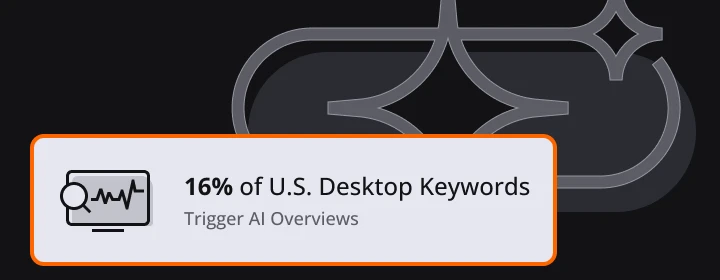
#### U.S. and Regional Statistics:
- AIOs appear in about **16% of U.S. desktop keywords**
- India shows similar saturation at approximately **16.5%**
- Brazil follows closely at **15.5%**
- UK markets show slightly lower penetration at **12.5%**
#### Broader Estimates:
Some datasets indicate AIOs appearing in up to 55% of Google searches when including mobile queries and specific query types. The variation in reported figures stems from differences in methodology—whether studies track desktop versus mobile, all queries versus specific verticals, or sample sizes across different time periods.
#### Device Split—The Mobile Dominance:
- **81% of queries that trigger an AI Overview occur on mobile devices**
- This statistic alone underscores why mobile-first SEO and UX isn’t optional
- Many users on mobile devices are accessing AIOs as their primary information source
| Region | AIO Presence (Desktop) | Notes |
|---|---|---|
| United States | ~16% | Highest early adoption |
| India | ~16.5% | Similar to U.S. patterns |
| Brazil | ~15.5% | Strong presence in Portuguese |
| United Kingdom | ~12.5% | Growing steadily |
| Global Average | ~13% | March 2025 data |
## What Kinds of Queries Trigger AI Overviews?
Query intent, length, complexity, and even keyword economics all influence whether Google AI generates an overview. Understanding these patterns helps you segment your keyword research and decide where to embrace AIO exposure versus where to defend traditional search results clicks.
#### Intent Breakdown:
- **90–100% of AIOs appear for informational queries**—users asking “what,” “how,” and “why” questions
- Only **6–10% trigger for commercial queries** where purchase intent exists
- Transactional queries and navigational queries together rarely exceed **4%** of AIO appearances
- However, 2025 data shows a shift toward broader coverage of lower-funnel, transactional keywords
#### Query Length Matters:
- Queries with **8+ words are approximately 7x more likely** to trigger an AI Overview than very short queries
- This aligns with long-tail SEO patterns where informational intent dominates
- Short, high-volume head terms see fewer AI overviews show up
#### Keyword Difficulty and Volume Patterns:
- A “typical” AIO-triggering keyword has difficulty around **12** and search volume around **500**
- About **60% of keywords triggering AI overviews have under 100 monthly searches**
- Many fall in the **21–60 difficulty range**, representing moderately competitive terms
#### CPC and Commercial Patterns:
- Keywords with average CPC between **$2–$5 are most likely to trigger AIOs** (about 32% of the time)
- Very high-CPC terms ($10+) see much lower AIO penetration at approximately **17%**
- This suggests Google Ads and AIOs currently compete less directly at the highest-value queries
#### Technical and Niche Queries:
- Queries containing technical jargon or industry-specific terminology are **48% more likely** to generate AI Overview responses
- This has implications for B2B marketers targeting informational keywords with specialized content
When developing keyword strategies at Timmermann Group, we segment research by intent, query length, and CPC to determine where clients should optimize for AIO citation versus where defending organic results positions makes more sense.
## How AI Overviews Interact with Other SERP Features
AI Overviews rarely appear in isolation. They co-exist with People Also Ask boxes, Related Searches, and other SERP features that collectively crowd the page and push traditional results further down.
#### Overlap with Other Features:
- **81–90% of AIO SERPs also display a “People Also Ask” box**
- **95%** show Related Searches
- Discussion/forum blocks and video carousels are common companions
- This creates a highly competitive above-the-fold environment
#### Displacement of Brand-Controlled Elements:
When AI Overviews appear, other features are significantly reduced:
- **96% fewer sitelinks** appear on AIO SERPs
- **84% fewer videos** are displayed
- **75% fewer Knowledge Panels** show up
This displacement means brand-controlled modules that previously dominated search results are being pushed aside by ai generated summaries.
#### Visual Dominance:
- AIOs occupy approximately **42% of desktop screen real estate**
- On mobile, they consume roughly **48% of the screen**
- Most AI overviews appear above the fold, pushing organic results and Google Ads below the initial view
#### PPC Implications:
- Google Ads presence on AIO SERPs rose from **less than 1% in March 2025** to approximately **25% by November 2025**
- Click-through rates for both organic and paid listings decline when AIOs are present
- This demands more integrated SEO + PPC + CRO planning to account for reduced above-the-fold visibility
## User Behavior and Trust: How People Are Actually Using AI Overviews
Google’s AI overviews are fundamentally changing how users scan, click, and trust search results—especially on mobile and among younger demographics who represent high-value customer cohorts.
#### Reading Patterns:
- Approximately **70% of searchers read only the first 30%** of an AI Overview
- Despite limited reading, **88% still click “show more”** even if they don’t fully consume the expanded content
- Users skim for quick answers, then decide whether deeper engagement is needed
#### Trust and Adoption:
- About **70% of consumers say they “somewhat trust”** generative AI search results
- Yet **75% simultaneously worry about misinformation**—a notable tension
- Around **79% expect to use AI-enhanced search** within the next year
- Consumer trust sits at 65% for businesses using AI, with only 14% expressing distrust
#### Demographic Patterns:
- **25–34-year-olds on mobile use AIOs as the final answer about 50% of the time**
- This indicates high reliance among younger, high-value cohorts
- Older demographics (61+) engage differently, with 30.8% using AI-powered voice assistants weekly
#### Device Behavior:
- Over four-fifths of AIO-triggering queries occur on mobile
- Mobile UX must support fast, high-intent paths from SERP to conversion
- Many users complete their entire search journey without ever leaving the SERP
#### User Behavior Takeaways for Marketers:
- Write concise, answer-first copy that captures attention in the first 30% of content
- Use strong headings and scannable lists that LLMs can parse
- Implement schema markup (FAQ, HowTo, Product) to increase citation likelihood
- Design mobile experiences assuming users arrive with partial answers already consumed

## Traffic and CTR Impact: Are AI Overviews Killing Clicks?
This section focuses on measurable performance shifts: click-through rates, traffic loss, and the emerging zero-click behavior that’s concerning marketing leaders across industries.
#### CTR Declines:
- Top-ranking pages experience a **34.5% reduction in CTR** on queries with AIOs (based on 300,000+ keyword studies)
- The top four positions specifically see approximately a **7% CTR drop**
- Top-ranking sites that previously dominated informational keywords are most affected
#### Traffic Swings:
- Some sites report **20–40% organic traffic declines** after AIO rollout
- Individual cases document drops as severe as **41%** (reported by SEO practitioners in 2024)
- The impact varies significantly by industry and content type
#### Zero-Click Trend:
- **58% of Google searches now result in zero clicks**
- AI Overviews are a major contributor, but not the sole cause
- Featured snippets, knowledge panels, and direct answers also play roles
- This represents a fundamental shift in how Google users interact with search
#### The Positive Side:
Not all the news is concerning:
- **63% of businesses report positive impacts** on organic traffic, visibility, or rankings from AI Overviews since May 2024, when they optimize correctly
- Brands mentioned as sources cited in AIOs often see increased brand awareness
- Some organizations are capturing new visibility that they didn’t have in traditional search results
#### Future Projections:
- Organic CTRs may decline another **25% by 2026** due to continued AIO growth
- This emphasizes the urgency of diversifying traffic sources across PPC, social, email, direct, and owned media
At Timmermann Group, we audit and monitor AIO impact using analytics, search console data, and visibility tools, then adjust SEO, PPC bidding, and CRO tactics accordingly to maintain search performance.
## Industry and Query-Type Differences: Who’s Most Affected?
AI Overviews don’t impact all industries equally. Some verticals and query types see far more disruption than others, making it essential to understand where your business sits in this shifting landscape.
#### Industries with High AIO Saturation:
| Industry | AIO Saturation | Notes |
|---|---|---|
| Science | ~25.96% | Highest percentage of queries with AIOs |
| Computers & Electronics | ~21% | Technical informational queries dominate |
| People & Society | ~17–26% | Broad informational coverage |
| Health (variable) | ~15–20% | Google has pulled back in some sensitive categories |
#### Industries with Low AIO Saturation:
- Real Estate: **under 5%** of queries trigger AIOs
- Shopping/ecommerce searches: **under 3%** in most cases
- Arts & Entertainment: **under 3%** saturation
#### Growth and Pullback Patterns:
In 2025, Google rapidly expanded AIO coverage to more commercial and navigational queries, then pulled back in some sensitive categories (particularly Health), creating volatility from quarter to quarter. This inconsistency makes ongoing monitoring essential.
#### Local Search:
- AIOs appear in only about **7% of local queries**
- Local SEO (map pack optimization, reviews, NAP consistency) remains relatively insulated
- Local queries still favor traditional local pack results
#### Vertical Expansion Examples (Year-over-Year):
- B2B technology queries with AIOs: **36% → 70%** (share rose dramatically)
- Insurance queries: **17% → 63%**
- Entertainment: **2% → 37%**
These figures represent some of the fastest-growing sectors for AI penetration.
#### Strategic Implications:
- For high-AIO categories: Focus on brand authority, informational content, and AI-friendly structure
- For low-AIO categories: Double down on classic SERP optimization and local search presence
- For volatile categories: Build flexible strategies that can adapt to quarterly changes
## Source Patterns: Who Gets Cited in AI Overviews?
Understanding which domains and content types AIOs cite helps shape your content strategy and authority-building efforts. The data reveals patterns that challenge some traditional SEO assumptions.
#### Self-Referencing Patterns:
- About **43–44% of AIOs link back to Google’s own properties** or to pages already in Google’s top results
- This reinforces the importance of existing organic strength as a foundation
#### Ranking Position vs. Citations:
- Approximately **40% of AIO sources would normally rank in positions 11–20** (not the top 10)
- Top 1–3 organic rankings in ecommerce only have about an **8% chance of being cited**
- This suggests AIOs use different selection criteria than traditional ranking algorithms
#### Domain Concentration:
- The **top 50 domains capture nearly 30%** of all AIO mentions
- Heavy bias toward high-authority brands with strong E-E-A-T signals
- Industry leaders with established expertise dominate citations
#### User-Generated and Expert Sources:
- **Reddit: ~5.5%** of AIOs cite Reddit discussions
- **Quora: ~4%** of citations
- **NIH.gov: ~1.8%** (medical/academic authority)
- **WebMD: ~1.5%**
- **YouTube: notable presence** for video-related queries
#### Ecommerce Visibility:
- Only **0.3–4% of AIOs include ecommerce links**
- **80% of ecommerce sources cited in AIOs don’t rank organically** for those same keywords
- This indicates a different selection logic for product pages versus informational content
#### Number of Sources Per Overview:
- Typical range: **6–14 sources per AIO**, with 9 being most common
- Short AIOs (under 600 characters): cite approximately **5 sources**
- Very long AIOs (over 6,600 characters): cite up to **28 sources**
- Most AI overviews pull from a broader set of pages than a single source
#### Authority-Building Recommendations:
- Build topical authority through comprehensive content clusters
- Strengthen E-E-A-T signals across your site
- Create a mix of expert-driven and community-informed content
- Focus on brand mentions and brand presence across authoritative platforms
- Don’t rely solely on traditional ranking positions for AIO visibility
## Content Format and UX Inside AI Overviews
AI Overviews display consistent formatting patterns: lists, short paragraphs, specific word count limits—that marketers can emulate on their own pages to increase the likelihood of being cited and effectively summarized.
#### List Usage Dominates:
- About **78% of AIOs use list-based formatting**
- **61% specifically use unordered (bullet) lists**, even for content that might logically be ranked or step-based
- This structure helps AI systems parse and summarize content efficiently
#### Ordered Lists Are Rare:
- Only **12% of AIOs use numbered lists**
- These appear primarily when step-by-step instructions are required
- How-to content should still use numbered steps for clarity
#### Paragraph-Only Overviews:
- Roughly **22% of AIOs rely on short paragraph blocks** without lists
- Typically used for definitions or simple factual answers
- These tend to be shorter and more direct
#### Average Length:
- The typical AI Overview is approximately **157 words**
- **99% stay under 328 words**
- **Two thirds fall between 150 and 200 words**
- Concise, focused content performs best
#### Screen Coverage:
- AIOs occupy nearly half the screen on both desktop and mobile
- Users may read the AI summary before seeing your meta description
- Above-the-fold real estate is increasingly dominated by AI-generated content
#### On-Page Recommendations:
Based on these patterns, optimize your content with:
- Concise introductions that answer the query in the first 50-100 words
- Answer-first headings that front-load key information
- Scannable bullet lists for complex topics
- Schema markup (FAQ, HowTo, Product) that LLMs can easily parse
- Strong internal structure with clear hierarchy
- Short paragraphs (2-3 sentences maximum)
These observations translate directly into content audit checklists our team at Timmermann Group uses when optimizing client pages for visibility in AI search environments.
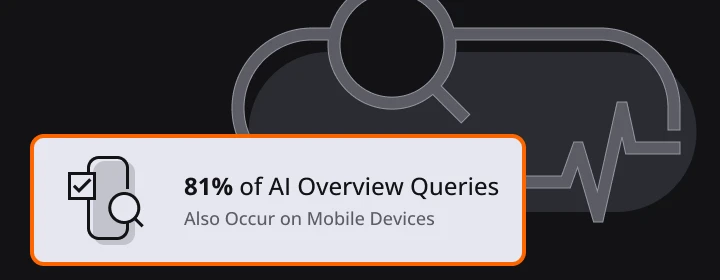
## Regional and Language Expansion of AI Overviews
Google’s AI Overviews expanded dramatically in geographic and linguistic scope between 2024 and 2025, influencing global SEO and multilingual strategy for brands operating internationally.
#### May 2025 Expansion:
- Google expanded AI Overviews to users in approximately **200 countries**
- Support now includes **40+ languages**
- Major additions include Arabic, Chinese, Malay, and Urdu
#### **Earlier Testing Phases:**
- Initial testing was primarily in the U.S. and a handful of English-speaking markets
- Gradual rollout allowed Google to refine the feature before broader deployment
- Past year data shows consistent expansion patterns
#### Current Regional Adoption:
- Data shows broadly similar AIO adoption rates in markets like **India and Brazil** compared to the U.S.
- Some European markets show slightly lower saturation
- Language-specific variations exist based on available training data
#### Implications for Multinational Brands:
- Consistent messaging across markets becomes more critical
- Localized content strategies must reflect the same expertise and trust signals as English content
- Local-language pages need strong E-E-A-T signals
- Keywords in non-English languages may see different AIO penetration rates
#### Prioritization Framework:
When advising clients, Timmermann Group helps prioritize which markets and languages to optimize for AI powered search first, based on:
- Market demand and search volume
- Competitive landscape in each region
- Current AIO penetration levels
- Business priority and revenue potential
## What AI Overview Statistics Mean for Your Marketing Strategy
The data in this comprehensive overview points to a fundamental truth: AI Overviews are shifting search from the familiar “10 blue links” model to an “answer-first” paradigm. This changes how brands must think about visibility, clicks, and conversions across the entire digital marketing funnel.
#### SEO Implications:
Ranking alone is no longer enough. Brands must optimize for being summarized and cited by AI:
- Structure content for easy parsing by AI systems
- Build strong E-E-A-T signals (Experience, Expertise, Authoritativeness, Trustworthiness)
- Develop topic clusters that establish comprehensive authority
- Focus on informational intent content that naturally attracts more queries with AIOs
- Monitor AIO presence across your priority keywords
#### PPC and CRO Implications:
Lower CTRs and increasing zero click rates demand efficiency gains:
- More strategic ad spend allocation based on AIO presence
- Better landing page experiences to convert the clicks you do earn
- Stronger conversion optimization to extract more value from fewer visitors
- Integration between paid and organic strategies
#### Channel Diversification:
Building resilient flywheel marketing means reducing dependence on any single source:
- Invest in email marketing for direct audience relationships
- Develop a social media presence that drives owned traffic
- Create content that builds brand recognition beyond search
- Strengthen direct and referral traffic channels
#### Measurement Evolution:
Traditional rank-and-click KPIs need expansion:
- Track impressions in AI layers where possible
- Monitor brand mentions in AIOs (whether or not they link to your site)
- Implement multi-touch attribution to understand full customer journeys
- Measure assisted conversions, not just last-click attribution
### The Timmermann Group Approach:
Our team helps clients navigate this evolution through:
1. **AIO Exposure Audit**: Analyzing which of your priority keywords trigger AI overviews and whether you’re being cited
2. **Traffic Risk/Opportunity Modeling**: Quantifying potential impact and identifying optimization opportunities
3. **Integrated Roadmap Development**: Building coordinated strategies across SEO, PPC, UX/CRO, and analytics
4. **Ongoing Monitoring and Adaptation**: Tracking the search engine journal of changes and adjusting tactics as the landscape evolves
The brands that act now—adapting content strategy, diversifying channels, and optimizing for this new reality—will capture visibility and market share while competitors scramble to catch up.
#### Ready to assess your AI search readiness?
[Schedule a Consultation with Timmermann Group](https://www.timmermann.com/contact) to audit your current exposure to AI Overviews and build a roadmap for sustainable growth in the evolving search landscape.
[](https://www.wearetg.com/contact)
**Categories:** SEO
---
### [Direct Traffic in Google Analytics: What It Is, Where to Find It, and How to Fix Your Data](https://www.wearetg.com/blog/direct-traffic-in-google-analytics/)
**Published:** January 28, 2026
**Author:** Rob Timmermann
**Content:**
Direct traffic in Google Analytics 4 is one of the most confusing and misinterpreted metrics. Many people assume it only reflects people typing a URL directly into their browser, but in GA4, the reality is far more complex. Before you can trust your acquisition data or make smart budget decisions, it’s critical to understand what “Direct” actually means, why it shows up, and when it’s signaling a real problem with your [analytics tracking](https://www.wearetg.com/services/analytics/).
## Quick answer: What “Direct” traffic means in GA4
Direct traffic in Google Analytics represents website visits where the platform cannot determine where the visitor came from. When GA4 labels a session as “Direct,” it means the referrer information was missing, stripped, or otherwise unavailable—not necessarily that someone typed your URL directly into their browser.
This distinction matters more than most marketers realize. While direct visits do include people typing timmermanngroup.com into their address bar, using bookmarks to saved pages, or clicking links from sales decks and proposals, the Direct bucket also catches all the traffic that GA4 simply couldn’t classify elsewhere. Think of it as the analytics equivalent of an “uncategorized” folder.
**Common real-world examples of legitimate direct traffic include:**
- Users typing your website address directly into the search bar
- Visitors clicking bookmarked links to your pricing or services pages
- Returning users whose browsers autocomplete your URL
- Prospects opening saved links from email clients or downloaded PDFs
The challenge for marketers is that misclassified direct traffic hides which SEO, PPC, email, and social campaigns are actually working. When you can’t see that a lead came from your LinkedIn campaign or email newsletter, you can’t properly credit those marketing efforts or make informed budget decisions.
A healthy direct traffic share typically falls in the 5–20% range for most established websites. When direct traffic numbers consistently climb above 30%, that’s usually a signal of tracking or configuration issues rather than a sudden surge in brand awareness.
In the sections ahead, we’ll show you exactly where to find direct traffic data in GA4, what causes inflated numbers, and how to fix the most common problems.
## Where to find direct traffic in Google Analytics 4
GA4 surfaces direct traffic data primarily through its Acquisition reports, with additional analysis options available through the Explorations feature. Understanding where to look—and how to slice the data—is the first step toward making sense of your direct visitors.
### Step-by-step navigation to direct traffic
To see direct traffic in your Google Analytics account:
1. Open GA4 and navigate to **Reports** in the left-hand menu
2. Click **Acquisition**
3. Select **Traffic acquisition**
This traffic acquisition report displays all your traffic sources broken down by session default channel group. Look for the row labeled “Direct” to see sessions, users, engaged sessions, and conversions attributed to this channel.
### Filtering and analyzing direct traffic
To focus exclusively on direct sessions:
1. Click **Add filter** at the top of the report
2. Set the dimension to “Session default channel group”
3. Set the condition to “exactly matches”
4. Select “Direct” as the value
5. Apply the filter
For deeper analysis, add a secondary dimension by clicking the plus sign next to the primary dimension. Adding “Landing page + query string” reveals which pages direct visitors are landing on first—a valuable insight for identifying patterns in your traffic.
### Building custom explorations
For more detailed analysis, use the Explore feature:
1. Navigate to **Explore** in the left menu
2. Select **Free form** exploration
3. Add dimensions like landing page, device category, country, and city
4. Add metrics such as sessions, conversions, and engagement rate
5. Apply a filter to include only Direct traffic
Agencies like Timmermann Group routinely build custom GA4 views and dashboards around direct vs. non-direct traffic for clients, making it easier to spot anomalies and track improvements over time.

## What actually causes direct traffic in GA4?
Direct traffic is a mix of legitimate direct visits and sessions where attribution data went missing somewhere along the way. Understanding these causes helps you distinguish between traffic you can’t control and traffic you’re simply not tracking correctly.
#### The “good” causes of direct traffic are straightforward:
- Users typing your URL directly
- Visitors using browser bookmarks
- People using browser autocomplete or history
#### The “invisible” causes are where things get complicated:
- Dark social shares (Slack, WhatsApp, SMS, email forwards)
- Clicks from mobile apps that don’t pass referral data
- Links in non-web documents like PDFs and presentations
#### Then there are the technical causes—the ones you can actually fix:
- Missing or broken utm parameters on campaign links
- JavaScript-based redirects that strip referrer information
- Pages without proper tracking code installed
- HTTP to HTTPS transitions that lose referral source data
- Cookie consent tools and browser privacy features
In B2B especially, direct traffic can spike around trade shows, email blasts, and sales enablement activities when links aren’t properly tagged. A prospect clicking a link in a proposal PDF shows up as direct traffic unless you’ve added tracking parameters to that URL.
### Manual entries, bookmarks, and returning visitors
GA4 treats a session as Direct when users type the URL (like timmermanngroup.com/services), click a bookmark, or use browser autocomplete to navigate. These represent genuine brand familiarity—people who know your site well enough to access it directly.
Many of these direct users originally found your site through organic search, paid search, or social media. Their first visit might have been attributed correctly, but subsequent bookmark visits appear as Direct because there’s no referral data to capture.
GA4’s session-based attribution makes it impossible to distinguish “true” manual url entry from other unknown sources in the Direct bucket. You can’t separate someone who typed your URL from someone whose referrer information was stripped by their browser.
**What you can do:**
- Treat long-engagement, multi-page direct sessions as a sign of real brand familiarity
- Pair GA4 data with qualitative methods like “How did you hear about us?” fields on lead forms
- Accept that some portion of direct traffic represents your marketing efforts paying off over time
### Dark social and untagged links
Dark social refers to shares and clicks from private or semi-private channels—Slack, Microsoft Teams, WhatsApp, SMS, and direct email forwards. Industry studies estimate that 70–80% of all link sharing happens through these dark social channels, and much of that traffic appears in GA4 as Direct.
**Consider these common B2B scenarios:**
| Scenario | Why it shows as Direct |
|---|---|
| Prospect clicks a link in an emailed PDF proposal | Email clients often strip referrer data |
| VP shares a case study link in a Slack channel | Slack doesn’t pass referrer information |
| Salesperson pastes a URL into LinkedIn DMs | Direct messages don’t include referrer headers |
| Colleague forwards an email with your newsletter link | The forward breaks the attribution chain |
These sources don’t send referrer data to websites, so GA4 has no choice but to label these sessions as Direct. The traffic appears as if visitors typed the URL when they actually clicked a shared link.
#### To reclaim some of this hidden traffic, use UTM-tagged links in:
- Email marketing campaigns
- Sales enablement decks and one-pagers
- Downloadable PDFs and resources
- Internal communications about campaigns
### Non-web documents and offline materials
Clicks from PDFs, Word documents, PowerPoints, Google Slides, and desktop applications typically don’t pass referrer information to GA4. This creates a persistent source of misattributed direct traffic that many organizations overlook.
#### Common scenarios that drive misattributed traffic:
- PDF spec sheets and datasheets emailed to prospects
- Pricing one-pagers shared during sales conversations
- Print brochures with QR codes linking to your site
- Event signage directing attendees to specific landing pages
- Proposals with embedded links to case studies
**The solution is adding utm parameters to every URL in these assets. For example, a QR code at a 2026 trade show might use:**
```
https://timmermanngroup.com/services?utm_source=tradeshow&utm_medium=qr&utm_campaign=expo_2026
```
With this tracking in place, that traffic appears in GA4 under your campaign data rather than inflating your website’s direct traffic.
One important caveat: old downloaded documents can’t be retroactively updated. If you’ve already distributed hundreds of PDFs with untagged links, those will continue generating direct traffic until they’re replaced. Improvements only apply from the date you start using updated files.
### Technical and configuration issues
A surprisingly large portion of direct traffic comes from fixable technical problems rather than user behavior. These issues are often invisible until you specifically audit for them.
**Common technical culprits include:**
| Issue | Impact on Direct Traffic |
|---|---|
| Missing tracking code on some pages | User lands on untracked page, moves to tracked page—appears as Direct |
| GA4/GTM not installed on error pages | 404 visits create gaps in tracking |
| Redirect chains that drop UTMs | Campaign parameters lost before reaching landing page |
| JavaScript-based redirects | Referrer stripped during client-side redirect |
| Incorrect referral exclusion settings | Self-referrals classified as Direct |
When a visitor lands on an untracked page and then navigates to a tracked page, GA4 often logs that session as Direct because it missed the initial entry point with its referrer information.
Regular analytics audits catch these problems before they significantly skew your data. Timmermann Group performs quarterly audits for clients to identify new pages, microsites, or landing pages that launched without proper tracking code.
Worth noting: GA4 processing bugs can occasionally cause one-day direct traffic spikes. Known GA4 issues (like those reported in November 2023) caused temporary data anomalies that couldn’t be retroactively fixed. If you see a single-day spike that immediately corrects itself, processing issues may be the cause.
### Privacy changes, cookies, and browser behavior
Modern privacy settings have fundamentally changed how web tracking works. Safari’s Intelligent Tracking Prevention (ITP), Firefox’s Enhanced Tracking Protection (ETP), Chrome’s evolving privacy sandbox, and widespread ad blocker usage all affect your ability to track traffic accurately.
**These privacy features impact direct traffic in several ways:**
- **Shortened cookie lifetimes** mean returning users whose cookies expired appear as new direct sessions
- **Blocked tracking scripts** prevent GA4 from capturing referrer information
- **iOS “Open in…” behavior** strips referrer data when users open links from apps
- **Some Android app behaviors** similarly ignore or remove referrer headers
Returning users whose cookies have expired may appear as new direct sessions because GA4 cannot tie them back to their original sources. A user clicks who first visited from organic search three months ago might show as Direct on their return visit if their browser cleared cookies.
While server-side tagging and first-party data strategies can help reduce this friction, some privacy-driven direct traffic is simply unavoidable. The best approach is to treat Direct as a “noisier” channel in the post-2020 privacy landscape and look for patterns rather than obsessing over perfect attribution.
## How to read and interpret your direct traffic
Marketers shouldn’t judge direct traffic only by volume. Engagement quality and conversion behavior reveal whether your direct visitors represent genuine brand familiarity or tracking failures.
### Comparing Direct to other channels
In the traffic acquisition report, compare Direct traffic against other channel groups on these key metrics:
| Metric | What High Values Mean for Direct | What Low Values Mean for Direct |
|---|---|---|
| Average engagement time | Real visitors exploring your site | Possible bot traffic or bounce issues |
| Pages per session | Engaged users navigating content | Single-page visits or misattribution |
| Conversion rate | High-intent returning visitors | Traffic that doesn’t match your audience |
| Bounce rate | Quick exits—potential spam | Engaged sessions (lower is better) |
High engagement metrics paired with strong conversion rates suggest genuine direct visitors—people familiar with your brand who came to complete a specific action. Low engagement with high bounce rates often signals spam, bot traffic, or severely misattributed sessions.
### Breaking down Direct by dimensions
Use the traffic acquisition report to segment direct traffic by:
- **Device category**: Mobile vs. desktop patterns can reveal app-related attribution issues
- **Country/City**: Geographic anomalies might indicate bot traffic or VPN usage
- **Landing page**: Which pages direct visitors arrive on first
If direct traffic primarily lands on deep pages rather than your homepage, that often indicates untagged links from emails, documents, or campaigns rather than true manual URL entry.
### Tracking trends over time
Examine direct traffic trends alongside your marketing activities:
- Spikes when new campaigns launch (without proper UTMs)
- Drops after fixing tracking issues
- Seasonal patterns around events or trade shows
- Correlation with email sends or content publication
Segmenting direct traffic into new vs. returning users helps distinguish between discovery problems and a healthy base of loyal website visitors. High returning-user rates in Direct often reflect brand strength, while high new-user rates might indicate attribution failures.
At Timmermann Group, we often build Looker Studio dashboards that color-code direct traffic health for clients—green for normal ranges, yellow for concerning levels, red for immediate investigation.

## How to reduce misclassified direct traffic (and improve accuracy)
The goal isn’t to eliminate Direct traffic entirely—that’s neither possible nor desirable. Instead, focus on shrinking the portion caused by avoidable tracking and setup problems so your remaining direct traffic numbers actually mean something.
A prioritized approach to reducing misclassified direct traffic:
1. Implement consistent UTM tagging across all marketing campaigns
2. Ensure complete GA4/GTM coverage on all pages
3. Secure the site with HTTPS and fix redirect issues
4. Block internal and bot traffic from reports
5. Build a measurement framework to track improvements
Direct traffic persistently above 25–30% for established sites usually points to multiple fixable issues working together. At Timmermann Group, we approach this as part of a broader analytics and measurement strategy rather than a one-off patch.
### Implement consistent UTM tagging across all campaigns
Untagged or poorly tagged marketing links frequently end up as Direct in GA4. Every email blast, paid social ad, display campaign, and sponsored content piece needs proper utm tracking codes to be classified correctly.
Create a shared UTM naming convention document for all teams and agencies. Best practices include:
- Use lowercase for all values (GA4 is case-sensitive)
- Keep source names consistent (e.g., always “linkedin” not sometimes “LinkedIn” or “li”)
- Define clear medium categories (email, cpc, social, referral)
- Use descriptive campaign names that make reporting meaningful
**Examples for typical B2B marketing channels:**
| Channel | utm\_source | utm\_medium | utm\_campaign |
|---|---|---|---|
| Email newsletter | newsletter | email | monthly\_update\_2025 |
| LinkedIn Ads | linkedin | cpc | whitepaper\_promotion |
| Trade show QR code | tradeshow | qr | expo\_chicago\_2025 |
| Partner referral | partner\_name | referral | comarketing\_q1 |
Use a centralized spreadsheet or UTM generator tool to prevent typos and inconsistent naming. A single misspelling can fragment your data or cause traffic to revert to Direct.
Timmermann Group often builds UTM taxonomies as part of the initial analytics setup to improve long-term reporting quality across all marketing channels.
### Ensure complete and correct GA4 / GTM implementation
Your GA4 or Google Tag Manager code must be installed on every public-facing page—including error pages, thank you pages, and all landing page templates. Missing tracking code is one of the most common causes of inflated direct traffic numbers.
#### To verify complete coverage:
1. Use tools like Screaming Frog or Sitebulb to crawl your site and check for GA4 tag presence
2. Manually spot-check critical URLs using browser developer tools (look for gtag.js or GTM container calls)
3. Test new page templates before they go live
4. Verify tracking on microsites and campaign landing pages
When a user clicks from an untracked page to a tracked page within one visit, that session often registers as Direct or as a self-referral—neither of which gives you accurate data about how that visitor actually found you.
Document a process requiring tracking validation before new pages, microsites, or campaign landing pages can launch. At Timmermann Group, we include ongoing analytics maintenance in retainer agreements specifically to prevent new tracking gaps as client sites evolve.
### Fix redirects, HTTPS issues, and URL structure
Redirect chains and protocol mismatches silently strip the referral data and utm parameters you work hard to implement. Common problems include:
- HTTP to HTTPS transitions without proper redirect handling
- Mixed www and non-www domain versions
- Poorly configured 301 or 302 redirects
- JavaScript-based redirects that lose referrer information
#### The fix requires coordination between analytics and development teams:
1. Complete a full migration to HTTPS with proper 301 redirects
2. Enforce a single canonical host (e.g., always redirect to <https://www.example.com>)
3. Review common redirect paths for legacy campaign URLs and vanity domains
4. Replace JavaScript redirects with server-side redirects for marketing landing pages
When a visitor lands on a secure https site after clicking a link on an HTTP page, the browser may not pass referrer information. This is by design for security reasons, but it means your traffic appears as Direct when it shouldn’t.
Collaborate with your dev team on any rebrand or domain change to monitor direct traffic before and after, catching issues early before they accumulate.
### Block internal and low-quality traffic
Internal visits from employees, agencies, and vendors frequently show up as Direct due to bookmarks, intranet links, and browser history. This internal traffic distorts your actual visitor behavior data.
#### To filter internal traffic in GA4:
1. Navigate to Admin > Data Streams > \[Your Stream\] > Configure tag settings
2. Click “Define internal traffic”
3. Add rules for your office IP addresses or VPN ranges
4. Enable the internal traffic filter in your data settings
#### Periodic reviews of suspicious direct traffic patterns help identify:
- Spikes with extremely short engagement times (likely bot traffic)
- High-volume visits from unusual geographic locations
- Sessions with 100% bounce rates and near-zero time on site
Consider using tools like Cloudflare or server-level rules to block obvious bots before they reach GA4. Every bot session that shows as Direct makes your legitimate direct traffic numbers less reliable for decision-making.
### Build a basic measurement framework around Direct
A simple measurement framework defines how direct traffic should typically behave for your specific business. This gives you a baseline for identifying problems and measuring improvements.
#### Your framework should document:
- Expected direct traffic range (e.g., 10–18% of total traffic)
- Typical landing pages for direct visitors
- Expected engagement and conversion rates
- Seasonal variations to expect
**Combine GA4 data with other sources for context:**
| Data Source | What It Adds |
|---|---|
| CRM data | Lead source attribution and sales feedback |
| Marketing automation | Email and campaign performance data |
| Self-reported attribution | “How did you hear about us?” responses |
| Google Search Console | Branded vs. non-branded search patterns |
Track changes in direct traffic after each major improvement. When you roll out consistent UTM tagging, complete an HTTPS migration, or finish a tracking audit, document the impact on your direct traffic numbers.
At Timmermann Group, we use this framework approach within a broader flywheel marketing model. Better direct traffic data improves channel budgeting decisions across SEO, PPC, social, email marketing, and content—creating more accurate analytics data that compounds over time.
## Accepting the limits of direct traffic (and using it wisely)
Even with perfect tagging and flawless implementation, a portion of direct traffic will always remain. Privacy tools continue to evolve, dark social sharing isn’t going away, and genuine typed or bookmarked visits represent real user behavior you want to capture.
#### The practical approach is twofold:
1. **Reduce the fixable portion** by implementing consistent tracking, fixing technical issues, and maintaining your analytics setup
2. **Treat the remainder as signal** rather than noise—a reflection of brand familiarity and offline marketing impact
Not all direct traffic is problematic. Good direct traffic represents people who know your brand well enough to navigate to you without an intermediary. These direct sessions often convert at higher rates than traffic from discovery channels.
#### Use direct traffic trends alongside other brand indicators:
- Branded organic search volume (via Google Search Console)
- Email engagement rates
- Sales team feedback on how prospects find you
- Social media mentions and engagement
The objective isn’t zero Direct—it’s trustworthy data that supports confident decisions about budget allocation and channel strategy. When you can trust your direct traffic numbers, you can also trust your attributed traffic numbers, which means more accurate data for every marketing decision you make.
If your direct traffic consistently runs above 25% and you’re not sure why, or if you suspect tracking issues are hiding the true performance of your marketing campaigns, it might be time for a professional audit.
#### Ready to clean up your GA4 data and get more accurate insights?
[Schedule a consultation with Timmermann Group](https://timmermanngroup.com/contact) to audit your analytics setup, reduce misclassified direct traffic, and build a measurement strategy designed for long-term growth.
**Categories:** Analytics
---
### [Demand Generation vs Lead Generation in Google Ads: How to Grow (and Convert) Demand](https://www.wearetg.com/blog/demand-generation-vs-lead-generation/)
**Published:** February 2, 2026
**Author:** Rob Timmermann
**Content:**
B2B buying has changed, but many Google Ads strategies haven’t kept up. In 2026, the real advantage lies in understanding when to create demand and when to capture intent in Google Ads. This guide breaks down why demand generation and lead generation are not competing strategies, how they work together in a full-funnel Google Ads approach, and how to balance budget, channels, and KPIs to drive both near-term pipeline and long-term revenue growth.
#### Key Takeaways
- B2B buyers spend most of their journey self-educating, so demand generation is required for Google Ads to work efficiently in 2026
- Lead generation alone targets a shrinking pool of in-market buyers and drives higher costs over time
- Demand gen builds awareness and trust that makes lead gen campaigns convert faster and at lower CPL
- In Google Ads, demand gen primarily runs through YouTube, Display, and Discovery, while lead gen is driven by Search and Performance Max
- The strongest strategies separate demand gen and lead gen by goals, budgets, and KPIs, then measure success across the full funnel
## Why Demand Gen vs Lead Gen Matters in 2026 Google Ads
B2B buyers have fundamentally changed how they research and purchase. Studies consistently show that buyers spend 60–70% of their journey self-educating online before ever reaching out to a sales rep. They’re reading industry reports, watching on-demand webinars, and comparing solutions long before they fill out a contact form.
This shift has massive implications for your Google Ads strategy. If you only run lead generation campaigns targeting bottom-funnel keywords, you’re fishing in a shrinking pond. You’re competing for the small percentage of potential buyers who already know exactly what they want. Meanwhile, the much larger pool of future customers—those still learning about their problems and exploring solutions—never sees your brand.
At Timmermann Group, we build full-funnel strategies that integrate SEO, paid media, UX & CRO, and analytics into a unified growth system. We’ve seen firsthand how businesses that treat demand generation and lead generation as complementary forces—rather than competing priorities—achieve more sustainable revenue growth. This article will show you how to design Google Ads campaigns for both demand creation and lead capture, and how to balance them across budgets and timelines in 2024 and beyond.
## Demand Generation vs Lead Generation: Clear Definitions
Before diving into campaign tactics, let’s establish what these two strategies actually mean in the context of Google Ads.
Demand generation is the process of creating awareness and interest among people who may not yet realize they have a problem—or that your category of solution exists. It focuses on building your brand’s authority and educating potential customers about problems worth solving. In Google Ads, this often involves YouTube campaigns, Display Network ads, and broader keyword targeting that answers early-stage questions.
Lead generation focuses on capturing contact information from prospects who already show purchase intent. These are people actively searching for solutions, comparing vendors, or ready to talk to sales teams. In Google Ads, lead gen typically means Search campaigns on high-intent keywords, Performance Max campaigns optimized for form fills, and remarketing to warm audiences.
Here’s a concrete example: Imagine a logistics software company in 2025. A demand gen campaign might target facility managers with YouTube ads explaining “How to Reduce Warehouse Picking Errors by 40%.” The goal isn’t immediate conversions—it’s building awareness that this problem is solvable. Six weeks later, that same facility manager searches “warehouse management software demo.” That’s where lead gen takes over, capturing the qualified prospect with a Search ad driving to a demo request page.
##### Quick Comparison:
- **When it happens:** Demand gen works at the top and middle of the sales funnel; lead gen operates at the bottom
- **Primary goal:** Demand generation creates awareness and education; lead generation captures intent and contact info
- **Key channels in Google Ads:** Demand gen leverages YouTube, Display, Discovery; lead gen focuses on Search, Performance Max, remarketing
### What Is Demand Generation?
Demand generation is a long-term marketing strategy focused on growing the pool of people who know about your brand, understand the problems you solve, and trust you as a credible solution. It’s not about getting as many leads as possible right now—it’s about systematically expanding your market presence.
In complex B2B environments where buying decisions involve 6–10 stakeholders, demand gen is especially critical. You need multiple people within an organization to recognize the problem, understand potential solutions, and feel confident in your expertise before anyone fills out a demo form. This requires repeated exposure to educational content, thought leadership, and brand messaging over time.
This approach aligns with what we call flywheel marketing at Timmermann Group: continuously adding force (visibility, education, trust-building) while removing friction (confusion, objections, knowledge gaps). Demand generation campaigns feed the flywheel by putting your brand in front of the right broad audience and giving them valuable insights that make later conversion easier.
##### Core characteristics of demand generation:
- Longer time horizon (3–12 months to see full impact)
- Targets a broad audience including those not yet in-market
- Uses softer CTAs like “Learn more” or “Watch the full guide”
- Spend often allocated to YouTube, Display, Discovery, and top-of-funnel keywords
- Success measured by engagement and awareness metrics, not just form fills
#### Goals of Demand Generation
Effective demand generation isn’t about vague “brand awareness.” It’s about measurable outcomes that indicate your market position is strengthening.
- **Increase branded search volume:** Track growth in searches for your company name, product names, and branded terms over 6–12 months
- **Grow engagement among specific ICPs:** Measure video completion rates, time on site, and return visits from your target buyer personas
- **Generate more high-intent website traffic:** Drive users to educational content that primes them for later conversion
- **Expand share of voice:** Monitor how often your brand appears in relevant conversations and search results compared to competitors
- **Build remarketing audiences:** Grow pools of engaged visitors you can nurture with more targeted messaging
Demand gen can also revive stagnant product lines or reposition a company entering a new market. For example, a manufacturing firm expanding into the Chicago market in 2025 would need demand generation campaigns to establish credibility with an audience that’s never heard of them before.
#### High-Level Demand Generation Tactics (Before We Talk Google Ads)
Before getting tactical with Google Ads, understand that successful demand generation relies on having the right content assets and strategic alignment across channels.
- **Educational content:** Create blog posts, guides, and videos that address your audience’s pain points without immediately pitching your product
- **Ungated resources:** Offer valuable insights freely to maximize reach and trust-building (gated content comes later in the funnel)
- **Thought leadership:** Publish industry reports, original research, and expert perspectives that position your brand as an authority
- **Social media presence:** Share valuable content consistently on social media platforms where your target buyers spend time
- **SEO alignment:** Ensure your demand gen content is optimized to rank organically, giving you compounding returns on content investments
UX & CRO matters at this stage too. Your website needs to make exploration easy and engaging. Visitors arriving from demand gen campaigns shouldn’t hit aggressive pop-ups or confusing navigation—they should find helpful content marketing that keeps them in your brand’s orbit.

### What Is Lead Generation?
Lead generation is the process of converting interested prospects into known contacts who can enter your sales or nurture workflows. While demand generation casts a wide net, lead gen focuses on capturing people who are ready to take the next step.
The emphasis here is on quality over volume. Traditional lead generation often prioritized getting as many leads as possible, but smart marketers know that flooding sales teams with unqualified contacts wastes everyone’s time. Modern lead gen strategy focuses on attracting and converting marketing qualified leads and sales qualified leads who actually fit your customer profile.
Lead generation focuses on lower-funnel intent using direct-response creative and strong calls-to-action. Think “Schedule a free consultation,” “Request a quote,” or “Start your trial.” The goal is to capture contact information from people who’ve already moved through problem awareness and are evaluating solutions.
Here’s the challenge many businesses face: they over-index on lead gen in Google Ads while under-investing in demand gen. This creates a vicious cycle. You’re competing for the same high-intent keywords as everyone else, driving up costs. And because you haven’t built awareness, your conversion rates suffer—potential customers don’t recognize or trust your brand enough to convert.
#### Goals of Lead Generation
Lead generation campaigns should tie directly to pipeline and revenue outcomes, not just form fill volume.
- **Increase sales-qualified opportunities:** Focus on leads that meet your qualification criteria and are ready for sales conversations
- **Lower customer acquisition cost (CAC):** Optimize for cost per qualified lead rather than raw cost per lead
- **Improve lead-to-opportunity conversion rates:** Track how many marketing qualified leads progress to SQL status and beyond
- **Accelerate the sales cycle:** Capture leads with enough intent and information that sales can close faster
- **Drive specific high-value actions:** Prioritize demo requests, consultation bookings, or RFP submissions over generic ebook downloads
Timelines differ significantly from demand gen. Lead generation campaigns can show ROI within 30–90 days if your sales cycle is relatively short. But even these quick wins depend on prior demand gen work—the leads you capture convert faster and at higher rates when they already know and trust your brand.
#### Common Lead Generation Tactics (Across Channels)
Lead gen tactics focus on converting warm prospects into actionable pipeline.
- **Gated content:** Offer valuable resources like industry reports, toolkits, or templates in exchange for contact information
- **High-intent landing pages:** Build conversion-focused pages with clear value propositions and minimal distractions
- **Remarketing sequences:** Re-engage site visitors who showed interest but didn’t convert on their first visit
- **Targeted email nurture campaigns:** Move captured leads through a sequence that educates and qualifies before sales handoff
- **Lead scoring frameworks:** Implement MQL and SQL definitions that help prioritize follow-up based on fit and engagement
At Timmermann Group, we pair lead gen PPC with CRO audits and A/B testing to improve conversion rates without simply increasing ad spend. Often, the biggest gains come from optimizing landing pages, forms, and page load speed—not from bidding more aggressively on the same keywords.
## Demand Generation vs Lead Generation in Google Ads: Key Differences
Google Ads is uniquely versatile. It can function as both an intent-capture platform (Search, Performance Max) and a demand-creation platform (YouTube, Display, Discovery), depending on how you configure your campaigns.
The key differences between demand gen and lead gen in Google Ads come down to campaign objectives, targeting strategies, creative approaches, and measurement frameworks. Understanding these distinctions helps you allocate budget effectively and avoid the common mistake of expecting demand-gen campaigns to deliver immediate lead-gen results (or vice versa).
A B2B SaaS firm might structure their Google Ads account with explicit separation: “Demand Gen” campaigns (YouTube for awareness, Display for remarketing education) and “Lead Gen” campaigns (Search on high-intent solution keywords, Performance Max for demo requests). Each has distinct budgets, KPIs, and success criteria.
**Quick reference:**
- **Campaign objective:** Demand gen uses “Brand awareness and reach” or engagement goals; lead gen uses “Leads” or “Sales” objectives
- **Targeting:** Demand gen targets broader audiences, in-market segments, and custom intent; lead gen targets high-intent keywords and warm remarketing lists
- **Creative style:** Demand gen emphasizes education and value; lead gen emphasizes urgency and specific offers
- **Measurement:** Demand gen tracks impressions, view rates, and branded search growth; lead gen tracks conversions, CPL, and pipeline value
### Objectives and Targeting: Capturing vs Creating Intent
The fundamental difference in search engine marketing is whether you’re capturing existing demand or generating demand that didn’t previously exist.
**Lead-gen-focused Google Search campaigns target bottom-funnel queries that signal active buying intent:**
- “Industrial PPC agency near me”
- “Best warehouse management software comparison”
- “B2B marketing services pricing”
**Demand generation campaigns target broader, problem-focused queries:**
- “How to improve manufacturing marketing ROI”
- “What causes high employee turnover in logistics”
- “Warehouse efficiency best practices 2025”
**Google’s audience solutions work differently for each approach. For demand gen, you might target:**
- In-market audiences interested in business services
- Custom intent audiences based on competitor research
- Affinity audiences aligned with your industry
**For lead gen, you’d focus on:**
- Remarketing lists of past site visitors
- Customer match lists from your CRM
- High-intent keyword targeting with exact and phrase match
At Timmermann Group, we configure campaign objectives to match the strategic purpose. Demand gen campaigns might optimize for engaged views or site engagement, while lead gen campaigns optimize for form submissions or phone calls.
### Channels Within Google Ads: Which Surfaces for Which Job?
Each Google Ads channel has different strengths for demand gen vs lead gen:
##### Search Network:
- **Primary use:** Lead generation on high-intent keywords
- **Secondary use:** Mid-funnel education on broader problem-focused terms
- **Example:** Targeting “commercial HVAC maintenance contract” for lead gen; targeting “how to reduce HVAC energy costs” for demand gen
##### YouTube:
- **Primary use:** Demand generation through educational video content
- **Secondary use:** Remarketing with product-focused videos to warm audiences
- **Example:** A 2025 campaign for a commercial HVAC company showing facility managers how to evaluate maintenance contracts, building awareness before they search
##### Display Network:
- **Primary use:** Upper and mid-funnel awareness, remarketing nurture
- **Secondary use:** Retargeting converters with upsell messaging
- **Example:** Banner ads promoting a free “2025 Facility Maintenance Cost Guide” to in-market audiences
##### Discovery Campaigns:
- **Primary use:** Native demand gen across Gmail, YouTube, and Discover
- **Secondary use:** Remarketing with softer CTAs
- **Example:** Reaching facility managers browsing industry content with helpful educational messaging
##### Performance Max:
- Can serve both purposes but skews toward lead capture when optimized for conversions
- Works best for lead gen when you have strong conversion data to train the algorithm
- **Example:** Driving demo requests across all Google surfaces with smart bidding
Coordinated messaging across these channels is essential. A potential buyer might first see your YouTube ad, then encounter a Display remarketing ad, and finally convert through Search. Inconsistent messaging creates friction; coordinated campaigns accelerate the buyer journey.
### Creative and Offers: Educational vs Conversion-Focused
#### Demand gen creative leads with value, not asks:
- “2025 Guide to Lowering Logistics Costs (Free Download)”
- “Watch: 5 Warehouse Mistakes Costing You 20% in Labor”
- “How Leading Manufacturers Are Cutting Production Downtime”
#### Lead gen creative emphasizes specific offers and urgency:
- “Book Your Free Logistics Cost Analysis—Limited Spots”
- “Get a Custom WMS Demo in 15 Minutes”
- “Request Your Manufacturing Efficiency Assessment Today”
#### The landing page experience must match the intent. Demand gen landing pages prioritize:
- Content depth and helpful resources
- Easy navigation to related content
- Multiple engagement paths (read, watch, explore)
#### Lead gen landing pages prioritize:
- Single, clear CTA above the fold
- Minimal navigation and distractions
- Trust signals (testimonials, logos, guarantees)
- Fast-loading, mobile-optimized forms
### Measurement and KPIs in Google Ads
Demand gen and lead gen require different measurement frameworks to accurately assess performance.
#### Demand Generation KPIs:
- Impressions and reach (tracking audience exposure)
- Video view rate and watch time (measuring content engagement)
- View-through conversions (tracking later conversions from viewers)
- Assisted conversions (attributing credit to awareness touchpoints)
- Branded search volume growth (measuring awareness impact over 3–6 months)
- Cost per thousand impressions (CPM), typically $5–15 for Display/YouTube
#### Lead Generation KPIs:
- Conversions and conversion rate (direct response measurement)
- Cost per conversion/lead (efficiency tracking)
- Qualified lead rate (quality measurement)
- MQL-to-SQL progression (pipeline quality)
- Cost per SQL and pipeline value (revenue-focused metrics)
- Closed-won revenue from nurtured leads (ultimate ROI)
Advanced tracking through GA4, offline conversion imports, and CRM integration allows you to connect both demand and lead gen efforts to actual revenue. This is critical for proving the full-funnel value of demand generation—showing that YouTube viewers eventually became your highest-value customers, even if they didn’t convert immediately.
## How Demand Generation and Lead Generation Work Together in a Full-Funnel Google Ads Strategy
The ideal state is a synchronized system where Google Ads works alongside SEO, social media, email, and CRO to support both awareness and conversion. Demand generation fills the top of the funnel with the right target audience while lead generation systematically nurtures and converts that audience into customers.
Think of it as a flywheel. Demand gen campaigns grow your remarketing lists and drive branded search volume. Lead gen campaigns mine these warm audiences for near-term opportunities. The learnings from lead gen (what converts, what objections arise, what buyers ask) inform better demand gen content. And the cycle continues, building momentum.
#### How users flow through a coordinated full-funnel strategy:
- **Stage 1:** User sees your YouTube awareness ad explaining a problem they recognize but haven’t prioritized
- **Stage 2:** User visits your site, consumes educational content, and enters your remarketing audience
- **Stage 3:** User receives Display remarketing showing a deeper guide or case study, reinforcing your expertise
- **Stage 4:** User later searches a high-intent solution keyword, sees your Search ad, and requests a demo
- **Stage 5:** Sales follows up with context from analytics, knowing which content the lead engaged with
This is how demand gen creates the conditions for successful lead generation. Without the earlier touches, that Search ad competes against more familiar brands—and loses.
### When to Prioritize Demand Generation in Google Ads
Lean more heavily on demand gen in these scenarios:
**New market entry:** If you’re expanding into a new geography or vertical in 2025, your target audience doesn’t know you exist. Lead gen campaigns will struggle because there’s no brand recognition to convert. Invest in building awareness first.
**Launching a new product category:** When you’re creating demand for something buyers don’t know they need, demand generation builds awareness of the problem before you pitch the solution. This is demand creation in its purest form.
**Stagnant branded search and direct traffic:** If your branded search volume has plateaued or declined, it signals that you’re not generating new interest. Demand gen campaigns can reignite growth.
**Long sales cycles (6+ months):** When buyers spend months researching before purchasing, you need consistent presence throughout their buying process. YouTube campaigns and thought leadership content keep you top-of-mind.
**Guidance on budget and timelines:** Commit 20–40% of your PPC budget to demand gen for at least 3–6 months before judging results solely on last-click conversions. Track leading indicators like engaged sessions, video completion rates, and branded search growth.
### When to Emphasize Lead Generation in Google Ads
Prioritize lead gen more heavily in these situations:
**Mature brand with strong awareness:** If you have solid brand recognition and steady organic/direct traffic, you can focus marketing efforts on capturing that demand rather than creating it.
**Aggressive quarterly revenue targets:** When sales teams need pipeline fast, high-intent Search and Performance Max campaigns deliver quicker results than awareness campaigns.
**Highly localized services:** For legal, medical, or industrial services where search intent is very clear (“commercial electrician St. Louis”), lead gen campaigns capture ready-to-buy prospects efficiently.
**Established category with clear buying signals:** When potential customers know exactly what to search for (“CRM software demo,” “managed IT services quote”), lead gen captures that inbound demand effectively.
Even in lead-gen-heavy phases, maintain a baseline of demand gen activity. Without it, you’ll see long-term brand erosion—rising CPCs as you compete harder for a shrinking pool of high-intent searchers, and declining conversion rates as competitors build stronger brand affinity.

## Practical Examples: Applying Demand Gen vs Lead Gen in Real Google Ads Campaigns
Let’s make this concrete with specific scenarios.
#### Example 1: B2B Precision Components Manufacturer (2024–2025)
A Midwest manufacturer of precision-machined components wants to expand its customer base beyond existing relationships. Their challenge: engineers and procurement managers don’t search for them by name because they’ve never heard of them.
##### Demand gen approach:
- YouTube campaigns targeting manufacturing engineers with educational content: “5 Tolerance Mistakes That Kill Part Quality”
- Display campaigns promoting a downloadable “2025 Precision Machining Specifications Guide” to in-market audiences
##### Lead gen approach:
- Search campaigns targeting high-intent queries: “precision machining RFQ,” “CNC machining quote Midwest”
- Remarketing campaigns to site visitors who downloaded the guide, offering a free manufacturing consultation
Result: The YouTube campaign generates 100,000 impressions and 15,000 video views over three months. Branded search for the company name increases 35%. When those warmed prospects later search for machining services, the company’s Search ads convert at 12%—double their previous rate with cold audiences.
#### Example 2: Regional Accounting Firm (Professional Services)
A regional accounting firm wants to attract mid-market businesses for tax planning and CFO advisory services. They compete with well-known national firms and local CPAs.
Demand gen approach:
- YouTube campaigns explaining “2025 Tax Law Changes Every Business Owner Should Know”
- Display campaigns promoting free educational content on tax planning strategies
Lead gen approach:
- Search campaigns on “business tax planning services \[city\]” and “CFO advisory services”
- Landing pages offering a free 30-minute tax strategy consultation
Result: The educational content positions the firm as experts. Business owners who watched the tax law video and later searched for services were 3x more likely to book a consultation than those who encountered the firm cold.
### Sample Funnel Architecture: From Awareness to SQL
Here’s a step-by-step funnel structure you can adapt:
#### Step 1: YouTube Awareness Campaign
- Promote a 2025 industry trends video relevant to your target buyers
- Objective: Video views and engagement
- Budget: 25% of total Google Ads spend
- KPIs: View rate, watch time, audience growth
#### Step 2: Display Remarketing Campaign
- Target video viewers and site visitors with ads promoting a deeper educational guide
- Objective: Drive site engagement and email capture
- Budget: 15% of total spend
- KPIs: Engaged sessions, guide downloads, email signups
#### Step 3: Search Campaign on High-Intent Keywords
- Target solution-focused queries with demo CTAs
- Objective: Lead capture (demo requests, consultation bookings)
- Budget: 45% of total spend
- KPIs: Conversions, cost per conversion, qualified lead rate
#### Step 4: Email Nurture and Sales Follow-Up
- Leverage CRM data and analytics to personalize outreach
- Sales gets context on which content the lead engaged with
- Objective: Convert leads into qualified prospects
GA4 attribution often reveals that many high-value leads first touched a demand gen campaign weeks or months before converting via Search. Without that attribution visibility, you’d undervalue the YouTube campaign that started the relationship.
## Choosing the Right Mix: How to Balance Demand Gen and Lead Gen in Google Ads
There’s no universal split between demand gen and lead gen spend. The right mix depends on your specific situation.
#### Factors that influence your allocation:
- **Sales cycle length:** Longer cycles (6+ months) favor more demand gen investment
- **Deal size:** Higher-value deals justify longer awareness-building periods
- **Brand maturity:** Newer or lesser-known brands need more demand gen; established brands can lean into lead gen
- **Competition in Google Ads auctions:** Highly competitive keywords may require more brand-building to improve conversion rates
- **Existing organic presence:** Strong SEO and content marketing can offset some demand gen needs
#### Example budget splits:
- **Newer advertisers needing quick wins:** 70% lead gen / 30% demand gen, with plan to shift toward 60/40 as brand awareness grows
- **Mature brands investing in long-term growth:** 50% lead gen / 50% demand gen, building sustainable pipeline while capturing current demand
- **New market entry or product launch:** 60% demand gen / 40% lead gen for the first 6 months, then rebalance as awareness builds
The key is continuous testing and reallocation based on performance data—not static percentages set once and forgotten.
### How to Measure and Adjust Over Time
Use blended metrics to evaluate whether your mix is working:
- **Overall CAC:** What’s your true cost to acquire a customer, accounting for all marketing spend?
- **Pipeline created:** How much pipeline value did marketing efforts generate this quarter?
- **Revenue by first-touch channel:** Which campaigns are originating your highest-value customers?
#### Time horizons to expect:
- Demand gen effects typically appear in leading indicators within 30–60 days (video views, site engagement, remarketing audience growth)
- Pipeline impact from demand gen usually shows up within 90–180 days, depending on sales cycle length
- Lead gen effects are more immediate, with conversions and CPL trackable within weeks
Use GA4, CRM integrations, and offline conversion imports into Google Ads to refine both demand and lead gen campaigns. Import actual closed-won revenue data to train Google’s algorithms on what a valuable conversion really looks like—not just form fills, but revenue-generating customers.
## How Timmermann Group Can Help You Build a Full-Funnel Google Ads Strategy
At Timmermann Group, we don’t run isolated Google Ads campaigns. We integrate SEO, PPC, web design, UX & CRO, social media marketing, email marketing, and analytics into a unified growth system designed to deliver measurable business growth over time.
We see too many businesses with lopsided strategies—dumping budget into high-intent Search campaigns while ignoring the demand gen work that would make those campaigns more efficient. Or running awareness campaigns with no measurement framework to prove their value.
#### Our approach:
- **Audit your existing Google Ads account** to diagnose over-reliance on lead gen, underinvestment in demand gen, tracking gaps, or landing page friction
- **Map your buyer journey** to identify where prospects drop off and where additional touchpoints would accelerate conversion
- **Build coordinated campaigns** across Search, YouTube, Display, and Performance Max with appropriate objectives for each funnel stage
- **Implement proper measurement** through GA4, offline conversion imports, and CRM integration so you can see the true ROI of both demand and lead gen efforts
- **Optimize continuously** using our flywheel marketing model—adding force (new demand, better content, expanded reach) while removing friction (UX issues, slow pages, misaligned messaging)
The result: more higher quality leads, healthier sales pipelines, and lower true acquisition costs over time. Not just more form fills—more revenue.
### Next Steps: Talk with Our Team
Ready to evaluate whether your Google Ads strategy has the right balance of demand gen and lead gen? Schedule a free strategy call with our team.
**What we’ll cover in your consultation:**
- Review of your current Google Ads account structure and performance
- Mapping of your target audience’s buyer journey and funnel stages
- Recommendations on channel mix, budget allocation, and campaign objectives
- Assessment of your measurement and analytics setup
#### Take the First Step
[Schedule a 30-minute consultation](https://www.timmermann.com/contact) if you are a B2B or B2C business seeking long-term, data-driven growth, not quick fixes. We will work with you to build a Google Ads strategy that creates demand today and converts leads tomorrow.
**Categories:** PPC
---
### [Server-Side Tracking: What It Is, Why It Matters, and How to Implement It](https://www.wearetg.com/blog/server-side-tracking/)
**Published:** February 5, 2026
**Author:** Rob Timmermann
**Content:**
If your marketing dashboards don’t match your actual sales numbers, you’re not alone. The gap between what your analytics reports and what really happened is widening every year and traditional tracking methods are a big part of the problem. Server-side tracking offers a solution that puts you back in control of your data while keeping you compliant with evolving privacy regulations.
## What is Server-side Tracking?
Server-side tracking refers to a method of collecting and sending analytics and marketing data from your own server instead of directly from the user’s browser. Rather than relying on JavaScript pixels that fire in the browser and send information straight to third-party platforms like Google Analytics, Meta, or TikTok, your web server acts as an intermediary that receives, processes, and forwards that data on your behalf.
This approach differs fundamentally from traditional client-side tracking, where scripts embedded in your web pages execute on the user’s device and communicate directly with advertising platforms and analytics tools.
Here’s how a typical request flow works on a modern ecommerce site:
- A user visits a product page on your website
- Instead of multiple pixels firing directly to Google, Meta, and other vendors, the browser sends a single event to your own server (or a subdomain like track.yourdomain.com)
- Your server receives this event, enriches it with additional context (like CRM data or campaign parameters), applies consent logic, and then forwards structured events to GA4, Meta Conversions API, Google Ads, and other destinations
At TG, we use server side tracking as the foundation for accurate performance measurement. When your data collection happens on infrastructure you control, you gain full control over what gets measured, how it’s processed, and where it goes.
## Why is Server-side Tracking Important in 2026?
The digital marketing landscape has shifted dramatically over the past few years. Third-party cookies are being phased out in Chrome, Safari’s Intelligent Tracking Prevention limits cookie lifespans to as little as 7 days, Firefox’s Enhanced Tracking Protection blocks known trackers by default, and ad blockers now affect 30-40% of tracking requests on many sites. Add GDPR, CCPA, and other privacy regulations into the mix, and traditional browser-based tracking faces significant challenges.
These changes aren’t just technical inconveniences—they directly impact your bottom line:
- **Observable conversion loss:** Many advertisers experience 10–30% fewer tracked conversions than actually occur, based on audits we’ve conducted across TG client accounts
- **Degraded PPC performance:** When platforms like Google Ads and Meta can’t see your conversions accurately, their bidding algorithms make poor decisions, hurting your ROAS
- **Skewed SEO and content attribution:** Without reliable data, you can’t identify which organic content drives revenue versus which just generates vanity traffic
- **Misguided UX and CRO decisions:** A/B tests and funnel optimizations built on incomplete data lead to false conclusions
Server-side tracking converts more of your measurement into first-party data under your control. This is critical for long-term flywheel marketing strategies where every channel feeds into the next.
Established B2B and B2C brands investing in multi-channel digital—organic, paid, email—see the most impact because they depend on precise attribution models to allocate budget effectively.
## How Server-side Tracking Works (step-by-step)
Data still starts with the user’s browser, but the “brain” of tracking moves to your server or a cloud environment. Think of it as adding a smart layer between your website visitors and the tools you use to measure performance.
Let’s walk through a concrete example of how an “Add to Cart” event flows through a server-side tracking setup on a TG-built website:
1. **User action occurs:** A visitor clicks “Add to Cart” on a product page
2. **Minimal browser request:** Instead of firing multiple client-side scripts to Google, Meta, and others, the browser sends a single first-party request to your tracking subdomain (e.g., track.yourdomain.com)
3. **Server receives the event:** Your server container—whether Google Tag Manager Server-Side, a custom Node.js service, or another solution—receives the raw event data
4. **Data enrichment and processing:** The server adds context like CRM identifiers, campaign data from URL parameters, product category information, or customer lifetime value segments
5. **Consent logic applied:** Before sending data anywhere, the server checks the user’s consent status and suppresses events for users who opted out of marketing tracking
6. **Events forwarded to destinations:** Clean, enriched events are sent server-to-server to GA4, Meta CAPI, Google Ads, LinkedIn, Klaviyo, HubSpot, and any other tools in your stack
This approach reduces the number of scripts running in the browser, which can improve Core Web Vitals and overall UX. Fewer client-side scripts mean faster page loads and a better experience for your users.
## Server-Side vs Client-side Tracking: Key Differences
Most brands will ultimately move to a hybrid model rather than going 100% server or 100% client. Understanding the differences helps you make smart decisions about where to invest.
#### **Client-side tracking at a high level:**
- Pixels and tags run directly in the user’s browser
- Vulnerable to ad blockers, browser restrictions like ITP, network failures, and inconsistent consent handling
- Easy to implement initially but increasingly unreliable
- Page speed suffers as more scripts get added over time
#### **Server-side tracking at a high level:**
- Events collected by your infrastructure and sent server-to-server to analytics and advertising platforms
- Greater control over data filtering, enrichment, and security
- More resilient to browser limitations and blocker tools
- Requires more upfront setup but delivers more control long-term
Here are the specific differences your marketing and dev teams will actually feel:
- **Data loss and reliability:** Client side can lose 20-50% of events to blockers and browser policies; server side typically captures 95-99%
- **Cookie lifetime and ownership:** Browser-set third-party cookies get truncated or blocked; server-set first-party cookies under your domain have longer, more predictable lifespans
- **Page speed and UX impact:** Each client-side script adds load time; server-side consolidates this into a single lightweight call
- **Privacy and compliance control:** Client-side scatters data across vendors immediately; server-side lets you filter, hash, or drop sensitive fields before data leaves your environment
- **Debugging complexity:** Client side is easier to inspect in browser dev tools; server side methods require log access and monitoring dashboards
- **Dependency on third-party scripts:** Client-side breaks when vendors change their code; server-side implementations are more stable across platform updates
One critical point: server-side does not magically bypass user consent or privacy laws. It simply centralizes and enforces consent more predictably than scattered browser scripts ever could.
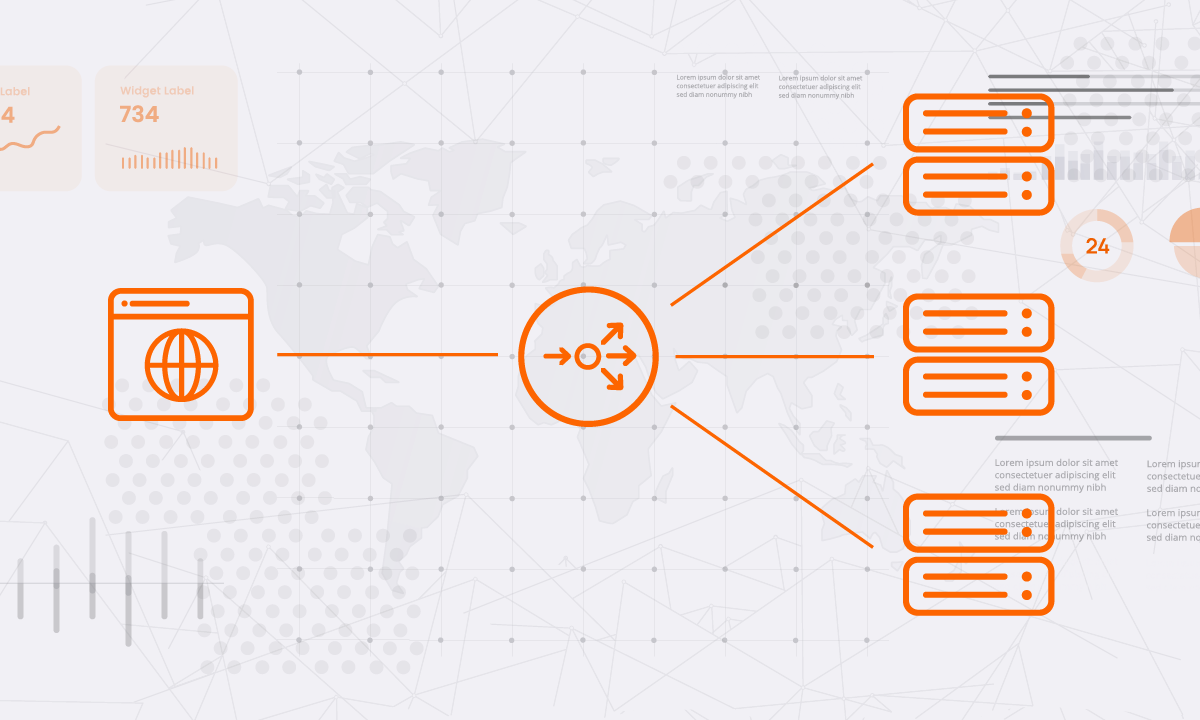
## How Server-side Tracking Works with Your Existing Cookie-banner Setup
Many brands already use Consent Management Platforms (CMPs) and cookie banners to comply with GDPR, CCPA, and other privacy regulations. The good news is that server-side tracking integrates with these systems rather than replacing them. Your existing consent mode infrastructure continues to work—it just gets smarter.
Here’s the basic pattern for how consent flows through a server-side setup:
- **User makes a choice:** Visitor interacts with your cookie banner and selects their preferences (accept all, reject non-essential, customize categories)
- **Consent signal captured:** The consent state gets recorded in your data layer or passed directly to your web application
- **Server reads consent:** Your server container receives the consent signal along with any events and uses it to decide what to send or suppress
- **Category-based routing:** Different consent categories (analytics, marketing, functional) map to different downstream tools—GA4 might receive events under “analytics” consent, while Meta CAPI only receives data when “marketing” is approved
Key considerations for consent management platform integration:
- Server-set first-party cookies can still be limited or disabled if users decline non-essential tracking
- Use a privacy-first implementation that respects user choices fully for GDPR and CCPA compliance
- Banner behavior must stay consistent across domains if you operate multiple properties
- Consent updates (user changes their mind) need to propagate to your server-side logic
- Your implementation must ensure server-side doesn’t “leak” data after a user opts out—this requires careful QA
## Benefits of Server-side Tracking for Marketing Performance
The benefits of server-side tracking tie directly to revenue, ROAS, and lead quality—not just “more data” in your reports.
- **Improved attribution accuracy:** More purchases and leads get correctly tied back to the campaigns and keywords that drove them. This matters enormously for Google Ads and Meta bidding algorithms, which optimize based on the conversion signals you send them. Better data means smarter automated bidding.
- **Higher-quality conversion signals:** You can send cleaner event data with richer parameters—like customer LTV segments, product categories, lead scores, or purchase frequency. This gives ad platforms more context to find similar high-value prospects.
- **Better funnel visibility across channels:** With reliable data collection, you can finally build multi-touch attribution models that show how SEO, paid search, social media platforms, and email work together. These powers flywheel optimization, where each channel reinforces the others.
- **Website performance gains:** Slimming down client-side scripts improves Core Web Vitals, which indirectly supports SEO rankings, UX quality, and conversion rates. Every millisecond of page load time you save translates to better user interactions.
- **Implementation resilience:** Fewer broken tags after site redesigns, A/B tests, or SPA framework changes because core tracking logic lives server-side. Your marketing measurement survives technical changes that would break traditional pixel implementations.
- **Reduced platform discrepancies:** When all your tools receive data from a single, consistent source, you spend less time reconciling numbers between Google Analytics, ad platforms, and your CRM.

## Data Privacy, Security, and Compliance
Privacy isn’t just a risk to manage—it’s becoming a competitive advantage. Brands that handle user privacy well earn more trust and face fewer regulatory headaches.
Server-side tracking gives you enhanced privacy compliance because you decide exactly which fields to keep, hash, truncate, or drop before data ever leaves your environment. For example:
- IP addresses can be anonymized or stripped entirely
- User agent strings can be generalized to prevent fingerprinting
- Email addresses can be hashed using SHA-256 for matching purposes without exposing raw PII
Centralizing data flows through your own server simplifies several compliance tasks:
- **Data subject requests:** When a user asks for their data or requests deletion, you have direct access to the source rather than chasing down records across dozens of third-party vendors
- **Records of processing:** Documentation becomes cleaner when all data routes through your infrastructure
- **Vendor data-sharing documentation:** You can clearly articulate what data goes where because you control the transmission
TG typically designs implementations to align with GDPR, CCPA/CPRA, and major ad platforms’ policies, including Google’s EU user consent policy and Meta’s data use restrictions.
Security best practices for server-side implementations include:
- HTTPS for all data transmission
- Access control on server containers (only authorized team members can modify tracking logic)
- Log retention policies that balance debugging needs with data minimization
- Separation of PII from behavioral analytics where possible
## Implementation Options and Stack Choices
There’s no single “right” stack for server-side tracking—the best choice depends on your traffic scale, dev resources, and existing tools.
#### Google Tag Manager Server-Side (sGTM):
- Most common starting point for mid-market and enterprise brands
- Runs on Google Cloud Platform or alternative hosting providers
- Familiar interface for teams already using Google Tag Manager
- Supports tags for GA4, Meta CAPI, Google Ads, LinkedIn, and many others
#### Direct server-to-server integrations:
- Meta Conversions API, Google Ads Enhanced Conversions, LinkedIn Conversions API
- Email platforms like Klaviyo or HubSpot capturing events directly from your backend
- Often used alongside sGTM for specific high-priority events like purchases
#### Alternative analytics approaches:
- GA4 via Measurement Protocol for direct server-to-server event sending
- Privacy-focused analytics tools that support server side data ingestion
- Custom data pipelines feeding data warehouses for advanced analysis
#### Trade-off matrix to consider:
| Factor | DIY / Self-Hosted | Agency-Led / Managed |
|---|---|---|
| Upfront cost | Higher dev time | Higher service fees |
| Ongoing maintenance | Your team owns it | Provider handles it |
| Flexibility | Maximum control | Some constraints |
| Speed to launch | Slower | Faster |
| Technical expertise needed | Significant | Minimal |
## How to Implement Server-side Tracking: a Practical Roadmap
Most TG implementations roll out in phases over 4–8 weeks, depending on complexity, traffic volume, and the number of platforms involved. Here’s the general process we follow:
**Phase 1: Discovery and Audit (Week 1-2)**
- Audit current tracking setup: GA4, any legacy Universal Analytics, pixels, tags, CRM events
- Document existing data gaps and identify where data loss is occurring
- Prioritize critical conversions: leads, demo requests, purchases, subscription signups
- Map out which platforms need server-side integration first
**Phase 2: Architecture Design (Week 2-3)**
- Decide on hosting: cloud provider like GCP, AWS, or managed hosting service
- Choose between sGTM, custom microservices, or a hybrid approach
- Define data models: event names, parameters, and user identifiers
- Plan consent integration with the existing CMP or cookie banner
**Phase 3: Implementation (Week 3-5)**
- Create a server container and configure the hosting environment
- Stand up tracking subdomain (e.g., track.yourdomain.com)
- Configure key tags: GA4, Meta CAPI, Google Ads Enhanced Conversions
- Wire in consent logic from your consent management platform
- Implement user ID strategies for cross-device tracking where permitted
**Phase 4: QA and Validation (Week 5-6)**
- Run client-side and server-side tracking in parallel
- Compare event counts and attribution patterns between old and new setups
- Fine-tune mapping and implement deduplication rules to avoid double-counting
- Validate consent enforcement across all user scenarios
**Phase 5: Rollout and Optimization (Week 6-8+)**
- Gradually route more platforms through server side
- Deprecate redundant client-side tags to improve page speed
- Build monitoring dashboards to track data quality over time
- Establish an ongoing review cadence for tracking health
## Common Pitfalls and How to Avoid Them
Server-side tracking can go wrong if treated as a “set-and-forget” IT project. Here are the issues we see most often and how to prevent them:
**Double-counted conversions:**
- Happens when both client-side and server-side tags fire for the same event
- Solution: Implement deduplication using event IDs and phase out redundant client-side tags
**Missing consent checks:**
- Server-side logic sends data even when users opted out
- Solution: Always validate consent state server-side before forwarding events; never assume consent
**Misaligned event names:**
- Your server sends “purchase,” but Meta expects “Purchase” (case-sensitive)
- Solution: Document your event schema and map carefully to each platform’s requirements
**Broken identifiers across domains:**
- User IDs don’t persist when visitors move between your main site and subdomains
- Solution: Plan cross-domain tracking architecture during the design phase
**Over-collecting personal data:**
- Server-side makes it easy to send everything—including data you shouldn’t keep
- Solution: Practice strict data minimization; only collect and forward what you actually need
**No clear ownership:**
- Tracking breaks and no one notices for weeks because it’s “IT’s job” or “marketing’s job.”
- Solution: Assign a specific owner for your tracking setup with clear responsibilities
**Lack of monitoring and alerts:**
- Data stops flowing, and you don’t find out until the monthly report looks wrong
- Solution: Set up automated alerts for significant drops in event volume or error rates
**No regression testing:**
- Site updates break tracking because no one tested the impact
- Solution: Include tracking validation in your deployment process for every release
## How TG Can Help You with Server-side Tracking
At TG, we treat tracking as the backbone of everything else we do—SEO, PPC, social media marketing, CRO, and email marketing all depend on accurate data to drive results. When your data management foundation is solid, every other marketing investment performs better.
Our typical engagement model includes:
- **Initial tracking audit:** We review your current setup, identify data gaps, and quantify how much you’re likely missing
- **Strategic roadmap:** We design an implementation plan that prioritizes quick wins while building toward a complete server-side solutions architecture
- **Implementation:** Our team handles the technical complexity—server container setup, tag configuration, consent integration, and QA
- **Ongoing optimization:** We tie tracking performance to your actual ROAS and revenue goals, adjusting as your campaigns and website evolve
What makes TG different is that our team includes both marketing strategists and developers. This combination is crucial for bridging technical implementation with real business outcomes. We don’t just make tracking work—we make it work for your marketing strategy.
We work with your existing tech stack—GA4, your CRM, ecommerce platform, and ad accounts—rather than forcing a complete rebuild. Server-side tracking is an enhancement, not a replacement for existing tools.
#### Ready to recover your lost data and improve campaign performance?
[Schedule a free consultation](https://example.com/contact) with TG to review your current tracking setup and identify where server-side tracking can make the biggest impact for your business.
**Categories:** Analytics
---
### [Why E-E-A-T Still Matters in 2025](https://www.wearetg.com/blog/google-eeat/)
**Published:** August 29, 2025
**Author:** Rob Timmermann
**Content:**
Your content is well-written, thoroughly researched, and packed with valuable information. So why is your website stuck on page three of Google? Chances are, you’re overlooking an essential ranking element: E-E-A-T
## What Is Google E-E-A-T?
E-E-A-T stands for Experience, Expertise, Authoritativeness, and Trustworthiness. Think of it as Google’s way of asking: “Should people trust this content enough to make important decisions based on it?”
Before you roll your eyes at another Google acronym, understand that E-E-A-T isn’t some arbitrary ranking factor. It’s Google’s attempt to solve a real problem. The internet is flooded with misleading, dangerous, or just plain wrong information. E-E-A-T helps Google identify content that won’t mislead or harm its users.
**Note**: There’s no “E-E-A-T score” that Google assigns to your content. Instead, E-E-A-T is a set of guidelines that Google’s human quality raters use to evaluate search results. These evaluations then help train Google’s algorithms to recognize high-quality content automatically.
### The Need for a Quality Control System
Google has one job, which is to help users find reliable information quickly. Every algorithm update, every new feature, every policy change serves this single purpose.
The problem? Anyone can publish anything online. Your cousin’s Facebook post about “miracle cures” sits next to peer-reviewed medical studies in search results. Google needed a way to separate credible information from potentially harmful nonsense.
That’s where E-E-A-T came in. It’s Google’s quality control system, designed to [elevate content that demonstrates real knowledge](https://www.wearetg.com/blog/content-marketing-metrics/) and downrank content that could mislead or harm users.

## The Four Pillars of E-E-A-T: Experience, Expertise, Authority and Trust
### 1. Experience
Google wants to see that content creators have real, first-hand experience with their topics.
**What this looks like**:
- A fitness blogger sharing before/after photos from their own transformation
- A restaurant reviewer including photos of dishes they actually ordered
- A tech reviewer showing hands-on testing of products they purchased
- A lawyer writing about cases they’ve actually handled
**How to show experience**:
- Include personal anecdotes and specific details that only come from real experience
- Share photos, screenshots, or other proof of your involvement
- Mention challenges you faced and how you overcame them
- Reference specific dates, locations, or circumstances from your experience
### 2. Expertise
Experience and expertise often overlap, but they’re different. Expertise is about demonstrating deep knowledge and skill in your subject area, whether that comes from formal education, professional experience, or years of dedicated study.
**What Google looks for**:
- Content that goes beyond surface-level information
- Accurate technical details and proper use of industry terminology
- References to current research, studies, or industry developments
- Demonstration of understanding complex concepts and their implications
**How to demonstrate expertise**:
- Include detailed author bios highlighting relevant qualifications
- Cite authoritative sources and recent research
- Explain complex topics in ways that show deep understanding
- Address common misconceptions or nuances that only experts would know
### 3. Authoritativeness
Google looks at whether other credible sources recognize you as an authority in your field.
**Signs of authority Google recognizes**:
- [Backlinks from reputable websites](https://www.wearetg.com/blog/link-juice/) in your industry
- Citations or mentions in mainstream media
- Guest posting opportunities on established platforms
- Speaking engagements or conference presentations
- Awards or recognition from industry organizations
**Building authority takes time**:
- Consistently [publish high-quality content](https://www.wearetg.com/blog/long-form-content/) in your niche
- Engage with other experts in your field
- Seek opportunities to contribute to established publications
- Build relationships with journalists and industry influencers
- Participate in industry conferences and events
### 4. Trustworthiness
Of all four E-E-A-T components, trustworthiness matters most to Google. You can have experience, expertise, and authority, but if users can’t trust your content, Google won’t rank it highly.
**What builds trustworthiness**
- Transparency about who you are and your qualifications
- Clear contact information and about pages
- Accurate, fact-checked information
- Proper citations and source attribution
- Regular content updates to maintain accuracy
- Professional [site experience and functionality](https://www.wearetg.com/blog/enhancing-user-experience-better-engagement/)
- Positive user reviews and testimonials
## Recent Algorithm Updates & What It Means for E-E-A-T Content in 2025
Google’s 2025 algorithm updates have significantly tightened E-E-A-T requirements, making it harder for mediocre content to slip through the cracks. If your traffic has dropped recently or you’re struggling to rank new content, these changes might be why.
### 1. AI Content Gets the Microscope Treatment
While AI-created content isn’t automatically penalized, Google now easily identifies content that lacks human insight, personal experience, or original thinking. The search giant doesn’t prohibit AI content outright, but it emphasizes that all content (regardless of how it’s created) must be helpful, reliable, and people-first.
So it’s safe to say the days of lightly editing ChatGPT output and expecting it to rank are over. If you’re using AI tools, they need to be starting points, not endpoints.
AI can help with research and structure, but the insights, examples, and expertise need to be authentically human. AI content that meets Google’s quality standards can rank well, but most AI-generated content needs significant human oversight and editing to reach E-E-A-T standards.
### 2. The “Experience” Factor Is Make-or-Break
Experience now carries more weight than ever before. Google is aggressively favoring content that demonstrates real-world, firsthand knowledge. A travel blog written by someone who actually visited the destinations will now significantly outrank one written by someone who just researched online. Similarly, a product review from someone who bought and used the product beats one written from spec sheets, no matter how well-researched the latter might be.
### 3. Google Fights Back Against Content Recycling
Content that simply rewrites existing articles or rehashes the same information everyone else is sharing faces steeper ranking penalties. Google’s algorithm has become sophisticated at identifying truly original insights versus cleverly reworded existing content. You can’t just take the top 10 articles on a topic, combine their points, and expect to rank. You need to bring something genuinely new to the conversation, like original research, unique perspectives or fresh content that hasn’t really been covered yet.
### 4. Fresh Content Gets Priority Treatment
Google now rewards content updates more aggressively. Stale content, even if it was once authoritative, will always lose ground to fresher alternatives. [Refreshing existing articles](https://www.wearetg.com/blog/seo-content/) with new data, current examples, or updated insights can significantly boost rankings.
### 5. Global Expansion Means Higher Stakes
Google’s Helpful Content system now applies more broadly across languages and regions. If you operate internationally or create multilingual content, technical SEO elements like proper hreflang implementation have become critical for maintaining E-E-A-T compliance.
## Some Industries Have Higher Quality Standards
E-E-A-T is especially critical for “Your Money or Your Life” (YMYL) content, or topics that could significantly impact someone’s health, financial security, safety, or overall well-being.
These include:
- Health and medical information
- Financial advice and investment guidance
- Legal information and advice
- Safety instructions and emergency procedures
- News about important current events
- Parenting and child safety information
- Information about pharmaceuticals and medical devices
If you create content in these areas, Google holds you to much higher E-E-A-T standards. A casual blog post about “natural remedies” will struggle to outrank content from established medical websites, regardless of how well-optimized it is for traditional SEO factors.

## Quick Wins to Improve Your Content’s E-E-A-T
### Start with Your Author Pages
Create detailed author bios that establish credibility. Include:
- Relevant education and certifications
- Professional experience in the field
- Links to previous work or publications
- Professional headshots and contact information
- Social media profiles showing expertise
### Upgrade Your Content Quality
- **Go deeper than your competitors**: Don’t just rehash what everyone else is saying. Add unique insights, personal experiences, and expert analysis.
- **Cite authoritative sources**: Link to government websites, academic institutions, established news organizations, and recognized industry experts.
- **Update content regularly**: Keep content current and accurate, especially for rapidly changing topics.
- **Show your work**: Explain your methodology, share your reasoning, and be transparent about your process.
### Build Your Site’s Credibility
- **Create comprehensive about pages**: Be transparent about who you are, what you do, and why you’re qualified to write about your topics.
- **Add contact information**: Make it easy for users to reach you with questions or concerns.
Include privacy policies and terms of service: Show that you take user privacy and legal compliance seriously.
- **Display testimonials and reviews**: Let satisfied customers or readers speak to your credibility.
### Earn Quality Backlinks
- **Create linkable assets**: Develop comprehensive guides, original research, or useful tools that others want to reference.
- **Guest post strategically**: Write for established publications in your industry to build authority and [earn quality backlinks](https://www.wearetg.com/blog/link-juice/).
- **Engage with your community**: Participate in industry discussions, forums, and social media conversations.
## What Measuring Success Actually Looks Like
Since there’s no E-E-A-T score to track, how do you know if your efforts are working?
**Indicators of improving E-E-A-T**:
- Increased organic traffic from competitive keywords
- Higher [click-through rates from search results](https://www.wearetg.com/blog/google-ctr-by-position/)
- More backlinks from authoritative websites
- Better user engagement metrics (time on page, bounce rate)
- Positive mentions in industry publications or social media
- Growth in branded search queries
**Questions to assess your content**:
- Would you trust this content enough to make an important decision based on it?
- Is the author clearly identified and credentialed for this topic?
- Does the content provide unique value beyond what’s already available?
- Are all claims properly sourced and verifiable?
- Would industry experts endorse this content?
## It’s Time To Stop Competing on Keywords Alone
Getting content to rank used to feel straightforward. You’d find the right keyword density, craft perfect meta descriptions, optimize your site speed, and call it done. It was a checklist-driven system that rewarded technical execution over genuine knowledge—and for years, that approach worked.
But Google has quietly engineered something much more significant with E-E-A-T. They’ve restored a fundamental principle that predates the internet itself: expertise should matter more than gaming the system. The world’s most sophisticated algorithm now recognizes and rewards authentic authority and trustworthiness.
This shift means businesses can no longer rely on technical tricks alone. Success now requires the kind of deep knowledge and genuine credibility that takes time to build. That’s where Timmermann Group comes in. We specialize in helping businesses make the transition from optimization to authority.
---
#### Build Authority That Search Engines and Users Trust
Ranking today isn’t about checking SEO boxes. It’s about proving real experience, expertise, authority, and trust. If your content isn’t demonstrating why you deserve to rank — through credible authorship, original insights, and strategic positioning — Google will reward someone who does.[ **Schedule a 30-minute consultation** ](https://www.wearetg.com/contact/)with Timmermann Group, and let’s build content that earns trust, authority, and long-term search visibility.
[](https://www.wearetg.com/contact)
**Categories:** SEO
---
### [On-Page Optimization: A Comprehensive Guide](https://www.wearetg.com/blog/on-page-optimization/)
**Published:** August 20, 2025
**Author:** Rob Timmermann
**Content:**
On-page optimization is key to improving your web pages’ search rankings and user experience. This guide will show you how to optimize elements such as content, meta tags, and URLs to attract more traffic and improve the visitor experience.
## Key Takeaways
- On-page SEO ([Search Engine Optimization](https://www.wearetg.com/services/seo/)) is essential for improving website visibility by optimizing content, layout, and HTML structure to enhance both user experience and search engine rankings.
- Key on-page SEO elements include title tags, meta descriptions, header tags, content quality, and mobile optimization, all of which play a crucial role in attracting and retaining users.
- Implementing advanced techniques such as structured data, featured snippets, and regular monitoring can significantly improve search engine rankings and overall site performance.

## Understanding On-Page Optimization
On-page SEO refers to the practice of optimizing individual web pages to improve a website’s visibility and attract visitors from search engines. This involves ensuring that the content, layout, and HTML tags on a page are structured so that both users and search engines can understand them. The significance of on-page SEO lies in its dual ability to enhance search engine rankings and improve the overall user experience.
A well-optimized website not only draws more traffic but also ensures that visitors find what they are looking for quickly and efficiently. This optimization includes reducing load times, ensuring the page’s content is relevant and valuable, and placing important information where it can be easily accessed. These efforts collectively lead to better engagement and satisfaction, which are crucial for maintaining a strong online presence.
One of the main distinctions between on-page and off-page SEO is the focus on the page’s structure and content in on-page SEO, whereas off-page SEO refers to external factors like backlinks and social signals. On-page SEO encompasses various elements, including keyword optimization, meta tags, and high-quality content, all of which are essential for making web pages more comprehensible to both search engines and users.
The ultimate goal of on-page SEO is to create a seamless experience that aligns with user intent while also making it easier for search engines to crawl and index the site’s content. By focusing on people-first content, you can ensure that your website meets the needs of its audience, which is a practice highly recommended by Google. This comprehensive approach to on-page optimization lays the foundation for a successful SEO strategy.
## Understanding Search Intent
Understanding search intent is at the heart of effective on-page seo. Search intent describes the underlying goal a user has when entering a query into a search engine. Recognizing this intent allows you to tailor your page seo elements such as title tags, meta descriptions, and content to better meet user expectations and improve your search rankings.
## Key Elements of On-Page SEO
On-page optimization involves various on-page seo components that contribute to a webpage’s visibility and performance on search engine results pages. These elements include:
- Keywords
- Header tags
- Title tags
- Meta descriptions
- Images
- Internal links
- A user-friendly experience.
Each of these components plays a crucial role in ensuring that your Web page meets both the users’ needs and the technical requirements of other search engines.
### Content Quality and Relevance
High-quality content is essential for effective on-page SEO; it should align with user search intent. Ensuring that your content is valuable, unique, and relevant can significantly improve your search engine rankings. One of the first steps in creating high-quality content is conducting thorough keyword research to identify what users are searching for. This involves selecting relevant keywords and topics that align with user intent. Incorporating related keywords alongside your primary target keywords helps improve search relevance and allows your content to cover a broader range of search queries.
Defining one topic per page allows you to provide detailed information on that specific subject, increasing your chances of ranking for that keyword. It’s also important to use your target keyword in the first 100-150 words of your blog post, as Google prioritizes keywords that appear early on the page. Additionally, considering the visitor’s search intent and the buyer’s journey during keyword research ensures that your content aligns with what users are looking for.
Keeping your content fresh and up to date is crucial for maintaining its value for both users and search engines. Benefits include:
- Regularly adding new information and revising existing content improves its relevance.
- It signals to search engines that your page is up to date.
- Creating comprehensive and well-written content can help you rank for phrases not explicitly used in the text, as search engines understand the semantic context.
Using primary and semantic keywords throughout the page optimizes your content for specific search terms. However, it’s important to avoid keyword stuffing, which can negatively impact your rankings and user experience. Instead, focus on naturally incorporating relevant keywords into your content to enhance its keyword density and SEO effectiveness.
### Title Tags and Meta Descriptions
Title tags are a critical on-page SEO factor, as they inform both visitors and search engines about a page’s content. A well-crafted title tag can significantly impact user behavior and their decision to click on your page. Maximize SEO effectiveness by ensuring title tags are concise, descriptive, and include primary keywords. The recommended character limit for title tags is 60 characters or fewer to avoid truncation in search results.
Each page on your website should have a unique title tag that accurately describes its content. This not only helps search engines understand the relevance of your pages but also improves the user experience by providing precise, accurate information.
Meta descriptions, on the other hand, serve as summaries of a page’s content and play a crucial role in improving click-through rates. Pages with meta descriptions receive about 5.8% more clicks compared to those without, highlighting the importance of this element. Meta descriptions should:
- Accurately reflect the page content
- Encourage users to click
- Avoid repetitiveness
- Use relevant keywords to highlight search terms and improve visibility
- Be between 155-160 characters in length to ensure they are fully displayed in search results
Creating compelling meta descriptions involves crafting a clear, engaging summary of the page’s content that entices users to learn more. A good meta description can significantly improve your click-through rate, making it an essential component of your on-page SEO strategy.
### Header Tags and Content Structure
Header tags play a vital role in organizing content for readers and indicating the importance of different sections to search engines. Using headings and subheadings helps users skim through content and assists search engines in understanding the page hierarchy. Proper use of header tags ensures that your content is logically structured, making it easier for both users and search engines to navigate.
Headings provide context for the page’s content, helping Google’s search algorithms determine its relevance. Structuring content logically with headers not only enhances readability but also helps keep audiences engaged.

Best practice for using headers in SEO includes:
- Use a single H1 per page to ensure a clear structure.
- Include target keywords in the headers, particularly in H1 and H2 tags, to optimize for SEO.
- Avoid using the exact keywords in headers as in the page title to improve semantic relevance.
Chunking content with headings helps maintain user engagement and facilitates more straightforward navigation through the material. This organized approach ensures your content is both user-friendly and search-engine-optimized.
### URL Structure
Having clear, descriptive page URLs is essential for on-page SEO. URLs should:
- Be simple
- Be informative
- Avoid random numbers or unnecessary text
- Incorporate a target keyword to help indicate to Google and users what the page is about, enhancing its visibility in search results.
Optimized URLs help users understand what the page is about and improve search engine matching. This is particularly important as search engines use URLs to understand the context of the page’s content. A well-structured URL can significantly affect how both users and search engines perceive your page.
When creating URLs, ensure they are short, descriptive, and include relevant keywords for your own website. This not only improves SEO but also enhances the user experience by providing precise and concise information about the page’s content.

## Advanced On-Page Optimization Techniques
Advanced on-page optimization techniques build upon the basics to further enhance your website’s visibility and performance. Utilizing tools like Semrush’s On-Page SEO Checker can streamline the optimization process by providing actionable insights. Regular SEO audits help identify issues such as duplicate content and keyword cannibalization before they impact performance.
Incorporating these advanced techniques and regular checks can significantly improve the effectiveness of your on-site SEO strategies.
### Featured Snippets
Featured snippets are a powerful way to increase the visibility and click-through rate (CTR) of your content. These snippets appear at the top of search results pages and provide a concise answer to the user’s query. Winning a featured snippet can significantly boost your website’s CTR, making it an essential goal for any SEO strategy.
To optimize for featured snippets, follow these steps:
- Provide clear and concise answers to common questions within your content.
- Use tools like Semrush’s Organic Research tool to identify search terms that trigger featured snippets.
- Target these keywords in your content.
- Utilize the Keyword Overview and SERP Analysis features to check if a keyword has a featured snippet.
- Tailor your content accordingly based on these insights.
By optimizing your content to specifically target keywords that already feature snippets, you can increase your chances of appearing in these coveted positions. This not only improves your visibility but also attracts more organic traffic to your website, enhancing your overall SEO efforts, especially when it comes to how search engine bots index your content.
### Structured Data and Schema Markup
Structured data and schema markup are essential components of advanced on-page SEO. Structured data helps search engines better understand the information on your page, which can lead to enhanced search results like rich snippets, knowledge panels, and more. Schema markup, a specific form of structured data, is used to create rich snippets that can significantly improve your click-through rates and visibility.
The benefits of using schema markup are manifold. Rich snippets, for example, provide additional information such as images, ratings, and reviews directly in the search results, making your listing more appealing to users. Implementing schema markup can also help search engines understand the context of your page’s content, potentially leading to more accurate and relevant search results.
Effectively implementing structured data involves:
- Ensuring your website contains specific information suitable for schema markup, such as product details, reviews, or event information.
- Using tools like the Schema Markup Validator to check if your schema is set up correctly.
- Using Site Audit tools to ensure that structured data is implemented adequately across your web pages.
Incorporating structured content, such as lists or definitions, can improve your chances of appearing in featured snippets, further enhancing your search visibility. By leveraging structured data and schema markup, you can provide a richer user experience and boost your SEO efforts.
### Page Speed Optimization
Page speed is a critical factor in both user experience and search engine rankings. A faster-loading page not only retains users but also helps achieve better search rankings. To effectively monitor and improve site speed, using tools like Google’s PageSpeed Insights is essential. This tool provides a speed score and actionable tips to enhance your page’s load times, taking on-page factors into account.
One effective technique for improving page speed is caching, which temporarily stores website elements, enabling faster loading on subsequent visits. Additionally, implementing a Content Delivery Network (CDN) can serve content from the nearest server to the visitor, significantly reducing load times.
Selecting a reliable web hosting provider is another crucial factor in page speed optimization. The quality of your hosting can directly influence how quickly your pages load, making it worth investing in a provider known for speed and reliability. By focusing on these aspects, you can ensure your pages load quickly, improving both user experience and SEO performance.
Optimizing images and using appropriate formats can also significantly enhance page loading speed. Ensure your images are compressed without sacrificing quality, and use responsive images to maintain fast load times across devices. These efforts collectively contribute to a quicker, more efficient website.
## Technical Optimization
[Technical SEO optimization](https://www.wearetg.com/blog/technical-seo/), while its own category of SEO, is also a foundational aspect of on-page seo that ensures your website is accessible, fast, and secure for both users and search engines. By addressing technical factors, you can significantly improve your page seo and boost your search rankings.
## Internal Linking Strategies
Internal linking is a powerful on-page SEO strategy that enhances a website’s navigation and helps users find related content easily. Linking to other pages within your website is essential for improving SEO and strengthening your site structure. By strategically placing internal links, you can:
- Boost your site’s rankings
- Ensure that visitors spend more time on your site
- Reduce bounce rates by placing links towards the top of a page
- Increase the time users spend on your site
A good internal linking strategy involves:
- Linking from high-authority pages to important content to enhance the ranking potential of those pages.
- Using keyword-rich anchor text for internal links signals to Google which keywords the linked page should rank for.
- Avoid using duplicate anchor text for multiple pages to prevent confusion for search engines.
Regular audits of internal links help maintain an effective linking structure and improve SEO. Including internal links in older articles can revitalize their relevance and traffic, making them an integral part of your on-site SEO strategy. Additionally, ensuring that users can find relevant links within three mouse clicks from the homepage enhances user experience and navigation.
By using varied anchor text and strategically placing internal links, you can improve the clarity and effectiveness of your internal linking strategy. This not only helps search engines crawl and index your site more effectively but also enhances the user experience by adding internal links and external links to make your content more accessible.
## Optimizing Images for SEO
Optimizing images is a crucial on-page SEO practice that can significantly impact search rankings and user engagement. When adding images to a page, it’s essential to use descriptive file names and include informative, relevant image alt text to enhance SEO performance. Alt text helps search engines understand the content of images and improves accessibility for screen reader users.
High-quality images can increase click-through rates from search results, making them a valuable asset for improving search visibility. Key aspects of image optimization include:
- Optimize images with alt tags to drive traffic from image search results.
- Using appropriate image formats.
- Ensuring images are compressed without sacrificing quality to improve page load speed.
Embedding images using standard HTML image elements helps search engines find and process them more effectively. Providing search engines with context about the page’s content through image optimization is key to improving your overall SEO performance. Utilizing responsive images ensures that they display correctly across various devices, enhancing the user experience on both desktop and mobile platforms.
By focusing on these image optimization aspects, you can enhance your website’s visibility, improve user engagement, and boost your search rankings. High-quality, optimized images are an essential component of a successful on-page SEO strategy.
## Mobile Optimization
Mobile optimization is essential for improving search rankings and user experience, as Google favors mobile-optimized sites. With the increasing use of mobile devices for browsing, ensuring your website is mobile-friendly is crucial. Incorporating touch-friendly features and a mobile-friendly design can enhance user retention and reduce bounce rates on mobile sites. These features improve navigation and make it easier for users to interact with your site on smaller screens.
Implementing Accelerated Mobile Pages (AMP) and using responsive images are key strategies for significantly improving load times and mobile device adaptability. AMP provides a streamlined version of your web pages that loads quickly on mobile devices, enhancing the user experience and improving search rankings. Responsive images ensure that your visual content adjusts to different screen sizes, maintaining fast load times and a consistent user experience across all devices.
By focusing on mobile optimization, you can ensure that your website meets the needs of modern users and stays competitive in search rankings. This not only improves user satisfaction but also aligns with Google’s mobile-first indexing approach, making it a critical component of your on-page SEO strategy.
## On-Page SEO and User Experience
On-page seo and user experience go hand in hand. A well-optimized website not only appeals to search engines but also provides a smooth, enjoyable experience for visitors. By focusing on key on-page seo elements, you can enhance usability, increase engagement, and ultimately improve your search rankings.
## On-Page SEO Tools and Resources
Leveraging the right tools and resources can make your on-page seo efforts more effective and efficient. There are a variety of platforms available to help you analyze, monitor, and optimize your page seo elements for better search engine rankings.
- Google Search Console: This free tool from Google provides valuable insights into your website’s performance in search engine results. It helps you monitor keyword rankings, identify technical issues, and optimize your site’s structure and content.
- SEO Suites (Ahrefs, SEMrush, Moz): These comprehensive tools offer in-depth on-page seo audits, keyword research, backlink analysis, and competitor insights. They can help you uncover opportunities to improve your on-page seo elements and overall strategy.
- Online Resources: Blogs, tutorials, and guides from reputable SEO experts can keep you up to date on the latest best practices and algorithm changes.
By regularly using these tools and resources, you can identify areas for improvement, track your progress, and stay ahead of the competition. Incorporating insights from platforms like Google Search Console and other SEO tools into your on-page seo strategy ensures your website remains optimized for both users and search engines.
## On-Page SEO and Analytics
Integrating analytics into your on-page seo strategy is essential for measuring success and making data-driven decisions. By tracking key metrics, you can assess how your on-page seo efforts are impacting your website’s performance and search engine rankings.
- Google Analytics: This powerful tool provides detailed information about your website’s traffic, user behavior, and conversion rates. By analyzing metrics such as page views, bounce rates, and average session duration, you can gauge the effectiveness of your on-page seo elements.
- Keyword Rankings and Organic Traffic: Monitoring your keyword rankings and organic traffic helps you understand which pages are performing well and which need further optimization.
- Refining Your Strategy: Use analytics data to identify trends, uncover opportunities, and adjust your on-page seo strategy for continuous improvement.
By combining on-page seo with robust analytics, you can create a feedback loop that drives ongoing optimization. This approach ensures your website remains visible in search engine results, attracts more organic traffic, and achieves higher search rankings over time.
## Monitoring and Adapting Your On-Page SEO
Good on-page optimization practices help maintain a website’s relevance over time, making regular monitoring and adaptation essential. SEO algorithms and user behavior change over time, so continuously evaluating your on-page SEO efforts allows for timely adjustments in response to these changes. Regularly tracking key SEO metrics ensures that your website remains optimized and competitive in search engine results.
Tools like Google Analytics can be used to measure the impact of on-page optimization. Monitoring keyword rankings and traffic analytics provides insights into your SEO performance and helps identify areas for improvement. Creating annotations when making significant on-page SEO changes helps track their impact and enables better analysis and adaptation.
Identifying trends in search queries can help optimize content and improve user engagement. By monitoring mobile traffic analytics, you can gain insights into user behavior and site performance on mobile devices, ensuring that your mobile optimization efforts are practical. Staying ahead of trends and adapting to changes in user behavior and search algorithms is crucial to maintaining peak on-page SEO performance and matching search intent.
Regular evaluation and adaptation of your on-page SEO strategy ensure that your website remains relevant, competitive, and optimized for both search engines and users. This proactive approach helps you stay ahead of the competition and continuously improve your SEO efforts.
## Summary
In conclusion, mastering on-page optimization is essential for achieving success in 2025. By focusing on key elements such as content quality, title tags, meta descriptions, header tags, and URL structure, you can significantly improve your website’s visibility and user engagement. Advanced techniques like featured snippets, structured data, and page speed optimization further enhance your SEO efforts, ensuring your website stays competitive in search rankings.
Monitoring and adapting your on-page SEO strategy is crucial for maintaining relevance and staying ahead of trends. By implementing the methods outlined in this guide and linking to and referencing authoritative and reputable websites, you can enhance your website’s credibility and SEO performance. Embrace these techniques and watch your online presence soar.
---
#### Ready to Turn On-Page SEO Into Measurable Growth?
On-page optimization isn’t just about tweaking title tags or adding keywords. It’s about aligning your content, structure, and user experience with what search engines (and real people) are actually looking for. If you’re unsure whether your current pages are fully optimized — or you want a strategic audit to uncover missed opportunities — let’s build a plan that improves rankings, engagement, and conversions.[ **Schedule a 30-minute consultation** ](https://www.wearetg.com/contact/)with Timmermann Group to start maximizing your on-page SEO performance.
[](https://www.wearetg.com/contact)
---
## Frequently Asked Questions
### What is an on-page optimization?
On-page optimization is essential for improving individual web pages by strategically optimizing content, title tags, meta descriptions, and internal linking to enhance search rankings. It significantly impacts user experience and search visibility by ensuring each page is structured correctly and optimized for target keywords and user intent.
### What is the difference between off-page and on-page optimization?
Off-page and on-page optimization are crucial complementary strategies that work together to improve your website’s search engine performance and authority. On-page optimization focuses on elements within your website, such as content and technical structure, while off-page optimization builds external authority through backlinks, social signals, and brand mentions.
### What are the four types of SEO?
The four types of SEO are on-page SEO, off-page SEO, technical SEO, and local SEO. These are all unique and essential components that work together to improve your website’s search engine performance and user experience.
### Which of the following is an example of on-page optimization?
Examples of on-page optimization include optimizing title tags, meta descriptions, header tags, internal linking, and keyword placement within content to improve search engine rankings. These techniques are essential for helping search engines understand your page content and significantly impact your website’s visibility and click-through rates from search results.
**Categories:** SEO
---
### [Google Ads for Lawyers: Advertising 101 What Lawyers Need to Know](https://www.wearetg.com/blog/google-ads-for-lawyers/)
**Published:** September 15, 2025
**Author:** Rob Timmermann
**Content:**
Standing out against the competition in a crowded legal market online requires more than a solid reputation and strong word-of-mouth referrals. Google Ads is one of the most effective tools for law firms looking to attract new clients and grow their practice. Every day, millions of users turn to Google to search for various services, including legal help. Leveraging Google Ads ensures your firm is visible when potential clients actively seek help. Whether your goal is to generate leads, increase consultations, or build brand awareness, understanding how to navigate the world of Google Ads can make all the difference. Ads for law firms, such as Google Ads and Google Local Service Ads, are a crucial component of digital marketing for legal practices, helping to generate leads and increase visibility.
In this blog, we’ll discuss the basics of Google Ads, explore the most beneficial types of ads for lawyers, and provide actionable steps to help you set up and optimize your campaigns. From search ads that connect you with clients when they need legal help to local service ads targeting specific geographic areas, Google Ads offers endless opportunities for law firms to grow their client base and drive success. Google Ads for law can be strategically used to set campaign goals, choose the right keywords, and optimize ad performance to attract potential clients.
A strong law firm’s online presence is essential, and using Google Ads alongside SEO can significantly improve your visibility and client acquisition.
## What Are Google Ads?
Google Ads is an online advertising platform where businesses, including law firms, can pay to display brief advertisements, service offerings, or videos to web users (formerly known as Google AdWords). These ads appear on Google’s search engine results pages (SERPs), YouTube, and across the Google Display Network, which comprises millions of websites, apps, and videos. Your ad appears in prominent positions when users search for relevant legal services. What makes Google Ads especially powerful is the ability to target people based on their active search queries, allowing law firms to connect with potential clients in real-time.
For law firms, Google Ads offers a critical advantage: reaching individuals already searching for legal services. Whether a potential client is looking for a personal injury lawyer, a criminal defense attorney, or help with a family law matter, they are likely turning to Google to find their answers. Google Ads ensures your law firm appears at the top of these search results in Google search results, providing you with prime visibility and a direct connection to prospects who need legal assistance.
By targeting relevant keywords, law firms can ensure their ads appear in front of users who are most likely to convert. Google Ads can also be used to drive traffic directly to your law firm’s website, generating leads and increasing your online presence. Rather than using broad strategies and generic keywords hoping to catch potential clients, your firm can use Google Ads to focus on a highly qualified audience searching for your services.
Using Google Ads for lawyers and law firms is not just about visibility; it’s about being there when potential clients need you most.
## Types of Google Ads Lawyers Can Use
Law firms can use several[ types of Google ads](https://support.google.com/google-ads/answer/1722124?hl=en) to reach potential clients, each offering unique benefits depending on their marketing goals. Whether the goal is to increase visibility, build brand awareness, or connect with local clients, understanding the different ad formats can help you choose the right strategy for your firm.
Google Ads enables law firms to display ads based on keyword targeting, ensuring their ads reach potential clients actively searching for legal services.
### Search Ads
Search Ads are among the most common and effective forms of Google Ads for lawyers and law firms. These text-based ads appear at the top of SERPs when users enter relevant keywords, such as “personal injury lawyer near me” or “divorce attorney in St. Louis.” Because they are triggered by user intent, Search Ads allow your law firm to appear precisely when potential clients actively seek legal services, making them highly valuable for generating qualified leads.
The main benefit of Search Ads is their prominent placement at the top of Google’s results, above organic listings. This visibility can be crucial in a competitive industry like law, where clients are often in immediate need and may choose the first relevant result they see. Additionally, Search Ads offer robust targeting options, allowing you to focus your ad spend on specific demographics, geographic areas, and even times of day when your audience is most likely to search for legal help. Organizing your keywords and ads into specific ad groups can further improve ad relevance and campaign performance by ensuring each ad group targets a particular theme or set of related keywords.
### Display Ads
Display Ads are visually engaging banner ads that appear across a vast network of websites, apps, and videos through Google’s Display Network. Unlike text-based Search Ads, which rely on keyword searches, Display Ads are image-based and designed to capture attention while users browse the web. These ads don’t necessarily target individuals actively searching for legal services, but help law firms build brand awareness by placing ads in front of potential clients visiting relevant sites.
For law firms, Display Ads are particularly useful for increasing visibility and keeping your firm top of mind. They allow you to target users based on their interests, demographics, and past online behavior, making it easier to reach individuals needing legal services in the future. Display Ads are customizable with compelling visuals and call-to-actions, helping your firm stand out in a crowded digital landscape. Creating compelling ads is essential to attract attention and encourage engagement, ensuring your message resonates with potential clients.
The main benefit of Display Ads is their ability to boost brand recognition. Even if a potential client isn’t actively seeking legal assistance, consistently seeing your firm’s ads on trusted websites can establish familiarity and make them more likely to reach out when they need legal help.
### Local Service Ads
[Local Service Ads (LSAs)](https://www.wearetg.com/glossary/lsa-local-services-ads/) are explicitly designed to help businesses, including law firms, connect with clients in their local area. These ads appear at the top of Google’s search results when users search for services like “criminal defense lawyer near me” or “family attorney in St. Louis.” Unlike traditional Google Ads, LSAs focus on local relevance, displaying your firm’s contact information, hours of operation, and even customer reviews, making it easier for potential clients to reach out directly.
For lawyers, the primary benefit of Local Service Ads is their ability to target specific geographic areas, ensuring that your firm’s ads are shown to people in your service area. This can be especially useful for legal professionals who rely on local clients, as LSAs allow you to capture leads from individuals looking for immediate help within your practice area. LSAs are also a cost-effective way to attract qualified leads. Using a pay-per-lead model, you only pay when someone contacts your firm through the ad.
### Video Ads
Video Ads are a dynamic form of Google advertising that allows law firms to engage potential clients through visual storytelling. These ads typically appear on YouTube and across Google’s Display Network, showing short video clips before, during, or after other video content. Video Ads can be highly effective for law firms looking to build trust and establish authority by showcasing their expertise, highlighting client success stories, or explaining complex legal topics in a more engaging format.
Video ads provide a unique opportunity to stand out from legal competition and create a lasting impression. The highly engaging nature of video content can evoke emotion and offer a more personal connection, powerfully capturing the attention of prospective clients. Whether it’s a 15-second introduction to your firm or a more in-depth explanation of your services, Video Ads allow you to convey your message clearly and memorably.
## Setting Up a Google Ads Account
Before launching your first Google Ads campaign, you’ll need to set up a Google Ads account tailored to your law firm’s needs. Start by visiting the Google Ads website and clicking “Start now.” You’ll be prompted to enter your business details, such as your law firm’s name, website, and contact information. Next, you’ll set an initial campaign budget. This can be adjusted later as you refine your ads campaign.
When choosing a campaign type, most law firms benefit from starting with the “Search Network,” which allows your ads to appear when potential clients search for specific keywords related to your legal services. For greater control over your Google Ads campaigns, consider switching to “Expert Mode.” This unlocks advanced features, such as custom targeting, detailed bidding strategies, and the ability to create multiple ad groups within your campaign.
Be sure to define clear goals for your Google Ads account, such as increasing website traffic, generating leads, or promoting specific legal services. Select objectives like “Leads” or “Website traffic” to align your campaign with your law firm’s marketing strategy. By setting up a well-structured Google Ads account from the start, law firms can more effectively reach potential clients, maximize their ad spend, and boost their online visibility.
Setting Up Google Ads: A Step-By-Step Guide
### Step 1: Define Your Goals
The first step in setting up successful ad campaigns is clearly defining your goals. Before launching any ads, it’s crucial to determine what you want to achieve. For law firms, these goals might include generating more leads, increasing consultations, attracting specific case inquiries, or boosting overall brand awareness. Having a clear objective can create a more focused and effective campaign that aligns with your firm’s broader marketing strategy. Setting clear objectives for your ad campaign is essential for improving relevance and ROI.
Understanding your goals is vital to optimizing your Google Ads performance. Knowing your target outcome will help you choose the right ad formats, keywords, and audience targeting, whether you want to drive immediate phone calls, form submissions, or website visits. Additionally, setting measurable goals allows you to track success and make data-driven adjustments throughout your campaign, ensuring your law firm gets the most out of its advertising investment.
### Step 2: Identify Your Target Audience
Once you’ve defined your goals, the next crucial step in setting up a law firm Google Ads campaign is identifying your target audience. This means understanding who your ideal clients are and how to segment them based on location, demographics, and intent. By clearly defining your audience, you can ensure that the people most likely to need your services see your ads, increasing the chances of converting leads into clients.
Segmentation is critical to reaching the right audience. You can target potential clients based on geographic location, ensuring your ads are shown to individuals within your service area. Additionally, demographics such as age, gender, and income level help narrow your focus to those most likely to engage with your firm. Intent is another decisive factor. By targeting keywords and behaviors that indicate someone is actively searching for legal help, you can connect with people who are ready to take action. Targeted advertising through Google Ads allows law firms to reach potential clients based on their specific needs and locations, making marketing campaigns more effective.
### Step 3: Choose the Right Keywords
Choosing the right keywords is vital in creating an effective Google Ads campaign. When seeking legal services, keywords are the terms and phrases that potential clients enter into search engines. For law firms, selecting legal-specific keywords ensures your ads are shown to individuals actively seeking assistance in your practice areas.
#### Keyword Relevancy
The importance of using relevant keywords cannot be overstated. Keywords like “personal injury lawyer near me” or “family law attorney in St. Louis” connect you with potential clients and increase the likelihood of attracting highly qualified leads. These terms indicate strong intent, meaning users are likely further along in their decision-making process and ready to reach out for help.
#### Short vs. Long-Tail Keywords
When performing keyword research and choosing specific keywords, consider[ short and long-tail keyword options](https://www.wearetg.com/long-tail-vs-short-tail-keywords/). Short-tail keywords are generic search terms consisting of no more than one or two words, like “lawyers” or “divorce lawyer.” Long-tail keywords are typically phrases of four to eight words that narrow down a search to the most applicable results, such as “top-rated lawyers in St. Louis” or “personal injury attorney specializing in car accidents.”
#### Keyword Match Types
In Google Ads, understanding keyword match types is essential for controlling when your ads appear.
- **Broad match** casts a wide net, allowing your ads to show for a variety of related search terms, synonyms, and even misspellings, which can help increase your ad reach.
- **Phrase match** targets searches that include your chosen phrase, ensuring your ads appear for queries containing that specific sequence of words.
- **Exact match** provides the most precision, showing your ads only for searches that match the exact keyword or very close variations.
Using single keyword ad groups (SKAGs) can further improve relevance and performance by creating dedicated ad groups for each top-performing keyword, allowing you to tailor ad copy more effectively. Additionally, dynamic keyword insertion is a feature that automatically inserts targeted keywords into your ad copy, enhancing ad relevance and click-through rates by matching user search queries in real time.
Broad, short-tail keywords can attract a wider audience, while long-tail keywords often yield higher conversion rates because they target users with more defined needs. Tools like Google’s Keyword Planner can help you identify high-impact keywords relevant to your legal services and assess their search volume and competition, helping you determine if they should be added to your Google Ads marketing strategy.
### Step 4: Write Engaging Ad Copy
Writing engaging ad copy is essential for capturing the attention of potential clients and encouraging them to take action. To stand out against the competition, your ads must be concise, compelling, and direct, addressing the legal needs of your target audience. Learning how to create compelling ads is crucial, as it helps attract potential clients and improve your campaign performance. Here are some tips to help you craft effective ad copy:
- **Be Clear and Direct:** Clearly convey your services and the benefits clients can expect. Use straightforward language that speaks directly to potential clients’ concerns, such as “Get a Free Consultation with an Experienced Divorce Attorney.”
- **Highlight Unique Selling Points:** Differentiate your law firm by showcasing what distinguishes you from the competition. Whether it’s your years of experience, success rate, or personalized service, make sure this information stands out in your ad.
- **Include a Strong Call to Action:** Encourage users to take the next step by including a compelling call to action, such as “Contact Us Today” or “Schedule Your Free Consultation.” A solid call to action creates a sense of urgency and guides potential clients on what to do next.
- **Use Emotional Appeals:** Legal matters often evoke strong emotions. Use your copy to resonate with potential clients’ feelings. Phrases like “We’re here to help you through this difficult time” can create a connection and highlight your empathetic approach to legal representation.
- **Test Different Variations:** Don’t hesitate to A/B test different versions of your ad copy to see what resonates best with your audience. Small changes in wording can significantly impact your ad’s performance.
Engaging ad copy captures attention and communicates the value of your services, making it crucial to your Google Ads strategy.
### Step 5: Set Your Budget
Establishing the proper budget is essential for managing your Google Ads campaign, especially in the legal industry. Google Ads operates on a[ pay-per-click (PPC) model](https://www.wearetg.com/services/pay-per-click-marketing/), meaning you only pay when someone clicks on your ad. PPC ads are a core component of digital marketing for law firms, allowing for measurable results and targeted client acquisition. Therefore, effectively managing your PPC budget helps maximize your return on investment (ROI) while attracting high-quality leads.
Here are key factors to consider when setting your budget:
- **Cost-Per-Click (CPC):** Because they’re highly competitive, legal-related keywords tend to have higher CPC rates. Understanding how much you’re willing to pay for each click and balancing this with potential revenue is crucial. Google’s Keyword Planner can help you estimate the average CPC for relevant legal terms.
- **Daily and Monthly Spend Limits:** Setting daily or monthly caps on your ad spend helps ensure you stay within your financial limits. It’s also important to revisit these limits as you optimize your campaigns for performance.
- **Campaign Goals:** Your budget should reflect your desired outcomes. Align your spending with the campaign’s objectives, whether your goal is to drive leads for consultations, increase brand awareness, or promote specific legal services. Larger goals, like acquiring a high volume of leads, may require a more significant investment.
- **Ad Bidding Strategy:** Google Ads offers different bidding options to control how your budget is spent. Choose a strategy that aligns with your campaign goals and allows you to manage your budget efficiently.
- **Monitor and Adjust:** As your campaign runs, monitor performance metrics and be ready to adjust your budget. If certain ads or keywords drive valuable leads, consider allocating more budget to them while reducing spending on underperforming ads. Ongoing management and optimization are key to successful PPC advertising in the legal industry.
## Landing Page Optimization for Law Firms
A successful Google Ads campaign doesn’t end with a click; your landing page plays a crucial role in converting potential clients into leads. For law firms, landing page optimization means ensuring that every visitor who arrives from your ad finds exactly what they’re looking for, with a clear path to take action.
Start by making sure your landing page is directly relevant to the ad content and the specific keywords you’re targeting. If your ad promotes “[personal injury legal services](https://www.wearetg.com/industry/personal-injury-seo/),” your landing page should focus on that practice area, not general legal information. Include a prominent, easy-to-find call-to-action (CTA), such as “Request a Free Consultation” or “Contact Our Attorneys Today,” and use simple forms to capture visitor information.
Mobile optimization is essential: over 60% of users searching for legal help do so on their phones. Ensure your landing pages load quickly, display correctly on all devices, and offer a user-friendly experience. Slow load times or cluttered layouts can increase bounce rates and reduce conversions.
Utilize keyword research tools like Google Keyword Planner to identify relevant keywords and naturally incorporate them into your landing page content. This not only improves your Google Ads Quality Score but also helps your landing page rank higher in organic search results, driving additional website traffic.
By focusing on landing page optimization, law firms can increase conversion rates, make the most of their ad spend, and provide a seamless experience for potential clients seeking legal help.
## Google Ads Success: Best Practices for Legal Industry Professionals
Law firms looking to run a successful Google Ads campaign need to apply tailored strategies that uniquely address the legal industry’s needs. With the right approach, Google Ads can deliver highly visible, targeted, and trackable results that significantly impact client acquisition. Google Ads work effectively for law firms when campaigns are strategically set up and managed, ensuring a strong return on investment.
The following are some best practices for creating successful Google Ads campaigns for law firms:
### Focus on Local Search Optimization
Local relevance is a critical component of a successful Google Ads campaign. Potential clients often search for attorneys in their immediate area, making location-based targeting essential to reaching the right audience. By optimizing your ads for local search, you can ensure that your law firm appears prominently when someone searches for legal services near them. This local search optimization through Google Ads significantly enhances your law firm’s online visibility and helps generate more leads.
### Use Negative Keywords
Negative keywords are crucial to any Google Ads strategy, especially for law firms. While the right keywords ensure your ads appear for relevant searches, using negative keywords helps prevent your ads from being displayed for irrelevant or unwanted search queries. This saves your law firm money by avoiding clicks from users unlikely to convert into clients. By using negative keywords, your ads are shown only to those searching for relevant legal services your firm offers.
#### What Are Negative Keywords?
Negative keywords are search terms that you specifically exclude from triggering your ads. Adding these keywords to your campaign can refine who sees your ads and avoid wasting your ad budget on clicks from irrelevant or unrelated searches. For instance, if you’re a personal injury lawyer, you may want to exclude terms like “free legal advice” or “legal internships,” which attract users who aren’t looking to hire an attorney.
Law firms often face the challenge of competing with other online legal content. Without negative keywords, your ads could appear in searches for legal topics or services you don’t provide, leading to unqualified clicks. For example:
- If your firm specializes in family law but not estate planning, you can use “wills” or “trusts” as negative keywords to avoid appearing in searches related to those areas.
- Excluding phrases like “pro bono” or “free” ensures you attract clients ready to pay for services rather than individuals seeking free consultations or legal aid.
Carefully managing negative keywords can improve the relevance of your ad traffic, leading to a higher ROI and better conversion rates. Regularly reviewing and updating your list of negative keywords based on your ad performance data will help your campaign stay efficient, ensuring you’re reaching potential clients actively searching for your specific legal services.
### Leverage Ad Extensions
Ad extensions are powerful tools within Google Ads that allow law firms to enhance their standard ads with additional information, making them more relevant and enticing to potential clients. Using capabilities like call extensions, location extensions, and structured snippets allows your firm to provide more details, improve visibility, and drive more engagement, all without additional cost.
#### Call Extensions
Call extensions add a clickable phone number to your ad, making it easy for potential clients to contact your firm directly. By enabling call extensions, you streamline the process for clients to reach out, which can lead to increased lead generation. Call extensions benefit law firms in a few ways:
- Direct Communication: Call extensions facilitate quick client inquiries, which is crucial when people are urgently seeking legal services.
- Mobile Optimization: Users can tap the phone number and call instantly on mobile devices, offering a seamless experience that encourages engagement.
#### Location Extensions
Location extensions help you display your firm’s address alongside your ad, showing potential clients exactly where your office is located. This feature is essential for law firms targeting clients in specific geographic areas. The extension can also include a clickable link to Google Maps, making it easy for users to find directions.
#### Structured Snippets
Structured snippets allow you to showcase specific aspects of your legal services, such as practice areas like “personal injury,” “family law,” or “criminal defense.” These snippets provide potential clients with quick insights into what your firm offers, helping them decide if your expertise matches their legal needs. Structured snippets are beneficial to law firms for:
- Enhanced Relevance: Highlighting practice areas helps capture users’ attention when searching for specific legal services, improving the chance of qualified clicks.
- Better Targeting: Structured snippets can make your ad stand out by providing more context, increasing the likelihood of attracting clients seeking your expertise.
### Regularly Test and Optimize Ads
A key to long-term success with Google Ads is continuously refining your approach through testing and optimization. A/B testing different ad elements for law firms and making data-driven adjustments can significantly improve performance and drive better results over time.
A/B testing, also known as split testing, involves running two versions of an ad with one varying element, such as the headline, CTA, or even the landing page. By comparing how each version performs, you can determine which variations resonate more with your target audience and yield better results.
For example, a law firm might test headlines like “Get a Free Legal Consultation today” versus “Experienced Personal Injury Lawyers Ready to Help.” The firm can fine-tune its messaging to align more closely with client needs and behavior by analyzing which ad generates more clicks or conversions. Testing allows you to pinpoint what works best in attracting potential clients and reduce wasted ad spending on less effective elements to focus on what drives results.
#### Optimizing Based on Performance
After running A/B tests, it is essential to analyze performance data and implement changes. Google Ads provides various metrics, such as CTR, CPC, and conversion rate, that help measure the success of your campaigns. Regularly reviewing these metrics and adjusting based on what’s working (or not) ensures that your ads remain competitive.
For instance, if ads featuring certain keywords generate more inquiries, you can increase the budget for those keywords or adjust the ad copy to emphasize them. Conversely, if certain ad variations consistently underperform, you can pause them to focus on the winning versions.
Here are some optimization strategies for law firms:
- **Headline Versions:** Test different wording or offers to see what drives more client engagement.
- **Ad Copy:** Experiment with concise versus more detailed ad text to see which approach appeals to your audience.
- **Keywords:** Regularly refine your keyword list to focus on high-intent, legal-specific search terms that yield better results.
## Tracking and Measuring Your Google Ads Performance
To ensure your Google Ads campaigns are delivering results, it’s essential for law firms to track and measure performance regularly. Google Ads offers robust analytics tools that provide detailed insights into key metrics such as clicks, impressions, conversions, and cost per lead. By monitoring these data points, you can determine which aspects of your Google Ads strategy are working and where improvements are needed.
Use Google Keyword Planner to evaluate the value of your chosen keywords, analyzing bid ranges, search volume, and competition. This helps you refine your keyword research and focus your budget on the terms most likely to attract potential clients. Regularly review your ad copy and landing pages to see which versions drive the most engagement and conversions.
Adjust your bidding strategies based on performance data. If certain keywords or ad groups are generating high-quality leads, consider increasing your bids or allocating more budget to those areas. Conversely, reduce spending on underperforming keywords or ads.
By consistently tracking and measuring your Google Ads performance, law firms can make data-driven decisions, optimize their campaigns, and maximize their return on investment.
## Common Google Ads Mistakes Lawyers Should Avoid
Even the most well-intentioned Google Ads campaigns can fall short if common mistakes aren’t avoided. For law firms, one of the biggest pitfalls is neglecting to use negative keywords, which can cause your ads to appear for irrelevant searches and waste valuable ad spend. Regularly update your negative keywords list to filter out unrelated queries and ensure your ads reach only those actively seeking your legal services.
Another frequent error is overlooking Quality Scores. Low Quality Scores can lead to higher costs per click and lower ad rankings, making your campaigns less effective. Focus on creating relevant ad copy, using targeted keywords, and optimizing your landing page to improve your Quality Score.
Landing page issues (such as slow load times, lack of mobile optimization, or confusing layouts) can also hurt your campaign’s performance. Make sure your landing pages are fast, mobile-friendly, and designed to convert visitors into leads.
Finally, not taking advantage of ad extensions like site links, callouts, and structured snippets can limit your ad’s visibility and engagement. Ad extensions provide additional information and make your ads more appealing to potential clients.
By steering clear of these common mistakes, law firms can create more effective Google Ads campaigns, drive relevant website traffic, and generate more qualified leads.
## Working with a Google Ads Expert: When and Why to Consider Professional Help
Navigating the complexities of Google Ads can be challenging, especially for busy law firms focused on serving clients. Partnering with a Google Ads expert can help you get the most out of your online advertising efforts. Experienced professionals bring specialized knowledge in keyword research, bidding strategies, and campaign optimization tailored to the legal industry.
A Google Ads expert can manage every aspect of your campaigns, from setting up ad groups and selecting the right keywords to monitoring performance and making data-driven adjustments. They understand the nuances of legal marketing, including compliance requirements and the importance of targeting the right audience.
By working with a professional, law firms can avoid costly mistakes, improve their ad relevance, and maximize their return on investment. Whether you’re launching your first campaign or looking to enhance existing efforts, a Google Ads expert can help you develop a winning strategy, increase your law firm’s online visibility, and attract more potential clients. If you want to focus on your law practice while ensuring your online advertising delivers results, consider enlisting the help of a Google Ads specialist.
## Maximize Your Law Firm’s Potential With an Effective Google Ads Strategy From TG
Google Ads are a powerful tool for law firms looking to expand their client base by connecting with individuals actively searching for legal services. Whether through search, display, local service, or video ads, the ability to target potential clients with precision can significantly boost visibility, drive inquiries, and ultimately increase conversions.
Law firms can create highly effective campaigns that stand out in a competitive marketplace by focusing on key practices like local search optimization, leveraging ad extensions, using negative keywords, and continuously testing and optimizing ads. However, managing a successful Google Ads campaign requires careful planning, consistent optimization, and a strategic approach to ad spend.If you’re ready to take your Google Ads campaigns to the next level, Timmermann Group is here to help. As a top-rated[ law firm marketing agency](https://www.wearetg.com/industry/law-firm-marketing-agency/), our PPC experts have successfully increased client inquiries for firms like yours. Don’t let your competitors dominate the Google Ads space – [Contact TG today](https://www.wearetg.com/contact/) to schedule your free strategy session and start seeing results.
---
#### Ready to Turn Clicks Into Clients?
Google Ads can be one of the most powerful client acquisition tools for law firms — but only when it’s built strategically, optimized consistently, and aligned with your growth goals. If you’re unsure whether your current campaigns are delivering real ROI — or you’re ready to launch a smarter Google Ads strategy — let’s build a plan that generates qualified leads, not just traffic.[ **Schedule a 30-minute consultation** ](https://www.wearetg.com/contact/)with Timmermann Group to start maximizing your law firm’s advertising potential.
[](https://www.wearetg.com/contact)
**Categories:** PPC
---
### [Schema Markup: The Complete Guide 2026](https://www.wearetg.com/blog/schema-markup/)
**Published:** November 19, 2025
**Author:** Rob Timmermann
**Content:**
In 2026, search engines process over 8.5 billion queries daily. While most websites compete for attention in crowded search results, those using structured data as a part of their [SEO strategy](https://www.wearetg.com/services/seo/) enjoy enhanced visibility through rich snippets, knowledge panels, and improved AI search integration.
This comprehensive guide will walk you through everything you need to know about schema markup in 2026, from basic concepts to advanced implementation strategies. You’ll learn how to add schema markup to your web pages, understand different types of schema markup, and measure the impact on your search results performance.
## Key Takeaways
- **Schema markup drives 20-30% higher click-through rates** by triggering rich results with star ratings, prices, and enhanced displays that make your listings stand out in search results
- **Five essential schema types maximize SEO impact**: Organization schema for brand recognition, Local Business for location visibility, Product schema for ecommerce, Article schema for content, and Review schema for trust signals
- **JSON-LD is the preferred implementation method** because it separates structured data from HTML content, making it easier to maintain and integrate with content management systems like WordPress
- **AI search integration makes schema markup critical for 2026** as Google’s Search Generative Experience and voice assistants rely heavily on structured data to understand content relationships and provide accurate responses
## What is Schema Markup?
Schema markup is **structured data code** added to HTML that helps search engines understand webpage content more effectively. Rather than relying on complex algorithms to interpret page content, schema markup provides explicit clues about what information means and how different elements relate to each other.
The foundation of schema markup lies in the [Schema.org](https://schema.org/) vocabulary, created collaboratively by Google, Bing, Yahoo, and Yandex in 2011. This standardized format allows search engines to process web page information with greater accuracy and confidence, transforming unstructured content into machine-readable data using key-value pairs.
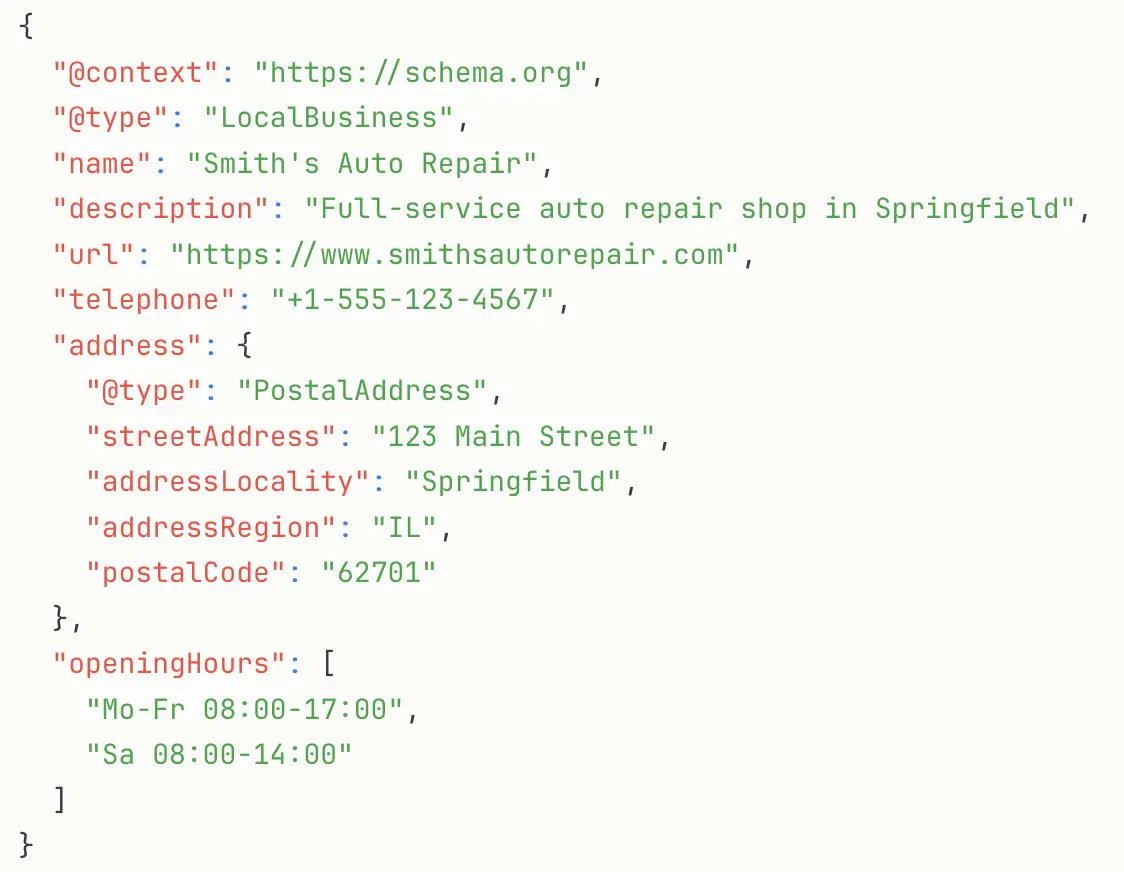
When you implement schema markup correctly, you’re essentially providing a roadmap for search engines to navigate your content. Instead of guessing what your page is about, search engines can identify specific entities, their properties, and relationships with surgical precision. This enhanced understanding enables search engines to deliver richer, more relevant search experiences to users.
The core principle behind schema markup involves **defining entities** (distinct things like people, products, or events), their properties (attributes like names, dates, or prices), and **relationships** between different elements. This structured approach helps search engines build comprehensive knowledge graphs that power everything from featured snippets to voice search responses.
Understanding how schema markup works is essential for any website owner serious about search engine optimization. By providing as much relevant information as possible through structured data, you enable search engines to present your content in the most favorable light possible.
## Why Schema Markup is Critical for SEO Success
Schema markup has become indispensable for SEO success because it directly influences how search engines display your content in search results. Websites with properly implemented structured data see click-through rate improvements of 20-30% compared to standard listings, according to industry studies and case studies from leading SEO agencies.
The primary benefit of adding schema markup lies in its ability to trigger rich results that make your listings stand out in search engine results pages. These enhanced displays include star ratings, price information, availability status, and other compelling details that encourage users to click through to your website.

Beyond visual enhancements, schema markup helps search engines understand web pages’ content context and relationships between entities on your web pages. This improved comprehension leads to better matching of your content with relevant search queries, potentially improving your rankings for target keywords and related terms.
As AI and voice search continue to evolve in 2026, schema markup becomes even more crucial for optimization. Generative AI search engines like Google’s Search Generative Experience rely heavily on structured data to understand content relationships and provide accurate information in AI-generated responses. Websites without schema markup risk being overlooked in these emerging search formats.
Schema markup also builds content knowledge graphs that support various search features. When you implement organization schema or local business schema, you’re helping search engines create comprehensive entity profiles that can trigger knowledge panels, improve local search visibility, and enhance brand recognition across multiple search touchpoints.
The competitive advantage of schema markup cannot be overstated in today’s search landscape. While many websites still lack proper structured data implementation, early adopters enjoy improved visibility, higher click-through rates, and better positioning for emerging search technologies.
## Essential Types of Schema Markup for Websites
The **[Schema.org vocabulary](https://schema.org/docs/schemas.html)** includes over 800 different schema types, but most websites benefit from implementing a core set of high-impact schemas. Understanding which types of schema markup to prioritize depends on your business model, content strategy, and target audience needs.
The most effective approach involves starting with foundational schemas that establish your website’s entity relationships, then expanding to content-specific schemas that enhance individual pages. This systematic implementation ensures maximum impact while maintaining code quality and avoiding potential markup issues.
### Organization Schema
**[Organization schema](https://schema.org/Organization)** defines your business entity with essential details like name, logo, address, and contact information. This foundational markup enables knowledge panel appearances in Google search results and establishes your brand as a recognized entity in search engine knowledge graphs.
Implementing organization schema correctly involves more than basic contact details. Include sameAs properties linking to your official social media profiles, specify your organization type (Corporation, LocalBusiness, NGO, etc.), and provide comprehensive contact details including phone numbers and physical addresses.
Here’s a complete JSON-LD example for organization markup:
```
{"@context":"https://schema.org","@type":"Organization","name":"ExampleCompany","url":"https://www.example.com","logo":"https://www.example.com/logo.png","address":{"@type":"PostalAddress","streetAddress":"123BusinessStreet","addressLocality":"City","addressRegion":"State","postalCode":"12345","addressCountry":"US"},"contactPoint":{"@type":"ContactPoint","telephone":"+1-555-123-4567","contactType":"customerservice"},"sameAs":["https://facebook.com/examplecompany","https://twitter.com/examplecompany","https://linkedin.com/company/examplecompany"]}
```
Organization schema serves as the foundation for other schema types on your website. When you establish clear organizational identity through structured data, you create a framework that supports product markup, local business markup, and other specialized schemas across your entire website.
### Local Business Schema
**[Local business schema](https://schema.org/LocalBusiness)** extends organization schema with location-specific details like opening hours, service areas, and customer reviews. This specialized markup is critical for local SEO and Google Business Profile optimization, directly impacting your visibility in local search results and Google Maps.
Effective local business schema includes detailed operational information that helps users make informed decisions. Specify exact opening hours for each day of the week, include seasonal variations if applicable, and mark special circumstances like holiday closures or temporary service changes.
The geo property within local business schema helps search engines understand your precise location, which is essential for “near me” searches and location-based query matching. Include both latitude and longitude coordinates for maximum accuracy, especially if your business operates from multiple locations.
For service-based businesses, the areaServed property defines your coverage area, helping search engines match your business with location-specific queries. This is particularly important for businesses that serve customers beyond their immediate physical location.
Review schema integration within local business markup can display star ratings and review summaries directly in search results. However, ensure compliance with Google’s review snippet guidelines to avoid penalties or loss of rich result eligibility.

### Product Schema
[**Product schema**](https://schema.org/Product) displays essential product details like price, availability, and customer reviews in search results, making it indispensable for [ecommerce websites](https://www.wearetg.com/services/ecommerce-web-design/) and affiliate marketers. This structured data markup directly influences purchasing decisions by providing key information before users visit your website.
When implementing product markup, distinguish between product snippets (informational displays) and merchant listings (transactional displays). Product schema supports both use cases, but the implementation details vary depending on whether you’re selling products directly or providing product information.
Essential product schema properties include name, description, brand, SKU, price, availability, and review ratings. For variable products with multiple options (sizes, colors, etc.), use the offers property to specify different pricing and availability for each variation.
```
{"@context":"https://schema.org","@type":"Product","name":"PremiumWidget","description":"High-qualitywidgetforprofessionaluse","brand":{"@type":"Brand","name":"WidgetCo"},"offers":{"@type":"Offer","price":"299.99","priceCurrency":"USD","availability":"https://schema.org/InStock","seller":{"@type":"Organization","name":"ExampleStore"}},"aggregateRating":{"@type":"AggregateRating","ratingValue":"4.5","reviewCount":"127"}}
```
Product schema also supports additional properties like warranty information, product dimensions, energy ratings, and more attributes specific to your product category. Including comprehensive product data increases your chances of appearing in relevant product-focused search features.
### Article Schema
**[Article schema](https://schema.org/Article)** optimizes news articles, blog posts, and editorial content for enhanced search visibility and potential inclusion in Google News results. This markup helps search engines understand your content’s authorship, publication date, and topical focus.
Proper article schema implementation includes author markup with detailed contributor information, publication date stamps, and headline optimization. For news websites and content publishers, this markup is essential for appearing in news carousels and topical search features.
The headline property should match your page’s H1 tag, while the description property can provide additional context beyond the meta description. Include featured image markup to increase the likelihood of image inclusion in article-rich results.
Author schema within article markup should link to comprehensive author profiles with biographical information, expertise indicators, and social media profiles. This supports [Google’s E-E-A-T](https://www.wearetg.com/blog/google-eeat/) (Experience, Expertise, Authoritativeness, Trustworthiness) evaluation criteria.
Publisher information within article schema helps establish content credibility and supports knowledge graph development. Include detailed organization markup for the publishing entity, with logo, contact information, and social media profiles.
### Review Schema
**[Review schema](https://schema.org/Review)** displays star ratings and review summaries in search results, significantly increasing trust signals and click-through rates for businesses across all industries. This markup can be applied to individual product reviews, service reviews, or aggregate business ratings.
When implementing review schema, ensure compliance with Google’s quality guidelines to avoid penalties. Only mark up genuine reviews from real customers, and avoid incentivizing or manipulating review generation specifically for schema markup purposes.
Individual review markup should include reviewer information, review date, rating value, and review content. For aggregate ratings, calculate accurate averages based on actual review data and update the markup when new reviews are received.
Review schema can be combined with other schema types for maximum impact. Product reviews within product markup, local business reviews within local business schema, and article reviews within article markup all contribute to enhanced search result displays.
Monitoring review schema performance requires tracking both rich result appearances and click-through rate improvements. Use Google Search Console to identify review-related structured data issues and ensure consistent display of review information in search results.
## Schema Markup Implementation Methods
Implementing schema markup involves choosing the right format for your technical setup and content management requirements. Three main formats are available, each with distinct advantages for different implementation scenarios and technical skill levels.
The choice between JSON-LD, Microdata, and RDFa affects both implementation complexity and long-term maintenance requirements. Understanding the strengths and limitations of each format helps you select the most appropriate approach for your specific situation.

### JSON-LD (Recommended)
**[JSON-LD](https://json-ld.org/primer/latest/)** has become Google’s preferred format for schema markup implementation due to its separation from HTML content and ease of maintenance. This JavaScript-based format is added to the HTML head section without affecting the existing page structure or visual presentation.
The primary advantage of JSON-LD lies in its independence from page content. You can add, modify, or remove structured data without touching existing HTML elements, making it ideal for content management systems and dynamic websites where content changes frequently.
JSON-LD supports complex nested structures and multiple entity relationships within a single code block. This flexibility makes it suitable for comprehensive markup implementations that describe multiple related entities on a single page.
**Here’s a complete JSON-LD example for local business markup:**
```
type="application/ld+json">{"@context":"https://schema.org","@type":"LocalBusiness","name":"DowntownCoffeeShop","address":{"@type":"PostalAddress","streetAddress":"456MainStreet","addressLocality":"Downtown","addressRegion":"CA","postalCode":"90210","addressCountry":"US"},"geo":{"@type":"GeoCoordinates","latitude":"34.0522","longitude":"-118.2437"},"openingHours":["Mo-Fr07:00-18:00","Sa08:00-16:00","Su09:00-15:00"],"telephone":"+1-555-123-4567","priceRange":"$$"}
```
JSON-LD also integrates seamlessly with content management systems and can be generated dynamically based on page content. This makes it particularly suitable for large websites with thousands of pages requiring schema markup.
### Microdata and RDFa
Microdata and RDFa represent inline markup formats that tag existing HTML elements with schema properties. While more complex to implement than JSON-LD, these formats provide tighter integration between markup and content, ensuring perfect synchronization between visible content and structured data.
Microdata uses HTML attributes like itemscope, itemtype, and itemprop to define schema properties directly within existing page elements. This approach guarantees that markup accurately represents visible content but requires more careful implementation to avoid HTML validation issues.
RDFa (Resource Description Framework in Attributes) offers more advanced semantic web integration capabilities than Microdata, supporting external vocabulary linking and complex entity relationships. However, its complexity makes it less suitable for typical SEO applications compared to JSON-LD or Microdata.
When to choose Microdata or RDFa over JSON-LD:
- Legacy systems where JSON-LD integration is difficult
- Content where perfect markup-content synchronization is critical
- Advanced semantic web applications requiring external vocabulary linking
- Situations where you need to validate HTML semantics alongside structured data
Both formats require more technical expertise to implement correctly and maintain over time. Changes to page content often necessitate corresponding markup updates, increasing the risk of inconsistencies between visible content and structured data.
## Step-by-Step Schema Implementation Guide
Successful schema markup implementation requires systematic planning, careful execution, and ongoing monitoring. This comprehensive approach ensures maximum SEO benefit while avoiding common pitfalls that can result in penalties or ineffective markup.
The implementation process involves multiple stages, from initial content audit through deployment and performance monitoring. Each stage builds upon previous work, creating a comprehensive structured data strategy that supports your overall SEO efforts.
### Planning Your Schema Strategy
Begin your schema implementation by auditing existing content to identify high-impact opportunities for structured data markup. Focus on pages that already perform well in organic search or represent important conversion paths for your business.
1. **Prioritize schema implementation** based on potential impact and available resources. Homepage, contact pages, product pages, and primary service pages typically offer the highest return on investment for schema markup efforts.
2. **Research competitor schema** implementations using SEO tools like Screaming Frog, SEMrush, or Ahrefs to identify gaps in your current approach. Understanding how competitors use structured data reveals opportunities for differentiation and improvement.
3. **Create a schema roadmap** that aligns with your business goals and technical capabilities. Start with foundational schemas like organization markup, then expand to page-specific schemas based on content type and user intent.
4. **Document your schema strategy** to ensure consistent implementation across your entire website. Include guidelines for different page types, required properties for each schema type, and quality assurance procedures to maintain markup accuracy.
### Creating Schema Markup
**[Google’s Structured Data Markup Helper](https://www.google.com/webmasters/markup-helper/u/0/)** provides an excellent starting point for beginners who need guidance creating their first schema implementations. This free tool generates basic markup code that you can customize for your specific needs.
Schema markup generators like those from **[Schema.dev](https://schema.dev/schema-builder/)** and **[TechnicalSEO.com](https://technicalseo.com/tools/schema-markup-generator/)** offer more advanced functionality for creating complex markup structures. These tools support multiple schema types and can generate code for different implementation formats.
For advanced customization requirements, manual JSON-LD creation provides complete control over markup structure and properties. This approach requires deeper technical knowledge but offers maximum flexibility for complex entity relationships and custom implementations.
WordPress users can leverage plugins like RankMath, Yoast, and Schema Pro for automated schema generation. These tools integrate with your content management system to generate structured data based on page content and site configuration.
Regardless of your chosen creation method, always validate generated markup before deployment. Use multiple testing tools to ensure code quality and compliance with Google’s structured data guidelines.
### Testing and Validation
[**Google Rich Results Test**](https://search.google.com/test/rich-results) serves as the primary validation tool for testing schema markup eligibility for rich snippets and enhanced search result features. This tool identifies markup errors and provides specific guidance for resolving issues.
The [**Schema.org Validator**](https://validator.schema.org/) offers comprehensive syntax error detection for all schema types, including those not supported by Google’s rich results. Use this tool to ensure markup accuracy and compliance with Schema.org standards.
**Google Search Console** monitoring provides ongoing oversight of structured data performance after implementation. Regular review of structured data reports helps identify new issues and track the effectiveness of your markup strategy.
Advanced SEO tools like **Screaming Frog** and **SEMrush** offer automated schema auditing capabilities for large websites. These tools can crawl your entire website to identify missing markup, syntax errors, and optimization opportunities.
Establish a regular auditing schedule to maintain schema markup quality over time. Content changes, site updates, and evolving schema standards require ongoing attention to ensure continued effectiveness.
### Implementation
Adding schema markup to your website can seem like a daunting task, but there are a few standard approaches. Each method has strengths and weaknesses, but the best choice will be the one that fits your use case the best.
Direct HTML injection involves adding JSON-LD scripts directly to your page source code, providing complete control over markup placement and structure. This method works well for static websites or situations where you need precise control over structured data implementation.
**Google Tag Manager** deployment offers a non-technical solution for implementing schema markup across your website. This approach allows marketing teams to manage structured data without requiring developer resources for each update or addition.
WordPress plugin integration using **RankMath**, **Yoast**, or dedicated schema plugins provides automated schema generation based on your content and site structure. These solutions handle technical implementation details while allowing customization for specific business needs.
Content management system-specific solutions for Shopify, Drupal, and other platforms often include built-in schema support or specialized extensions. Research available options for your specific CMS to find the most appropriate implementation approach.
Choose your implementation method based on technical resources, maintenance requirements, and the complexity of your schema markup needs. Consider long-term sustainability when selecting an approach, as schema markup requires ongoing maintenance and updates.
## Schema Markup Best Practices and Guidelines
Following [**Google’s Quality Guidelines**](https://static.googleusercontent.com/media/guidelines.raterhub.com/en//searchqualityevaluatorguidelines.pdf) is essential for avoiding penalties and maintaining rich result eligibility. These guidelines emphasize accuracy, relevance, and user value as core principles for effective schema markup implementation.
Ensure your markup accurately represents page content without marking up information that isn’t visible to users. Schema markup should enhance, not replace, good content and user experience design principles.
Avoid marking up content not visible to users, as this violates Google’s guidelines and can result in manual actions against your website. All structured data should correspond to actual page content that provides value to visitors.
Keep structured data updated with content changes to maintain accuracy and avoid misleading search engine interpretation. Outdated markup can harm your search visibility and user experience.
Use specific schema types rather than generic ones whenever possible. More specific markup provides greater value to search engines and increases your chances of triggering relevant rich result features.
Common mistakes to avoid include:
| **Mistake** | **Impact** | **Solution** |
|---|---|---|
| Marking up invisible content | Penalty risk | Only mark up visible content |
| Using incorrect schema types | Reduced effectiveness | Research appropriate types |
| Outdated markup properties | Poor performance | Regular auditing and updates |
| Inconsistent data across pages | Confusion for search engines | Standardize markup approach |
| Over-marking content | Decreased quality signals | Focus on high-value markup |
Implement markup gradually rather than attempting comprehensive coverage immediately. Start with your most important pages and schema types, then expand systematically based on performance data and available resources.
Monitor search engine algorithm updates that affect structured data handling. Google regularly updates its approach to processing schema markup, and staying informed helps you adapt your strategy accordingly.
## Measuring Schema Markup Success
Tracking schema markup performance requires monitoring multiple metrics across different tools and platforms. Success measurement should focus on both technical implementation quality and business impact metrics that demonstrate ROI.
Google Search Console provides the most comprehensive view of structured data performance, including rich result appearances, error reports, and enhancement suggestions. Regular review of these reports helps identify optimization opportunities and maintain markup quality.
Click-through rate improvements represent the most direct business impact of schema markup implementation. Compare CTR performance for pages with rich results versus standard listings to quantify the value of your structured data efforts.
Rich result appearance tracking using tools like SEMrush and Ahrefs helps monitor your visibility in enhanced search features. These tools can track your performance in featured snippets, knowledge panels, and other rich result types over time.
Key performance indicators for schema markup success include:
- Rich result appearance frequency
- Click-through rate improvements for enhanced listings
- Organic traffic increases to pages with schema markup
- Search visibility improvements for target keywords
- Knowledge panel appearances for brand queries
Set up alerts for schema validation errors and warnings to address issues promptly. Automated monitoring helps maintain markup quality as your website grows and content changes.
Analyze organic traffic patterns to identify correlations between schema implementation and search performance. While schema markup isn’t a direct ranking factor, it can influence user behavior and indirectly impact organic traffic.
Benchmark your schema markup performance against industry standards and competitor implementations. Understanding relative performance helps identify areas for improvement and competitive advantages.
Calculate return on investment for your schema markup efforts by comparing implementation costs with traffic and conversion improvements. This analysis helps justify continued investment in structured data optimization.
## Future of Schema Markup and AI Search
The evolution of generative AI and chatbot search results has dramatically increased the importance of schema markup for website visibility. AI-powered search engines rely heavily on structured data to understand content relationships and provide accurate information in generated responses.
Google’s Search Generative Experience and similar AI search features use schema markup to identify authoritative sources and attribute information correctly. Websites without proper structured data risk being overlooked in AI-generated search results and summaries.
Voice search optimization increasingly depends on schema markup to provide context for spoken queries. Smart devices and voice assistants use structured data to understand content relationships and deliver relevant information to users.
Emerging schema types for new content formats and technologies continue to expand the vocabulary available for markup implementation. Recent additions include schemas for virtual events, energy ratings, and subscription-based services, reflecting evolving web content needs.
**Through 2026, schema markup trends will likely focus on:**
- Enhanced integration with AI search experiences
- More sophisticated entity relationship mapping
- Expanded support for multimedia content types
- Integration with augmented reality and virtual reality applications
- Improved support for real-time data and dynamic content
Preparing for future search evolution requires staying current with Schema.org updates and search engine announcements. The schema markup landscape continues to evolve rapidly, and early adoption of new schema types often provides competitive advantages.
[Knowledge graphs](https://en.wikipedia.org/wiki/Knowledge_graph) will become increasingly important for search visibility, making comprehensive entity markup essential for maintaining competitive positioning. Websites that establish clear entity relationships through schema markup will be better positioned for future search algorithm updates.
As search engines become more sophisticated in processing structured data, the quality and comprehensiveness of schema implementation will become increasingly important differentiators. Investing in robust schema markup strategies today prepares your website for the continued evolution of search technology.
The integration of schema markup with emerging technologies like blockchain verification and decentralized web protocols may create new opportunities for establishing content authenticity and authority. Staying informed about these developments helps you adapt your strategy as new possibilities emerge.
Schema markup represents a fundamental shift toward semantic web principles, where content meaning is explicitly defined rather than inferred. Understanding this broader context helps you implement more effective structured data strategies that align with long-term search engine development.
By implementing comprehensive schema markup strategies today, you position your website for success in the AI-driven search landscape of 2026 and beyond. The websites that invest in structured data now will enjoy sustained competitive advantages as search technology continues to evolve.
---
#### Ready to Put Schema to Work for Your Website?
Schema markup is one of the fastest ways to improve how your pages appear in search results and how AI tools interpret your content—but only if it’s implemented correctly and aligned with your goals.Wondering which schema types actually matter for your site?[Schedule a 30-minute consultation](https://www.wearetg.com/contact/) with Timmermann Group, and we’ll help you identify where schema can improve visibility, eligibility for rich results, and AI-driven search features.
[](https://www.wearetg.com/contact)
---
## Frequently Asked Questions
#### What is schema markup?
Schema markup is structured data code added to HTML that helps search engines understand webpage content more effectively. This standardized vocabulary created by Google, Bing, Yahoo, and Yandex transforms unstructured content into machine-readable data using key-value pairs.
#### Is schema markup still important?
Schema markup remains critical for SEO success in 2026, especially with the rise of AI-powered search experiences and generative search results. Websites with properly implemented structured data see 20-30% higher click-through rates compared to standard listings and better positioning in emerging search technologies.
#### Why is schema markup important for SEO?
Schema markup enhances search visibility by triggering rich results that display star ratings, prices, and other compelling details directly in search results. This improved presentation increases click-through rates while helping search engines understand content context for better query matching and rankings.
#### What is schema markup in local SEO?
Local business schema markup displays essential location-specific details like opening hours, contact information, and customer reviews in search results. This structured data is critical for local SEO success, directly impacting visibility in local search results, Google Maps, and “near me” queries.
**Categories:** SEO, Web Development
---
### [What Does a Marketing Agency Do: Your Comprehensive Guide](https://www.wearetg.com/blog/what-does-a-marketing-agency-do/)
**Published:** January 3, 2024
**Author:** Rob Timmermann
**Content:**
What does a marketing agency do? At its core, a marketing agency boosts your business’s potential by developing targeted strategies, running data-driven campaigns, and optimizing your brand’s reach and reputation. Specializing in a vast array of services from digital marketing to creative content production, these agencies offer expertise that can transform your company’s marketing trajectory. Dive into our comprehensive guide to discover how a marketing agency can contribute to your business success without overwhelming your in-house resources.
## Key Takeaways
- A marketing agency offers many services, such as developing marketing strategies, executing campaigns, and measuring performance to help businesses increase brand visibility and enhance sales.
- Marketing agencies provide essential services, including digital marketing, content creation, brand development, and web design, which help businesses strengthen their online presence and reach target demographics.
- There are different types of marketing agencies – full-service, specialized, and boutique – each suited to various business needs, and the pros and cons of engaging an agency must be carefully considered to ensure alignment with business objectives and budget.
## Understanding the Role of a Marketing Agency

A [marketing agency](https://www.wearetg.com/about-us/), or marketing company, as they are also known, is an invaluable asset for businesses looking to increase sales and visibility. They provide specialized services that can aid in developing effective strategies tailored specifically to each business’s needs. But why should you consider hiring one?
There may be times when building an internal team isn’t feasible, but getting help from experts who know how to carry out successful campaigns would still benefit your business tremendously. A good example could be small enterprises lacking adequate resources and unable to access advanced technologies – these agencies provide expertise with their comprehensive range of skills while also providing cost savings compared to training staff members internally. With innovative ideas from fresh perspectives, it’s easy to scale efforts upwards whenever desired!
Employing a dedicated advertising firm alongside a skilled marketing firm or tapping into experienced industry professionals through an outside agency like this offers incredible opportunities that previously might have been beyond reach due to contrastingly limited means. Enlisting specialists allows companies to easily execute superior quality approaches, especially fitting precisely what firms seek to accomplish without dealing with them repeatedly, which is usually time-consuming and tedious.
### Developing Marketing Strategies
A marketing plan that reflects a client’s objectives, industry, and target customer base is an integral responsibility for any marketing agency. Their decisions are guided by their knowledge regarding the field in question and what it takes to fulfill customers’ needs – something that would not be feasible with an internal business-side marketing team alone.
These agencies offer key advantages by bringing fresh ideas into strategy development. They bring experience from different clients and impartial views compared to those who might already have preconceived notions within one’s organization. Due to its comprehensive understanding when working across industries, such firms can create customized plans paired up with suitable marketing materials specific to each sector.
Analyzing competitors has significant importance while formulating your Marketing Strategy – It helps comprehend how other companies conduct themselves out there, giving you greater insight into where you stand now plus finding a possible edge over them later down the line.
### Executing Marketing Campaigns
For any effective marketing strategy, the work of a great marketing agency is invaluable. They specialize in identifying and expanding their target audience through social media engagement to understand consumer preferences better. To maximize return on investment from email campaigns, they optimize bounce and open rates with creative iterations tailored towards resonating best with the intended clients. The initial kickoff meeting allows both sides – agency personnel and stakeholders – to get an insight into plans for the successful execution of these campaigns by presenting them elaborately and answering related questions that may arise during this time frame.
### Measuring and Optimizing Performance
A marketing agency plays a vital role in the performance monitoring of businesses, which lets them determine if their approach is viable. Before linking with an advertising firm, companies should establish specific parameters and metrics they want to improve. Popular measurements such as conversion rate, click-through rate, cost per acquisition (CPA), return on investment (ROI), and customer lifetime value are among these areas for evaluation purposes. This will enable both parties to strive towards the same goals while ensuring everyone stays aligned.
In order for data-driven approaches to be effective when marketers seek ROI optimization, it is essential that every dollar invested yields twofold or greater returns. To assist in enhancing productivity levels and maximizing the success of marketing campaigns, carrying out audit reviews could help analyze what techniques have been implemented beforehand so any errors can be identified quickly where necessary.
## Essential Services Provided by Marketing Agencies

Marketing agencies are specialists in providing businesses with the tools and resources they need to succeed. These [specialized marketing services](https://www.wearetg.com/services/) can encompass a wide range of areas, such as digital marketing, content creation, brand development, and web design – all helping companies reach their target audience effectively.
Each one has its advantages and challenges, so depending on what your business needs or wants to achieve, an agency may focus more heavily on certain aspects than others while also offering overall solutions that will assist you in reaching your goals.
Some examples of these specialist techniques include developing strategies for online presence enhancement via content generation and creating fresh campaigns utilizing innovative forms of digital media like social networks or search engine optimization (SEO). All this is done by skilled professionals who understand how best to utilize each service’s unique qualities when constructing comprehensive plans tailored specifically for achieving success through effective outreach towards the desired demographic groupings, making up a company’s intended customer base.
### Digital Marketing

Marketing agencies now put digital marketing at the forefront of their strategies. This service includes SEO (search engine optimization), PPC advertising, and email and social media campaigns, all working to increase a company’s online visibility and growth potential in target audiences.
A specific example is that of a social media agency overseeing its clients’ profiles so as to drive interaction, which could lead to conversions, this being one of the main goals for these types of operations. Another field within digital promotion is search engine optimization, aiming towards greater website recognition on web platforms such as Google or other similar ones, thereby creating more organic visits from customers who are specifically looking for said businesses/services through searches related to keywords sought by those companies after initial guidance given by the former marketing agency itself initially.
### Content Creation and Management

Through [content marketing](https://www.wearetg.com/services/content-marketing/), agencies help businesses develop and implement effective content strategies, taking the time to analyze their objectives, target audience needs, and industry. They first plan out what type of material should be created before generating topic ideas for things such as written blogs or social media posts, videos, and infographics. Agencies then dedicate resources to producing this content while ensuring it is promoted effectively with the right marketing initiatives according to an all-encompassing strategy they set forth. Thus, Marketing agencies provide essential services that consider client goals and broader industry trends when creating a cohesive approach toward engaging customers through quality digital materials targeting specific groups online.
### Brand Development and Design
Marketing agencies often provide services related to brand development and design. An important part of the process is formulating a proper strategy, creating communication tools, and updating or developing an identity for the desired results.
To establish/update/strengthen a business’s brand image in the best way possible, marketing teams will research customers’ profiles thoroughly while ensuring they define strong values and mission statements that reflect what their company stands for to guarantee successful campaigns. Getting good outcomes from those activities includes assessing already-existing elements of branding identities and doing extensive market research and analysis. This gives marketers confidence before executing any promotional programs targeting potential customers accurately.
These strategies allow brands to communicate effectively with intended audiences so everybody perceives them correctly based on customer insight gathered through detailed intelligence about interests, etcetera, through careful yet strategic planning within said projects regarding product promotion devised by such professionals specialized in direct marketing approaches like advertising online on social media among others which many high profile establishments rely upon regularly along associated corporate firms dealing into same categories previously mentioned possibly even more besides!
### Web Development and Design
Marketing agencies provide essential [web development and design services](https://www.wearetg.com/services/website-design/). They incorporate their customers’ needs into websites with a user-friendly interface, are optimized for mobile devices, emphasize SEO practices with swift loading speed, and have attractive content in an aesthetically pleasing layout. Through these efforts, they can increase customer engagement, drive sales conversions, and secure user loyalty due to the improved overall experience.
Utilizing programming languages such as HTML, CSS & JavaScript along with newer developing platforms, marketing companies deliver top-notch sites that look good and run proficiently, increasing traffic & online presence on behalf of their clients.
## Types of Marketing Agencies: Which One is Right for Your Business?
When businesses require assistance in growing, there are a number of marketing agencies to choose from. Each type has different strengths and specialties, which the business must carefully consider when determining its unique needs and objectives for success. The main types of these marketing firms include full-service agencies, specialized ones, or boutique companies.
We will now take an in-depth look at each variety so that selecting the right agency for maximum results on your marketing efforts is achievable.
### Full-Service Marketing Agencies
Marketing agencies offer comprehensive services, encompassing every element from advertising to promotional activities. These may include digital platform management, social media marketing, content production, ad campaigns designed to drive traffic, and numerous other options. Costs must be considered when selecting the right full-service advertising agency for your business needs. Before engaging any firm, you must establish a budget to ensure they can work within your financial constraints.
### Specialized Marketing Agencies
Specialized marketing agencies specialize in a particular area of marketing or industry and provide one service to fulfill the precise needs of businesses. This cost-effective option gives customers access to specialized technology and experts who understand their target audience and markets well. Such companies typically focus on industries like manufacturing or industrial sectors while utilizing various tools such as email, SMS, push notifications, and omnichannel campaigns through social media platforms along with influencer tactics, which are accompanied by affiliate/SEO/PPC management plus website & graphic design services tailored precisely toward each company’s exact specifications.
### Boutique Marketing Agencies
Engaging a boutique marketing agency offers numerous advantages, including personalized strategies tailored to fit the client’s needs and access to top-level talent for inspiring growth. These agencies are renowned for their attention to each account they manage compared to large companies with more clients. On the flip side, though, there is a downside, such as increased expenses compared to in-house services, a potential lack of substantial industry expertise coupled with communication difficulties, and the risk of not grasping fully what an organization’s brand or target market entails.
## Evaluating the Pros and Cons of Hiring a Marketing Agency
Hiring a marketing agency must be thoughtfully considered because some advantages and drawbacks must be carefully weighed. Companies should identify clear objectives, criteria for performance evaluation, and their available marketing budget before deciding.
One major benefit of employing a marketing agency is access to diverse experience, which can improve campaigns, specialized skills, and sophisticated tools designed specifically for advertising needs. It may take time to research agencies with suitable expertise. To properly allocate resources within allotted funds, these challenges cannot be ignored when selecting an appropriate partner organization.
Before bringing on any outside assistance from professional marketers, businesses need to consider what goals they wish to reach, then detail measurable metrics required to achieve them while factoring budgetary restrictions into the selection process so no unforeseen costs present themselves later.
## Tips for Choosing the Perfect Marketing Agency
When selecting a marketing and agency partner to collaborate with is an essential decision for any company. A good firm can aid businesses in achieving their goals, while the wrong one might cause time and money to be wasted. Here are some tips on finding the appropriate partner.
Recognize that there isn’t just one way of choosing a marketing agency. What may be suitable for one business does not necessarily fit another’s needs and objectives. It all depends on each specific organization’s desired outcomes.
### Define Your Goals and Objectives
When considering a marketing agency, setting up your business’s marketing objectives and ambitions is essential. These can be quantifiable goals consistent with overall company aims, such as improving brand reputation, amplifying visibility, and upgrading positioning within the marketplace. And achieving successful outcomes from all promotional and marketing activities.
Mapping out what you intend on accomplishing via an external partner will assist them in grasping your venture better so they can adjust their services around exactly what you need, ensuring optimal results for both parties involved!
### Research and Shortlist Potential Agencies
When choosing an agency for your marketing needs, you should know their capabilities. Your research should include examining their portfolio and reputation, getting acquainted with their techniques, and how they communicate and do cost calculations. Assessing how flexible the team is, plus establishing trustworthiness, must also play a key role during the selection process. You will need several months to undertake this task correctly before making any decisions so that both parties can make informed choices about collaboration moving forward.
### Review Portfolios and Case Studies
Examining [portfolios and case studies](https://www.wearetg.com/portfolio/) is fundamental when hiring a marketing agency. Going through these records can provide an understanding of the firm’s previous efforts and successes with clients and how capable they are of their services.
Case studies demonstrate faith from customers by showing off client triumphs and the value provided. Boosting customer loyalty to the company while demonstrating that it strives to achieve objectives set forth by its patrons. This proof helps persuade potential buyers to close deals with them, strengthening credibility and instilling confidence in the agency.
### Schedule Consultations and Ask Questions
Once you have shortlisted a few agencies, the next step is to book meetings for Exploration. These engagements will allow you to discuss your business’s requirements and comprehend how the agency plans to tackle potential marketing challenges. It’s essential that during this first appointment, some of these points are considered: their former experiences with businesses in similar industries, what methods they use when coming up with strategies related to marketing, and metrics used for evaluating successes or lack thereof. Types of technology and tools employed, successful stories where outcomes were positive, and who will manage your account going forward so that familiarity can be established early on between team members.
## Summary
In summary, marketing agencies are integral to the success of businesses as they provide and carry out customized marketing campaigns. They can assist companies in various ways, such as constructing digital advertising and specialized marketing solutions, generating content, developing brands, and creating websites that help firms gain more exposure from their target audience.
Time must be taken when deciding on an agency for your needs – making sure you have identified objectives clearly before beginning the search process, researching potentials thoroughly by reviewing previous works or case studies, and asking inquiring questions during initial consultations, etc., all these steps will enable one to pick an agency that suits best with brand’s purpose & ambitions.
---
#### Knowing What a Marketing Agency Does Is One Thing. Choosing the Right One Is Another.
The right agency doesn’t just run campaigns. It builds strategy around your business goals, aligns channels, tracks what actually matters, and focuses on measurable growth — not vanity metrics. If you’re evaluating whether partnering with a marketing agency makes sense for your business, let’s have a conversation. We’ll walk through your goals, identify opportunities, and show you what a strategic, conversion-focused approach really looks like.[ **Schedule a 30-minute consultation** ](https://www.wearetg.com/contact/)with Timmermann Group today.
[](https://www.wearetg.com/contact)
---
## Frequently Asked Questions
### What is the role of a marketing agency?
The role of a marketing agency is to manage communication between an organization and the market, launch campaigns, and generate value to make the brand or business more known and appealing to consumers.
### What is the point of a marketing agency?
A marketing agency maximizes businesses’ profits by implementing tailored and digital marketing strategies to reach ideal customer profiles. It’s all about using the most suitable promotional methods to help a business thrive in its market.
### What are the different types of marketing agencies?
When selecting a marketing agency, companies can choose between full-service agencies offering various services and specializing in specific areas or boutique firms focusing on one particular area. This decision could vary depending on the company’s needs and goals, as all three types have advantages.
### What are the main services provided by marketing agencies?
Marketing agencies offer various services, including digital marketing, website design, and brand advancement. These one-stop solutions can serve all your needs regarding promotion, social media marketing agency, and publicity.
### How do I choose the right marketing agency for my business?
To select an appropriate marketing agency for your organization, begin by articulating the desired results you aim to achieve with your marketing efforts. Review portfolios of potential firms and set up consultations to test how well each candidate meets these objectives and provide a platform where any questions can be asked.
**Categories:** Advice For Business Owners
---
### [Is SEO Dead? The Truth About Search Engine Optimization in 2025](https://www.wearetg.com/blog/is-seo-dead/)
**Published:** July 17, 2025
**Author:** Rob Timmermann
**Content:**
If you’ve been wondering whether SEO is dead in 2025, you’re not alone. With the rise of AI-driven search results, site click-throughs have decreased by as much as 34-35%, leading many business professionals to question the future of [search engine optimization](https://www.wearetg.com/services/seo/).
The short answer? SEO isn’t dead, but it’s undergoing the most significant transformation in its history.
While traditional SEO tactics are evolving rapidly, search engines remain the primary channel for information discovery. With Google maintaining 89.62% market share and 53.3% of all website traffic still coming from organic search, understanding how to adapt your SEO strategy has never been more critical.
## Key Takeaways
Before diving into the details, here are the essential points every digital marketer needs to understand about SEO as it stands today:
- SEO is not dead, but is undergoing significant transformation with AI integration
- Google still dominates with ~80% market share, making SEO essential for a website’s visibility
- AI tools like ChatGPT and Google’s SGE are changing search behavior, not eliminating SEO
- Traditional keyword-focused SEO is evolving toward user intent and content quality
- Brands must adapt to AI-driven search while maintaining core SEO principles
- Zero-click searches and AI overviews require new metrics and strategies
## The Current State of SEO
Despite claims that SEO is dead, the data tells a different story. Search engine optimization remains a cornerstone of digital marketing strategy, though the landscape has shifted dramatically.
### Market Dominance and Traffic Statistics
Google’s continued dominance in the search market proves that traditional search engines aren’t going anywhere. With nearly 80% market share, Google processes billions of search queries daily, making organic search results crucial for business visibility.
The numbers speak for themselves:
- 53.3% of all website traffic originates from organic searches
- 63% of shopping begins online, and 61% of B2B marketers say SEO is their top lead source
- Organic search results account for about 94% of all clicks compared to paid advertisements
- Mobile traffic now represents 59% of all website visits
### Algorithm Updates and Market Volatility
Google’s March 2024 core algorithm update caused significant volatility in search engine results pages, affecting countless websites. This volatility has contributed to the perception that SEO efforts are becoming unpredictable.
However, these updates reflect Google’s commitment to improving search experience quality rather than eliminating the need for SEO. Search algorithms are increasingly prioritizing high-quality content that demonstrates expertise, experience, authority, and trustworthiness.
### AI-Generated Content in Search Results
As of October 2024, AI-generated content comprises approximately 8% of top-ranking articles. This statistic highlights how AI tools are being integrated into content creation workflows, but it also demonstrates that human expertise remains valuable in creating content that ranks well.
## Why People Think SEO is Dead
With AI technology tangibly impacting web strategies and outcomes, many people have claimed that SEO no longer works. Several factors have contributed to the “SEO is dead” narrative, each representing real challenges that digital marketers must address:
### Google’s AI Overviews Impact
Google’s Search Generative Experience provides comprehensive AI-powered answers at the top of search results, fundamentally changing how people navigate and interact with search results. These AI summaries often provide users with immediate answers, reducing clicks to individual websites.
The impact is measurable: AI overviews can significantly reduce organic traffic to websites, especially for informational queries where users previously had to click through to find answers.
### Rise of Alternative Search Platforms
The search landscape is diversifying beyond traditional search engines:
- YouTube serves as the second-largest search engine globally
- TikTok and Instagram are becoming primary discovery channels for younger demographics
- AI chatbots are handling more searches than ever before
- Social media platforms are developing sophisticated search capabilities
This diversification means that SEO strategies must expand beyond Google to include AI platforms and social media optimization.
### Zero Click Searches and User Behavior
More Google queries now result in zero-click searches, where users find their answers directly on the search page without visiting any website. Featured snippets, knowledge panels, and AI overviews contribute to this trend.
While this reduces direct website traffic, it also creates opportunities for brands to gain visibility through optimized content that appears in these special search features.
### Industry Job Market Changes
This introduction to AI has created uncertainty about the future of SEO careers. The concern is that AI is replacing those who perform these roles with fewer and fewer open positions. This isn’t the case.
Recent changes reflect an evolution in the market rather than the elimination of SEO roles altogether. Current job listings highlight a clear trend in open roles: technical SEO, AI strategy, and analytics are in higher demand over traditional content execution roles. While AI can assist with implementation and execution, SEO strategists and specialists are still needed to perform the strategic planning necessary for businesses to excel in an increasingly complex marketplace.
## How SEO is Evolving, Not Dying
Rather than disappearing, search engine optimization is becoming more sophisticated and valuable. This evolution centers on several key areas:
### From Keywords to User Intent and Search Intent
Traditional SEO focused heavily on target keywords and keyword density. Current SEO practices prioritize understanding search intent and creating content that comprehensively addresses user queries.
This shift means that keyword research remains important, but the focus has expanded to include:
- Understanding the context behind search queries
- Creating content that answers related questions
- Optimizing for conversational queries and natural language processing
- Addressing multiple stages of the user journey
### Quality Over Quantity in Content Creation
Search algorithms now prioritize content quality over volume. The emphasis on helpful content means that creating content must focus on providing genuine value rather than simply targeting relevant keywords.
High-performing content demonstrates:
- Original research and unique insights
- Personal experience and human expertise
- Comprehensive coverage of topics
- Clear, actionable information
### Brand Authority and Recognition
Brand recognition has become increasingly important in search rankings. Google’s algorithms favor authoritative content from established brands, making brand building an essential component of current SEO efforts.
This trend means that generic content from unknown sources performs poorly compared to authentic content from recognized experts and brands.
### AI Models and SEO Symbiosis
Contrary to popular belief, AI models actually increase the demand for discoverable, high-quality content. AI systems require vast amounts of authoritative content for training data, making well-optimized content more valuable than ever.
AI scraping activity doubled between Q3 and Q4 of last year, with companies like OpenAI licensing content from major publishers. This creates new opportunities for content creators to monetize their expertise.

## Adapting Your SEO Strategy for Today
Success in SEO requires a comprehensive approach that addresses both traditional search engines and emerging AI platforms. SEO efforts will only continue to evolve, with key areas of focus including:
#### Content Strategy for the AI Era
Content creation must balance AI assistance with human expertise. The most successful approach involves:
#### Combining AI Tools with Human Insight
- Use AI tools for keyword research and content optimization
- Apply human creativity and experience to create unique perspectives
- Focus on “net-new value” content that provides fresh insights
- Ensure that the content written demonstrates genuine expertise
#### Creating Experience-Based Content
- Leverage original research and unique data
- Share personal insights and case studies
- Write content that AI cannot replicate
- Focus on helpful content that solves real problems
### Technical SEO Considerations
Technical optimization remains crucial for both traditional search engines and AI systems:
#### Mobile-First Optimization
- Ensure responsive design for all devices
- Optimize page speed for mobile users
- Implement mobile-friendly navigation
#### Structure for AI Consumption
- Use proper schema markup for enhanced search visibility
- Structure content for featured snippets inclusion
- Optimize meta descriptions for AI summaries
- Implement clear headings and logical content hierarchy
### Local SEO and Specialized Strategies
Local SEO continues to be essential for businesses serving specific geographic areas. The integration of AI search doesn’t eliminate the need for local optimization; it makes it more sophisticated.
Key local SEO considerations include:
- Optimizing for voice search and conversational queries
- Maintaining accurate business information across platforms
- Building local authority through community engagement
- Optimizing for visual search and Google Lens
### New Metrics and Measurement Strategies
Traditional SEO metrics like keyword rankings and organic traffic remain important, but SEO requires additional measurement approaches:
#### Brand-Focused Metrics
- Branded Search Volume: Track searches for your company name and products
- Direct Traffic Growth: Monitor increases in direct website visits
- Brand Mentions: Analyze mentions in AI-generated content and social media
- Share of Voice: Measure your brand’s presence in relevant conversations
#### Engagement and Quality Signals
- User Engagement: Track time on page, scroll depth, and interaction rates
- Content Performance: Monitor which content types perform best across platforms
- Cross-Platform Analytics: Measure performance across traditional and ai search results
- Conversion Quality: Focus on leads and sales rather than just traffic volume
#### Tools for SEO Tracking
Effective measurement requires both traditional analytics tools and new platforms designed for AI-era SEO:
- Traditional Tools: SEMrush and Ahrefs remain valuable for keyword research and competitor analysis
- AI-Focused Platforms: Tools like Profound for monitoring AI search presence
- Social Analytics: Platform-specific tools for tracking social media search performance
- Integrated Dashboards: Comprehensive analytics tools that track performance across multiple channels
## The Future of SEO
AI technology is only one piece of the puzzle, and adaptation and flexibility will be a major factor in deciding winning strategies. Looking ahead, several trends will shape the evolution of search engine optimization:
### Increasing AI Integration
AI will become more deeply integrated across all search platforms, requiring SEO professionals to understand how to optimize content for various AI systems. This includes optimizing for different AI models and understanding how they consume and present content.
### Visual and Voice Search Optimization
Visual search through platforms like Google Lens and voice search through smart devices will become standard considerations in SEO strategies. This requires new approaches to content optimization and keyword research.
### Personalized Search Experiences
Search results will become increasingly personalized based on user behavior, location, and preferences. This trend requires more sophisticated segmentation strategies and personalized content approaches.
### Content Licensing Opportunities
As AI companies increasingly license content from publishers, new revenue streams may emerge for high-quality content creators. This trend could fundamentally change how content marketing and SEO generate return on investment.
---
#### SEO Isn’t Dead. But Your Old Strategy Might Be.
SEO reporting should do more than recap rankings and traffic. It should connect performance to revenue, reveal where opportunities are being missed, and provide a clear roadmap for what to do next. If your reports are full of numbers but light on business impact, it’s time to upgrade your strategy across SEO, AI-driven search visibility, and integrated reporting.[ **Schedule a 30-minute consultation** ](https://www.wearetg.com/contact/)with Timmermann Group to future-proof your SEO strategy.
[](https://www.wearetg.com/contact)
---
## Frequently Asked Questions
**Is SEO really dead?** No, SEO is evolving, but remains essential with Google maintaining ~80% market share and search being a primary discovery channel for consumers and businesses.
**How is AI affecting SEO?** AI is changing how search results are presented through features like Google’s SGE, but it still relies on quality content and actually increases the need for discoverable information across the web.
**Should I stop investing in SEO?** No, but you should adapt your strategy to focus on content quality, user intent, and brand authority while optimizing for both traditional and AI-powered search experiences.
**What’s the biggest SEO challenge?** Zero-click searches and AI overviews are reducing website traffic, necessitating new approaches to measurement and content strategy that prioritize brand building and multi-channel presence.
**How can I future-proof my SEO strategy?** Focus on creating authoritative, unique content, building brand recognition, and staying adaptable to new search technologies and evolving user behaviors across platforms.
## Final Thoughts on the Future of SEO
The question “is SEO dead?” reflects legitimate concerns about industry changes, but the evidence clearly shows that search engine optimization remains vital. While the tactics and strategies continue evolving, the fundamental need for discoverable, high-quality content persists across all digital marketing channels.
The most successful businesses will be those that adapt their SEO efforts to embrace AI integration while maintaining focus on user value and brand authority. Rather than viewing AI as a threat to traditional SEO, savvy marketers are leveraging these tools to refine their strategies and enhance their search performance.
SEO isn’t dead. It’s simply becoming more sophisticated, strategic, and valuable for businesses that understand how to navigate the evolving search landscape. The key to success lies in staying up-to-date with search trends while maintaining a commitment to creating valuable content that serves your target audience across all platforms where people search for information.
Ready to get started? [Schedule a call](https://www.wearetg.com/contact/) with a member of Timmmerann Group to learn how you can evolve your SEO practices for great-to-glorious results.
1\. https://www.statista.com/statistics/216573/worldwide-market-share-of-search-engines/
**Categories:** SEO
---
### [How Much Are Attorney Websites? The 2026 Guide](https://www.wearetg.com/blog/attorney-website-cost-guide/)
**Published:** November 14, 2025
**Author:** Rob Timmermann
**Content:**
How much are attorney websites in 2026? The answer isn’t simple, but it’s not as expensive as you might think… *or* as cheap as you might hope.
In this guide, you’ll get a complete breakdown of [attorney website](https://www.wearetg.com/industry/law-firm-website-design/) costs across four distinct approaches, discover the hidden expenses that catch firms off guard, learn how to choose the right development path for your practice, and understand the factors that really drive costs.
## A Quick Glance at Attorney Website Costs
Before we dive into the details, here’s what every busy lawyer needs to know: your website should be viewed as a revenue generator, not just an expense. The ongoing costs can easily double your initial investment over three years, and the cheapest option usually ends up costing more in the long run. The ROI potential is significant. Well-executed websites can generate hundreds of leads annually for the right firm. But getting there requires understanding what you’re actually buying.
So what does a lawyer website actually cost in 2026? Depends on how much work you want to do yourself and how much help you need.
If you’re just starting out and have more time than money, you can build something yourself for $100-$2,500 a year. It’s not glamorous, but it works if you’re comfortable with technology and don’t mind spending evenings learning WordPress.
Want something more professional without breaking the bank? Freelance designers charge $2,000-$8,000 and can give you a custom look that doesn’t scream “template.” You’ll get personal attention, but you’re also putting all your eggs in one person’s basket.
Most growing firms end up working with a basic agency for $5,000-$15,000. You get experienced people who know what they’re doing, proven processes, and someone to call when things go wrong. It’s the sweet spot for firms that want quality without the premium price tag.
If you’re an established firm with a real marketing budget, full-service agencies charge $10,000-$35,000+ and handle everything like strategy, design, content, ongoing support, etc. It’s expensive, but these are the sites that actually generate serious business.
### What’s Different About Building a Website in 2026?
The legal website game has gotten more complicated (and more expensive) over the past few years. Everyone’s talking about AI integration, which sounds fancy but mostly means chatbots and automated client intake forms. It’s pushing costs up about 15-20% because someone has to build and maintain these features.
Google’s also gotten pickier about mobile websites. It’s not enough for your site to work on phones. It has to be [built mobile-first](https://www.wearetg.com/blog/seo-trends/). That means more design work and testing, which means higher costs.
Then there’s security. After all the high-profile data breaches, everyone’s paranoid about client information getting leaked. Law firms especially can’t afford security problems, so you’re looking at additional security measures that didn’t exist a few years ago.
Oh, and voice search is becoming a thing. People are asking Siri and Alexa to find lawyers, which means your website needs to be optimized for questions like “Who’s the best divorce attorney near me?” It’s one more thing to think about when building your site.
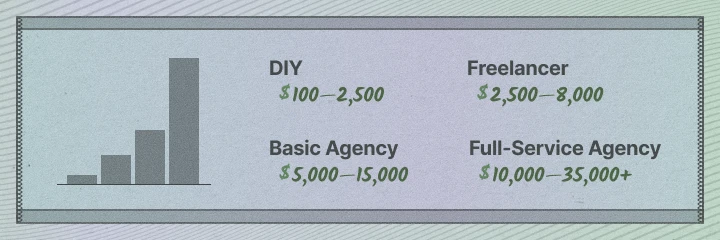
## The Four Approaches to Attorney Website Development
### 1. DIY Approach: Build It Yourself
#### Total Cost Range: $100 – $2,500/year
If you’re a solo practitioner just starting out, building your own website might seem like the obvious choice. Platform subscriptions run $10-100/month for WordPress.com or $20-50/month for Wix/Squarespace. Legal-specific builders like LawLytics or Clio charge $100-300/month but include industry-specific features.
You’ll also need domain and basic hosting ($100-200/year), premium themes or templates ($50-200 one-time), and stock photography ($100-500/year). But here’s what most lawyers don’t account for: your time investment. Plan on 40-80 hours for initial setup and 5-10 hours monthly for maintenance.
This approach works best for new solo practitioners with limited budgets, lawyers comfortable with technology, and firms needing a basic online presence quickly. The pros are obvious—lowest upfront cost, complete control, and quick setup. The cons? It’s incredibly time-intensive, offers limited customization, and provides no professional support when things go wrong.
### 2. Freelancer Designers: Professional Help on a Budget
#### Total Cost Range: $2,000 – $8,000
Working with a freelance designer gives you professional results without agency overhead. Design and development typically runs $1,500-$6,000, basic copywriting for 5-10 pages costs $500-$2,500, logo design adds $200-$800, basic SEO setup is $300-$800, and hosting setup runs $100-$300. Most projects take 3-8 weeks.
This approach works well for small firms wanting custom design, practices with specific visual requirements, and firms comfortable managing an ongoing relationship with an individual. You get personalized attention, cost-effective solutions, and flexible project scope.
The downside? You’re dealing with a single point of failure, limited ongoing support, and potential skill gaps if your freelancer isn’t experienced with legal websites specifically.
### 3. Basic Agency: Experienced Support
#### Total Cost Range: $5,000 – $15,000
Basic agencies offer a middle ground between freelancers and full-service firms. Custom design with a template foundation runs $3,000-$8,000, professional copywriting for 10-15 pages costs $1,000-$3,000, SEO optimization is $800-$2,000, CRM/software integration adds $500-$1,500, and six-month support packages run $700-$1,500. Expect 6-12 weeks for completion.
This approach suits growing firms ready to invest in marketing, practices wanting custom features and integrations, and firms needing a balance of quality and budget. You get custom design at a lower cost than full-service agencies, professional support, and proven templates that work. The limitations include some restrictions on unique features and potential for scope creep as your needs expand.
### 4. Full-Service Agency: Complete Professional Solution
#### Total Cost Range: $10,000 – $35,000+
Full-service agencies provide comprehensive solutions. Fully custom design and development runs $6,000-$20,000, comprehensive content strategy costs $2,000-$6,000, advanced SEO setup and technical optimization is $1,500-$4,000, CRM and marketing automation setup adds $1,000-$3,000, ongoing maintenance and support runs $200-$500/month, and analytics and conversion tracking costs $500-$1,500. Timeline is typically 8-16 weeks.
This approach works for established firms with marketing budgets, competitive markets requiring advanced features, multi-location practices, and firms wanting comprehensive digital strategy. You get a complete solution, ongoing support, proven results, and advanced features.
The downsides are the highest cost, longer timeline, and potential for over-engineering solutions beyond what you actually need.
## Hidden Costs That Inflate Your Final Price Tag
Here’s what catches most law firms off guard: the initial quote is never the complete picture. Those ongoing expenses that seem minor individually can easily double your investment over three years. Let’s break down what you’re really signing up for.
### Ongoing Expenses
Every website has basic operational costs that continue indefinitely. Domain and hosting run $100-500 annually, depending on your traffic and security requirements. Plugin and software licenses add $200-1,000+ yearly—and legal websites often need specialized tools for compliance, security, and client management. Backup and monitoring services cost $300-800 annually, but they’re essential for protecting your firm’s reputation and client data.
### Content Creation
Most firms underestimate content costs because they focus on the initial website build. Professional copywriting runs $100-500 per page, but that’s just the beginning. Want professional photos instead of generic stock images? Legal photography sessions cost $500-2,000. Planning to add video content? Expect $1,000-5,000 per video for professional production. And if you’re serious about content marketing, blog articles run $200-800 each.
### Site Maintenance
Websites aren’t “set it and forget it” investments. Monthly maintenance packages cost $100-500, covering security updates, plugin maintenance, and performance monitoring. When something breaks (and it will) emergency fixes run $100-200 per hour. Platform updates can require $500-2,000 annually in development work, especially if you have custom features. Security monitoring adds another $50-200 monthly, but it’s non-negotiable in today’s threat environment.
## What Really Drives Your Website Investment
Understanding these hidden costs is important, but the bigger question is what drives these expenses in the first place. Several key factors determine whether you’ll be on the lower or higher end of every cost range.
### Design Complexity
The more unique your website needs to be, the more you’ll pay. Multiple unique page layouts require individual design and development work. Custom graphics and animations look impressive but require specialized skills and time. If you need complete brand development—logo, color schemes, typography systems—that adds significant cost. And making everything work perfectly on mobile devices? That’s often more complex than the desktop version.
### Functionality Requirements
This is where costs can spiral quickly. Client intake forms and automation seem simple but require careful development and testing. Payment processing integration involves security requirements and compliance considerations. Live chat and chatbot features need ongoing management and optimization. Appointment scheduling systems must integrate with your existing calendar and practice management software. Document download portals require secure access controls and organization systems.
Each of these features seems reasonable individually, but they add up fast—and they all require ongoing maintenance and updates.
### Building for Growth
Google should find your site when people search for lawyers in your area. SEO sounds complicated, but it’s basically making sure search engines can read and understand your content so they’ll show it to the right people.
If you have multiple office locations, things get more complex. You need separate pages for each location with specific content about that area. Google wants to see that you’re actually relevant to someone searching in Brookfield versus someone in Clayton, even if you handle the same types of cases.
Then there’s content marketing, which is a fancy way of saying “regularly publishing helpful information to attract potential clients.” But you can’t just write blog posts and hope for the best. You need systems to publish content consistently, optimize it for search engines, and track whether anyone’s actually reading it.
### Third-Party Integrations
Your website doesn’t exist in isolation. Practice management software like Clio or MyCase needs to sync with your contact forms and client intake systems. CRM systems like Salesforce or HubSpot require data integration and workflow automation. Each integration point requires development time, testing, and ongoing maintenance as software updates and APIs change.
## What’s Best for Me? Decision Framework by Firm Size and Goals
### Solo Practitioners and New Firms
If you have time but limited budget, the DIY approach ($500-$2,500/year) makes sense. If you want professional results, work with a freelance designer ($2,000-$8,000). Key considerations include your growth timeline, technical comfort level, and time availability.
### Small to Medium Firms (2-10 Attorneys)
Cost-conscious firms should consider freelance designers ($2,000-$8,000), while firms in competitive markets benefit from basic agencies ($5,000-$15,000). Consider your local competition, marketing budget, and growth goals.
### Established Firms (10+ Attorneys)
Regional practices often do well with basic agencies ($5,000-$15,000), while firms in competitive or high-value markets should invest in full-service agencies ($10,000-$35,000+). Consider brand positioning, lead generation needs, and multi-location requirements.
### Specialty Practice Areas Requiring Premium Positioning
High-value practice areas like personal injury, corporate law, and medical malpractice should invest in full-service agencies. Competitive advantage through superior web presence justifies the investment, and higher case values support premium website costs.

## The Bottom Line on Website Investment
Here’s something most firms don’t think about: the cost of having a terrible website (or no website) is usually way higher than building a good one.
When potential clients can’t find basic information about your firm, can’t figure out what you actually do, or get frustrated trying to contact you, they move on to the next search result. And that next search result might be your competitor.
Think about it from a client’s perspective. They’ve got a legal problem, they’re probably stressed about it, and they want to find a lawyer who seems competent and trustworthy. If your website looks like it was built in 2005 or takes forever to load on their phone, what does that say about how you run your practice?
## Ready to Get Started?
If you’ve made it this far, you’re probably ready to do something about your website situation. Start by being honest about where you are right now. Do you have time to learn WordPress, or would you rather focus on practicing law? Is your local market competitive enough that you need every advantage, or will a basic site work fine for now?
Dig up whatever marketing materials you already have—brochures, business cards, that old website content. [Figure out your actual budget](https://www.wearetg.com/blog/law-firm-spend-on-marketing/) (not what you wish you could spend, but what you can actually afford). Then start having real conversations with potential partners.
Don’t try to make this decision in a vacuum. Talk to other lawyers about what worked for them. Ask to see examples of websites these developers have built for other law firms. And remember, you can always start smaller and upgrade later as your practice grows.
#### **Price is just one part of website success.**
What really matters is whether your attorney website attracts qualified traffic, builds trust, and converts visitors into consultations. [Schedule a consultation](https://www.wearetg.com/contact/) with a member of our team to explore what features and functionality deliver real ROI for attorney websites in 2026 — and determine the smartest investment path for your firm.
---
## Frequently Asked Questions
#### How much should a 20-page website cost?
For a 20-page legal website, expect $8,000-$25,000 depending on complexity and provider. More pages require more content creation, design work, and development time.
#### How much does a law firm website cost?
Law firm websites range from $2,000-$35,000+ depending on approach, features, and ongoing requirements. The key is matching investment to expected returns.
#### Should I go DIY or hire a professional for my law firm website?
Most established firms benefit from professional development due to compliance requirements and competitive pressures.
#### Can I start with a DIY website and upgrade to an agency later?
Yes, but plan for this transition. Some platforms make migration easier than others, and you may lose some content or functionality in the switch.
#### Are website builders like Wix suitable for law firms?
Website builders can work for basic sites, but they often lack legal-specific features and may not meet all compliance requirements. Consider your long-term needs carefully.
**Categories:** SEO, Content Strategy, Web Development
---
### [Your Complete Guide to Google and Amazon’s PPC Advertising Prices](https://www.wearetg.com/blog/ppc-advertising-prices/)
**Published:** May 21, 2025
**Author:** Rob Timmermann
**Content:**
Curious about how PPC advertising prices change from platform-to-platform? Well, wonder no more! Keep reading as we cover everything you need to know.
## How Much Does PPC Cost on Google?
On average, the cost-per-click (CPC) for Google search ads is approximately $2.69, while Google’s Performance Max campaigns (PMax) have an average CPC of around $0.63. It’s worth noting several different factors—like [competition, keyword choices, and quality score](https://www.wearetg.com/blog/ppc-costs/)—can contribute to either higher or lower PPC advertising prices.
## Understanding the Bidding Process for Google’s Ads
Google Ads operates on a bidding system where advertisers can choose from a few different strategies and pricing models when it comes to ad placement:
### Google Adwords Pricing Models
- **CPC (Cost-Per-Click):** Pay for each click on your ad.
- **CPM (Cost-Per-Thousand-Impressions):** Pay for every thousand ad impressions.
- **CPE (Cost-Per-Engagement):** Pay when users interact with your ad in predefined ways.
### Google PPC Strategies
- **Search Ads:** These are text-based advertisements displayed alongside search results on a Google search results page.
- **Display Ads:** Display ads are image-based and are shown on web pages, blogs, and other forms of content within the Google Display Network.
- **Shopping Campaigns:** Shopping campaigns appear on search results and the Google shopping tab.
- **Smart Campaigns:** Smart campaigns take the hard work out of audience segmentation, with an algorithm choosing who sees your ad *plus* the content and landing page.
- **Pmax Campaigns:** Performance Max, or “PMax” is a new campaign type that lets advertisers access all Google Ads inventory from a single campaign.
## How Much Does Amazon PPC Cost?
Amazon PPC costs vary, but on average, sellers can expect to pay between $0.15 to $6 per click. It’s important to note this figure is just an average, and actual costs may fluctuate based on your niche, campaign objectives, and budget allocation.
## Understanding Amazon’s PPC Process
Similar to Google, with Amazon PPC, sellers are charged each time a potential customer clicks and views their ad. Before diving into how much Amazon PPC costs, we should cover the metrics used to measure your campaign performance:
- **Advertising Cost of Sales (ACoS):** ACoS represents the percentage of attributed sales spent on advertising. It’s calculated by dividing total ad spend by attributed sales. For instance, if you spent $4 on advertising, resulting in attributed sales of $20, your ACoS would be 20% (i.e., $4/$20 = 0.20).
- **Attributed Sales:** This metric encompasses the total product sales generated within one week of clicks on your ads. Sales data may take up to 48 hours to populate, and as a result, it may not be immediately available in the ‘Today’ date range. You can access individual sales totals for advertised products and other products in the Campaign Performance report.
- **Impressions:** Impressions denote the number of times your ads were displayed to users. It’s important to note that it may take up to three days to remove invalid clicks from your reports. Therefore, clicks from the last three days might be subject to adjustment due to click invalidation.
- **Clicks:** Clicks indicate the number of times users clicked on your ads. Similar to impressions, it may take up to three days to remove invalid clicks from your reports. As a result, clicks from the last three days may be adjusted due to click invalidation.
## Different Types of Amazon Sponsored Ads
There’s three types of ads on the amazon platform—Sponsored Product ads, Sponsored Brand ads, and Sponsored Display ads—attributed to 77%, 39%, and 30% of Amazon’s PPC, respectively.
### 1. Sponsored Products Ads
Sponsored Products ads are the most prevalent form of Amazon PPC advertising. When creating Sponsored Products ads, sellers have the option to employ two distinct keyword targeting strategies: automatic targeting and manual targeting.
- **Automatic Targeting:** In automatic targeting, Amazon‘s algorithm selects keywords it deems relevant to the seller’s product listing. Over time, Amazon refines these ads based on shopper behavior data, optimizing them to enhance listing visibility and drive conversions.
- **Close Match Ads:** Target search terms closely related to the advertised product.
- **Loose Match Ads:** Target keywords loosely related to the product.
- **Substitutes:** Target shoppers considering similar products from different brands.
- **Complements:** Target shoppers viewing detail pages of products that complement the advertised product.
- **Manual Targeting:** Manual targeting involves sellers hand-selecting specific keywords to bid on. Ads generated through manual targeting only appear when a shopper’s search terms align with the chosen keywords. While more labor-intensive, manual targeting allows for greater control over ad performance and long-term cost optimization.
### 2. Sponsored Brands Ads
Formerly known as “headline search ads,” Sponsored Brands ads enable sellers to promote multiple products simultaneously and captivate shoppers with visually compelling content. These ads offer three formats, including headline banners at the top of search results and videos further down the page.
- **Product Collection Ads:** Feature the brand’s logo, tagline, and multiple products.
- **Store Spotlight Ads**: Highlight the brand’s store and key products.
- **Video Ads:** Showcase a single product through a 15-30 second video.
### 3. Sponsored Display Ads
Sponsored Display ads facilitate retargeting of customers who have visited product detail pages, both on and off Amazon. Unlike Sponsored Products and Brands ads, Sponsored Display ads can appear on Amazon’s affiliate sites, including Google, Facebook, Netflix, and mobile apps. These ads require sellers to have a registered brand to utilize them effectively.
## Take the Guesswork out of PPC Bidding Strategies
Having trouble appearing in search results? Take the guesswork out of AdWords with [PPC management services](https://www.wearetg.com/services/pay-per-click-marketing/) from Timmermann Group. Our team of Amazon and Google Ad-certified strategists craft campaigns that optimize your investment, ensuring you reach your target audience.
---
#### Google or Amazon — Which Platform Is Actually Driving ROI?
SCPC averages only tell part of the story. What really matters is how efficiently your ad spend turns into revenue. Different platforms require different bidding strategies, targeting approaches, and optimization tactics. If you’re unsure where to invest—or how to improve performance across both—let’s bring clarity to your PPC strategy.[ **Schedule a 30-minute consultation** ](https://www.wearetg.com/contact/)with Timmermann Group to evaluate your Google and Amazon campaigns, uncover hidden inefficiencies, and build a smarter cross-platform PPC plan.
[](https://www.wearetg.com/contact)
**Categories:** PPC
---
### [SEO Issues: How to Find and Fix Them Quickly](https://www.wearetg.com/blog/seo-issues/)
**Published:** January 13, 2025
**Author:** Rob Timmermann
**Content:**
Are SEO issues hurting your site’s performance? Identifying and fixing these common [SEO](https://www.wearetg.com/services/seo/) problems can improve your rankings and visibility. This article will guide you through understanding, finding, and resolving crucial SEO issues quickly.
## Key Takeaways
- Addressing technical SEO issues, like indexability and metadata, is vital for improving search engine rankings and user experience.
- Regular audits and updates for duplicate content, meta descriptions, and broken links can significantly enhance a site’s visibility and engagement.
- Optimizing for mobile compatibility, page speed, and HTTPS is essential for maintaining trust and improving overall SEO performance.
## Understanding SEO Issues
Addressing SEO concerns is critical for a website to achieve good search engine rankings, and swift action should be taken. The indexability of webpages, or the ability for these pages to be indexed by search engines like Google, is an essential part of SEO. If Google bots are unable to crawl your site’s pages properly, they won’t show up in the search results—leading you to miss out on potential visibility.
Components such as page titles, title tags, metadata, and XML sitemaps are vital because they aid search engines in understanding and assessing your website content. Neglecting these [SEO best practices](https://www.wearetg.com/blog/seo-best-practices/) can adversely affect your site’s visibility within a search engine’s ranking system. Overlooking technical optimization jeopardizes user experience and decreases engagement levels, which could Degrade your position within the ranks of various searches.
## Duplicate Content Problems
When identical content is presented across multiple pages, it poses a significant challenge for technical SEO because it confuses search engine crawlers and hinders accurate content indexing. Such complications often emerge when there are several iterations of a page for reasons like URL parameters or trailing slashes. When search engines encounter duplicate content, they typically select only one version to display in the search results, which might not align with your preferred version.
Issues such as having various versions of your homepage available online can also lead to duplicate content problems. Other contributing factors include faceted navigation systems and adding tracking parameters within URLs. This redundancy in content can negatively impact your SEO standing and diminish how valuable your site appears to search engines. To avoid any penalties that could arise and maintain optimal rankings, perform periodic [content audits](https://www.wearetg.com/blog/content-audit/) to ensure every piece of published material on your website is unique, crafted with quality in mind, and provides genuine value.
### Identifying Duplicate Content
Conducting frequent site audits is crucial for detecting duplicate content, which can adversely affect a website’s SEO performance. When there are several iterations of the same page, it not only has the potential to confuse users but also risks being improperly indexed by Google.
Utilizing tools such as Semrush’s Site Audit offers an in-depth examination that reveals duplicate content problems and identifies keyword cannibalization instances. Should any issues with duplicated material be discovered during a site audit, an error notification will flag them for your attention.
### Fixing Duplicate Content
Canonical tags serve as a directive to pinpoint the primary version of your content, helping you avoid complications with duplicate material. Employing 301 redirects for duplicate pages guarantees that users and search engine crawlers are directed to the accurate version of your content. Merging similar content into one detailed article can diminish the dangers associated with duplicate content. Performing routine audits of your website’s content helps you detect and regulate any issues with duplication.
Addressing problems related to duplicate material is essential for elevating your website’s prominence and standing on search engines. Ensuring every piece of your site’s content is distinctive and crafted skillfully boosts SEO performance and user satisfaction.
## Missing or Poor Meta Descriptions
Meta descriptions are summaries that appear in search results and influence user click-through rates. They help search engines index pages and generate audience interest. However, many pages lack this critical content. Studies show that 79% of sites were missing meta descriptions. The Site Audit report can identify missing or duplicate meta tags related to ‘tag’ issues.
Fix missing or duplicate meta tags by adding tags where needed or changing duplicates to be original. Update the meta description whenever a page is edited or updated. Optimizing meta tags from the start improves site performance and search engine interpretations.
Without meta descriptions, search engines may auto-generate snippets that could be unappealing to users.
### Crafting Effective Meta Descriptions
Crafting a compelling meta description involves incorporating target keywords and clear calls to action, which are crucial for prompting users to take the desired step. It’s imperative that this snippet accurately reflects what the user will encounter upon visiting the page.
To heighten on-page SEO and boost click-through rates from search results, it is advisable to tailor meta descriptions distinctly for mobile and desktop audiences. Concentrating on these facets can markedly bolster your page’s SEO performance.
### Regularly Updating Meta Descriptions
To maintain their significance in SEO strategies and ensure they stay relevant, it’s important to periodically refresh your meta descriptions. This routine maintenance sustains their impact on search engine optimization.
Evaluating the success of existing meta descriptions is crucial for understanding how beneficial they are to your organization. Each meta description must stand out as distinctive to optimize search visibility and improve click-through rates. Utilizing resources such as Google Search Console can be instrumental in efficiently overseeing and refining your meta descriptions.
## Broken Links and Their Impact
Encountering broken links can significantly annoy users, potentially causing them to develop an unfavorable view of the website and deterring visits. For search engines, these dysfunctional links are often seen as signs of a poorly maintained or outdated site, which can lower its perceived reliability and authority. This, in turn, may obstruct search engines from properly indexing the website’s content, leading to less prominence within search results. Large websites also face the issue of their crawl budget being squandered when trying to access non-existent pages.
When webpages yield errors such as those in the 4XX or 5XX range, they negatively influence overall website performance. Rectifying these issues isn’t particularly complex and improves user satisfaction and contributes positively to SEO when reclaiming lost links associated with 404 errors. Effectively handling server-side problems indicated by 5XX series errors requires ensuring that servers respond correctly—this action substantially bolsters site functionality.
### Finding Broken Links
Leverage Google Search Console’s backlinks function to pinpoint external broken links. Reports from Google Search Console generate a detailed list of broken links, allowing for thorough scrutiny. Additional tools to detect these faulty connections include website crawlers like Ahrefs, SEMRush, and Screaming Frog.
By consistently monitoring your site for broken links with Google Search Console or other tools, you can enhance your user experience while boosting your SEO performance.
### Fixing Broken Links
Redirecting to the most relevant pages is one of the quickest methods to fix broken links. Regular site audits help identify and fix broken links, ensuring ongoing site maintenance and performance. Fixing broken links is crucial for maintaining link equity and improving site navigation.
An ongoing process of checking for and fixing broken links is key to sustaining a healthy, broken, link-free website.
## Slow Page Speed
The speed at which a page loads is crucial for search engine rankings and the overall user experience. When pages load slowly, users are more inclined to abandon the site promptly, resulting in higher bounce rates. Such lagging speeds can undermine user engagement and diminish site performance and visibility online. Google has integrated Core Web Vitals into their metrics to assess loading speeds and interactivity of webpages—factors that directly influence search rankings. Utilizing tools such as Google Search Console enables website owners to pinpoint pages with slow loading times and understand how they affect the user’s experience.
Various strategies can be employed to optimize page speed, including compressing images, reducing HTTP requests, and leveraging a Content Delivery Network (CDN). These tactics accelerate webpage loading and foster better user experiences while simultaneously elevating positions within search engine listings.
### Analyzing Page Speed
Google PageSpeed Insights is a tool that evaluates your website’s loading speed and identifies problems. Analyzing page speed is vital for SEO as it directly affects user experience and rankings.
Such tools, including Google PageSpeed Insights, assist in pinpointing areas where performance can be optimized to decrease load times.
### Improving Page Speed
Utilizing the lazy loading approach for images ensures that they are only loaded when they enter the user’s view, enhancing the initial load time of a webpage. You can expedite your web page’s speed by minifying code and removing superfluous elements like whitespace and commentary.
Employing a Content Delivery Network (CDN) bolsters webpage load speeds by caching your site at locations nearer to visitors. The importance of optimizing page speed lies in its dual impact on enhancing both user experience and search engine rankings. The application of these strategies is instrumental in significantly elevating your website’s performance as well as its online prominence.
## Mobile Optimization Issues
Mobile optimization is vital, as over half of all searches are conducted on mobile devices. Google’s mobile-first indexing relies primarily on the mobile version of a website’s content for ranking. A mobile-friendly website is essential for search engine optimization. Use the Google URL Inspection Tool to check if your site has transitioned to mobile-first indexing. As of December 2018, mobile-first indexing represents more than half of the websites in search results.
Optimizing for mobile pages shows a commitment to accessibility and user satisfaction. Click-to-call buttons are valuable for improving the mobile user experience. Simplified forms can significantly enhance usability. Ensure correct implementation to avoid losing search visibility on a ‘.m’ mobile site.
### Ensuring Mobile Compatibility
Responsive design is the preferred technique for crafting websites that are friendly to mobile devices. There are three main approaches to achieving a mobile-friendly website: employing responsive web design, using adaptive design, or creating distinct sites for mobile.
Utilizing device detection allows the correct version of the site to be presented to mobile users. Concentrating on these strategies ensures that search engines and both users—mobile and desktop—can easily access and move through your site.
### Testing Mobile Performance
Google provides a tool called the Mobile-Friendly Test to assess websites’ performance on mobile devices. Promptly addressing and resolving issues related to mobile usability is vital for preserving search rankings. Conducting regular tests on mobile performance, focusing on features like accelerated mobile pages, is essential to sustaining search engine standings and ensuring a satisfactory user experience.
By consistently evaluating and improving the usability of mobile pages, there can be a notable boost in both user engagement and retention rates.
## Missing Alt Tags for Images
Alt tags are essential for both SEO and accessibility as they enable search engines to comprehend the context of images while making content accessible to a broader audience. Overlooking alt tags can lead to missed opportunities in SEO, lessening the significance of your image content and adversely affecting your site’s capacity to rank well.
Inadequate or missing alt tags may detract from the user experience, consequently impacting how effectively a site performs within search engine rankings. Search engines utilize these tags as part of their information-gathering process on images, which aids in better indexing of web pages.
Providing descriptive alt text for images is pivotal. It bolsters SEO and improves accessibility by offering crucial descriptions that enhance understanding for all users.
### Adding Alt Tags
When creating alt tags, it is critical to provide a precise description of the image along with pertinent keywords while avoiding superfluous terms such as ‘image of’. Alt text should contain an accurate depiction and relevant keywords. Employing alt tags is advised when adding new images to a website.
Alt tags are essential for boosting SEO and significantly improving accessibility for individuals with disabilities. These recommendations will bolster your website’s SEO and elevate the user experience.
### Regular Audits for Alt Tags
Performing regular checks on alt tags is crucial to ascertain that they represent the image content and remain pertinent. These audits facilitate the discovery of obsolete or irrelevant alt tag descriptions, guaranteeing their effectiveness for SEO and accessibility objectives.
It is vital to furnish images on your website with appropriate alt tag descriptions should they be missing.
## Poor Internal Linking Structure
Hyperlinks that connect users to additional content within the same domain are known as internal links. Effectively using internal linking can enhance search engine visibility and spread page authority, which could result in better search engine rankings. Descriptive anchor text is vital for search engine optimization because it helps explain what the linked pages entail to search engines.
Anchor text that lacks clarity can disrupt user experience and hinder crawler interpretation, diminishing the link’s impact. Pages with scant or nonexistent internal links might not rank well and risk becoming orphan pages without any incoming links. An insufficient internal linking structure may isolate pages, making them difficult for search engines to index.
Regular reviews are essential as part of an effective strategy for your website’s network of internal links to ensure your use of descriptive anchor text remains impactful and pertinent over time.
### Creating a Solid Internal Linking Strategy
Google emphasizes the importance of enhancing user experience through strategic internal linking methods. Examine the connections between source and target pages to uncover potential internal link placements. Employing Ahrefs’ Site Audit can help detect orphan pages missing internal links.
Establishing links from top-tier pages down to more in-depth content layers can facilitate better site navigation. To handle a substantial volume of internal links, it is advisable to devise an organized sitemap in the website’s footer.
### Regularly Reviewing Internal Links
Consistently examine and refresh internal links to maintain their relevance and operability. To comprehensively detect orphan pages, evaluate server logs, or utilize instruments like Ahrefs’ Site Audit. When dealing with on-page link quantities, it’s suggested to cap at 100. Managing this can be simplified by devising a tiered footer sitemap.
Incorporate links to orphan pages from pertinent existing pages or remove them should they lack significance. Excessive internal linking should be avoided as it may detrimentally affect both the user experience and the crawlability of the site.
## HTTPS Issues
Most leading websites implement HTTPS, underscoring its significance in ensuring online security. Essential for protecting a site and building user confidence, an SSL certificate is recognized by search engines as a mark of credibility and influences their rankings. While it’s considered a minor factor within the myriad elements that determine search engine positions, HTTPS does indeed affect them.
Search engines may penalize sites without SSL certificates due to perceived security risks, making users consider these sites less secure. A lack of TLS encryption could diminish a site’s standing within search engine listings. SSLs are critical for safeguarding data exchanged between servers and users through robust encryption measures.
Despite possessing a valid TLS certificate, some pages might revert to HTTP protocols. This inconsistency can pose problems. To verify if any website has fully adopted HTTPS protocol support across all its pages, you should begin by entering its domain into Google Chrome’s address bar.
### Implementing HTTPS
It is crucial to obtain an SSL/TLS certificate when establishing HTTPS, particularly for your subdomains if you currently lack one. Doing so guarantees that every page is delivered securely and bolsters users’ confidence.
### Monitoring HTTPS Status
Securing data transmission on your website via HTTPS is essential for enhancing user confidence and could favor your search engine rankings. To keep track of the HTTPS status, verify that all pages are delivered securely and consistently scrutinize potential problems.
By doing so, you will preserve both the security and integrity of your site.
## Unoptimized Title Tags
Title tags are essential for helping search engines classify web pages accurately. They appear in the search results and typically summarize a webpage’s content. Therefore, it is essential to verify that title tags are unique and not overly lengthy.
Within the HTML code of a webpage lies the title tag, which surfaces only on the SERP provided by a search engine. The presence of duplicate content might result in diminished ranking opportunities since search engines prefer distinct pages.
When several iterations of comparable content are present, it can lead to self-competition, where these variations vary with one another, possibly diminishing cumulative traffic flow.
### Writing Effective Title Tags
Ensure every page has a distinctive title tag that accurately encapsulates the page’s content while integrating pertinent keywords. It’s essential to maintain both relevance and distinctiveness, effortlessly weaving in keywords. Positioning your primary keyword at the start of the title tag may improve its impact.
Tools such as Positional can provide automated assistance for crafting these title tags, offering suggestions for titles tailored to specific keywords.
### Avoiding Common Title Tag Mistakes
Frequent errors include replicating title tags on various pages and neglecting to integrate target keywords. These practices can confuse search engines and lessen the significance of your content, which could adversely affect your SEO ranking. Excessively long title tags might also be cut short in search results, diminishing their impact.
Maintaining title tags within a range of 50-60 characters is advisable to prevent them from being truncated when displayed in search engine results.
## Summary
Addressing SEO issues is a critical step to ensuring your website’s success. Each action contributes significantly to your SEO performance, from fixing duplicate content and optimizing meta descriptions to improving page speed and ensuring mobile compatibility. Regular audits and updates are essential to maintain and improve your site’s visibility and user experience. Following the guidelines outlined in this blog post, you can tackle common SEO issues efficiently and enhance your site’s overall performance.
---
#### Not Sure What’s Quietly Hurting Your SEO?
SEO issues don’t always announce themselves. Sometimes it’s duplicate content. Sometimes it’s crawl errors, slow load times, or broken internal links quietly draining your visibility. If your rankings have stalled—or worse, declined—it’s time for a proactive audit.[ **Schedule a 30-minute consultation** ](https://www.wearetg.com/contact/)with Timmermann Group to uncover hidden SEO issues, prioritize what actually matters, and implement fixes that restore momentum and drive measurable growth.
[](https://www.wearetg.com/contact)
---
## Frequently Asked Questions
### Why is addressing duplicate content important for SEO?
Ensuring your site’s content is unique is essential for SEO. This helps search engines understand your website’s objective, improving its visibility and position in search results. Addressing duplicate content boosts SEO performance and helps distinguish your site within search results.
### How can I identify broken links on my website?
Utilizing tools such as Google Search Console, Ahrefs, SEMRush, or Screaming Frog can help you detect broken links on your website.
By addressing these broken links, the user experience on your site will improve and its SEO performance!
### What are the benefits of having a mobile-friendly website?
Enhancing user experience through a mobile-friendly website increases engagement and elevates your search rankings.
Seize this opportunity to engage with your audience more efficiently by embracing the shift!
### How often should I update my meta descriptions?
Refine your meta descriptions continuously to maintain their SEO impact. It is also essential to evaluate their performance routinely to confirm that they are still contributing value.
To keep your position at the forefront of search rankings, make sure you are constantly improving them!
### What is the role of alt tags in SEO?
Alt tags are essential for SEO. They help search engines comprehend image context while boosting accessibility and user experience.
By optimizing your alt tags, you’ll enhance your site’s visibility and effectiveness!
**Categories:** SEO
---
### [HVAC PPC: The Complete Guide for HVAC Companies](https://www.wearetg.com/blog/hvac-ppc/)
**Published:** April 12, 2024
**Author:** Rob Timmermann
**Content:**
As an HVAC contractor, you’re no stranger to the challenges of standing out in a crowded local market. Enter HVAC PPC advertising—an easy marketing tactic to put your [HVAC business](https://www.wearetg.com/industry/hvac-marketing-agency/) in front of customers at the exact moment they’re ready to convert.
But where do you even begin with PPC as an HVAC contractor? Better yet, what does it take to drive a steady stream of new leads? Keep reading as we discuss *everything* you need to know.
## Basic Overview of Pay-Per-Click HVAC Advertising
Pay-per-click (PPC) advertising is a powerful online marketing strategy that can be incredibly valuable for HVAC companies. PPC stands for Pay-Per-Click, which means you only pay when someone actually clicks on your ad.
With PPC, you can target customers who are actively searching for HVAC services in your local area. This enables you to target individuals who are already interested in what you have to offer, thereby significantly increasing your chances of converting them into loyal customers.
### How Does PPC Work?
The core of PPC advertising is bidding on relevant keywords related to your HVAC services. Whenever someone searches for those keywords, your ad will appear at the top of the search results, making it more likely for them to click on it and visit your website. You’ll be able to track important metrics, such as the number of people who clicked on your ads, the amount you’ve spent, and which keywords are performing the best.
## Understanding the Different Types of HVAC PPC Ads on Google
When it comes to PPC for HVAC companies, Google offers a wide array of ad formats, each with its own unique advantages. Let’s take a closer look at different options and discuss how they can elevate your HVAC marketing efforts:
### Search Ads
Search ads are the classic text-based ads that you see at the top of search engine results pages (SERPs). These ads resemble standard search result listings, with elements like the website name, page title, and meta description visible.
The key thing that sets search ads apart is that they are triggered by specific keyword searches. When someone searches for a term related to your HVAC services, your search ad can appear at the top of the results, giving you prime visibility.
What makes search ads so powerful is that you’re reaching people who are actively looking for what you offer. They’ve already expressed interest by typing in a relevant query, so they’re much more likely to click on your ad and become a potential customer.
The performance of your search ads is determined by a few key factors:
- **Expected click-through rate:** How likely people are to click on your ad.
- **Relevance to search intent:** How well your ad matches what the user is looking for.
- **Landing page relevance:** How relevant and useful your website is to the searcher.
By optimizing these elements, you can improve your Quality Score, which in turn allows you to get your ads placed higher in the search results for a lower cost-per-click (CPC) bid.
Search ads can be a highly cost-efficient way for HVAC companies to connect with motivated, in-market customers. By focusing on the right keywords and crafting compelling ad copy, you can drive valuable traffic to your website and generate more leads and sales.
### Local Service Ads
Rather than the traditional text-based search ads, Local Service Ads feature a prominent business listing at the top of the Google search results. These ads include key information like the business name, location, ratings, and contact details.
What makes Local Service Ads so powerful is the verification process that businesses have to go through to qualify. There are a few different status badges that can appear on these ads:
- **Google Screened:** This green checkmark indicates the business has passed Google’s background and license checks.
- **Google Guaranteed:** The white checkmark in a green background shows the business has gone through an even more rigorous screening process and has a $2,000 guarantee of satisfactory service.
- **License Verified by Google:** A green checkmark that verifies the business’s professional licenses.
- **Pre-Badge:** Businesses that have started the screening process but haven’t completed it yet can still advertise without a badge.
These verification badges help build trust with potential customers, letting them know they’re working with a reputable, high-quality HVAC provider.
When users click on a Local Service Ad, they’re presented with the ability to call or message the business directly. This means you’re getting highly qualified, purchase-ready leads coming straight to you.
And, since factors like response rates and user ratings can impact ad placement, Local Service Ads provide an incentive for HVAC companies to deliver excellent customer service.
### Display Ads
Unlike search ads, which are triggered by specific keyword queries, display ads use visual elements like images, graphics, and video to catch users’ attention as they browse the internet.
These display ads can appear in a variety of formats, such as:
- Banner ads at the top or sides of web pages
- Inline ads woven into the content of articles and blog posts
- Pop-ups or interstitial ads that cover part of the screen
- Video ads that play before, during, or after online video content
The power of display advertising lies in its ability to reach users at multiple touchpoints throughout their digital journey. Even if someone doesn’t click on your ad, repeated exposure can help build brand awareness and keep your HVAC company top-of-mind.
Google’s display network spans millions of websites, apps, and YouTube channels, giving HVAC advertisers a huge pool of potential customers to target. Google’s sophisticated targeting capabilities allow you to hone in on the specific demographics, interests, and behaviors of your ideal customers.
While display ads may not have the same direct response rate as search ads, they can still be highly effective at driving valuable actions like website visits, lead form submissions, and phone calls. And by using eye-catching visuals and clear calls-to-action, you can maximize the impact of your display advertising campaigns.
### Retargeting Ads
Retargeting, also known as “Google Remarketing,” is a PPC strategy that allows HVAC companies to reconnect with potential customers who have already shown interest in your services.
Here’s how it works:
1. Someone visits your HVAC company’s website.
2. A small piece of code (called a cookie) is placed on their browser, which adds them to a remarketing list.
3. As that person browses the internet and visits other websites that are part of the Google Ads network, they will start seeing your retargeted ads.
Retargeting ads are incredibly powerful because they allow you to stay top-of-mind with people who have already expressed interest in your HVAC business. Even if they didn’t convert on their initial visit, retargeting gives you another chance to get them to take action. Here are a few ways you can do that:
- Customize your retargeting ads to reach people on different devices, mobile apps, geographic locations, and more.
- Create separate remarketing lists and ad campaigns to focus on either first-time visitors or past customers.
- Better understand where someone is in the customer journey, and use targeted ads tailored, compelling messaging.
***Example:*** let’s say a homeowner searches “HVAC maintenance near me” and visits your website, but doesn’t convert. With retargeting, you could serve them an ad reminding them of your maintenance services and offering a special discount, enticing them to come back and schedule an appointment.
### Video Ads
As you might have guessed by the name, these ads appear on videos. YouTube, which is owned by Google, is the primary platform for these ads, which come in six different formats:
- **Skippable In-Stream Ads:** These ads play before, during, or after YouTube videos. They have no maximum length, and viewers can choose to skip the ad after the first 5 seconds.
- **Non-Skippable In-Stream Ads:** Similar to skippable in-stream, but these ads have a 20-second maximum length and cannot be skipped.
- **In-Feed Ads:** These video ads are featured on the YouTube homepage, search results, and up-next video recommendations, blending in with the organic content.
- **Bumper Ads:** 6-second non-skippable ads that play at the beginning of a YouTube video.
- **Outstream Ads:** Video ads that can run on websites and apps outside of YouTube, similar to display advertising.
- **Masthead Ads:** The top-tier YouTube video ad format, these appear at the very top of the YouTube homepage feed.
No matter which format you choose, video ads allow HVAC companies to deliver engaging visual content that captures attention and builds brand awareness. By targeting the right audience segments and optimizing your video creative, you can drive valuable actions like website visits, lead form submissions, and phone calls.
## Choosing the Right Google Ads Format
| **Type** | **Location** | **Best for** | **Pricing** |
|---|---|---|---|
| Search Ads | Throughout Google Search results | Promoting web pages related to HVAC keywords | $$$ |
| Local Service Ads | Google Maps and SERPs | Advertising geographically specific products or services to localized leads | $$$ |
| Display Ads | Seen on webpages, apps, and other Google properties within their Display network | Building awareness to new markets across content formats | $$ |
| Video Ads | Before, during, and after videos, in search feeds, and on the YouTube home feed. | Promoting video content or reaching highly engaged users with dynamic video ads | $ |
| Retargeting Ads | Text, images or video ads seen on websites, apps, and properties in the google network. *Note:* Similar to display ads but retargets customers who’ve already visited your site before. | Remarketing to prospects no matter how far along they’ve gotten in the sales cycle. | $ |
## From Search to Sale: Generate New Leads with a Well-rounded Strategy
Getting started with PPC is all about taking a comprehensive, multi-pronged approach. Here’s a tried-and-true strategy to capture demand, stand out from the competition, and convert more customers.
### Use Search Ads to Capture Demand
Search ads allow you to place your HVAC services in front of potential customers at the exact moment they’re searching for the solutions you offer. By bidding on highly relevant keywords like “HVAC repair near me” or “furnace installation”, your ads will appear at the top of the search results, maximizing your chances of generating a lead.
The key to success with search ads is thorough keyword research, [compelling ad copy](https://www.wearetg.com/blog/product-copywriting/), and a conversion-focused [user experience (UX)](https://www.wearetg.com/blog/ux-vs-ui/) on your website. By continuously monitoring performance, adjusting bids, and refining your targeting, you can optimize your search campaigns to capture more of the demand in your local market.
### Claim Your Spot with Local Service Ads
In addition to traditional search ads, *every* HVAC company should be using Google’s Local Service Ads.
This ad format allows you to showcase your business directly in the search results with a prominent listing that includes your company name, ratings, contact info, and a “Google Guaranteed” badge.
Getting set up with Local Service Ads requires going through Google’s verification process, which includes validating your licensing, insurance, and customer satisfaction. But once you’re approved, these ads can be an incredibly powerful way to stand out from the competition and connect with geographically targeted, purchase-ready leads.
### Re-pitch with Retargeting Ads
The final piece of a well-rounded PPC strategy for HVAC companies is retargeting. Also known as remarketing, this tactic allows you to reconnect with users who have already visited your website but may not have converted on their initial visit.
Retargeting ads, whether in the form of text, video, or display, give you the opportunity to reengage these potential customers with tailored messaging. For those who are further along in the sales funnel, you could highlight special offers or promotions. For those who are still in the research phase, you might use more educational content to nurture them.
By incorporating retargeting into your PPC mix, you can stay top-of-mind, overcome objections, and guide more of your website visitors towards becoming paying customers.
## Benefits of Running Paid Ads: 3 Ways They Boost Your HVAC Marketing Efforts
### 1. Drive Immediate Results
One of the biggest advantages of running PPC ads for your HVAC business is the ability to start generating leads and driving results almost immediately. Unlike other marketing tactics that can take months to build momentum, a well-executed PPC campaign can start producing real-time results within days or even hours.
Of course, it does take some time to fully optimize your PPC strategy and achieve the best possible returns. But after the initial ramp-up period of a few months, you’ll have valuable data to refine your ad targeting, bids, and creative. This allows you to continually improve the performance of your PPC campaigns and reach a larger audience with precision.
### 2. Low-Cost Lead Generation
PPC advertising provides HVAC companies with complete control over their marketing budgets. You set the maximum cost-per-click (CPC) you’re willing to pay, and you only pay when someone actually clicks on your ad.
This ensures your advertising dollars are being spent on reaching potential customers who have expressed interest in your services.
Additionally, the ability to closely monitor the performance of your PPC keywords and ads allows you to make informed optimizations over time. You can identify which ad elements and targeting strategies are driving the best returns, and allocate more budget to the high-performing areas.
### 3. Gain New Customer Insights
Running PPC ads gives HVAC companies the opportunity to reach a wide audience and gather detailed, actionable insights about their potential customers.
By analyzing factors like ad engagement, demographics, and user behavior, you can gain a deeper understanding of who your target customers are and what motivates them. With the insights learned from PPC, HVAC companies can make more informed choices about their service offerings, pricing, messaging, and overall marketing approach.
In short, this data-driven customer intelligence informs not just your PPC strategy but your broader marketing and business decisions as well
### Tips for HVAC Companies Getting Started with PPC
- **Set a Clear Goal:** The first step in launching a successful PPC campaign for your HVAC business is to establish a clear, measurable goal. Are you looking to increase brand awareness, generate more leads, boost website traffic, or drive more sales? Understanding your primary objective will help you choose the right strategy and Ad format to focus on.
- **Choose a Platform:** Once you’ve defined your goal, pick the PPC platform that will best help you achieve it. For example, if your goal is lead generation, then Search and Local Service Ads should be your top priority. If it’s brand awareness, then start with display ads.
- **Set a Budget:** Research[ average PPC costs](https://www.wearetg.com/blog/ppc-costs/) for the keywords you want to use. For HVAC companies in a major metropolitan area, it’s common to spend upwards of $5,000/month. Just remember: you *only* pay when someone clicks on your ad—start with a modest budget and then scale up as you see ROI.
- **Build Your Campaign:** Capture the attention of your target audience. Make sure your on-page copy is compelling enough to convert clicks into leads. Then, set up your PPC campaign parameters (like location, audience demographics, device targeting, and more.)
- **Measure Results:** Monitor key metrics like impressions, [click-through rate](https://www.wearetg.com/blog/google-ctr-by-position/), conversion rate, cost-per-acquisition, and quality score. Use these insights to refine your campaigns, optimize bids, and improve margins.
## Take the Guesswork out of HVAC Advertising
Look, we get it. Navigating the world of PPC advertising can be a struggle—especially for HVAC contractors who are already juggling a million other priorities. But the truth is that pay-per-click is a key piece of your online marketing efforts.
Luckily, you don’t have to go it alone.
At Timmermann Group, we’ve helped HVAC companies just like yours unlock the full potential of PPC advertising for 20+ years. Thanks to our agile approach, we know exactly what it takes for your ads to reach the right people at the right time for the right price.
Let us take the guesswork out of campaign management. Start a conversation with us, your [HVAC marketing agency](https://www.wearetg.com/industry/hvac-marketing-agency/), and learn how we create a customized advertising plan that captures that initial demand, ignites genuine interest, and guides potential customers straight to your doorstep.
---
#### Ready to Make HVAC PPC Actually Drive Revenue?
Running ads is easy. Running profitable HVAC PPC campaigns that generate booked service calls, installation estimates, and real ROI? That takes strategy. If you’re tired of guessing at keywords, juggling ad formats, or wondering why clicks aren’t turning into jobs, it’s time for a smarter approach.[ **Schedule a 30-minute consultation** ](https://www.wearetg.com/contact/)with Timmermann Group to discover how a data-driven HVAC PPC strategy can capture demand, dominate your local market, and convert searchers into scheduled appointments.
[](https://www.wearetg.com/contact)
**Categories:** PPC
---
### [PPC Costs & Management: What to Expect and How to Maximize Your Ad Budget](https://www.wearetg.com/blog/ppc-costs/)
**Published:** April 22, 2025
**Author:** Rob Timmermann
**Content:**
Tired of conference room discussions, scratching your head over questions like, “Have we done enough to reach buyers?” “How can we improve our conversion rate?” And, the all-too-common concern… “Are we overspending?”
If so, you’re not alone. Welcome to the world of online advertising—where every click comes with a price tag. [Pay-per-click (PPC) advertising](https://www.wearetg.com/services/pay-per-click-marketing/) can deliver powerful returns, but only when managed properly. But before you start bidding on keywords and launching search or display ads, it’s important to understand one thing:
*Pay-per-click success is as much about strategy as it is about spend.*
From campaign budgeting to management pricing models and measuring ROI, PPC requires more than a set-it-and-forget-it approach. Let’s break down what you need to know about PPC costs in 2025, what PPC pricing models are available, and how to budget and measure your spend to maximize ROI.
**Table of Contents**
- [Understanding the Basics of PPC Advertising](#basics-of-ppc)
- [What’s the Average PPC Cost in 2025?](#average-ppc-costs)
- [Factors Influencing PPC Costs](#factors-ppc-costs)
- [How Much Should My Business Spend on PPC?](#spend)
- [5 Common PPC Management Pricing Models](#pricing-models)
- [Hiring a PPC Campaign Manager vs a Third-Party Ad Agency](#hiring)
## Understanding the Basics of PPC Advertising
PPC advertising is a digital marketing strategy that helps drive immediate web traffic, leads, and sales. PPC, in a nutshell, is an auction. That’s why they call the price you’re willing to pay a “bid.” The ad that gets shown first is the one that paid the most, and when multiple ads are in play, they’re ranked according to bid amounts. It’s a straightforward system where your investment directly impacts visibility and clicks.
## What’s the Average PPC Cost in 2025?
For most businesses, their average PPC advertising costs are around $100 to $10,000 per month. Within spaces like Google Ads and Meta, you can expect to pay anywhere from $0.11 to $0.50 per click and $0.51 to $1.00 per 1k impressions.
## Factors Influencing PPC Costs
You’re probably thinking, “$100 to $10,000 per month is a pretty big gap, right?” Well, yes. While many businesses fall within this threshold, these cost projections are just that—an estimate.
In reality, a number of factors can influence what your company spends each month on PPC ads. These factors include, but are not limited to, industry competition, keyword research, chosen platform, and the quality of your landing pages.
### Industry Competition
One of the biggest factors in running an online PPC campaign is the industry in which your company operates. For example, if you’re in a competitive sector (like the [legal industry](https://www.wearetg.com/industry/law-firm-marketing-agency/)), you’ll probably spend more than companies in less-saturated markets (like [senior living services](https://www.wearetg.com/industry/senior-living-marketing-agency/)).
### Keyword Choices
Another factor that influences the cost of PPC management is the keywords you use. From a search intent perspective, different keyword classifications contribute to lower and higher bids. As mentioned above, let’s use the legal industry as an example.
- **Informational: “*Do I need a Lawyer to Apply for Bankruptcy?*”**
Informational search keywords tend to be less expensive, as there’s not necessarily an intent to purchase based on what the user typed.
- **Transactional: “*Bankruptcy Lawyers Near Me*”**
These search queries have purchase intent behind them, which often leads to a higher cost-per-click (CPC).
- **Competitor: “*XYZ Bankruptcy Attorneys*”**
Let’s say the customer typed in a competitor’s business name that you also use as a keyword. In this case, “Bankruptcy Attorney.” If you bid higher and have a better quality score than your competition, your ad will appear in the #1 search position. As a helpful tip, best practices suggest going after both [long-tail and short-tail keyword variations](https://www.wearetg.com/blog/long-tail-vs-short-tail-keywords/). This way, you can make your ad budget last longer.
### Chosen Platform
The advertising platform you choose plays a major role in determining your overall cost of PPC management. Google Ads, Amazon Sponsored Ads, Facebook, LinkedIn, and other networks all have unique pricing models, competition levels, and targeting capabilities. For example, average CPC on Google Search campaigns tends to be higher due to broader reach and more competition, while Amazon’s CPC can vary significantly based on product category and campaign type.
Each platform also operates within its own ecosystem: Google prioritizes keyword relevance and quality score, while Amazon focuses more on purchase intent and product listings. These structural differences impact what you pay and how far your budget will go.
If you’re deciding where to invest in your PPC strategy, it helps to understand how each platform compares in terms of pricing and performance. [Check out our blog post](https://www.wearetg.com/blog/ppc-advertising-prices/) to further examine how PPC advertising prices differ between Google and Amazon.
### Quality Score
Quality Score is Google’s rating of the quality and relevance of both your keywords and online ads. This metric is used to determine PPC costs and is multiplied by your maximum bid to determine ad rank in the auction process.
Your Quality Score depends on multiple factors, including:
- [Click-through rate (CTR)](https://www.wearetg.com/blog/google-ctr-by-position/).
- The relevance of each keyword to its ad group.
- Landing page quality and [organic website performance](https://www.wearetg.com/blog/how-can-seo-and-ppc-work-together-for-law-firms/).
- Your historical Google Ads account performance.
These are the core Quality Score components. And honestly, no one outside of Google knows how much each factor weighs in the algorithm. However, we do know that the click-through rate is the most important factor, followed by the quality of content you direct the user to (which, some could argue, are mutually exclusive).
***Improve Your Quality Score, Reduce Your* *PPC Cost**s***
*Ad copy should be compelling and sales-driven. It’s a simple premise, sure. But it’s also easier said than done. Click the button below to learn how to create product copywriting that sells.*
[*Read More*](https://www.wearetg.com/blog/product-copywriting/)
## How Much Should My Business Spend on PPC?
When it comes to determining the overall cost of your PPC campaign, there’s not really a “right” or “wrong” way to allocate your budget. It all comes down to identifying your goals and the percentage of ad spend it’ll take to drive those results.
As businesses vary in size, industry, and target audience, so do their PPC investment needs. Larger companies often have a broader reach and advertising goals, which is reflected in higher PPC costs. On the other hand, smaller businesses often focus on niche markets or specific demographics, with this hyper-targeted approach represented in a smaller PPC ads budget.
### Identify Where PPC Fits Into Your Current Marketing Spend
Most [business-to-business (B2B)](https://www.wearetg.com/industry/b2b-marketing-agency/) organizations allocate between 2% and 5% of their annual revenue to advertising costs. It’s important to note that this percentage can change based on your industry dynamics and long-term growth objectives.
[Business-to-Consumer (B2C)](https://www.wearetg.com/industry/b2c-marketing-agency/) companies deal with more diverse customer segments. In return, they often allocate a higher proportion—ranging from 5% to 10%—to accommodate multiple marketing channels and engagement strategies.
Here’s a breakdown of baseline PPC costs based on the size of your organization:
- **Small Business**: $1,000 to $10,000+ per month
- **Medium-Sized Business**: $10,000 to $500,000+ per month
- **Enterprise**: $500,000 to $100,000,000+ per month
Just remember: these are averages. True costs fluctuate based on your specific needs, industry competition, and alternative advertising strategies.
## 5 Common PPC Management Pricing Models
Once you’ve nailed down your campaign budget and understand what influences your PPC pricing, the next big question is: How will you pay for ongoing PPC management services? Whether you partner with an agency or hire a dedicated specialist, PPC professionals structure their fees in several ways. Each pricing model has advantages (and potential drawbacks) depending on your PPC budget, goals, and internal resources. Here’s a breakdown of the five most common PPC management pricing models and how they work:
### 1. Percentage of Ad Spend
With this model, the PPC agency charges a percentage of your monthly ad spend as their management fee, typically ranging from 15% to 30%. For example, if your monthly ad spend is $4,000 and the agency charges 25%, you would pay them $1,000. As your ad spend increases, the percentage charged by the agency may decrease, such as 20% for a $50,000 budget or 15% for a $100,000 budget.
- **Pros**: Aligns the management fee with your ad spend, making it fair for businesses with varying budgets. Agencies have an incentive to optimize campaigns for better results.
- **Cons**: As your ad spending grows, the management fee also increases, potentially leading agencies to focus more on increasing ad spend rather than campaign performance.
### 2. Flat Fee
The flat fee model involves paying a fixed amount to the PPC agency every month, providing predictability in budgeting without any hidden fees. It can be a simple fee, like $2,000 per month, to manage your PPC campaigns. Some PPC management agencies might adopt a tiered flat fee model, where the fee increases with the size of your PPC budget. For instance, if you have a $5,000 monthly PPC budget, they may charge a flat fee of $1,000 per month, and for a $30,000 budget, the fee might be $3,000 per month.
- **Pros**: Fixed monthly costs allow precise budget planning, and there are no surprises or hidden fees. It is suitable for businesses with consistent ad spend.
- **Cons**: It may not be cost-efficient for businesses with small ad budgets, and it does not account for variations in campaign performance.
### 3. Performance-Based Pricing
With a performance-based pricing model, PPC management agencies charge based on their results, often focusing on lead generation or specific conversion actions.
- **Pros**: You pay only for actual results, which motivates agencies to deliver high-quality leads and more conversions.
- **Cons**: This model lacks consistency in costs, and the quality of leads isn’t guaranteed.
### 4. Project-Based Pricing
Project-based pricing involves a one-time fee for a specific PPC project or campaign, regardless of ad spend. So, let’s say you needed an agency to create and manage a PPC campaign for a product launch. With a project-based approach, they’d quote you a single fixed price to run all the ads promoting your launch.
- **Pros**: Clear and fixed costs for a specific project or campaign. Ideal for short-term campaigns with well-defined scope and objectives.
- **Cons**: Not suitable for businesses with ongoing or long-term PPC management needs, and it lacks flexibility in adjusting to changes in campaign requirements and PPC strategy.
### 5. Hourly Rate
Some PPC agencies charge based on the number of hours they spend managing your PPC campaigns, with rates determined by the agency. For example, if the agency charges $200 per hour and spends 20 hours a month managing your PPC campaigns, you would pay $4,000.
- **Pros**: Transparent billing based on the actual time spent on your project.
- **Cons**: Costs can vary depending on the agency’s hourly rate and the complexity of tasks.
## Hiring a PPC Campaign Manager vs a Third-Party Ad Agency
In addition to the cost of a PPC campaign, there’s also the question: Who will take charge of your PPC management services? When it comes to finding someone to manage your PPC, there are two primary options: Hire an in-house PPC manager or outsource the task to a third-party agency.
Let’s break down the annual costs associated with each option:
- **In-House PPC Manager**: In-house campaign managers make an average salary of $72,071 per year, equating to $6,005 monthly. However, it’s not uncommon for top earners to command salaries of up to $105,500 annually, or $8,791 per month.
- **PPC Management Agency**: Outsourcing your PPC management costs an average of $30,000 to $60,000 annually, translating to $2,500 to $5,000 monthly. It’s important to note that different agencies have their own pricing models, and the quote you receive won’t be consistent from company to company.
### Why PPC Outsourcing Makes Sense: The Value of Partnering with a Digital Marketing Agency
- **Greater Expertise**: While you may learn about PPC online, it doesn’t compare to the understanding of professionals who do this full-time. With PPC outsourcing, you’re able to leverage the combined expertise of strategists, ad writers, data analysts, and more.
- **Cost-Effective Campaigns**: Handling a PPC campaign independently can lead to costly mistakes. In contrast, outsourcing helps you avoid these trial-and-error expenses.
- **Better Tools and Resources**: PPC management pricing usually includes access to the agency’s analytic tools and resources, giving you a no-cost way to streamline future campaign optimization.
- **No Learning Curve**: Skip the lengthy learning curve associated with running campaigns independently. Ad agencies already know what it takes to execute a successful campaign and provide tangible results.
### Help Your PPC Budget Work Smarter, Not Harder, with Timmermann Group
Managing a fine-tuned PPC campaign is no easy task, but it is by no means impossible. It all starts with a commitment to invest in the required resources. Whether you’re spending $1,000 or $100,000 a month, the key to PPC success isn’t just about how much you invest—it’s about how wisely you manage that spend.
By understanding the different cost factors, choosing the pricing model that fits your goals, and partnering with the right people, you can turn every click into a strategic opportunity. For many, that starts with [PPC services](https://www.wearetg.com/services/pay-per-click-marketing/) from Timmermann Group.
Get the most out of your PPC ads and maximize your investment with the help of TG’s [Google Ad-certified strategists](https://www.google.com/partners/agency?id=2981133800). With our thoughtful approach, your PPC campaigns can do more than just drive traffic. They’ll deliver measurable growth, better leads, and more revenue.
---
#### Not Sure If Your PPC Budget Is Working Hard Enough?
Clicks don’t equal revenue — strategy does. If you’re questioning your spend, your management model, or your ROI, it’s time for clarity. A well-structured PPC strategy aligns budget, bidding, targeting, and landing pages to maximize every dollar.[ **Schedule a 30-minute consultation** ](https://www.wearetg.com/contact/)with Timmermann Group to evaluate your current campaigns, uncover inefficiencies, and build a smarter PPC strategy that turns ad spend into measurable growth.
[](https://www.wearetg.com/contact)
**Categories:** PPC
---
### [Deciphering Features vs Benefits: Enhance Your Marketing with Clear Examples](https://www.wearetg.com/blog/features-vs-benefits/)
**Published:** August 30, 2024
**Author:** Rob Timmermann
**Content:**
If you’re puzzled about the buzz around ‘*features vs benefits*’ in marketing, you’re not alone. Feature lists are easy; they’re your product’s attributes. Benefits, though, are the real deal—they’re why a customer should care.
Understanding this distinction is your secret weapon to crafting messages that resonate and sell. Curious about how to wield this power? Stay tuned as we decode the magic behind features vs benefits to transform your marketing approaches.
## Key Takeaways
- Distinguishing between features (technical specifications) and benefits (positive outcomes for the customer) is central to a successful marketing campaign, with the latter being crucial in driving purchase decisions.
- Effective marketing bridges the gap between features and benefits, using strategies such as the ‘So What’ technique to translate technical features into relatable, real-world benefits that resonate with customers.
- Tailoring marketing messages to address customer pain points by aligning product features with benefits can significantly enhance customer satisfaction and loyalty and, ultimately, drive sales.
## Understanding the Core: Features vs. Benefits
At the core of any effective [marketing strategy](https://www.wearetg.com/services/strategy/) is a profound understanding of both features and their corresponding benefits. Features define the technical attributes of a product, including its specifications, components, and functions. Conversely, benefits elucidate the advantageous results or enhancements that customers may experience due to utilizing the product. This differentiation is essential because features provide information about what a product contains or does. Ultimately, it’s the advantages those features confer that convince people to buy.
Envisioning a feature as an objective characteristic pertaining to your merchandise—like how many edges are on your razor—while viewing a benefit through the lens of “How will this better my life?” acts as vital for marketers trying to bridge these two concepts effectively. In connecting both aspects, you unlock potent marketing approaches that resonate with consumers and increase sales conversions.
### Defining Product Features
The characteristics that define a product and its abilities are known as its features. They encompass specifications that outline the product’s appearance, what it’s made of, and what it can do. Here are some examples demonstrating various kinds of features:
- A solar inverter with a built-in DC isolator showcases cutting-edge technology.
- An easily transportable item due to its lightweight construction.
- For vivid images, a high-definition screen is crucial.
- Weather-resistant qualities make certain items suitable for use outdoors.
These aspects assist buyers in recognizing the distinctive attributes and advantages an item offers.
Features vary extensively across products, but multiple elements are frequently included, bolstering user-friendliness or representing breakthroughs in innovation. Take the Gillette Daisy Razor. Added blades, Lubrastrip, and an ergonomic handle improve usability while advancements like motion detection systems within new cars promote safety innovations—each element contributes to differentiating these offerings from competitors, providing each one with their own unique sales pitch.
Services, too, come equipped with distinguishing characteristics considered as features: consider internet service billed at 500 Mbps symmetrical upload/download speeds—a trait desirable for those needing swift online connectivity. Whether referring to tangible goods or services rendered, defining these specific details precisely is critical when educating customers about any particular offering’s singular points of interest.
### Identifying Product Benefits
While the technical details of a product’s features are essential, the benefits often resonate most with customers and influence their buying choices. Benefits emphasize how a product or service can positively transform a customer’s life by meeting emotional and practical needs, creating an impactful emotional connection.
These benefits tap into customers’ subjective emotions and personal experiences rather than focusing on the dry specifics. For example, instead of just noting that a smartphone comes equipped with a 5,000 mAh battery (a feature), emphasizing how this allows one to remain connected throughout the day without fretting over charging requirements (a benefit) makes all difference in perception. This term “benefit describes” precisely captures this transformative shift from mere features to highlighting real-life impact.
Concentrating on these advantages illustrates potential solutions to problems and ways products enhance daily living for consumers. By clarifying exactly how something will simplify aspects of life for users or improve their experience, we pinpoint why such considerations hold significant sway when making purchase decisions.
## Bridging the Gap Between Features and Benefits
It is essential in product marketing to connect a product’s technical aspects with its impact on consumers, effectively illustrating both features and benefits. Marketers must articulate the specificities of what their product entails and demonstrate how these attributes deliver real-world advantages to potential buyers. Crafting an alluring emotional brand story plays a key role in strengthening this connection within marketing communications.
Marketers can achieve more effective messaging by skillfully [blending descriptions of product features](https://www.wearetg.com/blog/product-copywriting/) with explanations of their corresponding benefits. By doing so, they ensure that while detailed technological characteristics are conveyed, they are framed in terms that underscore practical utility and emotional resonance for customers, enhancing overall marketing efficacy.
### The ‘So What’ Technique
The “So What” strategy can be highly effective for marketing professionals. It requires them to consistently pose the question, “So what?” after each feature is mentioned to unearth the actual value that customers gain from it. By adopting this approach, marketers are able to more deeply comprehend how product features translate into tangible advantages for consumers.
Take a power drill as an example: its high-torque motor is not just a feature, but answering “So what?” reveals that such a motor enables users to easily tackle robust tasks (the benefit) efficiently. This practice helps tailor marketing messages to center around how the product or service can provide superior outcomes tailored to the customer’s needs.
### From Technical Details to Customer Experience
Transitioning the focus from technical specifications to the customer experience is critical when crafting enticing marketing messages. While it’s crucial to include technical details, underscoring how a product can meet emotional and real-world needs may be more persuasive in motivating customers toward a purchase.
When developing marketing strategies, stressing the distinct value that benefits bring to consumers stands out in marketplaces crowded with similar features across products. Crafting product descriptions that highlight the ways in which an item will enhance a customer’s life or address specific issues enables marketers to forge stronger connections with their target audience.
## Crafting Compelling Product Descriptions
Combining features and benefits with engaging storytelling while upholding the brand voice is essential for creating persuasive product descriptions. These descriptions act as a sales pitch, imparting details that help customers form an attachment to the product, which increases the chances of completing a sale.
Weaving elements of storytelling into product descriptions can deeply resonate with customers’ emotions, greatly enhancing the impact of your message on them. A captivating description merges text and visuals seamlessly to present information effectively without inundating your audience, capturing their interest throughout.
### Highlighting Features Without Overwhelming
It is essential to distill product descriptions down to the most salient features and benefits without inundating the reader with information. Utilizing bullet points can help highlight these key elements in a way that’s easy for readers to digest. Employing formats like timelines or breaking up content into segments can also improve readability and ensure clarity.
Even when dealing with complex technical features, it is critical to present them clearly as they play an important role in fulfilling the diverse expectations of customers across different audience segments. By doing so, one ensures that both technically inclined and layperson customers fully understand what the product provides.
### Emphasizing Benefits to Sell More
Highlighting the advantages rather than the specifics of a product in marketing messages can boost sales and customer fulfillment. When these communications spotlight benefits, they are more likely to prompt customers to buy since these aspects resonate with their emotional and practical requirements, thus making the offering seem more attractive.
Take Marriott Hotels as an example. Their rewards program was promoted successfully by stressing tangible member experiences like scenic vacation vistas and accumulating reward points—elements that capture consumer interest—as well as mentioning no annual fees among its attributes. This tactic showcases how centering on advantages can enhance the effectiveness and allure of marketing efforts.
## Marketing Strategies: When to Focus on Features vs. When to Sell Benefits
Marketing strategies often emphasize product features or benefits, contingent upon factors such as the intended target audience, market saturation level, and product nature. When aiming at a particular market segment, concentrating on product features may prove advantageous if there is an in-depth comprehension of consumer behavior, needs, and challenges.
In markets that are heavily saturated with similar products or services, offering unique features could secure a competitive edge. This approach targets customers who already recognize common advantages but are looking for exceptional attributes that stand out from competitors. On the flip side, spotlighting benefits rather than focusing on features might be more persuasive within specialized markets where a product’s distinct perks resonate directly with its niche customer base desires and interests.
### Targeting Niche Markets
Focusing on particular product features can be critical when selling to niche markets that cater to discerning customers. Highlighting the specific attributes of a product aligns with the advanced knowledge and high expectations typical of a specialty audience.
By tailoring marketing strategies to emphasize these select features, companies operating within niche segments can:
- Build trust and establish credibility among their customer base
- Position themselves as authoritative figures in their respective fields
- Turn customers into vocal proponents for their brand
- Face fewer competitive challenges
- Command higher prices for their offerings
- Potentially enhance profit margins
### Engaging Broad Audiences
Marketing initiatives aim to capture the attention of a broad audience by showcasing how their lives can be enhanced through the use of a product. By spotlighting benefits, marketing strategies communicate to potential customers how various features address particular challenges or augment the user experience.
In conducting marketing campaigns, it is crucial to accentuate product perks using compelling visuals and scenarios that resonate with viewers instead of simply listing features. Using storytelling to present products underscores transformative outcomes for prospective clients, thereby vividly demonstrating its advantages and influencing how it could positively alter their lives.
## Integrating Features and Benefits in Marketing Campaigns
Ensuring that both features and benefits are in marketing campaigns can lead to unified messaging, which aids customers in grasping the value of a product. For effective structuring of marketing campaigns, it is crucial to:
- Recognize at what stage the customer is within the purchase funnel
- Set explicit objectives for the campaign
- Identify what action you want your intended audience to take after engaging with your marketing content
Incorporating a blend of product features and benefits into sales pages delivers an all-encompassing proposition of value that has proven to enhance conversion rates. Utilizing a feature-benefit matrix helps maintain consistency, relevancy, and clarity in marketing messages directed toward end-users by matching each benefit with its related feature.
### On Product Pages
Incorporating the features and benefits of items on their product pages offers a full picture for prospective buyers. It enables them to grasp what the item is capable of doing and how it can improve their lifestyle or solve particular problems they may encounter.
By utilizing interactive components like voice-over slideshows and dynamic lists, the workings of products are highlighted in an engaging manner that also enhances search engine standings. This results in increased web traffic and sales figures. A strategically crafted product page will customize its presentation of feature specifics and associated advantages according to industry needs — such as focusing on fabric types and dimensions for apparel or underscoring problem-solving capabilities for software solutions.
### In Advertising Copy
To captivate customers, advertising copy should begin with the advantages and entice them by emphasizing distinct features that are designed to assist in saving money. The use of before-and-after images can successfully exhibit the product’s transformational effects, rendering its value palpable to the customer.
Using powerful headlines and language that resonates on an emotional level can amplify the attractiveness and pertinence of a product’s benefits and features. Including endorsements from satisfied users along with their success narratives within ad content solidifies trust among prospective consumers by affirming the merit of what is being offered.
## Leveraging Customer Pain Points for Effective Messaging
Utilizing the challenges that customers face in your marketing strategies can serve to highlight how a product’s attributes and advantages offer solutions for these difficulties. By presenting a problem within sales material, you seize the customer’s interest by focusing on issues they’re eager to resolve.
Understanding what an audience aspires to, desires, and dreams about secretly allows us to link real benefits directly with those wishes. Adopting this strategy guarantees that marketing messages remain pertinent and strike a chord with the intended demographic.
### Identifying Common Pain Points
Recognizing the typical challenges or issues that customers face with products or services is crucial for crafting marketing strategies that effectively meet customer needs. These pain points can lead to adverse experiences and influence customer desires.
Gathering direct feedback from customers is critical in pinpointing these common issues. Marketing strategies must emphasize the benefits designed as solutions to address these pain points, thereby resonating deeply by enhancing the personal or professional aspects of a customer’s life, often forging an emotional bond between them and the product or service.
### Tailoring Features and Benefits to Pain Points
Adjusting product features to align with customer pain points can enhance customer satisfaction and foster customer loyalty. Businesses need to define how their products alleviate specific pain points, employing impactful messaging strategies that articulate this connection.
In marketing materials, emphasizing the benefits rather than merely listing features tends to resonate more deeply when addressing customers’ problems and improving their interaction with the product. Marketing messages should captivate decision-makers by weaving in compelling data or endorsements, showcasing financial advantages, and offering incentives such as free trials that specifically cater to their unique pain points.
## Case Studies: Successful Features vs. Benefits Marketing
Case studies and customer testimonials are powerful tools in marketing, demonstrating how a product’s features and benefits have successfully addressed the pain points of users. The strategic focus on either features or benefits in promotional materials should be tailored to fit the marketing approach designed for each distinct product or service.
Providing social proof through these narratives helps illustrate to prospective customers the effectiveness of a product by giving tangible examples of past successes. By doing so, it not only cultivates confidence but also gives practical demonstrations of the value that can be derived from using the product.
### Service-Based Businesses
Businesses that provide services should emphasize not only the technical aspects of their offerings but also the real-world advantages these elements offer to clients. Timmermann Group, for example, provides multiple services, such as graphic design, [SEO](https://www.wearetg.com/services/seo/), and [social media](https://www.wearetg.com/services/social-media-marketing/), which are integral components of their business operations.
These services deliver significant benefits, including improved brand awareness and proficient visual messaging, which are essential in appealing to prospective customers. Features such as rapid completion times and an efficient design workflow confer direct benefits upon customers by guaranteeing projects are finished promptly and collaboration is seamless.
### Product-Based Businesses
Businesses focused on products can gain an advantage by crafting a marketing strategy that highlights the features and benefits of their offerings, catering to various customer preferences. By strategizing effectively for product promotion, businesses reduce the risks associated with introducing new products and enhance the prospects of prosperous launches.
Implementing successful product marketing involves aligning the product with its intended market segment to cut down on advertising expenses while bolstering brand awareness. Through strategic product marketing efforts, businesses are equipped to extract valuable competitive intelligence that aids in situating their product favorably against competitors.
## Summary
In essence, distinguishing between features and benefits is key to formulating successful marketing strategies. Clear articulation of both elements ensures that marketing communications strike a chord with the intended audience. Benefits tend to be more persuasive as they tap into customers’ emotions and tackle their specific challenges.
As discussed, weaving together features and benefits in product descriptions, promotional text, and comprehensive marketing campaigns can greatly improve customer involvement and increase sales conversions. Keep in mind the adage “Features tell. Benefits sell” when crafting your upcoming marketing efforts to truly connect with your audience and achieve positive outcomes.
Are you ready to take your marketing to the next level? [Contact Timmermann Group](https://www.wearetg.com/contact/) today and schedule a free collaborative conversation.
---
#### Stop Listing Features. Start Selling Outcomes.
Customers don’t buy specs. They buy solutions, results, and outcomes that make their lives better. If your messaging focuses too heavily on features and not enough on the real-world impact, you could be leaving revenue on the table.[ **Schedule a 30-minute consultation** ](https://www.wearetg.com/contact/)with Timmermann Group to refine your messaging strategy and turn product features into benefit-driven marketing that actually drives conversions.
[](https://www.wearetg.com/contact)
---
## Frequently Asked Questions
### What is the difference between features and benefits in marketing?
In marketing, features highlight the product’s technical aspects, while benefits emphasize the advantageous results or value that customers may experience as a result of utilizing the product. While features are concentrated on the attributes of the product itself, benefits center around how those attributes serve the customer.
### Why is it important to highlight benefits in marketing?
In marketing, emphasizing benefits is crucial as it resonates with customers’ emotional and practical requirements. Making the product appear more appealing and relevant to them significantly influences their buying choices.
### How can the ‘So What’ technique improve marketing messages?
The ‘So What’ method in marketing communication is essential for pinpointing how the features truly affect customers. It emphasizes the benefits of crafting more tailored and potent messaging.
Employing this approach can significantly enhance audience engagement and improve your marketing efforts’ outcomes.
### What role do case studies play in marketing?
Marketing case[ studies](https://www.wearetg.com/portfolio/) play a crucial role by demonstrating how a product or service addresses real customer needs, building trust, and showing its value.
### How can businesses effectively integrate features and benefits in their marketing campaigns?
For successful marketing campaigns, it’s crucial to clearly articulate the features and benefits of your product or service. Utilize a feature-benefit matrix as a tool for maintaining uniformity in your messaging.
Employing this strategy guarantees that the full value provided by your product or service is emphasized effectively within your marketing endeavors.
**Categories:** Strategy
---
### [What’s The Best Website CMS for SEO?](https://www.wearetg.com/blog/website-cms-seo/)
**Published:** September 27, 2025
**Author:** Rob Timmermann
**Content:**
Trying to figure out which content management system will actually help your SEO instead of fighting against it? In this article we break down the platforms that make SEO easier (and which ones create headaches), highlight the features that actually move the needle, and help you make a decision based on your real needs.
## What *Actually* Matters When Choosing a CMS
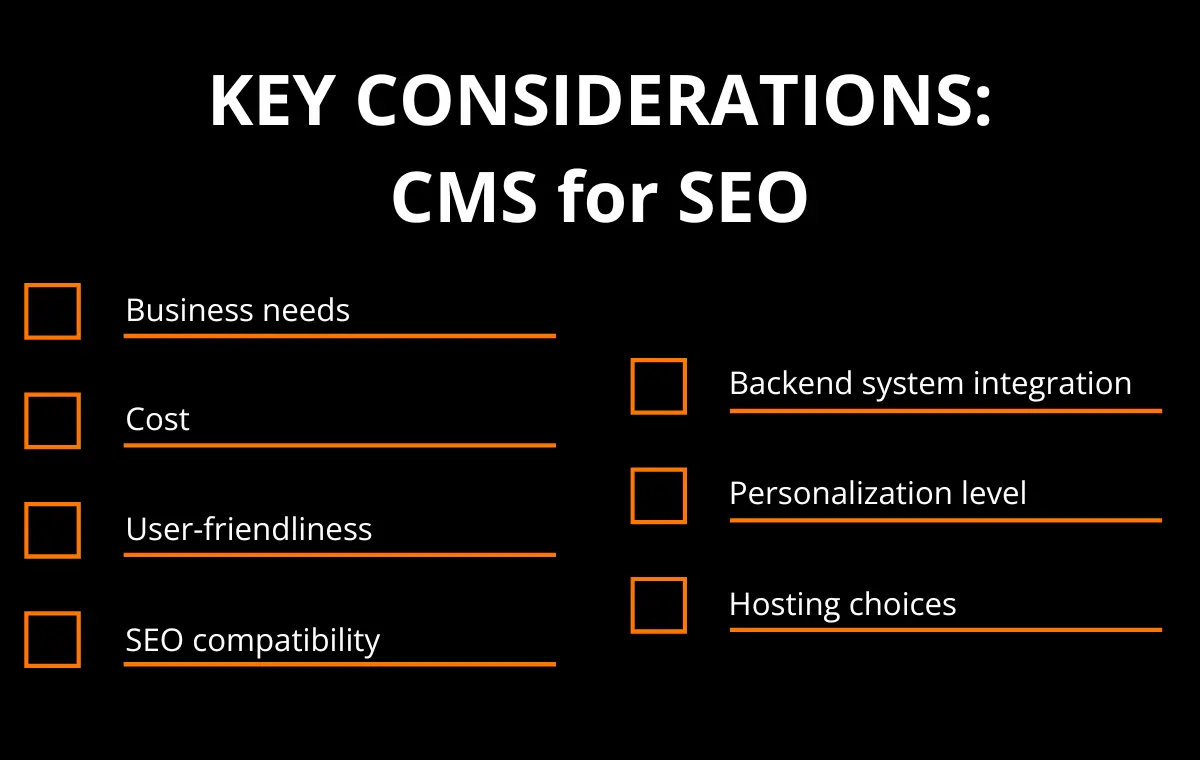
### You Need Control Over On-Page Elements
Here’s the non-negotiable: you need to easily edit page titles, H1 tags, meta descriptions, URLs, and image alt text. If your CMS makes this difficult, you’re starting with a handicap.
WordPress and Wix both handle this well. You can edit these elements directly from the page editor without touching code. Some platforms bury these settings in confusing menus or, worse, don’t give you full control at all.
If you’re evaluating a CMS, create a test page and try editing these elements. If it takes more than a few clicks or [requires developer help](https://www.wearetg.com/services/wordpress-web-design-agency/), that’s a red flag.
### Internal Linking Shouldn’t Be a Pain
Internal links help search engines understand your site structure and help users find related content. Your CMS should make this straightforward, not a manual nightmare. WordPress plugins like Internal Link Juicer and Yoast SEO Premium can automate suggestions and help you build a logical site structure. If you’re manually hunting for URLs to link to every single time you publish, you’ll either skip it (bad for SEO) or waste hours on busy work.
### Built-In Tools Save Time
The difference between a CMS with good SEO support and one without is night and day. Built-in tools or solid plugin ecosystems mean you can handle keyword research, meta tag management, and performance tracking without juggling multiple external tools.
## The Top CMS Platforms for SEO in 2025

### WordPress
WordPress runs 64.2% of all CMS websites, and for good reason. It’s incredibly flexible for SEO. Between Yoast SEO, Rank Math, and dozens of other plugins, you can control virtually every aspect of on-page and technical SEO.
The catch? WordPress requires maintenance. You need to keep plugins updated, choose a good hosting provider, and [pick an SEO-optimized theme](https://www.wearetg.com/blog/template-website-custom-website/) (Astra and Genesis are solid choices). But if you’re willing to invest a little time learning it, WordPress gives you more SEO control than almost any other platform.
### Drupal
Drupal is overkill for most small businesses, but for large sites with complex needs, it’s powerful. It handles clean URLs, meta tags, and sitemaps natively. Modules like Schema.org and Real-time SEO add advanced functionality.
The downside? Drupal has a steep learning curve. You’ll likely need a developer, which means it’s expensive. But for enterprise sites, government sites, or anyone with strict compliance requirements, Drupal delivers.
### Webflow
Webflow is what happens when designers build a CMS. It’s visual, intuitive, and handles SEO fundamentals well (custom meta tags, alt text, auto-generated sitemaps.) The best part? You can create sophisticated, custom designs without writing code, and everything stays SEO-friendly. If you care about design and want built-in SEO without wrestling with WordPress themes, Webflow deserves a serious look.
### Squarespace
Squarespace is genuinely user-friendly. Templates are designed with SEO in mind, automatic sitemaps work out of the box, and SSL comes standard. It’s a good choice for small businesses and creatives who want something that just works.
The limitation? Less flexibility than WordPress. You can’t add custom plugins or deeply customize technical SEO settings. For many people, that’s actually a feature—less complexity means fewer ways to break things.
### Adobe Commerce (Magento)
If you’re running a serious e-commerce operation, Adobe Commerce (formerly Magento) gives you powerful SEO tools built for online stores. All the [site features you’ll need](https://www.wearetg.com/blog/website-features/) are there, like metadata management, custom URLs, canonical tags, and structured data for products.
Fair warning: Magento is complex and expensive. You need developers to run it properly. But if you’re doing significant e-commerce volume, the investment pays off in better rankings and more control.
### Shopify
[Shopify makes e-commerce SEO accessible](https://www.wearetg.com/blog/shopify-seo/). You can customize metadata, create clean URLs, add alt text to product images, and manage redirects without technical knowledge. XML sitemaps generate automatically.
It’s not as powerful as Magento, but it’s exponentially easier to use. For most online stores, especially those just starting out, Shopify strikes the right balance between functionality and simplicity.
### WooCommerce
WooCommerce isn’t technically a CMS, it’s a WordPress plugin that turns your site into an e-commerce store. But it’s worth mentioning because it’s free, incredibly flexible, and gives you all of WordPress’s SEO advantages for e-commerce. The honest downside? Compared to Shopify, [WooCommerce sites require more maintenance](https://www.wearetg.com/blog/woocommerce-vs-shopify/). You’re managing hosting, security, updates, and compatibility between plugins. If something breaks, you’re troubleshooting it. For businesses with technical resources or agencies managing their site, that’s fine. For solo entrepreneurs who just want to sell products without thinking about server configs, Shopify’s simplicity wins.
### Wix
Wix has come a long way from its early days, when it was terrible for SEO. Modern Wix handles the basics well; mobile optimization, customizable metadata, different layouts, etc.
The Wix SEO Wiz walks beginners through optimization step-by-step. If you’re not technical and want something that holds your hand, Wix works. Just know you’re trading some power and flexibility for that simplicity.
### HubSpot CMS
HubSpot CMS is built for marketers who want everything in one place—CMS, CRM, marketing automation, and SEO tools all integrated. No hunting for plugins or managing multiple systems.
The trade-off is cost. HubSpot isn’t cheap. But if you’re already using HubSpot for marketing and sales, the CMS makes sense. Everything talks to everything else, which means less manual work and better data.
## Advanced Features That You’ll Want
As Google’s algorithm gets more sophisticated, you need more than just keywords and meta descriptions. Here’s what separates good SEO platforms from great ones in 2025.
### Structured Data Markup
Structured data helps Google understand what your content actually is—a recipe, a product, a review, an event. This can get you rich results in search: star ratings, prices, images, FAQs appearing directly in search results.
Platforms like Drupal, Wix, and Hygraph let you add structured data without touching code. If your CMS doesn’t support this easily, you’re missing out on visibility.
### Mobile Optimization
Google indexes the mobile version of your site first. If your mobile experience is broken, your rankings suffer. WordPress and Joomla both make it straightforward to build mobile-responsive sites. Most modern themes handle this automatically, but always test on actual phones, not just desktop browser windows resized to look like phones.
### Page Speed Optimization
Slow sites rank worse and lose visitors. Google cares about Core Web Vitals—real metrics measuring load speed, interactivity, and visual stability.
Drupal, Storyblok, and Wix include tools to improve speed: image compression, caching, lazy loading. But honestly? Your hosting provider matters as much as your CMS here. Fast hosting plus a decent CMS beats slow hosting plus the “fastest” CMS every time.
## Essential Plugins & Extensions
### Yoast SEO for WordPress
Yoast SEO is practically mandatory if you’re on WordPress. It analyzes your content as you write, checks readability, suggests improvements, and now uses AI to help write meta descriptions.
The free version handles basics. Premium adds internal linking suggestions, redirect management, and more advanced features. Either way, Yoast makes SEO approachable for non-experts.
### SEO Suite for Magento
SEO Suite Ultimate handles the technical stuff Magento doesn’t do natively: automated XML sitemaps, robots.txt generation, and AI-powered meta tag creation.
It’s expensive, but if you’re already invested in Magento, it’s worth it. The time saved on technical SEO tasks pays for itself quickly.
### Semrush Integration
Integrating Semrush with your CMS gives you keyword data, backlink analysis, and competitor insights right where you’re working. Instead of bouncing between tools, you see SEO data in context.
Not everyone needs this level of analytics, but if you’re serious about SEO, Semrush integration is worth the investment.
## Building Your SEO Strategy Around Your CMS

### Keyword Research Still Matters
You need to know what people are actually searching for. Tools like Semrush, Ahrefs, and even HubSpot’s built-in keyword tool show you search volume, difficulty, and related terms.
Focus on long-tail keywords (longer, more specific phrases) along with broader terms. [Long-tail keywords are easier to rank](https://www.wearetg.com/blog/long-tail-vs-short-tail-keywords/) for and often convert better because they match specific user intent.
### Content Optimization Is About People First
Write for humans, then optimize for search engines. That means clear writing, logical structure, and relevant keywords worked in naturally (not awkwardly stuffed into every paragraph.)
Include keywords in your title, H1 tag, first paragraph, meta description, and URL. But more importantly, answer the actual question someone’s asking when they search that term.
### Track What Matters
Google Analytics and Google Search Console show you what’s working. Watch organic traffic, bounce rate, time on page, and which keywords drive traffic.
## Common Problems Your CMS Should Solve
A good CMS prevents these issues. A bad one creates them.
### Duplicate Content
Multiple URLs showing the same content confuses search engines and dilutes your rankings. Your CMS should handle canonical tags automatically, telling Google which version to index.
Most modern platforms do this, but always check. Creating duplicate content accidentally is easier than you think.
### Clean URL Structure
URLs should be readable and descriptive: **/blog/website-cms-seo** not **/page?id=12345&category=blog**. Drupal’s Pathauto module, WordPress’s permalink settings, and most modern CMS platforms generate clean URLs by default. If you’re looking at a CMS that doesn’t, walk away.
### 301 Redirects
When you move or delete pages, 301 redirects tell search engines where the content went. Without them, you get 404 errors, lose link value, and frustrate users.
Wix’s redirect manager and Drupal’s redirect module make this straightforward. WordPress plugins like Redirection handle it easily. Don’t use a CMS that makes redirects difficult.
## So, What’s the Best CMS for SEO?
At the end of the day, there’s no universal “best” CMS for SEO — just the best one for your situation. WordPress offers the most flexibility and control. Shopify and Wix trade some power for simplicity. Drupal and Adobe Commerce handle enterprise complexity. Focus on platforms that make optimization straightforward, give you control over on-page elements, and support the tools and plugins you need to rank.
---
#### Choose a CMS That Supports Your SEO — Not One You’ll Outgrow
The wrong platform can slow your site down, limit your optimization control, and create technical headaches that hold your rankings back. The right one makes on-page SEO, technical updates, and long-term growth straightforward.[ **Schedule a 30-minute consultation** ](https://www.wearetg.com/contact/)with Timmermann Group to evaluate your current platform or plan your next CMS move with SEO built in from day one.
[](https://www.wearetg.com/contact)
---
## Frequently Asked Questions
### What should I look for in a CMS for SEO?
Look for easy control over page titles, meta descriptions, URLs, and alt text. Strong internal linking capabilities and good plugin support matter too. These directly affect whether you can actually optimize your site or constantly fight your CMS.
### Which CMS is best for SEO in 2025?
WordPress, Drupal, Webflow, Squarespace, Adobe Commerce, Shopify, Wix, and HubSpot CMS all handle SEO well. The “best” one depends on your technical skill, budget, and business needs—not just raw SEO features.
### Why does mobile optimization matter for SEO?
Google ranks sites based on their mobile version, not desktop. If your mobile site is slow or broken, your rankings tank across all devices. Most web traffic comes from phones now anyway.
### How do SEO plugins like Yoast help?
They analyze your content as you write and catch SEO issues before you publish—missing meta descriptions, weak keyword usage, readability problems. It’s like having an SEO expert looking over your shoulder.
### What does Semrush integration actually do?
It brings keyword data, backlink analysis, and competitor insights directly into your CMS workflow. Instead of jumping between tools, you see SEO metrics where you’re actually working.
**Categories:** SEO
---
### [Informational Keywords vs. Transactional Keywords: Why Traffic Alone Won’t Pay the Bills](https://www.wearetg.com/blog/informational-keywords-v-transactional-keywords/)
**Published:** October 15, 2024
**Author:** Rob Timmermann
**Content:**
When it comes to [Search Engine Optimization](https://www.wearetg.com/services/seo/) (SEO), many businesses measure success by how much traffic their website receives. After all, a surge in visitors must mean your strategy is working, right? Well, not exactly. While traffic is an important metric, it’s not the ultimate goal—revenue is. And not all traffic is created equal.
If your SEO strategy focuses solely on informational keywords—those designed to educate and build awareness—you may see a boost in visitors, but this traffic alone doesn’t pay the bills. What truly moves the needle are transactional keywords, those tied to purchase intent.
These are the searches made by people who are ready to take action—whether that’s making a purchase, scheduling a consultation, or requesting a quote. Transactional keywords are directly linked to revenue generation, which is why they need to play a central role in your SEO strategy.
### What Are Informational Keywords?
Informational keywords are search terms people use when they’re in the research phase of the buyer’s journey. They’re looking for information, solutions to problems, or answers to questions, not necessarily ready to make a purchase. Common examples include searches like “how to fix a leaky faucet” or “best SEO practices for small businesses.” These searches signal curiosity and interest but rarely immediate intent to buy.
While informational keywords are essential for attracting top-of-the-funnel traffic and establishing your brand as an authority, they often don’t lead directly to conversions. Their value lies in building awareness and trust with your audience, which can ultimately support future sales—but that process takes time.
### What Are Transactional Keywords?
On the other hand, transactional keywords are used by individuals who are much further along in the buyer’s journey. They are ready to act. These search terms are often paired with words like “buy,” “order,” “schedule,” or “consultation,” indicating high intent. For example, searches like “buy kitchen faucet online” or “SEO service pricing” show a clear readiness to make a decision.
Traffic driven by transactional keywords tends to convert at a much higher rate because these visitors are already primed to take action. They’ve done their research, and now they’re looking for the best option to meet their immediate needs. This is where the revenue-generating potential of your website truly comes into play.
### Finding the Balance
The key to a successful SEO strategy isn’t choosing between informational and transactional keywords, but knowing how to balance both. Informational keywords are valuable for bringing in a wide audience and nurturing long-term relationships. They help to establish your credibility and educate potential customers about the solutions you offer.
However, if your SEO strategy leans too heavily on informational keywords, you’ll see lots of visitors but fewer conversions. That’s why transactional keywords should always be prioritized for driving immediate revenue. By strategically targeting these high-intent terms, you can ensure that your SEO efforts not only attract traffic but also convert visitors into paying customers.
### Focus on What Moves the Needle
A well-rounded SEO strategy needs to prioritize both types of keywords. Informational content builds the foundation of your brand’s digital presence, but it’s the transactional keywords that convert awareness into action and ultimately drive revenue. By keeping a close eye on the terms that lead to sales, consultations, or inquiries, you can ensure your SEO strategy is moving the needle where it matters most—your bottom line.
In SEO, traffic is great, but conversions are better. Prioritizing transactional keywords ensures your traffic isn’t just numbers on a page—it’s real, revenue-driving business.
---
#### Stop Chasing Traffic. Start Targeting Revenue.
Informational traffic builds awareness, but transactional intent drives revenue. If your website is attracting visitors without generating quotes, consultations, or purchases, your keyword strategy may be misaligned with your business goals.[ **Schedule a 30-minute consultation** ](https://www.wearetg.com/contact/)with Timmermann Group to evaluate your keyword mix and build an SEO strategy that turns high-intent searches into measurable leads and revenue.
[](https://www.wearetg.com/contact)
**Categories:** SEO
---
### [Toxic Backlinks: What Are They & Should You Delete Them?](https://www.wearetg.com/blog/toxic-backlinks/)
**Published:** May 2, 2025
**Author:** Rob Timmermann
**Content:**
Toxic backlinks are links from other sites that harm your website’s search engine optimization (SEO). Knowing how to detect and fix them is considered by many to be of vital importance. This article will debunk common myths about toxic backlinks, explain what they are, and provide guidance on how to handle them properly.
### Key Takeaways
- Toxic backlinks, also known as bad backlinks, are links from external websites that negatively impact a website’s search engine rankings because search engines view these links as low-quality or in violation of their guidelines.
- Involuntary “spammy” backlinks are not considered as toxic as they once were and are often not considered toxic at all. Truly toxic backlinks come from manipulative or malicious practices.
- Toxic backlinks negatively impact SEO by triggering penalties from search engines, making it crucial to identify and remove them promptly.
### Understanding Toxic Backlinks
Backlinks from external sources that are toxic have a detrimental effect on the search engine ranking and online reputation of a website. In contrast to spammy links, which may not always harm your rankings, truly toxic backlinks are those generated with the sole intent of manipulating search engine results. These stem from negative SEO practices such as paid links or extensive link trading activities that could lead to sanctions or reductions in rank due to algorithmic actions by Google.
Google has become increasingly adept at distinguishing between simple spam and deliberately manipulative links. While it may overlook spammy links, harmful ones carry more weight because they suggest non-compliance with search engine guidelines, potentially leading to a decrease in organic visibility. An association with spam-filled sites can damage your site’s reputation, according to John Mueller from Google, who underscores the need to deal proactively with such concerns.
Efforts to identify toxic links are crucial for protecting your website’s integrity and maintaining its search engine positioning. A thorough backlink audit provides the opportunity for early detection and correction of harmful connections before they negatively impact both trustworthiness and SEO performance.
### Sources of Toxic Backlinks
Backlinks considered toxic typically originate from questionable sources that aim to artificially influence search engine rankings. Link farms, which exist purely to interlink within their network for the sake of SEO gains, can become a serious detriment if recognized by search engines due to their inclusion of unnatural or poor-quality links.
Private Blog Networks (PBNs) can be another source of toxic backlinks from linking sites. They constitute a negative SEO practice, violating Google’s guidelines and risking incurring significant penalties. PBNs are composed of various sites under a single ownership, creating cross-links among themselves to elevate their standing in search results artificially. The short-lived advantages they might provide do not compensate for the substantial long-term risks involved.
Employing manipulative methods to bolster a backlink profile, such as comment spamming, purchasing links, or engaging in excessive link swapping, can result in acquiring harmful and toxic backlinks that compromise your site’s reputation. These approaches constitute what is termed ‘link spam’ by search engines and may result in punitive measures that are detrimental to both your website’s placement in searches and its ability to receive organic traffic.
### Identifying Toxic Backlinks
It’s essential to identify and manage toxic backlinks to avoid penalties and maintain a robust SEO profile. These unnatural links can be identified in two ways: by employing specialized tools or by resorting to manual detection tactics, each approach presenting unique advantages and drawbacks.
SEO tools like Ahrefs and SEMRush can streamline the discovery of potentially harmful links by utilizing proprietary algorithms that highlight questionable links. It is essential to interpret their findings judiciously to avoid mistakenly classifying benign backlinks as harmful.
Conversely, the process of manual identification demands an active examination where each backlink is scrutinized individually in terms of its quality and relevance.
#### Using a Toxic Backlink Checker
Leveraging a backlink audit tool, such as the one provided by SEMRush, can significantly simplify the process of detecting toxic backlinks. These SEO tools provide the functionality to organize and sift through your site’s backlinks using various criteria, which assists you in identifying those detrimental links that require immediate action. They even offer a calculated toxicity score for each link that serves as an indicator of potential harm.
Nevertheless, it’s important to recognize that these automated tools are not foolproof. They might incorrectly flag link spam as toxic. To avoid mistakenly discarding beneficial backlinks, it is advisable to supplement the use of these automated tools with a thorough manual inspection.
Employing a toxic backlink checker can expedite both discovery and categorization tasks related to harmful links, thus enabling prompt remedial measures before any significant damage is done to your website’s search engine optimization (SEO) performance.
#### Manual Identification Techniques
For manual identification of incoming links, start the process by utilizing resources such as Google Search Console to review and scrutinize your backlinks thoroughly. Begin this task by extracting a roster of sites that link to you from Google Search Console and proceed to appraise each backlink. The reports concerning Backlink Analysis and Anchors within Google Search Console will be exceptionally helpful.
When conducting a manual review, gauge the caliber of each site that links to yours. Be on the lookout for indicators such as low-quality links, insufficient domain authority, unrelated content, or an excessive number of outbound links – all possible signs of substandard practices among linking sites. A sudden increase in backlinks or a recent formation of backlinks may also indicate attempts at manipulative tactics.
Although time-intensive, manual evaluation offers unparalleled accuracy when compared to automated systems. It ensures meticulous discrimination between harmful and harmless backlinks, aiding in purging only genuinely detrimental ones while maintaining the integrity of your website’s overall portfolio of quality links.
### Effects of Toxic Backlinks on SEO
Accumulating a high number of toxic links in a website’s backlink profile is an negative SEO practice that can result in severe penalties that negatively impact your online visibility. Search engines, such as Google, employ advanced detection techniques to identify and penalize websites that harbor an excessive number of bad backlinks. These repercussions can lead to a significant decline in search engine rankings and are implemented through either automatic demotion by algorithms or manual sanctions resulting from a review conducted by Google staff.
The accumulation of unnatural links may also suggest that your website is questionable or substandard, which could deter user interaction and increase exit rates on your site, both of which are detrimental to your SEO health. In severe scenarios, these low-quality links may even result in complete exclusion from search engine results pages (SERPs), rendering your site virtually invisible to potential visitors.
The existence of all these toxic backlinks undermines the perceived integrity and reliability of your website, both for users and search engines. This erosion of trust triggers a domino effect: plummeting rankings, followed by diminished organic traffic flow, ultimately resulting in negative SEO that affects every aspect of your digital presence.
### How to Remove Toxic Backlinks
While certain amounts of link spam are just a fact of life, it is important for the well-being of your website and its search engine optimization to eliminate harmful backlinks. This typically involves a two-step process that includes soliciting site owners to remove links, followed by employing Google’s disavow tool if needed.
Initially, you should reach out to the website owner to request that the undesirable link be removed before resorting to Google’s disavow option. In cases where there is no response from the site owner or they decline your request for link removal, creating a file with a list of URLs or domains for Google to disregard, known as a disavow file, and submitting it via the Disavow Links tool provided by Google serves as an alternative solution.
#### Requesting Link Removals
Start by reviewing the website’s backlink profile and collecting a list of toxic links. Begin removing the toxic backlinks by contacting websites to request link removal. Arrange the inks by Toxicity Score from highest to lowest (if using a tool), find the contact details for the referring domain with the most toxic link first, and reach out to the owner or administrator.
When contacting site owners, be polite and clear about your request. Explain why you need the link removed and, if applicable, suggest an alternative, such as changing the link to a nofollow link. Tools like SEMRush can simplify this process.
For backlinks acquired through agreements, contact your partners or clients to request the removal of links or the addition of nofollow links. If toxic backlinks persist for several weeks, consider disavowing links to protect your SEO.
#### Disavowing Links
Turning to the disavowal of backlinks is viewed as a measure of last resort to ward off the negative SEO effects attributed to toxic links. To generate a disavow list, one would compile URLs or domains into a text document that directs Google’s disavow tool to disregard these particular toxic links. This disavow file can then be submitted through Google’s Disavow Links interface, and it typically takes around 48 hours for Google to process this information. It is crucially important for you to consider removing any backlinks from your profile that could potentially damage your website’s standing.
When proceeding with the process of disavowing links, exercise extreme caution to avoid inadvertently compromising beneficial backlinks, as such missteps can lead to unintended negative repercussions on those valuable connections. The careful upkeep and revision of your list can help diminish the negative effects of unnatural links, while rejuvenating your site’s overall SEO. Nevertheless, vigilance must be exercised. Confirm that only definitively toxic links are targeted for exclusion via the disavowal process to avoid unnecessary trouble.
### Preventing Future Toxic Backlinks
Conducting regular reviews of your backlink profile is critical for preserving the SEO well-being of your site. By keeping a close watch on the links you acquire, you can pinpoint and address toxic links before they inflict damage. Maintaining a log of all correspondence related to link removal can aid in tracking your proactive measures.
Fostering authentic connections with fellow website owners may be beneficial in steering clear of hazardous backlinks. While exchanging links could incur search engine sanctions when overdone, it’s imperative to ensure that any links built are done organically. Steer clear of employing automated bots for link building since these typically yield low-quality or spam-ridden site backlinks.
The practice of designing widgets that incorporate automatic linking capabilities might lead to acquiring unwarranted attention from unrelated or dubious sources. Prioritize quality link-building strategies instead and refrain from resorting to submissions within low-tier directories. Such actions can potentially compromise both your site’s reputation and its backlink integrity.
### Strengthening Your Backlink Profile
It’s crucial to focus on acquiring high-quality links in order to augment and refine your healthy backlink profile, as well as bolster the overall strength of your backlink profile. Producing excellent content, such as infographics or comprehensive guides, has a strong potential for drawing valuable links towards you. Adopting outreach strategies that involve leveraging resource pages can help secure desirable backlinks by offering your content for inclusion.
Enhancing the authority of your site can be efficiently done by transforming unlinked brand mentions into actual backlinks. With the ‘Moving Man Method,’ it is possible to leverage outdated links that point elsewhere and recommend replacing them with updated content from your site. Engaging authentically within communities and contributing meaningfully to discussions tends to yield better results than trying to aggressively insert links during conversations.
### Summary
To summarize, harmful backlinks in a website’s backlink profile can significantly harm its search engine optimization, trustworthiness, and overall online reputation. Recognizing what constitutes toxic backlinks, doing a backlink audit to pinpoint their origins, and implementing measures to eliminate them are crucial steps in protecting your site from penalties and improving its search engine rankings. It is vital to examine your backlink profile and consistently create high-quality links, as these actions are integral to maintaining a sound SEO status.
It is essential to note that ‘spammy’ backlinks that a website did not intentionally acquire are often disregarded by Google when determining what constitutes a toxic backlink. While spammy links are not a positive indicator, Google continues to improve its ability to distinguish unwanted external links from manipulative backlinks.
Adhering to the tactics recommended in this guide will help protect your website from damaging backlinks while enhancing its long-term relevance. Keep in mind that being proactive with backlink management strategies, paired with quality link building, forms the cornerstone of an effective SEO approach.
---
#### Protect Your SEO Without Overreacting to Every “Toxic” Link
Not every suspicious-looking backlink deserves a disavow. The real risk comes from manipulative link schemes and ignored manual penalties — not random spam you didn’t ask for. Before deleting or disavowing links that could impact your authority, it’s important to audit strategically and understand what’s truly harming your rankings.[ **Schedule a 30-minute consultation** ](https://www.wearetg.com/contact/)with Timmermann Group to review your backlink profile and build a smarter link strategy that protects and strengthens your long-term SEO performance.
[](https://www.wearetg.com/contact)
---
### Frequently Asked Questions
#### What are toxic backlinks?
Toxic backlinks, also known as bad backlinks, are links from external websites that negatively impact a website’s search engine rankings because search engines view these links as low-quality or in violation of their guidelines.
Preserving the credibility of your site necessitates the identification and rejection of these harmful links.
#### How can I identify toxic backlinks?
To identify toxic backlinks, utilize tools such as SEMRush and Ahrefs, or conduct a manual review with data from Google Search Console.
These methods will help you pinpoint and address harmful links effectively.
#### What should I do if I find toxic backlinks?
If you find genuinely toxic backlinks, start by contacting the site owner to request their removal.
If that does not work, utilize Google’s Disavow Links tool to eliminate the negative impact on your site.
#### How do toxic backlinks affect my SEO?
Harmful backlinks can severely damage your SEO efforts, resulting in penalties that lower your search rankings and reduce the flow of organic traffic.
To safeguard the well-being and visibility of your site, it’s essential to consistently conduct audits for these toxic links and take steps to disavow them.
#### How can I prevent future toxic backlinks?
To prevent future toxic backlinks, regularly audit your backlink profile and foster genuine relationships with other website owners, while steering clear of risky link-building practices.
This proactive approach will help maintain a healthier online reputation.
**Categories:** SEO
---
### [HVAC SEO: Boost Your Business with the Best SEO Strategies](https://www.wearetg.com/blog/hvac-seo/)
**Published:** May 16, 2025
**Author:** Rob Timmermann
**Content:**
HVAC SEO can help by improving your website’s visibility on search engines. This article covers essential HVAC SEO strategies like keyword research, content optimization, and technical tweaks tailored for the HVAC industry.
## Key Takeaways
- HVAC SEO is essential for tailored visibility, targeting industry-specific challenges to generate high-quality leads and boost sales.
- Key components of a successful HVAC SEO strategy include keyword research, optimized content creation, and high-quality backlink building, all improving search engine rankings.
- Local SEO tactics, such as optimizing Google Business Profiles and generating positive online reviews, significantly enhance local search visibility for HVAC businesses.
## Understanding HVAC SEO
[HVAC SEO services](https://www.wearetg.com/industry/hvac-seo-company/) are tailored to cater to the distinct requirements of heating, ventilation, and air conditioning businesses within the HVAC industry. These specialized SEO services enhance an HVAC business’s visibility in search results over traditional SEO methods that might not tackle particular challenges faced by this industry. This targeted approach generates increased phone calls and leads for companies operating in air conditioning and related sectors.
### What is HVAC SEO?
HVAC SEO is the combination on-page, off-page, and technical improvements for websites tailored to the needs of HVAC companies. HVAC SEO services emphasize lasting search engine rankings, with strategies primarily focused on ranking for keywords with commercial intent that prospects might use when searching for HVAC businesses.
To ensure an edge over competitors, this process starts with a thorough SEO audit designed to evaluate and enhance existing plans within HVAC companies’ existing marketing strategies and search engine optimization practices. As important as SEO is, it is just one section of an [effective marketing strategy](https://www.wearetg.com/blog/marketing-strategy/).
### Importance of HVAC SEO for HVAC Companies
HVAC companies can achieve significant growth by creating high-quality leads through HVAC SEO. By improving their website rankings, they become more visible to potential clients actively seeking HVAC services.
An effective HVAC SEO marketing strategy employs robust SEO strategies that elevate visibility, draw in additional customers, enhance lead generation, and consequently drive up sales and revenues for the company. Increasing keyword visibility widens a company’s search reach, allowing it to engage with more prospective customers.
### Differences Between HVAC SEO and Traditional SEO Services
SEO services designed for HVAC businesses provide custom solutions aimed at the heating, ventilation, and air conditioning industry. These specialized offerings include both on-page and off-page SEO tactics specifically curated to meet the distinct demands and hurdles that may not be covered by general SEO strategies.
## Key Components of a Successful HVAC SEO Strategy
To achieve a triumphant HVAC SEO strategy, it’s essential to focus on various critical aspects, including conducting thorough keyword research, producing optimized SEO content, and developing high-quality backlinks. These components are vital in enhancing the search visibility of your HVAC website and attracting relevant traffic.
### Keyword Research for HVAC SEO
Effective SEO strategies for HVAC businesses start with comprehensive keyword research. It’s essential to pinpoint the keywords potential clients use in their searches when crafting an SEO strategy specifically tailored for HVAC services. Utilizing instruments such as Ahrefs and Semrush, one can confirm the viability of chosen keywords by evaluating critical data points, including search volume and competitive landscape.
Selecting keywords that are highly likely to convert visitors into customers, exemplified by terms like ‘Dallas AC Repair,’ is imperative for accurately aligning your strategy with user needs. By assigning these relevant keywords to distinct URLs, HVAC companies can enhance their content and meta tags precision, thereby elevating their visibility within search rankings.
### Creating SEO Optimized Content for HVAC Websites
Crafting top-tier content is pivotal for the triumph of HVAC SEO strategies. By developing material that meets customer requirements, HVAC businesses boost their search visibility and build trust and interaction with their audience. This can be achieved through various forms of media such as [blogs](https://www.wearetg.com/services/blogging/), instructional manuals, current events articles, visual content like videos, and infographics to captivate their target market.
With the Helpful Content Update highlighting the importance of generating truly beneficial material for consumers, it’s crucial for HVAC companies to focus on creating value-driven content. Optimizing technical aspects like image compression and reducing excessive coding are key actions that improve website loading speeds—a vital factor in maintaining user interest and engagement on HVAC websites.
### Building High-Quality Backlinks
Backlinks act as a stamp of approval for the authority and quality of a website, playing a vital role in influencing rankings on search engines. When HVAC websites acquire high-quality backlinks, their perceived trustworthiness is enhanced, leading to improved positions on search engine results pages and an uptick in organic traffic.
Creating useful assets such as tools or infographics can effortlessly draw in backlinks, naturally enhancing the site’s appeal.
## On-Page SEO Techniques for HVAC Contractors
Optimizing elements such as title tags, headers, internal links, and meta descriptions is critical to on-page SEO for HVAC contractors. By working with a trusted [contractor marketing agency](https://www.wearetg.com/industry/contractor-marketing-agency/) to implement these strategies, HVAC contractors can improve their click-through rates and search visibility, which in turn bolsters their overall SEO performance and enhances user experience.
### Optimizing Meta Tags and Descriptions
Meta descriptions, which are HTML attributes providing a synopsis of the content on a webpage, play a pivotal role in aiding users to discern the page’s subject matter. Integrating pertinent keywords within these meta descriptions can heighten visibility and boost initial click-through rates from search results. For HVAC SEO improvement, it is crucial to refine both meta descriptions and page titles to enhance click-through rates.
Page titles must be crafted with engaging and relevant keywords to attract clicks effectively. Optimizing such components aims to elevate website standings in search rankings and increase organic traffic flow.
### Using Headers and Keywords Effectively
Optimizing your website’s SEO performance can be significantly improved by strategically employing headers and keywords. Properly implementing H1, H2, and H3 tags bolsters SEO and augments the user experience through well-structured information presentation.
Incorporating pertinent keywords into headers and subheadings is crucial as it helps search engines index the page content appropriately.
### Internal Linking Strategies
By creating internal links with anchor texts rich in keywords, you make it easier for search engines to crawl your pages, discern their relevance, and improve the site’s SEO. This network of links establishes a structured hierarchy within your website, which enhances user navigation and enriches the overall experience.
## Off-Page SEO Strategies for HVAC Businesses
To elevate a website’s positioning on search engines, off-page SEO tactics focus on external influences such as obtaining backlinks, engaging with audiences on social media platforms, and garnering customer feedback. These methods are crucial in boosting brand recognition and attracting referral visits, which are key components for orchestrating a triumphant HVAC SEO campaign.
### Link Building for HVAC Companies
By writing guest blogs on pertinent websites, HVAC companies can markedly boost their exposure and obtain superior backlinks. Engaging in this approach not only improves the link profile but also allows for demonstrating industry knowledge while securing valuable backlinks.
Link building is crucial for HVAC companies aiming to bolster their online visibility and ascend search engine rankings. Adopting a robust strategy for guest blogging boosts authority and credibility — both of which are key to drawing in a greater number of potential clients.
### Leveraging Social Media Marketing
HVAC businesses can expand their brand awareness and increase website traffic through social media marketing. Platforms such as Facebook and Instagram are valuable digital marketing tools that allow for the posting of links to reach a broader audience.
By sharing content and engaging directly with customers, HVAC companies can enhance their SEO efforts via social media, Amplifying their online presence.
### Managing Online Reputation
HVAC companies rely heavily on customer feedback to maintain their online reputation and trustworthiness. Google boosts the visibility of HVAC reviews that include geo-locations, which can improve your business’s position in search results.
Utilizing tools such as Email & Text Clients allows businesses to easily direct customers to review sites, streamlining the process of leaving a review.
## Local SEO Tactics for HVAC Contractors
Neglecting local search optimization could mean that HVAC businesses miss out on potential customers who are specifically looking for HVAC services in their vicinity. By implementing local SEO strategies, an HVAC company can significantly improve its visibility within the local search results, especially when users make queries like ‘HVAC company near me’.
### Optimizing Google Business Profile
Securing and optimizing your Google Business Profile is vital for achieving triumph in local SEO. A meticulously enhanced profile dramatically enhances an HVAC company’s online presence and its ranking within local search results.
To elevate local SEO effectiveness for HVAC, fine-tuning your Google My Business listing is key, along with accruing affirmative reviews from customers, ensuring consistent local citations, and creating backlinks. Engaging services that are client-managed for local SEO can proficiently handle the management of a business’s presence in local searches.
### Generating Positive Local Reviews
Encouraging customers to post reviews on platforms such as Google Business Profile can substantially impact local SEO rankings and build trust with prospective clients, thereby improving local search visibility.
### Utilizing Local Citations and Directories
For HVAC companies aiming to improve their search rankings in local queries, ensuring that Name, Address, and Phone Number (NAP) are consistently and accurately listed across different directories is essential. Effective local SEO relies heavily on maintaining uniform NAP information throughout all online platforms.
## Technical SEO for HVAC Websites
Focusing on site speed, mobile optimization, and structured data is crucial for the backbone of an HVAC website’s performance known as technical SEO. Improving these technical elements directly impacts user engagement and increases the website’s overall visibility in search engine results.
### Improving Site Speed
Utilizing resources such as Google’s PageSpeed Insights can pinpoint precise opportunities to enhance the speed of a website, offering practical suggestions for improvement. For HVAC businesses striving to excel in a highly competitive environment, having a swift-loading website improves user experience and is critical for elevating their search engine standings.
### Mobile Optimization for HVAC Sites
Responsive design is crucial for HVAC websites because it allows them to adjust smoothly across different screen sizes, improving mobile users’ usability and boosting SEO performance. This is especially important since Google precedes mobile-friendly sites in its search rankings.
### Implementing Structured Data
By incorporating structured data, web content becomes more intelligible to search engines, which can enhance the visibility in search results by generating rich snippets. Similarly, utilizing schema markup enables search engines to grasp the content more effectively, thus improving its presence on search engine results pages (SERPs).
## Tracking and Measuring HVAC SEO Performance
Continuous monitoring and reporting on the performance of HVAC SEO services is crucial for enhancing search visibility, which in turn helps generate more leads and drive increased revenue from search results.
### Using Google Analytics for SEO Insights
Google Analytics offers critical insights into key SEO metrics that help HVAC businesses assess the success of their SEO strategies. It sheds light on website dynamics including traffic origins, user engagement, and bounce rates, thereby allowing these businesses to track their online performance accurately.
### Monitoring Search Rankings and Traffic
Consistently utilizing platforms such as SEMrush or Ahrefs can aid HVAC companies in tracking their keyword standings and evaluating variations in website traffic over time. These tools provide comprehensive analyses concerning search engine positions and the progression of web traffic, which is essential for perfecting SEO tactics.
### Analyzing ROI from HVAC SEO Efforts
Determining the return on investment (ROI) for HVAC SEO efforts involves contrasting the expenditure on SEO campaigns with the income accrued from augmented website traffic and resultant conversions. Over several months, ROI for such SEO campaigns in the HVAC sector can fluctuate between 678% to 800%.
## Common Mistakes to Avoid in HVAC SEO
Steer clear of frequent mistakes in HVAC SEO by prioritizing ethical strategies, remaining abreast of search algorithm updates, and acknowledging the significance of external factors. Eschewing black-hat SEO methods is crucial since they can result in harsh sanctions and harm your online reputation.
### Ignoring Local SEO
Neglecting local SEO could result in overlooking potential clients actively seeking HVAC services within their vicinity. Encouraging customers to leave reviews without compromising professionalism may significantly enhance the positive testimonials for HVAC services.
### Overlooking Mobile Users
Failing to adapt a website for mobile devices can lead to a subpar user experience, which often results in increased bounce rates and the potential loss of traffic and customers.
### Failing to Update Content Regularly
Regularly refreshed content can enhance search engine rankings since search engines have a preference for new and pertinent information. This practice draws in organic traffic by keeping up with the latest trends and user searches.
## Summary
Effective HVAC SEO strategies involve a combination of on-page, off-page, technical, and local SEO tactics. These strategies help HVAC companies improve their online visibility, attract more leads, and boost revenue. By avoiding common mistakes and continuously refining your approach, you can achieve a successful HVAC SEO campaign. Embrace these strategies and watch your HVAC business soar to new heights.
---
#### Turn HVAC SEO Into a Predictable Lead Engine
Ranking isn’t about vanity keywords. It’s about showing up for high-intent searches like “emergency AC repair” and “furnace replacement near me” — then converting that visibility into booked jobs. A strategic HVAC SEO plan combines local optimization, technical performance, content authority, and measurable ROI tracking.[ **Schedule a 30-minute consultation** ](https://www.wearetg.com/contact/)with Timmermann Group, an HVAC SEO marketing agency, to evaluate your current HVAC SEO strategy and turn smarter visibility into consistent leads and revenue growth.
[](https://www.wearetg.com/contact)
---
## Frequently Asked Questions
### What is HVAC SEO?
HVAC SEO is essential for boosting your business’s online visibility through targeted on-page, off-page, and technical strategies. By optimizing your HVAC website, you’ll attract more customers and stand out in search engine results!
### Why is HVAC SEO important for my business?
HVAC SEO is essential because it helps you attract more customers and generate high-quality leads, ultimately boosting your sales and revenue.
Embrace it to elevate your business success!
### How is HVAC SEO different from traditional SEO?
SEO tailored for the HVAC industry hones in on distinct tactics that address its individual challenges. Adopting this bespoke strategy can markedly enhance your online presence and success in drawing suitable clientele.
### What are the key components of a successful HVAC SEO strategy?
To achieve a successful HVAC SEO strategy, focus on thorough keyword research, create SEO-optimized content, and build quality backlinks.
Don’t forget to optimize your meta tags and descriptions while effectively using headers and internal linking to boost your visibility!
### How can I track and measure the success of my HVAC SEO efforts?
To effectively track and measure your HVAC SEO success, leverage tools like Google Analytics, SEMrush, and Ahrefs.
By monitoring your search rankings and user behavior, you can clearly see your progress and ROI!
**Categories:** SEO
---
### [HVAC Leads: Actionable Strategies for 2025](https://www.wearetg.com/blog/hvac-leads/)
**Published:** September 17, 2025
**Author:** Rob Timmermann
**Content:**
The HVAC industry is more competitive than ever, with HVAC contractors fighting for the same pool of customers in every market. Whether you’re a small local HVAC business or a growing commercial HVAC company, your success depends on one critical factor: generating a steady stream of qualified leads that convert into paying customers.
The challenge isn’t just about getting more leads; it’s about attracting high-quality leads that actually turn into profitable jobs. Too many HVAC companies waste time and money chasing low-quality prospects or relying on expensive lead generation companies that deliver shared leads with poor conversion rates.
In this guide, we’ll explore proven HVAC lead generation strategies that successful businesses use to dominate their local markets. From free methods that generate leads on autopilot to paid strategies that deliver immediate results, you’ll discover actionable tactics you can implement today to grow your customer base and increase revenue.
## Key Takeaways
- Generating HVAC leads in 2025 includes a mix of long-term strategies like local SEO, alongside paid advertising for immediate results.
- Exclusive leads convert far better than shared leads, making it crucial to prioritize lead quality over volume for long-term profitability.
- Optimizing your website, Google Business Profile, and content marketing builds trust and positions your HVAC company as the go-to local expert.
- Tracking metrics such as cost per lead, conversion rates, and customer lifetime value ensures your HVAC lead generation strategy stays profitable.
## Types of Leads and How to Get Them
In the HVAC industry, a lead represents a potential customer who has expressed interest in your HVAC services, whether that’s emergency AC repair, HVAC installation, routine maintenance, or commercial HVAC projects. These prospects might be homeowners with a broken air conditioning system, property managers seeking maintenance contracts, or businesses planning major HVAC upgrades.
Not all HVAC leads are created equal, though. Understanding the difference between lead types can make a significant difference in your marketing strategy and bottom line.
Shared leads are prospects sold to multiple HVAC contractors simultaneously. While these might seem cost-effective at $15-50 per lead, they typically convert at only 10-20% because you’re competing directly with other contractors for the same customer. The prospect often chooses based on price alone, which hurts your profit margins.
Exclusive HVAC leads, on the other hand, are prospects that only your HVAC company receives. Though they cost more ($45-300 per lead, depending on the source), they convert at much higher rates of 40-60%. When you’re the only contractor following up with a qualified lead, you can focus on value-based selling rather than competing on price alone.
The key insight for long-term business growth is that lead quality matters more than quantity. One exclusive, high-intent lead from a homeowner ready to replace their entire HVAC system is worth more than ten shared leads from price-shopping prospects. This is why the most successful HVAC businesses focus on generating high-quality HVAC leads through multiple channels rather than buying leads in bulk from third-party platforms.
## Free HVAC Lead Generation Strategies That Actually Work
The best lead generation approach combines both free and paid strategies, but free methods often deliver the highest ROI because they continue generating leads long after your initial investment. These organic strategies also tend to attract more qualified leads since prospects find you while actively searching for solutions.
### Optimize Your Google Business Profile for Maximum Visibility
Your Google Business Profile is often the first impression potential customers have of your HVAC company, especially for local searches like “emergency HVAC repair near me” or “AC installation \[city name\].” A fully optimized profile can dramatically increase your visibility in local search results and generate free HVAC leads consistently.
1. **Start with a complete profile setup** using accurate NAP (Name, Address, Phone) information across all online platforms. Consistency is crucial—any discrepancies between your website, Google Business Profile, and other directories can hurt your local seo rankings.
2. **Add specific HVAC service categories** that match what customers search for. Instead of just “HVAC contractor,” include detailed categories like “air duct cleaning service,” “commercial HVAC contractor,” “furnace repair service,” and “air conditioning installation.” This helps you appear for more specific searches that often have higher purchase intent.
3. **Upload high-quality photos regularly**, including before and after shots of HVAC installation projects, your service trucks with clear branding, team members in professional uniforms, and pictures of your clean, organized workspace. Photos humanize your business and build trust with potential customers browsing your profile.
4. **Respond to all customer reviews within 24-48 hours**, both positive and negative. Your response rate and quality affect your Google rankings, and prospects pay close attention to how you handle customer feedback. Thank customers for positive reviews and address concerns professionally in negative reviews.
5. **Post weekly Google Business updates** about seasonal maintenance tips, special offers, or educational content about air filters, air purifiers, and energy efficiency. These posts keep your profile active and provide value to potential customers researching HVAC services.
### Local SEO Optimization for HVAC Companies
Local search engine optimization, in addition to [traditional HVAC SEO strategies](https://www.wearetg.com/blog/hvac-seo-strategies/), is one of the most effective ways to generate HVAC leads because it captures customers at the moment they’re actively searching for HVAC services. SEO leads convert at 14.6% compared to just 1.7% for traditional outbound marketing methods.
1. **Target local keywords** that your ideal customers actually search for. Focus on terms like “HVAC repair \[city name\],” “emergency AC service near me,” “furnace installation \[city\],” and “commercial HVAC maintenance \[area\].” Use tools like Google’s Keyword Planner to identify the most searched terms in your service area.
2. **Create location-specific service pages** for each city or neighborhood you serve. Instead of one generic “HVAC Services” page, develop separate pages for “HVAC Repair in \[City A\],” “Air Conditioning Installation in \[City B\],” and “Commercial HVAC in \[City C\].” Each page should include local landmarks, service area maps, and testimonials from customers in that specific location.
3. **Build citations on local directories** like Yelp, Better Business Bureau, Angie’s List, and industry-specific platforms. Ensure your NAP information is identical across all platforms. Use tools like Moz Local or BrightLocal to audit your current citations and identify opportunities for new ones.
4. **Focus on earning backlinks** from local businesses, chambers of commerce, and industry associations. Partner with general contractors, real estate agents, and property management companies who can refer customers and link to your website.
A perfect example of successful local seo implementation is [Legacy Home Services](https://www.wearetg.com/portfolio/legacy-home-services/), whose comprehensive local optimization strategy resulted in significant increases in organic visibility and lead generation. Their approach focused on creating location-specific content and optimizing for local search intent, which is exactly what HVAC companies need to replicate. Consider hiring a professional [HVAC SEO company](https://www.wearetg.com/industry/hvac-seo-company/) to craft and implement a similar successful strategy for your organization.
### Content Marketing and Thought Leadership
Content marketing positions your HVAC business as the trusted expert in your market while attracting potential customers through search engines and social media marketing. Create helpful blog posts that answer common HVAC questions like “How often should I change my air filters?” or “Signs your commercial HVAC system needs repair.”
1. **Develop seasonal content calendars** that align with when customers need your services most. Spring content should focus on AC tune-ups and preparation for hot weather, while fall articles should cover furnace maintenance and heating system inspections. This approach captures customers when they’re most likely to need your hvac services.
2. **Write informative blog posts** about energy efficiency, indoor air quality improvements, new HVAC technologies, etc.. Topics such as smart thermostat installation, air purifier benefits, and energy-saving tips appeal to homeowners seeking ways to enhance their comfort and reduce their utility bills.
3. **Share your expertise** through local newspaper guest articles, community newsletters, and participation in local business events. When you become known as the local HVAC expert, referrals and direct inquiries increase naturally.
4. **Comment thoughtfully on industry blog posts and forums** where your potential customers might be researching HVAC topics. This builds your online reputation and can drive traffic back to your HVAC website.
### Referral Programs and Customer Retention
Your existing loyal customers are your best source for new HVAC leads. A well-structured referral program can generate high-quality prospects who already trust your services based on personal recommendations.
- Implement referral rewards that provide meaningful value to both the referring customer and the new prospect. Offer $50-100 service credits, discounts on future maintenance, or cash rewards for successful referrals that result in completed service calls or installations.
- Research shows that a 5% increase in customer retention can boost profits by over 25%, making existing customer nurturing crucial for sustainable growth. Create automated email marketing campaigns that send seasonal service reminders, maintenance tips, and special offers to past customers.
- Train your sales team and technicians to ask satisfied customers for referrals during service calls. The best time to request referrals is immediately after completing excellent work, when customer satisfaction is highest. Provide business cards or referral cards that customers can easily share with friends and neighbors.
- Develop loyalty programs that reward repeat business and encourage long-term relationships. Offer annual maintenance contracts with priority scheduling, discounted service calls, and exclusive access to new services like smart home HVAC integration.
## Paid HVAC Lead Generation Options
While free strategies build long-term success, paid HVAC lead generation can deliver immediate results when you need to increase your customer pipeline quickly. The key is choosing the right paid channels based on your budget, service area, and target customer type.
### Google Ads and Pay-Per-Click Advertising
Google search ads target high-intent customers actively searching for HVAC services right now. When someone searches “emergency HVAC repair” or “AC installation quotes,” they’re ready to hire a contractor immediately, making these some of the most valuable keywords in the HVAC industry.
- **Target high-intent keywords** that indicate immediate need: “emergency HVAC repair,” “broken AC repair,” “furnace replacement,” and “commercial HVAC service.” These searches typically convert better than general terms like “HVAC company” because the prospect has a specific, urgent need.
- **Set up location-based campaigns** within your actual service radius to avoid wasting budget on prospects outside your coverage area. Use Google’s radius targeting feature to focus your ads on specific cities, ZIP codes, or mile radiuses from your business location.
- **Create compelling ad copy** that highlights your competitive advantages: 24/7 emergency service, licensed and insured technicians, free estimates, or financing options. Include strong calls-to-action like “Call Now for Same-Day Service” or “Get Your Free Quote Today.”
- **Use call extensions and location extensions** to make it easy for mobile users to contact you directly from the search results. Since many HVAC searches happen on mobile devices, especially emergency searches, these extensions can significantly improve your click-through and conversion rates.
- **Monitor your Google Ads campaign performance carefully**, as HVAC keywords can cost $15-50 per click in competitive markets. Track which keywords generate the most qualified leads and adjust your bids accordingly. Focus your budget on terms that deliver paying customers rather than just website traffic.
### Lead Generation Platforms and Services
Third-party lead generation platforms can quickly fill your calendar with prospects, but understanding the different models and their trade-offs is essential for profitable growth.
- [HomeAdvisor](https://www.homeadvisor.com/), [Angi](https://www.angi.com/) (formerly Angie’s List) and [Thumbtack](https://www.thumbtack.com/) provide pre-qualified leads from homeowners who have already expressed interest in HVAC services. These platforms handle the initial marketing and lead capture, then sell those leads to participating contractors in the area.
- Shared leads typically cost $15-59 each but come with lower conversion rates because multiple contractors receive the same prospect information. You’re competing with 3-5 other HVAC companies for the same customer, often leading to price-based competition rather than value-based selling.
- Exclusive HVAC leads cost significantly more ($45-300) but convert at higher rates because you’re the only contractor following up with that prospect. While the upfront cost is higher, the improved conversion rates and reduced competition often make exclusive leads more profitable.
- [Service Direct](https://servicedirect.com/) and [33 Mile Radius](https://www.33mileradius.com/) offer pay-per-lead models with built-in call tracking, allowing you to monitor exactly which leads turn into customers. These platforms often provide speed-to-call discounts, encouraging quick follow-up, which dramatically improves conversion rates.
### Social Media Advertising
Social media platforms like Facebook and Instagram give HVAC companies powerful tools to reach local homeowners where they spend their time online. With precise targeting options and engaging ad formats, you can showcase your services, build trust, and generate steady leads at a lower cost than traditional advertising.
- Facebook and Instagram ads allow you to target homeowners in your service area based on demographics, interests, and behaviors. Target homeowners aged 30-65 who own their homes and live within your service radius.
- Promote seasonal offers like “$99 AC tune-up specials” during peak heating and cooling seasons when homeowners are most likely to need preventive maintenance. Time these campaigns to run just before extreme weather when people start thinking about their HVAC systems.
- Create video ads showcasing before/after system installations, customer testimonials, or your team performing quality work. Video content tends to generate higher engagement and helps build trust with potential customers who can see your expertise in action.
- Use retargeting pixels to follow up with website visitors who viewed your service pages but didn’t submit a contact form. These warm prospects are already familiar with your business and often convert at higher rates than cold traffic.
- Target specific audiences like “people who have recently moved” since new homeowners often need HVAC inspections, duct cleaning, or system upgrades when settling into their new property.
## Website Optimization for HVAC Lead Capture
Your HVAC website serves as the digital storefront for your business, and optimizing it for lead capture can dramatically improve your conversion rates from all your marketing efforts. Whether prospects find you through Google search, social media, or local service ads, your website needs to convert visitors into leads efficiently.
### Mobile-First Design and Speed Optimization
Over 60% of HVAC searches happen on mobile devices, especially emergency service requests when people need immediate help with broken heating or cooling systems. Your website must provide an excellent mobile experience to capture these high-value leads.
Ensure your website loads in under 3 seconds on mobile devices. Page speed directly impacts both search engine rankings and user experience. Prospects searching for emergency hvac services won’t wait for slow-loading pages when they need immediate assistance.
Use responsive design that automatically adjusts to work seamlessly across all screen sizes—from smartphones to tablets to desktop computers. Test your site regularly on different devices to ensure contact forms, phone numbers, and service information display correctly.
Implement prominent click-to-call buttons on mobile versions of your site. When someone searches “AC repair near me” on their phone, they want to call immediately, not fill out lengthy contact forms. Make your phone number the most prominent element on mobile pages.
Optimize your site architecture for mobile navigation. Use clear menu structures, avoid small text that’s hard to read on phones, and ensure that critical information like service areas, emergency contact numbers, and service offerings are easily accessible within two taps.
### Clear Calls-to-Action and Lead Capture Forms
Every page on your HVAC website should guide visitors toward taking action, whether that’s calling for emergency service, requesting a quote, or scheduling maintenance. The strategic placement of calls-to-action has a significant impact on lead generation.
Place prominent “Get Free Estimate” or “Call Now” buttons above the fold on every page, especially your homepage and service pages. Use contrasting colors like orange or red for urgency, which work particularly well for emergency HVAC services.
Keep contact forms simple with only 3-5 required fields maximum. Ask for name, phone number, email, service needed, and perhaps ZIP code to verify service area. Longer forms increase abandonment rates, especially on mobile devices.
Add live chat functionality or AI chatbots for 24/7 customer engagement. Many prospects visit hvac websites outside regular business hours, especially when dealing with emergency heating or cooling problems. Automated chat can capture these leads when you’re not available to answer phone calls.
Include multiple contact options to accommodate different customer preferences. Some people prefer calling, others want to fill out forms, and many like texting. Provide phone numbers, contact forms, and text messaging options to maximize lead capture.
Create urgency in your calls to action for emergency services. Use phrases like “24/7 Emergency Service,” “Same-Day Repairs,” or “Call Now – We’re Available” to encourage immediate action from prospects with urgent HVAC needs.
### Trust Signals and Social Proof
Building trust is crucial for HVAC lead generation because customers are often making significant financial decisions about their home comfort and safety. Strategic placement of trust signals can dramatically improve conversion rates.
Display licensing numbers, insurance certificates, and industry certifications prominently on your website. Include logos from professional associations like NATE (North American Technician Excellence), Better Business Bureau ratings, and manufacturer certifications from major HVAC brands.
Showcase customer testimonials with photos and specific project details rather than generic praise. Include testimonials that mention particular services like “They installed our new AC system in one day and the house stayed cool all summer” or “Their emergency repair team fixed our furnace on Christmas Eve.”
Feature online reviews prominently with star ratings from Google, Yelp, and Facebook. Display your overall review scores and recent positive reviews to show prospects that you consistently deliver excellent service. Link directly to your review profiles to encourage visitors to read more.
Include before/after photos of recent HVAC installation and repair projects. Visual proof of your work quality helps prospects envision the results they can expect. Tag pictures with specific services like “Commercial HVAC Installation” or “Emergency AC Repair” to reinforce your expertise.
Add security badges and guarantees to build confidence in your services. Display service guarantees, warranty information, and payment security certifications to reduce prospects’ concerns about hiring your HVAC company.
## Converting HVAC Leads into Paying Customers
Generating HVAC leads is only half the battle—converting those prospects into paying customers requires systematic follow-up processes and professional sales techniques. The difference between successful HVAC businesses and struggling ones often comes down to lead nurturing and conversion optimization.
### Speed-to-Lead Response Strategies
Response speed is critical in the HVAC industry, especially for emergency services and during peak seasons when customers have multiple options. Research shows that responding to leads within 5 minutes results in 9x higher conversion rates compared to waiting 30 minutes or longer.
Set up automated email and SMS responses for immediate acknowledgment when prospects submit contact forms or request quotes. These automatic responses should confirm receipt of their inquiry, provide your emergency contact number, and set expectations for when they’ll hear from you personally.
Use call tracking software to monitor response times and lead quality from different sources. This data helps you identify which lead generation methods produce the most qualified prospects and where you might be losing potential customers due to slow follow-up.
Implement lead scoring to prioritize high-value prospects for immediate attention. Leads requesting emergency AC repair or commercial HVAC installation should receive immediate phone calls, while maintenance inquiries might be suitable for email follow-up within a few hours.
Train your sales team to attempt contact multiple times using different methods. If a prospect doesn’t answer the phone, follow up with a text message, email, and additional phone calls over the next 24-48 hours. Many qualified leads require multiple touchpoints before connecting.
Create different response protocols for different lead types. Emergency service requests need immediate phone calls, while prospects requesting quotes for planned installations might prefer initial contact via email with detailed information about your process and timeline.
### Sales Process and Customer Experience
Professional presentation and systematic sales processes help convert more prospects into loyal customers while commanding higher prices for your HVAC services. Every interaction shapes the customer’s perception of your expertise and trustworthiness.
Provide detailed written estimates within 24 hours of initial contact, especially for installation and replacement projects. Include multiple options at different price points, clear explanations of recommended equipment, and warranty information. Professional estimates demonstrate your expertise and help customers make informed decisions.
Offer financing options for larger installations and system replacements since many homeowners can’t pay $5,000-15,000 upfront for new HVAC systems. Partner with financing companies that specialize in home improvement loans to make your services accessible to more potential customers.
Use professional uniforms, branded vehicles, and clean equipment to reinforce your credibility during service calls. First impressions matter significantly in the HVAC industry, where customers are inviting contractors into their homes and trusting them with expensive equipment.
Follow up with non-converted leads every 30-60 days with helpful maintenance tips, seasonal reminders, or special offers. Many prospects who don’t buy immediately may need your services later, especially as their current HVAC systems age or when they experience problems.
Document customer preferences, equipment details, and service history in your CRM system to provide personalized service on future interactions. When you remember a customer’s previous issues or preferences, it demonstrates professionalism and builds long-term relationships.
## Measuring and Tracking HVAC Lead Generation Success
Successful HVAC lead generation requires continuous monitoring and optimization of your marketing efforts. Without [proper tracking](https://www.wearetg.com/blog/how-do-you-measure-results-in-home-services-marketing/), you can’t identify which strategies generate the most qualified leads or provide the best return on investment.
### Essential Lead Generation Metrics
Track your Customer Acquisition Cost (CAC) by dividing total marketing spend by the number of new customers acquired. This metric helps you determine whether your lead generation methods are profitable and sustainable for long-term business growth.
Monitor lead-to-customer conversion rates by source to identify your most effective marketing channels. SEO and referral leads typically convert at higher rates than paid advertising or purchased leads, but every HVAC business has different results based on their market and execution.
Calculate Customer Lifetime Value (CLV) to determine how much you can profitably spend acquiring new customers. HVC customers who sign up for annual maintenance contracts or require multiple services over time have much higher CLV than one-time repair customers.
Track cost per lead and cost per conversion for each marketing channel separately. This granular data helps you allocate your marketing budget to the strategies that generate the most profitable customers rather than just the highest volume of inquiries.
Monitor phone calls, form submissions, and chat conversations separately since different lead types require different follow-up approaches. Emergency service calls should convert at higher rates but have lower project values compared to planned installation leads.
### Lead Tracking Tools and Software
Use Google Analytics to track website traffic sources, conversion goals, and user behavior on your HVAC website. Set up goal tracking for quote requests, service bookings, and phone calls to understand which pages and traffic sources generate the most valuable actions.
Implement call tracking with services like CallRail or CallTrackingMetrics to attribute phone calls to specific marketing campaigns. This is especially important for HVAC businesses since many customers prefer calling rather than filling out online forms, particularly for emergency services.
Consider CRM systems like HubSpot or Salesforce for comprehensive lead management and nurturing. These platforms help you track lead sources, follow-up activities, and conversion outcomes while automating some of the nurturing process.
Use HVAC-specific business management software like ServiceTitan or Housecall Pro that integrates lead tracking with scheduling, invoicing, and customer management. These specialized platforms understand the unique needs of HVAC contractors and provide industry-specific reporting.
Set up automated reporting to monitor your key metrics weekly or monthly without manual data compilation. Regular reporting helps you identify trends, spot problems early, and make data-driven decisions about your marketing strategy adjustments.
Track seasonal patterns in your lead generation to plan for busy and slow periods. HVAC businesses typically see increased demand during extreme weather, so understanding these patterns helps with staffing, inventory, and marketing budget allocation.
## Building a Competitive Edge in HVAC Lead Generation
The most successful HVAC businesses don’t rely on a single lead generation method; they create diversified marketing strategies that capture prospects from multiple channels while building long-term customer relationships. This approach provides stability during seasonal fluctuations and protection against changes in any single marketing channel.
Focus on creating a steady stream of qualified leads rather than chasing every prospect in your market. Quality trumps quantity in HVAC lead generation, especially as you build your reputation and can command premium prices for excellent service.
Remember that generating new leads is just the beginning—converting those prospects into paying customers and then retaining them for repeat business and referrals creates the foundation for sustainable growth in the competitive HVAC industry.
Start by implementing the free strategies outlined in this guide, then gradually add paid channels as your business grows and you can accurately measure ROI. The combination of strong local seo, optimized Google Business Profile presence, professional website design, and systematic lead follow-up processes will position your HVAC company for a significant difference in lead quality and conversion rates.
Test different approaches systematically, measure your results consistently, and focus your efforts on the strategies that generate the most profitable customers for your specific market and business model. With persistence and proper execution, these proven lead generation strategies will help you build a thriving HVAC business that attracts more HVAC leads and generates sustainable revenue growth. If you have any questions or need support, get in contact any time to talk with [HVAC marketing professionals](https://www.wearetg.com/industry/hvac-marketing-agency/).
---
#### Build a Predictable HVAC Lead Engine — Not Just a Busy Season Spike
Generating HVAC leads in 2025 isn’t about chasing shared lists or hoping Google Ads carry the load. It’s about building a diversified strategy, local SEO, paid media, referral systems, and conversion-focused website optimization that produces steady, profitable demand year-round.[ **Schedule a 30-minute consultation** ](https://www.wearetg.com/contact/)with Timmermann Group to evaluate your current HVAC lead strategy and turn smarter marketing into measurable jobs, revenue, and long-term growth.
[](https://www.wearetg.com/contact)
---
## Frequently Asked Questions – FAQs
#### How to get more leads for HVAC?
You can get more HVAC leads by using local SEO, optimizing your Google Business Profile, running paid ads, and offering referral incentives. Combining organic strategies with targeted paid campaigns creates a steady flow of high-quality leads.
#### How much do HVAC leads cost?
HVAC leads typically cost between $15 and $300 depending on whether they are shared or exclusive. Shared leads are cheaper but less likely to convert, while exclusive leads cost more but have higher conversion rates.
#### What is the $5000 rule for HVAC?
The $5000 rule in HVAC says that if the repair cost of a unit multiplied by its age exceeds $5000, replacement is the better option. This guideline helps homeowners decide whether to repair or replace heating and cooling systems.
#### What is the best website for HVAC leads?
The best websites for HVAC leads include HomeAdvisor, Angi, Thumbtack, and Service Direct, which connect contractors with homeowners actively seeking services. Exclusive lead services and local SEO-optimized websites often deliver higher quality results than shared lead platforms.
**Categories:** Social Media, SEO, PPC, LSO, Email Marketing
---
### [Long-Tail vs. Short-Tail Keywords: What They Mean and Which is Better](https://www.wearetg.com/blog/long-tail-vs-short-tail-keywords/)
**Published:** September 16, 2025
**Author:** Rob Timmermann
**Content:**
You’ve probably heard terms like “long-tail” and “short-tail” keywords thrown around, but what do they mean? And more importantly, does it really matter which type you use?
## What are Short-Tail Keywords?
Short-tail keywords are generic search terms consisting of one to two words that users are most likely to type into Google. These keywords are largely popular and can be found in millions of search queries each month. Because of their high search volume, these types of keywords offer a lot of traffic, but with that comes significantly more competition.
### Examples of Short-Tail Keywords
Let’s say you’re in the market for a new car, and you head to Google to see what’s out there. The broadest short-tail keyword would be simply “cars.” This keyword has over 1.2 million searches monthly and roughly 6.6 billion search results. Even slightly more specific short-tail keywords like “used cars” or “SUVs” won’t narrow things down much, but these might help you find what you’re interested in.
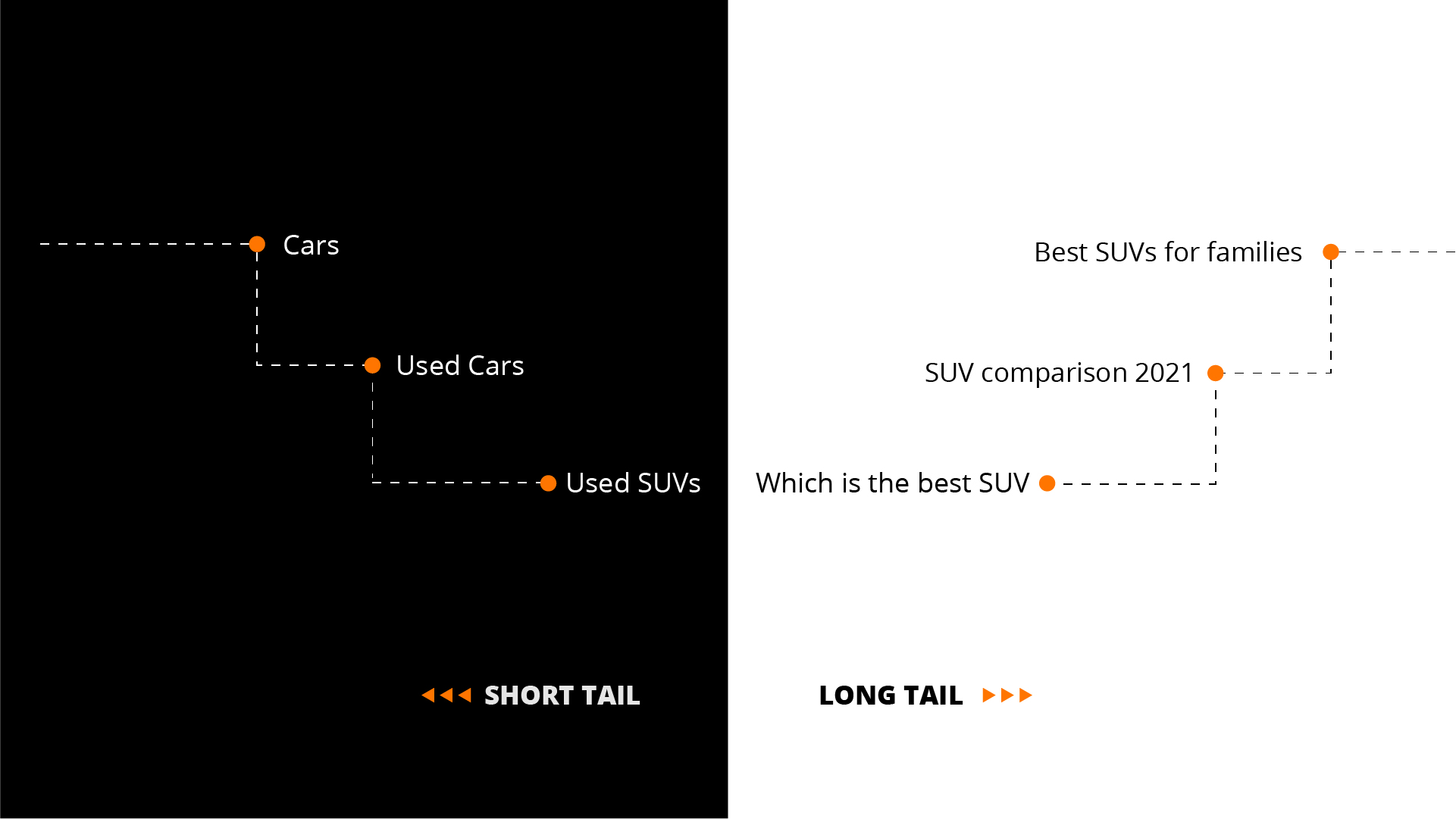
## What are Long-Tail Keywords?
Long-tail keywords are longer, more specific keyword phrases typically comprised of four to eight words strung together to narrow down a search to the most applicable results. Despite generating a smaller portion of individual searches, billions of long-tail keyword queries are generated monthly. The term “long-tail” refers to their position on the search demand curve, which we’ll explain shortly.
### What Do Long-Tail Keywords Mean for Your Strategy?
Long-tail keyword phrases are essentially more conversational and specific ways people search when they know exactly what they want. They represent a user who has moved beyond general browsing and is looking for something particular.
#### Types of Long-Tail Keywords
Long-tail keywords can be categorized into two types:
#### Topical
These are the primary keywords of a piece of content and represent the most popular way to search for any given topic. For example: “digital marketing strategies” or “best running shoes for flat feet.”
#### Supporting
These are subtopics of a topical keyword, offering more elaboration and specificity. Content is often written targeting these because they’re much more specific and easier to rank for. For example: “effective B2B digital marketing strategies for lead generation” or “best budget running shoes for flat feet under $100.”
### Examples of Long-Tail Keywords
Continuing with our vehicle search example, you can refine your search with specific long-tail keywords:
- “pre-owned Honda CR-V St Louis”
- “best fuel-efficient SUVs under $30000”
- “Toyota dealerships near me with certified mechanics”
- “how to negotiate car price at dealership”
These examples show how long-tail keywords can be questions, location-specific searches, or highly detailed product queries.
## Why Use Long-Tail Keywords?
### Benefits in SEO Context
Long-tail keywords offer several advantages for search engine optimization
- **Easier to rank for:** Thanks to lower search volume, there’s much less competition, making them an effective tactic for improving organic rankings
- **Higher conversion rates:** Users searching with long-tail keywords typically have clear intent and are further along in their buying journey
- **Targeted traffic:** You attract visitors who are specifically looking for what you offer
- **Topical authority:** Ranking for multiple related long-tail keywords helps [establish your expertise](https://www.wearetg.com/blog/google-eeat/) in a niche
### Benefits in PPC Context
In paid search campaigns, long-tail keywords provide significant advantages:
- **Lower cost-per-click:** Reduced competition means [lower bidding costs](https://www.wearetg.com/blog/ppc-costs/)
- **Higher quality scores:** More relevant, specific ads typically receive better quality scores
- **Better ROI:** Higher conversion rates combined with lower costs improve return on investment
- **Less wasted spend:** More precise targeting reduces irrelevant clicks
## Understanding the Search Demand Curve
The names “short-tail” and “long-tail” come from their position on the “search demand” curve. There are few, largely popular keywords that can generate millions of monthly queries, putting them on the “short end” of the curve (think just typing in “shoes”). Millions of search queries take up the middle, with search volumes in the thousands (like “running shoes for women”).
Then, on the remaining portion of the curve – the “long tail” – live the billions of search queries that only generate a small number of monthly searches (like “Nike women’s running shoes with arch support”). Being on the long-tail end may mean fewer monthly searches, but you know you’re getting the quality, targeted audience you want for better results.
## Understanding Search Intent & When To Use Each Type of Keyword
The key difference between long-tail and short-tail keywords is searcher intent. When you search “cars,” you’re probably in the early stages of your buying journey and just want to see what’s out there. It’s unlikely that you’d search for “cars” and immediately buy the first thing that pops up.
Rather, your search journey might progress like this:
1. “cars” (research phase)
2. “reliable SUVs” (narrowing options)
3. “Honda CR-V reviews” (evaluating specific models)
4. “Honda CR-V price St Louis” (ready to buy)
As you decipher between what you want and what you don’t want, your search becomes more focused, and the keywords get longer and more specific. While only a few people might search for “pre-owned Honda CR-V St Louis” in a given month, these [searchers are ready to buy](https://www.wearetg.com/blog/money-keywords/), making it a much more valuable interaction.
While long-tail keywords offer greater impact sooner, this doesn’t mean you should discount short-tail keywords entirely. However, be realistic about their implementation. Achieving top ten rankings using short-tail keywords can take years of content work and [backlink outreach](https://www.wearetg.com/blog/link-juice/).
### How to Find the Right Keywords
The perfect keyword strikes a balance. Broad enough to have search traffic behind it, yet specific enough to allow you to rank relatively easily.
If your keyword is too specific, like “low carb thin crust pizza restaurants that deliver to 902 South 5th Street,” no one is searching for it. If it’s too broad, like “pizza,” you’ll likely be relegated to the unexplored depths of Google’s search results.
You’ll want to optimize your site for specific keywords your potential customers will likely search. This might be “emergency plumbers near me,” “personal injury lawyer St Louis,” or “best wedding cake bakery in town.”
While you can use your best judgment when developing these keywords, you should [use data to back up your decisions](https://www.wearetg.com/blog/keyword-research/).
#### Keyword Research Tools
Various resources can help you determine potential traffic behind specific long-tail and short-tail keywords:
- Google Trends
- SEMrush
- Keywords Everywhere
- Google Keyword Planner
- Ahrefs
- Moz Keyword Explorer
Some are free, while others require a monthly subscription or credit purchases, so find the option that works best for your needs and budget.
### Finding the Sweet Spot Between Volume & Competition
Keywords with lower volume don’t necessarily mean lackluster results. Instead, examining the keyword’s competition level will help you better determine how successful it will be.
In keeping with our pizza example, using more specific terms like “thin crust pizza delivery” or “low carb pizza near me” will naturally have less search traffic than “pizza.” However, the competition is virtually non-existent, so ranking for those more specific terms is perfectly within reach.
## The Bottom Line
Both types of keywords are necessary, but [they serve different purposes](https://www.wearetg.com/blog/seo-vs-ppc/) in your SEO and PPC strategies. Short-tail keywords help with brand awareness and reaching users in the early research phase, while long-tail keywords drive targeted traffic with higher conversion potential.
The smartest approach? Use both, but be strategic. Start with long-tail keywords to build initial rankings and authority, then gradually target more competitive short-tail terms as your domain authority grows.
At the end of the day, it’s all about finding that sweet spot between getting enough search traffic to matter and not biting off more than you can chew competition-wise. Pick keywords that actually make sense for your business and the people you’re trying to reach. No point ranking for something that won’t bring you the right customers, right?
#### Build a Keyword Strategy That Matches Your Growth Stage
Short-tail and long-tail keywords serve different purposes, but knowing when and how to use each is what drives real results. If you’re chasing high-volume terms without the authority to rank — or ignoring high-intent long-tail opportunities — your strategy may be working harder than it needs to.[ **Schedule a 30-minute consultation** ](https://www.wearetg.com/contact/)with Timmermann Group to evaluate your keyword mix and turn smarter targeting into measurable traffic, leads, and conversions.
[](https://www.wearetg.com/contact)
**Categories:** SEO
---
### [How To Get Roofing Leads Without Door Knocking](https://www.wearetg.com/blog/roofing-leads-without-door-knocking/)
**Published:** January 2, 2024
**Author:** Rob Timmermann
**Content:**
In the roofing industry, how companies discover quality leads has significantly transformed. Sophisticated digital strategies are rapidly supplanting the traditional method of door-to-door solicitation. This shift represents a fundamental change in how roofing businesses engage with potential clients.
## What Are Roofing Leads
A roofing lead is a prospective client interested in [roofing services](https://www.wearetg.com/industry/roofing-marketing-agency/). These leads are categorized into two distinct types: shared and exclusive. Shared roofing leads are accessible to multiple roofing companies, often leading to heightened competition, whereas exclusive leads are specific to a single roofing business, and typically result in higher conversion rates.
The advent of digital technology has revolutionized how to generate quality roofing leads. Embracing digital strategies involves leveraging online platforms and tools to attract and engage potential clients. This method has proven more efficient and far-reaching than traditional techniques.
## The Impact of High-Quality Leads on Roofing Business Growth
Leads are essential for business growth because they represent potential paying customers. When a roofing company can generate leads, it increases its chances of converting those leads into paying customers, which results in increased revenue and business growth.
Additionally, roofing leads provide valuable information about potential clients that can be used to improve marketing efforts and tailor services to meet specific needs. By focusing on generating leads, roofing companies can position themselves for long-term success and growth.
## Buying Roofing Leads Lists: Pros and Cons
Purchasing roofing leads lists can be a double-edged sword. On the positive side, these lists offer immediate access to a pool of potential clients, which can be particularly beneficial for new businesses or those looking to expand their customer base quickly.
This approach can save time and resources that roofing companies would otherwise spend on more labor-intensive methods to generate roofing leads — like knocking on doors.
However, this strategy has potential drawbacks. The quality and exclusivity of the leads provided can vary greatly, which may impact the conversion rate.
Additionally, there’s the possibility of acquiring shared leads, meaning your competitors may have access to the same contact information, leading to a more competitive environment – services like Angi’s List or HomeAdvisor.
The costs associated with purchasing these lists can also fluctuate, requiring a careful assessment of the return on investment.
While buying roofing leads lists can provide a quick way to access potential clients, it’s crucial to consider the quality of the leads, the competitive landscape, and the overall cost-effectiveness of this approach before making a decision.
## Leveraging Google Ads for Roofing Leads
Google Ads have emerged as a powerful tool in the digital marketing strategy of roofing companies. The effectiveness of these ads lies in their ability to target qualified leads through carefully selected keywords and geotargeting, ensuring your advertising efforts reach the most relevant audience.
## YouTube Ads: A Visual Approach to Generating Leads
YouTube ads offer a dynamic and engaging way to connect with potential clients. By creating visually appealing and informative advertisements, roofing companies can effectively capture the attention of their target audience. The key to success with YouTube ads lies in targeting and retargeting strategies, ensuring your message reaches the most appropriate viewers.
## Facebook Advertising to Generate Roofing Leads

Facebook advertising offers a versatile platform for targeting potential roofing clients. With its sophisticated targeting capabilities, roofing companies can reach a specific demographic, increasing the likelihood of generating high-quality leads.
Additionally, the use of Facebook’s retargeting features allows roofing companies to re-engage with users who have previously interacted with their content or visited their website, further enhancing the chances of conversion.
## Local SEO Optimization for a Roofing Company
Local SEO plays a crucial role in the digital presence of many roofing contractors. By optimizing for local search, a roofing contractor can increase their visibility to potential clients in their immediate geographical area. This involves managing online listings, such as Google My Business, and ensuring all information is accurate and up-to-date.
Incorporating local keywords into website content and obtaining local backlinks also significantly boosts local search rankings, making it easier for nearby customers to find and choose their roofing services.
## Email Marketing: An Old School Approach with a New Twist
[Email marketing](https://www.wearetg.com/services/content-marketing/) remains a vital component of digital marketing strategies for roofing leads. It offers a direct line of communication with potential clients and, when executed correctly, can be highly effective. The key is to create targeted, relevant content that resonates with the recipient, encouraging potential leads to engage with your services.
Personalizing email marketing messages based on customer behavior and preferences, and segmenting email lists to cater to different groups of potential leads can significantly increase open rates and drive more targeted responses.
## Content Marketing: Building Authority and Trust
[Content marketing](https://www.wearetg.com/services/content-marketing/) is an effective way to establish authority and build trust within the roofing industry. Roofing companies can demonstrate their expertise and knowledge by providing valuable, informative content and attracting potential clients seeking reliable and professional services.
By consistently publishing articles, blogs, and guides on topics like roofing materials, maintenance tips, and industry trends, companies not only educate their audience but also improve their search engine rankings, making it easier for potential clients to find them online.
## Harnessing the Power of Social Media Platforms
[Social media platforms](https://www.wearetg.com/services/social-media-marketing/) offer a unique avenue for roofers to connect with potential clients. By crafting and disseminating content that resonates with your audience, you can build a robust online presence, fostering trust and credibility.
Engaging with your audience through regular posts, responding to comments, and sharing customer success stories can create a community around your brand. Utilizing features like stories, live videos, and polls on platforms like Instagram and Facebook can further increase engagement and give a personal touch to your roofing business.
Here are a few ideas for leveraging social media effectively:
**Showcase Before-and-After Projects**
Post photos or videos showcasing the transformation achieved through your roofing projects. This visual evidence of your work can be very persuasive.
**Educational Content**
Share tips and advice on roof maintenance, choosing materials, and understanding roofing services. This positions your company as a knowledgeable authority in the field.
**Customer Testimonials**
Share reviews and testimonials from existing customers. Video testimonials can be particularly impactful.
**Live Q&A Sessions**
Host live sessions where you answer common roofing questions, offering valuable insights directly to your audience.
**Behind-the-Scenes Glimpses**
Share what goes on behind the scenes in your roofing projects. This could include the planning process, safety measures, technology, and tools.
**Interactive Polls and Surveys**
Engage your audience with polls and surveys about their roofing preferences or experiences. This not only provides valuable feedback but also increases engagement.
**Seasonal Maintenance Tips**
Offer timely advice regarding seasonal changes, such as preparing a roof for winter or summer maintenance tips.
**Promotions and Special Offers**
Use social media to announce special promotions, discounts, or limited-time offers.
**Collaborations with Influencers**
Partner with local influencers or industry experts to expand your reach and add credibility to your brand.
**User-Generated Content**
Encourage your customers to share their stories or photos related to your services and repost this content on your channels.
**Safety Demonstrations**
Post videos demonstrating safety practices in roofing, highlighting your commitment to safety and professionalism.
**Industry News and Updates**
Keep your audience informed about the roofing industry’s latest trends, technologies, and regulations.
**Employee Spotlights**
Introduce your team members to your audience, adding a personal touch to your brand.
**Community Involvement Stories**
Share stories or images of your company’s involvement in local community events or charitable causes.
By implementing these ideas, you can harness the power of social media and content marketing to reach a wider audience and establish a deeper connection with potential clients.
## SEO Strategies for Roofing Websites
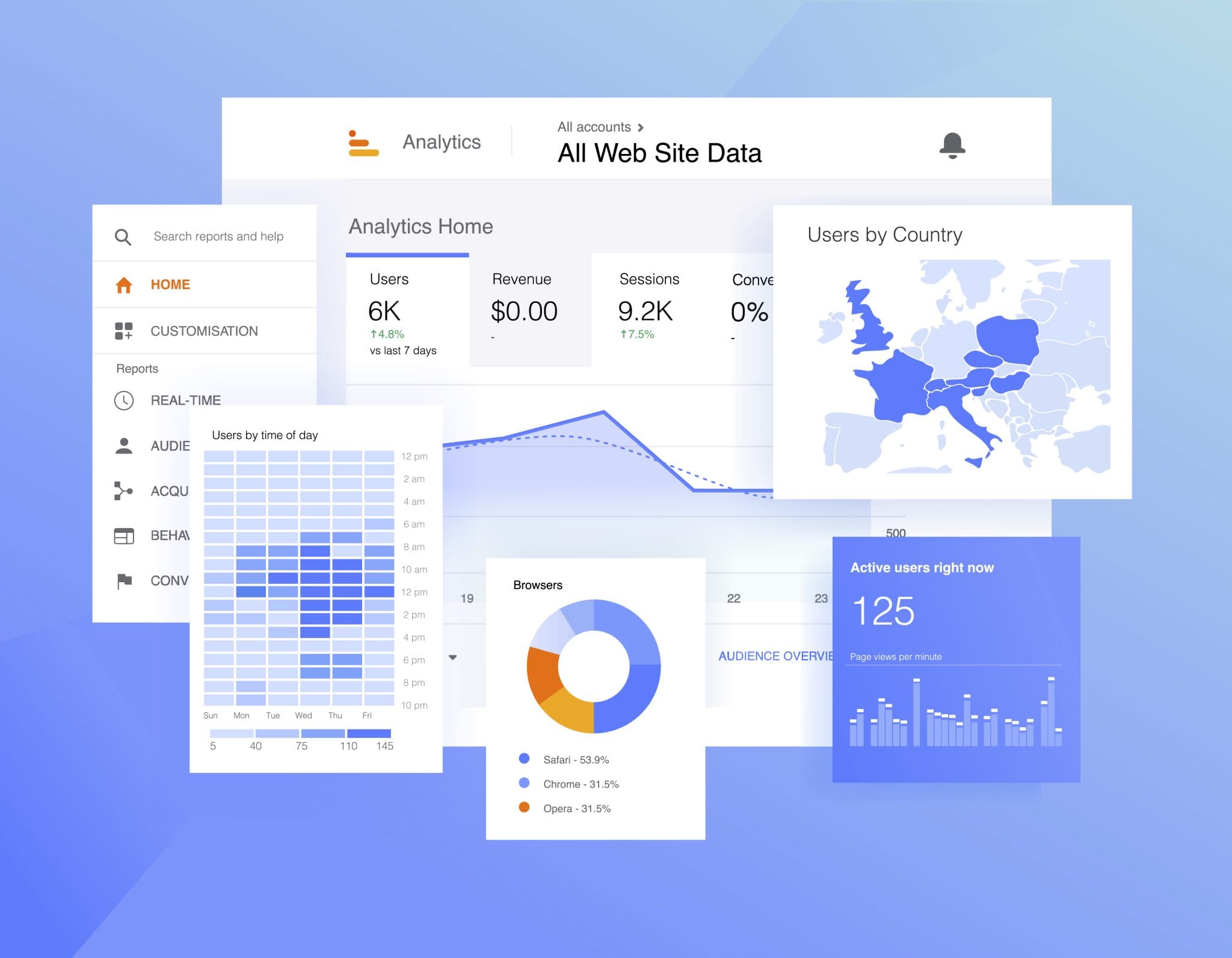
[Search Engine Optimization for roofing websites](https://www.wearetg.com/industry/roofing-seo/) is critical for ensuring a roofing company’s website ranks highly in search engine result pages. Effective SEO strategies involve:
### Keyword Research and Optimization:
- Identify keywords that potential clients use when searching for roofing services. Tools like Google Keyword Planner or SEMrush can be helpful.
- Incorporate these keywords into your website’s content, including titles, headings, and body text.
- Use local keywords to target clients in your specific service area, such as “roof repair in \[City Name\]” or “best roofing contractors in \[Region\].”
### Enhancing Website Speed and User Experience:
- Use tools like Google PageSpeed Insights to analyze and improve your website’s loading speed.
- Ensure your website is mobile-friendly, as many searches occur on mobile devices.
- Simplify navigation to make it easy for visitors to find information. A clean, intuitive design keeps users engaged longer.
### Building Quality Backlinks:
- Contact local businesses and industry blogs for partnership and guest posting opportunities. This can lead to valuable backlinks.
- Create high-quality, informative content that other websites want to link to, such as roofing guides, infographics, or case studies.
- Participate in local community events or sponsorships, and leverage these connections to get your website mentioned and linked on their websites and social media.
### Regularly Updating Website Content:
- Keep your website dynamic with regular blog posts about roofing tips, industry news, and company updates.
- Update your portfolio section with recent projects and customer testimonials. Ensure all your content is original and provides value to your audience.
### Optimizing for Local SEO:
- Claim and optimize your Google My Business listing with accurate, detailed business information.
- Encourage satisfied customers to leave positive reviews on your Google My Business profile.
- Include local landmarks and references in your website content to further localize your SEO efforts.
### Utilizing Search Engine Optimization Tools and Analytics:
- Use SEO tools like Moz or Ahrefs to track your website’s performance and identify areas for improvement.
- Monitor your website’s analytics to understand visitor behavior and adjust your strategies accordingly.
### Technical SEO Improvements:
- Ensure your website is secure (HTTPS), especially when collecting customer data.
- Use structured data (schema markup) to help search engines understand and display your content in rich snippets.
- Regularly check for and fix any broken links or errors (404 pages) on your website.
By implementing these SEO strategies, a roofing company can significantly improve its online visibility, attract more website traffic, and generate more roofing leads for your business.
## Networking and Partnerships
Building networks and establishing partnerships can be a powerful strategy for generating roofing leads. Collaborating with related businesses and participating in industry events can open doors to new opportunities and referrals.
## Referral Programs: Encouraging Word-of-Mouth Referrals to Your Roofing Business
Referral programs incentivize satisfied customers to recommend your services to others. A well-structured referral program can effectively generate leads through word-of-mouth, one of the most trusted forms of marketing.
## Utilizing Customer Reviews and Testimonials
Reviews and testimonials from past customers are invaluable in establishing trust and credibility for your roofing business. Stories of positive interactions with your company from satisfied clients can significantly influence potential customers’ decisions, making it a critical factor in lead generation.
## Landing Pages and Conversion Optimization
Optimized landing pages are essential to generate leads. A well-designed landing page should convey the value of your services and guide visitors toward action, such as requesting a quote or scheduling a consultation.
## Pay-Per-Click (PPC) Advertising

[PPC advertising](https://www.wearetg.com/services/pay-per-click-marketing/) is a targeted approach to generating roofing leads. A roofing company can attract potential clients actively searching for roofing services by creating ads that appear in search engine results.
## Community Involvement and Local Events
Participation in community events and local initiatives can enhance a roofing company’s visibility and reputation within their target market. This involvement builds brand awareness and establishes the roofing company as a trusted local service provider.
## Trade Shows and Industry Events
Trade shows and industry events offer valuable opportunities for networking and lead generation. By showcasing services and engaging with attendees, roofing businesses can establish connections and generate interest in their services.
## The Future of Roofing Lead Generation
A blend of traditional and digital strategies characterizes the future of roofing lead generation. As the industry continues to evolve, staying abreast of the latest trends and technologies will be crucial for roofing companies looking to expand their client base and grow their business.
## Timmermann Group Can Help
#### Build a Roofing Lead Pipeline That Doesn’t Rely on Door Knocking
Door knocking might get you in front of homeowners, but digital lead generation gets you found by people already searching, comparing, and ready to book. From Local SEO and Google Ads to social retargeting and conversion-optimized landing pages, the right strategy turns online visibility into steady calls, form fills, and booked jobs.[ **Schedule a 30-minute consultation** ](https://www.wearetg.com/contact/)with Timmermann Group, your home services marketing agency, to break down where your roofing lead flow is leaking value and how to turn smarter marketing into measurable leads and conversions.
[](https://www.wearetg.com/contact)
---
**Categories:** News
---
### [How To Choose An SEO Company in 2025](https://www.wearetg.com/blog/how-to-choose-an-seo-company/)
**Published:** May 31, 2024
**Author:** Rob Timmermann
**Content:**
SEO is the language of search engines. To connect with your people, you need to learn this language or hire a company that is already fluent. Next, you need to choose the right SEO agency that will meet the needs of your business. This article will help you navigate your most burning questions about selecting the right SEO agency for your business.
We’ll cover what makes [a great SEO company](https://www.wearetg.com/services/seo/), how to avoid scam SEO companies, and how to choose the best SEO company to trust for your in-house SEO responsibilities.
## What Makes A Great SEO Company: Essential Criteria for Your Decision
When you want SEO, you don’t just want any company that says they can do SEO. Selecting a great SEO company is important, but what makes one great?
First and foremost, it’s the company’s ability to implement SEO efforts that result in a greater conversion rate and prove that cause and effect through data. If the company tells you the strategies are working but can’t show you any numbers, testimonials, or successful client portfolios, it’s time to slowly back away – or run in the other direction.
A great SEO company can provide you with a look into [rich client case studies](https://www.wearetg.com/portfolio/) and show you evidence of a fully optimized website attracting visitors, engagements, and conversions. What good is a website if the potential clients who visit aren’t turning into full-fledged customers who are buying your products or services?
When researching an SEO company, analyze the range of marketing services it offers. You need a company that will not only ensure on-page optimization and produce relevant search results, but you also need SEO experts who take the users’ experience into account once they’re on your website. These two essential aspects of SEO will result in growing site traffic and lead volume and boost brand awareness.
**Pro tip**: getting users to your website through intelligent SEO is only part of what SEO specialists can do for you–we also make sure your users enjoy their time on your website, thus leaving them with a great impression of your company. At Timmermann Group we employ strategies such as limiting [keyword cannibalization](https://www.wearetg.com/blog/what-is-keyword-cannibalization/) and internal crosslinking to improve user experience. A positive experience builds your brand’s credibility!
Another thing that will let you know you’re in capable hands is the level to which the company’s SEO strategies are defined. When you’re trying to optimize your website for SEO, the last thing you want to do is “wing it.” SEO experts should love data, and know how to use it. You want an SEO company whose team excels in [data collection](https://www.wearetg.com/services/analytics/), [strategy creation](https://www.wearetg.com/services/strategy/), and [SEO content implementation](https://www.wearetg.com/services/content-marketing/).
## Step-by-Step Guide: How to Choose the Best SEO Company
Shopping round for an SEO company is not as easy as contacting the first marketing agency or business you find. Search engine optimization is a process that requires a lot of attention and, although some companies will know the basics of SEO, they won’t be knowledgeable enough to give you the most benefit.
Below are some tips to ensure you find the best SEO company for your needs that will get you the true results you want.
### 1. Outline Your Goals and Expectations
Before you can hire any external company, it’s necessary to understand your company’s goals. It’s impossible to reach a goal if you don’t first set one. This will also help when narrowing down potential SEO companies because you’ll know which direction you want to take, whether it’s a focus on the local audience or competing with national brands.
Some common objectives you may be aiming for that an SEO company can help with include:
- Establishing your business in a new market
- Expanding offerings and growing conversions
- Outranking the competition to gain organic traffic from search results
- Generating better results from current SEO strategies
Considering these objectives will help your company and the hired agency understand what kinds of metrics and strategies should be used to be successful.
### 2. Set a Budget
You can achieve any SEO goal you want – if you don’t mind how much money you spend. But if you’re like most companies, there’s a budget to stick to. Knowing your budget ahead of time will ensure you don’t find a company you really like, only to find out they are too expensive, making you start the entire search process over again. For the SEO company, having an idea of your budget early will help them create a strategy to get the most success within those cost parameters.
A budget ensures your expectations align with what you can truly afford to spend. It’s also important to remember that SEO should be a strategy you are investing in for long-term results, not something you’ll see an immediate return on. Don’t stress to much on budget and try to plan with flexibility in mind, because as your business grows, your SEO needs will change, as will the budget.
If you talk with an SEO agency that offers services at higher prices, it doesn’t always mean you’re going to get better results. While costs are important, focus more on their track record and expertise to determine how well they will work for you. You can also combine the two by requesting an estimated timeline for expected, tangible SEO results based on your budget.
### 3. Research, Research, Research
Once you have cleared up your expectations and needs, it’s time to start your search. A good first step is asking for referrals from trusted peers, but you could also check out a person or company you follow on social media or those that show up in your search.
As you look into the company, review their website and all social media channels. Do they live and breathe SEO? If not… hard pass. If they appear to have some decent experience, dig deeper. Has the company received industry recognition or awards for their expertise? Are they trusted thought leaders, sharing knowledge via articles, conferences, and other channels? Are they proactive in staying ahead of industry trends and changes? How do they interact and treat their staff and clients? These are all important things to look for as you research each company.
If you find one you may be interested in, get in touch with colleagues or other businesses that may have worked with the agency previously or currently.
If you’re doing an online search, take the time to evaluate potential agencies you’d like to work with by looking for reviews on their social media, Google, or professional review sites like Glassdoor.
Finalize the SEO companies you’d like to compare to a maximum of three.
### 4. Compare Your Top Options
Now that you’ve got your three top companies, it’s time to get into the gritty details. There are several pieces you need to carefully review before reaching out to each company:
- **Portfolio:** The company should demonstrate a record of SEO success showing they can handle any and all challenges and opportunities. The portfolio should provide a glimpse into how long they’ve been around and the types of industries or clients they’re experienced with.
- **Case Studies:** Reading through case studies, particularly those closely related to your business model, will provide insight into the kinds of tactics they may use for you and the performance you can expect.
- **Publications:** Browse and read through what they are publishing on a blog, social media, or other avenues to gauge the company’s personality, industry knowledge, and understanding.
- **Techniques and Strategies:** Not all SEO tactics and strategies are created equal. If you want continuous success, not just a one-time boost, ensure they follow practices that align with [Google’s guidelines](https://developers.google.com/search/docs/fundamentals/seo-starter-guide) for site ranking improvement. You’ll know for sure they follow best practices if the company has met all the requirements to [earn the trusted Google Partner badge](https://www.google.com/partners/agency?id=2981133800).
- **The Agency Team:** SEO is not one-dimensional, with many different team members that play a part. The team should be multidisciplinary to be the most effective, with various on-staff experts for each offered service. Having such a multifaceted team is usually indicative of good results, smart leadership, and healthy company culture.
Along with these general research tips, be sure to tailor your research to look for exactly what *your* company needs. If local reach is important to you, see how they do with [Local SEO](https://www.wearetg.com/services/local-search-optimization/). If you need [website design](https://www.wearetg.com/services/website-design/), research how they approach an SEO strategy from the ground up. If you want a better-performing blog, look into how their [content marketing](https://www.wearetg.com/services/content-marketing/) and SEO strategies work together.
### 5. Contact and Interview Top Prospects
Once you feel confident in your top prospects, it’s time to reach out for an interview.
The interview should be a two-part call. First is the introduction, and while it seems simple, it will tell you a lot. Trust your gut here. Does this company know what they are talking about? Could you work with them for multiple years? If not, then you know not to move any further. If you like what you are hearing, listen for these questions from the SEO company and be prepared to answer:
- **How did you find us?** If they are tracking this, then they will probably be helping you track it.
- **What are your goals?** They need to ask this to determine if they are capable of delivering on it.
- **What is your average sale amount?** They need to know this to calculate the ROI of SEO for your company.
- **What is the lifetime value of your customer?** This is important for calculating the ROI of SEO since the initial lead may only be a small fraction of the revenue that can be achieved from the initial sale.
- **Who are your competitors?** This helps determine how hard they will be to outrank due to what progress they have made and what progress they are currently performing.
- **What did you or do you like about your current agency?** This is a great question for them to ask because they should be concerned about your past SEO history and how they can improve the experience for you.
- **What is your budget range?** They should ask this on the initial call. If you still aren’t sure or don’t want to discuss that quite yet, the company should be able to provide you with a range before they go any further. If they can’t, it may show signs of inexperience.
- **What is your timeline?** Your answer here helps clarify multiple parts, including the start date and results date. Results could be keyword rankings, but they should also include generating revenue.
If any of these questions or their responses to your answers don’t feel right, don’t move forward with a second call.
For those who make it to round two, the second part of the interview call would be the proposal. This discussion should detail where your website is currently, what strategies it will take to get you to where you want it to be, and what it will cost. From this step and conversation, you should feel confident that the company is ready to hit the ground running.
#### Questions To Ask Before Hiring An SEO Company
The SEO company shouldn’t be the only ones asking questions during these discussions. There are some great questions you should be asking the SEO company for better clarification on the working partnership you can expect.
- **What experience do you have with SEO?** Get a feel for how much they’ve worked with SEO strategies, the kinds of successes they’ve had, how many clients they regularly work with, and even how many long-term clients they have. The more experience they have with SEO on a daily basis, the better that should be for you.
- **How do you define SEO success?** Some companies will focus primarily on rankings and traffic while others will focus on leads and revenue. How success is measured should be important and it should be tailored to what *you* need. The more your company and the agency are aligned, the more successful you’ll be.
- **What strategies would you use to improve my website’s ranking?**
- **When should I expect to see results?** This is important because not only can it set expectations, but it can end up revealing spammy SEO companies to stay away from. A promise for results in 30 days to a few months is unrealistic as SEO usually takes anywhere from three to six months, or even up to a full year of work. An even better answer is if they perform a site audit to give you a more tailored estimate.
- **What kind of SEO reporting will you provide?** Every SEO company should provide reporting, but not every company’s reports will be useful. Get an idea for the metrics they measure, what attribution model they use, and more. If you’re not getting a clear answer, ask for an example report.
- **How do you communicate with your clients?** Communication is the key to any successful partnership. Understand how the agency expects communication to happen, whether it’s via email, phone, or video conferences; how often you can expect communication; who is responsible for communicating with you; and if they are able to meet your communication needs and expectations.
- **Why should we choose your company vs. another?** The answer to this question should be taken with a grain of salt as everyone is going to make themselves sound like the best. However, you could gain some valuable insight on other SEO companies you may be interviewing, such as price inconsistencies, poor behind-the-scenes practices, and more.
- **Can you provide me with case studies or examples of your work?** If the agency does not offer this information on their website, ask for it. They should be able to provide you with this without hesitation.
- **What kind of monthly retainer do you require?** Most SEO companies will work with a monthly pricing model, but some may charge hourly or per project. Clarify this expectation with the agency so you know what to expect for your budget.
- **Are there any additional costs I should expect?** No one likes surprise fees. If there are potential costs that may come down the line as strategies are optimized, discuss those now.
- **Can you explain your billing process?** Again, knowing what to expect is always best. Get a feel for how often you’re billed, how bills are sent, and how you should pay.
Asking these questions highlights the accountability and transparency of the company with whom you’re speaking while also helping you acquire the information you need to make an educated decision.
Furthermore, if you consider these questions before you ask them, you can decide which answers your company needs to hear before moving forward as you choose which SEO company with which to work.
### 6. Time to Decide
Now is the time to make some decisions. You already know that SEO is a smart move for your business, so you shouldn’t delay in choosing the right SEO company to partner with because the competition will only continue getting harder to catch.
From those you’ve interviewed, select the agency that is strategic in its approach, not just tactical. In the proposal, you don’t want a quota of how many links or blogs are included over the contract duration because these needs are more strategic and will most likely fluctuate depending on your needs. What you should see is a strategy the agency is working towards that will adjust quarterly depending on the evolution of website performance.
Additionally, there are mandatory components of SEO that should be included, and those are:
- **Keyword Research and Strategy**: What keywords will make the most impact for your performance
- **On-Page Optimization**: How the team plans on adjusting existing content
- **Content Creation:** How and where the team plans to create new content for your website
- **Off-Page Optimization:** The link acquisition strategy
### Avoiding Scam SEO Companies: Red Flags to Watch Out For

Since optimizing websites for SEO is a topic commonly known worldwide, many people are touting themselves as SEO experts. These “experts” may (or may not) know how to perform a single aspect of SEO while remaining ignorant of the whole picture. To give them the benefit of the doubt, they may not even realize they don’t have all the information they need.
To that end, when you’re ready to entrust your SEO to an agency, you can’t afford to extend your trust or budget where your confidence is not warranted.
So, how do you know how to avoid scam SEO companies? Here are some red flags to watch out for:
- **Black Hat SEO**: Black Hat SEO refers to “experts” using techniques that can get a site to rank higher in the short-term but almost always get that same site blocked in the end due to bad techniques such as keyword stuffing, cloaking, and using private link networks.
- **Cheap rates equal cheap results**: Grabbing a deal feels great when online shopping, but SEO is not the place for sales. Knowing if it’s a good price is whether or not the company’s value and reputation match the remuneration they’ve set forth on their website or in your pricing quote. Essentially, the value they offer should match the price they charge.
- **Big promises with no evidence of prior success**: If a company promises you the moon but doesn’t even have a track record of getting past clients above the ceiling, you might want to continue searching. Customer testimonials and previous or current customer websites can provide great insight into the SEO company’s track record.
## Ready to Hire The Best SEO Agency? Contact Timmermann Group Today
To hire the [best SEO agency](https://www.wearetg.com/services/seo/) for your company, weigh all the attributes that make an SEO great with the specific objectives you have regarding your SEO needs. By performing research on your options, including investigating testimonials, requesting work samples and asking the right questions, you’ll be well on the path toward finding and developing the perfect SEO partnership.
At Timmermann Group, we create personalized strategies to meet your diverse business needs to not only meet your goals but exceed them. With a team of true SEO experts, we’ll analyze your uniquely competitive SEO landscape, strategize a strong SEO plan, create compelling SEO-optimized content, and implement it all to your website.
#### Choose Strategy. Not Empty Promises.
Choosing the right SEO company in 2025 means looking beyond rankings and buzzwords. You need a strategic partner who can connect data to revenue, align with your goals, and prove performance with transparency. If you’re evaluating agencies and want clarity on what a real, results-driven SEO strategy looks like, now’s the time to ask the right questions.[ **Schedule a 30-minute consultation** ](https://www.wearetg.com/contact/)with Timmermann Group to review your goals, evaluate your current SEO performance, and determine what it would take to turn strategy into measurable growth.
[](https://www.wearetg.com/contact)
**Categories:** SEO
---
### [Off-Page Optimization: The Ultimate Off-Page SEO Guide](https://www.wearetg.com/blog/off-page-seo-services/)
**Published:** August 26, 2025
**Author:** Rob Timmermann
**Content:**
Off-page optimization helps improve your website’s ranking by enhancing its authority and trustworthiness through external activities. Often overlooked compared to on-page SEO and technical SEO, off-page SEO is an essential cornerstone of any SEO strategy. Whether you’re a business owner looking to improve local search rankings or an SEO professional seeking to expand your off-site optimization knowledge, this guide provides actionable insights to elevate your search engine performance through strategic external SEO efforts.
## Key Takeaways
- Off-page SEO encompasses all optimization activities performed outside your website to improve search rankings by building authority, trust, and credibility.
- Consistent investment in off-page SEO strategies, such as acquiring high-quality backlinks and fostering brand mentions, is vital for enhancing search engine rankings and online visibility.
- Advanced techniques, including digital PR and influencer marketing, can further amplify the impact of off-page SEO by increasing brand exposure and driving organic traffic.
## What Is Off Page SEO?
Off-page SEO refers to the efforts made to improve your website’s unpaid search engine rankings through activities that occur outside of your website. Unlike on-page SEO, which focuses on optimizing elements within your site, off-page SEO encompasses a wide range of external optimization activities aimed at enhancing your website’s authority, relevance, and trustworthiness in the eyes of search engines.

## Importance of Off-Page SEO
A robust off-page SEO plan is essential for improving your website’s visibility and authority with both users and search engines. While on-page SEO optimizes your website’s internal elements, off-page SEO builds trust through third-party endorsements that search engines and users rely on to assess your site’s authority and reliability.
For search engines, off-page signals like high-quality backlinks, consistent citations, and brand mentions serve as algorithmic trust indicators that validate your content’s credibility and relevance. These external endorsements help search algorithms determine your website’s authority and influence ranking positions in search results.
For users, off-page SEO elements such as positive reviews, social media engagement, and media coverage provide social proof that builds confidence in your brand before they even visit your website. When users see your business mentioned in reputable publications, endorsed by industry experts, or highly rated by other customers, they develop trust in your expertise and offerings.
Investing in off-page SEO ensures your website remains competitive and visible in the crowded digital landscape.
## Core Elements of Off-Page SEO
The core elements of off-page SEO are the building blocks that form the foundation of a successful off-page SEO strategy. These elements include:
- Link building
- Brand mentions and citations
- Content marketing
- Social media engagement
Each of these components plays a vital role in enhancing your website’s authority, domain authority, credibility, and visibility on search engines.
### Link Building
Link building is a cornerstone of off-page SEO, focusing on acquiring high-quality backlinks from authoritative sources to elevate your website’s trustworthiness and search engine rankings. Search engines prioritize the authority and relevance of linking sites over the sheer number of links, making it essential to focus on quality rather than quantity. Effective link building strategies involve reaching out to reputable sites for guest blogging, which can earn high-quality backlinks while exposing your content to new audiences.
One of the most effective link building techniques is broken link building. This method involves identifying broken links on other websites and offering your content as a replacement. By providing valuable content, you not only replace the broken link but also enhance your backlink profile, contributing to higher search engine rankings.
Additionally, targeting reputable sites that align with your brand’s values is helpful for successful guest posts, ensuring that the backlinks you acquire are from trusted and relevant sources. High-quality backlinks from authoritative sources significantly improve your website’s authority and search engine rankings. These valuable backlinks signal to search engines that your site is a credible and trustworthy source of information, ultimately boosting your site’s visibility and organic traffic.
### Brand Mentions & Citations
Brand mentions and citations are critical components of off-page SEO that influence search engine rankings and website authority. Key points include:
- Search engines use citations to confirm the legitimacy and accuracy of a business.
- Consistent[ NAP](https://www.wearetg.com/glossary/nap-name-address-phone/) (Name, Address, Phone) information across platforms is critical for trustworthiness.
- Multiple directory listings validate that a business is real and established.
- These factors directly influence local search algorithm rankings.
Unlinked brand mentions, where your brand is mentioned without a hyperlink, can also contribute to your website’s reputation and search rankings. By monitoring brand mentions using tools like Google Alerts, you can identify opportunities to convert these unlinked mentions into valuable backlinks and referring domains, further enhancing your site’s authority and visibility.
Consistent citations and brand mentions help establish your site’s reputation and improve its search engine visibility.
### Content Marketing
Content marketing is a powerful off-page SEO pillar that involves creating valuable content aimed at earning backlinks and increasing brand visibility across different platforms. Effective content marketing helps businesses earn backlinks by providing genuine value rather than through direct outreach. The primary goals of content marketing are to create content that naturally earns backlinks and boosts brand awareness.
Content marketing relies on content syndication, which involves republishing content on one or more websites to gain exposure to new audiences. Ensure the syndicated content version links back to the original to maintain value. Additionally, repurposing content for different platforms, such as creating infographics, slideshows, and social media carousels, helps maximize reach and engagement.
Visual content, such as videos, earns links more easily compared to text-based content due to its appeal. By creating and distributing valuable and shareable content, you can attract quality backlinks, increase brand mentions, and enhance your overall off-page SEO efforts.
### Social Media Engagement
Social media engagement plays a seemingly indirect yet significant role in off-page SEO by increasing brand awareness, driving traffic, and earning backlinks. Engaging on social media platforms boosts visibility, leading to increased mentions, traffic, and backlinks, all of which contribute to better search engine rankings. Search engines recognize high-quality engagement on forums and social media as a signal of credibility. This strengthens your off-page SEO efforts.
Recommended platforms for niche engagement include Reddit, Quora, and niche-specific forums. By actively participating in discussions and providing valuable insights, you can enhance your online reputation and drive more organic traffic to your site.
Social media engagement is a powerful tool for increasing your site’s visibility and building a strong online presence.
## Advanced Off Page SEO
More advanced off-page SEO can significantly improve your site’s visibility and performance. These techniques, while more complex, can give you a competitive edge and drive more organic traffic to your site.
### Digital PR
Digital PR focuses on gaining media coverage and backlinks through valuable content. By using PR techniques to gain backlinks and authoritative links, digital PR helps improve your website’s authority and search engine rankings. Key tactics include earning media coverage, journalist outreach, and responding to HARO (Help a Reporter Out) requests, which allow you to earn high-authority backlinks.
The benefits of digital PR for SEO include:
- Earning authoritative backlinks
- Increasing brand awareness
- Building credibility
- Generating referral traffic
Journalists can help in off-page SEO by linking to your site in return for expert commentary or brand assets.
By focusing on gaining backlinks and brand mentions, digital PR provides a substantial boost to your off-page SEO efforts.
### Influencer Marketing
Influencer marketing involves promoting your brand and content using the reach of industry influencers. Collaborating with popular bloggers and social media creators to promote your products or services can introduce your brand to new audiences and increase visibility. Influencer marketing benefits SEO by earning social mentions and gaining backlinks from influencers’ platforms.
Working with experts or influencers can amplify your content and help increase brand awareness. Participating in webinars and public speaking can also enhance your brand’s authority and increase its online presence.
Fostering relationships with influencers and engaging in industry discussions boosts off-page SEO efforts and drives more organic traffic to your site.
## Local SEO Services
[Local SEO](https://www.wearetg.com/blog/local-seo-best-practices/) is a specialized branch of off-page SEO that focuses on improving a business’s visibility in local search results through search engine optimization. Key local SEO strategies include optimizing your Google Business Profile, establishing local citations, and earning positive online reviews.
By implementing these strategies, local businesses can improve their local search rankings and attract more customers from their geographic area.
### Google Business Profile
[Optimizing your Google Business Profile](https://www.wearetg.com/blog/google-business-profile-guidelines/) is crucial for improving local SEO and visibility in local search results. To optimize your profile:
- Claim and verify your listing.
- Complete accurate details.
- Upload high-quality images.
- Regularly update your profile with new photos, updates, and timely responses to reviews to enhance your local SEO efforts.
Google Business Profile provides essential business information, customer reviews, ratings, and insights on searches.

### Local Citations
Local citations are online listings that provide a business’s name, address, and phone number (NAP). Consistent NAP information across online directories is crucial for an accurate local SEO presence, as inconsistent citations can confuse both people and search engines, negatively impacting search visibility. Utilizing a listing management tool can help ensure accurate and consistent NAP listings across various platforms.
By establishing local citations on authoritative websites and directories, businesses can improve their local search rankings and drive more organic traffic. Local citations validate that a business is real and established, directly influencing local search algorithm rankings.
### Online Reviews
Positive customer reviews contribute to enhancing a website’s online reputation, thereby supporting its SEO efforts. Search engines evaluate online reviews as signals of a business’s trustworthiness and reliability, influencing local search rankings. By responding promptly to customer reviews, businesses can build trust and positively influence potential customers’ decisions, further improving their search engine visibility.
Encouraging satisfied customers to leave positive reviews on platforms like Google, Yelp, and industry-specific review sites can significantly boost your local SEO efforts. Managing online reviews effectively is a critical component of maintaining a strong online presence and enhancing your website’s reputation.
## Monitoring and Analyzing Off Page SEO Efforts
Monitoring and analyzing off-page SEO efforts are crucial for maintaining and improving search rankings over time. The effectiveness of off-page SEO relies heavily on external validation, such as backlinks and brand mentions, making regular monitoring essential.
Sustained off-page SEO efforts can create a self-reinforcing cycle, where improved rankings can boost search rankings, leading to more visibility and additional backlinks.
### Google Search Console
Google Search Console is an essential tool for monitoring your site’s performance in search results. This free tool helps webmasters:
- Track their backlink profile, including the quality and quantity of backlinks pointing to their site.
- Regularly review backlink data to identify which sites are linking to them.
- Evaluate the impact of these backlinks on their search engine rankings.
Using Google Search Console, you can also monitor other search engines aspects of your site’s SEO health, such as search visibility and indexing issues. This comprehensive monitoring allows you to make informed decisions about your off-page SEO strategy and adjust your tactics to improve your site’s performance over time.
### Google Alerts
Google Alerts is a powerful tool designed to notify users about new content related to specified keywords or topics. By setting up alerts for your brand name and relevant keywords, you can track how often your brand is mentioned online, making it easier to manage your online reputation. Monitoring brand mentions through Google Alerts allows you to promptly address any negative content and protect your online reputation.
Additionally, Google Alerts can help you identify opportunities for earning backlinks by notifying you when your brand or related topics are mentioned on other websites. By reaching out to these sites and requesting a backlink, you can enhance your backlink profile and improve your search engine rankings.
### SEO Tools
Specialized SEO tools like Ahrefs and SEMrush are essential for analyzing backlink profiles and understanding the overall health of your website’s SEO. Ahrefs provides detailed insights into your backlinks, including their quality and relevance, allowing you to identify new linking opportunities and monitor your existing backlinks. SEMrush’s Domain Overview offers comprehensive data on organic and paid traffic, backlink profiles, and keyword rankings, helping you make informed decisions about your off-page SEO plan.
Using these tools, you can track your off-page SEO efforts, analyze your competitors’ backlink profiles, and identify areas for improvement. Regularly monitoring and updating off-page SEO navigation ensures your website remains competitive and continues to improve search engine visibility.
## Staying Competitive with Off-Page SEO
Staying competitive in the ever-evolving world of SEO requires a consistent and strategic approach to off-page SEO. By staying proactive and adapting to industry trends, you can ensure that your site’s authority remains visible and authoritative in the digital landscape.
### Quality Over Quantity
When it comes to acquiring backlinks, quality always trumps quantity. High-quality backlinks from authoritative sites signal trustworthiness and relevance to search engines, significantly boosting your search engine rankings. On the other hand, a large number of low-quality backlinks might harm your SEO efforts and negatively impact your site’s credibility. Additionally, acquiring high-quality links can further enhance your online presence.
Focusing on quality backlinks ensures that your backlink profile remains strong and enhances your online credibility. By targeting reputable sites for guest blogging, engaging in content marketing, and leveraging digital PR, you can acquire high-quality backlinks that contribute to better search rankings and a more authoritative online presence.
### Consistent Efforts
Consistency is key to maintaining long-term search engine rankings. Regular and sustained off-page SEO activities are crucial for achieving lasting improvements in search rankings, including:
- Link building
- Social media engagement
- Content marketing
It’s important to remember that SEO is a marathon, not a sprint. Consistent efforts over time will yield the best results, helping you build a strong online presence and maintain your competitive edge in the digital landscape.
## Summary
In conclusion, off-page SEO is a critical component of any comprehensive SEO strategy. By focusing on activities that occur outside your website, such as link building, brand mentions, content marketing, and social media engagement, you can enhance your website’s authority, credibility, and visibility on search engines. Advanced strategies like digital PR and influencer marketing can further boost your off-page SEO efforts, providing a competitive edge in the market.
To stay competitive, it’s essential to prioritize quality over quantity when acquiring backlinks and maintain consistent off-page SEO efforts. Regular monitoring and analysis using tools like Google Search Console, Google Alerts, and specialized SEO tools will help you track your progress and make informed decisions. By investing in off-page SEO, you can ensure that your website remains visible, authoritative, and competitive in the ever-evolving digital landscape.
---
#### Build Authority Beyond Your Website
Off-page SEO is what separates visible brands from invisible ones. Backlinks, brand mentions, digital PR, and local citations signal trust to both users and search engines. If you’re only focusing on on-page and technical SEO, you’re leaving authority and ranking power on the table.[ **Schedule a 30-minute consultation** ](https://www.wearetg.com/contact/)with Timmermann Group to evaluate where your off-page strategy is falling short and how to turn stronger authority signals into measurable search visibility and conversions.
[](https://www.wearetg.com/contact)
---
## Frequently Asked Questions
#### What is the difference between on-page SEO and off-page SEO?
On-page SEO optimizes elements within your website, like content and meta tags, whereas off-page SEO involves external activities such as link building and social media engagement to enhance search engine rankings.
#### Why is off-page SEO important?
Off-page SEO is essential for enhancing your website’s credibility and authority, which ultimately boosts its visibility and organic traffic. This approach supports sustained growth in search engine rankings.
#### What are some effective link-building strategies?
To boost your link-building efforts, focus on guest blogging, broken link building, and securing high-quality backlinks from authoritative sources. These strategies can significantly enhance your site’s authority and visibility.
#### How can I monitor my off-page SEO efforts?
To effectively monitor your off-page SEO efforts, utilize tools such as Google Search Console, Google Alerts, and dedicated SEO platforms like Ahrefs and SEMrush. These resources will provide valuable insights into your backlinks, brand mentions, and overall online presence.
#### What role do online reviews play in local SEO?
Online reviews play a crucial role in local SEO by enhancing your website’s reputation and influencing search rankings; responding to them further builds trust and can sway potential customers’ decisions.
**Categories:** SEO
---
### [Roofing Keywords: A Strategic Guide for Roofing Companies](https://www.wearetg.com/blog/roofing-keywords/)
**Published:** January 10, 2024
**Author:** Rob Timmermann
**Content:**
Roofing companies have to battle to capture potential customers’ attention constantly. This comprehensive guide is your roadmap to understanding and utilizing roofing keywords, a crucial component in boosting your online presence and driving business growth.
## Understanding Roofing Keywords: The Foundation of Your [Roofing SEO](https://www.wearetg.com/industry/roofing-seo/) Strategy
Roofing keywords are more than just buzzwords; they are the linchpin of your online marketing efforts. These are the terms your potential clients type into search engines when looking for roofing services. Effective use of roofing keywords is akin to speaking the language of your potential customers. By effectively identifying and using these keywords, you can ensure your company’s website appears in the search engines of the right audience at the right time.
When your [roofing website’s content](https://www.wearetg.com/industry/roofing-website-design/) aligns with your audience’s exact phrases and terms, it bridges the gap between their needs and your roofing services. This alignment enhances your visibility in search engines. It ensures the traffic to your site is more relevant and likely to convert into business.
### Identifying Your Target Keywords
The journey begins with pinpointing the main keywords that resonate with your roofing services and audience. Start by listing terms related to your core offerings, like “roof installation” or “roof repair.”
Remember to include location-based keywords for [local SEO](https://www.wearetg.com/services/local-search-optimization/). SEO tools can provide insights into the popularity and competitiveness of these keywords.
When selecting keywords, consider the full spectrum of roofing services you offer. For instance, if you specialize in residential and commercial roofing, you’ll want to include keywords specific to each area.
Analyze your competitors, too; see what keywords they are ranking for and identify any gaps in their strategy you can capitalize on. Remember, the goal is to balance popular and niche keywords to capture a broad yet relevant audience.
### The Most Effective Roofing Keywords
As a roofing company, your search results depend on your specific services and target audience. However, broadly speaking, here are some of the most effective roofing keywords that most roofing contractors can use to increase their search results and attract potential customers:
18. Roof Installation
19. Roof Repair Near Me
20. Roof Replacement
21. Residential Roofing
22. Commercial Roofing
23. Emergency Roof Repair
24. Roof Maintenance
25. Roof Inspection
26. Flat Roof Repair
27. Metal Roofing Solutions
28. Asphalt Roof Replacement
29. Roofing Service
30. Roofing Material
31. Tile Roof
32. Bitumen Roof
33. Metal roof
34. Soffit Replacement
35. Fascia Replacement
36. Commercial roofers
Remember to include location-based keywords, such as the city’s name or state where the roofing business operates. For instance, “roof installation in \[City Name\]” or “residential roofing contractors in \[State Name\].” Roofing companies should balance popular and niche SEO keywords to capture a wide yet relevant audience.
## The Benefits: Why Roofing Keywords Matter
Integrating the best keywords into your website isn’t only about improving rankings; it’s about connecting with your target audience. Using top keywords leads to better search engine visibility, which translates to more website traffic. This increased exposure can significantly impact your lead generation and conversion rates, ultimately boosting your bottom line.
Beyond attracting more visitors, the right keywords can enhance user experience. When your content resonates with what users are searching for, it increases the likelihood of them spending more time on your site, exploring your roofing services, and eventually reaching out for a quote or consultation. This improves your SEO rankings and builds trust and credibility with your audience.
## Navigating the Challenges: SEO Isn’t Always Easy
The road to search engine success is filled with challenges. The landscape is competitive, and ranking for popular search terms can be challenging. Moreover, search engine algorithms constantly change, requiring you to stay updated and adapt your strategies accordingly.
What works today might not work tomorrow. Therefore, staying informed about the latest SEO trends and updates is crucial. Regularly updating your website with fresh, keyword-rich content and maintaining an active online presence through social media and local listings can help you stay relevant and competitive.
## Beyond the Basics: Related SEO Strategies
To maximize the impact of your roofing keywords, integrate them into a broader [SEO strategy](https://www.wearetg.com/services/seo/). This includes optimizing your website’s structure and content, engaging in local SEO practices, and building quality backlinks. Each element works synergistically with your top keywords to strengthen your online presence.
These elements are crucial for keeping visitors engaged and reducing bounce rates, positively impacting your search engine rankings.
## Real-World Applications: Keywords in Action
Imagine a roofing company that specializes in eco-friendly solutions. Targeting keywords like “green roofing solutions” and “eco-friendly roof repair” attracts a niche market looking for these specific services. This targeted approach helps you rank higher, drives more traffic and ensures it is highly relevant to their offerings.
Consider a roofing company that noticed increased local interest in solar roofing solutions. By targeting keywords like “solar roofing installation” and “eco-friendly roofing in \[City Name\],” they not only attracted traffic looking for these specific services but also established themselves as a forward-thinking, environmentally conscious brand in their local market.
## Examples of Location-Based Keywords for Roofing Companies
Location-based keywords play a crucial role in SEO for local roofing companies. These keywords include the name of the city, county, or state where your business operates. Utilizing these keywords in your website content can improve your search engine rankings for local search queries.
### Here are some examples of location-based keywords for roofing companies:
1. Roof repair services in \[City name\]
2. \[City name\] Roofing Contractors
3. Residential roofing contractors near me
4. Commercial roofing companies in \[County name\]
5. Emergency roof repair in \[State name\]
6. Flat roof installation in \[City name\]
7. Metal roofing contractor in \[County name\]
8. Slate roof repair in \[City name\]
9. Tile roofing companies in \[State name\]
When selecting location-based keywords, it’s essential to consider the areas where your business operates. You can also use tools like[ Google’s Keyword Planner](https://business.google.com/us/ad-tools/keyword-planner/) to find popular and relevant location-based keywords for your target market.
### What are some effective local SEO practices for roofing companies?
Some effective [local SEO](https://www.wearetg.com/services/local-search-optimization/) practices for roofing companies include optimizing your Google My Business listing, including location-based keywords on your website, and obtaining backlinks from local sources. Participating in local community events and sponsorships is also helpful to increase visibility and establish your company as a trusted local business.
For roofing companies, local SEO is vital. This includes optimizing your Google My Business listing with up-to-date information, encouraging satisfied customers to leave reviews, and ensuring your NAP (Name, Address, Phone Number) information is consistent across all online platforms.
Local SEO also involves creating location-specific content and engaging with local community events and news, which can significantly boost your local online presence.
## How Often Should Roofing Companies Update Their Websites With Fresh Content?
For roofing companies, regularly[ updating their websites with fresh, keyword-rich content](https://www.wearetg.com/services/content-marketing/) is crucial for maintaining and improving their SEO rankings. The frequency of updates can vary based on several factors, but here are some general guidelines:
1. **Blog Posts:** Aim to publish new blog posts at least once or twice a month. Consistent blogging helps keep your website dynamic and provides regular opportunities to incorporate relevant keywords, address current trends, and answer common customer questions.
2. **Service Pages and Portfolio Updates:** Whenever there’s a change in services, pricing, or completed projects, update these pages. Blog posts might be more frequent than this, but service pages are crucial for keeping your website accurate and relevant.
3. **Seasonal Content:** Roofing needs can be seasonal (e.g., preparing for winter post-storm repairs). Update your website with seasonal content that aligns with these trends. Depending on your location and climate, this could be a few times a year.
4. **Industry News and Developments:** If there are significant changes or innovations in the roofing industry, update your website to reflect these. This could include new materials, techniques, or sustainability practices.
5. **User Experience and Technical Updates:** Regularly (at least quarterly) check and update your website for user experience improvements. This includes site speed, mobile optimization, and navigation, indirectly affecting SEO.
6. **Local Events and Community Involvement:** If your company participates in local events or community projects, update your website with this information. It shows local engagement and can be a good source of fresh content.
7. **Customer Testimonials and Reviews:** As you receive new customer testimonials or reviews, add them to your website. This not only provides fresh content but also helps in building trust with potential customers.
8. **SEO and Keyword Adjustments:** SEO is an ongoing process. Regularly (at least every six months) review your keyword strategy and adjust based on performance, new keyword opportunities, and changes in search trends.
While the exact frequency can vary, a good rule of thumb for roofing companies is to update their website with new, keyword-rich content at least once a month. This ensures the website remains dynamic, relevant, and well-positioned in search engine results.
## Your Path to SEO Success
Embracing the power of roofing keywords is a journey of continuous learning and adaptation. It’s about understanding the needs and behaviors of your target market and aligning your online presence to meet those needs.
With the right keyword approach and a robust overall SEO strategy, your roofing company can achieve greater visibility, more leads, and increased business success.
---
#### Turn Roofing Searches Into Signed Jobs
Roofing keywords aren’t just about traffic. They’re about showing up when someone in your service area needs a roof repair, replacement, or inspection right now. If you’re not ranking for high-intent, location-based searches, those leads are going straight to your competitors. A strategic keyword and local SEO plan ensures your company appears at the exact moment homeowners are ready to hire..[ **Schedule a 30-minute consultation** ](https://www.wearetg.com/contact/)with Timmermann Group to break down where your roofing visibility is leaking value and how to turn local searches into measurable leads and booked jobs.
[](https://www.wearetg.com/contact)
**Categories:** News
---
### [The Complete Guide to Keyword Research](https://www.wearetg.com/blog/keyword-research/)
**Published:** October 14, 2025
**Author:** Rob Timmermann
**Content:**
Keyword research serves as the foundation of successful SEO ([search engine optimization](https://www.wearetg.com/services/seo/)) and digital marketing strategies. When you understand the terms your target audience searches for, you can create content that attracts more qualified traffic, improves search engine rankings, and drives meaningful business results. This comprehensive approach helps your website climb higher in Google while delivering better outcomes for your business.
## Key Takeaways
- Keyword research helps identify search terms your audience uses, informing your content and SEO strategy
- Understanding search intent matters more than focusing solely on high search volume keywords
- Long-tail keywords (3-5 words) offer less competition and higher conversion potential than broad terms
- Free tools like Google Keyword Planner and Ahrefs Webmaster Tools provide excellent starting points for research and analysis
## Keyword Research Fundamentals
Effective keyword research goes beyond simply finding popular search terms – it requires understanding what drives user behavior and how search engines interpret query intent. Modern keyword research, including organic keyword research, focuses on matching user needs with valuable content rather than keyword stuffing or targeting irrelevant high-volume terms. The most successful strategies combine data-driven analysis with genuine understanding of your audience’s problems and questions.
This approach ensures your content not only ranks well but actually helps users accomplish their goals. When you align your keyword research with real user needs, finding keywords and finding related keywords becomes essential for comprehensive coverage and relevance. You create a sustainable competitive advantage that drives long-term growth.
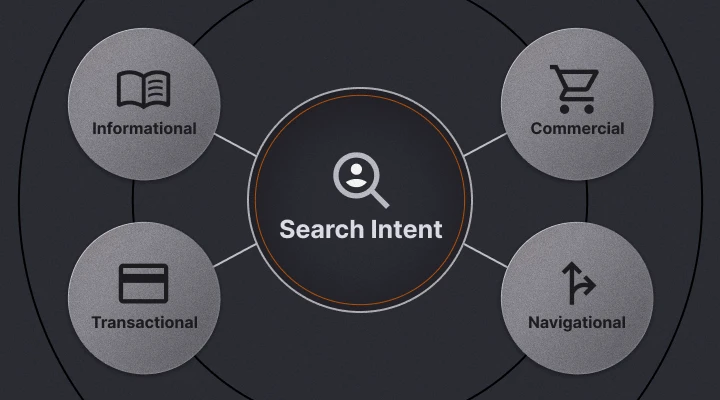
### Understanding Search Intent
Search intent represents the underlying purpose behind every search query, and it’s crucial for creating content that ranks well and satisfies users. When you align your keyword research with search intent, you improve both your search rankings and user engagement while reducing bounce rates. Understanding search intent helps you avoid the common mistake of targeting high-volume keywords that don’t match your content’s purpose.
This mismatch leads to poor user experience and lower conversion rates, which ultimately hurts your SEO performance. Smart marketers focus on intent-driven keyword research to build sustainable organic traffic growth.
The four main types of search intent include:
#### Informational Intent:
- Users seeking knowledge or answers to specific questions
- Examples: “how to do keyword research,” “what is SEO,” “benefits of content marketing”
- Content types: Blog posts, guides, tutorials, FAQ pages, educational resources.
- Optimization focus: Comprehensive answers, clear explanations, actionable insights
#### Commercial Intent:
- Users researching products or services before making purchase decisions
- Examples: “best keyword research tools,” “SEMrush vs Ahrefs comparison,” “keyword research software reviews”
- Content types: Comparison pages, product reviews, feature lists, buying guides
- Optimization focus: Detailed comparisons, pros and cons, pricing information, user testimonials
#### Transactional Intent:
- Examples: “buy SEMrush subscription,” “download keyword research template,” “sign up for free trial”
- Content types: Product pages, landing pages, checkout flows, subscription forms
- Optimization focus: Clear calls-to-action, pricing details, purchase information, trust signals
#### Navigational Intent:
- Users looking for specific websites or brand pages
- Examples: “Google Keyword Planner login,” “Ahrefs dashboard,” “SEMrush keyword magic tool”
- Content types: Brand pages, specific tool pages, login portals, company directories
- Optimization focus: Brand recognition, easy navigation, direct access paths
Analyzing search engine results pages (SERPs) for your target keywords reveals which content types Google rewards for specific queries. This analysis helps you create content that matches user expectations and search engine preferences, improving your chances of ranking success.
### Types of Keywords
Successful keyword research incorporates both broad head terms and specific long-tail keywords to create a comprehensive SEO strategy. Understanding the differences between these keyword types helps you make strategic decisions about which terms to target based on your website’s authority and goals.
#### Head Terms:
- 1-2 words in length with broad, general meanings
- High search volumes (often 10,000+ monthly searches)
- Intense competition from established, authoritative websites
- Lower conversion rates due to vague, unclear intent • Examples: “shoes,” “marketing,” “software,” “fitness”
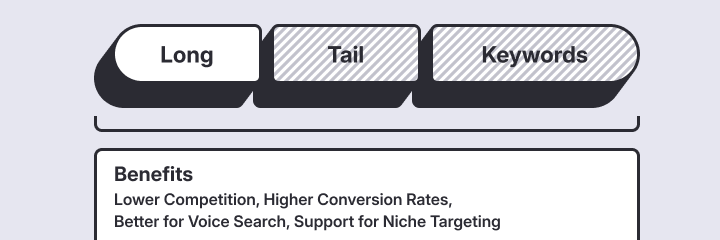
#### Long-tail Keywords:
- 3-5 words in length with specific, detailed meanings
- Lower search volumes (typically under 1,000 monthly searches)
- Less competition from other websites in your niche
- Higher conversion rates due to specific, clear intent
- Examples: “best running shoes for flat feet,” “email marketing automation software for small business”
Long-tail keywords make up more than 70% of all search engine queries, driven largely by the increasing use of voice search and conversational queries. These specific phrases encounter less competition and allow businesses to align their content more closely with user needs, attracting visitors who are more likely to convert.
#### The strategic approach involves targeting a balanced mix of both keyword types:
- Use head terms to establish topical authority and brand recognition
- Target long-tail keywords for quick wins and highly specific traffic
- Create content clusters that address related search queries comprehensively
- Build internal linking structures between related keyword targets
Identifying more keywords, including similar keywords, is essential for building a robust keyword list. By expanding your research to include these terms, you increase your chances of targeting the best keywords for your audience, maximizing relevance, search volume, and conversion potential.

## Step-by-Step Keyword Research Process
Conducting effective keyword research requires a systematic approach that balances creativity with data-driven analysis. This structured process helps you discover valuable keyword opportunities while avoiding common pitfalls that waste time and resources. Following a consistent methodology ensures you don’t miss important opportunities and helps you prioritize your efforts for maximum impact.
### Step 1: Topic Brainstorming
Begin your keyword research by identifying broad topics relevant to your business and audience needs. This foundational step sets the direction for your entire keyword research process and determines the scope of opportunities you’ll discover.
#### Primary Brainstorming Sources:
- Customer service inquiries and frequently asked questions from support tickets
- Sales team feedback about common customer concerns and objections
- Social media comments, messages, and engagement patterns
- Industry forums, community discussions, and Q&A platforms
- Competitor content analysis and market gap identification
- Internal team knowledge, expertise, and industry insights
Consider the problems your products or services solve, the questions your customers frequently ask, and the subjects that matter most to your target market. These real-world insights often reveal keyword opportunities that automated tools cannot discover on their own.
#### Organization and Planning Strategies:
- Group topics into themed categories or “content buckets” for better management
- Prioritize based on business relevance, customer importance, and resource availability
- Consider seasonal trends, trending topics, and timely opportunities
- Map topics to different stages of the customer journey and buying cycle
Draw insights from customer-facing team members in sales and support roles, as they possess firsthand knowledge about common customer inquiries and pain points. Analyze your competitors’ websites to discover which topics they’re targeting, potentially revealing content gaps in your own strategy that you can exploit.
### Step 2: Keyword Discovery
Use keyword research tools to expand your initial topic list into specific keyword opportunities that you can target with content. Using a keyword tool or free tool can help you find keywords efficiently, making it easier to discover relevant terms and optimize your strategy. This phase transforms broad topics into actionable keyword targets that you can optimize for and measure success against.
Start with your broad topics as seed keywords, then leverage tools to generate related terms, questions, and phrases your audience might use. Cast a wide net initially to ensure you don’t miss valuable opportunities that could drive targeted traffic to your site.
#### Primary Discovery Techniques:
- Input seed keywords into multiple research tools for comprehensive coverage
- Use free searches in tools like Ubersuggest to analyze keyword performance and related keywords
- Explore Google’s autocomplete suggestions for real-time search insights
- Analyze “People Also Ask” sections in Google search results
- Review “Related Searches” at the bottom of Google results pages
- Use question-based keyword tools like AnswerThePublic for content inspiration
- Examine competitor keyword strategies and content themes
Google’s autocomplete feature and “related searches” section provide valuable insights into real user queries and search behavior. These suggestions reflect actual search patterns and can reveal keyword opportunities that automated tools might miss or overlook. Additionally, Google’s Keyword Planner and Google Ads Keyword Planner are valuable resources for keyword discovery, offering data on search volume, competition, and trends to help refine your keyword list.
#### Advanced Discovery Methods:
- Analyze internal site search data for user query patterns and interests
- Review customer support tickets for common terminology and language
- Monitor social media conversations for trending topics and emerging language
- Use Google Trends to identify seasonal patterns and cyclical opportunities
- Explore industry-specific forums, communities, and discussion boards
Consider seasonal trends and emerging topics by examining Google Trends data alongside your keyword research tools. This helps you identify timely opportunities and understand how search patterns change throughout the year, allowing you to plan content accordingly.
### Step 3: Analysis & Evaluation
Evaluate each potential keyword based on three critical factors: search volume, competition level, and relevance to your business goals. This analysis helps you prioritize your keyword targets for maximum impact and return on investment.
**Search Volume Analysis:** Monthly search volume (MSV) serves as the primary indicator of user demand and traffic potential for any given keyword. Evaluating the average monthly search volume is crucial for assessing a keyword’s traffic potential and comparing it to actual estimated traffic for top-ranking pages. While higher volumes suggest greater traffic opportunities, they often come with increased competition from established websites. Rather than focusing on exact numbers, consider search volume ranges for more realistic expectations about potential traffic. Look for consistent volume trends over time to avoid keywords that experience dramatic seasonal fluctuations that might not align with your content strategy.
**Competition Assessment:** Keyword difficulty scores from research tools provide valuable insights into the ranking challenge level you’ll face for specific terms. High keyword difficulty indicates strong competition, making it more challenging to rank for those keywords, especially if their business value or search volume is not proportionally high. Ranking difficulty is a key metric for evaluating how challenging it is to rank for certain keywords, often estimated using factors like backlinks and domain authority. The domain authority of currently ranking pages reveals the competitive landscape strength and shows you what level of website authority you’re competing against. Content quality and depth of top-ranking results reveal the content standards needed to compete effectively in those search results. Additionally, the number and [quality of backlinks](https://www.wearetg.com/blog/toxic-backlinks/) to ranking pages indicate the link-building requirements necessary to achieve competitive rankings.
**Relevance Evaluation:** The most critical factor involves ensuring alignment between keywords and your products, services, and business objectives. Each keyword should match your target audience’s needs, problems, and search behavior patterns to drive qualified traffic. Consider whether the keyword fits with your content creation capabilities and available resources before committing to target it. Most importantly, evaluate the potential for conversion, engagement, and measurable business impact that each keyword can deliver for your specific situation.
Assess keyword difficulty scores to understand how challenging it will be to rank for specific terms. For newer or smaller websites, focusing on “low-hanging fruit” keywords with moderate search volumes and manageable competition often yields better results than targeting highly competitive terms.
#### SERP Analysis Techniques:
- Examine the top 10 results for each target keyword thoroughly
- Identify content types that rank well (articles, product pages, videos, tools)
- Analyze content length, depth, and quality of top-ranking pages
- Note featured snippets, local packs, and other SERP features present
- Analyze how much traffic top-ranking pages receive, as this can sometimes exceed the search volume due to ranking for multiple keywords or the presence of SERP features
Analyze the current search engine results pages (SERPs) for your target keywords to understand what type of content Google rewards. This reveals whether you need informational articles, product pages, or other specific content formats to compete effectively. When conducting competitor analysis, be sure to evaluate certain keywords that your competitors rank for, as this can inform and strengthen your own SEO strategy.
### Step 4: List Refinement & Prioritization
Transform your broad keyword list into a focused set of high-potential targets by filtering based on your analysis results. This refinement process ensures you invest time and resources in keywords that will deliver the best results for your specific situation. As part of this process, review all the keywords your website currently ranks for to identify opportunities for improvement and expansion.
#### Primary Refinement Criteria:
- Remove keywords with extremely high competition that exceed your website’s current authority
- Eliminate terms with very low search volume that won’t drive meaningful traffic
- Filter out irrelevant or off-topic keywords that don’t match your business
- Group related keywords into content clusters for comprehensive coverage
- Identify quick wins versus long-term targets for strategic planning
Prioritize keywords that align with your business objectives while considering your current website authority and available resources. Balance short-term wins with long-term growth opportunities by including both achievable keywords and aspirational targets.
#### Strategic Prioritization Framework:
- High relevance + Low competition = Immediate targets for quick wins
- High relevance + High competition = Long-term goals requiring sustained effort
- Medium relevance + Low competition = Content expansion opportunities
- Low relevance + Any competition = Remove from target list
Group related keywords together to create content clusters that can be addressed comprehensively rather than targeting each term individually. This approach builds topical authority and improves your overall search visibility across related terms.
## Keyword Clustering
Keyword clustering is a powerful technique in keyword research that involves grouping related keywords together based on their search intent, relevance, and search volume. By organizing keywords into clusters, you can better understand the themes and patterns within your keyword data, making it easier to create targeted content that addresses multiple related search queries at once.
Using a keyword research tool like Google Keyword Planner or Ahrefs, you can identify clusters of keywords that share similar meanings or intent. For example, if you’re researching the topic of “fitness,” you might find clusters around “home fitness routines,” “fitness tips for beginners,” and “best fitness equipment.” Each cluster represents a set of related keywords that can be targeted together within a single piece of content or across a series of related pages.
## Keyword Research Tools Comparison
Selecting the right keyword research tools can significantly impact the effectiveness of your SEO strategy and the quality of insights you gather. Understanding the strengths and limitations of different tools helps you make informed decisions based on your specific needs, budget constraints, and level of expertise. Choosing the best keyword research tool depends on your requirements for data accuracy, usability, and the features that align with your SEO goals.

### Free Tools
Several excellent free keyword research tools provide substantial value for businesses just starting their SEO journey or operating with limited budgets. These tools offer essential functionality without requiring financial investment, making them ideal for testing strategies and understanding keyword research fundamentals.
#### Benefits of Free Tools:
- No financial commitment required, perfect for beginners and small businesses
- Excellent for learning keyword research basics and developing foundational skills
- Provide access to Google’s own data and search insights
- Offer valuable insights into competitor strategies and market opportunities
#### Limitations to Consider:
- Restricted number of daily searches and query limitations
- Limited access to historical data and trend analysis
- Fewer advanced features compared to paid alternatives
- Free tools may not provide the depth of data needed for advanced paid search campaigns, such as those managed on Google Ads or Bing.
- Reduced customer support options and learning resources
### Google Keyword Planner
Google Keyword Planner remains the most widely used free keyword research tool, offering direct insights from the world’s largest search engine. While it requires a Google Ads account to access, the tool provides valuable data for both SEO and PPC campaigns without any subscription fees.
#### Key Features and Capabilities:
- Search volume ranges for keywords with seasonal trend data
- Competition levels specifically for paid advertising campaigns
- Keyword suggestions based on seed terms and website analysis
- Historical trend data and seasonal pattern identification
- Geographic and language targeting options for localized research
- Planning and optimizing Google Ads campaigns by analyzing keyword search volume, competition, and business value
The tool excels at discovering related keywords and providing historical trend data, though it displays search volumes in ranges rather than exact numbers. While Google Keyword Planner is primarily designed for paid search, it can also inform organic keyword research by highlighting potential organic ranking opportunities. This limitation is offset by the reliability and authenticity of Google’s data source, making it invaluable for validation.
### Ahrefs Webmaster Tools
Ahrefs Webmaster Tools provides advanced backlink analysis and organic keyword data for verified domains completely free of charge. This tool shows which keywords your website currently ranks for within the top 100 search results, offering detailed insights into your organic search performance.
#### Core Capabilities and Features:
- Current keyword rankings for your verified website with position tracking
- Organic traffic estimates and trends over time
- Comprehensive backlink profile analysis and monitoring
- Top-performing pages and content insights with traffic data
- Keyword opportunities and ranking improvement suggestions
The platform delivers comprehensive data about your site’s search visibility and helps identify specific areas where you can improve rankings. For verified websites, it provides detailed keyword ranking information that would typically require paid subscriptions from other providers.
### When to Upgrade to Paid Tools
Consider upgrading to paid keyword research tools when you encounter search limitations, need advanced features, or require detailed tracking capabilities that free tools cannot provide. A paid keyword tool typically offers more comprehensive data, advanced features, and greater usability for all skill levels compared to free options. The decision often depends on the scale and sophistication of your SEO efforts and business requirements.
#### Primary Upgrade Indicators:
- Consistently reaching daily search limits and needing more query capacity
- Requiring more detailed competitor analysis and market intelligence
- Needing advanced filtering and segmentation options for large keyword lists
- Managing multiple websites, clients, or complex SEO campaigns
- Seeking automated reporting and monitoring features for efficiency
#### Popular Paid Alternatives and Their Strengths:
- SEMrush: Comprehensive competitive analysis and market research capabilities
- Moz Pro: User-friendly interface with excellent educational resources and community
- Ahrefs: Extensive backlink database and advanced keyword research features
- KWFinder: Simple interface with accurate keyword difficulty assessment tools
The investment in paid tools often pays for itself through improved keyword targeting, better competitive intelligence, and more efficient research processes that save significant time and deliver better results.
## Advanced Keyword Research Strategies
Moving beyond basic keyword discovery requires implementing advanced strategies that uncover hidden opportunities and provide sustainable competitive advantages. These techniques help identify emerging trends, exploit competitor weaknesses, and maximize your keyword research ROI while building long-term market position.
### Long-tail Keyword Expansion Techniques
Long-tail keywords, and an effective [strategy built around them](https://www.wearetg.com/blog/keyword-types/), offer exceptional opportunities for websites looking to establish topical authority and attract highly qualified traffic. These specific phrases typically face less competition while delivering higher conversion rates due to their precise match with user intent and specific search needs.
#### Long-tail Keyword Advantages:
- Significantly lower competition from established, authoritative websites
- Higher conversion rates due to specific user intent and clear search purpose
- Easier to rank for in shorter timeframes with less link-building required
- Better alignment with voice search queries and conversational search patterns
- More cost-effective for paid advertising campaigns with lower cost-per-click
#### Strategic Expansion Methods
**Question-Based Keyword Development:**
- Use tools like AnswerThePublic for comprehensive question variations
- Analyze “People Also Ask” sections in Google results for related queries
- Monitor customer service inquiries for frequently asked questions
- Explore forum discussions, Q&A websites, and community platforms
**Modifier-Based Keyword Extensions:**
- Add geographic modifiers for local SEO opportunities (“keyword research services in Chicago”)
- Include temporal qualifiers for timely content (“best keyword research tools 2025”)
- Use comparison terms for competitive content (“keyword research tool vs competitor analysis”)
- Add problem-specific modifiers for targeted solutions (“keyword research for low traffic websites”)
**Voice Search Optimization Strategies:**
- Target conversational, natural language phrases that people actually speak
- Focus on question-based queries starting with who, what, where, when, why, how
- Consider local search patterns and mobile usage behaviors
- Optimize for featured snippets and direct answer formats
Create comprehensive content clusters around long-tail keywords by grouping related terms that address similar user needs. This approach allows you to cover topics thoroughly while targeting multiple keyword variations within a single, authoritative piece of content.
### Competitor Keyword Analysis
Analyzing competitor keyword strategies reveals valuable opportunities and helps identify market gaps you can exploit for competitive advantage. This competitive intelligence guides your content strategy and helps you understand what’s working effectively in your industry.
Identifying Relevant Competitors: Start by identifying direct business competitors operating in your specific market, as these represent your most immediate competition for keyword rankings. Look for websites consistently ranking for your target keywords, even if they’re not direct business competitors, since they compete for the same search visibility. Include content publishers and thought leaders in your industry who may not sell competing products but compete for attention and authority. Also consider sites receiving similar traffic volumes and targeting similar audiences, as these often pursue comparable keyword strategies.
Advanced Analysis Techniques: Use comprehensive tools like SEMrush or Ahrefs to analyze competitor domains thoroughly and understand their complete keyword strategy. Examine their top-performing content and primary keyword targets to identify what’s working well in your industry. Pay special attention to keywords where competitors rank on page 2 or at the bottom of page 1, as these often represent easier opportunities. Analyze their content gaps, missed opportunities, and weak points to find areas where you can provide superior coverage or better user experience.
Actionable Competitive Intelligence Applications: This research helps you discover new keyword opportunities you hadn’t previously considered, expanding your potential target list significantly. Identify content topics that drive significant traffic in your industry, giving you proven templates for successful content creation. Understanding keyword difficulty from real market data and competition provides more accurate assessments than tool estimates alone. Finally, this analysis can reveal link-building prospects and potential partnership opportunities with sites in your competitive landscape.
Focus specifically on keywords where competitors rank on page 2 or at the bottom of page 1, as these represent realistic opportunities for improvement. These “low-hanging fruit” keywords often require less effort to rank for while still providing meaningful traffic potential and business value.
## Common Mistakes in Keyword Research
Even experienced marketers can fall into common traps during the keyword research process. One frequent mistake is focusing solely on high volume keywords that are extremely competitive, making it difficult for newer or smaller sites to achieve first page rankings. Ignoring long tail keywords, which often have lower competition and higher conversion rates, can mean missing out on valuable traffic.
Another pitfall is failing to consider search intent when selecting keywords. Targeting keywords without understanding what users are actually looking for can result in content that doesn’t satisfy their needs, leading to high bounce rates and poor engagement.
Relying exclusively on a single keyword research tool can also limit your perspective. Each tool may provide different keyword data, so using a combination of tools helps you build more comprehensive keyword lists and uncover specific keywords you might otherwise miss.
Additionally, not updating or refining your keyword lists regularly can cause your strategy to become outdated as search trends and user behavior evolve. Finally, keyword stuffing—overusing keywords in your content—can harm user experience and search engine rankings. Instead, focus on creating valuable content that naturally incorporates your target keywords.
By avoiding these common mistakes, you can develop a more effective keyword research strategy that targets the right keywords, aligns with search intent, and drives meaningful results.
## Best Practices for Keyword Research
To get the most out of your keyword research, it’s important to follow a set of proven best practices. Start by brainstorming broad topics relevant to your business, then use keyword research tools to narrow down to specific keywords that align with your goals. Always consider search intent and relevance when evaluating which keywords to target—choose keywords that match what your target audience is actually searching for.
Use a variety of keyword research tools to gather keyword data from multiple sources, ensuring you don’t miss valuable keyword ideas. Group related keywords together and use keyword clustering to identify content opportunities and create comprehensive keyword lists.
Prioritize keywords based on their potential impact, feasibility, and alignment with your business objectives. Regularly update and refine your keyword lists to keep your strategy current as search trends and user behavior change.
By following these best practices—starting broad, using multiple tools, considering search intent, grouping related keywords, and continuously refining your keyword lists—you’ll be able to prioritize keywords effectively and build a keyword research strategy that drives traffic, conversions, and long-term growth.
## Implementation & Optimization
Successful keyword research extends beyond initial discovery to include ongoing monitoring, optimization, and strategic refinement processes. This continuous improvement approach ensures your keyword strategy remains effective as search trends evolve, competition changes, and your business grows.
### Monitoring Keyword Performance
Track your keyword rankings regularly using comprehensive tools like Google Search Console, which provides detailed performance data directly from Google’s search algorithm. This monitoring reveals which strategies work best for your specific situation and where adjustments are needed for improvement.
#### Essential Performance Monitoring Metrics:
- Identify cyclical patterns in keyword search volume over multiple years
- Compare seasonal trends across different years to spot consistent patterns
- Discover regional variations in seasonal interest and local opportunities
- Predict upcoming seasonal spikes for proactive content planning
#### Monitoring Tools and Implementation Techniques:
- Google Search Console for authoritative Google data and performance insights
- Dedicated rank tracking tools for comprehensive position monitoring
- Google Analytics for traffic analysis and conversion attribution
- Competitor analysis tools for market intelligence and benchmark comparison
Set up automated alerts for significant ranking changes, allowing you to quickly respond to algorithm updates, competitive threats, or content performance issues. Analyze user behavior metrics alongside ranking data to ensure your keyword targeting aligns with actual user needs and search intent.
### Updating Your Strategy
Refresh your keyword research every three months to account for changing search trends, seasonal variations, and evolving user behavior patterns. Search patterns shift continuously, and yesterday’s high-performing keywords may lose relevance or become more competitive over time.
#### Strategy Update Triggers and Indicators:
- Significant algorithm updates from Google that affect search rankings
- Changes in business focus, target market, or strategic objectives
- New product launches, service offerings, or market expansion
- Seasonal shifts in search behavior and user interest patterns
- Emerging competitors or significant market disruption events
#### Comprehensive Strategy Refresh Process:
- Analyze performance of current keyword targets with detailed metrics review
- Identify new keyword opportunities in your market and related niches
- Update competitor analysis and market research with fresh data
- Refresh content plans based on performance data and emerging trends
- Adjust resource allocation based on ROI analysis and strategic priorities
Incorporate new keyword opportunities discovered through ongoing content performance analysis and direct customer feedback. Adjust your keyword strategy based on business changes, new product launches, or shifts in your target market to maintain relevance and effectiveness.
## Conclusion & Next Steps
Effective keyword research forms the backbone of [successful SEO](https://www.wearetg.com/services/seo/) strategies, connecting your content with the specific terms your audience uses to find solutions. By implementing systematic research processes, leveraging appropriate tools, and focusing on user intent, you can identify keyword opportunities that drive meaningful business results and sustainable growth.
Start by choosing tools that match your budget and expertise level, conducting thorough competitive analysis, and developing content that addresses real user needs rather than just search volume numbers. Remember that keyword research is an ongoing process requiring regular updates and strategic refinement as search trends evolve and market conditions change.
---
#### Build a Keyword Strategy That Drives Qualified Traffic
Keyword research isn’t about collecting a huge list of terms. It’s about understanding search intent, finding the opportunities your competitors miss, and building a roadmap that turns content into qualified traffic and measurable business outcomes. If your keyword strategy feels scattered, outdated, or focused on rankings without results, it’s time to tighten the research process and prioritize what moves the needle.[ **Schedule a 30-minute consultation** ](https://www.wearetg.com/contact/)with Timmermann Group to break down where your keyword strategy is leaking value and how to turn smarter targeting into measurable conversions.
[](https://www.wearetg.com/contact)
---
## Frequently Asked Questions
#### What is keyword research, and why is it important?
Keyword research is the process of identifying and analyzing the search terms that people enter into search engines when looking for information, products, or services. It helps businesses understand their audience’s search behavior, optimize their content accordingly, and improve their visibility in search results.
#### Why is search intent more important than search volume?
Search intent ensures your content matches what users actually want to find, leading to better rankings, higher engagement, and improved conversion rates. Understanding intent helps you create content that satisfies user needs rather than simply targeting high-volume keywords that may not align with your business goals.
#### What are the best free keyword research tools available?
Google Keyword Planner, Ahrefs Webmaster Tools, and Ubersuggest offer excellent free functionality for keyword research. Each provides unique features like search volume data, competitor analysis, and keyword suggestions without requiring paid subscriptions, making them ideal for beginners and small businesses.
#### How can long-tail keywords benefit my SEO strategy?
Long-tail keywords face less competition, often convert better due to their specificity, and help you rank faster than broad terms. They make up over 70% of search queries and allow you to target very specific user needs and questions, often resulting in higher-quality traffic.
#### When should I consider upgrading from free to paid keyword research tools?
Consider upgrading when you consistently reach search limits, need advanced features like detailed competitor analysis, or require comprehensive tracking capabilities. Paid tools offer larger databases, more sophisticated analytics, and additional SEO features that support complex optimization strategies and larger-scale operations.
**Categories:** SEO
---
### [The 6 Foundational Components of SEO for Online Visibility](https://www.wearetg.com/blog/components-of-seo/)
**Published:** October 14, 2025
**Author:** Rob Timmermann
**Content:**
The difference between websites that dominate search results and those that remain invisible isn’t luck; it’s understanding and implementing the core components of [search engine optimization](https://www.wearetg.com/services/seo/ "SEO") that search engines actually reward. Whether you’re starting from scratch or looking to improve an existing strategy, mastering these six essential parts of SEO can help transform your website from a digital afterthought into a visible, traffic-generating asset.
## Key Takeaways
- Prioritize core SEO elements – keyword research, on-page optimization, content creation, off-page SEO, technical SEO, and user experience – to enhance website visibility.
- Conduct thorough keyword research to align your content with user intent, ensuring better targeting and improved chances of ranking high in search results.
- Create a holistic SEO strategy that integrates all key components, maximizing your website’s performance and alignment with the needs of qualified users.
## The Core Elements of SEO
SEO, or [Search Engine Optimization](https://www.wearetg.com/services/seo/), is a complex practice designed to elevate a site’s presence on search engine platforms. As detailed a field as SEO is, the core elements consist of a handful of critical areas:
- Conducting keyword research
- Refining on-page elements
- Creating valuable content
- Building off-page authority indicators
- Refining technical aspects of the site
- Optimizing for user experience (UX)
Each of these elements plays a vital role in creating a comprehensive SEO strategy that drives organic traffic and improves search visibility. Let’s explore how each component contributes to your overall optimization efforts.

## Conducting Keyword Research
Keyword research serves as the foundation for all SEO efforts, identifying the terms and phrases your target audience uses when searching for relevant content. This essential part of SEO involves analyzing search volume, competition levels, and user intent to discover opportunities that align with your business goals.
### Why Keyword Research Matters
- Attracts visitors actively searching for your products or services
- Provides direction for creating content that matches user search intent
- Identifies low-competition keywords with high ranking potential
- Ensures SEO efforts target keywords that drive business results
- Helps organize content to avoid competing against your own pages
### Essential Keyword Research Tools
Effective [keyword research](https://www.wearetg.com/blog/keyword-types/) can be conducted using tools like Google Keyword Planner, SEMrush, or Ahrefs. These tools help you analyze search volume and competition, allowing you to identify high-potential keywords. Understanding which keywords are most relevant to your target audience will enable you to create content that aligns with their search behaviors and needs.
### Keyword Mapping and Organization
Keyword mapping is another essential aspect of this process. It involves selecting the most appropriate page for each keyword to avoid keyword cannibalization and ensure your content is effectively targeted. Tools like SEMrush or Ahrefs can help you determine which pages are currently ranking and adjust as needed.
### Understanding Search Intent
Ultimately, the goal of keyword research is to match your content with the search intent of your audience. By doing so, you can improve your chances of appearing in search engine results and driving organic traffic to your site. As Google’s John Mueller has often emphasized, understanding search intent is key to creating content that meets user needs and performs well in search rankings.

## Refining On-Page Elements
On-page SEO optimization involves fine-tuning individual page components to improve search engine understanding and user experience. This crucial piece of SEO includes title tags, meta descriptions, headings (H1, H2, H3), URL structures, and linking strategies that help search engines comprehend your content’s context and relevance.
### Why On-Page Optimization Matters
- Helps search engines quickly identify what your page is about
- Optimized title tags and meta descriptions encourage more clicks from search results
- Well-structured content with clear headings improves readability and navigation
- Strategic internal linking distributes authority throughout your website
- Proper formatting increases the chances of appearing in featured snippets
### Title Tags and Meta Descriptions
One of the most crucial aspects is optimizing title tags, as they provide search engines with a high-level overview of your page content. Including keywords in your URLs can help search engines understand your page’s content and improve its ranking potential. Meta descriptions are equally important, as they briefly summarize your page’s content and can influence click-through rates from search engine results.
### Image Optimization and Alt Text
Image tags are another important element of on-page SEO. They improve website accessibility and help search engines understand the relevance of your images, enhancing both user experience and SEO. Confirm that any employed content management system adheres to recognized on-page SEO practices, including assigning descriptive filenames for visuals alongside suitable alt text explanations, aiding in image comprehension by various search engines.
### Internal Linking Strategy
Internal linking is a powerful on-page SEO technique involving linking to other internal website pages using hyperlinks between pages. This helps search engines crawl your site more effectively and understand the relationship between important pages and other pages on your site. Linking to your most important pages ensures they are easily accessible and prioritized by search engines, which can improve their indexing and ranking.
### Structured Data Implementation
Structured data markup, such as schema markup, can also enhance your search results by providing additional information that can increase click-through rates. Schema markup is a type of structured data that helps search engines better understand your content and can improve the appearance of your listings with rich snippets.
## Creating Valuable Content
[Content creation](https://www.wearetg.com/blog/types-of-content/) focuses on developing meaningful, relevant information that satisfies user intent and meets search engine quality standards. As one of the most important elements of SEO, valuable content addresses your audience’s questions, provides solutions to their problems, and demonstrates expertise in your field.
### Why Content Creation Matters
- Demonstrates expertise and builds trust with both users and search engines
- High-quality content earns links from other websites without active outreach
- Engaging content keeps visitors on your site longer, signaling quality
- Comprehensive content naturally ranks for multiple related search terms
- Valuable content positions your business as an industry thought leader
### High-Quality Content Development
At the core of search engine optimization lies content creation. Producing high-quality content that matches user intent is essential for boosting SEO performance. It not only draws in users but also communicates to search engines the value your site provides, which can greatly affect your position in rankings. Well-crafted content can also earn natural links from other websites, which are valuable for SEO and contribute to sustainable growth.
### Content Optimization Techniques
In crafting content, it’s vital to incorporate pertinent keywords and utilize distinct headings and subheadings while ensuring readability and scannability. This practice aids both search engines in deciphering your page contents and improves overall user experience on your site. Adding a variety of formats like videos, infographics, and images can heighten engagement and satisfaction among users.
### Content Maintenance and Updates
It’s equally important to keep updating and refining existing content to uphold its relevance. This action enhances visibility within search results pages (SERPs). Conducting in-depth content audits helps identify areas for improvement and ensures your material remains competitive. Monitoring engagement metrics such as time spent on-page or bounce rates gives valuable insights into the quality of your material.
## Building Off-Page Authority Indicators
Off-page SEO encompasses external strategies that enhance your website’s credibility and reputation beyond your domain. This part of SEO includes acquiring high-quality backlinks from reputable websites, earning brand mentions across the web, and leveraging social media activity to demonstrate trustworthiness.
### Why Off-Page SEO Matters
- Quality backlinks signal to search engines that your site is trustworthy and valuable
- Links from other websites drive direct visitors to your content
- Brand mentions and social signals expand your online presence
- Strong off-page signals help you outrank competitors in search results
- External links help search engines discover and index your content faster
### Link Building Strategies
[Link building](https://www.wearetg.com/blog/link-juice/) is a key off-page SEO tactic focused on acquiring backlinks from other sites and other websites. Google’s John Mueller has reiterated Google’s official stance that “a link is a link” and emphasized the importance of focusing on link quality over quantity to avoid spam and penalties. Establishing backlinks from well-respected, reputable other sites and other websites is especially valuable for improving your website’s authority.
### Brand Mentions and Social Signals
Engaging with brand mentions and customer feedback also aids in fortifying your website’s credibility. While their immediate effect on ranking positions can be ambiguous, they foster confidence within your user base and send important signals that Google and other search engines use to evaluate authority. Social media marketing has a knock-on effect by generating discussion around your brand, which may lead to additional backlinks and name-drops.
Off-page-focused SEO includes a variety of SEO tactics beyond just link building, such as brand mentions and social engagement. By concentrating on securing top-tier backlinks along with nurturing relationships with followers via social platforms, you enrich efforts toward successful off-page SEO outcomes.
## Refining Technical Aspects of the Site
Technical SEO focuses on optimizing the underlying structure and performance of your website. This comprehensive aspect of SEO encompasses four key categories: crawlability, indexability, site architecture, and performance. These technical elements provide the foundation that allows search engines to efficiently evaluate and rank your website.
### Why Technical SEO Matters
- Proper technical setup allows search engines to crawl and index your content
- Fast-loading sites provide better user experience and ranking advantages
- Mobile-optimized sites capture the majority of search traffic effectively
- Proper technical configuration avoids duplicate content and crawl errors
- Strong technical foundation handles increased traffic and content growth
### Page Speed and Core Web Vitals
Page speed is a crucial ranking factor for search engines and a key component of a successful SEO strategy. A fast-loading web page not only improves your position in search engine results but also enhances the user experience, leading to higher engagement and conversion rates. Google has acknowledged that page speed serves as a direct ranking factor, citing that over half of users will abandon a mobile site if loading takes longer than one to two seconds.
Core Web Vitals are a set of essential metrics introduced by Google to measure a website’s performance and user experience. These metrics, Largest Contentful Paint (LCP), First Input Delay (FID), and Cumulative Layout Shift (CLS), focus on how quickly your site loads, how responsive it is to user interactions, and how visually stable it remains as content loads.
### Mobile Optimization
Mobile friendliness is no longer optional; it’s a necessity for any modern SEO strategy. With the majority of queries now coming from mobile devices, search engines like Google prioritize mobile-friendly websites in their search results. A mobile-friendly website should feature a responsive design that automatically adjusts to fit any screen size, ensuring a seamless user experience whether someone is browsing on a smartphone, tablet, or desktop.
### Security and Technical Infrastructure
Adopting HTTPS ensures customer data protection and factors into Google’s ranking criteria. Structured data markup also contributes by enhancing listed information within search outcomes, which may boost click-throughs. A web crawler, the automated bot used by search engines, scans and indexes website content to determine search rankings.
### Addressing Duplicate Content Issues
Duplicate content can be a significant obstacle to achieving strong search engine rankings and attracting organic traffic. When identical or very similar content appears on multiple web pages, search engines may struggle to determine which version to show in search results. To tackle duplicate content, it’s important to implement solutions like canonicalization, which tells search engines which version of a page is the preferred one.
## Optimizing for User Experience (UX)
[User experience optimization](https://www.wearetg.com/blog/enhancing-user-experience-better-engagement/) creates an intuitive, appealing journey for visitors exploring your site. This vital component of SEO includes improving page loading speeds, ensuring mobile responsiveness, creating clear navigation structures, and designing layouts that facilitate easy content consumption.
### Why User Experience Matters
- Better UX keeps visitors engaged and exploring more pages on your site
- Smooth user journeys lead to more desired actions and business outcomes
- Search engines use user behavior signals as ranking factors
- Positive experiences encourage repeat visits and customer retention
- Inclusive design ensures your content reaches the widest possible audience
### Site Navigation and Architecture
The organization of website navigation should be straightforward and intuitive, assisting both users and search engine crawlers in locating content efficiently. Creating a logical site hierarchy that makes sense to both users and search engines is essential. Ensure that your most important pages, such as category or pillar pages, are easily accessible from the homepage and are linked to from other pages within your site.
### User Engagement Metrics
Ensuring a satisfactory user experience is essential for SEO, as search engines favor websites that facilitate smooth navigation and swift page loads. Data indicates that 88% of consumers are unlikely to return to a website after a poor encounter, potentially increasing bounce rates and diminishing rankings.
### Conversion Optimization
Striking harmony between UX design elements with an eye on SEO demands crafting an interface that not only caters well to human visitors but also aligns neatly with search engine requirements. Embedding clear calls-to-action (CTAs) within your site promotes active visitor participation while directing them toward desired actions seamlessly, a practice that boosts engagement metrics known by search engines as indicators of high-quality content.
## Implementing a Holistic SEO Strategy
For optimal outcomes, it’s vital to integrate all elements of SEO into a comprehensive approach. Each pillar is critical for enhancing your website’s visibility and driving organic traffic, and understanding how these pieces of SEO work together creates powerful synergy for better search rankings.
### Integrating SEO Components
On-page optimization involves refining elements like title tags, content, and internal linking strategies to boost the visibility of webpages on search engines. Elevating the performance of certain pages through links from well-established ones can make a notable difference in their search engine rankings. Google ranks content based on its quality, contextuality with respect to user queries (search intent), and keyword relevance, among other factors.
### SEO Tools and Measurement
Utilizing tools such as Google Keyword Planner, Ahrefs, and SEMrush enables you to identify potent keywords while also gauging your overall page SEO effectiveness. By weaving these various aspects into one consolidated strategy for page SEO improvement, you create more powerful synergy, which fosters better positioning in searches, resulting in amplified organic visits.
### Understanding Search Engine Algorithms
Understanding how search engines work is fundamental to building a successful SEO strategy. Search engines like Google, Bing, and Yahoo use sophisticated algorithms to crawl, index, and rank web pages in response to user queries. The process begins when search engines crawl websites using web crawlers, or spiders, which systematically browse the web to discover new and updated content.
A few actionable SEO tips: regularly update your content, optimize images with descriptive alt text, and ensure your site loads quickly to support your holistic strategy. Overall, this integrated tactic serves to amplify online presence via robust improvements across different aspects governing modern-day SERP standings, leading to enhanced audience reach organically driven by smart strategic planning around key focus areas.
### Advanced SEO Considerations
Beyond the core components of SEO, several advanced strategies can further enhance your website’s performance and visibility in search results. These specialized areas require additional attention but can provide significant competitive advantages.
### Local SEO and Building Your Online Presence
[Local SEO](https://www.wearetg.com/blog/local-seo-best-practices/) is essential for businesses that want to attract customers in a specific geographic area. By optimizing your website for local search queries, you can increase your visibility in local search results and connect with potential customers nearby. Start by creating and verifying your Google My Business listing, which helps your business appear in Google Maps and local search results.
Building high-quality local citations, mentions of your business on other reputable websites, can further boost your local SEO efforts. Engage with your community by creating content tailored to local interests, such as blog posts about local events, customer reviews, and social media updates.
### Measuring SEO Success
Tracking and measuring SEO success is essential for refining your strategy and achieving long-term growth. Key performance indicators (KPIs) such as organic traffic, search engine rankings, and conversion rates provide valuable insights into how well your SEO efforts are performing. Tools like Google Analytics and Google Search Console allow you to monitor website traffic, analyze queries, and understand user behavior on your site.
In addition to Google’s tools, platforms like Ahrefs, SEMrush, and Moz offer advanced analytics and tracking features, helping you keep a close eye on your SEO performance. By regularly reviewing these metrics, you can identify which strategies are working and make data-driven decisions to enhance your website’s visibility.
### Common SEO Mistakes to Avoid
Avoiding common SEO mistakes is crucial for building a solid foundation and ensuring the long-term success of your SEO strategy. One frequent error is keyword stuffing, overusing keywords in an attempt to manipulate search rankings, which can actually harm your site’s visibility. Duplicate content is another pitfall, as it confuses search engines and can dilute your ranking power across multiple web pages.
Neglecting technical SEO aspects such as site architecture, cross-linking of internal pages, and structured data markup can make it difficult for search engines to properly crawl and index your pages. Slow page speed and poor mobile friendliness not only frustrate users but also negatively impact your rankings.
### Staying Up-to-Date with SEO Trends
The world of SEO is always evolving, with new trends, technologies, and algorithm updates shaping the way websites are ranked in search results. Staying up-to-date with the latest SEO trends is vital for maintaining a competitive edge and ensuring your SEO strategy remains effective.
Follow industry leaders, attend SEO conferences, and regularly read reputable SEO blogs to keep informed about changes such as updates to Google’s ranking factors, including Core Web Vitals. Emerging trends like voice search optimization, artificial intelligence in search, and evolving user behaviors can all impact how your website performs in search engines.
## Summary
While the SEO world buzzes with excitement over the latest AI tools and cutting-edge tactics, the reality is surprisingly straightforward: websites that consistently rank well master the fundamentals first. The six components of SEO outlined in this guide aren’t glamorous or revolutionary; they’re the proven foundation that separates thriving websites from digital ghost towns. Whether you do it yourself or work with industry pros, consistently executing these core elements of SEO will quietly build the sustainable, long-term visibility that actually moves the needle for your business.

#### Are All Six Components of Your SEO Strategy Working Together?
Strong SEO isn’t built on one tactic. It’s built on alignment between keyword strategy, content, technical performance, authority signals, and user experience. If even one foundational component is weak, your visibility, traffic, and conversions will feel it.[ **Schedule a 30-minute consultation** ](https://www.wearetg.com/contact/)with Timmermann Group to uncover which parts of your SEO foundation are leaking value and how to turn stronger visibility into measurable conversions.
[](https://www.wearetg.com/contact)
---
## Frequently Asked Questions
### What are the main components of SEO?
The main components of SEO include keyword research, content creation, on-page optimization, off-page SEO (link building), technical SEO, and user experience optimization. These six core elements work together to improve your website’s visibility in search engine results.
### What are the 4 pillars of SEO?
The 4 pillars of SEO are on-page SEO, off-page SEO, technical SEO, and content creation. These fundamental components of SEO work together to improve your website’s search engine visibility and ranking potential.
### What are the 3 C’s of SEO?
The 3 C’s of SEO are Content, Code, and Credibility, representing the essential elements for search engine success. These three components of SEO work synergistically to create websites that rank well and satisfy both users and search engines.
### What are the 4 steps of SEO?
The 4 steps of SEO are keyword research, on-page optimization, content creation, and off-page promotion. Following these steps ensures you systematically address all core elements of SEO for maximum search engine performance.
### How does content creation impact SEO?
Creating high-quality content that matches what users are searching for is crucial for boosting your SEO and improving user experience. Content serves as the backbone for all other parts of SEO, providing substance for search engines to index and users to engage with.
### Why is off-page SEO important?
Off-page SEO is essential as it significantly boosts your website’s authority and credibility through quality backlinks from trusted sites. This aspect of SEO signals to search engines that your content is valuable and trustworthy, improving your search rankings and attracting more visitors.
### How does user experience affect SEO?
A favorable user experience has a considerable effect on SEO as it increases engagement and lowers bounce rates, which in turn improves your website’s rankings. UX is now considered one of the critical elements of SEO that directly impacts how search engines evaluate and rank websites.
**Categories:** UX, SEO, LSO
---
### [Social Media Graphics: The Ultimate Guide](https://www.wearetg.com/blog/social-media-graphics/)
**Published:** November 2, 2025
**Author:** Rob Timmermann
**Content:**
Achieving a truly thriving online presence requires strategic utilization of [social media marketing](https://www.wearetg.com/services/social-media-marketing/), and that includes the graphics you share with followers. Social media graphics should be visually captivating and strategically designed to engage users. Whether you aim to boost brand awareness, drive engagement, or increase conversions, harnessing the power of effective social media graphics can significantly enhance your online presence.
In this guide, we’ll explore the significance of these graphics, best practices for creating them, and how they can help revolutionize your strategy and achieve your digital marketing goals.
## What is Social Media Design?
Social media design is a specialized form of graphic design tailored specifically for platforms like Facebook, Instagram, Twitter, and LinkedIn. Designing for social media requires ideation, planning, and aesthetic development of social pages. Creating social media graphics is part of those aesthetics. Unlike traditional graphic design, social media design takes into account factors such as platform requirements, user engagement, and shareability.
There are several types of social media graphics that fall under this type of design, including:
- Social media post graphics
- Story graphics and templates for Instagram and LinkedIn
- Cover and profile picture images
- Highlight covers
- Covers for new formats, such as the Instagram Reel
These graphics can be strategically used by brands to educate customers about their products, provide insight into the unique benefits of their products or services, share industry insights, showcase customer reviews, ask questions to encourage engagement, and much more.
### Social Media vs. Print Design: What’s the Difference?
Both social media and print design aim to communicate messages effectively, albeit in different contexts and mediums; however, that’s not the only way they differ. Social media design thrives on interactivity, engagement, and shareability, while print design focuses solely on static visuals intended for physical distribution. Here’s how else they differ:
**Investment:** Social media ads generally cost less than print ads, allowing your advertising budget to be used more strategically. Using social media, you can pinpoint only those audiences that are most likely to care about what your business has to offer. Print may boast a large readership, but not all of those individuals will be interested in your products or services. Social media can reach a larger audience, and with more precise targeting, it becomes a wiser investment.
**Performance Tracking:** Understanding how well your advertising works is crucial to informing future campaigns. You won’t know if your print design is effective unless you manually track calls or visits directly related to the ad, or implement specific tracking techniques, such as unique phone numbers or website URLs. Tracking this performance takes time, as not every print media piece is read simultaneously. With social media, you can track ad performance in real time over the course of the campaign. Social analytics offer insight into audience targeting, ad conversions, and ad performance, allowing your team to optimize when necessary to better meet your performance goals.
**Direct Communication:** Once your print design is out in the world, you have to wait for customers to reach out, and there’s no opportunity for direct engagement. With social media posts, you can communicate with customers as they interact with the content. This communication can encourage conversions as it shows your commitment to offering customer support and transparency. Designing social media graphics should focus on encouraging engagement and communication rather than simply sharing one-sided information.
**Evolving Trends:** Print design remains fairly consistent, with any emerging trends taking a slow rollout. Social media involves constantly changing trends, requiring ad managers to stay updated on the latest policies and user expectations. For smaller internal teams or business managers trying to manage social media advertising independently, keeping up with these rapidly evolving trends can be overwhelming.
## The Impact and Importance of Quality Social Media Designs
Quality social media graphics are not just visually appealing; they are also powerful tools for capturing attention, communicating your brand identity, driving engagement, and conveying information quickly. Various statistics support the effectiveness of social media graphics:
- Visual content is over 40 times more likely to be shared than other content on social media
- Infographics receive three times more likes and shares on social than other content types
- Using the right brand colors when you create social media graphics increases brand recognition by up to 80%
- Brands using consistent presentation across social media templates are three to four times more likely to experience brand visibility
- Content posted with relevant imagery receives 94% more views than posts without
Based on these statistics, there’s no question that a thoughtfully crafted social media graphic can make a big impression on users and achieve a positive result for your business.
## Key Principles of Social Media Design
Exploring the fundamental principles of social media design ensures you create [stunning social media graphics](https://www.wearetg.com/services/graphic-design/) that consistently resonate with your audience and support your marketing goals.
### Keep it Simple
Simplicity is key in social media design. Avoid cluttering your designs with unnecessary elements, and focus on delivering your message clearly and concisely. Here are some tips for keeping it simple:
- Start with a clear objective for each graphic. What do you want your audience to take away?
- Use whitespace strategically to give your design room to breathe and draw attention to key elements.
- Limit the number of fonts and colors to maintain visual consistency and readability.
- Embrace minimalist design elements like clean lines, simple shapes, and uncluttered layouts.
### Use Consistent Branding
Consistency is key to building brand recognition and trust on social media. Maintain a cohesive look and feel across all major social media platforms through consistent colors, fonts, and design elements that reflect your brand identity. Here’s how to use consistent branding effectively:
- Establish brand guidelines that dictate your color palette, typography, imagery style, and logo usage.
- To reinforce your brand identity, consistently use branded elements such as logos, colors, and fonts in your graphics.
- Create social media templates for recurring content types, such as quotes or product promotions, to maintain visual consistency.
- Regularly audit your social media profiles to ensure all graphics adhere to your brand guidelines.
### Prioritize Visual Hierarchy
Visual hierarchy guides the viewer’s eye through your content, directing attention to the most important elements and messages. Leverage visual cues to create designs that are visually engaging and easy to navigate. Here’s how to prioritize visual hierarchy:
- Identify the primary focal point of your graphic and make it the most visually prominent element.
- Use contrasting colors, sizes, and fonts to differentiate between different elements and create a hierarchy.
- Group related elements together and use whitespace to separate distinct sections of your design.
- Consider your audience’s reading patterns and arrange elements accordingly, placing the most important information where it’s most likely to be seen first.
### Optimize for Mobile
Given the increasing number of users accessing social media via mobile devices, it’s crucial to ensure your designs are optimized for smaller screens to maximize engagement and reach a wider audience. Here are some tips for optimizing your designs for mobile:
- Choose a responsive design approach that adapts your graphics to different screen sizes and orientations.
- Use legible fonts and avoid small text sizes that may be difficult to read on mobile devices.
- Keep important information and calls to action within the “thumb zone”—the area of the screen that’s easily reachable with one hand.
- Test your designs on various mobile devices and platforms to ensure they display correctly and function smoothly.
### Experiment with Formats
Don’t be afraid to explore different content formats to keep your social media presence fresh and engaging. Experimenting with images, videos, carousels, and Stories can help you discover what resonates best with your audience and drive higher levels of engagement. Here’s how to do so effectively:
- Analyze your audience’s preferences and behavior to identify which content formats are most popular.
- Test different formats and variations of content to see what generates the highest levels of engagement and response.
- Keep an eye on emerging trends and platform features to stay ahead of the curve and capitalize on new opportunities.
- Don’t be afraid to take risks and think outside the box—sometimes, the most unexpected formats yield the best results.
## Social Media Graphics Best Practices: Tips for Creating Engaging Designs
There is no one-size-fits-all solution to creating social media graphics, but there are several best practices to follow to achieve the greatest results.
- **Build a Clear Visual Strategy:** Every social media strategy should be driven by a purpose, follow a cohesive narrative, post with ideal timing, and more. Your visual strategy should include comprehensive audience research, a mood board, recurring themes, platform adaptation strategies, and planned post-timing via a production calendar.
- **Know Design Basics:** Effective social media graphics should be created by individuals who have a grasp of design basics at a minimum. Such basic design principles should be firmly understood, including having a clear subject, following the rule of thirds, utilizing natural light, ensuring enough contrast, choosing complementary colors, keeping it simple, and avoiding over-editing.
- **Take Advantage of Free Social Media Templates, Tools, and Resources:** Although it is highly recommended to hire a photographer or[ experienced graphic designer](https://www.wearetg.com/services/graphic-design/) to create custom, branded content, many free resources may be able to help when budgets are tight. These may include free stock imagery, customizable Story templates, editing apps, and more. Just be sure to choose wisely and be cautious of anything that looks outdated or conflicts with your brand messaging.
- **Create Images to Sizing Specs:** The wrong image sizes can kill otherwise stunning social media graphics. Incorrect aspect ratios can be stretched, cropped, and smashed, creating an out-of-proportion image that poorly reflects your brand. Every social media platform has its own specifications, so all graphics will need to be formatted for every platform you intend to publish them on. Additionally, consider all the devices your audience will be using and preview all posts before publishing to ensure nothing important is cropped out.
- **Be Strategic with Text:** Fewer words are best, from quotes to text overlays. Any text you include on social media designs should always be bold, legible, straightforward, and concise, with enough contrast to the background to make it easy to read. Web Content Accessibility Guidelines (WCAG) recommend using a 4.5 to 1 contrast. All text should be spell-checked, written in a legible font, formatted with WCAG-recommended colors, and short in length.
- **Reflect Your Audience:** Be mindful of your audience and use visuals that accurately reflect who they are and what your brand stands for. If your brand supports diversity, fights against gender or racial stereotypes, or promotes body positivity, all imagery should follow suit.
- **Ensure Accessibility:** Users of all abilities can access your content, so designs should be produced with accessibility in mind. This also helps you reach a broader audience and adds more appeal to your brand over competitors who may not be as inclusive. Accessibility includes creating alt-text image descriptions, video captions, and descriptive transcripts for audio or video posts.
- **Remember SEO:** Although social media graphics aren’t directly placed on your website, they should still be optimized for search engines. Adding keywords, title tags, and image alt text can help users find your social pages through search engines or by clicking on related hashtags.
- **Be Creative:** Creativity comes easily to some, but when you’re told to “be creative,” it can be challenging. Winning awards for creative work is great, but the biggest rewards for these graphics are the likes, comments, shares, and sales you receive directly from customers engaging with your social media channels. The more creative and unique your designs (that align with your branding), the more attention it will undoubtedly receive.
## Creative Social Media Designs to Capture User Attention
Looking for some inspiration for your social media designs? Here are some of the latest award-winning graphics created by our social media designers at Timmermann Group. Each helped capture the attention of the target audiences and delivered the company’s impactful messages.
### Boom Pilates – Instagram \| 2024 Gold Winner from the Hermes Creative Awards

This campaign was started with the ultimate goal of enhancing Boom Pilates studio’s digital engagement and brand awareness. Timmermann Group’s social team utilized innovative digital marketing strategies, combining traditional and modern technologies, to enhance their digital presence and brand recognition, emphasizing Boom’s unique Pilates approach. The goal was to achieve measurable growth in their online community and website traffic, establishing Boom as a benchmark for digital communications excellence in the wellness industry.
The social media marketing objective for Boom was to build community engagement and brand advocacy. The team worked to boost follower engagement on Instagram by creating compelling and creative content that demonstrated the unique Pilates methodology through stories, posts, and reels. We also encouraged community participation by inviting followers to share their own Pilates stories and experiences, thereby enhancing brand loyalty, increasing user-generated content, and elevating Boom’s reputation as a pioneering, community-focused Pilates studio.
The primary key performance indicators (KPIs) we focused on were organic engagements, organic reach, organic views, and follower growth. The campaign featured three different styles of social media graphics — photography, graphic design, and video reel — each working to achieve the desired KPIs. Here are some of the key statistics from these top-performing ads:
- **Photography Social Media Graphic:**
- Reach: 1,134
- Likes: 140
- Comments: 18
- Shares: 10
- Profile Visits: 45
- **Graphic Design Ad:**
- Reach: 594
- Likes: 54
- Shares: 7
- Profile Visits: 14
- Accounts Engaged: 56
- **Video Reel:**
- Plays: 2,317
- Reach: 1,522
- Likes: 47
- Comments: 13
- Total Watch Time: 2hr 53min 59sec
Over the entirety of 2023, Timmermann Group was able to grow Boom’s follower count by 3,927 and achieve a total of 5,827 likes.
### Priority STD – Social Ads \| 2024 Platinum Winner from the Hermes Creative Awards

Priority STD’s business goal was to increase the number of purchases made on its website. For social media, Timmermann Group’s objective was to generate qualified leads. To accomplish this goal, we worked to drive qualified traffic to the website that was likely to convert and build brand awareness. We also identified and engaged the target audience through key demographics, interests, and behaviors of potential customers. With this information, our social media team tailored the content to resonate with these target audiences for a more effective, focused marketing effort.
The objective of the Priority STD social campaign was to introduce a refreshed brand identity accompanied by visually cohesive graphics. By employing a website retargeting strategy, this campaign utilized images of fruits to symbolize the importance of sexual health and participation in STD/STI testing. Each call-to-action (CTA) offered users a $20 discount on their tests after clicking the corresponding link. As a result of this CTA, these eye-catching ads garnered 1,910 link clicks.
## Make Your Own Social Media Impact with Designs by Timmermann Group
Social media graphics should not be taken lightly. There’s much more strategy involved than simply posting an image with a caption you think may be interesting to the audience. With Timmermann Group, we elevate your brand’s online presence with high-quality social media graphics and designs. From captivating visuals to engaging content, we have the expertise to help you stand out from the competition.
Ready to make an impact?[ Contact us today](https://www.wearetg.com/contact/) to discuss your social media marketing needs.
---
#### Make Your Graphics Work Harder Than Your Caption
Great social media graphics aren’t just “pretty.” They’re strategic assets that stop the scroll, reinforce your brand, and guide people toward the next step, whether that’s clicking, commenting, or converting. If your visuals feel inconsistent, hard to read on mobile, or disconnected from your goals, it’s time to build a design system that performs across platforms.[ **Schedule a 30-minute consultation** ](https://www.wearetg.com/contact/)with Timmermann Group to break down where your social visuals are leaking value and how to turn stronger design into measurable engagement and conversions.
[](https://www.wearetg.com/contact)
---
**Categories:** Social Media
---
### [SEO Reporting Essentials: The Ultimate Guide](https://www.wearetg.com/blog/seo-reporting/)
**Published:** August 20, 2025
**Author:** Rob Timmermann
**Content:**
Want to know how your SEO ([search engine optimization](https://www.wearetg.com/services/seo/)) efforts are paying off? SEO reporting provides the data you need to evaluate your strategy, track essential metrics, and show what’s working (and what needs improvement). In today’s rapidly evolving search landscape with AI Overviews expanding and new answer engines gaining market share, effective SEO reporting is more crucial than ever for staying competitive and making data-driven decisions.
## Key Takeaways
- SEO reporting transforms raw data into actionable insights that drive real business decisions
- Track organic traffic, keyword rankings, backlinks, and technical health for comprehensive performance visibility
- Automation tools save hours while improving accuracy and consistency across all your reports
- Context and clear recommendations matter more than raw data – focus on what stakeholders can actually act on
## Understanding SEO Reports
### 
### What Is an SEO Report?
An SEO report is a comprehensive overview of selected metrics that illustrate your website’s performance in search results. These reports consolidate data from multiple sources to paint a clear picture of how your organic search efforts are performing over time.
Especially for[ ](https://www.google.com/url?q=https://www.wearetg.com/services/seo/&sa=D&source=editors&ust=1755719379746183&usg=AOvVaw2FQocfoE6vTaG98Avr2DUN)[complex SEO strategies](https://www.google.com/url?q=https://www.wearetg.com/services/seo/&sa=D&source=editors&ust=1755719379746353&usg=AOvVaw0hQaOGdQzc5hFYe1jfTkWP), SEO reports can take various formats depending on your audience and goals. PDF documents work well for detailed analysis with charts and comprehensive insights, while slide presentations excel for executive summaries and high-level overviews. Interactive dashboards provide real-time data access for ongoing monitoring, and spreadsheets can offer organized metrics and trends for those who prefer raw data analysis.
Most businesses opt for monthly SEO reporting, though the frequency can vary based on goals and campaign intensity. Over 50% of marketing agencies create monthly SEO reports for their clients, reflecting common industry practices.
### Why SEO Reporting Is Critical
Regular SEO reporting serves multiple essential purposes for businesses and agencies alike:
- **Performance assessment and trend identification** – Quickly spot traffic dips, ranking losses, or emerging opportunities
- **ROI demonstration and budget justification** – Show stakeholders tangible business impact to secure continued funding
- **Client communication and stakeholder alignment** – Build trust and keep teams informed about progress
- **Optimization opportunity discovery** – Reveal content gaps, technical issues, and keyword opportunities
Without proper reporting, it becomes nearly impossible to demonstrate value and make data-driven decisions that keep you ahead of the competition. Especially in the face of increased industry competition due to AI, clear SEO reporting is more critical than ever.
## Essential SEO Metrics to Track
[Setting up analytics](https://www.wearetg.com/services/analytics/) and selecting the right metrics is the foundation of effective SEO reporting. Your metrics should tell a complete story of your SEO performance while directly connecting to business outcomes. The key is choosing indicators that provide actionable insights rather than just impressive-looking numbers.
### Core Performance Indicators
These fundamental metrics form the backbone of any SEO report and directly reflect your organic search success. They provide immediate insight into how well your SEO efforts are translating into real website performance and business value.
#### Organic Traffic and Traffic Quality
Organic traffic represents visitors arriving from unpaid search results, the lifeblood of any SEO strategy. The average monthly share of organic traffic is 58%, growing by 2.39% from January to December 2024. However, tracking volume alone isn’t enough. You need to analyze both quantity and quality by examining total organic sessions, new versus returning organic visitors, pages per session from organic traffic, and most importantly, organic traffic conversion rates.
#### Keyword Rankings and Visibility
Understanding how your target keywords perform in search engine results pages gives you direct insight into your SEO effectiveness. Monitoring search volume for your targeted keywords is essential to assess potential traffic and competitiveness. It’s also important to track which keywords your site ranks for and how those rankings change over time. Focus on tracking average keyword positions, the number of keywords ranking in top 10 and top 20 positions, featured snippet captures, and appearances in other SERP features. This data helps you understand your competitive position and identify opportunities for improvement.
#### Click-Through Rates (CTR)
CTR measures how often people click your results when they appear in search. This metric has become increasingly important as nearly 60% of Google searches now [end without a click](https://www.wearetg.com/blog/google-ai-overviews/), making CTR optimization crucial for capturing the traffic that is available.
#### Conversion Rates and Business Impact
The ultimate goal of SEO is driving business results, not just traffic. Connect your SEO metrics to business outcomes by tracking organic traffic conversion rates, revenue generated from organic search, lead quality from organic channels, and goal completions. This connection between SEO performance and business impact is what transforms reporting from a nice-to-have into a business-critical function.
### Technical and Authority Metrics
While core performance indicators show your results, technical and authority metrics reveal the underlying factors that drive those results. These metrics help you understand the health and competitive strength of your website from a search engine perspective.
#### Backlink Profiles and Link Quality
Around 44% of marketers report using AI tools for link building, making backlink tracking essential for understanding your competitive position. Use a backlink checker to analyze new and lost backlinks, review Authority Scores, and assess backlink quality by filtering links with various parameters. Monitor how many backlinks your site has, including tracking both new and lost links over time. Pay special attention to the domain authority of linking sites and your anchor text distribution, as these factors significantly impact the value of your backlink profile.
#### Technical SEO Health Indicators
[Technical performance](https://www.wearetg.com/blog/technical-seo/) directly impacts your search rankings and user experience. Identifying and fixing broken links is crucial for maintaining site health and protecting your search rankings. Regular SEO audits should include the process of fixing technical issues to ensure optimal website performance. Track critical factors like page load speeds, mobile usability scores, Core Web Vitals metrics, and crawl errors. Monitoring site speed is especially important, as it affects both user experience and search rankings. These technical elements form the foundation that supports all your other SEO efforts.
#### Website Authority Scores
Authority metrics like Domain Authority, Authority Score, or similar proprietary measurements help gauge your site’s competitive strength and ranking potential. While these scores don’t directly impact rankings, they provide valuable context for understanding your position in the competitive landscape.
### Choosing the Right Metrics
Different businesses require different focal points in their SEO reporting:
- **E-commerce sites** – Product page rankings, organic revenue, shopping campaign performance
- **Lead generation businesses** – Conversion rates, form submissions, phone calls from organic traffic
- **Content publishers** – Pageviews, time on site, social shares, ad revenue attribution
Avoid vanity metrics that look impressive but don’t drive real business value. These include total keywords tracked without context, domain authority increases that don’t correspond to traffic gains, or social media followers unless they’re directly tied to organic discovery.
Your metrics selection should also match your audience’s expertise level. C-suite executives want ROI and competitive positioning data. Marketing managers need campaign performance and technical health insights. SEO specialists require granular keyword data and specific optimization opportunities.
## Data Collection and Sources
Accurate data collection forms the backbone of effective SEO reporting, requiring a strategic approach to gathering information from multiple platforms. The key is establishing reliable data pipelines that provide comprehensive coverage of your SEO performance while maintaining accuracy and consistency across all sources.

### Google Analytics 4
Google Analytics 4 serves as the foundation for understanding user behavior and conversion tracking. Key setup considerations include:
Setting Up Tracking for SEO Metrics – Configure GA4 to properly attribute organic search traffic and conversions by setting up conversion events for key business actions, creating custom dimensions for SEO-specific tracking, and configuring enhanced e-commerce for detailed transaction data when applicable.
Landing Page Performance Analysis – Use the Landing Pages report to understand which pages drive the most organic traffic and conversions. Focus on identifying your top-performing organic landing pages, analyzing bounce rates by page and traffic source, and understanding conversion paths that start from organic search.
Traffic Source Segmentation – Create segments to isolate organic search traffic and compare performance across channels. This allows you to analyze organic search versus paid search performance, identify direct traffic that may originate from brand searches, and track referral traffic that could indicate successful link building efforts.
### Google Search Console
Google Search Console provides essential insights directly from Google about your site’s search performance.
Organic Clicks and Impressions – Track the fundamental metrics of search visibility by monitoring total clicks and impressions over time, analyzing average click-through rates by query and page, and identifying position trends for your target keywords.
Query Performance Analysis – Understanding what searches drive traffic to your site reveals valuable optimization opportunities. Focus on your top-performing search queries, identify queries with high impressions but low CTR that represent optimization opportunities, and track seasonal trends in search behavior that can inform your content strategy.
Technical Issue Identification – Use GSC to monitor site health through coverage issues and indexing problems, Core Web Vitals performance monitoring, mobile usability error tracking, and security issue alerts that could affect search performance.
### SEO Tools and Platforms
SEMrush or ahrefs for Comprehensive Analysis – Semrush is basically synonymous with SEO, offering robust features for keyword research and position tracking, competitor analysis and gap identification, backlink analysis and link building opportunities, plus comprehensive site audit capabilities for technical SEO optimization.
Screaming Frog – Essential technical SEO crawler for identifying site structure issues and optimization opportunities
### Data Integration Strategies
Effective SEO reporting requires seamlessly combining data from multiple sources to create a unified view of performance. The challenge lies in reconciling different data collection methodologies and ensuring consistency across platforms while maintaining the unique insights each tool provides.
**Combining Multiple Data Sources** – The most effective SEO reports blend data from various platforms to create a comprehensive view. Use GA4 for user behavior and conversion insights, Search Console for search performance data, SEO tools for competitive and technical insights, and social media platforms for content amplification metrics.
**Handling “Not Provided” Keyword Data** – Google Analytics limits keyword visibility for privacy reasons, but tools like SEMrush’s Organic Traffic Insights can uncover this hidden data, giving you a complete picture of which keywords actually drive traffic to your pages.
**Cross-Platform Data Validation** – Always cross-reference data across platforms to ensure accuracy and identify discrepancies that might indicate tracking issues or data collection problems. This validation step is crucial for maintaining report credibility.
## Creating Effective SEO Reports
Creating SEO reports that drive action requires more than just compiling data from various sources; it demands strategic thinking about presentation, audience needs, and actionable insights. The most successful SEO reports transform complex performance data into clear narratives that guide decision-making and demonstrate tangible business value.
### Report Structure and Format
Executive Summary Best Practices – Start every report with a concise summary that highlights key performance changes since the last report, your most significant wins and challenges, primary recommendations for the next period, and clear progress toward established goals. This summary should be digestible for busy executives who may not read the full report.
Logical Flow and Organization – Structure your reports to tell a coherent story that builds from high-level insights to specific recommendations:
1. Executive summary
2. Overall performance overview
3. Detailed metric analysis
4. Competitive insights
5. Technical health status
6. Recommendations and next steps
Visual Data Presentation – Most clients don’t want to wade through 15 pages of SEO metrics. They want the highlights and what it means for their business. Use charts, graphs, and tables strategically to make complex data digestible and engaging.
### Customization for Target Audiences
**Internal Team vs. Client Reporting** – Internal reports can include more technical detail and granular metrics since your team understands the nuances of SEO implementation. Client reports should focus primarily on business impact and strategic insights that relate to their goals and concerns.
**Technical vs. Executive-Level Insights** – Executives need high-level performance summaries and clear ROI data they can use for decision-making. Technical stakeholders require detailed diagnostic information and specific implementation guidance they can act upon immediately.
**Industry-Specific Considerations** – Tailor metrics and insights based on your industry context. B2B companies should focus on lead quality, longer conversion cycles, and thought leadership metrics. Local businesses need emphasis on local search rankings, Google My Business performance, and location-based traffic patterns. E-commerce sites require detailed product visibility data, category performance analysis, and direct revenue attribution.
### Providing Context and Insights
**Explaining Trends and Fluctuations:** Never present data without context. When showing changes, always explain potential causes for performance shifts, external factors that might influence metrics, and seasonal considerations with year-over-year comparisons. This context transforms raw data into actionable intelligence.
**Connecting Data to Business Outcomes:** Link SEO metrics to broader business goals whenever possible. Instead of just saying “organic traffic increased 23%,” explain that this “resulted in 15 additional qualified leads.” Show how “improved Core Web Vitals scores contributed to a 12% increase in mobile conversions” or that “top-ranking content pieces generated $45K in attributed revenue this quarter.”
**Actionable Recommendations:** End each section with specific, actionable recommendations that include priority levels (high, medium, low), resource requirements covering time, budget, and technical expertise needed, expected timelines for implementation and results, plus success metrics to track progress.
## Automation and Efficiency
Modern SEO reporting tools can significantly reduce the time spent on manual data collection and report creation while improving accuracy and consistency. Automation is not just a time-saver but a competitive advantage.
### Automated Reporting Tools
Automated reporting platforms eliminate the tedious work of manually gathering data from multiple sources and formatting reports. These tools not only save time but also reduce human error and ensure consistent delivery schedules that keep stakeholders informed and engaged.
- **Google Looker Studio** – Free reporting platform with 1,000+ data source integrations, seamless Google ecosystem connectivity, real-time updates, and customizable visualizations
- **Agency Analytics** – White-label solution designed for agencies with 80+ tool integrations, multi-client management, goal tracking, and automated report scheduling
- **Custom Spreadsheets with APIs** – Ultimate flexibility using Google Sheets with API connections for complete customization, cost-effective implementation, and familiar interface for stakeholders
### Customizable Dashboards
Effective dashboards provide real-time access to critical metrics while maintaining a clean, user-friendly interface that stakeholders can understand at a glance. The best dashboards balance comprehensive data coverage with intuitive design that doesn’t overwhelm users with unnecessary complexity.
**Real-Time Monitoring Capabilities** – Set up dashboards that provide immediate access to critical metrics:
- Traffic and ranking alerts for significant changes
- Conversion tracking for key business events
- Technical health monitoring for site issues
**User-Centric Design Principles** – Design dashboards with the end-user in mind:
- Clean, uncluttered interfaces
- Relevant metric groupings
- Clear visual hierarchy
- Mobile-responsive design for on-the-go access
### Time-Saving Strategies
Maximizing efficiency in SEO reporting requires strategic approaches to data collection, report generation, and quality control. The goal is reducing manual effort while maintaining the high standards that make reports valuable and actionable for decision-makers.
**Streamlining Data Collection** – Reduce manual work through:
- Automated data exports and imports
- API integrations between platforms
- Scheduled report generation and delivery
- Template reuse across similar projects
**Maintaining Report Quality While Saving Time** – Automation shouldn’t compromise quality:
- Review automated insights for accuracy
- Add human context and interpretation
- Customize templates for specific client needs
- Regularly audit automated processes for errors
## Best Practices and Common Pitfalls
Implementing SEO reporting best practices can significantly improve the clarity and impact of your reports while avoiding common mistakes that undermine credibility. The difference between good and great SEO reporting often lies in attention to detail, consistency, and a deep understanding of what stakeholders need to make informed decisions.
### Report Quality Standards
Maintaining high standards in your SEO reports builds trust with stakeholders and ensures your insights drive meaningful action. Quality reporting requires attention to accuracy, presentation, and consistency across all deliverables and time periods.
**Regular Update Schedules** – Consistency builds trust and maintains stakeholder engagement. Annual SEO reports should be sent to clients 6 to 8 weeks before the annual operating plan for optimal impact.
**Accuracy and Data Validation** – Always verify data accuracy by:
- Cross-referencing metrics across multiple platforms
- Checking for data anomalies or discrepancies
- Using consistent date ranges and measurement periods
- Documenting any data limitations or collection issues
**Professional Presentation** – Maintain professional standards through:
- Consistent branding and formatting
- Error-free content and calculations
- Clear, well-labeled charts and graphs
- Logical information architecture
### Communication Excellence
Building trust through transparent reporting requires honest acknowledgment of both successes and challenges. Provide realistic timelines for improvement and explain your methodology and data sources clearly. Share positive trends alongside areas needing attention to maintain credibility with stakeholders.
**Make reports accessible to all stakeholders by avoiding unnecessary jargon and technical complexity:**
- Define technical terms when necessary
- Use plain language explanations
- Include context for unfamiliar metrics
- Provide glossaries for complex reports
SEO is a long game, so keep key stakeholders motivated with positive notes and decisive actions. Always conclude with clear next steps and priorities, realistic expectations for improvement, confidence in your strategy and approach, plus specific actions to address challenges.

### Common Mistakes to Avoid
Keep reports focused and digestible by limiting metrics to those that truly matter. Use executive summaries for high-level overviews, break complex topics into manageable sections, and prioritize insights over raw data. Over-complication is one of the fastest ways to lose stakeholder engagement.
**Avoid metrics that don’t drive business value, including:**
- Rankings without traffic context
- Traffic without conversion context
- Social metrics without business impact
- Technical scores without user experience impact
Maintain regular communication by setting and sticking to reporting schedules. Communicate any delays or changes promptly, provide interim updates for significant changes, and use automation tools to ensure consistency. Inconsistent reporting erodes trust and makes it harder to track meaningful progress over time.
## Advanced Reporting Considerations
As your SEO reporting matures, incorporating advanced analytical techniques and broader business context elevates your reports from basic performance tracking to strategic business intelligence. These sophisticated approaches help you uncover deeper insights, identify emerging opportunities, and demonstrate SEO’s role in the broader marketing ecosystem.
### Competitor Analysis Integration
Use SEO tools to identify who you’re really competing with in search results by analyzing top-ranking sites for your target keywords, identifying competitors gaining market share, monitoring new entrants in your space, and tracking industry leaders and disruptors.
Compare your performance against competitors across multiple dimensions. Look at keyword ranking overlaps and gaps, content performance and format preferences, backlink acquisition strategies, and technical SEO implementation quality.
Turn competitive intelligence into[ ](https://www.google.com/url?q=https://www.wearetg.com/services/strategy/&sa=D&source=editors&ust=1755719379785067&usg=AOvVaw1oMyY82KRbgTIDSmlw7DRP)[actionable strategy](https://www.wearetg.com/services/strategy/) by identifying keyword opportunities competitors are missing. Analyze successful competitor content formats, discover new link-building prospects, and understand industry best practices and emerging trends that you can leverage.
### Seasonal and Trend Analysis
Avoid misinterpreting seasonal fluctuations by comparing like periods across different years:
- Same periods across different years
- Holiday and event-driven traffic patterns
- Industry-specific seasonal trends
- Long-term growth trajectories beyond seasonal noise
Look beyond monthly fluctuations to identify sustained growth or decline patterns, emerging search behavior changes, content performance evolution, and technical optimization impact over time. This longer-term perspective helps separate real trends from temporary variations.
### Multi-Channel Integration
Create holistic search marketing reports by combining organic and paid keyword performance data, total search visibility and share of voice metrics, cost-per-acquisition comparisons across channels, and conversion path analysis that includes both organic and paid touchpoints.
Understanding SEO’s role in the customer journey requires sophisticated attribution modeling. Consider first-touch attribution for awareness campaigns, last-touch attribution for direct conversion tracking, multi-touch attribution for complex B2B sales cycles, and time-decay models for longer consideration periods. This comprehensive view helps demonstrate SEO’s true business impact beyond simple last-click attribution.
## Choosing the Right SEO Reporting Tool
Selecting the right SEO reporting tools is fundamental to effective SEO progress reporting. With a wide array of options available, it’s important to choose a solution that aligns with your business needs and supports your SEO strategy.
### Evaluation Criteria
**When evaluating an SEO reporting tool, consider the following key criteria to ensure it meets your requirements:**
- **Comprehensive Metric Tracking****:** The tool should track essential SEO metrics such as organic traffic, keyword rankings, and your backlink profile. This enables you to monitor your website’s authority, search engine visibility, and overall SEO performance.
- **Automated SEO Reports****:** Look for tools that offer automated SEO reports, reducing manual effort and ensuring consistent, timely updates. Automated reporting tools like Google Data Studio, SEMrush, and Ahrefs can deliver scheduled reports directly to your inbox or dashboard.
- **Integration with Multiple SEO Tools****:** The best reporting tools integrate seamlessly with other SEO tools and platforms, allowing you to consolidate data from sources like Google Analytics, Google Search Console, and third-party SEO audit tools for a holistic view.
- **User-Friendly Interface****:** A good reporting tool should be intuitive and easy to use, enabling you to create detailed reports, visualize key metrics, and share valuable insights with stakeholders without a steep learning curve.
- **Actionable Insights and Recommendations****:** Beyond raw data, the tool should provide clear recommendations for improving SEO performance, such as suggestions for keyword research, technical SEO audits, or link-building strategies.
For instance, SEMrush offers robust features for tracking keyword rankings, conducting SEO audits, and generating automated reports with actionable recommendations. Ahrefs excels at backlink analysis, helping you understand your backlink profile and identify new link-building opportunities. Google Data Studio stands out for its customizable dashboards and ability to integrate data from multiple sources, making it a versatile choice for SEO professionals.
By carefully considering these criteria, you can select a reporting tool that not only tracks key metrics but also helps you identify trends, uncover SEO issues, and optimize your SEO efforts for better results. The right tool will empower you to create SEO reports that drive decision-making, demonstrate progress, and ultimately support your business’s growth in search engine results.
Overall, effective SEO progress reporting hinges on choosing the right reporting tool, setting measurable milestones, and leveraging automated SEO reports to track and communicate your SEO strategy’s impact. By focusing on these essentials, you’ll be well-equipped to optimize your SEO efforts, identify new opportunities, and achieve sustained success in organic search.
## Future-Proofing Your SEO Reporting
SEO reporting requires more than just tracking rankings and traffic – it demands adaptation to emerging technologies and evolving search landscapes. With adapting to AI advancements regularly ranked as the top challenge SEOs and digital marketers face, successful SEO reporting must evolve to include new metrics, leverage automation tools, and provide clearer business insights than ever before.
### Emerging Metrics and Technologies
New Ranking Factors and Measurement Opportunities – With the widespread adoption of generative AI and Google’s AI Overviews expanding, new metrics are becoming important:
- AI Overview citation tracking
- Answer engine optimization (AEO) performance
- E-E-A-T signals (Experience, Expertise, Authority, and Trust) measurement
- User experience metrics beyond Core Web Vitals
AI and Machine Learning in Reporting – AI writing tools help create large volumes of content quickly, allowing websites to cover more topics and target more keywords. Leverage AI for automated insight generation and trend identification, predictive analytics for performance forecasting, natural language report summaries, and anomaly detection with alert systems.
### Scaling Your Reporting Process
As your organization grows or you take on more clients, maintaining report quality while increasing efficiency becomes a critical challenge. Effective scaling requires standardized processes, clear governance structures, and collaborative workflows that maintain consistency without stifling innovation.
**Enterprise-Level Reporting Considerations** – For large organizations, consider:
- Standardized reporting templates across teams
- Centralized data governance and quality control
- Role-based access controls for sensitive data
- Integration with business intelligence platforms
**Team Collaboration and Workflow Optimization** – Improve team efficiency through:
- Collaborative report creation and review processes
- Standardized reporting schedules and responsibilities
- Cross-training to avoid single points of failure
- Regular process review and optimization
**Maintaining Consistency Across Multiple Projects** – Ensure quality and efficiency at scale:
- Template libraries for different client types
- Standardized metrics definitions and calculations
- Quality assurance checklists and processes
- Regular team training on tools and best practices
## Conclusion
SEO reporting requires more than just tracking rankings and traffic. With adapting to[ ](https://www.google.com/url?q=https://www.wearetg.com/blog/ai-search-optimization/&sa=D&source=editors&ust=1755719379799413&usg=AOvVaw0-8Z5VMy9sitfFl1lGEUd1)[AI advancements](https://www.google.com/url?q=https://www.wearetg.com/blog/ai-search-optimization/&sa=D&source=editors&ust=1755719379799599&usg=AOvVaw3riot_ijOaMD8XwndZXote) ranked as the top challenge SEOs and digital marketers face, [successful SEO reporting](https://www.wearetg.com/services/analytics/) must evolve to include new metrics, leverage automation tools, and provide clearer business insights than ever before.
---
#### Is Your SEO Reporting Driving Decisions or Just Delivering Data?
SEO reporting should do more than recap rankings and traffic. It should connect performance to revenue, reveal where opportunities are being missed, and provide a clear roadmap for what to do next. If your reports are full of numbers but light on business impact, it’s time to upgrade your strategy across SEO, AI-driven search visibility, and integrated reporting.[ **Schedule a 30-minute consultation** ](https://www.wearetg.com/contact/)with Timmermann Group to break down where your visibility is leaking value and how to turn higher rankings into measurable conversions.
[](https://www.wearetg.com/contact)
---
## Frequently Asked Questions
#### What is SEO reporting?
SEO reporting is essential for measuring and demonstrating the success of your search engine optimization efforts by tracking key performance metrics and trends. It significantly contributes to strategic decision-making, helping businesses identify opportunities and optimize their organic search performance for better results.
#### What does SEO mean?
SEO stands for Search Engine Optimization, which is crucial for improving your website’s visibility and rankings in search engine results pages through strategic optimization techniques. By implementing effective SEO practices, businesses can significantly increase their organic traffic and achieve sustainable long-term growth.
#### What are the 4 types of SEO?
The four types of SEO are on-page SEO, off-page SEO, technical SEO, and local SEO. These are all unique and important components that work together to improve your website’s search engine performance and user experience.
#### What are the 3 C’s of SEO?
The 3 C’s of SEO are Content, Code, and Credibility – fundamental pillars that significantly impact your website’s search engine rankings and user engagement. By focusing on high-quality content, clean technical implementation, and building trustworthy authority signals, businesses can achieve sustainable SEO success.
#### How can I monitor on-page SEO efforts?
You should regularly monitor key SEO metrics through tools like Google Analytics and track keyword rankings to assess the effectiveness of your on-page SEO efforts. Adapting to changes in search algorithms and user behavior is essential for maintaining optimal site performance.
**Categories:** SEO
---
### [GEO vs SEO: Understanding the Evolution of AI-Powered Search](https://www.wearetg.com/blog/geo-vs-seo/)
**Published:** July 28, 2025
**Author:** Rob Timmermann
**Content:**
The search landscape is experiencing its most dramatic transformation since Google’s inception. By 2026, Gartner predicts a 25% decline in traditional search volume as AI-powered platforms reshape how users discover information. This shift has given birth to generative engine optimization (GEO), a strategy that complements traditional [search engine optimization](https://www.wearetg.com/services/seo/) (SEO) to maximize digital visibility across both human-driven and AI-driven search experiences.
Understanding the difference between GEO vs SEO isn’t academic; it’s essential for maintaining a competitive advantage in an evolving digital marketing landscape. While traditional SEO focuses on ranking websites in search engine results, GEO targets inclusion in AI-generated responses from platforms like ChatGPT, Google AI Overviews, Gemini, and Perplexity.
This comprehensive guide explores both strategies, their unique approaches, and how strategic marketers are implementing integrated optimization tactics to future-proof their online visibility.
### Key Takeaways
The evolution from traditional to AI-powered search optimization represents a fundamental shift in how content gets discovered and consumed online. Here are the essential insights every digital marketer needs to understand:
- **GEO (Generative Engine Optimization) targets AI-powered search engines like ChatGPT, Gemini, Google’s AI Overviews, and Perplexity**, while SEO focuses on traditional search engines
- **SEO aims to rank websites in search results pages**, while GEO optimizes content to be featured in AI-generated responses and direct answers
- **By 2026, Gartner predicts a 25% decline in traditional search volume**, making GEO increasingly critical for maintaining website visibility
- **Both strategies are complementary** – GEO doesn’t replace SEO but works alongside traditional SEO practices to maximize reach across all search platforms
- **Key GEO tactics include citation optimization, statistical integration, and structured content** that AI systems can easily synthesize and reference
The rapid adoption of AI technology in search is undeniable. ChatGPT reached 100 million users in just two months, with no signs of slowing down. These statistics underscore the importance of understanding both SEO and GEO strategies for a comprehensive digital marketing strategy.
## What is SEO (Search Engine Optimization)?
Search engine optimization remains the foundation of digital marketing strategy, focusing on improving a website’s visibility in traditional search engine results. SEO optimizes websites to rank higher in search results from Google, Bing, and Yahoo by combining technical enhancements, content optimization, and authority building.
SEO encompasses several key components that work together to improve search rankings:
- **Content and Keyword Strategy:** Effective SEO relies on comprehensive keyword research to identify relevant keywords that match user intent. This involves creating high-quality content that addresses specific user queries while strategically incorporating targeted terms throughout the text, meta descriptions, and headers.
- **Technical Optimization:** The technical foundation includes optimizing load speed, ensuring mobile friendliness, implementing structured data markup, and creating XML sitemaps that help search engines crawl and index content effectively.
- **Authority Building:** SEO strategies focus on establishing domain authority by acquiring high-quality backlinks from reputable and credible sources, leveraging social signals, and demonstrating expertise through comprehensive topic coverage.
Success in traditional SEO methods is measured by established metrics, including organic traffic growth, click-through rates, improved search rankings, and, ultimately, conversion performance tracked through analytics platforms.
### SEO Success Factors
SEO techniques have evolved significantly, but continue to rely on several fundamental pillars:
- Quality content addressing user search intent with comprehensive information that satisfies both search engines and human readers
- Strategic keyword placement in titles, headers, meta tags, and body content without compromising readability
- Technical performance optimization, including site speed, mobile responsiveness, and schema markup implementation
- Authority building through high-quality backlinks from reputable websites within relevant industries
- User experience signals like low bounce rates, high time-on-page metrics, and strong user engagement indicators
The E-E-A-T principles (Experience, Expertise, Authoritativeness, Trustworthiness) have become increasingly important as search engines prioritize content quality and source credibility in their ranking algorithms.
## What is GEO (Generative Engine Optimization)?
[Generative engine optimization](https://www.wearetg.com/blog/what-is-generative-engine-optimization/) represents a paradigm shift in how content gets discovered and presented to users. Rather than optimizing for search engine results, GEO focuses on positioning content to be referenced and cited in AI-generated responses from platforms like ChatGPT, Google AI Overviews, Gemini, Claude, Perplexity, and Copilot.
GEO differs from traditional approaches because generative engines don’t simply rank pages; they synthesize information from multiple sources to create comprehensive answers. This means that optimizing content requires a fundamentally different approach, prioritizing citation-worthy information over SEO ranking factors.
The core elements of effective GEO strategies include:
- **Citation-Ready Content Structure:** AI engines prefer content that’s clearly structured with logical flow, authoritative citations, and easily extractable information. This means organizing content with clear headings, relevant data points, and explicit source attribution.
- **Statistical Integration:** AI systems often reference current and accurate statistics when generating responses. Including relevant statistics and quantifiable data significantly increases the likelihood of citation in AI-generated results.
- **Authoritative Source Positioning:** GEO content must establish clear expertise through credible citations, up-to-date information, and comprehensive topic coverage, positioning the content as a reliable reference source.
- **Entity Optimization:** AI systems understand relationships between concepts, people, places, and topics. Optimizing content for entity recognition enables AI engines to interpret and reference information within relevant contexts accurately.
### GEO Success Factors
Success in generative engine optimization requires a different mindset and measurement approach:
- Authoritative citations from credible sources that AI systems can verify and reference in their responses
- Statistical data integration with current, accurate numbers that support content claims and provide quantifiable insights
- Clear, conversational language that AI can easily parse, understand, and synthesize for user queries
- Structured content with logical flow that addresses comprehensive topic coverage without gaps or inconsistencies
- Entity optimization helps AI understand relationships between concepts, topics, and authoritative sources
Unlike SEO metrics focused on traffic and rankings, GEO success is measured through citation frequency, brand mentions in AI responses, and content inclusion in synthesized answers.
## How SEO and GEO Target Different Search Behaviors
The fundamental difference between GEO vs SEO lies in how they address distinct user search behaviors and expectations. SEO targets users who expect to click through to websites for detailed information, while GEO addresses the growing trend of users seeking immediate, comprehensive answers without leaving the search interface.
**Traditional Search Behavior:** Users typically enter queries expecting a list of relevant websites to explore. They’re willing to click through multiple results, compare information, and engage with specific websites to complete their research or purchase journey. This behavior supports the traditional digital marketing funnel, where website traffic converts to leads and sales.
**AI-Driven Search Behavior:** Modern users increasingly expect direct answers to their questions. When using AI-powered search engines, users want synthesized information that combines insights from multiple sources without the need to visit individual websites. This represents a shift toward zero-click searches, where value is delivered immediately.
**Consider these behavioral indicators:**
- In 2023, a Gartner study reported that 79% of consumers plan to use AI-enhanced search within the next year, indicating massive adoption of AI-driven search platforms
- ChatGPT reached 100 million users in just 2 months, demonstrating unprecedented adoption speed for AI search tools
- Google’s Search Generative Experience now appears for millions of queries, fundamentally changing user expectations for search results
This behavioral shift doesn’t eliminate the need for traditional SEO; rather, it creates demand for integrated strategies that capture value across both search paradigms.
### The Zero-Click Trend
The rise of zero-click searches represents both a significant challenge and an opportunity in modern search optimization. AI-generated responses often provide users with sufficient information to answer their queries without requiring website visits, fundamentally changing how content creators must think about value delivery.
However, this doesn’t mean reduced brand value. Content that gets cited in AI responses can build authority, trust, and brand recognition even without direct traffic. The key is to optimize content so that it is both citable by AI systems and compelling enough to drive engagement when users do click through.
## Key Differences in Optimization Strategies
Understanding the strategic differences between traditional SEO and GEO is crucial for developing effective integrated approaches. While both strategies share some foundational elements, their tactical implementations and success metrics diverge significantly.
| **Aspect** | **SEO** | **GEO** |
|---|---|---|
| **Target Platform** | Traditional search engines (Google, Bing) | AI-driven search engines (ChatGPT, Gemini, Google AI Overviews, Perplexity) |
| **Primary Goal** | Rank website pages, maximize organic site traffic | Get content cited/referenced in AI-generated responses |
| **Optimization Focus** | Relevant keywords, links, technical SEO, and search intent | Structured data, clear citations, factual/statistical integration |
| **Success Measurement** | Organic traffic, click-through rate, rankings, conversions | Citation frequency, impression metrics in AI responses, and brand mentions |
| **Content Structure** | Long-form, intent-driven, optimized for both bots and humans | Scannable, precise, structured for AI parsing and synthesis |
| **User Action Goal** | Click through to the website for deeper engagement | Immediate answer consumption in AI result interfaces |
These differences highlight why both SEO and GEO require distinct tactical approaches while supporting complementary strategic objectives.
### SEO Success Factors
Traditional search engine optimization continues to rely on well-established best practices that have proven effective over decades:
- **Content Quality and Relevance:** SEO focuses on creating high-quality content that thoroughly addresses users’ intent while incorporating relevant keywords naturally throughout the text. This includes optimizing titles, meta descriptions, and headers to match search queries.
- **Technical FoundatiUser Experience Optimization:** Modern SEO strategies prioritize user engagement metrics, including reduced bounce rates, increased time-on-page, and strong click-through rates that signal content quality to search algorithms.
### GEO Success Factors
Generative engine optimization requires a fundamentally different approach that prioritizes AI comprehension and citation-worthiness:
- **Citation-Ready Authority:** GEO content must include authoritative and credible sources that AI systems can verify and reference. This means incorporating explicit citations, up-to-date research, and clearly attributed information.
- **Statistical Integration:** AI engines frequently reference quantifiable data when generating responses. Including relevant statistics, current research findings, and measurable insights significantly increases citation probability.
- **Structured Information Architecture:** GEO targets a clear, logical content structure that AI systems can easily parse and synthesize. This includes using descriptive headers, logical topic progression, and explicit connections between related concepts.
- **Entity Relationship Optimization:** Effective GEO strategies help AI systems understand relationships between people, places, concepts, and topics through clear entity references and contextual connections.
The success of GEO strategies is measured through different metrics than traditional SEO, focusing on citation frequency and inclusion in AI-generated responses rather than traffic and rankings.
## Measuring Success: SEO vs GEO Metrics
The measurement approaches for SEO and GEO reflect their different objectives and user interactions. Traditional SEO metrics focus on traffic generation and user engagement, while GEO metrics emphasize citation visibility and brand presence in AI-generated content.
### SEO Measurement Approaches
Traditional search engine optimization relies on established analytics frameworks that track user acquisition, engagement, and conversion:
- **Traffic and Visibility Metrics:** Organic traffic growth, search rankings for target keywords, impression metrics in search results, and click-through rates from search engine results pages provide core performance indicators.
- **Engagement and Quality Signals:** User behavior metrics, including bounce rate, time on page, pages per session, and conversion rate, help measure content quality and user satisfaction.
- **Authority and Technical Performance:** Domain authority improvements, backlink acquisition rates, page load speeds, and technical SEO compliance scores indicate overall optimization effectiveness.
These metrics are well-supported by mature analytics tools, including Google Analytics, Google Search Console, and numerous third-party SEO platforms that provide comprehensive performance tracking.
### GEO Measurement Challenges and Solutions
Measuring generative engine optimization success requires new approaches and emerging tools explicitly designed for AI-powered search environments:
- **Citation and Mention Tracking:** The primary GEO success metric involves tracking how frequently content gets cited or referenced in AI-generated responses across platforms like ChatGPT, Perplexity, and Google’s Search Generative Experience.
- **Impression Metrics in AI Responses:** Unlike traditional search, where impressions are easily tracked, GEO requires monitoring content appearance in AI-synthesized answers, which often happens without direct attribution or tracking capabilities.
- **Brand Visibility in AI Outputs:** Measuring brand mentions and authority recognition within AI-generated content provides insight into how effectively content establishes thought leadership and expertise.
Tools like HubSpot’s AI Search Grader have emerged to help measure GEO performance, though the measurement ecosystem remains less mature than traditional SEO analytics. As the field develops, more sophisticated tracking and attribution tools will likely emerge to support comprehensive GEO measurement.
## The Complementary Relationship Between SEO and GEO
Rather than competing strategies, SEO and GEO work synergistically to maximize digital visibility across the entire search ecosystem. Understanding their complementary nature is essential for developing comprehensive optimization strategies that capture value from both traditional and AI-powered search platforms.
- **Shared Foundation Elements:** Both SEO and GEO benefit from high-quality content creation, authoritative source citations, structured data implementation, and comprehensive topic coverage. These foundational elements support success in both optimization approaches.
- **Technical Synergies:** Technical SEO improvements, including structured data markup, site speed optimization, and mobile friendliness, benefit both traditional search rankings and AI content parsing capabilities. Investment in technical infrastructure supports both strategies simultaneously.
- **Authority Building Overlap:** Content that builds authority for traditional SEO—through expert insights, comprehensive research, and credible citations—also enhances credibility for AI citation purposes. Authority signals translate effectively across both optimization approaches.
- **Content Quality Benefits:** The emphasis on creating relevant content that serves user intent supports both click-through engagement (SEO) and citation-worthy information (GEO). Quality content naturally satisfies both optimization requirements.
## Implementation Strategies for Both SEO and GEO
Developing practical implementation strategies for both SEO and GEO requires understanding how to layer optimization techniques effectively while managing resource allocation across both approaches.
### Strategic Integration Approaches
Successful integration of both SEO and GEO requires strategic planning that maximizes overlap while addressing unique requirements:
- **Content Enhancement Strategy:** Start with high-performing SEO content and enhance it with GEO elements, including authoritative citations, relevant statistics, and structured information that AI systems can easily reference.
- **Dual-Purpose Content Creation:** Develop content creation processes that simultaneously address traditional keyword targeting and AI synthesis requirements through comprehensive topic coverage and clear information architecture.
- **Measurement Integration:** Implement analytics approaches that track both traditional SEO metrics (traffic, rankings) and emerging GEO indicators (citations, AI mentions) to provide a comprehensive view of optimization performance.
### Starting with SEO Foundations
Traditional SEO practices provide the technical and content foundation that supports effective GEO implementation:
- **Technical Infrastructure:** Ensure robust technical SEO, including fast load times, mobile-friendliness, secure HTTPS implementation, and comprehensive structured data markup. These technical elements benefit both search engine crawling and AI content parsing.
- **Content Strategy Development:** Begin with thorough keyword research to understand user intent and search behavior. Create high-quality content that addresses user queries comprehensively while establishing topical authority and expertise.
- **Authority Building:** Focus on building domain authority through high-quality backlinks, expert content creation, and establishing clear E-E-A-T signals that demonstrate expertise, experience, authoritativeness, and trustworthiness.
### Layering GEO Enhancements
Once solid SEO foundations are established, layer GEO-specific optimizations that enhance AI citation potential:
- **Citation Integration:** Add authoritative, credible sources to existing content, ensuring proper attribution and current information that AI systems can verify and reference in their responses.
- **Statistical Enhancement:** Incorporate relevant data points, current research findings, and quantifiable insights that provide concrete information for AI synthesis and user value.
- **Structure Optimization:** Reorganize content with clear headings, logical flow, and explicit topic connections that help AI systems understand and extract relevant information effectively.
- **Entity Optimization:** Ensure clear entity references, including people, places, organizations, and concepts that help AI systems understand content context and relationships.
### Integrated Content Creation Workflows
Develop content creation processes that simultaneously address both SEO and GEO requirements:
- **Topic Research and Planning:** Use keyword research to identify user intent while considering the questions AI systems might synthesize answers to. Focus on comprehensive topic coverage that serves both objectives.
- **Content Structure and Writing:** Create content with a clear hierarchical structure, descriptive headers, and logical progression that serves both human readers and AI parsing requirements.
- **Citation and Data Integration:** Include authoritative sources and relevant statistics naturally within content flow, ensuring information adds value for readers while providing citation-worthy references for AI systems.
- **Optimization and Enhancement:** Review content for both traditional SEO elements (keyword placement, meta descriptions) and GEO requirements (citation clarity, statistical accuracy, structural logic).
### Performance Monitoring and Iteration
Implement measurement approaches that track success across both optimization strategies:
- **Comprehensive Analytics:** Use traditional SEO tools (Google Analytics, Search Console) alongside emerging GEO measurement tools to understand performance across both search paradigms.
- **Content Performance Analysis:** Regularly analyze which content performs well in traditional search rankings and AI citations to identify successful optimization patterns.
- **Strategy Refinement:** Continuously refine approaches based on performance data, algorithm updates, and emerging best practices in both SEO and GEO optimization.
## Future Outlook: The Evolution of Search Optimization
The search optimization landscape is experiencing unprecedented change as AI technology reshapes how users discover and consume information. Understanding future trends and preparing for continued evolution is essential for maintaining a competitive advantage in digital marketing.
### AI Adoption and Market Transformation
The statistics surrounding AI adoption in search reveal the magnitude of this transformation:
- **Rapid User Adoption:** AI-powered search tools have achieved remarkable adoption rates, with ChatGPT reaching 100 million users in just two months: one of the fastest technology adoption curves in history.
- **Business Integration:** Approximately 65% of organizations now regularly use generative AI, nearly doubling adoption rates in less than a year. This business adoption drives demand for AI-compatible content and optimization strategies.
- **Consumer Behavior Shift:** A 2023 Gartner study found that 79% of consumers planned to use AI-enhanced search within the next year, suggesting mainstream adoption of AI-driven search.
- **Market Prediction:** Gartner’s forecast of a 25% decline in traditional search volume by 2026 underscores the need to develop integrated optimization strategies that address both current and future search paradigms.
### Technology Evolution and Platform Development
The continued evolution of AI search technology will likely bring new optimization opportunities and challenges:
- **Platform Maturation:** As AI search platforms mature, they’re developing more sophisticated citation systems, real-time web crawling capabilities, and improved accuracy in source attribution, creating new opportunities for content visibility.
- **Hybrid Search Models:** Future search experiences will likely blend traditional result listings with AI-generated answers, requiring optimization strategies that succeed across multiple presentation formats.
- **Multimodal Search Integration:** The integration of voice, image, and video search capabilities with AI-powered synthesis will expand optimization requirements beyond traditional text-based content.
### Strategic Recommendations for Future-Proofing
Organizations that adapt early to integrated SEO and GEO strategies will maintain significant competitive advantages:
- **Develop Dual Competencies:** Build internal expertise in both traditional SEO practices and emerging GEO techniques to ensure comprehensive optimization capabilities as the market evolves.
- **Invest in Quality and Authority:** Focus on creating high-quality content with strong authoritative foundations that perform well across both traditional and AI-powered search environments.
- **Embrace Measurement Evolution:** Adopt emerging analytics tools and metrics that track performance across both traditional search rankings and AI citation frequency to understand comprehensive optimization effectiveness.
- **Maintain Strategic Flexibility:** Stay informed about technological developments and be prepared to adapt optimization strategies as AI search technology and user behaviors continue evolving.
The future of search optimization belongs to marketers who understand that traditional SEO practices provide essential foundations while GEO strategies address emerging user behaviors and technological capabilities. Success requires mastering both approaches and developing integrated strategies that maximize visibility across the complete search ecosystem.
## Frequently Asked Questions – FAQ
**What is the main difference between GEO and SEO?** SEO optimizes content to rank higher in traditional search engine results pages using relevant keywords, backlinks, and technical optimization. GEO targets AI-powered search engines to appear in AI-generated responses using citations, structured data, and comprehensive topic coverage. SEO focuses on driving website traffic through click-throughs, while GEO aims for brand mentions and information inclusion in direct AI answers. Both serve different but complementary roles in a comprehensive digital marketing strategy.
**Is GEO replacing SEO completely?** No, [SEO is alive and well](https://www.wearetg.com/blog/is-seo-dead/). GEO *complements* traditional SEO rather than replacing it entirely. Traditional search engines remain crucial for organic traffic generation and website visibility, especially for transactional queries and detailed research needs. Users still click through to websites for comprehensive information, product purchases, and deeper engagement. SEO remains crucial for building domain authority, technical performance, and user experience that supports overall digital marketing objectives. Integrated strategies that combine both SEO and GEO provide the most comprehensive search optimization coverage.
**How do I measure GEO success for my website?** Track citation visibility and brand mentions in AI-generated responses across platforms like ChatGPT, Google AI Overviews, and Perplexity. Use emerging tools like HubSpot’s AI Search Grader to analyze performance in AI-powered search engines and monitor impression metrics showing how often content appears in AI answers. Measure relevance scores for queries related to your industry expertise and track authority recognition within synthesized responses. While GEO measurement tools are still developing, focus on citation frequency and quality of AI mentions as primary success indicators.
**What are the most effective GEO tactics to implement?** Add authoritative and credible sources with clear citations to boost content trustworthiness and provide AI systems with verifiable references. Integrate relevant statistics and current data points that AI systems can reference when generating responses. Structure content with clear headings, logical flow, and comprehensive topic coverage that helps AI understand and synthesize information effectively. Focus on entity optimization by clearly defining relationships between concepts, people, and topics. Ensure content provides direct answers to common user queries while maintaining accuracy and authority.
**Can small businesses benefit from both SEO and GEO?** Yes, both strategies are scalable and beneficial for businesses of all sizes. Start with strong traditional SEO practices, including local optimization, quality content creation, and basic technical improvements. Gradually incorporate GEO elements like authoritative citations, relevant statistics, and structured content organization. Focus on comprehensive topic coverage within your industry expertise to serve both traditional search rankings and AI citation purposes. Small businesses can often achieve better results by focusing on specific niches where they can establish clear authority and expertise across both optimization approaches.
## Final Thoughts
The evolution from traditional to AI-powered search optimization represents more than a technological shift—it’s a fundamental change in how users discover and consume information online. Understanding GEO vs SEO isn’t about choosing between strategies; it’s about developing integrated approaches that maximize visibility across the complete search ecosystem.
As AI technology continues to reshape search behaviors, the organizations that thrive will be those that master both traditional SEO practices and emerging GEO techniques. The 25% predicted decline in traditional search volume by 2026 doesn’t eliminate the need for SEO—it emphasizes the importance of developing comprehensive strategies that capture value from both human-driven and AI-driven search experiences.
The future belongs to marketers who understand that high-quality content, authoritative citations, and strategic optimization serve users effectively regardless of whether they discover information through traditional search rankings or AI-generated responses. By building on solid SEO foundations while embracing GEO innovations, businesses can future-proof their digital marketing strategies and maintain a competitive advantage in an evolving landscape.
Start by auditing your current SEO performance, then systematically enhance your best content with GEO elements, including authoritative citations, relevant statistics, and structured information that AI systems can easily reference. The intersection of traditional and AI-powered search optimization represents the next frontier in digital marketing, and early adopters will capture the greatest rewards.
**Categories:** SEO
---
### [A Data-Driven Guide to Google CTR by Position in 2026](https://www.wearetg.com/blog/google-ctr-by-position/)
**Published:** January 24, 2024
**Author:** Rob Timmermann
**Content:**
Knowing the click-through rates (CTR) for each SERP position can be a game-changer if you want to maximize your visibility on Google. In this article, we’ll directly address the complex data surrounding Google CTR by position, offering insight into how each rank impacts user engagement and what you can expect as you climb or fall in the rankings.
#### Key Takeaways
- A superior rank on Google’s Search Engine Results Pages (SERPs) usually correlates with a higher click-through rate (CTR), emphasizing the importance of strategic SEO to secure top positions for increased website visibility.
- While organic search results tend to yield higher CTRs due to perceived credibility, paid search results are crucial for immediate brand visibility and traffic. A strategic balance between the two can maximize overall site performance.
- The average click-through rate for Google SERPs varies by position and industry, indicating that maintaining a high SERP position, keeping up with Google’s algorithm updates, and targeting with [long-tail keywords](https://www.wearetg.com/blog/long-tail-vs-short-tail-keywords/) are crucial for boosting CTR and website traffic.
## Understanding Google Click-Through Rates by SERP Position
Every click in the digital world is significant. As your website garners more clicks, your CTR rises, increasing your content’s visibility. Google’s organic search results play an essential role in this process. A superior SERP position usually correlates with a greater probability of users clicking on the website link. Therefore, boosting your website’s CTR requires a deep understanding of Google’s search results pages.
The factors influencing your website’s CTR extend beyond the realm of organic search results. The dynamics of organic and paid search results impact user behavior on Google SERPs, and their influence on ad clicks and conversions cannot be overstated. Achieving a balance between the visibility of paid search results and the credibility of organic results is a delicate task.

### The Impact of Search Engine Results Pages (SERPs)
The influence of SERPs on CTR is significant in the Google search environment. SERPs are the outcome provided by Google when a user submits a search query, encompassing:
- Organic results
- Paid Google Ads results
- Featured Snippets
- Other features
As the stage where your website makes its first impression, SERPs directly impact your CTR.
A superior rank typically leads to a higher CTR, underscoring the importance of businesses crafting strategic SEO efforts to secure leading positions.
### The Dynamics of Organic vs Paid Search Results
Just as a coin has two sides, so do Google’s search results – the organic and the paid. Users trust Google’s organic search results and the natural rankings determined by Google’s algorithms, which bolster your brand’s credibility and result in higher CTRs.
However, paid search results, being advertisements tied to the search query, may not draw as many clicks as organic results, but they are vital in boosting brand visibility and driving traffic.
### The Role of SERP Features in CTR
SERP features – the additional elements that Google includes in search results – are the game-changers in the race for clicks. Whether it is a Featured Snippet offering a quick answer to a user’s query, a Knowledge Panel providing a brief overview of a topic, or an image or video carousel displaying visual content, these features capture user attention and can impact your website’s CTR significantly.
## The Anatomy of a Typical Google Search Page
Transitioning from the concepts of CTR and SERPs, we will explore a standard Google search page in detail. It’s more than just a list of websites; it’s a carefully curated collection of information designed to best answer a user’s query. The Google search results pages primarily feature paid advertisements positioned at the top, with organic results displayed below the ads. This arrangement is designed to offer users a mix of options, balancing immediate, paid solutions with more organic, potentially in-depth answers.
The Google search page, as well as other Google search pages, also boast an array of SERP features, including:
- Featured Snippets
- Knowledge Panels
- Video Carousels
- Image Packs
These features transform the conventional search experience by offering more compelling and informative content directly within the SERP. They shape user interactions with the search page significantly, thereby influencing the CTR of the listed websites.
### Understanding Google’s Search Engine Presents
Google’s presentation of search results, including local search results, is not a one-size-fits-all approach. Several factors cause this variation, such as the type of device used, the user’s search intent, and their past behavior. For instance, mobile SERPs present a more simplified interface, focusing on rich results, while desktop SERPs provide a more extensive layout.
Google’s algorithm also takes into account search intent, striving to deliver the most relevant and valuable content that aligns with the user’s search intent.
### The Interplay Between Desktop and Mobile Searches
Google’s search environment is diverse, accommodating different devices and user preferences. The interplay between desktop and mobile searches is critical to this diversity. Mobile search experiences a decrease in CTR between positions #1 and #2, while desktop shows a steeper decrease.
However, the CTR levels off after position #5 and remains relatively steady from position #9 onwards. This indicates how the device used for search can shape the user’s interaction with the SERP and the subsequent CTR.
## Key CTR Benchmarks for Google Ranking Positions
| **Google Search Feature** | **Click-Through-Rate (CTR)** | **Clicks Received (Per 10K Clicks)** |
|---|---|---|
| Ad Position 1 | 2.10% | 210 |
| Ad Position 2 | 1.40% | 140 |
| Ad Position 3 | 1.30% | 130 |
| Ad Position 4 | 1.20% | 120 |
| Search Position 1 | 39.80% | 3980 |
| Search Position 2 | 18.70% | 1870 |
| Search Position 3 | 10.20% | 1020 |
| Search Position 4 | 7.20% | 720 |
| Search Position 5 | 5.10% | 510 |
| Search Position 6 | 4.40% | 440 |
| Search Position 7 | 3.00% | 300 |
| Search Position 8 | 2.10% | 210 |
| Search Position 9 | 1.90% | 190 |
| Search Position 10 | 1.60% | 160 |
While being aware of your CTR is crucial, it’s equally important to understand how it compares with key benchmarks. These benchmarks serve as a guide, helping businesses evaluate their website’s performance in Google search results and identify areas for improvement. For instance, the typical CTR for the primary organic search result in Google’s SERP varies, with the #1 result having an average of 27.6% and occasionally reaching as high as 39.8%. Position two typically experiences a CTR of 15.8%.
Moreover, the CTR is not static; it fluctuates as you move up or down in the SERP positions. A website can experience an average increase of 32.3% in its CTR when it moves up one position in Google’s SERPs. This highlights the critical importance of securing a high-ranking position in SERPs to boost CTR and website traffic.
### What Does a High CTR Indicate?
A high CTR is more than a bragging right; it signifies your website’s success. A high CTR reveals that a substantial proportion of users find your content engaging and relevant, as demonstrated by the high level of interaction through clicks. This translates into more traffic for your website and enhances your website’s SEO performance, leading to higher rankings in search results.
### Average Click-Through Rate: Expectations vs Reality
While striving for a high CTR is essential, setting realistic expectations in line with industry standards and search trends is equally important. The average CTR for Google SERPs varies across different industries, generally around 1.91% for search ads and ranging from 6-7% for organic search results.
It’s also noteworthy that competition can lead to a reduction in the CTR for Google ads, with a decrease of up to 2% between the first and second positions and another 2% between the second and third positions.
---
#### Win the Click, Not Just the Ranking
Organic and paid results fight for attention on every search. The brands that win understand how to succeed in both. **Schedule a 30-minute consultation** to build a search strategy designed for how your audience is actually converting.
[](https://www.wearetg.com/contact)
---
## Strategies to Elevate Your Web Page Summaries in Search Results
In the expansive sea of search results, differentiation is critical. One way to do this is by elevating your web page summaries in search results. The strategies to achieve this revolve around two critical elements of your webpage: meta descriptions and title tags. Meta descriptions provide a concise, persuasive summary of the web page’s content, enticing users to click the link. A compelling call-to-action within the meta description can notably boost the probability of a user clicking through.
Conversely, title tags serve as your webpage’s headlines. They should:
- Be unique for each page
- Contain a primary keyword
- Accurately reflect the content
- Be designed to be enticing to the reader
### Crafting Compelling Meta Descriptions
Meta descriptions are like appetizers; they whet the user’s appetite and set the stage for the main course – your webpage content. Crafting compelling meta descriptions is, thus, a subtle art.
It involves:
- Limiting the length to 155 characters
- Employing an active voice with actionable language
- Incorporating a call to action
- Utilizing the focus keyphrase
- Crafting unique descriptions for each page
- Including pertinent information about the content
### Optimizing Title Tags for Maximum Impact
Title tags are the first thing a user sees in search results, making them an invaluable piece of real estate in your SEO strategy.
A well-optimized title tag:
- Is of optimal length
- Is unique for each page
- Contains a primary keyword
- Accurately reflects the content
- Is designed to be enticing to the reader
Implementing these strategies can enhance the appeal of title tags to users and subsequently boost CTR.
## Leveraging Long-Tail Keywords to Boost Organic CTR
As we venture further into the world of [SEO](https://www.wearetg.com/blog/benefits-of-seo/), long-tail keywords surface as potent instruments to enhance organic CTR. These are highly specific search queries with relatively low search volumes. They consist of longer and more specific keyword phrases that are typically used by visitors when they are closer to a point of purchase or have a clear intent.
Leveraging long-tail keywords enhances:
- Organic click-through rates by augmenting organic traffic,
- Attaining top positions in search engine results,
- And enhancing conversions through their specificity and alignment with particular user intentions.
### Identifying and Targeting Your Niche with Long-Tail Keywords
Long-tail keywords function as precision tools, allowing you to:
- Target your niche with unrivaled precision
- Offer a higher level of specificity compared to generic terms
- Allow for targeted outreach to niche demographics
- Have lower competition levels in comparison to generic keywords
##### The Correlation Between Long-Tail Keywords and Higher CTR
The specificity and high targeting of long-tail keywords result in a higher organic CTR, improved Quality Score, and decreased irrelevance in searches. This can effectively mitigate the impact of CTR decreases from paid ads, leading to a win-win situation for your website’s visibility and user engagement.
## The Influence of Paid Search on Organic CTR
Paid search serves as a turbo boost in your [SEO strategy](https://www.wearetg.com/services/seo/), offering instant visibility and targeted reach. However, it’s not without its trade-offs. The relationship between paid search and organic CTR is intricate. Solid organic search results can enhance the CTR for related pay-per-click (PPC) ads on the same SERP.
Conversely, paid search can enhance organic campaign results by:
- Increasing brand recognition and familiarity
- Primarily emphasizing immediate visibility through investment
- Having an indirect impact on organic CTR
- Enhanced brand recognition from paid ads may lead to higher organic CTR for certain searches, although the precise effect can vary.
### Evaluating the Trade-Offs Between Paid and Organic Search
Although paid search provides immediate visibility, it comes at a cost. On the other hand, organic search results, the natural rankings determined by Google’s algorithms, are trusted by users and enhance your brand’s credibility, leading to higher CTRs. Prioritizing organic search results can yield various advantages, such as:
- Cost efficiency
- Higher click-through rates
- Enhanced brand visibility
- A perception of editorial integrity that attracts loyal and engaged visitors
### Strategies to Counteract the CTR Drop from Paid Ads
To mitigate a decrease in CTR from paid ads, it is crucial to implement a range of strategies, such as:
- Improving keyword targeting
- Optimizing ad copy
- Testing various ad variations
- Ensuring ad relevance and innovation
It’s all about finding the optimal balance between paid and organic search, ensuring they complement each other rather than compete.
## The Algorithm Advantage: Aligning with Google’s Latest Trends
In the ever-changing landscape of Google search, staying up-to-date with the latest algorithm trends is crucial. Google updates its search algorithms approximately 500-600 times per year, with notable updates such as the October 2023 Core Algorithm Update and other confirmed algorithmic updates.
These updates refine the process of ranking web pages, with the goal of presenting the most relevant results to users’ search queries. They have brought about notable changes in CTR, especially beyond the first page of search results, highlighting the importance of maintaining a high SERP placement for improved visibility and CTR.
### Keeping Pace with Google Algorithm Updates
Staying abreast of Google’s algorithm trends calls for alertness and flexibility. Businesses can monitor these updates using tools such as:
- Google Search Console
- [Google Analytics](https://www.wearetg.com/services/analytics/)
- Ahrefs
- Semrush
- MozCast
Understanding the implications of each specific update can help businesses refine their SEO strategies, ensuring that their rankings and traffic remain consistent despite changes in the algorithms.
### How SERP Position Influences CTR in Light of Algorithm Shifts
With the continuous evolution of Google’s algorithms, the impact of SERP position on CTR becomes progressively crucial. SERP positioning is influenced by Google’s algorithm, which evaluates the relevance of web pages to the search query, with the goal of presenting the most relevant results. Recent updates have refined this process, resulting in notable changes in click-through rates.
## Summary
In the digital marketing landscape, understanding Google’s Click-Through Rate (CTR) by position is not just a strategy; it’s a necessity. It’s the key to unlocking the full potential of your online presence, guiding you through the vast landscape of Google’s search results pages. A high CTR is a testament to the quality and relevance of your content, a sign that your website isn’t just seen but visited and valued.
From exploring the dynamics of organic and paid search results to delving into the anatomy of a typical Google search page, from leveraging long-tail keywords to understanding the influence of Google’s algorithm updates, we’ve embarked on a comprehensive journey into the world of Google’s CTR. Understanding these aspects and implementing the right strategies can help businesses maximize their online visibility and reach their target audience effectively.
---
#### Ready to Stop Leaking Value and Improve Your CTR?
Understanding CTR by position is only useful if you turn that insight into action. If your rankings aren’t translating into clicks, traffic, or real business growth, it’s time to tighten the strategy behind your SEO, AI SEO, and paid media efforts. **Schedule a 30-minute consultation** with Timmermann Group to break down where your visibility is leaking value and how to turn higher rankings into measurable conversions.
[](https://www.wearetg.com/contact)
---
## Frequently Asked Questions
### What is the click-through rate of Google position?
The click-through rate of Google’s positions varies depending on the ranking position, with higher positions receiving higher CTR.
### Which search position receives the highest CTR?
Ranking #1 achieves the highest CTR, with a typical CTR of 39.8%, more than double that of the 2nd position and nearly four times that of the 3rd position.
### What is a good CTR on Google?
A good click-through rate (CTR) on Google is generally considered to fall between 3% and 5%, although some industries may aim for higher rates, such as 7% to 9% or even 10% to 12% in certain sectors. Aim for a CTR above these averages to achieve better performance.
### What is the average CTR for Google organic?
The average CTR for Google organic search results is 1.51% across all industries, with the automotive industry having a CTR above 3%. In addition, the #1 organic result on Google has an average CTR of 27.6%, making it 10x more likely to receive a click compared to a page in the #10 spot.
### What are the differences in CTR patterns between desktop and mobile searches?
In conclusion, mobile search experiences a decrease in CTR between positions #1 and #2, whereas desktop shows a steeper decline. Additionally, the CTR levels off after position #5 and then remains steady from position #9 onwards.
**Categories:** SEO
---
### [HubSpot SEO: The Ultimate Guide for Marketers Using HubSpot CMS](https://www.wearetg.com/blog/hubspot-seo/)
**Published:** January 30, 2026
**Author:** Rob Timmermann
**Content:**
HubSpot SEO is more than optimizing pages for rankings—it’s about tying organic visibility directly to leads, pipeline, and revenue. When your CMS, content, and CRM live in one platform, SEO stops being a siloed tactic and becomes a measurable growth channel. This guide breaks down how HubSpot SEO works in 2026 and how to use it strategically inside HubSpot CMS.
## What Is HubSpot SEO?
HubSpot SEO refers to the practice of optimizing your website, blog, and landing pages for search engines using HubSpot’s integrated suite of tools. Unlike traditional CMS platforms that require third-party plugins and custom development to achieve solid organic visibility, HubSpot bakes SEO functionality directly into its Marketing Hub and CMS Hub. This means marketers can manage technical SEO, on-page optimization, content strategy, and performance analytics from a single dashboard—connecting every organic visitor to the CRM and tying SEO efforts directly to revenue outcomes.
At Timmermann Group, we’ve helped dozens of businesses unlock the full potential of HubSpot’s SEO capabilities. As a full-service digital marketing agency with deep expertise in SEO, web design, and HubSpot implementations, we built this guide as a specialized resource within our broader [SEO service offering](https://www.wearetg.com/services/hubspot-seo-agency/ "HubSpot SEO Agency"). Whether you’re evaluating HubSpot as your next CMS or looking to squeeze more value from an existing portal, this page will walk you through the entire process.
When we talk about HubSpot SEO in 2026, we’re describing the complete discipline: technical configuration, keyword research, topic cluster planning, on-page optimization, internal linking, performance tracking, and attribution reporting, all executed natively inside HubSpot. Common scenarios where this approach delivers strong returns include B2B lead-generation companies running inbound campaigns, mid-market brands migrating from outdated WordPress installs, and multi-location businesses that need local SEO integrated with centralized marketing operations.
The rest of this guide is a step-by-step playbook. We’ll cover whether HubSpot is truly SEO-friendly, which organizations get the most value from the platform, how to set up and audit your site, and how to build a content strategy that scales. By the end, you’ll have a clear plan to implement immediately, or you’ll know exactly what to ask for when you contact our team for help.
## Is HubSpot SEO-Friendly in 2026?
Yes, HubSpot is an SEO-friendly CMS, and here’s why that matters for your business. Out of the box, HubSpot provides several essential features that many other platforms require plugins or custom development to match. Built-in SSL certificates secure your site by default, which is a confirmed Google ranking signal. Automatic XML sitemaps ensure search engines can discover and crawl your website pages without manual intervention. Mobile-responsive themes mean your content displays properly across devices, aligning with Google’s mobile-first indexing.
Beyond the basics, HubSpot includes a drag-and-drop editor that lets non-technical marketers create optimized pages, a content staging environment for testing before publishing, and a native SEO recommendations tool that scans your site and prioritizes fixes. These capabilities streamline the optimization process significantly compared to generic CMSs where you might piece together Yoast, caching plugins, security add-ons, and custom code just to reach a similar baseline.
That said, HubSpot isn’t without limitations. If your business requires server-level control, ultra-custom headless setups, or niche configurations beyond what HubSpot supports, you may need workarounds. At Timmermann Group, we typically address these edge cases through custom modules, API integrations, or hybrid hosting strategies—keeping your SEO foundation intact while accommodating technical requirements.
For most established B2B and B2C organizations, HubSpot offers more than enough SEO flexibility when paired with a strategic partner who understands both the platform and the competitive landscape. The key is having a team that can configure, optimize, and iterate on your HubSpot portal with SEO best practices baked in from day one.
## Who Should Use HubSpot for SEO?
Not every organization will maximize the value of HubSpot’s SEO stack. This section profiles the types of businesses that typically see the strongest returns.
**B2B SaaS companies** already using HubSpot CRM and Marketing Hub are natural fits. When your sales team lives in HubSpot and your marketing automation runs through the same platform, having your website and SEO data in that ecosystem creates a seamless feedback loop. You can track a visitor from their first organic click through to closed-won revenue without stitching together multiple tools.
**Professional services firms**—law practices, financial advisors, manufacturing companies—benefit from HubSpot’s integrated lead tracking. These businesses often have longer sales cycles where understanding which organic content influenced a deal is essential for proving ROI and refining strategy.
**Multi-location businesses** investing in local SEO and call tracking find HubSpot valuable for centralizing operations. While HubSpot’s native local SEO features aren’t as deep as dedicated local platforms, integrations with Google Business Profile and location-specific content clusters make it workable—especially when paired with Timmermann Group’s local search optimization expertise.
Marketing teams that want CRM, email marketing, CMS, and SEO unified in one place instead of managing five different logins typically thrive on HubSpot. We usually recommend HubSpot SEO for businesses with a serious commitment to content marketing, PPC, and conversion optimization working together—the flywheel approach that compounds results over time.
If you’re running a simple brochure site with no ongoing marketing activity, you may not fully leverage HubSpot’s SEO stack. Growth-oriented teams with active content calendars, lead generation goals, and a focus on continuous improvement usually see the strongest ROI.
## Core HubSpot Features That Impact SEO
This section provides a tour of specific HubSpot features that directly affect search performance. Understanding what’s available—and how to configure it properly—gives you a practical foundation for everything that follows.
**SEO Recommendations Tool** scans your entire site and generates prioritized, actionable fixes. It identifies missing meta descriptions, weak headings, thin content, and mobile issues. You can find it under Marketing > Website > SEO, and it serves as your ongoing audit dashboard. Addressing high-impact recommendations first helps you build momentum.
**Topic Clusters and the SEO Topics Tool** let you organize content around core themes. By creating a pillar page (a comprehensive resource on a broad topic) and linking it to related cluster posts, you signal topical authority to search engines. This feature lives in the same SEO section and provides a visual map of how your content connects.
**URL Redirects** are managed in Settings > Website > Domains & URLs > URL Redirects. Properly configuring 301 redirects during a site migration or restructuring preserves link equity and prevents traffic loss. HubSpot supports bulk uploads via CSV, making large migrations manageable.
**Blog and Landing Page Editor** includes an “Optimize” sidebar tab where you can check and edit the page’s title, meta description, URL, and more in real time. This makes on-page SEO accessible without switching between tools or screens.
**Image and File Manager** affects page speed and accessibility. Uploading optimized images with descriptive file names and proper alt text improves both Core Web Vitals and screen readers compatibility.
**Built-In Analytics** provides traffic source breakdowns, page performance metrics, and engagement data. While you’ll still want to connect Google Analytics and Google Search Console for deeper insights, HubSpot’s native reports give marketers immediate visibility into what’s working.
Each of these features connects directly to SEO outcomes. Redirects preserve link equity during a redesign. Image optimization affects Core Web Vitals and load times. Topic clusters influence how Google understands your authority on a subject. The key is configuring them deliberately rather than relying on defaults.
## Using HubSpot’s SEO Recommendations the Right Way
HubSpot’s SEO recommendations tool scans your pages and blog posts to generate prioritized suggestions inside both the SEO dashboard and the content editor’s Optimize tab. These recommendations aren’t random—they’re ranked by SEO impact and technical difficulty, helping marketing teams triage effectively.
When you access the tool, you’ll see issues grouped into categories:
| Recommendation Type | Example Issue | Typical Owner |
|---|---|---|
| Missing meta titles/descriptions | Page lacks a custom meta description | Marketer |
| Weak or missing H1 | Blog post has no H1 or duplicate H1s | Marketer |
| Thin content | Page has fewer than 300 words | Content team |
| Missing image alt text | Images uploaded without descriptive alt | Marketer |
| Mobile usability issues | Tap targets too small | Developer |
| Canonical tag problems | Conflicting canonical URLs | Developer |
| Security warnings | Mixed content (HTTP/HTTPS) | Developer |
The most efficient approach is separating “quick wins” from “developer tasks.” Marketers can typically handle meta descriptions, alt text, and content updates within the HubSpot editor. Technical issues like canonical configurations or mobile template fixes usually require developer involvement.
We recommend establishing a weekly review cadence. Every Monday, someone on the marketing team should pull up SEO recommendations, identify new issues, assign owners in your project management tool (HubSpot Projects works well for this), and track completion. This rhythm prevents issues from piling up.
At Timmermann Group, we typically start HubSpot engagements with a comprehensive SEO recommendations sweep across priority templates and pillar pages. Most clients can address critical issues within 30–60 days, establishing a clean baseline for ongoing optimization.
## On-Page SEO in HubSpot: Pages, Blog Posts, and Landing Pages
This section is your practical guide to optimizing individual URLs in HubSpot—whether you’re working on website pages, blog posts, or campaign landing pages.
Every page type in HubSpot follows a similar on-page checklist:
- **Title tags**: Keep them under 60 characters, front-load keywords, and include your brand name
- **Meta descriptions**: Write compelling summaries between 140–160 characters that encourage clicks
- **Headings**: Use one H1 per page, structure content with H2s and H3s logically
- **URL structure**: Keep URLs short, readable, and keyword-relevant
- **Internal links**: Connect related content to build site architecture
- **Content depth**: Match or exceed the depth of top-ranking competitors
For B2B topics in competitive verticals, blog posts often need 1,200–2,000 words to rank—but this isn’t a hard rule. Timmermann Group analyzes the search results for each target keyword before determining ideal length. Sometimes a focused 800-word post outperforms a bloated 3,000-word article that fails to answer the user’s query.
In the HubSpot editor, you’ll find the “Optimize” sidebar on the right side of your screen. This is where you edit SEO fields, check readability scores, and review recommendations specific to that page. The interface makes it straightforward to improve optimization without switching tools.
Title and meta description best practices for 2026:
- **Title format**: Primary Keyword \| Secondary Benefit \| Brand Name
- **Example**: “HubSpot SEO Services \| Drive Organic Leads \| Timmermann Group”
- **Meta description**: Action-oriented language with a clear value proposition
Consistency across your site builds trust with both users and search engines.
### Image Alt Text, File Names, and Media Optimization
HubSpot treats images and files as separate assets, which directly affects both accessibility and SEO. Screen readers rely on alt text to describe images to visually impaired users, while search engines use alt text and file names to understand image content and context.
Best practices for image optimization in HubSpot:
- **Descriptive alt text for meaningful images**: Describe what the image shows and its relevance to the content
- **Blank alt text for decorative elements**: Icons and design flourishes don’t need descriptions
- **Keyword-aware file names**: Use natural, descriptive names like “industrial-hvac-maintenance-st-louis.jpg” instead of “IMG\_1029.jpg”
- **Resize and compress before upload**: HubSpot’s file manager helps, but pre-upload optimization delivers better results
- **Use modern formats**: WebP images where browser support allows for faster load times
**Before and after example:**
| Element | Before | After |
|---|---|---|
| File name | DSC\_0847.jpg | b2b-marketing-team-meeting.jpg |
| Alt text | (empty) | Marketing team reviewing quarterly SEO performance dashboard |
HubSpot’s file manager and image editor provide helpful tools, but they don’t replace proper pre-upload optimization—especially for image-heavy B2B sites and ecommerce catalogs where page speed directly affects conversions.
### Titles, Meta Descriptions, and URL Structure in HubSpot
All key SEO fields are editable within each HubSpot page and blog post. You’ll find them under Settings and the Optimize sidebar in the editor.
**Title tag best practices:**
- 50–60 characters maximum
- Front-load primary keywords
- Include brand name when space allows
- Avoid keyword stuffing
**Meta description best practices:**
- 140–160 characters
- Write for humans, not algorithms
- Include a call-to-action or benefit statement
- Use each description once (no duplicates across pages)
**URL structure best practices:**
- Readable URLs using hyphens between words
- Include primary keywords naturally
- Avoid unnecessary parameters and session IDs
- Keep paths logical and hierarchical (e.g., /services/seo/hubspot-seo/)
When you need to change a URL—whether during a redesign, rebrand, or content restructure—HubSpot’s redirect tool prevents 404 errors and preserves link equity. Navigate to Settings > Website > Domains & URLs > URL Redirects to create individual or bulk redirects.
Timmermann Group often maps ideal URL structures during site architecture planning before we build templates in HubSpot. This proactive approach prevents messy redirects and creates a logical hierarchy that supports internal linking from day one.
## Building Topic Clusters and Pillar Pages in HubSpot
Topic clusters have become essential for SEO in 2026 because they demonstrate topical authority to search engines. Instead of publishing isolated blog posts that compete with each other, you organize content around core themes—signaling to Google that you’re a comprehensive resource on that subject.
A topic cluster consists of:
1. **Pillar page**: A long-form, comprehensive resource covering a broad topic (e.g., “Industrial SEO”)
2. **Cluster content**: 8–15 supporting posts covering specific subtopics (e.g., “Manufacturing Keyword Research,” “Technical SEO for Industrial Websites”)
3. **Internal links**: Bidirectional links connecting cluster posts to the pillar and vice versa
HubSpot’s Topics tool helps marketers plan and visualize clusters. You choose a core topic, identify subtopics based on keyword research, and map supporting posts. The tool even tracks which content pieces are attached to each cluster and monitors their collective performance.
**Recommended process for building a topic cluster:**
1. Conduct keyword research to identify a topic with sufficient search volume
2. Analyze search results to understand what’s ranking and what users want
3. Create a long-form pillar page in HubSpot CMS (typically 2,500–4,000 words)
4. Build 8–15 cluster posts over the following weeks or months
5. Link each cluster post to the pillar page using descriptive anchor text
6. Link from the pillar to each cluster post
7. Monitor performance and update content as needed
**Concrete example**: A manufacturing company builds a topic cluster around “Preventive Maintenance.” The pillar page covers everything from definition to implementation to ROI calculation. Cluster posts address “Preventive Maintenance Checklist for CNC Machines,” “CMMS Software Comparison,” “Reducing Downtime Through Scheduled Maintenance,” and related subtopics. Over six months, the company sees their pillar page rank in the top three positions for their target keywords while cluster posts capture long-tail traffic.
At Timmermann Group, we integrate topic clusters within a broader flywheel strategy. Organic content attracts visitors, then email nurtures, remarketing, and sales enablement convert and delight those leads—all tracked inside HubSpot.
### Internal Linking and Navigation Strategy
HubSpot makes it easy to add internal links inside the editor—you highlight text, click the link icon, and search for content. But those links need a deliberate strategy to support SEO rather than becoming random connections.
**Internal linking best practices:**
- Link from high-authority pages (your homepage, popular blog posts) to new strategic content
- Use descriptive anchor text that tells users and search engines what they’ll find
- Maintain a logical path from top-level navigation to deep resources
- Don’t overlink—3–5 internal links per 1,000 words is a reasonable range
- Update older posts to link to newer, relevant content
HubSpot provides several elements for internal linking:
- **Global navigation menus**: Your primary site structure
- **Footer links**: Secondary navigation and utility pages
- **CTAs**: Calls-to-action that link to related offers or pages
- **In-content links**: Contextual links within body copy
Your internal linking strategy should align with your topic cluster plan. Each cluster post links to its pillar, the pillar links to all cluster content, and related clusters connect at logical points. This creates a web of relevance that search engines can crawl efficiently.
We recommend maintaining an internal linking “map” for pillar pages and high-value landing pages. Document which pages link to each priority URL and which pages each priority URL links to. This prevents links from becoming random over time and identifies orphan pages—pages with no internal links pointing to them.
During audits, Timmermann Group evaluates internal link depth (how many clicks from the homepage) and fixes orphan pages directly in HubSpot. Pages buried more than three or four clicks deep often underperform because search engines assign them less importance.
## Technical SEO on HubSpot CMS
Technical SEO covers the behind-the-scenes elements that affect how search engines crawl, index, and rank your site. While HubSpot handles many basics automatically, marketers and developers still need to configure certain settings properly.
**Key technical elements in HubSpot:**
| Element | HubSpot Handling | Your Responsibility |
|---|---|---|
| SSL certificates | Automatic | None |
| XML sitemaps | Auto-generated | Verify accuracy |
| Robots.txt | Default provided | Customize if needed |
| Canonical tags | Default to self | Configure for duplicates |
| 404 error handling | Default page | Customize experience |
| Page speed | CDN included | Optimize content/scripts |
**Robots.txt rules** can be customized for HubSpot-hosted domains in Settings > Website > Pages > SEO & Crawlers. This is where you block staging domains from indexing—a critical step before launching a new site.
**Canonical tags** tell search engines which version of a page is the “main” version. HubSpot defaults each page’s canonical tag to itself, but you can customize this in page settings when dealing with duplicate content, product variations, or syndicated content.
**Error handling** for 404s and 500s affects user experience and can impact rankings if errors are widespread. Create a custom 404 page that helps users navigate to relevant content rather than leaving your site.
Timmermann Group includes a technical configuration checklist during any HubSpot site launch or migration. We test both live and staging content, verify robots.txt settings, check canonical implementations, and validate sitemap accuracy before going live.
Alongside HubSpot’s native tools, we use Google Search Console for indexing insights, third-party crawlers like Screaming Frog for comprehensive audits, and PageSpeed Insights for performance testing. These tools validate that your HubSpot configuration is working as intended.
### Managing URL Redirects and Site Migrations in HubSpot
URL changes and site migrations can destroy years of SEO progress—or preserve it entirely. The difference comes down to how redirects are handled.
HubSpot’s Redirects interface (Settings > Website > Domains & URLs > URL Redirects) lets marketers create individual redirects or upload bulk redirects from a CSV file. This bulk functionality is essential when migrating from an old site—say, a 2018 WordPress install with hundreds of URLs—to HubSpot CMS.
**Redirect best practices:**
- Always use 301 redirects for permanent URL changes (302s are for temporary moves only)
- Avoid redirect chains (URL A → URL B → URL C); redirect directly to the final destination
- Test priority redirects immediately after launch
- Update internal links over time to point to new URLs directly, reducing redirect reliance
- Create a comprehensive redirect map before migration day
**Migration example**: A B2B services company moved from WordPress to HubSpot CMS. Before launch, we mapped every indexed URL from the old site to its new HubSpot equivalent. We uploaded 347 redirects via CSV, tested the top 50 traffic-driving URLs manually, and monitored Google Search Console for crawl errors post-launch. Within 60 days, organic traffic not only recovered but increased 15% as the new site’s improved performance and content structure took effect.
Timmermann Group handles pre-migration mapping, QA testing, and post-launch monitoring as part of our HubSpot SEO engagements. Migrations are high-stakes projects where experience matters—a single missed redirect for a high-traffic page can cost thousands of dollars in lost leads.
### International SEO, Hreflang, and Language Settings
HubSpot supports multi-language content and hreflang tags, which matter when your business serves multiple countries or language markets.
To set up language variations in HubSpot:
1. Enable multi-language content in your portal settings
2. Create language variations for specific pages and blogs
3. HubSpot automatically generates hreflang tags for hosted domains
4. Verify implementation using Google Search Console’s International Targeting report
**Common pitfalls to avoid:**
- Incorrect language codes (e.g., using “sp” instead of “es” for Spanish)
- Missing or inconsistent canonical links across language variants
- Using relative URLs instead of absolute URLs in custom hreflang code
- Forgetting to translate meta descriptions and alt text, not just body content
**Simple example**: A company has an English (en-us) primary site with a Spanish (es-es) version for their Latin American market. Using HubSpot’s multi-language groups, each English page has a linked Spanish variant. HubSpot generates hreflang tags automatically, telling Google which version to display in each market’s search results.
International sites should coordinate SEO, content translation, and UX with a specialist team. Misconfigurations can result in the wrong language version ranking in specific countries or duplicate content penalties across language variants. Timmermann Group helps clients navigate these complexities to avoid costly mistakes.
### Page Speed, Core Web Vitals, and Mobile UX in HubSpot
Google’s Core Web Vitals and mobile-first indexing make performance and user experience critical ranking factors in 2026. Mobile-optimized sites rank approximately 20% higher, and poor performance directly increases bounce rates.
**Page speed levers within HubSpot:**
- Choose lightweight themes designed with performance in mind
- Minimize heavy third-party scripts (chat widgets, tracking pixels, embedded videos)
- Optimize images before upload (compression, sizing, modern formats)
- Lazy-load images and videos below the fold
- Leverage HubSpot’s CDN for faster global delivery
**Mobile UX considerations:**
- Tap target sizes (buttons and links should be easy to tap on mobile)
- Viewport meta tag configuration (usually handled by HubSpot themes)
- Font sizes (minimum 16px for body text)
- Avoid intrusive interstitials (pop-ups that block content on mobile)
All of these elements are configurable in HubSpot templates. Timmermann Group’s design and development team prototypes templates with performance budgets baked in—we set targets for page weight, load time, and Core Web Vitals scores before design begins.
Use PageSpeed Insights and Lighthouse alongside HubSpot analytics to track performance improvements. Check metrics monthly and address regressions quickly. A site that loads in 2 seconds today might slow to 4 seconds after six months of adding scripts and unoptimized images.
## Using HubSpot Data to Measure and Improve SEO
Measurement is the backbone of sustainable SEO. HubSpot’s reporting capabilities—combined with integrations to Google Search Console and Google Analytics—provide the data you need to understand what’s working and where to focus next.
**Setting up integrations:**
1. Connect Google Search Console to HubSpot for query, impression, and click data
2. Integrate Google Analytics 4 for deeper engagement and conversion tracking
3. Configure HubSpot tracking code on all pages (automatic for HubSpot-hosted content)
**Key HubSpot metrics for SEO:**
| Metric | Why It Matters |
|---|---|
| Organic sessions | Overall SEO traffic volume |
| New contacts from organic | Lead generation from SEO |
| Lifecycle stage progression | Quality of organic leads |
| Influenced deals/pipeline | Revenue attribution to SEO |
| Top converting pages | Which content drives conversions |
| Blog post performance | Individual content ROI |
At Timmermann Group, we build SEO dashboards for clients inside HubSpot (or external BI tools like Databox) so marketing and leadership can see ROI clearly. These dashboards answer the question every executive asks: “What is SEO actually doing for the business?”Beyond monthly metrics, we recommend cohort-style analysis. Track leads created from organic content published in Q2 2025 and follow them through to closed-won revenue later in the year. This reveals which content investments actually generate returns and informs future content strategy decisions.
### SEO Reporting and Dashboards in HubSpot
HubSpot’s custom reporting and dashboard capabilities let you build SEO-specific views that go beyond basic traffic numbers.
**Recommended dashboard components:**
- Traffic by source with organic drilled down by device and geography
- Top-converting SEO landing pages (blog posts, pillar pages, service pages)
- Topic cluster performance showing traffic and conversions per cluster
- New contacts from organic search over time (weekly, monthly, quarterly trends)
- Blog post contribution to new contacts (which posts generate the most leads)
**Example “Monthly SEO Performance” dashboard layout:**
1. **Overview widget**: Total organic sessions, new contacts, MQLs this month vs. last month
2. **Trend chart**: Organic traffic over the past 12 months
3. **Top pages table**: Top 10 pages by organic traffic with conversion rates
4. **Topic cluster breakdown**: Traffic and contacts per cluster
5. **Search Console data**: Top queries, impressions, CTR, average position
Timmermann Group uses this type of dashboard for monthly client reviews. Consistent reporting cadence helps prioritize next SEO initiatives based on real results rather than assumptions or hunches.
Tie SEO KPIs to revenue metrics visible in HubSpot CRM. MQLs, SQLs, and closed-won deals attributed to organic search demonstrate true business impact—not just vanity metrics like rankings or traffic.
### Attribution, Lead Quality, and HubSpot CRM Integration
HubSpot’s biggest SEO advantage is its tight integration between marketing activity and CRM data. Unlike standalone SEO tools, HubSpot lets you trace a visitor’s journey from first organic click through to closed deal.
**Using attribution reports:**
- First-touch attribution shows which organic pages or queries initially attracted leads
- Multi-touch attribution reveals the full path to conversion across channels
- Last-touch attribution identifies which content closed the deal
**Segmenting organic leads:**
- Create HubSpot lists for contacts whose original source was organic search
- Compare close rates for organic leads vs. paid or referral leads
- Analyze deal sizes and sales cycle lengths by original traffic source
At Timmermann Group, we often discover high-intent SEO opportunities by analyzing sales conversations attached to deals that originated from organic content. If sales notes mention that a prospect found you searching for “industrial preventive maintenance software,” that keyword deserves more investment.
**Example lead path:**
1. User searches “HubSpot SEO best practices” on Google
2. Clicks organic result to your blog post on topic clusters
3. Reads post, clicks CTA for “Free HubSpot SEO Audit”
4. Fills out form, becomes contact
5. Marketing nurtures via email sequence
6. Sales reaches out, schedules demo
7. Deal created in pipeline
8. Closed-won: $48,000 annual contract
This entire journey is trackable in HubSpot—from the first organic impression to closed revenue.
## How Timmermann Group Approaches HubSpot SEO Services
Timmermann Group delivers HubSpot SEO as a specialized service within our broader digital marketing capabilities. We combine platform expertise with strategic thinking to help businesses drive measurable growth through organic search.
**Our typical engagement flow:**
1. **Initial HubSpot SEO audit**: Comprehensive review of technical configuration, content structure, and optimization opportunities
2. **Technical and content roadmap**: Prioritized action plan based on impact and effort
3. **On-site optimization**: Implementation of quick wins and ongoing page-level improvements
4. **Topic cluster buildout**: Strategic content planning and creation aligned with business goals
5. **CRO/UX refinements**: Improving conversion paths so organic traffic generates leads
6. **Ongoing reporting**: Monthly performance reviews with actionable insights
We’re platform-agnostic strategists who let data guide recommendations, but we’ve been implementing HubSpot sites since the early 2010s. That experience includes full migrations from legacy platforms, complete redesigns within HubSpot, and ground-up builds for companies new to the platform.
Our flywheel approach uses HubSpot SEO to attract visitors, then leverages email marketing, remarketing, and conversion rate optimization—all within HubSpot—to engage and delight those visitors into customers. SEO doesn’t exist in isolation; it connects to every other marketing activity.
**Ready to improve your HubSpot SEO performance?** [Schedule a free consultation](https://www.wearetg.com/services/seo/) with Timmermann Group. We’ll review your current setup, identify opportunities, and outline a roadmap tailored to your business goals.
### When to Bring in a HubSpot SEO Agency Partner
Not every situation requires outside help, but there are clear signs that a business is ready for expert HubSpot SEO support:
- **Plateaued organic traffic**: You’ve been stuck at the same level for 6+ months despite publishing content
- **Stalled lead growth**: Traffic exists but isn’t converting to contacts and deals
- **Messy portal structure**: Years of accumulated content with no clear organization or internal linking
- **Upcoming website migration**: Moving to HubSpot from WordPress, Drupal, or a custom CMS
- **Expansion into new markets**: International rollout, new service lines, or multi-location growth
An agency like Timmermann Group accelerates results through a cross-functional team (SEO specialists, developers, designers, content strategists, and analysts), proven processes refined over years of client work, and deep familiarity with both HubSpot and complex B2B buying cycles.
**Scenarios where DIY HubSpot SEO often falls short:**
- International rollouts requiring proper hreflang and geo-targeting
- Multi-domain setups with cross-domain tracking and redirect complexity
- Complex lead scoring that needs alignment between marketing and sales
- Aligning SEO with multi-channel campaigns (PPC, paid social, email)
Partnering with an experienced HubSpot SEO agency delivers better visibility, higher-quality leads, cleaner data, and a more efficient marketing flywheel—all built inside the HubSpot ecosystem you already use.
#### Ready to Get Started?
[Schedule a consultation Timmermann Group](https://www.wearetg.com/contact/) for a customized HubSpot SEO roadmap tailored to your industry, tech stack, and growth goals. Let’s build something that drives real business results.
[](https://www.wearetg.com/contact)
**Categories:** SEO
---
### [Why Are My Google Reviews Disappearing?](https://www.wearetg.com/blog/why-are-my-google-reviews-disappearing/)
**Published:** January 28, 2026
**Author:** Rob Timmermann
**Content:**
If you’ve logged into your Google Business Profile recently and noticed your review count has dropped, you’re not alone. Business owners across the globe are asking the same question: “Why are my Google reviews disappearing?”
The answer lies in Google’s latest Core Update, which has completely changed how reviews are managed and impacts [local search](https://www.wearetg.com/services/local-search-optimization/). What you’re seeing is actually part of a global cleanup effort that’s affecting review counts across the board.
## Understanding Why Google Is Deleting Reviews
Lost about 10–15% of your reviews recently? Google is behind it. They’re actively purging older reviews connected to inactive or questionable accounts as part of a deliberate overhaul. This isn’t a bug, a hack, or a mistake on your part. It’s an intentional shift in how Google validates and displays reviews.
The good news? Most businesses are finding that while their total review numbers dropped, their overall star rating has remained roughly the same. That means the reviews being removed weren’t necessarily negative. Google is targeting what it deems “suspicious” or “inauthentic” reviews across the board, including some 4- and 5-star reviews.

### But Why Is Google Removing Reviews Right Now?
Google’s core update coincided with the busy holiday shopping season, which might seem like odd timing. But this massive review spam crackdown has been building for a while, driven by three key factors.
#### More Sophisticated AI Detection
Google has significantly upgraded its automated review filtering systems, incorporating advanced AI models like Gemini to analyze reviews at a scale and depth previously unattainable.
**The system scrutinizes multiple data points simultaneously, including:**
- **Account age and activity:** Is this a real person who uses Google regularly, or a dormant account that suddenly woke up to leave a review?
- **Review patterns:** Does this person only leave 5-star reviews, or review random businesses across different cities?
- **Suspicious timing:** Did multiple reviews flood in right after a promotion, or all arrive within minutes of each other?
- **Language red flags:** Generic promotional language, identical phrases across multiple reviews, or vague content without specific details
The downside? Google’s AI doesn’t always get it right, and genuine customer reviews can sometimes get caught in the filter.
**This happens when:**
- A customer leaves a review under an old, inactive Google account they rarely use
- Someone creates a new Google account specifically to leave a review
- Multiple customers leave reviews during a short timeframe
- Customers use generic language, or didn’t write anything at all
So if you’ve lost genuine reviews despite playing by the rules, this is likely why — your real customers just happened to look suspicious to an algorithm.
#### Regulatory Pressure
This isn’t just Google being picky. Regulatory bodies like the UK’s Competition and Markets Authority (CMA) have been putting serious pressure on tech platforms to crack down on fake reviews. Google faces potential fines for non-compliance, which means they’re taking enforcement much more seriously than ever before.
#### Review Manipulation
The crackdown isn’t about obviously fake reviews. Google is also going after all types of review manipulation:
- Incentivized reviews (reviews given in exchange for discounts, free products, or other perks)
- Bulk review submissions (suspicious patterns of multiple reviews in short timeframes)
- Reviews from suspicious accounts (inactive profiles, newly created accounts, or accounts with unusual activity)
- Artificially inflated positive reviews (even genuine customer reviews may be removed if the account looks inactive)
## What Businesses Are Experiencing
The impact of this update has been widespread and sometimes alarming for business owners.
#### Sudden Review Count Drops
Many businesses woke up to find that dozens (sometimes hundreds) of reviews had vanished overnight. In most cases, these were positive reviews, which understandably caused panic among business owners who had worked hard to build their reputation.
#### Profile Review Bans
Some businesses found their profiles temporarily banned from receiving new reviews. If Google’s systems flagged suspicious activity on your profile, you might have been locked out of collecting new reviews for a period of time.
#### Local Search Ranking Fluctuations
Because review count and quality are important ranking factors for local search, this cleanup caused major volatility in the Local Pack rankings.
## Other Reasons Google Reviews Disappear (Beyond the Core Update)
While Google’s Core Update is responsible for the most recent review losses, there are other common causes.
### Policy Violations That Trigger Permanent Removal
- Incentivized or purchased reviews
- Reviews containing promotional content like URLs, phone numbers, or discount codes
- Profanity, slurs, threats, or personal employee information
- Conflicts of interest such as employee, owner, or competitor reviews
- Fake or misleading claims from people who never visited your business
### User and Account Issues
- Reviewers deleting their own reviews
- Deleted or suspended Google accounts
When a reviewer deletes their account or is suspended, all their reviews permanently disappear.
### Google Business Profile Configuration Issues
- Unverified or recently reinstated profiles
- Duplicate or merged listings
- Business relocations
- Inactive profiles with little ongoing activity
### Technical Glitches and Display Issues
- Incorrect review counts
- Delayed or stuck new reviews
- Temporary display bugs during updates

## How to Diagnose What’s Happening to Your Reviews
#### Step 1: Document What’s Missing
- Screenshot or export current reviews
- Compare against past records
- Look for common patterns
#### Step 2: Check for Policy Triggers
- Incentives or discounts
- URLs or contact info
- Profanity or threats
- Employee or competitor reviews
#### Step 3: Audit Your Profile
- Compare against [Google Business Profile guidelines](https://www.wearetg.com/blog/google-business-profile-guidelines/)
- Recent edits or category changes
- Verification status
- Duplicate listings
#### Step 4: Check for Widespread Issues
- Google Business Profile Help Community
- Local SEO and small business forums
#### Step 5: Contact Google Support (If Needed)
Visit [support.google.com/business/gethelp](https://www.support.google.com/business/gethelp) and select “Reviews missing or not showing.”
## What Should You Do If Google Reviews Disappear?
- Don’t panic — 10–15% drops are common right now
- Identify the root cause
- Fix what you can control
- Stay active and respond to all reviews
- Ensure compliance with Google’s policies
- Diversify reviews across multiple platforms
#### Why This Could Actually Be a Good Thing
- It levels the playing field
- It increases consumer trust
- It encourages better business practices
## The Bottom Line on Google Reviews Being Deleted
Google is recalibrating how it evaluates trust and authenticity. If you’re focused on real customer satisfaction and compliant review practices, you’ll be just fine.
#### Quick Recap
- 10–15% review drops are normal
- Both positive and negative reviews are affected
- Star ratings often remain stable
- Policy violations, profile issues, and user actions also cause losses
- Quality always wins over quantity
**Categories:** LSO
---
### [SEO Service Types: Understanding Which Is Right for Your Business](https://www.wearetg.com/blog/seo-service-types/)
**Published:** January 21, 2026
**Author:** Rob Timmermann
**Content:**
You know you want better search rankings, but which SEO service matches your specific business model? A local franchise operates differently from a global enterprise, and a WooCommerce store has different needs than a Magento site. The good news is that [specialized SEO services](https://www.wearetg.com/services/seo/#module--specialized-seo-services) exist for every business type and platform. Keep reading as we break down the different types of SEO services, so you can make smart decisions about where to invest your time and budget.
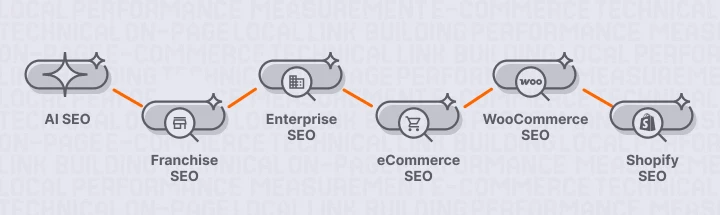
## AI SEO Services
The search landscape is evolving beyond Google. AI-powered search engines like Gemini, Copilot, ChatGPT, and Perplexity are changing how people discover information and make purchasing decisions. AI SEO services help businesses capture visibility in these emerging platforms where traditional SEO tactics fall short.
### How AI SEO Works
Our approach starts with AI keyword and prompt research, identifying not just what people search for, but how they ask questions to AI assistants. This shifts the focus from short keywords to natural, conversational queries that AI systems are designed to answer.
Next comes conversational content creation. Instead of keyword-stuffed pages, AI SEO prioritizes comprehensive, naturally written content that directly addresses user questions. This content needs to be structured in a way that AI systems can easily extract, understand, and cite as authoritative sources.
Semantic site structuring ensures your website’s information architecture makes sense to AI algorithms. This includes implementing advanced schema markup, creating clear topical relationships between pages, and organizing content in ways that help AI systems understand your expertise and authority.
### The AI SEO Advantage
When your brand appears in AI-generated answers, you’re reaching users at the exact moment they’re seeking solutions. The result is greater visibility across multiple search platforms, stronger authority as a cited source, and measurable growth in both traditional rankings and AI search results. As search behavior continues shifting toward AI assistants, early adoption of AI SEO strategies creates competitive advantages that compound over time.
## Franchise SEO Services
Multi-location businesses face a unique challenge: they need to rank well in dozens or hundreds of local markets while maintaining consistent brand messaging across every location. [Franchise SEO services](https://www.wearetg.com/services/franchise-seo/) solve this problem by combining local search optimization with centralized brand control.
### The Franchise SEO Approach
Our franchise SEO strategy starts with localized content development. Each location needs content that speaks to its specific market while staying true to the brand voice. This includes location-specific service pages, local area guides, and community-focused content that resonates with each market.
Optimized location pages serve as the foundation for local visibility. Each franchise unit gets a dedicated page with accurate NAP (name, address, phone) information, location-specific keywords, embedded maps, and unique content that helps both search engines and customers understand what makes each location valuable.
Structured data implementation ensures that search engines properly understand your multi-location structure. This includes organization schema that connects franchise locations to the parent brand, local business markup for each location, and review schema that showcases location-specific reputation signals.
### Why Franchise SEO Delivers Results
The combination of brand authority and local relevance creates powerful ranking advantages. Our approach generates more traffic to each location’s digital presence, more leads from local search queries, and measurable growth for every franchise unit. When done correctly, franchise SEO turns each location into a local market leader while leveraging the trust and recognition of the larger brand.
## Enterprise SEO Services
Large websites and complex organizational structures require a strategic, scalable SEO approach that goes far beyond basic optimization. Enterprise SEO services address the unique challenges that come with thousands of pages, multiple stakeholders, and sophisticated technical requirements.
### Enterprise-Scale Strategy
We align your teams, platforms, and content with SEO best practices to drive sustainable, organization-wide performance. This means coordinating with development, marketing, product, and legal teams to ensure SEO considerations are built into every digital initiative from the start.
For enterprise organizations operating globally, international targeting becomes critical. This includes implementing hreflang tags correctly, developing market-specific content strategies, managing multi-regional technical infrastructure, and ensuring that search engines understand which content serves which geographic and linguistic audiences.
Cross-functional integration ensures that SEO isn’t siloed in the marketing department but instead influences decisions across the organization. From product naming conventions to URL structures to content approval workflows, enterprise SEO creates systems that maintain optimization quality at scale.
### The Enterprise Difference
Enterprise SEO delivers results that move the needle for large organizations. When you’re working with millions of potential organic sessions, even small percentage improvements translate to significant revenue gains. Our enterprise approach provides the strategic oversight, technical expertise, and stakeholder management needed to capture these opportunities while managing the inherent complexity of large-scale digital properties.
## eCommerce SEO Services
Online stores face unique SEO challenges that standard business websites don’t encounter. Product-heavy websites need specialized optimization that drives organic traffic while improving the shopping experience. eCommerce SEO services are built specifically to address these challenges and convert search visibility into sales.
### eCommerce Optimization Strategy
We specialize in optimizing category pages, which often represent your biggest ranking opportunities. Category pages target high-volume commercial keywords that shoppers use when they’re ready to buy, and proper optimization turns these pages into traffic and revenue generators.
Product listings require strategic optimization that balances SEO requirements with conversion optimization. This includes crafting unique, compelling product descriptions, optimizing product titles for both search engines and shoppers, implementing schema markup that displays prices and availability directly in search results, and ensuring each product page provides the information customers need to make confident purchase decisions.
Site structure optimization helps search engines understand your inventory while improving user experience. This means creating logical category hierarchies, implementing effective filtering and navigation systems, managing internal linking to distribute authority, and ensuring smooth crawling and indexing despite large, frequently changing catalogs.
### The eCommerce SEO Payoff
The outcome is higher rankings for commercial keywords, more qualified shoppers arriving at your site, and increased sales from organic traffic. Unlike other marketing channels where you pay for every visitor, eCommerce SEO creates a sustainable traffic source that continues delivering customers long after the initial optimization investment.
## WooCommerce SEO Services
WooCommerce powers millions of online stores, but out-of-the-box installations often miss critical SEO opportunities. WooCommerce SEO services fine-tune your WordPress-based store to ensure it ranks well and performs smoothly in search results.
### WooCommerce-Specific Optimization
We start by improving product metadata, ensuring every product has optimized titles, descriptions, and image alt text that help search engines understand your inventory. WooCommerce’s flexible structure allows for extensive customization, which we leverage to create SEO-perfect product pages.
Speeding up load times addresses one of WooCommerce’s common weaknesses. We implement caching solutions, optimize database queries, compress images, and streamline plugin usage to ensure your store loads quickly across all devices. Fast loading speeds directly impact both rankings and conversion rates.
Streamlining navigation creates clear paths for both users and search engine crawlers. This includes optimizing category structures, implementing breadcrumb navigation, creating related product links that distribute authority, and ensuring your most important products are easily accessible.
### WooCommerce Results
That means more traffic from improved search visibility, better engagement from faster page loads and intuitive navigation, and higher conversions as shoppers find what they need quickly. WooCommerce’s flexibility combined with strategic SEO creates a powerful foundation for online retail success.
## Shopify SEO Services
Shopify makes launching an online store simple, but maximizing organic visibility requires specialized optimization. Shopify SEO services optimize your store for search engines without compromising its sleek, user-friendly design that makes Shopify stores convert so well.
### Shopify SEO Approach
We start by fixing technical issues that often plague Shopify stores. This includes addressing URL structure limitations, optimizing theme code for Core Web Vitals, resolving duplicate content issues, and ensuring proper canonicalization across your product catalog.
Enhancing product descriptions goes beyond basic keyword inclusion. We create unique, compelling descriptions that help products rank while convincing shoppers to buy. This includes identifying product-specific keywords, writing descriptions that address common customer questions, and formatting content for easy scanning and engagement.
Internal linking distributes authority throughout your Shopify store and creates pathways that help both users and search engines discover your products. We implement strategic links from high-authority pages to key products, create related product connections, and ensure your category structure supports SEO goals.
### Shopify SEO Outcomes
The result is stronger rankings for your target keywords, more organic traffic from qualified shoppers, and better ROI from your Shopify investment. Shopify’s built-in optimization features, combined with strategic SEO expertise, create stores that both rank well and convert effectively.
## Reddit SEO Services
Reddit is one of the most influential platforms for authentic discussions and product discovery. Google increasingly features Reddit threads in search results, making Reddit visibility crucial for brand awareness and organic traffic growth.
### Strategic Reddit Optimization
With a tailored Reddit SEO strategy, your brand can engage communities in the right way. This starts with identifying relevant subreddits where your target audience actively participates, understanding community rules and culture, and developing authentic participation approaches that provide genuine value rather than promotional spam.
Increasing visibility in search requires creating Reddit content that ranks in both Reddit’s internal search and Google’s results. This includes crafting informative titles with natural keyword inclusion, providing comprehensive answers that become go-to resources, and building karma and account authority that increases content visibility.
Earning meaningful traffic from trusted conversations means strategically converting Reddit visibility into website visits. We develop participation strategies that subtly highlight your expertise, create landing pages optimized for Reddit traffic, and measure the real business impact of Reddit SEO efforts.
### Reddit SEO Impact
We help you leverage the platform to drive both awareness and conversions. Reddit users are highly engaged, skeptical of traditional advertising, and more likely to trust peer recommendations. When your brand earns credibility on Reddit, you gain access to audiences that traditional SEO and advertising struggle to reach effectively.
## Magento SEO Services
Magento stores (now Adobe Commerce) power some of the world’s largest online retailers, but the platform’s complexity requires specialized SEO expertise. Magento SEO services are built to optimize every detail of these sophisticated eCommerce operations.
### Magento-Specific Optimization
We account for complex product catalogs that might include thousands or millions of SKUs, multiple attributes and filtering options, configurable products with variations, and sophisticated category structures. Proper optimization ensures search engines can efficiently crawl and index these large catalogs without getting stuck in infinite filtering combinations.
Site speed optimization addresses Magento’s performance challenges. The platform’s power comes with technical overhead that can slow page loads. We implement full-page caching, optimize database queries, streamline extension usage, and leverage content delivery networks to ensure your Magento store loads quickly.
User experience optimization ensures that Magento’s extensive capabilities don’t overwhelm shoppers. This includes creating intuitive navigation through complex catalogs, implementing effective faceted search, ensuring mobile responsiveness, and optimizing checkout flows that keep SEO-driven traffic converting.
### Magento SEO Results
From technical structure to on-page content, our optimization helps your products rank higher and convert better. We’ll help your store stand out in a competitive eCommerce landscape where Magento’s scalability and features, combined with strategic SEO, create powerful competitive advantages.
## BigCommerce SEO Services
BigCommerce makes scaling your store simple with built-in features and reliability, but without the right SEO, growth can stall. BigCommerce SEO services maximize the platform’s native capabilities while implementing advanced strategies that drive sustainable traffic and revenue.
### BigCommerce SEO Strategy
Our approach focuses on increasing product discoverability through strategic keyword targeting, optimized product content, enhanced structured data, and category page optimization. BigCommerce includes strong native SEO features that we leverage to accelerate results without requiring extensive custom development.
Improving site performance ensures that BigCommerce stores load quickly and provide excellent user experiences. We optimize BigCommerce’s already-solid infrastructure by implementing efficient theme code, compressing images, leveraging BigCommerce’s CDN effectively, and ensuring mobile performance meets Core Web Vitals standards.
Attracting qualified buyers requires understanding purchase intent and creating content that captures shoppers ready to buy. We develop keyword strategies targeting commercial queries, optimize for product comparison searches, create compelling category descriptions, and ensure your BigCommerce store appears for the searches that drive revenue.
### BigCommerce Growth
We align SEO with your sales goals to generate lasting revenue growth. BigCommerce’s reliability and features combined with strategic SEO create a foundation for scaling your online business without the technical headaches that plague other platforms.
## Bottom Line on the Different Types of SEO Services
Each type of SEO service drives growth differently. From AI-powered search optimization to platform-specific technical expertise, the right service depends entirely on your business model, technology stack, and growth goals. Whether you’re running a multi-location franchise, managing an enterprise website, or selling products on Shopify, specialized SEO services exist to help you compete and win in your specific market.
With search behavior evolving and platforms multiplying, there’s never been a better time to invest in the SEO services that match your specific situation. The businesses that thrive in the coming years will be those that recognize SEO isn’t one-size-fits-all, but rather a collection of specialized approaches tailored to specific business needs.
#### Still have questions about which of these SEO service types would make the biggest impact for your website?
[Schedule a free 30-minute consultation](https://www.wearetg.com/contact/ "Contact Us") with our team to get a clear action plan.
**Categories:** SEO, LSO
---
### [SEO Audit: What to Know for Exceptional Results](https://www.wearetg.com/blog/seo-audit/)
**Published:** January 19, 2026
**Author:** Rob Timmermann
**Content:**
If you’ve ever tried to improve your website’s visibility in search engines, someone has probably told you to “start with an SEO audit.” And while that advice isn’t wrong, it’s incomplete. The reality is more nuanced: sometimes you need a comprehensive SEO audit before making a single change, and sometimes you can start generating wins within days while the deeper analysis happens in the background.
This guide breaks down exactly what an SEO audit is, what tools you need, how to conduct one step-by-step, and—critically—how to know whether you should invest in a full audit or start with a leaner approach. At Timmermann Group, we’ve helped hundreds of businesses navigate this decision, and we’ve learned that the best path forward depends entirely on where you’re starting from.
## What Is an SEO Audit?
An SEO audit is a structured, point-in-time evaluation of your website’s performance across search engine optimization factors. It examines your site’s technical SEO infrastructure, on page elements, content quality, user experience, and off-page signals like your backlink profile to identify what’s working, what’s broken, and what’s missing.
At Timmermann Group, we treat audits as comprehensive “website health checks” that map technical issues directly to business outcomes like leads, revenue, and pipeline quality. A site crawl error isn’t just a red flag in a report—it’s a quantifiable loss in potential customers reaching your important pages. This business-first lens separates a useful audit from a document that collects dust.
A modern SEO audit in 2024 and beyond must address more than classic search results. With Google AI Overviews, Bing Copilot, and ChatGPT increasingly surfacing direct answers, your audit needs to evaluate how your brand appears in ai search contexts—not just where you rank for blue links.
Consider a B2B manufacturer we worked with recently. Their site had been online for years with steady but stagnant organic traffic. A thorough SEO audit revealed that their robots.txt file was inadvertently blocking critical product category pages from site crawlers, and content gaps meant they had zero visibility for “how to choose” comparison queries that their buyers were actively searching. Within 60 days of addressing these hidden SEO issues, they saw a 34% increase in qualified leads from google search.
That said, not every business needs to wait for a 100+ page audit report before improving their site. Many companies can begin generating quick wins while the deeper analysis runs in parallel. This is an important distinction, and one we’ll explore throughout this guide.
### Key benefits of an SEO audit:
- Identifies technical SEO errors blocking search engines from crawling and indexing your site
- Reveals content gaps and opportunities to capture relevant keywords
- Pinpoints user experience issues hurting conversions and engagement
- Evaluates your website’s ranking potential against competitors
- Creates a prioritized roadmap for SEO efforts that drive measurable growth
- Establishes baselines to track SEO performance over time
## Do You Really Need a Full SEO Audit to Start SEO?
No, you don’t always need a complete SEO audit before improving your site—especially if you’re starting from minimal SEO activity.
This might sound counterintuitive coming from an agency that offers audit services, but it’s the truth. A full audit is an investment of time and resources. For some businesses, that investment is essential. For others, it’s overkill when what they really need is to fix obvious technical issues and start building momentum.

### When a Lightweight Discovery Is Enough
Several scenarios call for a leaner approach:
- **New site launch:** You have a fresh website with limited content and no SEO history. There’s simply not enough data to justify an exhaustive audit. Start with foundational optimization and build from there.
- **Obvious technical blockers:** Your robots.txt is blocking your entire site, you have no XML sitemap submitted to google search console, or you’re still on HTTP instead of HTTPS. Fix SEO issues you can see before hunting for the ones you can’t.
- **No prior SEO strategy:** If you’ve never done systematic search engine optimization, a quick diagnostic will surface the 80% of high-impact issues that matter most. Research suggests that quick audits using free SEO tools like Google Search Console and a free crawler can identify the majority of critical problems in under two hours.
### When a Full Audit Is Essential
A comprehensive SEO audit becomes critical when:
- **Large enterprise sites:** If you have 10,000+ URLs across multiple pages, you need systematic analysis to avoid missing critical problems buried in scale.
- **Multi-location businesses:** Companies with location-specific pages across dozens of markets need structured audits to identify inconsistencies in local visibility and NAP data.
- **Site migrations or redesigns:** Moving to a new domain, restructuring your site structure, or launching a redesign without a technical SEO audit is asking for traffic losses.
- **Algorithm recovery:** If your site took a hit from the March 2024 Core Update or similar, you need a deep dive into content quality and E-E-A-T signals before you can recover.
- **Stalled growth despite ongoing work:** When SEO efforts aren’t producing results, a site audit helps diagnose whether the problem is execution, strategy, or competitive positioning.
### A Phased Approach That Works
At Timmermann Group, our typical approach involves a brief diagnostic “SEO triage” to unlock quick wins while deeper audit work runs in parallel. Here’s how that typically breaks down:
| Phase | Timeline | Focus |
|---|---|---|
| **Triage** | Week 1–2 | Fix crawl and indexing blockers, verify GSC/GA4, address critical technical errors |
| **Foundation** | Month 1–2 | Optimize key pages for page optimization, improve local search visibility, set tracking baselines |
| **Expansion** | Month 3+ | Broader audit insights inform content strategy, link building, and site architecture improvements |
### Full SEO Audit vs. Lean SEO Assessment:
| Factor | Full SEO Audit | Lean SEO Assessment |
|---|---|---|
| **Objective** | Comprehensive analysis of entire website | Identify and fix high-impact issues quickly |
| **Timeline** | 4–8 weeks | 1–2 weeks |
| **Best for** | Large sites, migrations, recovery scenarios | New sites, obvious blockers, starting SEO programs |
| **Deliverable** | Detailed report with prioritized recommendations | Focused action list for immediate implementation |
| **Investment** | Higher upfront, long-term strategic value | Lower upfront, faster time-to-results |
## What Tools Do You Need for an SEO Audit?
A professional website audit in 2024 requires a stack of tools that cover different aspects of SEO analysis. Here’s what you need and what each category contributes:
### Essential Tools for Any SEO Audit:
- **Google Search Console (GSC):** Your primary window into how Google sees your site. Use it to check indexing status, identify technical SEO issues, monitor Core Web Vitals, and see which queries drive impressions and clicks. This is a free SEO checker that every business should have configured.
- **Google Analytics 4 (GA4):** Connects SEO visibility to actual business outcomes. Track organic traffic, engagement metrics, and conversions to measure the impact of optimization work. Use it alongside google analytics reports to understand user behavior on individual web pages.
- **Crawling Tool (Screaming Frog, Sitebulb, or similar):** Simulates how search engines crawl your entire site. Identifies broken links, redirect chains, missing meta tags, duplicate content, and other technical errors that a manual review would miss. Screaming Frog’s free tier crawls up to 500 URLs—sufficient for many small businesses.
- **Rank Tracker:** Monitors search rankings for your target keywords over time. Essential for measuring whether optimization work is moving the needle on search engine results pages.
- **Backlink Analyzer (Ahrefs, Semrush, Moz):** Evaluates your backlink data, including referring domains, link quality, anchor text distribution, and sites linking to your competitors but not you. A healthy backlink profile correlates strongly with higher search visibility.
- **Page Experience Tools (PageSpeed Insights, GSC Core Web Vitals report):** Measures site speed and core web vitals performance. These metrics directly impact both search rankings and user experience.
### Agency-Grade Tools We Use at Timmermann Group:
As a full-service agency, we combine data from multiple paid suites to create decision-ready reports:
- **Semrush or Ahrefs:** For competitive analysis, keyword gap research, and comprehensive SEO audit tool capabilities that analyze site health at scale
- **Looker Studio:** To build custom dashboards connecting GSC, GA4, and other data sources into a single view of SEO performance
- **Similarweb:** For competitive traffic analysis and market benchmarking
- **Specialized AI visibility tools:** To monitor how your brand appears in AI-generated search results
A basic in-house audit can start for free with GSC, GA4, and a free crawler. But deeper SEO analysis typically benefits from agency-grade tools that provide broader context and competitive intelligence.
## Step-by-Step SEO Audit Checklist
This section provides a complete SEO audit checklist broken into clear phases. Each step includes what to check, how to check it, and what healthy versus problematic states look like.
The goal isn’t just to run tools and generate reports. It’s to produce actionable findings that a marketer or web manager can interpret and prioritize. Let’s work through each phase systematically.
### Technical Foundations: Can Search Engines Access and Understand Your Site?
Before evaluating content or links, you need to confirm that search engines can actually reach, crawl, and understand your web pages. This is where a technical audit begins.
#### Crawlability Checklist:
- **Robots.txt review:** Check that your robots.txt file isn’t blocking key pages from site crawlers. Access it at yoursite.com/robots.txt. Confirm that important sections (services, products, blog, location pages) are not disallowed.
- **XML sitemap verification:** Ensure you have a valid sitemap submitted to Google Search Console and Bing Webmaster Tools. The sitemap should include all important pages and exclude pages you don’t want indexed (like thank-you pages or internal search results).
- **HTTP status codes:** Use a crawler like Screaming Frog to scan your entire site for status codes. You want to see mostly 200s (success). Flag any 4xx errors (broken pages), 5xx errors (server issues), or excessive 3xx redirects (redirect chains).
- **Canonical consistency:** Verify that your site has a single canonical version—either www or non-www, and always HTTPS. All variations should 301 redirect to the preferred version. Inconsistent canonicalization confuses search engines about which version to rank.
#### Technical Hygiene Checks:
- **Staging environments:** Confirm that development or staging sites are not indexable via robots.txt or server-level blocks. We’ve seen entire staging sites indexed and competing with production.
- **Hreflang for international sites:** If you serve multiple languages or regions, verify hreflang implementation is correct and reciprocal.
- **Noindex usage:** Audit pages with noindex tags to ensure you’re not accidentally blocking important pages from indexation.
- **HTTPS and TLS:** Confirm your entire site runs on HTTPS with a valid SSL certificate. A secure site is both a ranking factor and a trust signal for visitors.
- **Server response time:** Pages should respond in under 200ms. Slow server response indicates hosting or configuration issues that impact page speed across your entire website.
### Crawl, Indexing, and Site Architecture
Once you’ve confirmed basic accessibility, evaluate how well search engines are actually indexing your site and whether your site structure supports discovery of key pages.
#### Indexing Analysis:
- **GSC Index Coverage report:** Compare “Indexed” versus “Excluded” URLs. Pay attention to patterns in exclusion reasons:
- “Crawled – currently not indexed” often indicates low-quality or thin content
- “Duplicate without user-selected canonical” signals canonicalization issues
- “Blocked by robots.txt” means you’re preventing crawling of those URLs
- **Index bloat:** Are pages indexed that shouldn’t be? Filter pages, paginated archives, and internal search results can waste crawl budget without providing value.
- **Orphan pages:** Identify important pages that have no internal links pointing to them. If search engines can’t discover a page through links, it’s unlikely to rank.
#### Site Architecture Review:
- **Logical hierarchy:** Your site should follow a clear structure: Home > Category > Subcategory > Individual Page. Users and search engines should be able to understand where they are and how pages relate.
- **Click depth:** Key pages should be reachable within 3 clicks from the homepage. Use your crawler to identify pages buried too deep in the site structure.
- **Navigation audit:** Review header navigation, footer links, and sidebar menus. Are your most important pages easily accessible? Are you linking to outdated or low-priority content prominently?
- **Internal links mapping:** Identify your top-value URLs (service pages, core product pages, lead-gen content) and verify they receive internal links from blogs, resources, and navigation hubs.
For example, a multi-location service business should group city pages clearly by state and metro, with internal links flowing from regional hubs to individual location pages. A user searching for “HVAC repair Kansas City” should land on a page that’s well-linked from both the main services section and a Missouri regional page.
### On-Page SEO: Metadata, Headings, and Content Structure
An on-page SEO audit evaluates how well individual web pages are optimized for their target queries and user intent.
#### Metadata Checks:
- **Title tags:** Each page needs a unique, descriptive title between 50–60 characters. Front-load primary keywords where natural. Avoid duplicate titles across multiple pages.
- **Meta descriptions:** Write compelling descriptions between 150–160 characters that accurately summarize the page and encourage clicks. While not a direct ranking factor, meta descriptions significantly impact CTR in search results.
- **Keyword alignment:** Verify that page titles and descriptions align with the relevant keywords each page should target. Use GSC to see which queries already drive impressions to each page.
#### Content Structure:
- **H1 usage:** Each page should have one H1 that clearly describes the page topic. Multiple H1s or missing H1s create confusion for both users and search engines.
- **Heading hierarchy:** H2–H6 tags should create a logical outline of the content. Subheadings help users scan and help search engines understand content structure.
- **Structured data:** Identify opportunities for schema markup—Organization, LocalBusiness, Product, FAQ, Article, Breadcrumb. Use Google’s Rich Results Test to validate implementation.
- **Internal anchor text:** Links within your content should use descriptive anchor text (e.g., “St. Louis SEO services” rather than “click here”). This supports topical relevance and helps search engines understand linked page content.
**Prioritization Tip:** Focus your on page optimization on a sample of high-impact URLs first—typically your top 10–50 landing pages by traffic or revenue. Scale sitewide optimization after proving the approach works on your most important pages.
### Content Quality, Search Intent, and E-E-A-T
Post-2024 Google updates have raised the bar significantly for content quality. Your audit must evaluate whether content meets the standards that now drive rankings.
#### Defining High-Quality Content:
- **Depth and comprehensiveness:** Does the content thoroughly answer the user’s question? Thin pages under 300 words rarely satisfy informational queries.
- **Originality:** Is the content unique, or is it recycled from other sources? Sites hit by recent algorithm updates often had content that added little value beyond what already existed.
- **Author expertise:** For topics where expertise matters (especially YMYL—Your Money, Your Life), is there a clear author with demonstrated knowledge? Author bios, about pages, and credentials signal trustworthiness.
- **Freshness:** Is content updated regularly? Outdated statistics, broken links, and obsolete recommendations hurt both rankings and conversions.
#### Intent Mapping:
Use GSC’s Performance report to identify pages with impressions but low CTR or poor average position. These are opportunities for improvement.
For each key page, determine search intent:
| Intent Type | User Goal | Content Format |
|---|---|---|
| **Informational** | Learn something | Guides, how-tos, educational content |
| **Commercial** | Compare options | Reviews, comparisons, best-of lists |
| **Transactional** | Take action | Product pages, service pages, pricing |
| **Local** | Find nearby | Location pages, maps, directions |
Ensure each page’s content matches its target intent. A service page shouldn’t read like a blog post, and an educational guide shouldn’t aggressively push sales.
#### E-E-A-T Signals:
- Visible author bios with credentials
- Comprehensive “About Us” page
- Trust signals: testimonials, case studies, certifications
- Third-party reviews on platforms like Google and industry directories
- Clear contact information and physical address
- Secure site (HTTPS)
#### Content Gaps and Cannibalization:
- Identify thin pages that should be merged or expanded
- Find duplicate content across multiple pages targeting the same keywords
- Map topic clusters to ensure you’re building comprehensive coverage around themes your business should own
- Flag obsolete content for updating or removal

### User Experience, Core Web Vitals, and Site Speed
Google’s core web vitals are direct ranking signals, but more importantly, they correlate with user satisfaction and conversion rates. Sites passing Core Web Vitals see 24% lower bounce rates and 19% higher conversion rates.
#### Core Web Vitals Explained:
| Metric | What It Measures | Good Threshold |
|---|---|---|
| **LCP (Largest Contentful Paint)** | Loading speed—how fast the main content appears | Under 2.5 seconds |
| **INP (Interaction to Next Paint)** | Responsiveness—how fast the page responds to input | Under 200ms |
| **CLS (Cumulative Layout Shift)** | Visual stability—how much the page shifts during loading | Under 0.1 |
Check these in GSC’s Page Experience report for field data (real user metrics) and PageSpeed Insights for lab data (simulated testing).
#### Common Fixes:
- Compress and properly size images
- Implement browser caching
- Reduce or defer unnecessary JavaScript
- Optimize web fonts (use font-display: swap)
- Upgrade hosting if server response times are consistently slow
#### Mobile Usability:
68% of online experiences are abandoned if page speed exceeds 3 seconds, and mobile devices now account for the majority of web traffic. Your audit must verify:
- Responsive design that adapts to all screen sizes
- Tap targets sized appropriately for fingers (at least 48×48 pixels)
- Readable font sizes without zooming
- No intrusive interstitials blocking content on smartphones
#### Connecting UX to Business Metrics:
Use GA4 to analyze behavior metrics alongside Core Web Vitals:
- Bounce rate and engagement rate by page
- Average session duration
- Conversion rate for key actions (form submissions, calls, purchases)
Better UX benefits both algorithmic rankings and actual business KPIs—not just an arbitrary SEO score. When we improve page speed for clients, we track both ranking changes and conversion improvements to demonstrate full ROI.
### Off-Page SEO: Backlinks, Brand Signals, and Local Presence
Off-page factors—particularly external factors like backlinks and brand authority—remain critical ranking signals. Your audit should evaluate these elements systematically.
#### Backlink Profile Analysis:
Using a tool like Ahrefs or Semrush, evaluate:
- **Referring domains:** More unique domains linking to you generally correlates with higher authority. Focus on quality over quantity.
- **Domain Rating (DR) or Domain Authority (DA):** Sites with DR/DA above 50 are generally considered authoritative. Below 20 may indicate a weak link profile.
- **Link velocity:** Are you gaining or losing links over time? Sudden drops may indicate lost relationships or content becoming outdated.
- **Topical relevance:** Links from sites in your industry carry more weight than random directories.
- **Anchor text distribution:** Natural profiles have diverse anchor text. Heavy concentration on exact-match keywords can appear manipulative.
#### Identifying Risky Links:
- Spam scores above 5% warrant investigation
- Links from known link farms, PBNs, or unrelated sites
- Paid links without proper nofollow/sponsored attributes
- Links from hacked or compromised sites
Disavow is rarely necessary unless you have a history of manipulative link building or an obvious negative SEO attack. Google is generally good at ignoring low-quality links rather than penalizing for them.
#### Local SEO Audit (for local businesses):
- **Google Business Profile:** Verify accuracy of business name, address, phone (NAP), hours, categories, and description
- **NAP consistency:** Check that your NAP matches across 50+ directories and citations
- **Reviews:** Monitor review volume and sentiment on Google, Yelp, and industry-specific platforms
- **Local content:** Ensure you have optimized pages for each service area or location you serve
#### Brand Signals and Authority:
- Identify unlinked brand mentions that could become links
- Evaluate thought leadership content and its reach
- Review partnerships and sponsorships for link opportunities
At Timmermann Group, we turn this analysis into a prioritized outreach and digital PR plan rather than just flagging “toxic links” for removal.
### AI Search, SERP Features, and Modern Visibility
The search landscape has shifted dramatically with the rise of AI-generated answers. Your audit must account for these new visibility opportunities.
#### AI Visibility Monitoring:
- Test your priority queries in Google AI Overviews and Bing Copilot
- Note whether AI responses cite your site, competitors, or neither
- Evaluate how accurately your brand and services are described in AI-generated content
Sites with strong topical authority appear in significantly more AI overviews. Building comprehensive content clusters positions you as a source these systems want to cite.
#### SERP Features to Audit:
| Feature | How to Earn It |
|---|---|
| **Featured Snippets** | Clear, concise answers formatted with lists, tables, or definitions |
| **People Also Ask** | FAQ-style content addressing related questions |
| **Local Pack** | Optimized Google Business Profile and local signals |
| **Image Pack** | Optimized images with descriptive alt text and file names |
| **Video Results** | YouTube content or properly marked up video embeds |
| **Rich Results** | Schema markup (FAQ, How-To, Product, Review) |
#### Strategic Mapping:
Map priority topics and relevant keywords to desired SERP features:
- FAQ schema for common customer questions
- How-to markup for tutorial content
- Video for complex explanations or demonstrations
- LocalBusiness schema for location pages
This connects back to your content strategy—understanding which features appear for your target queries informs what content formats you should create.
## Turning Audit Findings Into an Action Plan
An audit is only valuable if it leads to decisions. Every issue identified needs a clear disposition: fix, improve, consolidate, create, or ignore.
### Prioritization Framework:
We use an impact vs. effort matrix to categorize findings:
| Priority | Description | Examples |
|---|---|---|
| **Critical** | Blocking indexing or conversions | robots.txt errors, broken internal links on key pages, HTTPS issues |
| **High** | Strong ranking/UX upside | Missing meta descriptions on high-traffic pages, slow page speed on conversion pages |
| **Medium** | Meaningful improvements | Internal linking optimization, schema implementation |
| **Low** | Nice-to-have | Minor meta tag tweaks, image compression on low-traffic pages |
#### Typical Phase 1 Actions (First 30 Days):
- Fix robots.txt and sitemap errors
- Implement HTTPS redirects if still on HTTP
- Repair top broken links (especially on important pages)
- Correct title tags on highest-traffic pages
- Address critical Core Web Vitals failures
#### Phase 2+ Actions (60–180 Days):
- Content consolidation and thin page remediation
- Content gaps and new content creation
- Link building and digital PR
- Advanced schema implementation
- Site architecture restructuring
### Building Your Roadmap:
Create a simple SEO roadmap with specific timeframes and owners:
| Timeframe | Focus | Owner |
|---|---|---|
| **30 days** | Critical technical fixes, quick wins | Development team |
| **90 days** | On-page optimization, content improvements | Marketing team |
| **6 months** | Link building, content expansion, advanced optimization | Agency + in-house |
At Timmermann Group, we pair this roadmap with Looker Studio dashboards connected to GA4 and GSC so stakeholders can monitor progress against KPIs in real-time.
## When to Partner With an Agency for an SEO Audit
Some situations clearly call for professional support. Here are concrete triggers for bringing in a partner:
- **Traffic or lead declines after a Google update:** Diagnosing algorithm impacts requires experience and specialized tools
- **Complex site migrations or redesigns:** Moving URLs without proper planning destroys rankings; an agency brings migration expertise
- **Multi-location or multi-language setups:** Complexity multiplies with each location and language
- **Stalled organic growth:** When internal efforts aren’t producing results, fresh eyes identify blind spots
- **Technical debt:** Legacy sites with years of accumulated technical errors need systematic remediation
### Advantages of Agency-Led Audits:
- Access to enterprise-grade SEO audit tool suites
- Cross-channel insight connecting SEO to PPC, UX/CRO, analytics, and email
- Experience interpreting nuanced data and prioritizing effectively
- Benchmarking against competitor and industry standards
At Timmermann Group, our audits integrate into a broader flywheel marketing approach. We tie SEO fixes to PPC efficiency, CRO improvements, and content strategy rather than operating in a silo. This means your website’s performance improvements compound across channels.
We offer flexible engagement models—from focused technical audit engagements to comprehensive strategic audits spanning SEO, web, and analytics. You don’t need to commit to a large, multi-month project to get started. A conversation or light assessment can help determine the right scope for your situation.
## How to Start Improving SEO Today (Even Before a Full Audit)
You don’t need to wait for a complete audit report to start making progress. Here’s what you can do in the next 7–14 days:
### Immediate Action Checklist:
1. **Verify GSC and GA4 are properly configured:** If you can’t measure it, you can’t improve it. Confirm both tools are collecting data correctly.
2. **Fix obvious 404 errors:** Use GSC’s Pages report to find broken links and either restore content or redirect to relevant pages.
3. **Update title tags on your top 5 pages:** Make them unique, compelling, and keyword-aligned.
4. **Refresh your most important service or product page:** Add depth, update statistics, improve formatting, and ease search engines’ understanding of your expertise.
5. **Optimize your Google Business Profile:** Ensure NAP accuracy, add photos, respond to reviews, and post updates.
6. **Check mobile usability:** Load your site on mobile devices and note any obvious issues with navigation, readability, or speed.
7. **Set baseline benchmarks:** Document current organic sessions, leads, and rankings for 10–20 target keywords so you can measure improvement.
### Focus on What Matters Most:
Pick one or two key revenue-driving pages and make them “best in class” in content quality, UX, and conversion experience. A single high-performing page often outweighs dozens of mediocre ones.
### Start the Conversation:
At Timmermann Group, our typical starting point is a free strategy call to review your site live, identify quick wins, and discuss whether a full audit is warranted. We’ll tell you honestly whether you need a 50-hour comprehensive analysis or a focused sprint on obvious opportunities.
The core message is simple: a thorough SEO audit is powerful, but you don’t have to wait for perfection to begin compounding gains. Starting small and iterating is often the most effective path to sustainable organic growth.
Ready to see where your site stands? Schedule a free 30min consultation call with our team, and we’ll help you determine the right next step—whether that’s a quick diagnostic or a deep dive into your site health.
**Categories:** SEO
---
### [Shopify SEO: The Essential Guide to Maximize Your Store](https://www.wearetg.com/blog/shopify-seo/)
**Published:** September 12, 2024
**Author:** Rob Timmermann
**Content:**
Are you figuring out how to SEO your Shopify store for better search engine performance? This guide cuts through the complexity of Shopify for SEO and offers a roadmap to elevate your store’s SEO strategy with [Shopify SEO](https://www.wearetg.com/services/shopify-seo/) best practices. Discover how to leverage the built-in SEO functionalities of Shopify, strategize your keyword use, optimize each page, and beyond. We streamline the essentials and highlight advanced tools that refine your store’s visibility and drive meaningful traffic. Step confidently into improving your Shopify store’s SEO with clear, actionable steps that yield results.
## Key Takeaways
- Optimizing a Shopify store for SEO involves utilizing built-in features for site structure and content, enhancing visibility in search engine results, and potentially increasing traffic by up to 30%.
- Strategic SEO practices include managing meta titles and descriptions, configuring Google Search Console for performance monitoring, and creating a user-friendly site structure through navigation and collections.
- Mastering keyword selection and placement is key, as well as balancing search volume with competition while generating high-quality content and employing off-page SEO tactics to build authority and improve rankings.
## Unlocking Shopify’s SEO Potential
Imagine your Shopify store as a storefront nestled in the heart of a busy metropolis. How will anyone discover what you offer without an inviting sign, bright entrance, or defined walkway to guide shoppers inside? In cyberspace, these physical aspects correspond to optimizing your Shopify store with clear and searchable content and an intuitive site structure for easy navigation. Drawing in organic traffic and enhancing online exposure entails optimizing your shop’s optimization specifically for search engines through diligent SEO work. This method employs carefully curated tactics to strengthen your digital footprint and elevate your website’s position within search engine rankings.
Shopify is equipped with inherent capabilities that bolster effective SEO strategies. It grants mastery over content management and architectural configuration while promoting streamlined coding practices alongside systematic organization of the site structure. By capitalizing on Shopify’s framework, which encourages well-planned navigation architecture, you can fortify the SEO foundation, making it easier for both potential customers and search engines to locate and comprehend various page contents within your platform easily. Did you know that by executing sound SEO techniques on Shopify, there’s a possibility of securing front-page status on search results? Such advancement could spike daily visitor counts by nearly 30%, drastically broadening the scope of who sees—and potentially frequents—your virtual storefront! Are these possibilities starting to resonate? Now might be just the time we explore deeper into how one can harness all facets offered through Shopify’s tailored-for-SEO features.
## Essential SEO Settings in Shopify
Similar to how an appealing storefront window attracts shoppers, your Shopify store’s meta titles and descriptions can draw in online consumers to your ecommerce site. Crafting unique and optimized meta elements can greatly enhance your placement within search engine results.
Managing these crucial components becomes more complex when you have numerous product pages. In such cases, the SEO tools provided by Shopify are indispensable for efficient handling.
### Configuring Google Search Console
View Google Search Console as your Shopify store’s security surveillance, and think of Google Analytics as a tool to decipher the behaviors of your patrons. This setup lets you keep tabs on how well your shop is doing online and spot any problems that might turn customers away.
To integrate your Shopify store domain with Google Search Console, here are the steps:
1. Ensure you have a Google account. If not, create one.
2. Use the URL prefix method in Google Search Console to add your Shopify domain.
3. You’ll get an HTML tag from Google Search Console after this step.
4. Embed this HTML tag into the theme. The liquid file of your Shopify Store—specifically within its head> section.
With these measures done, tracking how well you’re performing in Google search becomes possible, and identifying issues is straightforward — it’s an important step towards fully leveraging SEO benefits for improving visibility and traffic to your Shopify store.
### Enhancing Your Search Engine Listing Preview
The initial encounter between potential customers and your online store often occurs via the search engine listing preview, making it crucial to create compelling title tags and meta descriptions that entice users from the search results to visit your site. These elements are instrumental in attracting clicks and play a significant role in optimizing your store’s SEO.
Shopify’s interface allows you to conveniently input and modify metadata like title tags and meta descriptions within its ‘Search Engine Listing Preview’ area for each page of your website. By tailoring these details, you ensure clear communication of content, which can lead to increased click-throughs by interested consumers. It is important to adhere to suggested character lengths for both titles and descriptions so as not to inadvertently cut off text within search engine result snippets.
### Streamlining Site Structure with Navigation and Collections
Imagine entering a shop where the arrangement of products is haphazard, with no discernible categories or directional signage. It’s perplexing, isn’t it? Similarly crucial in the digital realm is an orderly site structure for your Shopify store. This serves as the skeletal framework for your Shopify SEO efforts and facilitates both search engine crawling and user experience.
To establish such an organized structure on a Shopify platform:
1. Assemble collections that represent various categories
2. Incorporate individual products into these specific collections
3. Utilize the menu system provided by Shopify to integrate these collections visibly as navigational categories
4. Craft a hierarchical architecture that accurately reflects how the online storefront is arranged
Enhancing visibility across different devices ensures shoppers have consistent experiences and strengthens SEO due to clear navigation pathways within a Shopify website.
## Keyword Mastery for Shopify Success
Keywords act as navigational beacons for search engines to locate your eCommerce site. These are the words that potential customers enter into a search bar in pursuit of products or services similar to what you offer. The triumphant optimization of your Shopify store’s SEO is heavily dependent on proficient keyword choice and their strategic implementation.
We shall delve into methods for discovering pertinent keywords, artfully embedding target keywords throughout your content, and maintaining equilibrium between search volume and competitive presence.
### Unearthing Relevant Keywords
Conducting keyword research is akin to prospecting for gold, as it requires filtering through many search terms to unearth valuable gems – those low-competition keywords matching your customers’ looking for.
In pursuit of these lucrative keywords, initiate by identifying at least five central themes pertinent to your merchandise. Reflect on the potential search phrases your clientele might input. Apply tools such as Ahrefs’ Keywords Explorer or SEMRush in order to uncover underutilized keywords capable of attracting increased traffic and elevating conversions for your Shopify store.
### Strategic Placement of Target Keywords
When you’ve identified the most beneficial keywords for your Shopify store, you should integrate them thoughtfully throughout. Embedding these target keywords into the URLs of your product pages will enhance SEO by making it easier for search engines and visitors to grasp what each page offers. This practice extends beyond just product pages – be sure to also finesse blog posts by focusing on a single keyword and embedding it within key parts such as:
- H1 header
- Title tag
- Webpage URL
- Opening paragraph
- Meta description
To Advance your SEO footprint, ensure that all your target keywords are associated with appropriate existing pages on your Shopify site or create new content specifically tailored to those untapped keywords. Remember that quality trumps quantity. Avoid cramming too many keywords into content in favor of producing valuable and pertinent material for readers.
### Balancing Search Volume and Competition
Selecting keywords isn’t solely about homing in on the most sought-after terms. It’s equally important to find a harmonious balance between search volume and competition levels. Opting for less competitive keywords may yield faster ranking advancements despite their modest search volumes.
Conversely, while high-search-volume keywords have the potential to attract considerable traffic, they typically come with steep competition. By examining keyword difficulty scores, you can uncover terms that achieve an equilibrium of search volume and competitiveness – essentially finding the optimal niche that channels highly relevant visitors to your Shopify store.
## On-Page SEO Tactics for Shopify Stores
Let’s explore how you can enhance your Shopify store’s SEO performance beyond just keywords. By creating enticing product descriptions, fine-tuning image optimization, and implementing robust internal linking strategies, we aim to elevate your store’s on-page components for improved search engine rankings.
### Crafting Compelling Product Descriptions
Regard your product descriptions as the digital equivalent of sales representatives. Their purpose is not only to entice and educate but also to transform visitors into purchasers. Their significance extends even more when it comes to enhancing your Shopify SEO.
In crafting superior product descriptions that elevate SEO performance, always aim for descriptive title tags infused with your target keyword where fitting. Craft meta descriptions thoughtfully by weaving in keywords and a persuasive call to action (CTA), all while maintaining a brevity of 105 characters or less to avoid being cut off in search engine results pages (SERPs). Remember that an effective product description should cater to prospective customers and search engines alike.
### Utilizing Alt Text for Image Optimization
Search engines cannot visually interpret images. Instead, they depend on alt text – a brief depiction of what an image displays – to grasp its content. Alt text plays a crucial role in conveying the theme of an image for search engine comprehension and aiding users who utilize screen readers.
Enhancing your Shopify product pages with superior imagery accompanied by suitable alt text can elevate user interaction and improve your rankings on search engines. Remember that employing descriptive file names for your images is another strategy that aids in optimizing SEO efficiency.
### Internal Linking Strategies
Internal linking serves as a navigational aid within your Shopify store, directing users between pages and enhancing the overall experience on your site. Importantly, when implemented effectively, this structure of internal links can elevate your SEO results.
By enabling smooth navigation for visitors with internal links, you encourage extended interaction and more in-depth exploration of what you offer. These connections assist search engines in finding fresh content on your website and deciphering how various pages interconnect – factors that are advantageous for climbing up the ladder in search engine rankings.
## Building Authority with Off-Page SEO
On-page SEO focuses on optimizing your website’s content and layout, whereas off-page SEO employs tactics beyond your site to boost its position in search engine results. Here are methods for enhancing authority via off-page SEO:
- Securing high-quality inbound links
- Utilizing signals from social media platforms
- Contributing guest posts to well-known websites
- Engaging with internet communities and discussion boards
- Establishing connections with key influencers within your sector
Employing these strategies can lead to enhanced visibility for your site and a better likelihood of achieving higher rankings within the outcomes presented by search engines.
### Acquiring Quality Backlinks
View backlinks, which are links from external sites pointing to your Shopify store, as endorsements of credibility and quality that search engines take note of. These signals suggest to search engines that your content is worthwhile and reliable, leading to a potential enhancement in your shop’s rankings on those engines.
There’s a variety of tactics you can use to secure these valuable backlinks for your store. Among these techniques are:
- Imitating the homepage link patterns of rival stores
- Building relationships with journalists and influencers who might feature your products or content
- Taking part in opportunities where journalists seek expert commentary or insights
- Crafting compelling content designed specifically to garner organic backlinking interest
- Engaging in the process known as broken link building by offering up replacement links for dead ones found on other websites with relevant connections
Using broken link building can be particularly strategic. It involves seeking out web pages with non-working links and suggesting they update their site by linking instead to related resources available at your Shopify store. This method not only fixes an issue for the host website but also creates additional pathways for improving visibility through increased relevance within search engine algorithms.
### Leveraging Social Signals
In the modern era of digitization, platforms on social media have emerged as potent avenues for disseminating content. Engaging actively in specialized communities like Facebook Groups or Reddit forums enables you to elevate your brand’s profile by forging connections with those you intend to reach.
Heightened recognition of your brand can lead to a rise in mentions and obtaining backlinks, indirectly improving your standing on search engines. It is crucial to acknowledge that search engine optimization extends beyond mere website tweaks—it encompasses cultivating a notable online presence and nurturing bonds within the digital ecosystem where your audience congregates.
## Content Marketing: Fuel for Your Shopify SEO Engine
Content serves as the powerhouse driving your Shopify SEO efforts. Engaging with your customer base, ranking higher across various keywords, and acquiring additional backlinks are all achieved through content. Let’s explore the ways in which a robust content marketing approach can amplify your Shopify SEO, including establishing a blog strategy, crafting content that encourages sharing, and promoting it to maximize its impact.
### Develop a Blogging Strategy
Developing an effective blogging strategy can be likened to meticulously planning a road trip, with clear objectives for the journey, activities en route, and desired outcomes upon reaching your destination. Utilize tools for keyword research at the beginning of your content creation process to unearth new topics that resonate with your target audience’s interests and their search tendencies.
Ensure every blog post is aligned with not only what you want to accomplish but also showcases your company’s expertise by providing insightful information that reinforces where you stand in the market. The primary objective goes beyond simply drawing more traffic. It’s about pulling in quality traffic – potential customers who have shown interest in what your business has to offer.
### Creating Shareable Content
Think of shareable content as a powerful attractor for backlinks to your Shopify store. It stands out because it’s distinctive, captivating, and offers significant value, which encourages other websites to create links pointing towards it.
Examples such as research studies, complementary tools, or engaging interactive widgets stand out due to their visual appeal and the simplicity of spreading them around. Remember that the greater the originality, quality, and relevance of your content, the higher its chances of being circulated and receiving links from various sources.
### Content Promotion Tactics
Producing excellent content is merely the initial phase. You must efficiently market your material to a broader demographic for maximum impact. Social media platforms are powerful venues for distributing content, utilizing tactics like employing hashtags, tagging other brands or individuals in posts, and interacting with your audience through comments and direct messages.
You can also leverage email marketing campaigns as a tool to send your content straight to a specific group of people, which encourages recurring visits and strengthens their engagement with what you’ve produced. Partnering with influencers offers an opportunity to amplify the visibility of your content by tapping into the influencer’s own network of followers for additional promotional channels.
It’s essential not just to increase visibility but also to make sure that it resonates with the appropriate audience when promoting content.
## Harnessing Technical SEO for a Seamless Shopify Experience
Just as a finely tuned machine operates without a hitch, optimizing your Shopify store with effective technical SEO practices ensures an effortless user experience while significantly enhancing its rankings. Let’s explore how you can employ technical SEO to ensure that your Shopify store provides a smooth and seamless experience, including improvements to website speed, mobile-friendliness, and secure navigation using HTTPS.
### Speed Optimization
In the fast-paced realm of online retail, swift performance is key. A website that lags can turn off potential customers and inhibit sales conversions. Are you aware, though, that the speed of your site also plays an integral role in search engine optimization (SEO)?
To better user satisfaction and elevate your position in search engine rankings, it’s essential to improve how quickly your pages load. Consider implementing these strategies for accelerated page loading.
- Utilize Shopify’s Image CDN to enable image optimization for expedited loading.
- Select web themes designed with performance efficiency in mind.
- Regularly evaluate any third-party apps and scripts for their impact on site speed.
Adhering to these suggestions ensures rapid webpage delivery while fostering a frictionless experience for visitors navigating your site.
### Mobile Responsiveness
With the rise of internet use on mobile devices, optimizing your Shopify store for mobile users is increasingly important. The likelihood of ranking well is significantly boosted by making sure landing pages are designed with mobile in mind, especially since Google adopts a mobile-first indexing approach, using the site’s mobile version as its primary source for indexing and ranking. To gauge how effectively your Shopify store operates on smartphones and tablets, you can turn to the Mobile Usability report within Google Search Console, which offers key details regarding the performance of your website on these devices.
### Secure Browsing with HTTPS
In the current age of digital advancements, safeguarding online security is of paramount importance. Consumers must be assured that their sensitive data, including personal and credit card information, remain secure during transactions. Secure browsing through HTTPS plays a critical role in this regard. The move from HTTP to HTTPS represents an essential aspect of technical SEO that search engines such as Google use as a criterion for ranking websites, thereby potentially increasing organic traffic to these sites.
‘Hyper Text Transfer Protocol Secure’ or HTTPS signifies that all data exchanged is encrypted, bolstering website security. When visitors see a site utilizing HTTPS protocol, they tend to feel more at ease sharing private information and confidently making financial transactions. This enhanced sense of security can improve perceptions regarding the site’s reliability and integrity—a factor that search engines consider when assessing quality signals for ranking purposes.
## Advanced Shopify SEO Features and Tools
Shopify comes equipped with SEO capabilities that can significantly boost your online presence, but to really excel in search engine rankings, utilizing its advanced SEO features and tools is key. These include a range of SEO apps and plugins, the ability to tailor robots.txt for improved crawling efficiency, and the incorporation of schema markup, which helps create rich snippets. Delving into these enhanced functionalities can markedly improve your Shopify SEO performance.
### SEO Apps and Plugins
SEO applications and plugins serve as powerful aids for enhancing the visibility of your Shopify store on search engines, while lso making SEO tasks much more manageable. Smart SEO is a tool that can automatically generate relevant meta and alt tags. To provide structured data to search engines, which helps streamline the entire optimization process. By adhering to an SEO checklist, you are able to verify that all critical optimization components have been noticed.
Plugin SEO offers automatic scrutiny of page elements—this feature proves beneficial by conserving time and resources for store proprietors. Conversely, Booster SEO & Image Optimizer enhances site speed through effective image optimization within Shopify stores.
Selecting appropriate tools is crucial as they can significantly impact your efforts in optimizing for various search engines—not just the dominant ones.
### Customizing Robots.txt for Optimal Crawling
Though it might seem like an insignificant element, the robots.txt file is crucial for your website’s SEO. It provides directions to search engine crawlers regarding which areas or pages of your site are off-limits for scanning and indexing.
Owners of a Shopify store have the option to modify their robots.txt file through the platform’s integrated robots.txt.liquid file found in its themes. By implementing explicit commands, such as ‘Disallow:’, you can enhance how search engines crawl your site by barring them from indexing specific sections.
### Implementing Schema Markup for Rich Snippets
Think of rich snippets as the finishing touch to your SEO masterpiece. These enhanced details—such as pricing, availability, and review ratings—are showcased right on the search engine results pages, creating standout snippets that could result in improved click-through rates.
If a Shopify store’s theme does not inherently include schema markup capabilities, merchants can make use of tools like Smart SEO. While integrating features such as user-generated content and star ratings might necessitate extra apps or tailored coding solutions, this additional work has the potential to substantially elevate your store’s presence within search engine results.
## Working with an Shopify SEO Agency Partner
Ultimately, to harness the full potential of Shopify SEO, one must fine-tune both on-page and off-page elements by employing appropriate keywords, crafting content that encourages sharing, and utilizing sophisticated SEO features and instruments. It encompasses ensuring an impeccable user experience, generating substantive material, and cultivating connections within your digital network. With the proper tactics and resources at your disposal, you can elevate your Shopify store’s search engine presence, attracting more organic traffic. So are you poised to revolutionize your online shop into a formidable force in SEO?
#### Not sure if your Shopify SEO is helping or holding you back?
[Schedule a 30-minute collaborative conversation](https://www.wearetg.com/contact/) and Timmermann Group will identify technical gaps, content issues, and missed opportunities that are limiting your organic growth.
## Frequently Asked Questions
### What is Shopify SEO, and why is it important?
Optimizing your store through Shopify SEO enhances online visibility and drives organic traffic. It plays a significant role in increasing traffic and improving the user experience, thereby amplifying your store’s presence on the web.
### How can I improve the SEO of my Shopify store?
Concentrate on enhancing the SEO of your Shopify store by optimizing its site structure, crafting meta titles and descriptions, enriching images with alt text, securing high-quality backlinks, generating premium content that is friendly to SEO practices, and utilizing sophisticated SEO features and tools.
### What are the main on-page SEO tactics for Shopify stores?
Concentrate on refining meta titles and descriptions, implementing alt text for imagery, crafting compelling product narratives, and establishing a robust internal linking structure to enhance your Shopify store’s on-page SEO. Doing so will boost your store’s visibility in search engines and draw in an increased volume of organic traffic.
### How can I acquire quality backlinks for my Shopify store?
In order to secure high-quality backlinks for your Shopify store, concentrate on producing distinctive and captivating content. Replicate the homepage links of your rivals while also connecting with journalists and influencers. Make sure to answer any questions that journalists may have.
By implementing these strategies, you will cultivate a robust backlink profile, enhancing your store’s online presence.
### What are some advanced Shopify SEO features and tools I can use?
By leveraging sophisticated features and tools for Shopify SEO, such as SEO apps, plugins, and tailoring your robots.txt file, and integrating schema markup to create rich snippets, you can heighten your store’s visibility on search engines.
Applying these techniques will bolster your store’s digital footprint and attract more traffic and potential customers.
**Categories:** SEO
---
### [SEO Website Design: Strategies That Rank & Convert](https://www.wearetg.com/blog/seo-website-design/)
**Published:** January 13, 2026
**Author:** Rob Timmermann
**Content:**
For years, website design and [search engine optimization](https://www.wearetg.com/services/seo) (SEO) were treated as two separate phases: design the website first, then “add SEO” after launch. That outdated approach often leads to unnecessary rework, performance issues, and missed growth opportunities baked into the site from day one.
The reality is more straightforward and impactful: **SEO website design starts well before a site goes live**.
Every design decision, from navigation structure and page layouts to typography and mobile behavior, directly influences how search engines crawl, interpret, and rank your site. When SEO is considered alongside design from the beginning, the result is a website that doesn’t just look polished but also actively drives visibility, qualified traffic, and conversions. Web designers and web developers must collaborate early to integrate SEO best practices and content creation into the process, ensuring the site is both user-focused and search-friendly from the start.
In this guide, we’ll explore how SEO-first website design works, why it matters, and which design choices most often undermine organic performance. Conducting keyword research and creating content early in the website development process is crucial to SEO success. SEO is a cost-effective way to attract visitors and is especially essential for small businesses to stand out in a competitive digital space. Remember, SEO is a long-term marketing strategy that should be considered from the very beginning of website planning.
## Key Takeaways
- **SEO is not a layer; it’s embedded in design** decisions that affect crawlability, indexation, and rankings.
- **Planning SEO during wireframing prevents structural issues** that are expensive to fix post-launch.
- **Early keyword research and thoughtful website structure planning are essential** to optimizing content, aligning with user intent, and ensuring strong SEO.
- **Strong design improves SEO** through clear information architecture, mobile-first layouts, readable typography, and optimized media.
- **Overdesigned navigation, oversized visuals, and mobile compromises can quietly damage search performance.**
- T**he most effective websites are built through close collaboration** between designers, developers, and SEO specialists.
## What Is SEO Web Design?
SEO website design is the practice of designing websites with search visibility, usability, and technical performance considered from the outset, rather than retrofitted later.
#### At its core, SEO web design balances three priorities:
- **Aesthetics** that communicate brand credibility
- **Usability** that supports how real users navigate and consume content
- **Search visibility** that enables sustainable, long-term traffic growth
Building the site correctly from the start is essential. This means focusing on optimal site structure and integrating relevant keywords during website development. Incorporating SEO best practices early ensures the site is organized for both users and search engines, making content easily discoverable and improving overall search rankings.
Traditional workflows often treat SEO as a checklist applied after launch, optimizing page titles, adding keywords, or compressing images once the site is already built. While those tactics still matter, they’re far more effective when the site’s structure and design already support them.
SEO-first design shifts the mindset from *fixing issues* to *preventing them*, ensuring the website is structurally sound, scalable, and search-friendly from day one.
## Website Design Principles That Shape SEO Outcomes
SEO and web design are often framed as competing priorities, but in reality, they reinforce each other. Many of the same choices that improve usability also improve search performance.
Designing with SEO in mind clarifies structure, hierarchy, and content, benefiting both users and search engines. A well-planned website architecture and structure ensure your site is intuitive, efficient, and easy to navigate, making key pages accessible within a few clicks for both users and search engines.
A strong internal linking strategy, including more internal links, helps highlight important pages, improves crawlability, and boosts overall SEO performance.
### Information Architecture & Navigation
Search engines and users both rely on clear organization.
- Flat, logical site hierarchies make it easier for search engines to crawl and understand page relationships.
- Intuitive menus and breadcrumb trails reinforce context and orientation.
- Limiting page depth ensures important content isn’t buried several clicks deep.
- Highlight essential pages in your navigation and ensure they are accessible within a few clicks.
A comprehensive internal linking strategy that uses more internal links and descriptive anchor text helps users navigate your site, distributes link equity, and provides search engines with valuable context about content relevance. Creating a logical hierarchy with broad categories and specific subcategories further facilitates both user navigation and search engine indexing.
When information architecture is well planned, users find what they need faster, and search engines can accurately assess page importance.

### Visual Hierarchy & Content Readability
Design plays a direct role in how content is consumed. High-quality, relevant website content is essential for both SEO and user engagement, as it helps establish authority, meet user needs, and drive conversions.
- Typography, spacing, and contrast affect readability and engagement.
- Strong visual hierarchy guides users through content in a logical flow.
- Headings should follow semantic HTML structure (H1, H2, H3), not just visual styling.
Using headers to create a clear content hierarchy not only improves the user experience but also benefits SEO by helping search engines understand your content’s structure and importance. Ample white space and clear layouts further enhance content readability and professionalism.
When content is easy to scan and read, users stay longer, engage more, and send positive behavioral signals back to search engines.
### Responsive & Mobile-First Design
Google evaluates your site primarily through its mobile experience. Making your site mobile-friendly is essential for both SEO and user experience, as Google uses mobile-first indexing and prioritizes sites that perform well on mobile devices.
That makes mobile-first design a ranking factor—not just a UX consideration.
- Responsive layouts must preserve content hierarchy across devices.
- Mobile navigation should simplify access without hiding critical pages.
- Breakpoints should enhance usability without removing content or internal links.
A mobile-friendly design ensures your site works just as well on handheld devices as on desktops. If the mobile experience is compromised, organic performance often declines. Maintain content parity, or, in other words, ensure your content is identical across mobile and desktop versions to avoid SEO issues.
Focus on mobile navigation simplicity, such as using a hamburger menu to make it easy for users to find key pages on small screens.
### Image & Media Use
Visual elements can either support SEO or quietly erode it. Integrating high-quality visuals and optimizing them for faster load times are essential to improving page speed and enhancing the user experience. Page speed and website speed refer to how quickly a page loads after a link is clicked.
- Large hero images and galleries can significantly slow page load times.
- Unoptimized media negatively impacts Core Web Vitals.
- Alt text, descriptive filenames, and compression should be built into the design process.
Well-optimized media improves performance, accessibility, and search clarity at the same time.
### Page Layout for Engagement
Layout influences how users interact with content.
- Strategic placement of calls to action encourages conversion without disrupting the flow.
- Scannable sections and intentional white space improve time on page.
- Clear content blocks reduce pogo-sticking back to search results.
Thoughtful layout design supports engagement metrics that search engines increasingly value.
### Accessibility as SEO
Accessibility is a compliance and UX concern as well as an SEO asset.
- Alt attributes, captions, and ARIA roles improve clarity for assistive technologies and search engines.
- Accessible sites are easier to crawl and interpret.
- Inclusive design builds trust while reinforcing technical best practices.
Accessibility strengthens rankings while signaling brand credibility and care.
## Technical SEO Considerations During Design
Design decisions directly affect how well [technical SEO](https://www.wearetg.com/blog/technical-seo/) performs. When visuals and structure ignore technical constraints, even strong optimization strategies struggle to overcome them. Optimizing meta tags, including the meta description and title tags, is essential to improving search engine visibility and increasing click-through rates on search engine results pages (SERPs). Additionally, implementing an XML Sitemap and a robots.txt file helps search engines crawl and index your site more efficiently.

### Site Speed as a Design Constraint
Performance begins at the design level.
- Lightweight design systems consistently outperform animation-heavy layouts.
- Excessive motion effects and oversized visuals increase load times.
- Optimizing assets during design prevents performance issues later.
Fast websites don’t happen by accident; they’re designed intentionally. Monitoring your site’s performance, including metrics that track website traffic and user engagement, is essential for measuring SEO success and ensuring your site continues to perform well.
### URL & Navigation Design
SEO-friendly URLs should be planned, not improvised.
- Simple, descriptive slugs reinforce site hierarchy and relevance.
- Plan URLs for all website pages to ensure they are easily accessible and properly indexed by search engines.
- Shallow URL depth improves crawl efficiency.
- The navigation structure should mirror the logical URL patterns.
Clean URLs help search engines understand your site faster and more accurately.
### Crawlability & Indexation
Certain design trends introduce crawlability risks.
- JavaScript-heavy designs can hide content from search engines.
- Important content should never rely solely on client-side rendering.
- Robots.txt and noindex rules must align with design intent.
- Ensure your site is search engine-friendly by optimizing site structure and technical elements for search engine crawlers and indexing, making it easier for them to crawl and index your content.
SEO-aware design ensures the pages that matter most are visible and indexable.
### Schema & Metadata in the Design Process
Metadata is most effective when standardized.
- Title and meta description fields should be built into templates.
- Schema markup should be integrated into components, not bolted on later.
- Consistent metadata improves clarity across the entire site.
- Designing templates with SEO fields enforces best practices sitewide.
## Designing for Content & SEO Longevity
Websites evolve, and SEO-friendly web design plans for that growth.
- Flexible templates support blogs, landing pages, and resource hubs.
- Consistent headers, CTAs, and sidebars strengthen internal linking.
- Structured layouts accommodate FAQs, tables, and instructional content.
Incorporating user-generated content, such as customer reviews and testimonials, provides authentic social proof that builds trust and engagement with your audience. Regularly updating and optimizing website content is essential to maintain an SEO-friendly structure and ensure your site continues to perform well in search rankings.
Designing for scalability ensures your SEO strategy remains effective over time.
## SEO Website Design Workflow
SEO website design isn’t a single step but a continuous process. Performing keyword research is a foundational step—using keyword research tools can help you uncover popular search phrases with reasonable competition, ensuring your website content aligns with user search behavior. Leveraging SEO tools during your website design workflow is essential for optimizing site structure, metadata, and content for better search engine visibility. Additionally, it’s essential to build high-quality backlinks, as they build trust and improve SEO performance.
#### 1. Discovery & Strategy
SEO and design strategy should begin with identifying your target audience and the search queries they use, ensuring your approach is informed by who you want to reach and how they search online. Aligning around goals, audiences, and search intent helps create a website that meets user needs and improves SEO performance.
#### 2. Information Architecture & Wireframes
Information architecture, navigation, site structure, and internal linking strategy are validated and planned during the wireframing phase, along with URL mapping, before visual design begins.
#### 3. Design Mockups
Layouts include content hierarchy, alt-text planning, and metadata placeholders, with a focus on optimizing the page’s content for on-page SEO and overall SEO. This includes researching and incorporating relevant keywords and planning effective meta descriptions to improve search visibility and click-through rates.
#### 4. Development
Templates are built for speed, responsiveness, and structured data by default, but integrating SEO best practices during website development is crucial to ensure all web pages are optimized for search engine algorithms and perform well in Google’s search results.
#### 5. QA & Launch
Redirects, SEO QA, and UX testing protect rankings while improving usability. After launch, it’s essential to monitor SEO performance, website traffic, and organic search results to assess the effectiveness of your SEO strategy.
## Common SEO-Killing Design Mistakes
Even beautiful websites can struggle in search if design choices work against SEO. Poor design choices can negatively impact your pages’ ranking in search engine results pages (SERPs), making it harder for your site to be found by potential customers. A confusing website layout makes it hard for visitors to find what they’re looking for and makes it difficult for search engines to crawl your site, further reducing your visibility.
- Overdesigned navigation with JavaScript-only links
- Hero-heavy pages that bury meaningful texts
- Desktop-first designs that ignore mobile users
- Using images instead of text for headings or buttons
- Lack of internal linking logic within templates
Avoiding these mistakes preserves both search engine rankings and user trust.
## Measuring the Impact of Design on SEO
Design changes should be measured, not assumed.
Key metrics include:
- Bounce rate and dwell time
- Scroll depth and engagement events
- Core Web Vitals performance
Using SEO tools to track SEO performance and website traffic is essential for measuring the impact of design changes. Tools like Google Analytics (GA4), Google Search Console, and heatmaps reveal how design affects organic performance. Many redesigns that prioritize SEO-first principles see measurable gains in visibility, engagement, and conversions.
## Conclusion
Strong SEO-friendly website design means every design choice doubles as an SEO choice.
When designers, developers, and SEO specialists work together from the start, websites perform better for users and search engines alike. To achieve true SEO success, it’s also essential to build quality backlinks and engage in off-page SEO by connecting with other websites, such as through guest posting and industry partnerships, to boost your site’s authority and visibility.
If you’re planning a redesign or new build, the smartest move is to evaluate whether SEO is truly baked into your design process.
#### See What’s Holding Your Website Back
[Schedule a conversation with Timmermann Group](https://www.wearetg.com/contact/) to audit your website design strategy and ensure SEO is built into every layer, from structure to launch. Learn more about our approach to website design and how we help brands build sites that rank, convert, and scale.
---
## Frequently Asked Questions
#### How early should SEO be involved in website design?
Ideally, before wireframes are finalized. SEO impacts site architecture, navigation depth, internal linking, and content hierarchy, all of which are difficult and costly to change after launch.
#### Can a website redesign hurt SEO?
Yes, if redirects, internal linking, content parity, and crawlability aren’t planned properly, even a well-built website redesign can tank your SEO rankings. SEO-first redesigns protect existing rankings while improving performance.
#### Is SEO-first design only for large websites?
No. Smaller sites often benefit the most because early structural mistakes can limit growth for years. Getting it right from the start creates long-term efficiency.
#### What’s the difference between SEO-friendly and SEO-first design?
SEO-friendly design applies best practices after the site is built. SEO-first design embeds those practices into every structural and layout decision from day one.
**Categories:** SEO, Web Design
---
### [SEO Strategy: The Practical Guide for 2026](https://www.wearetg.com/blog/seo-strategy/)
**Published:** November 21, 2025
**Author:** Rob Timmermann
**Content:**
Want to boost your website’s search engine rankings? This guide to [SEO strategy](https://www.wearetg.com/services/seo/) covers all the foundations of effectively getting started. From setting goals to monitoring outcomes, each step is presented in detail to demystify the process of search engine optimization.
## Key Takeaways
- Establish clear, S.M.A.R.T. SEO goals aligned with business objectives to effectively measure and track performance.
- Conduct comprehensive keyword research, using effective tools to analyze competitor keywords and create high-quality content tailored to search intent.
- Audit and optimize your website according to the best practices of each SEO pillar – on-page, technical, and off-page.
- Regularly monitor and measure SEO performance with analytics tools, conducting audits to identify improvements and adapt strategies based on data.
#### Jump to Section
If you know what you’re looking for, jump straight to the information you need.
[Establish Clear SEO Goals](https://www.wearetg.com/blog/seo-strategy/#establish-clear-seo-goals)
[Conduct Comprehensive Keyword Research](https://www.wearetg.com/blog/seo-strategy/#conduct-comprehensive-keyword-research)
[Understand and Optimize for Search Intent](https://www.wearetg.com/blog/seo-strategy/#understand-and-optimize-for-search-intent)
[Create High-Quality, Authority-Driven Content](https://www.wearetg.com/blog/seo-strategy/#create-high-quality-authority-driven-content)
[Optimize On-Page Elements for SEO](https://www.wearetg.com/blog/seo-strategy/#optimize-on-page-elements-for-seo)
[Improve Technical SEO](https://www.wearetg.com/blog/seo-strategy/#improve-technical-seo)
[Build Quality Backlinks](https://www.wearetg.com/blog/seo-strategy/#build-quality-backlinks)
[Monitor and Measure SEO Performance](https://www.wearetg.com/blog/seo-strategy/#monitor-and-measure-seo-performance)

## Establish Clear SEO Goals
Setting clear SEO goals is the cornerstone of any successful SEO strategy. Without well-defined goals, it’s challenging to measure the effectiveness of your search engine optimization efforts and make necessary adjustments. Your goals should align with your business objectives, ensuring that your SEO activities contribute to your overall success.
Setting SMART (Specific, Measurable, Achievable, Relevant, Time-bound) goals allows you to track progress and focus on tangible results.
### Align SEO Goals with Business Objectives
When your SEO goals align with business objectives, your efforts become more relevant and impactful. For instance, if your business focuses on sales, your SEO goals should aim at increasing conversions and lead generation.
On the other hand, if brand awareness is your primary goal, your SEO objectives should focus on boosting organic traffic and visibility, as well as increasing organic search traffic. Utilizing tools like Google Analytics can help you identify pages and content that need optimization, ensuring that your SEO strategy supports your business goals.
### Set S.M.A.R.T. SEO Goals
The S.M.A.R.T. framework is an effective method for setting actionable SEO goals:
- **S**pecific goals clearly define what you want to achieve.
- **M**easurable goals allow you to track progress.
- **A**chievable goals ensure that your targets are realistic.
- **R**elevant goals align with your business objectives.
- **T**ime-bound goals set a clear timeline for achieving your objectives.
This framework helps create an effective SEO strategy that drives results and enhances websites’ visibility.
## Conduct Comprehensive Keyword Research
Once goals are established, [keyword research](https://www.wearetg.com/blog/keyword-research/) is typically the first component of any SEO strategy. It helps you understand what your audience is searching for and how you can meet their needs. Identifying relevant keywords helps optimize content to rank higher in search results and drive organic traffic.
Tools like Google Keyword Planner, Ahrefs, and Semrush are invaluable for conducting keyword research, providing insights into search volume, competition, and keyword suggestions.

### Utilize Keyword Research Tools
Keyword research tools are essential for uncovering high-volume and low-competition keywords that can enhance your SEO strategy. Google Keyword Planner provides insights into search volume and a keyword tool for suggestions, while Semrush helps confirm research and provides keyword ranking data.
Analyzing competitors’ pages and using tools like Search Console allows for consistent measurement and tracking of keyword rankings, ensuring effective SEO efforts.
### Analyze Competitor Keywords
Analyzing competitor keywords is crucial for unveiling opportunities and gaps in their SEO strategies. By examining the keywords your competitors rank for, you can identify content gaps and leverage these insights to enhance your own SEO approach.
Additionally, analyzing competitors’ successful PR efforts can reveal effective link-building strategies, helping you drive organic growth.
### Identify Long-Tail Keywords
Long-tail keywords are longer and more specific than general queries, resulting in less competition and easier rankings. Focusing on long-tail keywords enables the creation of content highly relevant to user queries, thus improving search rankings.
Tools like Google Autocomplete and customer language can provide insights into long-tail keywords, helping you identify topics that target keyword search suggestions might miss.
## Understand and Optimize for Search Intent
While identifying the keywords is step 1, understanding the intent of their searches is essential for creating content that meets user needs and ranks well in search. Search intent refers to the underlying reason behind a user’s search queries, whether they are seeking information, navigation, or a transaction.
Analyzing intent helps align content with user expectations, meeting their needs and improving search rankings.
### Analyze SERPs for Search Intent
Examining the SERP for a keyword can identify effective page types and topics that rank well in Google’s search results, including relevant pages and seo results. Observing top results helps understand the content format that meets user expectations for a given keyword.
Analyzing SERPs helps in understanding the available content and competition, guiding your content creation process and ensuring that your content matches user intent.
### Tailor Content to Match User Intent
Creating content that aligns with user intent is essential for improving search rankings. If your content doesn’t fully cover the topic, identify and add missing subtopics to enhance its relevance. Adjusting subheadings and copy to leverage new search intent can improve your content’s ranking potential.
Tailoring content to match user intent ensures it meets user needs and drives organic traffic.
## Create High-Quality, Authority-Driven Content
With an understanding of keywords to target and the intent that users have when searching those keywords, the next step is creating high-quality, authority-driven content that builds trust with your audience and improves your search rankings. Content that provides clear and specific information is more likely to be referenced by readers and rank well in search engine results.
Focusing on E-E-A-T (Experience, Expertise, Authoritativeness, Trustworthiness) principles and structuring content for readability helps create material that resonates with the audience and drives organic traffic.
### Focus on E-E-A-T Principles
The [E-E-A-T principles](https://www.wearetg.com/blog/google-eeat/) emphasize Experience, Expertise, Authoritativeness, and Trustworthiness in content creation. Collaborating with subject matter experts on complex topics enhances credibility, while updating existing content ensures accuracy and relevance.
Understanding Google’s algorithm ranking helps strengthen the Authoritativeness and Trustworthiness of content, aligning it with search expectations and improving search rankings.
### Structure Content for Readability
Structuring content for readability is crucial for retaining readers on a webpage. Headings should cover key parts of the topic with clear, descriptive titles, allowing users to scan the content and understand its coverage on the first page. Additionally, using structured data can enhance how search engines interpret the content.
Avoiding walls of text and using headings effectively can enhance user engagement and improve your content’s ranking potential.
### Incorporate Visuals and Media
Incorporating visuals and media into your content is essential for enhancing user engagement and comprehension. Relevant images can clarify complex topics, while visuals can significantly boost the shareability of your content on social media sites.
Effective use of visuals and media makes content more accessible and engaging for the audience
## Optimize On-Page Elements for SEO
In addition to these foundational steps, optimizing core on-page elements is also crucial for enhancing search visibility and user experience. A clean and organized layout helps search engines interpret content better, while optimizing on-page content around target keywords and indexed pages can improve your rankings in search engine results pages (SERPs) and on your web page.
Crafting compelling title tags and meta descriptions, implementing effective URL structures, and utilizing internal linking are key strategies for on-page optimization.
### Craft Compelling Title Tags and Meta Descriptions
Title tags and meta descriptions are essential for SEO as they tell search engines and users what the page is about. Unique title tags should accurately reflect the content of each page, incorporating relevant keywords to improve search visibility and include a clear page title.
Well-crafted title tags and meta descriptions can significantly increase click-through rates from search engine results, driving more organic traffic to your website.

### Implement Effective URL Structures
Effective URL structures are crucial for enhancing SEO performance and user navigation. Clean and descriptive URLs help users anticipate the content of a target page, improving click-through rates and search rankings. Including target keywords in the URL enhances relevance, making it easier for search engines to index and rank your content, especially when managing multiple urls.
### Utilize Internal Linking
Internal linking is the practice of linking one page of your website to another page on the same site, guiding users and search crawlers through the content. Effective internal links can enhance user navigation, improve the authority of your website, and help distribute page authority across different pages.
Strategic internal linking can boost content ranking potential and improve site structure.
## Improve Technical SEO
Similar to on-page optimizations, technical SEO is essential for ensuring that your website is easy for engines to crawl and index, directly impacting your search visibility. Regularly using tools like Google Search Console and Semrush can help maintain site health and identify technical SEO issues.
Optimizing website speed, ensuring mobile-friendliness, and fixing crawl errors are key aspects of technical SEO and search engine optimization SEO that can enhance your website’s performance and search rankings.
### Optimize Website Speed
Page speed refers to how quickly website content loads, which is critical for maintaining user experience and ranking. Key points about page speed include:
- Compressing media files is essential for improving page load speed.
- Tools like Google PageSpeed Insights can help identify speed issues and suggest improvements.
- Since 2018, Google has considered page speed as a ranking factor, making it crucial for SEO performance.
### Ensure Mobile-Friendliness
Mobile optimization is critical for SEO as it ensures site accessibility on mobile devices and significantly affects indexing and rankings. With over 54% of consumers using their phones to look up questions on search engines, mobile responsiveness is essential for enhancing user experience.
Google employs mobile-first indexing, prioritizing the mobile version of a site for indexing and ranking, making mobile optimization a key aspect of technical SEO, answer engine optimization, and search engine algorithms.
### Fix Crawl Errors and Broken Links
Fixing crawl errors and broken links is crucial for maintaining a healthy website structure. Regular SEO audits help identify and resolve these issues, ensuring that search engines can effectively crawl and index your website. [Screaming Frog](https://www.screamingfrog.co.uk/seo-spider/) is a popular and effective tool for such audits.
Utilizing internal linking strategically helps guide search engines through your site, enhancing content context and authority with relevant internal links.
## Build Quality Backlinks
As the third pillar of SEO, off-page SEO largely consists of building quality backlinks – an essential practice for improving search engine rankings and driving organic traffic. Backlinks serve as endorsements for your website, signaling to search engines that your content is reliable and valuable, which ultimately helps your site rank.
Leveraging guest posting, digital PR strategies, and monitoring backlinks helps attract high-quality inbound links, enhancing website visibility and authority.
### Leverage Guest Posting
Guest posting is an effective method for earning backlinks and enhancing online visibility. Contributing blog posts to reputable sites earns high-quality backlinks, boosting search engine rankings. To find prospects for backlinks, search Google for relevant terms or use specialist tools.
Consider tactics that fit your brand’s niche and resources, such as the Middleman Method, which can be effective for acquiring backlinks for content with commercial value. Engaging in guest posting helps build relationships with other websites, improving your SEO performance.
### Utilize Digital PR Strategies
Digital PR strategies are crucial for building quality backlinks and enhancing your online presence. Key strategies include:
- Creating backlinks through press releases and influencer collaborations to attract high-quality inbound links from reputable sites.
- Analyzing competitors’ content and referencing patterns to find link opportunities.
- Targeting relevant sites that publish high-quality content.
Utilizing digital PR strategies effectively can significantly boost your website’s visibility and search engine rankings.
### Monitor and Disavow Toxic Links
Regularly auditing your backlink profile is essential to identify and disavow harmful links that may hurt your SEO efforts. Monitoring your backlinks helps identify links that could negatively impact your search engine rankings. Tools like SEMrush can detect potentially toxic backlinks, and a free backlink checker allows webmasters to inform Google to disregard specific links pointing to their site.
By monitoring and disavowing toxic links, you can maintain a healthy backlink profile and protect your website’s SEO performance.
## Monitor and Measure SEO Performance
Monitoring and measuring SEO performance and [content performance](https://www.wearetg.com/blog/content-marketing-metrics/) is crucial for understanding the impact of your efforts and refining your strategy. Tools like Google Analytics and SEMrush provide valuable insights into key metrics, including:
- Organic traffic
- Bounce rates
- Conversions Using these tools helps track SEO performance and make data-driven decisions to address emerging trends or issues.
Regular monitoring ensures that your SEO strategy remains effective and aligned with your business goals.
### Use Analytics Tools
Analytics tools are essential for monitoring SEO performance and making data-driven decisions. Google Analytics 4 provides comprehensive insights into organic search performance metrics, while Semrush’s Position Tracking tool offers valuable information on keyword metrics, competitor rankings, and SERP feature appearances. Avoiding vanity metrics is important, as they do not provide meaningful insights into the performance of SEO tools.
Effective use of analytics tools enables the tracking of SEO performance and the refinement of strategy based on actionable data.
### Conduct Regular SEO Audits
Regular SEO audits are essential for identifying outdated content and other areas needing improvement for better SEO performance. Conducting audits ensures your website remains optimized and aligned with current SEO best practices.
Tools like Google Search Console can help identify technical SEO issues, while regular audits can uncover content gaps and opportunities for improvement. Maintaining a consistent audit schedule ensures ongoing website health and search visibility.
### Adjust Strategy Based on Data
Adjusting your SEO strategy based on data findings is crucial for staying current with emerging trends and issues. Focusing on directional trends and monitoring leading indicators can provide proactive insights into the health of your SEO strategy.
Using insights from analytics and regular audits allows you to refine your SEO approach, ensuring that your efforts remain effective and aligned with your business goals. Regularly adjusting your strategy based on data helps you stay ahead in the ever-evolving digital landscape.
## Summary
In conclusion, mastering the best SEO strategy for 2026 involves setting clear goals, conducting comprehensive keyword research, understanding search intent, creating high-quality content, optimizing on-page elements, improving technical SEO, building quality backlinks, and continuously monitoring and measuring performance. By following these steps and adjusting your strategy based on data, you can enhance your website’s visibility, drive organic traffic, and achieve your business objectives. Stay proactive, stay informed, and let your SEO efforts propel you to new heights in the digital world.
#### The right SEO strategy helps you capture demand before competitors do.
[Schedule a 30-minute consultation](https://www.wearetg.com/contact/) with Timmermann Group to assess where your strategy can create an edge.
---
## Frequently Asked Questions
#### Why is setting clear SEO goals important?
Setting clear SEO goals is crucial as it allows you to measure the success of your optimization efforts and align them with broader business objectives. This clarity enhances focus and guides strategy.
#### What tools can I use for keyword research?
For effective keyword research, Google Keyword Planner, Semrush, and Google Search Console are essential tools you should consider using. Each of these tools can help you identify relevant keywords for your projects.
#### How can I optimize my website for mobile users?
To optimize your website for mobile users, focus on creating a mobile-responsive design and improving page load speed, ensuring an efficient transaction process for a seamless user experience.
#### What are the E-E-A-T principles?
The E-E-A-T principles focus on Experience, Expertise, Authoritativeness, and Trustworthiness, which are essential for establishing credibility and enhancing search rankings in content creation. Adhering to these principles helps ensure that your content is reliable and valuable to your audience.
#### How often should I conduct SEO audits?
Conducting SEO audits at least quarterly will help you maintain a healthy website structure and effectively address areas needing improvement. Consistency is key for long-term success.
**Categories:** SEO
---
### [SEO Best Practices for 2026](https://www.wearetg.com/blog/seo-best-practices/)
**Published:** October 1, 2025
**Author:** Rob Timmermann
**Content:**
Search “SEO best practices” and you’ll find 100 articles that contradict each other. Some rehash advice from 10 years ago. Others promise secrets that’ll magically boost your rankings. Most leave you more confused than when you started.
This guide is different. We’re talking about what actually works in 2026. Not what worked years ago, and not speculative tactics that might work someday. Just proven fundamentals that drive organic traffic, regardless of any algorithm changes.
## 10 SEO Best Practices That’ll Actually Move the Needle
First, it’s important to know SEO isn’t one singular thing. It’s a [collection of tactics](https://www.wearetg.com/services/seo/) that work together. Get one element right and ignore the others? You’ll see limited results. But nail the fundamentals across the board, and you’ll start to see noticeable improvements.
### 1. Write Title Tags That Capture Attention
Your title tag is the first thing potential visitors see in search results. It’s your chance to stand out among dozens of other results competing for the same click.
Start with your primary keyword near the beginning. Google prioritizes words that appear early in titles, so front-loading your target keyword helps. But don’t sacrifice clarity for keyword placement—if your title doesn’t make sense, people won’t click.
More importantly, your title needs to match what searchers are actually looking for. If someone searches “how to fix a leaky faucet” and your title promises “everything you need to know about plumbing,” that’s a mismatch. Be specific. Address the exact query.
Keep titles under 60 characters to avoid truncation in search results. Every character matters when you’re competing for attention.
### 2. Your Meta Descriptions Should Make People Want to Click
Your meta description is the 150-160 characters of text that appears below your title in search results. It’s not a ranking factor, but it absolutely affects whether people click on your result.
Think of it as ad copy. What would make someone choose your page over the nine other results on the screen? Usually, it’s because you directly address their question and make it clear you have the answer.
Include [your target keyword](https://www.wearetg.com/blog/keyword-types/) naturally. It’ll be bolded in search results when it matches the query. But don’t just stuff keywords. Write compelling copy that accurately represents what’s on the page. Clickbait titles that overpromise hurt more than they help. And keep it under 155 characters. Anything longer gets cut off, and you lose control of your message.
### 3. Know Where to Put Your Keywords (Without Overdoing It)
Keywords matter, but where you place them matters more.
#### In Your URL
Clean, descriptive URLs that include your target keyword help both users and search engines understand what the page covers. Compare **/blog/seo-best-practices** to **blog/page?id=12345** The first one is obviously better.
#### In Headings
Your H1 should include your main keyword. Subheadings (H2s and H3s) can include variations and related terms. This creates a logical structure that’s easy to scan.
#### In Image Alt Text
Alt text describes images for accessibility and gives search engines context about visual content. Use it to naturally incorporate keywords while being genuinely descriptive.
Don’t force keywords where they don’t belong. If it sounds awkward when you read it aloud, rewrite it.
### 4. Write for Humans First, Search Engines Second
The old SEO playbook was to jam keywords into content as many times as possible. That hasn’t worked in years. Modern search algorithms prioritize content that reads naturally and provides genuine value.
Write your content first. Then go back and incorporate keywords where they fit naturally. If you’re forcing keywords into sentences where they don’t belong, you’re doing it wrong.
Focus on answering the question or solving the problem that brought someone to your page. That’s what keeps them reading and signals to search engines that your content satisfies search intent.
### 5. Use Images & Video The Right Way
Text-only content is outdated. Images, videos, infographics, and interactive elements improve user engagement, which indirectly helps SEO by keeping people on your page longer.
But don’t just add media for the sake of it. Every image or video should add value. Think explanatory videos, data visualizations, step-by-step screenshots. These enhance understanding and make content more shareable.
Don’t forget to optimize your media files. Compress images to reduce file size without sacrificing quality. Use descriptive filenames and alt text. Choose the right format (WebP for images, MP4 for video). Large, unoptimized media files slow down your page, which hurts both user experience and rankings.
### 6. Only Build Internal Links That Make Sense
Internal links connect pages on your website. They help users navigate and help search engines understand your site structure and which pages are most important.
#### Create a Logical Link Structure
Think of internal linking as [building a web of related content](https://www.wearetg.com/blog/link-juice/). Your most important pages should receive the most internal links. Supporting pages should link to each other where relevant and back to main topic pages.
Identify opportunities where linking adds value. If you mention a topic you’ve covered in depth elsewhere, link to it. If a page gets traffic but doesn’t convert well, link it to more conversion-focused pages.
Don’t link just for the sake of linking. Every link should genuinely help the user by providing additional relevant information.
#### Write Clear, Actionable Anchor Text
Anchor text is the clickable words in a link. It tells both users and search engines what they’ll find on the other page.
Make anchor text descriptive but concise. “Learn more about keyword research” is better than “click here.” Generic phrases like “click here” or “read more” waste an opportunity to provide context.
Avoid over-optimizing anchor text with exact-match keywords for every internal link. Vary your anchor text naturally. Mix branded terms, partial matches, and descriptive phrases.
### 7. Don’t Neglect Technical SEO
Technical SEO covers the behind-the-scenes elements that make your site crawlable, indexable, and fast. Get this wrong, and your content efforts won’t matter.
#### Mobile Optimization Is Non-Negotiable
Google uses mobile-first indexing. That means it looks at the mobile version of your site to determine rankings. If your mobile experience is broken, your rankings suffer everywhere.
Your site needs to be responsive, meaning it adapts to different screen sizes automatically. Text should be readable without zooming. Buttons and links need to be large enough to tap easily. Navigation should work smoothly on touchscreens.
Test on actual mobile devices, not just desktop browsers resized to look like phones. Real-world testing catches issues automated tools miss.
#### Page Speed Directly Impacts Rankings
Slow sites frustrate users and rank worse. Page speed has been a ranking factor for years, and with Core Web Vitals, Google now measures specific aspects of loading performance, interactivity, and visual stability.
Common speed killers:
- Unoptimized images (too large, wrong format)
- Render-blocking CSS and JavaScript
- Slow server response times
- No caching strategy
- Too many third-party scripts
Tools like PageSpeed Insights and GTmetrix identify these issues. Fixing them often requires technical work; compressing images, minifying code, leveraging browser caching, using a CDN.
If your pages take more than 3 seconds to load, you’re losing visitors before they even see your content.
#### HTTPS Is Required, Not Optional
HTTPS (the padlock icon in your browser) means traffic between your site and visitors is encrypted. Google considers it a ranking signal, browsers warn users about non-HTTPS sites, and users increasingly expect it. Get an SSL certificate from your hosting provider (many include it free). Once installed, redirect all HTTP traffic to HTTPS versions. Update internal links to use HTTPS URLs.
### 8. Build Your Website’s Authority Through Backlinks
Backlinks are links from other websites that point to yours. And in 2026, they’re still one of the strongest ranking factors. They signal to search engines that other sites consider your content valuable enough to reference.
#### Write Helpful Content People Want to Link to
The best backlink strategy is creating content worth linking to. That means:
- Original research or data
- [Comprehensive guides](https://www.wearetg.com/blog/long-form-content/)
- Unique insights or analysis
- Helpful tools or resources
- Visual content like infographics
Generic blog posts rarely attract links naturally. Content that teaches something new, challenges conventional thinking, or provides unique value gets shared and linked to.
#### Build Relationships, Not Just Links
Cold outreach asking for links rarely works. Building genuine relationships does.
Engage with people in your industry on social media. Share their work. Comment thoughtfully on their content. Support their projects. When you’ve established a relationship, they’re more likely to link to your content or collaborate.
Look for natural link opportunities: guest posting on relevant sites, getting featured in roundup posts, contributing expert quotes to journalists, sponsoring industry events or resources.
Quality beats quantity. One link from a highly authoritative, relevant site is worth dozens from low-quality directories.
### 9. Focus on Local Search for Quick Wins
If you serve a specific geographic area, local SEO is critical. It’s how you show up when people search “plumber near me” or “best coffee shop in \[city\].”
#### Optimize Your Google Business Profile
Your Google Business Profile (formerly Google My Business) is the single most important local SEO tool. It’s free, and it directly impacts how you appear in local search results and Google Maps.
- Keep your profile complete and accurate:
- Business name, address, phone number (NAP)
- Hours of operation
- Business category
- Photos of your business, products, or services
- Regular posts and updates
#### Get More Reviews and Citations
Online reviews impact both rankings and conversion. Encourage satisfied customers to leave reviews on Google, Yelp, and industry-specific platforms.
They’re easy to get, too. Start by sending follow-up emails with direct links to review platforms. Respond to every review to show you value feedback.
Citations, on the other hand, are mentions of your business name, address, and phone number on other websites, like directories, local news sites, industry associations. [Consistent NAP information](https://www.wearetg.com/glossary/nap-name-address-phone/) across citations helps Google verify your business and improve local rankings.
### 10. Only Measure What Matters
None of this matters if you can’t measure results. Make sure to track what’s working, identify what isn’t, and adjust accordingly.
#### Which Metrics You’ll Want to Watch
- **Organic traffic**: Visitors from search engines. Growing organic traffic usually means your SEO is working.
- **Bounce rate**: Percentage of visitors who leave after viewing one page. High bounce rates often indicate content that doesn’t match search intent or poor user experience.
- **Conversion rate**: Percentage of visitors who complete desired actions (purchases, signups, contact forms).
- **Keyword rankings**: Where you rank for target keywords. Track this over time to see if you’re gaining or losing ground.
- **Backlinks**: Number and quality of sites linking to you. Growing backlinks from authoritative sites indicates increasing domain authority.
#### Use Search Console To Track Progress
Google Search Console is free, and tells you everything you need to know about how your content is ranking.
- Which queries bring traffic to your site
- Which pages get the most impressions and clicks
- Technical issues Google encounters when crawling your site
- How your site appears in search results
The Search Performance report shows your best and worst-performing pages. The Coverage report identifies indexing issues. Use this data to prioritize improvements.
## The Bottom Line About SEO Best Practices
If we’re being honest, most SEO optimizations are pretty straightforward. Fix your technical foundation, create content people actually want, build quality links, and measure your results. Doing these things consistently beats jumping on every new trend. You don’t need to reinvent the wheel. Stick with what works.
#### If you’ve followed best practices but aren’t seeing results, talking to an SEO Strategist should be your next step.
[Book a 30-minute consultation](https://www.wearetg.com/contact/) with Timmermann Group, and we’ll identify where execution can improve.
---
## Frequently Asked Questions
### What are the most important SEO strategies?
The most important strategies are: thorough keyword research, optimizing your site structure, creating high-quality content that matches search intent, building quality backlinks, and fixing technical issues. These fundamentals drive results.
### What are the 3 C’s of SEO?
Content, code, and credibility. Content addresses user needs. Code (technical SEO) makes your site accessible to search engines. Credibility (backlinks and authority) signals your site is trustworthy.
### What factors matter most in SEO?
Title tags, meta descriptions, strategic keyword placement, mobile optimization, page speed, HTTPS security, internal linking, and quality backlinks. Get these right and you’ve covered 80% of what matters.
### How does content optimization improve SEO?
Content optimization balances keyword usage with natural language, creates genuinely valuable information, and uses rich media to improve engagement. Well-optimized content matches search intent, keeps people on your page, and earns backlinks naturally—all of which improve rankings.
**Categories:** SEO, LSO
---
### [SEO for ChatGPT: The Complete 2026 Guide](https://www.wearetg.com/blog/seo-for-chatgpt/)
**Published:** October 7, 2025
**Author:** Rob Timmermann
**Content:**
With ChatGPT processing over 1 billion queries monthly, ranking in AI search tools is quickly becoming a necessity for businesses to stay competitive.
Unlike traditional SEO, “ranking” in ChatGPT is a more [comprehensive process](https://www.wearetg.com/services/ai-seo/) of getting content referenced, cited, and presented as a trusted source. This guide offers nuanced insights into this process, along with practical advice on how to leverage it to optimize your content’s ranking.
## Key Takeaways
- ChatGPT uses both **old training data and live web searches** to find content.
- ChatGPT values **expertise and credibility** over backlinks and domain authority.
- **Deep, comprehensive content** gets cited more than shallow articles.
- Basic **technical SEO** helps ChatGPT find and read your content.
## How ChatGPT Actually Finds and Uses Information
Here’s where most guides get it completely wrong. ChatGPT doesn’t constantly search the web for every query. It has two distinct modes of operation that determine whether your content gets discovered.
First, ChatGPT draws from its training data, a massive body of text from across the internet, frozen at its knowledge cutoff date. This training data includes websites, articles, books, and other text sources that were crawled before the model was trained.
Second, ChatGPT can perform real-time web searches when it determines that current information is needed. This happens when users ask about recent events, request up-to-date data, or when ChatGPT recognizes that its training data might be insufficient.
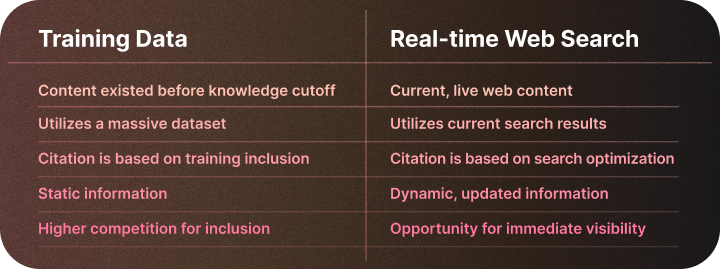
The web search functionality uses Bing’s search infrastructure, but ChatGPT applies its own filtering and evaluation criteria when selecting sources. It doesn’t just grab the top Bing results; it evaluates content quality, relevance, and credibility before incorporating information into responses.
### Source Selection Process
ChatGPT’s source selection follows a hierarchy that prioritizes certain types of content over others. The model evaluates several factors simultaneously when choosing which sources to cite:
- **Content depth and comprehensiveness** – Detailed coverage beats surface-level information
- **Author and publication credibility** – Established authorities get preference
- **Information accuracy and consistency** – Cross-verified facts rank higher
- **Relevance to specific queries** – Perfect matches outrank tangentially related content
- **Source type hierarchy** – Primary sources typically outrank secondary aggregation
Interestingly, ChatGPT shows a strong preference for educational and institutional sources when available. Government websites, academic papers, established news organizations, and industry-leading publications consistently appear in citations more frequently than blog posts or promotional content.
### Citation Behavior
On a similar note, ChatGPT’s citation patterns reveal a lot about its preferences. It tends to cite sources that provide specific, factual information rather than opinion pieces. Statistical data, research findings, and expert quotes get referenced more frequently than general commentary.
The model also shows a preference for sources that clearly attribute their own information. Content that cites original research or provides clear source attribution tends to get cited more often than unsourced claims.
## The ChatGPT Content Evaluation Framework
ChatGPT evaluates authority differently than traditional search. While backlinks matter for web search discovery, ChatGPT pays more attention to content-based authority signals:
- **Expertise demonstration** through detailed, accurate information
- **Industry-specific terminology** used correctly and naturally
- **Institutional affiliation** with established organizations
- **Source attribution** within your own content
- **Consistent quality** across your content library
- **Recognition by other authoritative sources** in your field
The model also recognizes institutional authority. Content from established organizations, industry associations, academic institutions, and government agencies receives higher credibility scores than individual blog posts or promotional content.
Citation of credible sources within your content signals authority to ChatGPT. When your content references other authoritative sources and provides proper attribution, it suggests you’re operating within legitimate information ecosystems rather than creating isolated content.
### Content Quality Indicators
Depth matters enormously for ChatGPT optimization. Surface-level content that barely scratches a topic rarely gets cited. The model strongly favors [comprehensive coverage](https://www.wearetg.com/blog/long-form-content/) that addresses multiple aspects of a topic.
Accuracy is non-negotiable. ChatGPT has mechanisms for detecting and avoiding inaccurate information. Content with factual errors, outdated data, or misleading claims gets deprioritized even if it’s otherwise well-optimized.
Logical structure and clear organization help ChatGPT extract relevant information efficiently. Content that uses proper headings, clear transitions, and logical information hierarchy gets processed more effectively than poorly structured material.
Completeness of coverage influences citation frequency. Content that answers related questions, addresses common objections, and provides context beyond the immediate topic tends to get referenced more often.
### Recency and Freshness
Like many AI tools, ChatGPT’s approach to content freshness is more nuanced than traditional search engine optimization. For topics where information doesn’t change rapidly, older but authoritative content can outrank newer but less comprehensive material. However, publishing fresh content and keeping information current is crucial to improve the likelihood of being cited by ChatGPT, as it values up-to-date and relevant sources.
However, for rapidly evolving topics, technology trends, current events, and regulatory changes, ChatGPT strongly prioritizes recent information. The model can recognize when topics require current data and will favor sources with recent publication dates.
Regular content updates matter, but not just for freshness signals. Updated content that maintains accuracy while adding new information, examples, or insights demonstrates ongoing expertise and commitment to quality. Implementing content recency strategies, such as updating statistics and incorporating recent examples, helps maintain relevance for AI-powered searches.
### Source Credibility Assessment
ChatGPT evaluates source credibility through multiple lenses. Publication credibility, author expertise, content consistency, and information verification all factor into credibility assessment.
The model can distinguish between content from established, credible publications and unknown sources. It also evaluates author bylines and can associate content with known experts in specific fields.
Cross-source verification plays a huge role. Information that appears consistently across multiple credible sources gets higher credibility scores than claims that appear in isolation.
### Topical Expertise Recognition
Building topical expertise requires consistent, high-quality content creation over time. ChatGPT can recognize when sources consistently provide valuable information on specific topics.
Depth of coverage within topic areas matters more than breadth across unrelated subjects. Websites that demonstrate deep expertise in specific domains tend to get cited more frequently within those areas than generalist sites.
The model also recognizes expertise through content sophistication. Technical accuracy, proper use of industry terminology, and demonstration of insider knowledge all contribute to expertise recognition.
## Technical SEO for ChatGPT Discovery
Your content needs to be technically accessible before ChatGPT can consider it. This starts with fundamental requirements that ensure discoverability:
- **Clean URL structures** that are easily crawlable
- **Proper internal linking** connecting related content
- **XML sitemaps** listing your important pages
- **Accessible robots.txt** allowing crawling of key content
- **Server-side rendering** for JavaScript-heavy sites
- **Consistent uptime** and fast server response times
JavaScript-heavy sites need special attention. If your content requires JavaScript execution to render, it may not be accessible to ChatGPT’s crawling systems. Server-side rendering or proper prerendering ensures content availability.
### Content Structure Optimization
Header hierarchy matters significantly for ChatGPT optimization. Proper H1, H2, and H3 usage helps the model understand your content structure and extract relevant information efficiently. To optimize content structure, use well-organized headings and a clear hierarchy, which improves both human readability and ChatGPT’s ability to extract key details.
Clear section breaks and logical information organization make it easier for ChatGPT to identify specific pieces of information relevant to particular queries. Well-structured content gets cited more frequently than poorly organized material.
Use descriptive headings that clearly indicate what information follows. Generic headings like “Overview” or “Introduction” are less helpful than specific, descriptive headings that summarize the content.
Lists, tables, and other structured content formats work particularly well for ChatGPT extraction. Information presented in these formats gets referenced more frequently than dense paragraph text. Additionally, using bullet points to break down complex topics improves skimmability and makes key information more accessible for both readers and AI.
As part of optimizing content structure, remember to craft effective meta descriptions that incorporate relevant keywords. Well-written meta descriptions can enhance search engine visibility and improve click-through rates.
### Schema Markup That Matters
Not all schema markup influences ChatGPT, but certain types provide clear benefits. The most valuable schema types for ChatGPT optimization include:
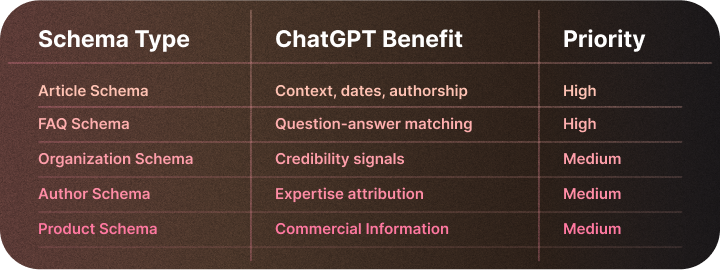
FAQ schema can be particularly valuable since ChatGPT often deals with question-answering scenarios. Properly marked up FAQ content increases the likelihood of being cited in response to related queries.
### Page Performance
Page load speed affects ChatGPT’s ability to access your content during real-time searches. Slow-loading pages may not be fully processed or may be skipped entirely in favor of faster alternatives.
Server reliability is crucial. If your pages frequently return errors or time out, they won’t be available when ChatGPT attempts to access them. Consistent uptime is essential for maintaining visibility.
Content delivery networks (CDNs) can improve accessibility by reducing load times and increasing reliability across different geographic regions where ChatGPT’s systems might be accessing your content.
### Mobile and Multi-device Optimization
ChatGPT’s web browsing capabilities include mobile user agents, so your content needs to be accessible and well-formatted across device types.
Responsive design ensures your content displays properly regardless of how ChatGPT accesses it. Mobile-unfriendly sites may have their content improperly parsed or ignored entirely.
Touch-friendly interfaces and mobile-optimized navigation don’t directly affect ChatGPT, but they influence overall site quality signals that can impact how your content gets evaluated.
## Content Strategy for ChatGPT Visibility
Shallow content rarely gets cited by ChatGPT. The model strongly favors comprehensive coverage that addresses topics thoroughly rather than providing surface-level information.
This doesn’t mean longer is always better—it means complete is better than incomplete. Cover the essential aspects of your topic, address common questions, and provide the level of detail someone would need to truly understand the subject.
Include examples, case studies, and specific details that demonstrate practical application of concepts. Abstract information gets cited less frequently than concrete, actionable insights.
Address counterarguments and alternative perspectives within your content. Balanced coverage that acknowledges different viewpoints tends to get cited more often than one-sided presentations.
### Question-Based Content Architecture
Structure your content around the questions your audience actually asks. ChatGPT often deals with specific queries, so content that directly answers those questions has a higher chance of being cited.
Use tools like Answer the Public, Google’s “People also ask” feature, and industry forums to identify the actual questions people have about your topics. Build content sections that directly address these questions.
Create comprehensive FAQ sections that go beyond basic questions. Address complex, nuanced questions that demonstrate deep understanding of your subject matter.
Consider the follow-up questions users might ask after getting initial answers. Content that addresses the natural progression of inquiry tends to get cited more frequently.
### Primary Source Development
Becoming a primary source dramatically increases your chances of being cited by ChatGPT. Original research, proprietary data, and firsthand insights carry much more weight than aggregated information from other sources.
The most effective primary source content includes:
- **Original surveys and studies** that provide new industry insights
- **Proprietary data analysis** that reveals unique trends or patterns
- **Case studies** from your own experience documenting real results
- **Expert interviews** with recognized thought leaders
- **First-hand testing and experimentation** with documented methodologies
- **Industry reports** based on your unique market position
Document your own experiments, case studies, and results. Primary source content about your own experiences and outcomes provides the type of specific, credible information ChatGPT values.
### Multi-angle Topic Coverage
Cover your core topics from multiple angles and perspectives. Different users approach the same topics with different backgrounds, needs, and contexts.
Create beginner guides alongside advanced tutorials. Address the same concepts from different skill levels to capture a broader range of queries.
Cover both theoretical and practical aspects of your topics. Some users want to understand concepts, while others need implementation guidance.
Address different use cases and scenarios within your topic area. Comprehensive coverage of various applications increases the likelihood of being cited across different queries.
### Content Freshness Strategies
Maintain accuracy across your content library. Outdated information can harm your credibility and reduce citation frequency across all your content.
Update statistics, examples, and references regularly. Fresh data and current examples make your content more valuable for ChatGPT citations.
Add new sections to existing content when relevant developments occur in your field. Expanding existing content often works better than creating entirely new pages.
Create content calendars that align with keyword research, industry cycles, seasonal trends, and predictable information needs. Timely content creation increases your chances of being the current, authoritative source when topics become relevant.
## Building Links for ChatGPT SEO
Link building remains a cornerstone of search engine optimization, but when it comes to ChatGPT and other AI-driven platforms, the types of links you pursue, how you acquire them, and how much [“link juice”](https://www.wearetg.com/blog/link-juice/) they can offer have a unique impact on your website visibility and authority.
ChatGPT, like traditional search, evaluates the quality and relevance of links pointing to your site. However, its AI systems place particular emphasis on the credibility and context of those links, especially when generating responses that cite external sources. Here’s how you can optimize your link building strategy for ChatGPT SEO:
1. **Authority Links:** Securing links from high authority sites—such as government agencies, educational institutions, and respected industry leaders—signals to both search engines and ChatGPT that your content is trustworthy. These links can elevate your site’s authority, making it more likely to be referenced in AI-generated content and search results.
2. **Relevant Links:** Links from websites within your niche or closely related industries help ChatGPT understand your site’s context. When your content is linked by other relevant sources, it reinforces your expertise and increases the chances of being cited in responses tailored to specific user needs.
3. **Internal Links:** A well-structured internal linking strategy not only improves user satisfaction by guiding visitors to relevant material, but also helps ChatGPT’s crawlers and other search engine bots efficiently discover and index your content. This enhances your site’s overall SEO performance and ensures that key information is easily accessible for AI-driven searches.
4. **Natural Links:** Earning links organically—through high-quality content creation, guest blogging, resource page inclusion, or brand mentions on other websites—demonstrates genuine authority and relevance. ChatGPT and other search engines are adept at recognizing natural link profiles, which can boost your site’s credibility and reduce the risk of being flagged as spam.
5. **Social Links:** While links from social media platforms may not always pass traditional SEO value, they can drive significant traffic and engagement metrics. Increased user interaction and brand visibility on social channels can indirectly influence how ChatGPT and other AI tools perceive your site’s authority and relevance.
To build a robust link profile that benefits both ChatGPT and traditional search engines, leverage a combination of proven SEO tools and strategies:
- **Keyword Research:** Use advanced keyword research tools to find relevant keywords and content ideas that attract links from other websites. Targeting high search volume and trending topics can increase your chances of earning valuable backlinks.
- **Content Creation:** Focus on creating content that is not only informative and engaging but also link-worthy. Comprehensive guides, original research, and interactive elements can encourage other sites to reference your work.
- **Link Building Campaigns:** Implement targeted link building strategies such as guest posting, resource page outreach, and broken link building to acquire high-quality links from authoritative and relevant sources.
- **Competitor Analysis:** Regularly analyze your competitors’ link profiles using SEO tools to identify new opportunities for link acquisition and to benchmark your own progress.
- **SEO Audits:** Conduct ongoing SEO audits to ensure your site remains fully SEO optimized, with a healthy internal link structure and no technical barriers to crawling or indexing.
By prioritizing high-quality, relevant content and focusing on natural, authoritative link acquisition, you’ll not only improve your site’s ranking on ChatGPT but also strengthen your overall digital presence across all major search engines. Remember, effective link building is about building relationships and providing value—both to users and to the AI systems that power the next generation of search.
## Advanced ChatGPT SEO Tactics
Consistency across your content builds trust with ChatGPT’s evaluation systems. Maintain consistent quality, accuracy, and depth across all your content rather than having a few standout pieces mixed with mediocre material.
Create content clusters around your core topics. Multiple pieces of related, high-quality content on the same subject area increases your chances of being recognized as a topical authority.
Cross-link related content within your site to help ChatGPT understand the relationships between your different pieces of content. This internal linking also helps establish your comprehensive coverage of topic areas.
Maintain consistent authorship attribution. Having recognized experts consistently associated with your content helps build authority signals over time.
### Semantic Content Optimization
Think beyond individual keywords to conceptual coverage. ChatGPT understands context and relationships between concepts, so comprehensive conceptual coverage matters more than keyword density.
Use related terms, synonyms, and contextually relevant vocabulary throughout your content. This helps ChatGPT understand the full scope of topics you’re addressing.
Address related concepts and topics that provide context for your main subject. Comprehensive contextual coverage helps your content get cited for a broader range of queries.
Create content that connects different concepts and explains relationships between ideas. This type of contextual content often gets cited when ChatGPT needs to explain complex topics.
### Entity-Based SEO
Focus on becoming associated with specific entities—people, companies, concepts, or topics—within your field. ChatGPT recognizes entity relationships and can associate your content with specific expertise areas.
Create comprehensive profiles and coverage of important entities in your industry. Becoming the go-to source for information about specific companies, people, or concepts increases citation frequency.
Use proper entity markup and clear entity references throughout your content. Help ChatGPT understand which entities your content covers and how they relate to each other.
### Cross-Reference Optimization
Study which sources get cited alongside yours in ChatGPT responses. Understanding your “citation neighbors” helps identify opportunities for improved positioning.
Create content that complements rather than duplicates information from other authoritative sources. Filling gaps in existing coverage increases your chances of being cited alongside established authorities.
Reference and link to other high-quality sources appropriately. Demonstrating that you operate within legitimate information ecosystems rather than isolation helps build credibility.
### Conversation Flow Optimization
Structure your content to match how ChatGPT presents information. Study ChatGPT responses in your field to understand common information patterns and presentation styles.
Use clear, concise language that works well for synthesis into ChatGPT responses. Overly complex or convoluted writing is less likely to be quoted directly.
Create quotable sections with clear, authoritative statements that work well as citations. These might be key insights, important statistics, or clear explanations of complex concepts.
## Measuring and Tracking ChatGPT SEO Success
[Set up monitoring](https://www.wearetg.com/services/analytics/) systems to track when your brand, content, or expertise gets mentioned in ChatGPT responses. This requires a combination of manual testing and systematic monitoring approaches.
Create a list of key queries related to your expertise and regularly test them in ChatGPT to see if your content gets cited. Track changes in citation frequency over time.
Use tools like Google Alerts to monitor mentions of your brand across the web, which can help identify when your content gets referenced in articles that might later be cited by ChatGPT.
Monitor competitor citations to understand the competitive landscape and identify opportunities where you could replace or supplement competitor content in ChatGPT responses.
### Query Performance Analysis
Develop a systematic approach to understanding which types of queries result in citations of your content. Key metrics to track include:
- **Query categories** that consistently cite your content
- **Seasonal patterns** in citation frequency
- **Query variations** that affect citation likelihood
- **Competitor comparison** across similar queries
- **Citation context** and positioning within responses
Test variations of similar queries to understand how query phrasing affects citation likelihood. Even free tools like Google Search Console can tell you most of what you need to know. Small changes in how questions are asked can dramatically change which sources get cited.
### Competitive Intelligence
Analyze which sources consistently get cited alongside yours or instead of yours for key queries in your field. Understanding the competitive citation landscape helps identify improvement opportunities.
Study the content characteristics of frequently cited competitors. What makes their content more citation-worthy than yours? Use this analysis to improve your own content strategy.
Identify gaps where competitors get cited but you don’t. These represent opportunities to create better content or optimize existing content for improved visibility.
### ROI Measurement
Track traffic referrals that can be attributed to ChatGPT citations. While direct attribution can be challenging, look for patterns in direct traffic, branded searches, and other indicators that might correlate with ChatGPT visibility.
Monitor changes in brand awareness and thought leadership indicators that might correlate with increased ChatGPT citations. Surveys, social media mentions, and industry recognition can provide indirect ROI measurements.
### Attribution Tracking
Develop systems to track the customer journey from ChatGPT exposure to conversion. This might involve tracking branded searches, direct website visits, or other indicators that users discovered you through AI interactions.
Use UTM parameters and other tracking methods to identify traffic that might be coming from users who discovered you through ChatGPT but didn’t click directly from the platform.
Monitor changes in organic search performance for branded terms, which can indicate increased brand awareness potentially driven by ChatGPT citations.
## Summary
ChatGPT SEO represents a fundamental shift in how content gets discovered and consumed. The companies that master these strategies now will establish dominant positions before the competition realizes what’s happening. Start with comprehensive, authoritative content creation, focus on becoming a trusted source in your field, and systematically track your progress. The opportunity is massive, but it won’t stay under the radar forever.
#### If your content isn’t being referenced or surfaced by AI tools, it’s time to rethink your approach.
[Book a 30-minute consultation](https://www.wearetg.com/contact/) with Timmermann Group and we’ll identify what’s missing.
---
## Frequently Asked Questions
### Is there SEO for ChatGPT?
Yes, SEO for ChatGPT involves optimizing your content to get cited and referenced in ChatGPT’s responses. ChatGPT pulls information from both its training data and real-time web searches, making your content discoverable through proper optimization strategies.
### How to optimize search for ChatGPT?
Optimize for ChatGPT by creating comprehensive, authoritative content with proper technical SEO and clear source attribution. Focus on becoming a primary source with original research and expertise rather than just copying information from other sites.
### How to rank #1 in ChatGPT results AI SEO strategy?
Build topical authority through consistent, high-quality content creation and establish yourself as a trusted source in your field. “Ranking #1” in ChatGPT means getting consistently cited as an authoritative source rather than appearing at the top of a traditional search results list.
### What is SEO for AI called?
SEO for AI is commonly called Generative Engine Optimization (GEO) or AI SEO. This approach focuses on optimizing content specifically for AI-powered search tools and chatbots rather than traditional search engines like Google.
**Categories:** SEO, News
---
### [The Essential Website Audit Checklist: What Actually Matters in 2026](https://www.wearetg.com/blog/website-audit-checklist/)
**Published:** October 15, 2025
**Author:** Rob Timmermann
**Content:**
There’s a lot of data you can pull from website audits. Like, a lot. But here’s what I’ve learned after years of doing this work; most don’t actually impact your rankings.
The issues you need to worry about are the ones blocking Google from seeing your content. Pages accidentally set to noindex. JavaScript that hides your content from crawlers. Site speed so slow Google thinks your server is down.
Everything else? Sure, it matters. But this guide focuses on the stuff that can kill your traffic overnight.
## Make Sure Google Can Actually Find Your Pages
First question: Can search engines even find your pages? If not, nothing else matters. Google can’t rank pages it can’t see. So before you optimize anything, make sure crawlers can find and index your content.
#### Understanding crawlability & indexing
Crawlability is whether Google’s bots can access and navigate your site. Indexing is whether Google can store and retrieve your pages to show them in search results. Think of it like this: crawlability is whether Google can walk through your front door and explore your house. Indexing is whether Google can remember what it saw and tell other people about it.
##### Common technical problems to watch for
Common crawlability problems include robots.txt files that accidentally block important pages, broken internal links that create dead ends, and redirect chains that exhaust Google’s crawl budget before reaching your content.
Indexing issues often show up as noindex tags on pages you want ranked, canonical tags pointing to the wrong URLs, or content hidden behind JavaScript that Google can’t process.
##### Why this affects your visibility
Here’s the bottom line: if Google can’t crawl your pages, they won’t get indexed. If they’re not indexed, they can’t rank. You could have the best content in the world, but if Google never sees it, you might as well not have published it at all.
#### How to audit your crawlability & indexing
##### XML Sitemap
Your XML sitemap is essentially a roadmap of your site for search engines. It tells Google which pages exist and which ones you consider most important. In 2026, with sites becoming increasingly complex and dynamic, a proper sitemap isn’t optional—it’s essential.
Your sitemap should include only the pages you want indexed. Don’t include pages with noindex tags, redirected URLs, or pages blocked by robots.txt. That just confuses search engines and wastes crawl budget.
##### How to Implement
Most modern CMS platforms (WordPress, Shopify, Wix) generate sitemaps automatically. If yours doesn’t, plugins like Yoast SEO or RankMath can create one for you. Once you have a sitemap, submit it through Google Search Console under the Sitemaps section.
Keep it updated. When you add new pages or remove old ones, your sitemap should reflect those changes. Most automatic sitemap generators handle this, but it’s worth checking periodically.
##### Robots.txt File
The robots.txt file tells search engines which parts of your site they can access and which are off-limits. The problem is, many sites accidentally block important pages.
Check your robots.txt file by visiting yoursite.com/robots.txt. Look for “Disallow” directives that might be blocking pages you want indexed. Common mistakes include blocking CSS or JavaScript files that Google needs to render your pages properly, or accidentally blocking entire sections of your site.
You can test your robots.txt file in Google Search Console under the URL Inspection tool to see if specific URLs are blocked.
## Your Site Needs to Work on Phones
#### Why mobile-first indexing matters
Mobile devices account for over 60% of all web traffic. And Google now predominantly uses the mobile version of your site for indexing and ranking. If your site doesn’t work on a smartphone, you’re alienating the majority of your potential audience before they even read your first paragraph.
#### What makes a site truly responsive
Responsive design isn’t about making things smaller. A truly mobile-friendly site includes:
- **Touch-friendly navigation** with adequately sized buttons and links (Google recommends at least 48×48 pixels for tap targets)
- **Readable text** without zooming, typically 16px or larger for body copy
- **Content that fits the screen** without requiring horizontal scrolling
- **Fast-loading images** optimized for mobile bandwidth
- **Simplified navigation** that works with thumbs, not just mouse cursors
#### Testing your mobile experience
##### Google’s Mobile-Friendly Test
Head to Google’s Mobile-Friendly Test tool and enter your URL. It’ll show you exactly how Googlebot sees your mobile site and flag critical issues. If Google says your site isn’t mobile-friendly, that’s a red flag you need to address immediately.
##### Google’s Mobile Usability Report
Inside Search Console, check the Mobile Usability report under the Experience section. This shows you specific pages with mobile issues like text that’s too small, content wider than the screen, or clickable elements too close together. The beauty of this report is that it shows you real problems Google has encountered while crawling your site.
##### Manual Review on Devices
Don’t skip this step. Open your site on actual phones and tablets, both iOS and Android if possible. Use Chrome’s DevTools to test different screen sizes. Click through your navigation, fill out forms, and try to complete key user actions. You’ll often discover usability issues that automated tools miss, like a form that’s technically responsive but practically unusable on a small screen.
## Help Search Engines Understand Your Content
Schema markup is code you add to your website that helps search engines understand your content better. Instead of just reading text and guessing what it means, schema explicitly tells search engines “this is a recipe,” “this is a person’s job title,” or “this is a product price.”
#### Why schema markup matters more than ever in 2026
##### Zero-click searches & rich results
Zero-click searches, where users get their answer directly on the search results page without clicking through to a website, have made structured data even more important in 2026. When your content has proper schema markup, you’re more likely to appear in featured snippets, knowledge panels, and rich results.
Yes, this sometimes means fewer clicks to your site sometimes. But it also means you own things like the [AI overview and “people also ask box.”](https://www.wearetg.com/blog/google-ai-overviews/) This helps establish authority even if users don’t click through. And for transactional queries, rich results with star ratings, prices, and availability can actually increase click-through rates.
##### How search engines think about entities
Modern search engines prioritize entities (people, places, things, and concepts) over individual keywords. Schema markup helps search engines understand the entities on your page and how they relate to each other.
When you mark up a local business with schema, you’re not just saying “here’s a business name and address.” You’re telling Google about an entity with a specific location, operating hours, services offered, and relationships to other entities like the people who work there or the products they sell. This deeper understanding helps search engines match your content to complex, conversational queries.
In practical terms, this means using schema markup like Organization, LocalBusiness, Person, Product, Article, FAQPage, and HowTo depending on your content type. Tools like Google’s Rich Results Test can show you if your schema is implemented correctly.
## Every Second Counts When It Comes to Page Speed
We already covered how Google now uses the mobile version of your site for indexing. But beyond rankings, think about your own behavior. When was the last time you waited patiently for a slow website to load? Most users bounce within three seconds if a page doesn’t load. Site speed [also ties into Google’s E-E-A-T framework](https://www.wearetg.com/blog/google-eeat/) (Experience, Expertise, Authoritativeness, Trustworthiness). A slow, clunky website signals poor quality and undermines trust. If your site feels neglected or unprofessional, why would users trust your expertise?
#### Tools to measure your site speed
- **PageSpeed Insights** provides both lab data and real-world field data from actual users. It shows your Core Web Vitals scores and prioritizes the fixes that will make the biggest impact.
- **GTmetrix** gives you a detailed waterfall view of how your page loads, helping you identify specific resources slowing things down.
- **Google Search Console’s Core Web Vitals** report shows you which pages on your site are struggling, based on real user data. This is gold because it tells you where to focus your efforts.
#### What to look for in your speed reports
Once you run these tests, you’ll get a list of recommendations. Here’s what to look for:
##### Unoptimized Images
This is the most common culprit. Large, uncompressed images can account for 50-70% of a page’s total weight. Compress images before uploading, use modern formats like WebP, and implement lazy loading so images only load as users scroll to them.
##### Render-Blocking Scripts/CSS
When JavaScript or CSS files block your page from rendering, users see a blank screen while they wait. Move non-critical CSS and JavaScript to load asynchronously or defer their loading until after the main content appears.
##### Server Response Time
If your server takes forever to respond (anything over 600ms is problematic), you might need better hosting. Cheap shared hosting often can’t handle traffic spikes or complex queries efficiently. Consider upgrading to better hosting or implementing a content delivery network (CDN).
##### Caching
Caching stores static versions of your pages so they don’t need to be rebuilt from scratch every time someone visits. Browser caching, server-side caching, and CDN caching all work together to dramatically improve load times for repeat visitors.
##### Excessive Plugins or Code
Every plugin or third-party script adds weight to your site. That social media feed widget? It might be loading dozens of requests. Audit your plugins regularly and remove anything you’re not actively using. For critical third-party scripts like analytics, consider loading them asynchronously.
---
### Download Our Free Website Audit Checklist
[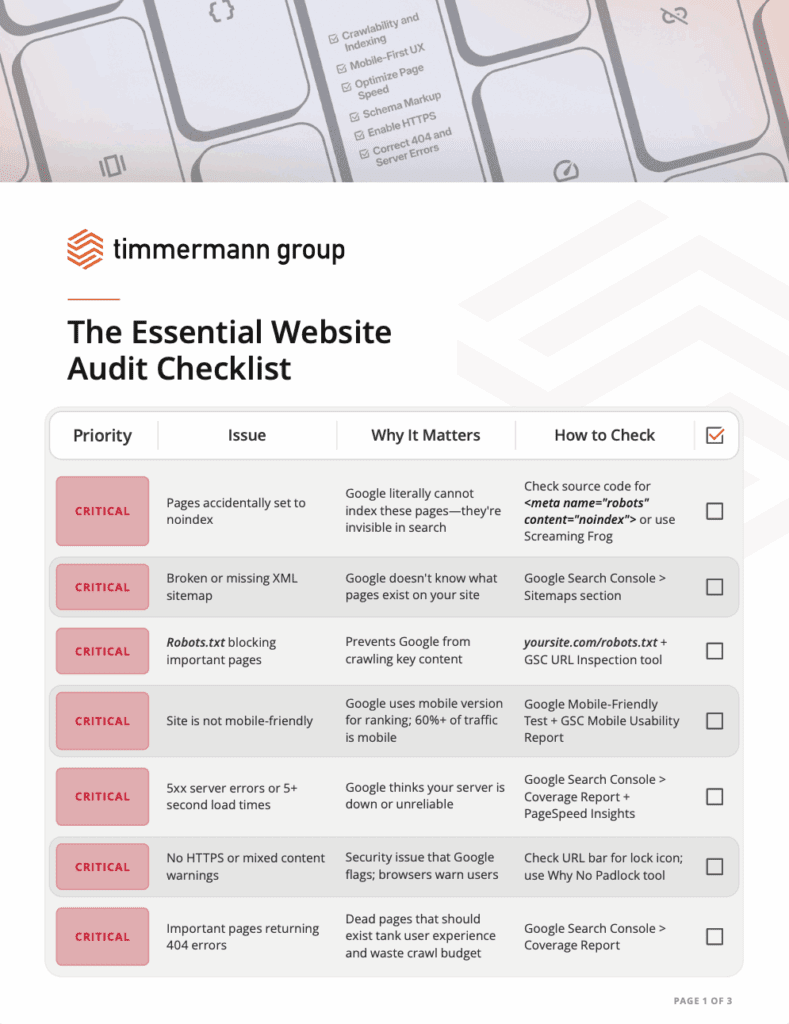](https://www.wearetg.com/wp-content/uploads/2025/10/TG-Website-Audit-Checklist.pdf)
[**\[Download the PDF\]**](https://www.wearetg.com/wp-content/uploads/2025/10/TG-Website-Audit-Checklist.pdf)
---
#### A website audit checklist is a starting point, not the solution.
Our SEO services include monthly technical audits to catch issues before they hurt your rankings, plus an in-house dev team that implements fixes immediately. No waiting, no back-and-forth, no wondering if it’s done right. [Schedule a free consultation](https://www.wearetg.com/contact/ "Contact Us") to learn how Timmermann Group can help fix issues with your website that allow it to rank, convert, and deliver results for your business.
**Categories:** UX, CRO, SEO, Web Development
---
### [SEO for Perplexity: Effective Ranking Strategies 2025](https://www.wearetg.com/blog/seo-for-perplexity/)
**Published:** October 20, 2025
**Author:** Rob Timmermann
**Content:**
SEO for Perplexity focuses on optimizing for AI-driven search engines that prioritize user intent and third-party validation over traditional keywords. This article explains the importance of [AI SEO](https://www.wearetg.com/services/ai-seo/) for Perplexity and provides key strategies to enhance your search rankings and stay competitive.
## Key Takeaways
- SEO for Perplexity emphasizes **third-party validation and user intent**, marking a shift from traditional keyword-focused strategies to high-quality, user-centric content.
- Understanding **user intent and optimizing content structure** are critical for successfully optimizing SEO for Perlexity, encouraging the use of clear headers, bullet points, and direct answers to enhance user engagement.
- Regularly **refreshing content and monitoring algorithm changes** are essential for maintaining visibility and competitiveness in the evolving AI-driven search landscape.
## Why SEO for Perplexity is Essential for Modern Marketers
In the ever-evolving world of digital marketing, traditional SEO methods are no longer enough to secure top rankings on AI-driven search engines like Perplexity. Unlike traditional SEO, which relies heavily on keywords, Perplexity works by emphasizing third-party validation and user intent, making it essential for marketers to adapt their strategies accordingly. Optimizing for Perplexity allows businesses to gain a competitive edge in search visibility and stay relevant in the AI-driven market.
Perplexity relies on recent and authoritative content, shifting the focus from merely stuffing keywords to creating high-quality, user-centric material. This AI search assistant combines conversational queries with trusted web results, prioritizing user intent and providing more personalized outcomes. Marketers who understand and adapt to these preferences can significantly improve their search rankings and enhance their brand’s strong presence with answer engines, AI search engines, retrieval augmented generation, AI-powered search, and Perplexity work.
Moreover, the importance of [Generative Engine Optimization (GEO)](https://www.wearetg.com/blog/generative-engine-optimization/) cannot be overstated. This technique emphasizes creating content that aligns with AI engines’ preferences, further solidifying the need for modern marketers to stay ahead of the curve and continuously refine their SEO strategies. SEO for Perplexity is not just a trend; it’s a necessity for those looking to lead in the digital marketing space.

## Understanding User Intent in Perplexity
To succeed in SEO for Perplexity, understanding user intent is the first step. Perplexity’s search results approach is user-centric, refining results through specific questions and prioritizing human-centered content. Users on Perplexity often pose questions in a conversational manner, asking for best practices or specific tasks. Recognizing different types of user questions enables marketers to create relevant material that boosts search rankings and enhances user experience. These types include:
- Informational
- Navigational
- Transactional
- Commercial
Understanding user intent also involves creating FAQs that target follow-up questions, thus enhancing content relevance and addressing exact queries users are likely to ask. This approach not only aligns with Perplexity’s preferences but also demonstrates experience and expertise, further improving search rankings.
### Identifying Popular Keywords
Identifying popular keywords is a cornerstone of SEO for Perplexity. Unlike traditional search engines, Perplexity relies on long-tail, question-based phrases, making it crucial for marketers to focus on these types of keywords to improve visibility.
Searching for industry-relevant keywords on Perplexity and using insights from industry-specific sources helps businesses align their content with user searches and improve search rankings, unlike other search engines.
### Analyzing User Queries
Analyzing the user’s query and the original query is essential for understanding the underlying motivations behind them. This involves transforming simple keyword searches into more complex natural language queries that reflect specific needs. Segmenting user queries into categories allows marketers to tailor their content to specific needs, thereby improving relevance and increasing user engagement.
### Enhancing Content Clarity
Enhancing content clarity is crucial for user engagement and optimal visibility on Perplexity. Crafting content in a conversational tone, utilizing structured content, and integrating visual elements like diagrams or charts can significantly improve user experiences.
Implementing an inverted pyramid style allows for quick identification of core information, making the content more user-friendly and increasing the likelihood of citation.
## Optimizing Content Structure for Perplexity
Structuring content effectively is vital for Perplexity AI optimization. Clear, structured content aligns with user expectations and improves readability, increasing the likelihood of citation. Perplexity relies on AI SEO, which emphasizes creating content that provides direct answers to user queries. Focusing on conversational questions and direct, concise answers enhances content effectiveness, including ai generated answers and ai overviews.
Using clear headers and short lists helps address multiple questions within a single piece, promoting natural language processing and improving content structure. Creating content that aligns with AI engines and predicting user intent is essential for optimizing content for Perplexity, especially when utilizing a large language model.
### Utilizing Bullet Points and Lists
Bullet points and lists are powerful tools for improving content visibility and organization. They enhance readability and ensure that key takeaways are easily identifiable.
Lists should be used judiciously to complement the text without overwhelming it, making the content more engaging and user-friendly.
### Implementing Q&A Sections
Implementing Q&A sections can effectively match user search behaviors and increase engagement. Providing straightforward answers to common questions is similar to optimizing for featured snippets, making the content more accessible and relevant to users.
### Providing Clear, Concise Answers
Providing clear, concise, and accurate answers is crucial for user engagement and success on Perplexity. Utilizing tools like Perplexity to provide users with a thorough exploration of topics and identify follow-up questions can enhance content optimization for pro users.
Using bullet points and numbered lists to organize information improves readability, while addressing multiple questions within a single piece reduces confusion and increases user satisfaction.
## Leveraging Authoritative Sources
Leveraging authoritative sources is critical for building trust with both users and search engines. Perplexity prioritizes domain authority when ranking content, making it essential for marketers to engage with reputable sources and expert opinions. Engaging with authoritative sites like Reddit and TripAdvisor can add credibility to your content, as these platforms are preferred by Perplexity for user-generated content and authoritative domains.
Understanding domain overlaps between Perplexity and Google is crucial for identifying shared trusted sources and maximizing visibility. Engaging with real consumers and community-driven insights can further enhance credibility and improve search rankings.
### Citing Reputable Sources
Citing reputable sources and credible sources builds trust and reduces confusion, particularly in industries like finance and insurance. Articles that include lists, how-to guides, and dates in the title are commonly cited and significantly enhance engagement.
Third-party validation through reviews can improve visibility on Perplexity and contribute to greater SEO success.
### Building Domain Authority
Building domain authority is essential for appearing in user searches on Perplexity. Writing content with experts and aligning strategies with high-value domain citations can increase the likelihood of being cited.
Focusing on websites with high traffic, good domain authority, and strong community engagement, including government sites, should be prioritized for content generation specific to your target audience.
### Engaging with Industry-Specific Platforms
Engaging with industry-specific platforms is crucial for enhancing visibility on Perplexity. Prioritize industry-specific review sites and aggregator platforms relevant to your sector to improve your brand’s presence on key platforms.
Increasing discussions about your brand on community forums can further enhance the likelihood of being showcased on Perplexity.

## Incorporating Multimedia for Enhanced Engagement
Incorporating multimedia elements into your content can significantly boost user engagement and improve search engine rankings. Visual content, such as videos and images, can capture attention, encourage longer viewing times, and improve memory retention for users. By integrating multimedia, you can create a richer and more engaging user experience.
A visually appealing layout that combines text with images and videos makes content more inviting and easier to comprehend. This approach not only enhances user engagement but also increases the chances of your content being cited by Perplexity.
### Using Data Visualizations
Using data visualizations like charts and graphs simplifies complex information, making it easier for users to understand and retain. Effective data visualizations can significantly enhance content engagement and help convey key insights more clearly.
### Integrating Videos and Images
Integrating videos and images with text provides a richer user experience and can increase user engagement by capturing attention and encouraging longer viewing times. Visual aids help improve memory retention and make content more inviting.
## Refreshing and Updating Content Regularly
Regularly updating content is crucial for maintaining visibility and providing users with timely information. Key practices include:
- Covering fresh topics and providing comprehensive details to keep content relevant and valuable.
- Conducting regular content audits to ensure the relevancy and accuracy of information.
- Making sure content responds to users’ needs.
Adjusting your strategy based on ongoing performance metrics is crucial to keep content aligned with user expectations. By refreshing and updating content regularly, you can boost visibility and stay ahead of the competition.
### Timely Updates
Timely updates are increasingly crucial for maintaining high-quality content and staying ahead of trends. Regularly updating published content ensures that it remains relevant and valuable for users, providing practical insights, fresh content, and significant impact.
Addressing current events or trends can enhance your site’s visibility on Perplexity and keep your content fresh and engaging.
### Monitoring Algorithm Changes
Monitoring algorithm changes is essential for adapting your SEO strategies effectively. Changes in the landscape of partnerships can offer hints about future algorithm preferences for Perplexity. Real-time data tracking helps assess the effectiveness of your AI optimization efforts, ensuring that your content remains relevant and maintains high search rankings.
## Tracking Success and Adapting Strategies
Tracking success and adapting strategies is crucial for maintaining competitiveness in AI SEO. Evaluating performance helps identify areas needing improvement and ensures that your strategies remain effective. Perplexity AI allows businesses to understand consumer behavior by analyzing extensive datasets, aiding in the development of tailored strategies using AI tools.
The platform’s ability to forecast market trends supports proactive strategy adaptations, enabling real-time decision-making and streamlining workflows for marketers. Leveraging Perplexity AI helps businesses stay competitive and effectively navigate the evolving landscape of AI-driven search engines.
### Using Analytics Tools
Using analytics tools is essential for tracking Perplexity rankings and understanding visibility. Although tracking Perplexity rankings can be inconvenient, tools like OmniSEO make things easier.
OmniSEO allows organizations to monitor visibility across search engines and analyze competitor visibility over time, providing valuable insights for adapting SEO strategies and driving more traffic.
### Adapting Based on Performance
Adapting your strategies based on performance is crucial for success in AI-driven search. Actively participating in niche communities and engaging with real consumers can enhance brand visibility and provide valuable feedback for fine-tuning strategies.
Creating genuinely useful and informative content is the key to success, ensuring that your SEO performance remains competitive and effective.
## Summary
Mastering SEO for Perplexity involves understanding and implementing various strategies to ensure your content ranks highly on this AI-driven search engine. From recognizing the importance of user intent to leveraging authoritative sources and incorporating multimedia elements, each aspect plays a vital role in improving search visibility and user engagement. Regularly updating content and monitoring algorithm changes are also crucial for maintaining relevance and competitiveness.
By following these top strategies, marketers can effectively navigate the evolving landscape of AI-powered search engines like Perplexity. Embrace these practices, and you’ll find yourself well-positioned to achieve SEO success, ensuring your brand stands out in the crowded digital marketplace.
#### As more users rely on AI answers, early visibility matters.
[Schedule a 30-minute consultation](https://www.wearetg.com/contact/) with Timmermann Group to identify how your brand can earn placement in Perplexity results.
---
## Frequently Asked Questions
### Why is SEO for Perplexity different from traditional SEO?
SEO for Perplexity is distinct from traditional SEO because it focuses on user intent and third-party validation rather than just keywords. This AI-driven method highlights the importance of recent, authoritative content and engaging conversational queries for effective modern marketing strategies.
### How can I identify popular keywords for Perplexity optimization?
To identify popular keywords for Perplexity optimization, concentrate on long-tail, question-based phrases and utilize industry-specific sources for high-quality keyword data. This strategy enhances content alignment with user searches and boosts visibility on the platform.
### What are the benefits of using multimedia in my content?
Using multimedia in your content greatly enhances user engagement and improves search engine rankings. By capturing attention and encouraging longer viewing times, it creates a more memorable and enriching experience for your audience.
### Is it important to update my content regularly?
Refreshing and updating your content regularly is essential for maintaining visibility and relevance. This practice not only keeps your information current but also enhances user value and competitive edge.
### What tools can I use to track my SEO performance for Perplexity?
To effectively track your SEO for Perplexity performance, consider using tools like OmniSEO, which monitor rankings and visibility across search engines and analyze competitor performance to refine your SEO strategies. This data will enable you to drive more traffic and improve your overall results.
**Categories:** SEO
---
### [The Benefits of SEO in 2026](https://www.wearetg.com/blog/benefits-of-seo/)
**Published:** October 21, 2025
**Author:** Rob Timmermann
**Content:**
Right now, hundreds of potential customers in your area are searching for exactly what you offer. But they’re finding your competitors, not you.
That’s where [Search Engine Optimization](https://www.wearetg.com/services/seo/) can help. The benefits of SEO extend far beyond simply getting your website to appear in Google search results. When done correctly, it establishes a foundation that enables customers to find your business when they need your products or services.
## Why is SEO Important and How Can It Help My Business?
Here’s what SEO actually does for businesses and why it matters for your growth.
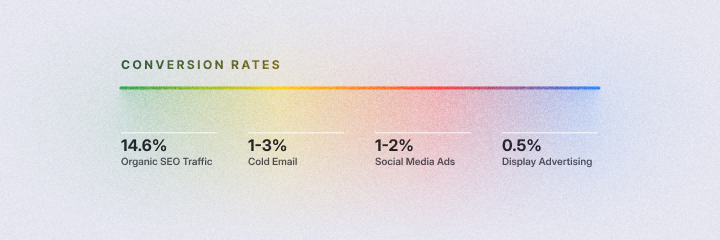
### 1. Free Website Traffic That Actually Converts
Here’s the thing about organic traffic—it’s free, and it’s targeted. When someone searches for “best pizza near me” and your restaurant shows up at the top, that person is already hungry and ready to order. You didn’t have to interrupt their day with an ad or convince them they needed pizza. They came looking for you.
- Organic search traffic: **14.6%** average conversion rate
- Cold email: **1-3%** conversion rate
- Social media ads: **1-2%** conversion rate
- Display advertising: **0.5%** conversion rate
#### Finding People Who Actually Want What You’re Selling
Keyword research involves identifying the exact words people use when searching for businesses like yours. Instead of guessing what customers want, you’re using data to know what they want. For example, if you’re a divorce lawyer, you might discover that people search for “how to file for divorce” way more often than “divorce attorney services.” One search tells you they’re ready to hire someone; the other tells you they’re still figuring things out.
Look for keywords containing:
- “Near me” or location-specific terms
- “Best,” “top,” “reviews” (comparison searches)
- “How to,” “tutorial,” “guide” (information-seeking that leads to purchases)
- Brand names + “vs” (competitive research)
#### Stealing Customers from Your Competition
When you rank high in search results, you’re basically putting up a billboard on the busiest street in your industry. Except this billboard only shows up when people are actively looking for what you’re advertising.
- **For Local Businesses**: Focus on “service + location” keywords. A dental practice might target “teeth whitening downtown Seattle” rather than just “teeth whitening.”
- **For E-commerce**: Target product-specific searches with buying intent like “buy wireless headphones under $100” or “iPhone 14 case reviews.”
- **For B2B Services**: Focus on problem-solving searches like “how to reduce employee turnover” or “CRM software for manufacturing companies.”
### 2. Way Cheaper Than Paid Advertising
Compared to most marketing strategies, SEO is ridiculously cost-effective. Think about it: with paid ads, you pay for every single click, whether that person buys anything or not. With SEO, you do the work once, and it keeps working for you.
#### Why Interrupting People Doesn’t Work Anymore
Traditional marketing is like knocking on doors, where you’re interrupting people who might not even want what you’re selling. Search engine marketing is more like having a good storefront on a busy street, where people come to you because they’re already interested.
To put it into perspective, cold calling has a success rate of about 2%. People who find you through search have a much higher chance of becoming customers because they’re already looking for solutions you provide.
### 3. Sustainable Revenue and Rapid ROI
Here’s where SEO really pays off. That blog post you wrote six months ago? It’s still bringing in customers. That Google My Business profile you optimized last year? Still showing up when people search locally. Compare that to a PPC campaign where the minute you stop paying, the traffic stops. With SEO, your investment keeps working long after you’ve moved on to other projects.
**Typical SEO Investment Timeline**:
- Months 1-3: Initial investment in optimization and content creation
- Months 4-6: Traffic begins increasing, break-even point
- Months 7-12: Positive ROI, traffic continues growing
- Year 2+: Significant ROI, with minimal ongoing costs
#### When SEO Pays for Itself
Most businesses see ROI between months 6-12, but the timeline depends on:
- **Industry competition**: Low-competition niches show results in 3-6 months
- **Website starting point**: New sites take 6-12 months; established sites see results in 3-6 months
- **Investment level**: Higher initial investments typically show faster results
### 4. Make Your Website Actually Useful
Google isn’t stupid. They figured out that people prefer websites that actually work well. When someone finds your business while they’re out and about, you want them to be able to use your website easily.
#### Your Website Should Work on Phones
More than half of all web traffic comes from phones now. Google knows if your website looks terrible on mobile or takes forever to load, and no matter what you’ll always have a mobile-friendly competitor site that ranks higher.
**Core Web Vitals That Matter:**
- **Largest Contentful Paint (LCP)**: Page loading speed
- Target: Under 2.5 seconds
- Impact: Faster loading improves both rankings and conversions
- **First Input Delay (FID)**: Page responsiveness
- Target: Under 100 milliseconds
- Impact: Affects how quickly users can interact with your site
- **Cumulative Layout Shift (CLS)**: Visual stability
- Target: Under 0.1
- Impact: Prevents annoying layout shifts that hurt user experience
#### Don’t Make People Hunt for Information
A well-organized website helps everyone: search engines, customers, even you when you need to update something. When people can find what they’re looking for quickly, they’re more likely to stick around and actually contact you or make a purchase. Think of your website like a well-organized store. If customers can’t find what they need, they’ll leave and shop somewhere else.
**Mobile Optimization Checklist**:
- Test your site on multiple devices and screen sizes
- Ensure buttons are at least 44×44 pixels for easy tapping
- Use legible font sizes (minimum 16px)
- Optimize images for mobile loading speeds
### 5. Build Trust and Credibility
Ranking high in Google results makes you look more credible, whether you like it or not. People trust Google to show them the best results, so being at the top makes you look like the best option.
#### Google’s Trust Test
Google wants to promote websites that demonstrate Experience, Expertise, Authoritativeness, and Trustworthiness (E-A-T). This isn’t just about gaming search algorithms—it’s about actually being good at what you do and proving it.
If you’re a financial advisor, for example, having articles that demonstrate your knowledge of tax law and investment strategies will help you rank higher. But more importantly, it’ll help potential clients trust you with their money.
So, instead of just targeting “financial planning,” you also want to create comprehensive resources covering:’
- Retirement planning for different age groups
- Tax optimization strategies
- Investment portfolio management
- Estate/education planning basics
#### Helping People Instead of “Just” Selling
Good content isn’t just about stuffing keywords into blog posts. It’s about answering the questions your potential customers actually have. When you consistently publish helpful, accurate information, people start seeing you as an expert in your field.
This builds trust before people even contact you. By the time they’re ready to hire someone, they already feel like they know you and trust your expertise.
**Measuring Authority Growth**:
- Keyword rankings: Track positions for industry-related terms
- Organic traffic growth: Monitor increases in search traffic
- Backlink acquisition: Count quality sites linking to your content
- Brand search volume: People searching for your company name specifically

### 6. Start Showing Up in Local Search Results
If you have a physical location, [local SEO](https://www.wearetg.com/blog/local-seo-best-practices/) is absolutely crucial. When people search for businesses “near me,” you want to be the first thing they see.
#### Your Google Business Profile Is Everything
Your Google My Business profile is like your business card, storefront, and customer service desk all rolled into one. Keep your hours updated, respond to reviews, post photos of your actual business. This stuff matters more than you might think.
When someone searches for “coffee shop near me,” Google shows them a map with local options. Having an optimized profile with good reviews and current information makes you more likely to get chosen.
**Essential Profile Elements**:
- **Complete business information**: Address, phone, hours, website
- **Category selection**: Choose the most specific, relevant categories
- **Regular posts**: Share updates, offers, events (2-3 times per week)
- **Photo management**: Upload high-quality images of your location, products, team
- **Review management**: Respond to all reviews professionally and promptly
#### You Don’t Have to Compete with Larger Players
Instead of trying to rank for “pizza restaurant” (which is nearly impossible), focus on “pizza shop downtown Portland” or “best pizza near Pioneer Square.” Location-specific searches are easier to rank for and bring you customers who can actually visit your business.
This includes phrases like:
- “Service + your city”
- “Service + neighborhood names”
- “Service + near \[local landmarks\]”
Well-optimized local businesses typically see:
- **50-100%** increase in “directions requested” from Google My Business
- **25-75%** increase in phone calls from local searches
- Higher visibility in “near me” searches within **3-6 months**
### 7. Beat the Competition with a Solid SEO Strategy
SEO is competitive, but that’s exactly why it works. Look at who’s ranking for the keywords you want to target. What are they doing well? What are they missing? You don’t have to reinvent the wheel. You just have to build a better wheel.
- What keywords do they rank for that you don’t?
- What [type of content performs](https://www.wearetg.com/blog/types-of-content/) well for them?
- Are there topics they haven’t covered thoroughly?
For example, if your competitor has a great blog but terrible website navigation, you can beat them by doing both well.
#### Rolling with Google’s Changes
Google changes their algorithm constantly, but the basic principles stay the same: [make your website useful](https://www.wearetg.com/blog/enhancing-user-experience-better-engagement/) for real people, and good things will follow. Focus on genuinely helping your customers, and you’ll weather most algorithm changes. Don’t just create content that’s slightly better than your competitors. Create content that’s significantly more comprehensive and valuable.
**Example**: If competitors have 800-word guides on “How to Choose a CRM,” create a 3,000-word ultimate guide that includes:
- Detailed feature comparisons
- Implementation checklists
- Industry-specific recommendations
- Video walkthroughs
- Calculator tools or templates
### 8. SEO Boosts Your Other Marketing Efforts
SEO doesn’t exist in a vacuum. It works better when combined with your other marketing efforts.
#### Social Media
Social media doesn’t directly impact SEO rankings, but it [helps in other ways](https://www.wearetg.com/blog/seo-best-practices/). When people share your content on social platforms, it can lead to backlinks and increased brand awareness. Plus, your social profiles often show up in search results for your brand name.
#### Content Marketing
Every piece of content you create is an opportunity to rank for new keywords and attract different segments of your audience. A well-planned content strategy supports your SEO goals while also giving you material for email newsletters. Here’s how you can do that:
- Use popular blog content as email newsletter material
- Email subscribers are more likely to link to and share your content
- Email campaigns can drive traffic to new content, boosting its initial performance
- Segment email lists based on content engagement to improve relevance
### 9. SEO Helps Capture Existing Customer Demand
The scale of organic search is where SEO gets really powerful. Every month, thousands of people search for what you offer. And instead of creating demand for your product, you’re capturing demand that already exists.
Here’s why that matters for a lot of businesses in 2026:
- Organic search traffic remains stable, even during times of economic uncertainty
- Businesses with strong SEO foundations maintain visibility when competitors reduce marketing spend
- In inflationary periods, consumer search behavior shifts to cost-conscious queries that favor informational content
**Unlike Pay-per-click campaigns, organic search provides consistent, predictable leads. Learn more about the [differences between SEO and PPC](https://www.wearetg.com/blog/seo-vs-ppc/) in our guide.**
### 10. SEO Gives You Measurable Business Results
You can’t improve what you don’t measure. For most businesses, this is where one of the largest benefits of SEO lies.
#### Key Performance Indicators (KPIs)
Track organic traffic, but also track what that traffic does on your site. Are people contacting you? Signing up for your newsletter? Making purchases? Rankings don’t matter if they’re not driving business results.
**User Metrics**:
- **Organic sessions**: Total visitors from search engines
- **Click-through rate (CTR)**: Percentage of people who click your result when they see it
- **Average session duration**: How long visitors stay on your site
- **Pages per session**: How many pages visitors view
**Business Metrics**:
- **Conversion rate from organic traffic**: Percentage of organic visitors who become customers
- **Customer lifetime value from SEO**: Long-term value of customers acquired through search
- **Cost per acquisition**: Total SEO investment divided by new customers acquired
- **Revenue attribution**: Sales directly linked to organic search traffic
## The Bottom Line
SEO isn’t magic, but it’s one of the most reliable ways to grow a business online. It takes time to see results, but those results compound over time in ways that paid advertising never does. Just like you need reliable electricity and internet to run your business, your website needs a reliable way to stay visible.
Just remember, the businesses that show up first on Google aren’t necessarily the ones with the biggest marketing budgets. They’re the ones who did SEO right, and that made it easy for customers to find them.
#### SEO compounds over time when it’s done right.
[Schedule a 30-minute consultation](https://www.wearetg.com/contact/) with Timmermann Group and we’ll help you evaluate how SEO fits into your long-term marketing strategy.
---
## Frequently Asked Questions About the Benefits of SEO
### What are the advantages of using SEO?
SEO brings you customers who are already looking for what you offer, builds long-term credibility for your business, and costs less than most other marketing strategies. Unlike paid advertising, the results keep working even after you stop actively working on it.
### What is local SEO, and how does it benefit brick-and-mortar businesses?
Local SEO helps physical businesses show up when people search for services “near me” or in specific cities. It’s crucial for restaurants, retail stores, service businesses, and anyone who needs customers to visit their location.
### How does SEO help in outperforming competitors?
When you rank higher in search results, you get more of the customers who are actively looking for your type of business. SEO lets you compete based on being helpful and relevant, not just having the biggest advertising budget.
### What are the key performance indicators (KPIs) for measuring SEO success?
Tools like Google Analytics show you which SEO efforts are actually working and which aren’t. Without data, you’re just guessing about what your customers want and how they find you.
### What are the benefits of using analytical tools for SEO?
Analyzing your website’s performance and optimizing SEO with tools like Google Analytics and SEMrush can help you gain more knowledge, track visitors, and observe keyword ranks, all while developing a better SEO strategy for increased outcomes.
### Can I skip the trial-and-error phase of SEO entirely?
Timmermann Group has helped hundreds of businesses implement the exact SEO strategies covered in this Our clients typically see their first traffic increases within 60-90 days and achieve positive ROI within 6-12 months. [Book an introductory call with our team](https://www.wearetg.com/contact/) to learn more.
**Categories:** SEO
---
### [UX Design: Principles for 2026](https://www.wearetg.com/blog/ux-design/)
**Published:** October 24, 2025
**Author:** Rob Timmermann
**Content:**
User experience (UX) design is the practice of creating intuitive, enjoyable, and user-friendly experiences with digital solutions. This is essential to [website design](https://www.wearetg.com/services/website-design/) as it directly affects how audiences feel and engage with the platform, which, in turn, can drive business success.
In this article, we’ll explore the top UX design principles for 2026 as well as upcoming trends to watch to help you discover how you can balance user needs with your business goals.
## Key Takeaways
- UX design prioritizes user-centered approaches, balancing user satisfaction with business objectives to create enjoyable and accessible products.
- Key components of UX design include user research, information architecture, and prototyping, all essential for crafting user-centric experiences.
- Future trends in UX design, such as artificial intelligence (AI), augmented reality (AR), and sustainability, are transforming user interactions and shaping expectations in the digital landscape.
## Understanding UX Design
UX design focuses on creating experiences that are usable, meaningful, and enjoyable. While visual appeal is important, usability is the foundation of a positive user experience. The best UX designs balance functionality and aesthetics, guiding users naturally while reinforcing brand identity.
Designers adopt a user-centered approach, understanding audience requirements through research, evaluating design concepts, and creating interactive models, such as layout drafts. They then prototype, test, and refine solutions to ensure real insights inform every design decision. Aligning design with both user and business objectives creates products that delight users and drive measurable results.
### The Role of UX Designers
Unlike graphic design, which primarily focuses on aesthetics, UX design encompasses the entire user experience with a product. Effective UX is achieved when usability, visual appeal, and engagement work together.
UX designers collaborate with multiple stakeholders, such as product managers, developers, and marketers, to ensure the product meets user needs and business goals. Their responsibilities include:
- **User research and feedback collection:** Through interviews, surveys, and analytics, UX designers gather valuable insights into user behavior, motivations, and pain points. This research ensures design choices align with what the target audience truly wants and needs.
- **Creating user personas:** Personas represent key user types based on research data. They help the design team keep different user goals and challenges in mind, ensuring the final product feels relevant and intuitive to all audiences.
- **Developing user flows:** User flows map out the path a user takes to complete a task within a product. Visualizing these journeys helps designers identify unnecessary steps and improve overall efficiency.
- **Building wireframes and prototypes:** Wireframes outline a page’s structure and hierarchy, while prototypes allow for interactive testing of design ideas. Together, they help validate concepts, gather early feedback, and refine usability before development begins.
- **Conducting usability testing:** Observing real users as they interact with a product helps uncover friction points, confusing navigation, and other usability issues. This hands-on feedback allows designers to refine the experience before launch.
## Key Components of UX Design
To achieve intuitive, meaningful designs for UX, designers follow core principles that guide every decision and action throughout the design process:
- **Understand Your Users & Goals:** A successful design starts with a deep understanding of business objects and user needs. UX designers conduct research, gather feedback, and analyze behavior to define the problems the product must solve.
- **Define Functional & Content Requirements:** A Clear scope ensures the product includes the right features and information. This principle helps prioritize what is essential, avoiding unnecessary complexity while meeting user expectations.
- **Organize Information Effectively:** Structure is key to helping users navigate and interact with a product. Through thoughtful information architecture and interaction design, designers create intuitive flows that reduce confusion and improve usability.
- **Prototype & Visualize Interactions:** Using wireframes, mockups, and prototypes allows designers to test layouts, navigation, and interactions before final development. These tools help identify pain points early and refine the user journey.
- **Design for Clarity & Engagement:** Visual design (colors, typography, imagery, and interactive elements) should support usability and reinforce brand identity. The interface should feel intuitive, guiding users smoothly through tasks while creating a positive experience.
Following these principles ensures that UX designers consider every aspect of the user experience, from initial research to final visual design. Implementing proven UX practices can improve conversion rates, particularly on e-commerce platforms, and deliver products that are visually appealing and genuinely usable.
### User Research
Audience analysis provides essential insights into audience needs, preferences, and behaviors. By conducting this research, the team gathers valuable data to guide every stage of the design process, from initial concept development to final design.
Effective user research includes various methods to gather insights about user preferences and behaviors, such as:
- Interviews
- Surveys
- Usability testing
Based on this research, UX designers can create user personas and user stories to further tailor the product to the specific needs of the target audience.
Utilizing tools like heatmaps during user research can help designers visualize user interactions on websites, providing insights into how users navigate and engage with the content and follow their user journeys.
It’s important to remember that audience insights are ongoing. Continuous feedback collection is crucial for refining the interface and ensuring that it aligns with end-user needs and expected behavior. Your audience is constantly evolving, so your UX design should work to keep up.
### Information Architecture
Information architecture (IA) is a critical component of UX design, focusing on how content is structured and organized to facilitate easy navigation for users. Properly structured materials significantly enhance interaction by making data easier to locate and navigate. IA involves creating a clear and intuitive hierarchy of information, ensuring that users can find what they need quickly and efficiently.
Creating site maps is one way to convey the hierarchy of information within a website product, aiding user navigation and helping other designers visualize the overall structure. By organizing content logically and coherently, UX designers can reduce cognitive load and improve the overall usability of the product.
Incorporating information architecture into development ensures the interface looks polished and provides a smooth, intuitive interaction.
### Prototyping and Wireframing
Prototyping and wireframing are essential tools in the UX design process, allowing designers to visualize and validate their concepts early on to ensure user needs are prioritized in the design process.
Paper prototypes involve developing representations of design ideas that can be tested with users to gather feedback and make informed design decisions.
Wireframes serve as blueprints for a product’s layout, showcasing the arrangement of elements on each page and how they interact with each other.
Taking the time to create interactive models or layout drafts saves time and resources while ensuring the final interface delivers a smooth, satisfying interaction.
## Enhancing User Experience
Enhancing interaction is an ongoing workflow that involves continuous research, analysis, and iteration. In this section, we will explore various methods for enhancing user experience, including:
- Usability testing
- Interaction design
- Visual design
Each method plays a vital role in creating solutions that are functional, delightful, and captivating.
### Usability Testing
Usability testing is the process of evaluating whether a design is effective for its target users and identifying areas for improvement. It is vital for uncovering design flaws and understanding how users interact with the product. [Usability tests can be performed](https://www.nngroup.com/articles/usability-testing-101/) in-person or remotely, and may be moderated or unmoderated. Surveys are another common method for gathering user feedback, helping designers understand user needs and preferences directly from the target audience.
Designers should conduct usability testing early and often during the design process to identify potential issues early and make necessary adjustments, ensuring the final product meets user expectations.
### Interaction Design
Interaction design focuses on how users interact with products. Interaction designers create clear, logical user flows to intuitively guide users through the product, enabling them to achieve their goals easily.
### Visual Design
Effective visual design can enhance user engagement by making information aesthetically pleasing and easier to process. The appearance of a product can significantly influence engagement and perceptions of usability, as users are more likely to interact with visually appealing products. Focus on elements like color schemes, typography, and layout to create a positive first impression that draws users in and encourages them to explore the product further.
Visual design is also crucial in ensuring the user interface is functional. Designers can guide users’ attention to the most important elements by incorporating principles of visual hierarchy and balance, making the experience cohesive and intuitive.
## Tools and Techniques for UX Designers
In UX design, having the right tools and techniques is essential for creating, modifying, and refining user interfaces and experiences. Designers utilize various tools to enhance collaboration, streamline workflows, and improve overall interface quality.
AI tools are expected to redefine the development workflow, influencing how teams create and deliver interactions. Leveraging generative AI and incorporating AI skills allows designers to analyze user behaviors and customize interfaces, making experiences more relevant and engaging, and giving your company a competitive edge.
### Design Software
Design software is crucial in the UX design process, as it provides tools that streamline workflows, enhance collaboration, and improve overall design quality.
Here are some design tools and their key features:
- **Figma:** Both easy-to-learn and more feature-rich than its competitors, Figma is the most popular choice among designers and companies alike. The software is constantly evolving to keep up with trends, and its massive community often steps in to add more features via plug-ins and shareable files.
- **Adobe XD:** As part of Adobe’s Creative Cloud, this tool is available to most creative teams. However, Adobe has slowed its investment in XD software development, casting its future in doubt.
- **Sketch:** The Sketch application is favored by companies with greater security concerns as its leading programs are cloud-based. It’s capable of running locally without an internet connection, ensuring the information used in designs is more secure.
### User Feedback Methods
Continual testing and user feedback collection are essential in UX design after a product is launched. This process involves:
- Conducting usability testing to analyze results
- Making design improvements based on the analysis
- Planning future tests to enhance user interaction
- Incorporating user feedback into the design process to ensure the product meets user needs and delivers a satisfying experience.
### Data Analysis
Data analysis provides valuable insights into how users interact with a product. User experience analysis involves collecting and assessing data on user interactions, utilizing both quantitative and qualitative methods.
- **Quantitative data** includes metrics such as success rates, error rates, and customer satisfaction scores.
- **Qualitative data** provides insights through direct feedback to identify pain points in the user journey.
Combining both quantitative and qualitative data provides a comprehensive view of user interactions, highlighting the existing issues as well as the underlying causes.
Prioritizing fixes based on this data analysis allows product teams to address the most critical usability issues first.
## Future Trends in UX Design
UX design is increasingly influenced by innovative technologies and trends that reshape user interactions and their experiences. Artificial intelligence and machine learning are becoming integral to UX, enabling the creation of personalized interactions tailored to audience preferences.
There is also a growing emphasis on sustainability in design practices, reflecting users’ values and influencing their expectations from products and services.
### AI and Machine Learning
AI and machine learning are set to transform UX design by:
- Enabling the creation of personalized and adaptive user experiences.
- Enhancing personalized experiences by learning from user interactions and predicting needs, allowing for more relevant and engaging interfaces.
- Facilitating the creation of adaptive UX that responds to individual user behaviors, suggesting a transformative future for design practices.
AI is also being suggested for application in UX design education, helping designers develop the skills necessary to effectively leverage these technologies.
### Augmented Reality (AR)
Augmented Reality (AR) overlays digital information, such as images and data, onto the real world, significantly changing how audiences engage with their environment. Essentially, digital objects can overlay real-world environments through smartphones and mobile apps, seamlessly blending the digital and physical worlds.
Amazon, for example, has integrated AR across its platform, offering customers the option to “View in Your Room” while shopping, enabling users to visualize a product in their own space before making a purchase.
By integrating AR into user-centered design, UX designers can create more engaging and immersive experiences that capture users’ attention and facilitate deeper interaction with products.
### Sustainability in Design
There is a growing emphasis on integrating sustainable practices into design to enhance user experience and societal impact. Sustainable design practices promote environmentally responsible choices in UX design, focusing on reducing environmental impact while improving user experience. This approach reflects users’ values and influences their expectations of products and services.
For physical products, this can be displayed by incorporating energy efficiency into designs, as well as recycled or responsibly sourced materials. For digital products, this can be done by using efficient technologies, energy-efficient infrastructure, ethical data handling, and green hosting services.
## Engage Your Users with Expert UX Design
User experience design is a multifaceted discipline that, when done correctly, can positively shape user interactions and experiences. By understanding the key components of UX design, including user research, information architecture, and prototyping, designers can create products that meet user needs and deliver a seamless, satisfying experience.
As we move into 2026, staying ahead of these trends, looking toward what’s to come, and incorporating best practices into the design process will be essential for creating user-centric products that resonate with audiences and drive business success.
#### If users are visiting your site but not converting, UX may be the issue.
[Schedule a conversation](https://www.wearetg.com/contact/) with Timmermann Group to identify where experience breakdowns are happening.
---
## Frequently Asked Questions
##### Why is a well-designed website essential in today’s marketplace?
A well-designed website creates a strong first impression, enhances conversion rates, and nurtures lasting relationships with customers. Ensuring your website is user-friendly and visually appealing is key to thriving in today’s marketplace.
##### What role does user experience play in web design?
User experience (UX) profoundly influences how users interact with a site, affecting navigation, accessibility, and overall satisfaction. Prioritizing UX ensures that visitors can easily access information and complete tasks effectively.
##### What is the impact of first impressions on website visitors?
First impressions have a significant impact on website visitors, as users form opinions about a business within seconds based on the site’s design, which influences their decision to engage further. Hence, a professional and appealing website can enhance user retention and interactions.
##### How can strategic web design drive conversions?
Strategic web design drives conversions by utilizing clear calls-to-action and an effective visual hierarchy that guides users toward their desired actions. This approach fosters engagement, ultimately leading to increased leads and sales.
**Categories:** UX, Web Design
---
### [Web Design Trends 2026: The Complete Guide](https://www.wearetg.com/blog/web-design-trends/)
**Published:** October 27, 2025
**Author:** Rob Timmermann
**Content:**
In 2026, staying ahead in [web design](https://www.wearetg.com/services/website-design/) meant striking the right balance between timeless design principles and bold new experimentation. From earth-toned color palettes and oversized typography to immersive, interactive experiences, this year’s leading web design trends focus on both performance and engagement. Whether you’re refreshing your brand or launching a new site, understanding the latest web design trends ensures your digital presence stays current.
Web design trends influence both aesthetics and usability, and they also shape the digital world, making it crucial to adapt and thrive in this dynamic environment.
To bring these insights to life, explore the website design services from Timmermann Group, where strategy, creativity, and usability come together to help your brand stand out online.
## Key Takeaways
- Blend timeless design principles with selective trend adoption for long-term impact.
- Stay up-to-date with the latest web design trends to maintain a competitive edge.
- Earth tones, bold typography, and engaging color strategies dominated 2026.
- Interactive elements, micro-animations, and personalization drive user engagement.
- Prioritize accessibility, usability, brand alignment, and a seamless user experience over purely decorative features.
- Design with the goal of leaving a lasting impression on visitors.
## Timeless Web Design Principles That Never Go Out of Style
Even as trends shift, foundational principles remain essential for creating websites that perform. Structured layouts, such as grid systems, continue to provide the necessary framework for both classic and modern web design, supporting responsiveness and adaptability. Mastering these elements ensures that newer design innovations enhance rather than compromise usability.
Strong typography also remains a timeless element, supporting both readability and brand identity.
#### User-Centered Design
Successful websites prioritize the user experience by focusing on user-friendly navigation and a user-friendly interface. Intuitive navigation, readable content, and accessible interfaces enable visitors to quickly find information and complete key actions. Ignoring user needs risks higher bounce rates, lower engagement, and missed conversions.
#### Core Usability Principles: Navigation, Readability, & Accessibility
A clear navigation bar acts as a roadmap, guiding visitors effortlessly. Coupled with readable content and accessible features—like alt text, keyboard navigation, and screen reader compatibility—these fundamentals remain critical as visual styles evolve.
#### Performance Optimization
Fast-loading websites improve both user satisfaction and search visibility. Techniques such as image compression, efficient coding, and smart caching ensure your site is responsive, engaging, and future-ready.
#### Mobile Responsiveness
With mobile usage dominating web traffic, responsive web design has become the standard for modern websites. Mobile-first layouts, touch-friendly navigation, and adaptive content ensure seamless experiences across all devices.
A key goal of mobile responsiveness is the seamless integration of content and functionality, enabling users to enjoy engaging and cohesive experiences regardless of the device they use.
#### Visual Hierarchy & Information Architecture
Organized content, featuring clear headings established through the use of different font sizes, consistent layouts, and logical flows, allows users to quickly scan and engage with your site. A strong hierarchy supports usability and accessibility while reinforcing brand messaging.
## 2026 Web Design Color Trends
Color remains one of the most powerful tools in web design, shaping user emotions, guiding attention, and reinforcing brand identity. In 2026, designers experimented with both subtle and bold palettes to create engaging, memorable experiences. Selecting the right color palette is crucial for both visual appeal and accessibility, ensuring that websites are attractive and usable for all visitors. Some of the key trends include:
- **Pantone’s Cloud Dancer:** Named the Color of the Year 2026, Cloud Dancer is a warm, inviting neutral designed to bring calm, clarity, and approachability to modern design. Its soft, understated character creates a welcoming foundation for human-centered websites, helping content feel more accessible and trustworthy. Exceptionally versatile, Cloud Dancer pairs seamlessly with both vibrant accent colors and muted earth tones, making it easy to build balanced, refined palettes that feel intentional, modern, and visually cohesive.
- **Earth-toned Palettes:** Nature-inspired hues, like clay, sage, and sandy neutrals, have gained popularity for their calming, authentic feel. These colors convey sustainability and groundedness, making them ideal for lifestyle brands, hospitality, and eco-conscious businesses. For example, in the design of the [Three Forks Ranch](https://www.wearetg.com/portfolio/three-forks-ranch/) website, we incorporated earth tones throughout to create a natural and inviting atmosphere that reflects minimalist design principles.
- **Monochrome Color Schemes:** Monochrome color schemes are a bold, minimalist design choice that is gaining popularity. By using variations of a single hue, these schemes create visually impactful, honest, and authentic websites that stand out through simplicity.
- **Dopamine Colors:** Vibrant, high-energy colors, sometimes referred to as “dopamine colors,” bring excitement and engagement to a site. These playful, neon, and saturated hues are perfect for brands seeking to convey energy, fun, or creativity. In[ the Dogswell project](https://www.wearetg.com/portfolio/dogswell/), we utilized these lively tones to visually express the joyful energy of their brand.
- **Sophisticated Gradients:** Gradients have evolved beyond the basic two-tone blends into multi-tonal combinations that add depth and dimension. The[ Moxi Events website](https://www.wearetg.com/portfolio/moxi-events/) demonstrates how subtle gradient layering can create modern, elegant visual experiences without overwhelming the user.
- **Dark Mode:** Dark mode is more than a trend; it’s a functional, user-centered design strategy. Using darker backgrounds with carefully chosen accent colors can reduce eye strain, especially in low-light environments, and improve readability when paired with sufficient contrast.
- **Low-Contrast Palettes:** When executed thoughtfully, low-contrast palettes create a softer, more sophisticated visual experience, guiding attention to key elements. Designers must also strike a balance between aesthetics and accessibility by maintaining sufficient contrast for legibility and ensuring that color choices meet WCAG standards, all while embracing minimalist design approaches.
#### Implementing 2026 Color Trends in Brand Identity
Introducing new color trends isn’t just about following what’s “in style,” it’s about integrating them meaningfully into your brand identity. Consider these best practices:
- **Align with Brand Personality:** Choose colors that reflect your values, tone, and audience expectations.
- **Create Consistency Across Touchpoints:** Extend trend-inspired palettes to web, social media, and marketing materials for a cohesive brand identity.
- **Prioritize Accessibility:** Ensure color combinations remain readable and inclusive for all users.
- **Consider User Preferences:** Offer options like dark mode or color customization to personalize the experience and enhance engagement.
- **Use Accent Colors Strategically:** Incorporate bold or dopamine-inspired hues in buttons, CTAs, and interactive elements rather than across every aspect.
- **Test & Iterate:** Evaluate how new colors perform in real-world settings, considering engagement metrics and user feedback.
## Typography & Visual Design Trends for 2026
Typography is both a functional element and a core component of your brand’s voice and the overall user experience. In 2026, web designers experimented with bold, expressive typefaces, flexible font technologies, and creative layouts to create websites that felt modern, engaging, and memorable. Motion design is increasingly used to create standout features and enhance visual appeal, making websites more dynamic and intuitive.
- **Bold, Expressive Headlines:** Oversized hero text grabs attention and communicates hierarchy.
- **Variable Fonts:** Offer flexibility across devices while improving performance.
- **Mixing Serif & Sans-Serif:** Creates contrast, hierarchy, and personality.
- **Text-First Hero Sections:** Prioritize clarity and fast load times over heavy imagery.
- **Custom Lettering & Illustrations:** Adds authenticity and differentiation.
- **Motion Design for Typography:** Dynamic typography and purposeful animations serve as standout features, boosting visual appeal and creating engaging user experiences.
By combining these typography and visual design trends, designers can create websites that are readable and visually engaging, ensuring content resonates with users while staying on-trend in web design. Thoughtful use of typography reinforces brand identity, guides user attention, and enhances overall usability.
Forward-Looking Tip: For 2026, consider integrating subtle kinetic typography or animated lettering to create engagement without sacrificing accessibility.
## Interactive Design & Animation Trends
Interactivity and motion have become key elements in modern web design, creating dynamic experiences that engage users and communicate a brand’s personality. In 2026, websites are moving beyond static layouts to embrace animations, micro-interactions, and immersive visuals that make browsing memorable and intuitive. Smooth transitions between sections and elements are essential for creating an immersive experience that keeps users engaged and encourages exploration.
- **Micro-Interactions:** Hover effects, button animations, and scroll cues reinforce usability.
- **Small Animations (Micro-Animations):** Subtle, purposeful animations guide user interactions, provide feedback, and add visual interest to both websites and ecommerce platforms.
- **Scroll-Triggered Animations:** Narratively guide visitors through content and add depth to web pages. Elements like text, images, or graphics can animate as the user scrolls.
- **Cursor & Hover Animations:** Add playful, attention-guiding elements.
- **Smart Video Integration:** Looping, silent, optimized videos for fast loading provide visual interest without slowing down your site.
- **3D Elements & WebGL:** Enhance the immersive experience with product visualization and storytelling, using advanced graphics to create interactive journeys.
By integrating these interactive design and animation trends, your website can move from static visuals to a highly engaging, user-centered experience. Thoughtful use of motion, small animations, and smooth transitions enhances storytelling, reinforces brand identity, and drives users to explore content more deeply, all while staying aligned with 2026 web design trends.
***Forward-Looking Tip:** Combining micro-interactions with personalized content and AR/VR elements will become more prevalent in 2026.*
## Layout & Navigation Innovation
In 2026, websites transitioned beyond conventional grid-based layouts and traditional top navigation menus. While structured layouts, including grid systems, remain foundational for responsiveness and adaptability, they are evolving to support both traditional and experimental designs. Designers are experimenting with bold structures, modular designs, and interactive navigation to create unique, engaging experiences that guide users naturally through content. A creative blend of modular layouts and interactive navigation can result in digital experiences that feel both authentic and innovative. Innovative layouts not only enhance aesthetics but also improve usability when executed thoughtfully.
- **Experimental Navigation:** Radial menus, gesture-based controls, and interactive micro-menus.
- **Non-Traditional Scrolling:** Horizontal or diagonal scroll adds storytelling potential.
- **Bento Grids & Modular Layouts:** Balance creativity with digestible content blocks.
- **Asymmetrical Layouts:** Guide attention and communicate modern aesthetics.
- **Anti Design:** Embraces experimental, unconventional, and imperfect styles with asymmetrical layouts and overlapping elements, challenging conventional aesthetics.
- **Full-Screen Headers:** Create immersive first impressions with bold visuals and interactive elements.
## Design Philosophy Trends: From Minimalism to Maximalism
Successful web design is about embracing a broader spectrum of philosophies, from the restrained elegance of modern minimalism to the bold, layered approach of tactile maximalism. Understanding these trends helps brands select the style that best communicates their identity while creating memorable, user-friendly experiences. Both minimalist and maximalist design philosophies encourage self expression, allowing designers to showcase creativity and authenticity in unique ways.
- **Tactile Maximalism:** Designers incorporate patterns, layered visuals, textures, custom illustrations, interactive features, and vibrant color palettes to convey energy and personality. Incorporating a human touch through handcrafted or imperfect elements adds authenticity and emotional engagement.
- **Modern Minimalism:** Purposeful white space and clean typography emphasize clarity and professionalism. A minimalistic approach focuses on simplicity, essential visual elements, and streamlined navigation to enhance usability and convey modernity.
- **Organic Shapes & Nature-Inspired Elements:** Curves and fluid lines create approachable, human-centered designs, often enhanced by the human touch of artistic or imperfect details.
- **Balanced Approach:** Combine minimal layouts with maximalist accents for impact.
## Sustainable & Ethical Design Practices
In 2026, web design is not just about aesthetics and functionality—it’s also about responsibility. Sustainable and ethical practices are becoming essential considerations for modern websites, ensuring that digital experiences are both environmentally conscious and inclusive for all users.
- **Eco-Friendly Design:** Optimized code and lightweight media reduce digital carbon footprints.
- **Green Hosting & Development:** Renewable energy-powered servers and efficient frameworks.
- **Inclusive Design:** Accessibility for all users, privacy-conscious interfaces, and ethical UX.
- **Performance as Responsibility:** Faster websites consume less bandwidth and energy.
Sustainable and ethical design demonstrates that your brand values more than just aesthetics—it signals responsibility, forward-thinking, and care for your audience and the planet. These practices can improve SEO, user satisfaction, and brand perception, all while supporting a greener digital ecosystem.
Forward-Looking Tip: Sustainable design will continue to align with brand values and user expectations into 2026.
## Technology-Driven Design Trends
Technology continues to shape the future of web design, enabling more personalized, immersive, and efficient digital experiences. Advances in web development and digital design are driving innovation in 2026, with new techniques and creative approaches setting the standard for modern, sustainable websites. In 2026, designers are leveraging artificial intelligence (AI), AR/VR, voice interfaces, and advanced personalization to create websites that are not only visually appealing but also smarter, more responsive, and tailored to individual users. A professional development company plays a crucial role in implementing these technology-driven trends, combining technical expertise and creativity to deliver standout digital solutions.
- **AI-Powered Tools:** Automate layout, color, and typography decisions.
- **Voice Interfaces:** Enhance navigation and accessibility.
- **AR/VR Experiences:** Immersive product showcases and storytelling.
- **Progressive Web Apps:** App-like performance without downloads.
- **Advanced Personalization:** Geolocation and behavior-based content tailoring.
Technology-driven design trends elevate your website from a static presence to a responsive, interactive platform that anticipates user needs. Integrating AI, AR/VR, voice interfaces, and personalization enables you to stay competitive, deliver exceptional user experiences, and align with forward-looking web design trends that will define the future of digital interaction.
## Mobile-First and Performance Optimization
In 2026, a mobile-first approach is no longer optional—it’s a requirement. With the majority of users accessing websites via smartphones and tablets, designing for mobile first ensures your site delivers a seamless, engaging experience across all devices. Coupled with performance optimization, this approach improves usability, search rankings, and overall user satisfaction.
- **Thumb-Friendly Navigation:** Touch-accessible menus and buttons.
- **Progressive Loading:** Lazy loading images for faster performance.
- **Mobile-Specific Patterns:** Swipe gestures, sticky headers, collapsible content, bottom navigation bars, and card-based layouts improve usability and guide users through content efficiently. Effective homepage design is especially important on mobile, as it captures user attention quickly and guides navigation with clear, bold titles and minimalistic layouts.
- **SEO & Speed Optimization:** Compressed images, scripts, and CDNs improve engagement.
By prioritizing mobile-first design and performance optimization, your website meets the expectations of modern users while aligning with key 2026 web design trends. A mobile-first mindset ensures accessibility, improves conversions, and lays a strong foundation for integrating other interactive or advanced design elements, from animations to AI-driven personalization.
## Content and User Experience Trends
In 2026, content strategy and user experience (UX) are more closely intertwined than ever. Designing for the entire experience—integrating content, navigation, and personalization—is essential for a seamless and immersive user journey. Engaging, well-structured content combined with interactive design creates meaningful experiences that keep visitors on your site, encourage exploration, and build trust with your brand. Using interactive storytelling and custom visuals helps keep visitors engaged throughout their visit.
- **Custom Illustrations:** Replace generic stock photos.
- **Interactive Scroll Storytelling:** Dynamic narratives guide engagement.
- **AI Chatbots:** Personalized, intelligent assistance.
- **Data Visualization:** Simplifies complex information.
- **Inclusive Design:** Accessibility improves reach and trust.
Combining thoughtful content with user-centered design ensures that visitors not only stay longer on your site but also engage with your brand meaningfully. Interactive storytelling, custom visuals, intelligent chatbots, and accessible design align with 2026 web design trends, creating websites that deliver a memorable experience for website visitors and are effective in achieving business goals.
## Accessibility & Inclusive Design
Accessibility is not optional — it’s a core part of good UX and a legal and ethical requirement for many organizations. In 2026 designers doubled down on inclusive practices that make sites usable for everyone: people with visual, auditory, motor, or cognitive differences, as well as people on older devices or slow connections. Accessible design improves reach, trust, and conversion while reducing risk.
- **WCAG & semantic structure** — Build with semantic HTML, clear heading hierarchy, and ARIA attributes where appropriate to ensure screen readers and assistive tech interpret content correctly.
- **Color & contrast** — Test color combinations (including dark mode) to meet or exceed WCAG contrast ratios; avoid relying on color alone to convey meaning.
- **Keyboard & motor accessibility** — Ensure every interactive element is reachable and operable by keyboard; design clear focus states and avoid interactions that require precise pointing.
- **Readable content & cognitive accessibility** — Use plain language, clear layouts, generous spacing, and consistent UI patterns to help users with reading or cognitive challenges. Design layouts and interactions that effectively guide the user’s attention to important content, supporting a seamless user experience.
- **Media accessibility** — Provide captions/transcripts for audio and video, and supply descriptive alt text for images and meaningful labels for interactive graphics.
- **Performance & progressive enhancement** — Design so core functionality works without JavaScript or on slow networks; performance improvements often benefit accessibility directly.
- **Testing & user validation** — Combine automated audits (axe, Lighthouse) with manual testing and real-user sessions that include people with disabilities.
Inclusive design improves usability for everyone, enhances your brand’s reputation, and broadens your audience. Accessibility isn’t just a trend—it’s a permanent principle that complements other 2026 web design trends, from dark mode color palettes to mobile-first layouts. A commitment to accessibility demonstrates care for users, builds trust, and future-proofs your website against regulatory changes.
Forward-looking tip: As we move into 2026, expect accessibility to be baked into design systems and component libraries by default — not bolted on. Invest early in accessible components and documentation to make future updates faster, more compliant, and more inclusive.
## Industry-Specific Design Trends
Different industries have unique goals, audiences, and user expectations, which makes tailoring web design strategies essential. In 2026, designers are adopting industry-specific trends to create websites that meet functional needs, showcase brand identity, and deliver exceptional user experiences. A skilled web design team plays a crucial role in developing these strategies, ensuring each website is innovative, user-friendly, and aligned with industry demands.
- **E-Commerce:** 3D product visualization, AR previews, interactive shopping, and high-quality product images that create engaging, luxury shopping experiences and make products the focal point of the site.
- **SaaS Platforms:** Clean dashboards, modular layouts, personalized data displays.
- **Creative Portfolios:** Asymmetrical grids, animated micro-interactions, and custom typography for experimental layouts and artistic expression. The best website examples in this category set benchmarks for creativity, immersive experiences, and user engagement.
- **Corporate Websites:** Minimalist yet modern, full-screen headers, and subtle motion graphics to communicate credibility and reliability while still feeling current.
By aligning design strategies with industry-specific trends, businesses can create websites that resonate with their target audience, optimize user experience, and achieve specific business goals. Whether you’re selling products, offering software, showcasing creativity, or presenting a corporate brand, tailoring your design to your industry ensures your website is both effective and visually compelling.
## Implementing 2026 Web Design Trends: Best Practices
Staying on top of web design trends is important, but implementing them strategically is key to creating a website that enhances user experience, supports your brand, and delivers measurable results. Each web design trend should be evaluated for its ability to capture audiences’ attention through bold visuals, engaging layouts, and nostalgic or innovative elements. Reviewing successful web designs can provide inspiration and highlight best practices for integrating these trends effectively. Here are best practices for integrating 2026 design trends into your site effectively.
- **Align Trends with Brand Identity:** Choose trends that support your story.
- **Prioritize High-Impact Elements:** Focus on performance, accessibility, and mobile-first design.
- **Test & Iterate:** Use A/B testing and analytics for data-driven design decisions.
- **Avoid Overload:** Selectively implement trends for clarity and usability.
- **Future-Proof Design:** Flexible frameworks and modular layouts prepare you for 2026 trends.
## Conclusion: The Future of Web Design
Web design in 2026 is all about striking a balance between timeless principles and innovative trends. From mobile-first layouts and interactive experiences to sustainable practices and bold visuals, modern websites must engage users, reflect brand identity, and perform flawlessly across devices.
By focusing on user-centered design, accessibility, and selective trend adoption, businesses can create sites that are both visually striking and functional. Innovative web design bridges the gap between the digital and physical worlds, creating a lasting impression that enhances both online and offline brand experiences.
#### Ready to bring these trends to life?
[Schedule a conversation](https://www.wearetg.com/contact/) with Timmermann Group, and we’ll help you identify which 2026 trends actually make sense for your website.
---
## Frequently Asked Questions
#### What Are The 5 Golden Rules of Web Design?
1. **User-Centered Design:** Prioritize usability, ensuring navigation, readability, and accessibility for all visitors.
2. **Mobile Responsiveness:** Design for mobile first to provide seamless experiences across devices.
3. **Performance Optimization:** Fast-loading pages improve user experience and SEO rankings.
4. **Clear Visual Hierarchy:** Organize content logically so visitors can find information quickly.
5. **Consistent Branding:** Maintain cohesive colors, typography, and messaging to reinforce brand identity.
#### What is trending in website design 2026?
Bold typography, interactive animations, custom illustrations, dark mode, and sustainable design practices are defining 2026 web design trends. Current trends also include responsive web design and evolving user experience standards, ensuring websites adapt seamlessly to different devices and meet modern user expectations.
#### What is the 3-second rule in web design?
The 3-second rule suggests that a website should clearly communicate its purpose and key value within the first three seconds of a visitor landing on the page.
#### Are websites still relevant in 2026?
Yes, websites remain essential for credibility, lead generation, e-commerce, and providing a central hub for your brand online.
**Categories:** Web Design
---
### [Social Media Marketing for Small Businesses: The ROI-Driven Strategy Guide for 2026](https://www.wearetg.com/blog/social-media-marketing-for-small-businesses/)
**Published:** November 4, 2025
**Author:** Rob Timmermann
**Content:**
Many small businesses treat social media like a checklist: post something today, hope for likes, repeat. The truth is, when done properly, [social media marketing](https://www.wearetg.com/services/social-media-marketing/) for small businesses can be one of the most cost-effective growth channels you have, especially when you’re constrained on budget and resources.
In this guide, you’ll learn how to build a social media strategy that moves the needle for your business by “being present” and delivering measurable return. You’ll discover how to choose the right platforms, craft content that converts, engage your audience meaningfully, amplify your wins with paid support, and measure what actually matters.
### Key Takeaways
- **Strategy Over Frequency:** Quality content aligned with business goals outperforms posting daily without purpose.
- **Platform Selection is Make-or-Break:** Choosing where your target customers actually spend time and money on is more important than simply being everywhere.
- **Engagement Drives Conversion:** Social media success isn’t just about broadcasting; businesses that respond, collaborate, and build community see higher loyalty and repeat purchases.
- **Video & UGC Are Your Secret Weapons:** User-generated content and short-form video require minimal investment but deliver big authenticity and reach.
- **Measure What Matters:** Track metrics tied to business outcomes (clicks, leads, sales) rather than vanity metrics (likes, followers), then double down on what works.

## Set the Foundation: Build Your ROI-Driven Strategy
Before you worry about posts, hashtags, or filters, it’s crucial to get the foundation right and build a strong social media marketing strategy.
### Define Your Goals and Target Audience
Start with business outcomes, not social metrics. **Your social media goals should tie clearly to revenue-oriented objectives.** For example:
- Brand awareness → New customer discovery
- Engagement → Customer loyalty/retention
- Traffic → Lead generation
- Conversions → Direct sales
Once the outcomes are defined, dive into who you’re talking to:
- Demographics, behaviors, and pain points
- Where they spend time online
- What content influences their buying decisions
A clearly defined audience helps you focus your platform choices, the tone of your content, and the calls-to-action you’ll choose.
### Choose the Right Platforms for Your Business
Not all social platforms are equal for small businesses. The right ones are those where your audience is active and where the platform’s features align with your business type. This may include:
- **Instagram & TikTok:** Great for visual products, younger audience demographics, and high engagement
- **Facebook:** Appeal to local communities, older demographics, and utilize marketplace features
- **LinkedIn:** Ideal for B2B, professional services, and industry thought-leadership.
Businesses can choose to present on one platform, or a combination of several, but remember: **it’s about quality over quantity.** For example, a small local bakery might flourish when showcasing products on Instagram or TikTok, and a specialized construction business may find better success driving leads on Facebook or LinkedIn. Whatever the case may be, being strong on one or two platforms beats being mediocre on five or six.
### Conduct a Competitive Analysis
Regardless of your industry, your business isn’t the only one strategizing to bring new customers in the door. Take a look at what your peers and competitors are doing and analyze what’s working and what’s not. **The goal isn’t to copy your competitor’s strategy, but to determine what they’re doing successfully that you’re missing.** Take a look at your competitors’:
- Content types, including videos, images, stories, and live events
- Posting frequency
- Engagement patterns, or what gets the most comments and shares on their pages
**Through this analysis, you can determine what gaps exist that your business can fill.** For example, maybe no one is doing behind-the-scenes videos or the company is not effectively responding to customer comments. There are various tools (free and low-cost), like built-in platform analytics, social listening tools, and competitive benchmark trackers that can help you better spot growth opportunities. Knowing where to focus your social media efforts to stand out reduces waste of time and resources.
## Build a Content Strategy: Create Posts That Convert
Content isn’t simply “something to post.” The content you share on social platforms should be treated as a tool that moves people closer to you.
### Prioritize Quality Over Quantity
Posting frequently without purpose often leads to noise, not meaningful outcomes. Instead:
- Use a content calendar aligned with your business goals and customer-journey stages
- Plan posts that map your audience through the buyer’s journey, from awareness to consideration and, ultimately, to decision
- Jump on viral trends only when they make sense for your brand, not for vanity purposes
For content that has a greater chance of resonating with your audience, be sure it adheres to the[ 5 Cs of Content Marketing](https://www.wearetg.com/blog/5-cs-of-content-marketing/): it’s clear, consistent, creative, credible, and customer-centric.
### Leverage User-Generated Content (UGC)
UGC builds trust fast, amplifying authenticity and conversion for your small business. **When customers see real people using your product or service, it resonates.** Some examples of this would be:
- A boutique reposting customer photos showcasing their clothing on real body types
- A fitness studio sharing real client transformation posts with context about the work they’ve put in
- A restaurant sharing high-quality photos of meals and reviews of recent location visits
Encourage your community to share content about your business by running a hashtag, offering incentives, sharing reposts, and more. When using UGC, be sure to always ask persmission to share, tag the user, and reshare strategically, giving context as to why you’re sharing a particular piece of content.
### Use Video to Drive Engagement and Sales
Video content dominates social media platforms. Short-form videos, like Reels, TikToks, or Shorts, are highly effective at generating engagement. For small business owners with a bit more budget and time, long-form videos have made a resurgence in 2026 as more social media platforms have increased the length allowance for posted videos.
Some great videos small businesses can share with their target audience include:
- Behind-the-scenes
- Product or service demos
- “How-to” tutorials
- Day-in-the-life footage
The best part about video for your social media marketing campaigns? You don’t need to invest in a bunch of expensive videographer equipment to make it good. A smartphone and a simple editing tool are enough to create great content.
### Share Your Story (The Small Business Advantage)
Small business owners have an advantage on social media: authenticity. Having a business more focused on the local community, or working with a small team, already feels more accessible to people, and **using the right storytelling methods can help create emotional connections with your brand**. On your social media accounts, share things like:
- Your origin story
- Your team at work, real company culture, or insights into your processes
- Your small business’s values and mission
- The wins and struggles you experience (transparency is highly relatable for people)
Creating that emotional connection helps drive brand loyalty, referrals, and repeat business.

## Foster Engagement: Turn Followers Into Customers
Don’t think of your social media accounts as a broadcast channel. Social media users are your community members. **Being part of the community means engaging with social media posts**, so if you’re posting but not responding to comments, you’re alienating your customers.
### Engage, Don’t Just Broadcast
In addition to posting on social media channels, use various engagement tactics, such as:
- Replying promptly to comments and DMs
- Like and comment on customer posts
- Engage with other local businesses and community pages to further increase brand awareness
Maintaining active engagement signals to the algorithms that showcase you to new users that your small business belongs in the conversation, giving your posts a free reach boost.
### Look for Collaboration Opportunities
There are additional ways you can expand the reach and credibility of your social media presence, including:
- **Outbound Engagement:** Join various conversations in comment threads of other relevant accounts
- **Direct Partnerships:** Partner with influencers, local creators, and complementary businesses
For small businesses with limited budgets, choosing a micro-influencer over a macro-influencer can provide greater authenticity and cost-effectiveness.
- **Micro-influencer:** These are social media creators with a follower count between about 10,000 and 100,000. Their audiences tend to be highly engaged and more niche to specific industries, but can create more authentic connections with brands.
- **Macro-influencer:** These are social media personalities with large followings of 100,000 to 1 million. They’ve established themselves as a thought leader in a specific field and leverage their notoriety or expertise to influence the audience. Macro-influencers are best utilized for mass brand awareness and visibility, but don’t generate as high engagement rates and generally cost more than their micro counterparts.
### Keep It Playful (Humor Humanizes Your Brand)
People enjoy fun content on social media platforms, so sharing light-hearted, meme-friendly, or self-aware content tends to generate more shares and greater organic reach. When done well, humor helps humanize your brand and creates word-of-mouth momentum to spread the word about your business.
For example, small businesses with a staff majority comprised of older individuals sharing a video about their products or services, but speaking in “Gen Z terms.” They understand how silly they sound saying their quaint bed & breakfast has real rizz, but it makes viewers laugh and captures attention, which promotes their business and makes it feel like an appealing place to book their next weekend getaway.
Don’t be afraid to be a bit more laid-back in your social media marketing efforts. A little humor can go a long way.
## Paid Strategy: Amplify What’s Working
Organic traffic is essential, but utilizing paid ads gives you the leverage to scale your best content and generate even more awareness.
### Run Paid Social Campaigns Strategically
Unfortunately, due to factors on social media platforms – such as their “pay-to-play” business model, intense competition, and complex algorithms that prioritize paid ads – you’re limited in reaching your target audience organically. Supplementing your efforts with paid social campaigns helps your best content perform even better.
Here are some key steps to strategically running a paid social campaign:
- Start small, with campaign budgets of around $5-$10 per day
- Choose the right campaign types, such as local awareness ads, retargeting ads, or lead-generation ads, with a clear CTA
- Use professionally designed,[ attention-grabbing social graphics and creative](https://www.wearetg.com/blog/paid-social-ad-creative/) (a poorly designed ad won’t generate many leads, no matter how much budget you put behind it)
- Set clear ROI goals for your campaign before launching, such as cost per lead or cost per sale
- As your campaign runs, test, measure, and scale what works, and cut what doesn’t
## Optimization: Measure & Improve
Organizing a social media strategy without referencing data is just guesswork. Turn data into decisions to make your social media truly work for you (and reference it often).
### Track Performance with Analytics
Measurement is non-negotiable. You’ll never know how your customers are engaging with your business or how you can better appeal to your target audience without regularly measuring social media performance. Start with metrics that tie to business outcomes, such as:
- **Engagement Rates:** Actions such as likes, comments, and shares play into engagement; this data is useful, but must be analyzed alongside other metrics
- **Reach & Impressions:** This metric is good for awareness
- **Click-through-rate (CTR):** The CTR percentage signals current traffic quality
- **Conversions:** These are the “real” outcomes of your social media efforts, such as appointments, purchases, and leads
Analytics tools are built into each of the major social media platforms for insights, but you should also use Google Analytics or a similar tool to review overall performance. When reviewing data, reference your results with the average social media engagement rates ([1.4% – 2.8% in 2026](https://blog.hootsuite.com/social-media-statistics/)) to determine success. If any of your metrics are consistently low-performing, cut them from your campaigns and double down on what’s actually bringing results.
For the clearest insight into performance, be sure to set a benchmark for your social media marketing from the start. A benchmark lets you see how your performance improves over time.
### Stay Consistent and Patient
Like many digital marketing efforts, achieving success on social media can be a long game. Don’t give up on things if you don’t see results immediately. Stay patient and be strategic—the right decisions will lead you down a successful path. Here are some tips to make the most of your social media plan:
- **Prioritize consistency over perfection:** Showing up on your audience’s feed two times per week is better than sporadic, irrelevant daily posts
- **Stick to your brand voice** while refining your strategy over time; straying too far from your brand can erode any trust customers have in your business
- **Celebrate wins, no matter how small**, whether it’s more followers, comments, or clicks; all of these add up to conversions
## Practical Implementation: Time to Get Tactical
Now that your social media strategy is ready to go, it’s time to focus on what you’ll do over the next 30 days and the tools you’ll use to keep growing.
### Your 30-Day Social Media Action Plan
- **Week 1:** Define goals, identify audience, choose platforms
- **Week 2:** Create content calendar, set up social media profiles
- **Week 3:** Post consistently, engage actively
- **Week 4:** Review analytics, adjust strategy
### Free Tools and Resources
- **Content creation:** Canva, CapCut, smartphone camera
- **Scheduling:** Buffer, Later, native platform schedulers
- **Analytics:** Platform native analytics (free) and/or Google Analytics
- **Templates:** Content calendar, competitive analysis tracker, ROI calculator
## Turn Social Media Into a Growth Engine for Your Small Business
Social media marketing is about more than just racking up likes or followers. The right strategy drives real business results through well-thought-out, consistent effort. As a small business owner, you have the unique advantage of being authentic and agile with a close community connection that big brands just can’t replicate.
As you begin, start with one social media platform, focus on your audience, create value, engage actively, and measure what matters.
#### Likes don’t pay the bills, but revenue does.
[Schedule a 30-minute consultation](https://www.wearetg.com/contact/) with Timmermann Group, and we’ll help you align your social media strategy with real business outcomes.
---
## Frequently Asked Questions
#### How often should small businesses post on social media?
Small businesses should post 2-3 high-value posts per week with consistent engagement. This approach outperforms daily posting without a strategy, as quality content that supports business goals delivers better ROI than posting just to “stay active.”
#### Which social media platform is best for small businesses?
The best platform depends on your target audience: Instagram and TikTok for visual products and younger demographics, Facebook for local businesses and older audiences, and LinkedIn for B2B companies. Start with one platform where your customers spend time, master it, then expand to others.
#### How much should small businesses spend on social media advertising?
Small businesses should start with $5-$10 per day on one strategic campaign like local awareness, retargeting, or lead generation. Many businesses see positive ROI within their first month when ads are properly targeted and tested.
#### How long does it take to see results from social media marketing?
Most small businesses see initial engagement within 2-4 weeks, but meaningful business results like leads and sales typically take 3-6 months of consistent effort. Tracking metrics from day one allows you to optimize strategy and demonstrate ROI throughout the process.
#### What metrics should small businesses track on social media?
Small businesses should track click-through rates, lead generation (form fills, calls, bookings), and conversions (purchases, appointments). While engagement metrics matter for visibility, business-outcome metrics tied directly to revenue prove true ROI.
#### Can small businesses succeed on social media without paid ads?
Yes, small businesses can succeed organically through consistent posting, active engagement, collaboration, user-generated content, and video. However, even a small budget of $50-$100 per month can significantly accelerate results by amplifying your best-performing content to qualified customers.
#### Should small businesses hire a social media manager?
You can manage social media yourself if you have 3-5 hours per week to dedicate to strategy and execution. Hiring a freelancer or agency makes sense when time is limited or faster results are needed, as professional management often pays for itself through improved ROI.
**Categories:** Social Media, Advice For Business Owners
---
### [Web Design For Small Businesses: Best Solutions 2026](https://www.wearetg.com/blog/small-business-web-design/)
**Published:** November 10, 2025
**Author:** Rob Timmermann
**Content:**
A professional website is no longer just a “nice to have.” If you have a business, you need a website. Most consumers’ first move is to search for their needs online, and as a small business, it’s crucial to get in front of them wherever you can. However, simply creating any website is not enough; you need a great website that captures attention, boosts your credibility, and establishes your small business as a top choice for the products and services you offer.
[Excellent website design](https://www.wearetg.com/services/website-design/) goes beyond basic design and enhances your brand legitimacy, improves visibility in search results, and meets essential business needs like usability, SEO, and integration capabilities.
Whether you’re looking to refresh an existing website or build one from scratch, choosing the right approach can make all the difference in attracting new customers and driving conversions. In this guide, we’ll explore the best web design solutions for small businesses in 2026, helping you identify the right fit for your goals, budget, and timeline.
## Key Takeaways
- Start with web design fundamentals that drive engagement and trust
- Focus on core pages that guide visitors toward conversion
- Your budget determines the right design approach
- Your business type shapes the features and functionality you’ll need
- Ensure your website is user-friendly, making it easy for both visitors to navigate and business owners to update and manage
## Getting Started with Your Small Business Website Project
Launching a new website is an exciting milestone. Here’s how to set your project up for success:
1. **Define Your Goals**: What do you want your website to achieve? Leads, sales, awareness?
2. **Plan Your Content**: Gather your copy, photos, and branding assets early.
3. **Choose Your Platform**: Select a design approach that fits your budget and skill level.
4. **Collaborate with a Professional**: Agencies like Timmermann Group can guide you from concept to launch.
5. **Test Your New Site Before Launch**: Test your new site on different devices, check links, forms, speed, and mobile performance to ensure everything is ready before going live.
6. **Go Live and Promote**: Announce your launch across social channels and email to maximize visibility.
## Core Web Design Principles & Elements Every Small Business Needs
A great small business website blends functionality, aesthetics, and performance to create a seamless experience that builds trust and drives action. Whether you’re building from scratch or redesigning an existing site, these are the core principles and elements your web design should include. Applying these principles is crucial for delivering a superior user experience and enhancing engagement.
### Visual and Branding Foundations
Your website should instantly communicate who you are.
- **Professional Header**: Feature your logo, business name, and intuitive navigation that guides users to key pages like “Services” and “Contact.”
- **Consistent Branding**: Use your brand’s color palette, fonts, and tone throughout the site to build recognition and credibility.
- **High-Quality Visuals**: Authentic images of your products, services, and team help humanize your brand and connect with local audiences.
- **Strategic Use of White Space**: Give content breathing room to enhance readability and direct attention to calls to action.
Including examples of your branding and visuals, such as sample logos, color schemes, or branded imagery, can help visitors quickly recognize and connect with your business.
### Functionality and User Experience
Visitors should be able to find information quickly and easily on any device.
- **Mobile Responsiveness**: With most [traffic coming from mobile devices](https://explodingtopics.com/blog/mobile-internet-traffic), your site must look and function flawlessly on every screen.
- **Clear Contact Information**: Display your phone, email, and address prominently in both the header and footer. For [local SEO](https://www.wearetg.com/services/local-search-optimization/), include a Google Maps integration.
- **Intuitive Navigation**: Keep menus simple and consistent, and consider adding a search function for convenience.
- **Fast Loading Speed**: Users expect your site to load within three seconds. Compress images and choose a reliable hosting service to enhance speed and retention. Choosing the right host is crucial to ensure your website is fully functional and reliable from the moment it launches.
#### Technical and SEO Essentials
A professional website should look good and perform well in search.
- **SSL Certificate**: Secure your site to protect customer data and improve Google rankings.
- **SEO Best Practices**: Optimize your headings, meta tags, and image alt text with keywords to increase visibility, and ensure your site is structured so that search engines can easily understand and rank your content.
- **Accessibility**: Ensure color contrast, alt text, and keyboard navigation make your site usable for all visitors.
Together, these elements form the foundation of a high-performing small business website that earns trust, captures attention, and drives real results.
## Core Pages Your Small Business Website Must Have
Your website doesn’t need dozens of pages to make an impact. Instead, focus on the key sections that tell your story, demonstrate your value, and guide users to act.
- **Homepage**: Your homepage should immediately answer one question for visitors: What can this business do for me? Lead with a strong headline that defines your value proposition, supported by engaging visuals and a clear call to action, such as “Get a Quote,” “Shop Now,” or “Book a Consultation.”
- **About Page**: People want to do business with brands they trust. Use your About page to share your story, mission, and values. Highlight your expertise, your team, and what makes your business unique. Adding photos of real people, such as owners, employees, or your workspace, helps personalize your brand and establish credibility.
- **Services or Products Pages**: This is where visitors decide whether your business fits their needs. Clearly outline what you offer, using descriptive language and pricing information where possible. Displaying transparent pricing plans helps customers compare options and make informed decisions. Breaking out individual services or products into individual website pages will help you reach customers looking for something particular and allow you the space to add relevant information to help them make an informed purchase. If you offer multiple tiers or packages, take it a step further and create an easy-to-compare guide or format them in a way that allows for comparison, guiding decision-making.
- **Contact Page**: Your Contact page should eliminate friction. Include multiple ways for visitors to reach you via a simple contact form, phone number, business hours, and a Google Maps integration for local directions. The easier it is for customers to connect, the more likely they are to make a purchase.
- **Privacy Policy & Terms**: Protect your business legally and build trust. Beyond professionalism, these pages are required for most businesses, primarily if you collect customer data. They demonstrate transparency and protect your company from potential liability.
- **Testimonials and Reviews**: Utilize social proof to enhance credibility and boost conversions. Before making a purchase or booking a service, most users look for proof that others had a positive experience. Featuring testimonials or Google reviews helps build confidence and turn visitors into customers. Video testimonials or case studies can add a powerful layer of authenticity.
## Small Business Web Design Options in 2026
When creating a small business website, there’s no one-size-fits-all solution. The best approach depends on your goals, budget, technical skill level, and the amount of time you can invest. In 2026, small businesses have more website design options than ever, from DIY website builders to full-service digital agencies like Timmermann Group. Finding the best website builder is crucial for small businesses as these platforms offer user-friendly features, secure hosting, integrated marketing tools, and multi-channel sales capabilities.
Here’s how the main choices compare:
| Approach | Budget Range | Timeline | Best For |
|---|---|---|---|
| DIY Website Builders | $0 – $1,000 | 1–4 Weeks | Startups, solopreneurs |
| Template-Based Services | $1,250 – $5,000 | 2–6 Weeks | Small teams, local businesses |
| Custom Web Design & Development | $5,000 – $50,000+ | 6–16 Weeks | Growing brands, complex needs |
Regardless of which path you choose, your website is a valuable investment in your brand’s visibility and success. For small businesses aiming to compete online in 2026 and beyond, the ideal web design solution should strike a balance between cost, quality, and performance, enabling your site to look great and convert visitors effectively.
### DIY Website Builders for Budget-Conscious Businesses
For small business owners just getting started, DIY website builders offer an affordable and accessible way to launch a professional-looking site without technical expertise. These platforms provide intuitive, drag-and-drop interfaces and pre-designed templates, making setup straightforward. Many website builders also offer built-in SEO tools, simplifying both the setup and optimization process for users.
- [Wix](https://www.wix.com/): Starting at $17/month, Wix is one of the most popular small business website builders thanks to its drag-and-drop editor and over 900 templates. It’s ideal for entrepreneurs who want creative freedom without coding knowledge.
- [Squarespace](https://www.squarespace.com/): Starting at $16/month, Squarespace offers sleek, modern designs perfect for service-based businesses such as salons, photographers, and consultants.
- [Shopify](https://www.shopify.com/): Priced from $29/month, Shopify is tailored for ecommerce businesses that need built-in inventory, payment, and shipping tools, and is designed to help small businesses sell products online efficiently.
- [WordPress](https://wordpress.com/): Starting at just $4 per month, WordPress.com is best suited for content-heavy businesses, such as bloggers, publishers, or professional service firms, that prioritize SEO and long-form content. However, WordPress may have a steeper learning curve compared to other content management systems.
These platforms allow non-technical users to create professional-looking sites, though customization and scalability are often limited.
Custom Web Design and Development
For growing businesses ready to invest in long-term digital success, custom web design and development deliver the most value and flexibility. This approach offers tailored functionality, advanced integrations, and a unique look that reflects your brand’s identity and goals.
- [**Full-service web design agencies**](https://www.wearetg.com/services/website-design/), such as Timmermann Group, offer a comprehensive suite of end-to-end website projects, typically ranging from $5,000 to $50,000 or more, depending on the project’s complexity. These agencies provide everything from design to digital marketing in one seamless package.
- [**Custom WordPress development**](https://www.wearetg.com/services/wordpress-web-design-agency/) enables the creation of unique designs, interactive features, and backend systems that support ecommerce, booking, or client portals. Hiring a developer or a team of developers is often necessary for advanced or highly customized features.
- **Enterprise-level solutions** are ideal for scaling small businesses that need performance optimization, CRM integrations, or multi-location management.
- **Ongoing maintenance and support** ensure your site stays secure, fast, and optimized long after launch. Clients may need to manage updates themselves or rely on their agency to handle updates, backups, and security.
Custom sites can integrate with CRM systems, ecommerce platforms, and marketing tools to streamline operations and maximize conversions.
## Key Features to Prioritize Based on Your Business Type
The features your small business website needs will depend heavily on your industry, target audience, and business goals. Understanding which elements are must-haves versus nice-to-haves can help you plan your budget and ensure your website delivers the results you need. Additionally, consider integrating with existing business tools, such as CRM systems, appointment software, or ecommerce platforms, to keep your workflows seamless.
Small businesses can select from a wide range of features and integrations to tailor their website to their unique needs.
Here’s a breakdown of recommended features for the most common small business categories:
### Service-Based Businesses
Service-based businesses, such as contractors, salons, or local service providers, require websites that foster trust and simplify the scheduling process for customers. For example, [Timmermann Group’s home services marketing expertise](https://www.wearetg.com/industry/home-services-marketing-agency/) highlights the importance of functionality that directly supports bookings and showcases your work.
**Must-Have features**:
- **Online booking and appointment scheduling systems** enable customers to select a date and time, thereby reducing friction and streamlining customer interactions.
- **Service portfolio with before/after photos** to visually demonstrate quality and expertise.
- **Customer testimonials and case studies** to build credibility and trust.
- **Contact forms for service inquiries** to capture leads quickly.
- **Google Maps integration** so customers can easily locate your business and verify service areas.
**Nice-to-Have Features**:
- Service-specific blogs for SEO and authority
- Loyalty program sign-ups or newsletter integration
- Chatbots for immediate support
**Integration Considerations**: Your ecommerce site should integrate with inventory management, accounting software, and email marketing platforms for operational efficiency.
### Professional Services and B2B Companies
Professional services, such as law firms, consulting agencies, or financial advisors, require websites that convey credibility, authority, and thought leadership. For example, a client portal that allows secure document sharing is a valuable feature for these businesses. Our [law firm website design services](https://www.wearetg.com/industry/law-firm-website-design/) demonstrate how tailored features can drive leads and establish expertise.
**Must-Have Features**:
- **Detailed service pages with pricing information** to set clear expectations.
- **Team member profiles and credentials** to showcase expertise and trustworthiness.
- **Case studies and white papers** to support lead generation and demonstrate success.
- **Contact forms with lead capture capabilities** to convert site visitors into clients.
- **Professional blog for thought leadership** to strengthen authority and improve SEO.
**Nice-to-Have Features**:
- Client portals for document sharing or project tracking
- Appointment scheduling for consultations
- Newsletter subscriptions or gated content for lead nurturing
**Integration Considerations**: Ensure your website integrates with CRM systems, email marketing platforms, and analytics tools to track leads and optimize performance.
## How to Choose the Right Web Design Approach for Your Business
Selecting your web design path starts with understanding your priorities:
- **Budget**: What can you reasonably invest in for long-term impact?
- **Timeline**: Do you need to launch in a few weeks, or can you plan for several months? Small business owners should take the time to evaluate their options, often over several weeks, to make the best choice.
- **Technical Skills**: Are you comfortable managing updates yourself? Or do you prefer working with a professional team that manages these tasks for you?
- **Support**: Will you need ongoing maintenance or SEO assistance?
- **Future Growth**: Are you planning for the future, ensuring your website can grow and adapt as your business evolves?
Before choosing a particular designer or agency, there are some questions you should be asking to ensure they’re the right website builder for your small business needs:
- What’s included in your proposal? (Design, development, hosting, SEO?)
- Do you offer post-launch support?
- How do you handle content creation or migration?
- What’s your experience in my industry?
- How will you assist me in managing my website after its launch, and does your platform automatically manage updates?
When discussing hosting, be sure to consider reliable hosting providers that offer strong support, security, and scalability tailored to your business needs.
If they’re unable to offer clear answers to your questions, that could be a potential red flag. It’s best to look for a different website builder who can help you create a new website. If none of the main solutions seem to fit, remember there are other options available for small businesses.
## Frequently Asked Questions
### How much does a small business website design cost?
Costs range widely, from free DIY builders to $50,000 or more for custom development. Most small businesses spend between $3,000 and $10,000 for a professionally designed, conversion-optimized site.
### How do you design a website for a small business?
Start by defining your goals, audience, and budget. Choose a platform (DIY or custom), design around user experience, and ensure your site is mobile-friendly, SEO-optimized, and conversion-focused.
### What is the 3-second rule in web design?
Users decide within three seconds whether to stay on your site. That’s why clear messaging, fast load times, and an engaging design are essential.
### What are the 7 C’s of a website?
The 7 C’s of web design outline the key elements that make a website effective, engaging, and user-focused:
1. **Clarity**: Your messaging, navigation, and visuals should be direct and straightforward. Visitors should immediately understand who you are, what you offer, and what their next steps should be.
2. **Consistency**: Maintain a uniform look and feel across your site, using colors, fonts, tone, and imagery, to reinforce your brand identity and enhance the user experience.
3. **Credibility**: Use professional design, secure connections (HTTPS), customer testimonials, and clear contact information to build trust with visitors.
4. **Content**: Provide valuable, relevant, and well-organized content that addresses your audience’s needs and supports your SEO objectives.
5. **Convenience**: Make your website easy to navigate and intuitive to use, ensuring visitors can quickly find what they’re looking for on any device.
6. **Communication**: Engage your audience with clear calls to action, accessible contact forms, and straightforward messaging that encourages interaction.
7. **Conversion**: Guide visitors toward meaningful actions, like requesting a quote, scheduling a consultation, or completing a purchase, through strong CTAs and strategic design.
## Partner with Timmermann Group & Turn Your Website into Your Strongest Marketing Tool
Your website is the foundation of your digital marketing strategy, and it deserves to be built for growth. At Timmermann Group, we design and develop websites that help small businesses stand out, earn trust, and convert visitors into customers. From design strategy to launch and beyond, our team will ensure your website is a true driver of business success.
#### Not sure which web design solution makes the most sense for your business in 2026?
[Book a 30-minute consultation](https://www.wearetg.com/contact/) with Timmermann Group to evaluate whether your current design is helping or holding your business back.
**Categories:** Web Design
---
### [Website Content: 10 Best Practices for 2026](https://www.wearetg.com/blog/website-content/)
**Published:** November 12, 2025
**Author:** Rob Timmermann
**Content:**
Creating effective website content is crucial for engaging visitors and achieving online success, whether you’re developing it for a new [website design](https://www.wearetg.com/services/website-design/) or an existing site. In this article, we’ll break down how best practices have shifted in 2026 to a more modern approach, with AI-driven discovery, user expectations for personalization, and the blurring of content and commerce. Providing unique resources, downloads, or exclusive content can offer additional value to website visitors, enhancing their experience and engagement. Here are the ten essentials for creating effective website content:
## Introduction to Website Content
Website content is the foundation of your digital presence, combining words, visuals, and multimedia to tell your brand’s story and engage your audience. Effective website content does more than fill a page; it answers your audience’s questions, guides them toward **meaningful actions,** and supports your overall **content strategy**. Whether you’re creating content for a blog post, product page, or your About Us page, every element should work together to boost your search engine rankings and drive business results.
A successful website leverages a mix of blogging strategies, content management systems, and social media promotion to reach and resonate with its audience. By understanding what your audience is searching for and delivering content that meets those needs, you can build trust, establish credibility, and turn your website into a powerful tool for growth. In today’s competitive landscape, creating content that is both **valuable** and **discoverable** by search engines is essential for standing out and achieving your marketing goals.
#### Developing a Content Strategy
A robust content strategy is **the blueprint for creating website content** that attracts, engages, and retains your target audience. It starts with in-depth research to understand who your audience is, what they care about, and how they interact with your website. From there, you’ll identify your unique value proposition and determine which content formats (blog posts, videos, or case studies) will best communicate your message.
Your content strategy should also **outline clear goals and key performance indicators**, ensuring every piece of content serves a purpose. By regularly measuring and tracking performance with tools like Google Analytics, you can make data-driven decisions to refine your approach and maximize results. Ultimately, a well-developed content strategy ensures your website content is aligned with your business objectives and consistently delivers value to your audience.
## 1. Understand Your Target Audience
Creating compelling marketing content starts with understanding your **target audience**. Who are you writing for? Are they prospects? Current clients or partners? Employees of the company? Media companies?
Every audience has unique needs, expectations, and characteristics that should inform your content marketing strategy, enabling you to deliver a personalized experience to site visitors. It’s essential to understand what your audience expects in terms of **content length**, **style**, and **depth**, so your content aligns with their needs and provides real value. In fact, **71% of consumers** expect personalized interactions on business websites. If you’re not embracing this to customize messaging, you’re at high risk of falling far behind the competition.
In addition to personalization, you need to showcase what makes you unique and how your services or products deliver value to customers and clients. When you tailor content to distinct audience segments, you can speak more precisely to their needs. A clear **unique value proposition** (UVP) and consistent messaging ensure that visitors understand how your services solve their problems.
***Tip:** Create detailed personas, map out their pain points, and write content that addresses those directly rather than generic “about us” copy.*
## 2. Conduct Comprehensive Keyword & Intent Research (Without Stuffing)
Keyword strategy supports successful strategies, aligning your content with **user searches** to make it easier for search engines to find and rank your web pages. Instead of focusing on high-volume terms, your keywords should capture **search intent**, include long-tail phrases, and be thematically relevant.
Modern keyword research requires targeting both **transactional keywords** (those that drive conversions) and high-traffic, **informationally relevant keywords** (like industry news). Your search engine optimization (SEO) strategy must factor in how people are searching—via voice, mobile, and AI assistants—and what they mean when they search. Matching with intent helps ensure your content actually satisfies what users are looking for.
***Tip:** Use tools like Google Keyword Planner, Google Trends, and Google Analytics to identify trending keywords; analyze the current top results to understand format, depth, and angle; understand your audience’s search behavior; and analyze your competitors’ keyword strategies. Many of these are free tools that can help with keyword research and website analysis. Then, map keywords to specific pages and topics using both head terms and long-tail keywords, don’t just sprinkle them everywhere.*
## 3. Craft High-Quality Blog Posts & Pages
Blog posts are a flexible, approachable web content format for maintaining consistent engagement with your audience. However, simply writing several thin posts won’t offer much reward. The content you put online needs to offer depth, originality, and usefulness if you want it to rank well in search results. Plus, as more tools turn to AI, you want your content to become the reference for these tools, offering your website as the citation, adding authority to your business.
As you create content, focus on clear, concise writing that’s easy to scan, respects your reader’s time, and maintains their interest. When you do write long-form articles or blog posts, ensure they resonate with your audience and keep them captivated. You can also write guest posts to further establish your business’s authority across the web.
Here are some tips to keep every blog post consistently professional and of high quality:
- **Incorporate clear calls to action** naturally in the text to guide readers toward a desired action (i.e., sign up for a newsletter, explore additional content)
- **Regularly add fresh, relevant content** to your blog to keep your audience engaged and improve search engine rankings
- **Use bullet points to organize information** clearly and improve readability for website visitors
- **Perform thorough revisions** to maintain quality control and accuracy
- **Track content performance** long-term, optimizing when necessary for sustained growth
***Tip:** Focus on fewer but more impactful posts. Prioritize quality over quantity, structure your content well with clear headings and visuals, and refresh older posts to maintain relevance.*
#### Content Types
There’s no singular approach to web content. Different formats serve different purposes and appeal to various segments of your audience. **Blog posts** are ideal for sharing in-depth information and valuable insights, while **how-to guides** and **step-by-step tutorials** help walk readers through complex processes. **Infographics** and **videos** can break down complex ideas into easily digestible visuals, increasing both engagement and retention.
To maximize the impact of your content, optimize each type for search engines by using relevant keywords, meta tags, and structured data. Mixing content types on your website not only caters to different learning styles but also improves your search engine rankings by signaling to search engines that your site offers a wealth of relevant information. By strategically combining blog posts, how-to guides, infographics, and other formats, you can keep your audience engaged and provide the valuable insights they’re seeking.
## 4. Use Visuals & Multimedia to Enhance Engagement
Words are important, but visuals elevate content performance. Videos, infographics, charts, and interactive elements help break up text, clarify ideas, and maintain attention. These elements also enhance the overall visual appeal of your website, making it more engaging and aesthetically pleasing for visitors. Additionally, incorporating branded elements into these custom visuals enhances shareability. Even if a user saves your infographic as a reference, your brand identity remains visible.
In 2026, short-form video and mobile consumption dominated the digital marketplace, so blending these elements into your content strategy gives you an edge. Even adding relevant stock images throughout a blog post or web page can significantly increase reader engagement and retention rates (let’s be honest, no one likes staring at a wall of text).
***Tip:** For each major piece of content, include at least one strong visual (image or video) and consider a “rich media” version, such as a short animated summary or explainer clip.*
## 5. Create How-To Guides, Tutorials, & “Practical” Content
Think about all of the times you’ve wanted to try something but haven’t quite known where to start. Chances are, you went to your favorite search engine or voice assistant and asked, “How do I…”
Having content on your website that shows how to do something **builds authority, trust, and keeps users engaged**. These are the pieces that often perform well in search and yield higher interaction. Creating content that makes complex tasks more manageable includes step-by-step guides, actionable advice, checklists, or simple instructions, anything that can help readers save time and put your advice into practice. It’s essential to focus on creating valuable content that helps readers achieve their objectives and address their concerns.
***Tip:** Make sure the reader leaves with something tangible. For example, framing a blog “How to Rank in AI Search Results” as opposed to “Why You Should Rank in AI Search Results.” The second point could be something discussed within the how-to blog, but learning how to do it is much more valuable than just being told why it’s a good thing.*
#### Establishing Thought Leadership
Thought leadership content plays a crucial role in **building credibility and trust** with your target audience. By consistently publishing high-quality, informative content (long-form articles, original research, and interviews with industry experts), you position your brand as a go-to resource for valuable insights and expertise. This type of leadership content not only attracts potential customers but also helps you stand out in a crowded marketplace.
To maximize the impact of your thought leadership efforts, **share your content across multiple platforms, including your website, social media channels, and industry publications**. This approach extends your reach, reinforces your authority, and ensures your audience sees you as a trusted advisor. By investing in thought leadership content, you can build lasting relationships with your audience and drive meaningful business growth.
#### Building Brand Identity
Your website content is a powerful tool for building and reinforcing your brand identity. **Every word, image, and design element should reflect your brand’s personality, values, and mission**, creating a cohesive experience that resonates with your target audience. By maintaining a consistent tone, voice, and visual style across all your website content, you help establish a strong, recognizable brand identity that sets you apart from competitors.
Use your website to tell your brand’s story, highlight your unique value proposition, and showcase your products or services in a way that speaks directly to your audience’s needs and aspirations. When your content consistently communicates who you are and what you stand for, you create a lasting impression that builds loyalty and drives long-term success. In today’s digital landscape, building a strong brand identity through your website is not just important—it plays a crucial role in connecting with your audience and achieving your business goals.
## 6. Leveraging Social Media & Distribution Channels (Not Just Your Website)
Publishing content to your website is only the start—it won’t do any good if it’s not getting seen. Social media platforms, email, and other distribution platforms are powerful tools to help you amplify your reach and drive traffic back to your website. Efficient content production processes are essential for managing and scaling high-quality, consistent content across multiple distribution channels.
Take things a step further and tailor how you share the content to each platform’s unique audience to encourage more significant engagement:
- **User-generated content (UGC)** and relevant hashtags enhance credibility and discoverability on social media.
- **Social media ads** and cross-platform content promotion drive targeted traffic to your website and maximize audience engagement.
- **Utilizing analytics tools** helps you understand which content performs best on social media, allowing you to refine your strategy and foster community and loyalty through audience engagement, such as comments and messages.
***Tip:** Tailor your content sharing approach to the platform (e.g., LinkedIn for professional insights, Instagram for visual snippets). Use traffic from those channels to inform your website content strategy.*
## 7. Integrate Testimonials, Case Studies, & Social Proof
People are more likely to engage when they see proof that you can deliver. According to a PowerReviews report, over 99% of consumers read reviews when shopping online, highlighting the importance of showcasing social proof. Showcasing success stories and case studies not only demonstrates your expertise but also helps attract and build trust with potential clients by providing evidence of your results. Incorporating real-world results, client stories, quotes, or video testimonials helps build credibility and trust with your audience.
***Tip:** Choose a few strong case studies that reflect your most valuable service areas, include real outcomes with metrics if possible, and embed them into your content mix, not just as a separate “case study” page.*
## 8. Add Interactive Content to Boost Engagement
Interactive content elements, such as quizzes, assessments, calculators, and polls, can pull users deeper into your content and provide insights into their needs and preferences. These encourage user participation, making your content more engaging and memorable.
**Interactive content helps by:**
- Personalizing user experiences
- Refining buyer personas to optimize your sales funnels
- Boosting brand awareness
- Providing valuable leads, such as growing email subscriber lists
- Helping generate leads by engaging users and encouraging them to provide their contact information
***Tip:** Implement interactive content that creates a dynamic, engaging user experience that drives conversions. For example, let’s say you have a blog about determining your content score. You can embed an assessment into your blog, then follow up with personalized suggestions based on their responses.*
## 9. Optimizing for Search Engines & AI-Driven Discovery
Search engine optimization (SEO) is essential, but you also need to think about how content is discovered through AI assistants, voice search, and non-traditional search channels.
Ensure every page on your website has clear page titles, meta descriptions, structured data (where appropriate), internal linking that signals topic relevance, optimized keywords, mobile-friendly design, and fast load times. Structured content enhances the user experience and makes it easier for search engines to crawl your site, benefiting both SEO and user engagement across all pages. Consistently producing high-quality content is crucial for improving search engine rankings and engaging users. These [SEO best practices](https://www.wearetg.com/blog/seo-best-practices/) will further enhance your content authority and increase site traffic by establishing a hierarchy within your website.
***Tip:** Regularly audit your site for basic SEO hygiene, fixing things like broken links, missing meta tags, and slow page speed. From there, consider advanced signals: Google’s E-E-A-T (Experience, Expertise, Authority, Trust) and structured content for AI. Regularly updating fresh content and adding new pages signals to search engines that your site is active and relevant, further improving your search engine rankings.*
## 10. Measure Performance, Audit Content, & Iterate
A content strategy that doesn’t evolve will stagnate. Routinely measuring content performance helps refine your content strategy and ensure its effectiveness. Review your key performance indicators (KPIs), such as:
- Unique visitors
- Time spent on page
- Bounce rates
**Utilize tools like Google Analytics to track performance and identify areas for improvement.** Analyzing your audience’s behavior, such as which pages they engage with, share, or convert on, provides valuable insights to refine and optimize your content strategy further. Additionally, conduct content audits to identify gaps and determine what needs to be updated or removed to keep content fresh and relevant.
***Tip:** Regularly assess your content marketing KPIs every month to stay on top of performance and make necessary adjustments. Review your highest-performing content, update or retire underperforming pages, and align your content pipeline with business goals, such as leads, conversions, and retention.*
## Build Content That Works Harder For Your Brand
In 2026 and beyond, effective website content is about more than keywords or aesthetics; it’s about creating a digital experience that informs, connects, and converts. By understanding your audience, producing high-quality and visually engaging content, and maintaining a consistent brand voice across all website content to strengthen brand recognition and trust, leveraging social channels, and continuously optimizing based on performance data, your website becomes a true business growth engine.
#### Content expectations are changing fast.
If you’re ready to elevate your content strategy, craft pages that rank and resonate, and turn your website into a consistent lead generator,[ schedule a conversation](https://www.wearetg.com/contact/) with Timmermann Group. Our team will help you develop a results-driven content strategy tailored to your audience, goals, and how people discover brands now and in the future.
---
## Frequently Asked Questions
#### Why is keyword research important for website content?
Because it connects your content to what users are actually searching and helps you craft pages that are visible and relevant in search and AI-driven discovery.
#### How can visual content improve user engagement?
Because it breaks up text, clarifies complex ideas, appeals to mobile users, and supports multiple formats—making your content more digestible and shareable.
#### What are the benefits of creating how-to guides and tutorials?
They position your brand as an authority, build trust, deliver tangible value to your audience, and often drive higher engagement and conversions.
#### How can social media platforms be leveraged for content strategy?
They help amplify your content, drive traffic back to your site, and foster relationships with your audience, enabling your website content to reach a broader, more engaged audience.
#### Why is it important to measure content performance?
Measuring content performance is crucial because it lets you know what’s working, what isn’t, and what to adjust—so your strategy stays aligned with real business outcomes (not just page views).
**Categories:** Content Marketing, Blogging
---
### [Google AI Overviews: What Are They and How Do You Use Them?](https://www.wearetg.com/blog/google-ai-overviews/)
**Published:** May 20, 2025
**Author:** Rob Timmermann
**Content:**
Google AI Overviews are changing how we search and consume information, making getting quick, relevant answers easier. This piece examines these overviews, highlighting their impact on user experience and the search ecosystem. Whether you’re a casual searcher or an [SEO expert](https://www.wearetg.com/services/seo/), learn how AI-generated summaries influence the future of information discovery.
## Key Takeaways
- Google AI Overviews revolutionizes search by synthesizing web content into concise summaries using the Gemini language model. This enhances user experience and accommodates 80% of search queries.
- AI Overviews offer features like synthesized information, categorized search results, visual search through video understanding, and curated webpage links, reshaping search result pages into dynamic knowledge hubs.
- Introducing AI-generated content into search results affects user behavior and SEO practices, prompting a shift towards high-quality, multimedia-rich content and new strategies for optimizing AI Overviews.
## Exploring Google AI Overviews: A Revolution in Search
In the digital realm, Google AI is revolutionizing its Overviews by fundamentally transforming the presentation and consumption of search results. Rather than mere supplements to Google searches, these overviews offer concise syntheses of web content for complex topics or brainstorming purposes that enhance user experiences. Encompassing 80% of queries across numerous sectors, they advance search efficiency. This powerful tool raises concerns about possible inaccuracies within AI-generated responses—a reminder that with significant capability comes substantial responsibility.
### The Mechanics Behind AI Overviews
Google’s AI Overviews are driven by the innovative Gemini language model, which is at the core of this system. This model allows AI to multi-step reasoning and planning and handle multiple forms of data. These sophisticated functions will enable it to interpret complex queries, create concise summaries, and present connected topics that enhance depth during a search.
As search technologies develop, Google envisions its intelligent and adaptive Gemini model to be foundational in advancing how its search engine operates seamlessly within an evolving digital landscape.
### Personalizing Your Search Experience
Google AI Overviews offer a customizable search experience, allowing you to modify your results page according to your preferences. Within Search Labs, this feature grants you control over its activation status and the depth and language of information presented. By accommodating minimalist tastes and desires for comprehensive detail, AI Overviews empowers users to mold their Google search results unprecedentedly.
## Google AI Overviews in Action: Features and Functions
Explore the capabilities of AI Overviews, and you’ll discover a collection of features designed to enhance the search experience. These overviews aim to serve more than a billion users by providing condensed information, organizing search results into categories, and offering citation links for additional inquiry. Google’s aspirations extend beyond simple queries like dining and recipes. They are part of an evolving vision where generative AI transforms search result pages into well-arranged information repositories.
### Navigating Through Enhanced Results Pages
With improvements in video comprehension, Google has revitalized visual search. Users can now perform searches using videos instead of just text, exploring improved pages with results that offer more dynamic and captivating information for their queries.
### Directing Users to Relevant Webpage Links
Google’s AI acts as a diligent curator, selecting webpage links for inclusion in the AI Overviews based on their relevance and compliance with search guidelines. Publishers can be assured that if they adhere to Google’s established search criteria, their content may automatically qualify for these overviews without necessitating extra steps.
Despite this seamless integration into AI Overviews, tracking how these links perform is difficult since Google Search Console doesn’t provide specific filters to analyze traffic coming from AI Overviews.
## The Impact on Search Queries and User Behavior
The prevalence of AI-generated responses is altering the classic pattern of searching and clicking. On the Google search results page, users are now given opportunities to absorb succinct summaries directly, which could lessen their need to navigate from that page to visit other websites.
There’s an evolving trend where AI-driven technologies deliver personalized and conversational answers on search results pages, signaling a new standard for interacting with Google searches.
### Answer Boxes vs. Full Page Exploration
The emergence of AI-generated answer boxes at the peak of a search results page has sparked tension between those seeking rapid answers and others yearning for a thorough investigation. Despite these summaries providing instant satisfaction, user evaluations suggest a strong preference for the extensive information available on complete web pages.
These answer boxes act as an initial touchpoint, encouraging users to Investigate topics when additional depth is required.
### Adjusting to New Search Generative Experience
With the advent of AI Overviews, Google Search is entering a new era, transforming the search generative experience. Users are now faced with blending traditional search results and AI-generated content to optimize their searches. This evolution isn’t solely about efficiency. It’s about maximizing the effectiveness of each search session by combining succinct, AI-powered overviews with the comprehensive and varied information found on web pages.
## SEO Implications: Adapting to an AI-Driven Search Landscape
As Google’s AI continues to advance, businesses need to adapt their SEO strategies to maintain relevance within this evolving AI-centric search environment. Despite the efforts of SEO specialists who are actively seeking new methodologies to align with these technological advancements, a concrete optimization strategy is yet elusive.
### Strategies for Optimizing Content for AI Overviews
In the domain of AI Overviews, there’s a pressing need for thoroughly researched, high-quality, and captivating content. By weaving structured data into the narrative along with trustworthy references and various multimedia components, one can greatly boost one’s chances of having their material included in responses produced by artificial intelligence.
It’s crucial to keep an eye on impression statistics to assess how effectively these methods are performing. This tracking helps decipher the impact your content has on addressing user queries.
### Understanding the Role of Featured Snippets and Link Cards
The AI Overview feature, embodied in link cards, transforms user interaction with search results by achieving higher click-through rates than standard search elements. This significant improvement in the efficacy of searches underscores the profound influence of AI on how users engage with the content on a results page, establishing these link cards as a critical component within that space.
## Preparing for the Future: Google’s Vision for AI in Search
Google’s unwavering commitment to advancing AI technology is on the verge of delivering remarkable benefits, as generative AI stands ready to add trillions of dollars to the world economy. The upcoming improvements in Google Workspace through Gemini 1.5 represent a new era in productivity tools augmented by AI, seamlessly incorporated into the office environment.
### Innovations on the Horizon: Upcoming AI Tools and Features
Google revealed that its AI Overviews are set to transform into highly customized search experiences, boasting conversational and interactive summaries. Leveraging advanced AI models such as Imagen 3 and Trillium, Google continues to redefine the realms of content generation and search engine performance, thereby reinforcing its leading position in Google searches.
Anticipation is building as these state-of-the-art tools and features will soon be within reach. Labs users and Google Cloud clients can expect access by mid-2024.
### The Evolution of Google’s AI: From Gemini to Gemma
The shift from Gemini to Gemma signifies a pivotal moment in the advancement of Google’s AI. We can look forward to new features set to debut this summer that will expand the functionality of Google’s AI Overviews.
This change represents more than just tech progress. It indicates a more comprehensive incorporation of AI within various Google services, specifically within the Google App.
## AI Overviews: By the Numbers
AIOs are not a niche experiment, and we are seeing their increased role in the growing body of [AI Overview statistics](https://www.wearetg.com/blog/ai-overview-statistics/). They are reshaping search behavior at scale.
- **~80% of search queries now trigger AI-generated assistance** for informational or exploratory intent
- **Over 1 billion users are exposed to AI-enhanced results globally**
- **AI Overview link cards have demonstrated higher click-through rates** than traditional organic listings in early testing
- **Zero-click behavior is increasing**, as users consume summarized answers directly on the SERP
- **Search sessions are becoming longer and more conversational**, driven by multi-step AI responses
These shifts signal a fundamental change in how visibility, authority, and engagement are earned in search results.
#### AI Overviews are changing search visibility. Is your business showing up?
[Schedule a consultation](https://www.wearetg.com/contact/) to evaluate your current presence and uncover opportunities for improvement.
**Categories:** SEO
---
### [WooCommerce SEO: The 2026 WooCommerce Playbook](https://www.wearetg.com/blog/woocommerce-seo/)
**Published:** January 6, 2026
**Author:** Rob Timmermann
**Content:**
Want to take your WooCommerce store to the next level? WooCommerce SEO is key. This playbook will walk you through the necessary strategies to improve your store’s search engine rankings and lead more customers to your online store.
### Key Takeaways
- WooCommerce SEO enhances visibility and traffic for online stores through on-page, off-page, local SEO, and technical strategies.
- Successful on-page optimization includes effective keyword research, unique product titles, and SEO-friendly URLs, significantly driving organic traffic.
- Technical SEO elements like site speed optimization, mobile responsiveness, and the use of XML sitemaps are crucial for improving search engine performance.
### What is WooCommerce SEO?
SEO for WooCommerce is a methodical approach designed to enhance the prominence and visitor numbers of WooCommerce stores. The stakes are high in online commerce, making it imperative for your store to stand out on search engines. This optimization not only increases exposure but also brings in natural web traffic, which is vital for attracting fresh customers. But what elements make up SEO specifically tailored to WooCommerce?
Aiming to elevate e-commerce earnings and maintain the competitiveness of an online store hinges upon implementing comprehensive WooCommerce SEO tactics. These strategies embrace a holistic blend that includes improvements both within pages, externally (off-page), locally through local SEO practices, and from a technical standpoint—all contributing majorly toward making your store more visible on search engines.
Mastering SEO in the context of WooCommerce isn’t solely about drawing crowds. Rather, it’s centered around enticing those visitors who are poised at their keyboard with the intent to buy. By zeroing in on thorough keyword research, fine-tuning product headlines and summaries, as well as crafting URLs that cater favorably towards search engine algorithms, can vastly upgrade your shop’s position within these rankings—thereby ushering increased amounts of relevant organic traffic directly toward you.
### Setting Up Your WooCommerce Store for SEO Success
Embarking on an SEO strategy for your WooCommerce store involves a strategic setup from the outset. Utilize esteemed SEO plugins such as Yoast SEO to streamline optimization tasks specific to WooCommerce sites, enabling you to effectively enhance both product and category pages with various search engine-friendly features.
To ensure that your search engine optimization efforts aren’t compromised, conduct a thorough security audit of your site. By identifying any potential weaknesses and rectifying them, you help secure not only the safety of your online store, but also maintain its SEO integrity. Timmermann Group advises employing WordPress security plugins for optimal protection against threats. Initiating this process by establishing a distinctive Site Title and Tagline will lay down the essential foundation reflecting the identity of your storefront.
Selecting an appropriate theme plays a crucial role in fortifying the success of making your WooCommerce store conducive to search engines’ needs. Opt for themes acknowledged for their versatility in customization like Astra or Divi. These are designed specifically with strong consideration for Search Engine Results Page (SERP) friendliness. With solid groundwork set upon these principles, it’s possible to significantly boost how visible and accessible one’s e-commerce space becomes within internet searches.
### On-Page SEO Strategies for WooCommerce
Improving your WooCommerce store’s search engine visibility and drawing more organic traffic hinges on effective on-page SEO. Leveraging the built-in functionalities of WooCommerce, users can seamlessly integrate essential elements like title tags and meta descriptions to bolster their search engine optimization efforts. These components are vital in aiding search engines to comprehend your page content, thereby elevating the presence of your store within the realm of search results.
On-page SEO is comprehensive and encompasses practices such as thorough keyword research, refining product titles and descriptions, and crafting URLs that cater to SEO principles. Such methods play a pivotal role in channeling organic traffic toward your store while also boosting its position on various search engines. Prioritizing these approaches guarantees that your WooCommerce shop remains finely tuned for optimal performance and successfully entices the intended demographic.
The cornerstone of an effective SEO strategy lies in meticulous keyword research. This process revolves around pinpointing terms prospective customers utilize when looking for products similar to what you offer. Ensuring that product titles and write-ups stand out—infused with pertinent keywords—not only captivates interest, but also underscores uniqueness.
Lastly, developing succinct yet expressive URLs replete with targeted keywords substantially boosts a store’s prominence across search engines—an invaluable factor that contributes to enhanced online discoverability.
#### Keyword Research for WooCommerce
Optimizing your online store for search engines involves focusing on product-centric keywords to improve your presence in search results. It’s crucial to comprehend the way customers search and adapt your keyword strategy accordingly, targeting transactional searches likely to draw in potential purchasers through e-commerce SEO.
For conducting effective keyword research, resources such as Google Keyword Planner, Ahrefs, Ubersuggest, and SEMrush are exceptionally helpful. They assist you in pinpointing relevant keywords capable of driving organic traffic towards your WooCommerce store. Embracing keyword research as a continuous activity is vital for staying up-to-date with changing market trends.
Regularly refining the choice of keywords is key not only for preserving but also elevating the visibility of your store within search engine rankings. This persistent optimization effort plays a critical role in boosting organic traffic consistently over time.
#### Optimizing Product Titles and Descriptions
Crafting unique descriptions for products elevates search engine optimization (SEO) and sidesteps issues of duplicate content. When product descriptions are identical, there is an unwanted rivalry in acquiring positions on the search engine results page (SERP), which can detrimentally affect your store’s visibility. It is crucial to integrate target keywords into both product titles and descriptions to amplify rankings in search engines.
Product descriptions that captivate users by underscoring features and advantages may lead to increased time spent on your website, thereby benefiting SEO outcomes. Shun complex terminology and opt for clear, accessible language instead. Meta descriptions enriched with compelling words, vivid adjectives, and effective calls-to-action can markedly boost click-through rates.
Consistent evaluation of SEO scores assigned to your product titles and meta-descriptions aids in their enhancement for more favorable performance metrics. Strategically placing targeted keywords within the initial 10% portion of a description, combined with succinctly crafting meta-descriptions at under 160 characters, contributes significantly towards boosting your store’s prominence on search engines.
#### Creating SEO-Friendly URLs
To optimize visibility and user experience, URLs should be succinct, clear-cut, and contain pertinent keywords. This enables users to traverse your shop effortlessly like following a well-defined path. Static URLs with relevant keywords is something that Timmermann Group recommends for optimizing WooCommerce SEO.
Adopting the following best practices can lead to more SEO-friendly URLs:
1. Utilize hyphens as separators between words.
2. Steer clear of using special characters.
3. Include the focus keyword within the URL itself.
4. Employ lowercase letters exclusively to sidestep issues related to duplicate content or broken links.
Such streamlined URLs not only improve navigation but also assist search engines in comprehending your website’s architecture.
If you’re updating existing URLs, ensure that you implement 301 redirects from previous versions to maintain link equity intact. It is crucial that each page on your site has a unique canonical URL which serves as an antidote against potential duplicate content problems—this amplification boosts overall SEO effectiveness significantly.
### Enhancing Product Pages for Better Search Engine Rankings
Optimizing your product pages is essential for achieving higher rankings on search engine results. Utilizing tools such as Rank Math PRO can specifically enhance the SEO of WooCommerce product pages by providing unique tests and insights designed for them. For WooCommerce stores with an extensive inventory exceeding 100 products, it’s beneficial to index product tags to increase search visibility.
Incorporating customer reviews into your product pages not only generates content created by users, which boosts SEO but also fosters trust among potential customers. This trusted content is favored by search engines and serves to elevate a site’s position on the search engine results pages (SERPs).
For maximum optimization of your product pages, prioritize incorporating high-resolution images complete with descriptive alt text, adding structured data markup, and strategically placing internal links within your content. Delving into these specific tactics will give you insight into how they can bolster the standing of your WooCommerce store in search engine results.
#### Using High-Quality Product Images with Alt Text
Ensuring that your WooCommerce store displays high-quality product images is pivotal for making a strong initial impression and boosting the overall experience of users. These images serve as more than just visual draws. They are instrumental in enhancing search engine optimization (SEO). Utilizing alt text with your images bolsters both their accessibility and the ability of search engines to index them effectively.
For optimal performance in search rankings, it’s important to craft alt text that not only describes the image accurately but also incorporates relevant keywords seamlessly. This practice helps search engines comprehend what your pictures represent, thereby possibly elevating their position within search results. Creating an image sitemap can specifically augment visibility for the pictorial elements on your site.
By investing effort into refining product visuals with top-tier imagery and descriptive alt text tailored to SEO best practices, you stand to markedly bolster both user engagement on your platform and its prominence within searches conducted via various search engines.
#### Adding Structured Data and Schema Markup
Structured data, often referred to as schema markup, acts as a universally recognized syntax that conveys details about your webpage and categorizes its content for enhanced comprehension by search engines. This method boosts the prominence of your WooCommerce store by generating rich snippets in the search results that can lead to higher click-through rates.
For structured data implementation, Google endorses using JSON-LD format. Utilizing plugins such as Rank Math automates this process by transforming information from WooCommerce product pages into a configuration suitable for schema. Rich snippets then present valuable information directly within the search results, including reviews, ratings, price points, and stock status, which enhances user experience.
Incorporating structured data with schema markup is pivotal in ensuring that product pages on your website are accurately interpreted by search engines. This clarity contributes significantly to elevating your site’s position in search engine rankings and driving more organic traffic towards it.
#### Implementing Internal Links
Internal links serve as pathways linking related content on a website, enabling easier navigation for visitors. These connections are crucial for search engine optimization because they facilitate the process by which search engines explore and catalog web pages. Establishing an efficient internal link framework is imperative not only to direct users effectively but also to enhance SEO.
Using plugins such as Rank Math can significantly improve breadcrumbs, thereby advancing site navigation and boosting SEO performance. Breadcrumbs provide a transparent trail of the user’s journey within the website and play a role in how results appear in searches. The way your site is navigated has repercussions on visitor behavior patterns including bounce rates and duration of visits, factors that greatly influence SEO success.
Implementing a strong strategy for internal linking ensures ease of movement through your WooCommerce store, optimizing both customer experience and effectiveness with search engines.
### Off-Page SEO Techniques for WooCommerce
Off-page SEO encompasses strategies external to your website that aim to boost its prominence and credibility. For WooCommerce stores, off-page SEO efforts are focused on elevating their presence in search engine results through the acquisition of reputable backlinks and harnessing social media influences.
Customer testimonials act as a potent form of endorsement, influencing prospective buyers’ decision-making. These reviews not only provide valuable insights but also contribute as a crucial ranking factor within local SEO, enhancing visibility for location-based searches. By prioritizing off-page SEO practices, you elevate your store’s trustworthiness and draw in more visitors from diverse channels.
To increase your WooCommerce store’s position in search engine rankings. Delve into tailored off-page SEO tactics specific to this platform’s needs.
#### Building High-Quality Backlinks
Attaining backlinks from numerous, authoritative sites is crucial in developing a robust link profile, which can significantly influence your site’s trust level and search engine rankings. Producing content that people are compelled to share, such as informative infographics and captivating articles, plays an essential role in garnering high-quality backlinks.
Engaging in guest posting with relevant anchor text without seeming artificial offers another avenue for gaining valuable backlinks. Identifying websites with broken links and proposing your own content as a substitute can be an excellent method to secure beneficial links. It is equally important to dissociate from spammy or low-tier links through disavowal to safeguard the reputation of your website.
Cultivating top-notch backlinks can substantially elevate the standing of your WooCommerce store and bolster its visibility on search engines.
#### Leveraging Social Media Signals
Interacting on social media platforms helps increase awareness of your brand and channels a considerable amount of traffic to your eCommerce site. By consistently sharing compelling content on these networks, you optimize the impact of social signals for SEO advantages. This engagement is crucial in improving the visibility of your e-commerce site.
Utilizing strategies that focus on engaging with users and posting effectively on social media can lead to increased search engine visibility for your WooCommerce store. These platforms offer an essential avenue for engaging with potential customers, showcasing products, and funneling visitors directly to your online store.
Incorporating elements from social media into your overall SEO strategy can significantly elevate the prominence of your shop on the internet, thereby drawing more attention from prospective buyers.
### Technical SEO for WooCommerce
Optimizing the technical elements of your website is essential for enhancing its performance on search engines. WooCommerce comes equipped with SEO functionalities such as title tags, meta descriptions, and XML sitemaps that aid in bolstering search visibility. By focusing on technical SEO, you ensure that your WooCommerce store can be easily navigated and recognized by search engines.
Speedy page loads are vital to WooCommerce SEO since search engines favor websites that load quickly. Oversized images might impede this speed. Implementing breadcrumbs enhances the overall navigation and user experience, allowing users to effortlessly track their location within your site’s structure. Tools like Google Analytics and Search Console are invaluable for pinpointing potential improvements, refining user experiences, and keeping pace with evolving search engine algorithms.
Delving into specific technical SEO methods is crucial for advancing the performance of your WooCommerce store in terms of online searches.
#### Improving Site Speed and Performance
The performance of your WooCommerce store, including user experience and search engine rankings, is significantly influenced by the speed at which your site operates. Conversion rates are also affected by this crucial factor. The elements that dictate site speed encompass server capability, how technically refined your setup is, and the efficiency with which website code executes. Optimal enhancement strategies for accelerating site speed include refining coding practices, streamlining image files, incorporating a Content Delivery Network (CDN), applying lazy loading techniques as well as adopting various caching methods.
To maintain rapid load times across different devices, effectively utilize tools such as Google PageSpeed Insights to test and track how quickly your website functions. Elevating the velocity at which your store loads not only improves overall user satisfaction but can also lead to lower abandonment rates while boosting its standing in search engine results pages (SERPs).
#### Mobile Optimization
Mobile optimization is crucial for performance and competition, as 46% of online shoppers prefer mobile devices, and over 60% of Google searches occur on mobile. If a WooCommerce store is not mobile-friendly, it can lead to missed potential customers and increased usability issues. Google prioritizes mobile-friendly websites in search results, which is vital for improving SEO rankings.
Responsive design ensures that a WooCommerce website adjusts seamlessly to various screen sizes, preventing loss of customers. Implementing techniques like Accelerated Mobile Pages (AMP) can further enhance mobile optimization for WooCommerce stores.
Optimizing your store for mobile devices provides better search engine visibility and improves search engine visibility.
#### Using XML Sitemaps
Sitemaps in XML format are pivotal for search engines to locate and catalogue every page within your WooCommerce store. These sitemaps furnish search engines with vital details, which include an inventory of significant pages, the frequency of updates, and varying priority rankings among those pages. Sitemaps dedicated to images serve as a boon for image visibility by assisting in the indexing of visual material by search engines, thus improving outcomes in image searches.
Employing XML sitemaps is fundamental to guarantee that search engines scrutinize each segment of your site thoroughly. This strategy not only bolsters brand prominence but also augments findability online. By integrating XML sitemaps into your digital infrastructure, you elevate your store’s standing on search engine results and confirm comprehensive indexing and availability of all content presented on your platform.
### Local SEO Tips for WooCommerce Stores
Optimizing for local SEO enhances the prominence of WooCommerce stores in search results, drawing in nearby customers and elevating sales figures. The primary goal of local SEO is to tailor a business’s online footprint so that it stands out when potential customers conduct searches relevant to their locale. Local inventory ads provide a significant advantage by advertising up-to-date stock levels from brick-and-mortar locations, alongside promoting options such as buy-online-pick-up-in-store.
By showcasing accurate stock information and store details directly within search results through local inventory ads, businesses can convert web-based queries into physical storefront transactions. Adopting these strategies aimed at optimizing for local SEO ensures greater exposure for your WooCommerce store among community shoppers and bolsters its position in the realm of local search outcomes.
#### Optimizing for Local Keywords
Incorporating geographical locations into search phrases, known as local keywords, is a strategy to draw in nearby clientele. Opting for targeted and less contested long-tail local keywords can bolster your store’s standing in local SEO. These particular keywords elevate your ranking within the vicinity-focused search results, which leads to an influx of more precisely directed site visitors.
To conduct productive keyword research on a local scale means pinpointing the exact words and expressions that potential customers from the area are using when they’re looking for products similar to yours. Infusing these identified keywords throughout your website’s content can significantly enhance how visible your store becomes in those localized searches, thereby increasing footfall from consumers located close by.
#### Utilizing Google My Business
Google My Business offers a no-cost resource for overseeing your digital footprint on Google Search and Maps. It allows you to highlight vital information like contact details, web address, operational hours, images of your establishment, and feedback from patrons. A robust profile on Google My Business boosts your prominence in searches and map results by prominently featuring crucial business particulars.
Ensuring that your Google My Business listing is comprehensive bolsters reliability with prospective clients while fostering greater interaction. The platform provides analytics regarding how users interact with your entry, which can guide enhancements to the profile.
Leveraging the capabilities of Google My Business can bolster local SEO efforts for your shopfront, thereby drawing in an increased number of nearby consumers.
### Monitoring and Analyzing SEO Performance
The goal of overseeing SEO performance is to observe key SEO metrics and either sustain or enhance rankings on search engines. By closely observing and evaluating the performance of your SEO strategy, you gain a clearer understanding of how users interact with your site, where your traffic originates, and which marketing strategies are most successful. It’s crucial to keep detailed records of findings from SEO audits as well as any subsequent actions taken in order to effectively monitor progress made through various SEO initiatives.
In the context of WooCommerce SEO specifically, analytics and monitoring serve the vital function of converting collected data into practical insights that can be applied toward refining off-page SEO tactics. Utilizing Google Search Console helps track how URLs fare and assess their online visibility levels. Setting up notifications within Google Analytics proves advantageous. It enables alerts regarding substantial shifts in website traffic, conversion rates, or other pivotal metrics – ensuring prompt awareness about significant developments impacting your site’s reach and engagement.
#### Using Google Analytics for WooCommerce
WooCommerce store owners can gain critical insights into customer behavior and the performance of their website by harnessing Google Analytics, which is essential for refining SEO strategies. The integration process between Google Analytics and WooCommerce is streamlined with the aid of the WooCommerce Google Analytics Pro extension, eliminating any need for hands-on setup.
By engaging with data from Google Analytics, those managing a WooCommerce store are empowered to keep track of vital metrics that inform continuous optimization of their SEO tactics to enhance online visibility and boost sales. Such information equips you with a richer comprehension of how your store operates, thereby enabling strategic improvements tailored towards advancing your SEO approach.
#### Leveraging Google Search Console
Monitoring your website’s search visibility and SEO health is crucial, which makes Google Search Console an indispensable tool. It offers important insights into web traffic and SEO effectiveness, similarly provided by Google Analytics. Utilizing Google Search Console can highlight potential areas of enhancement to bolster the SEO of your online store.
Employing a notable functionality within Google Search Console, you can create tailored alerts for significant SEO-related problems. This capability allows you to keep tabs on how your WooCommerce store fares in search results, pinpoint any issues that may arise, and implement corrective measures to elevate your store’s visibility as well as its position in rankings.
### Advanced WooCommerce SEO Techniques
Revamping your SEO approach for a WooCommerce store involves embracing modern trends and innovations. With the evolving complexity of search engines, it’s necessary to adapt your SEO techniques accordingly. The essence of on-page SEO continues to be high-quality content that captivates visitors, ensuring they revisit frequently. It’s also crucial now more than ever to grasp the intent behind searches by employing methods like semantic SEO.
As Natural Language Processing (NLP) advances, it plays a vital role in enabling search engines to discern the nuances within content, leading to more refined and relevant search results. The integration of AI into SEO is revolutionizing strategies with cutting-edge tools and methodologies as well. Keeping pace with these advancements positions your WooCommerce shop advantageously in terms of online visibility.
Exploring advanced tactics such as optimizing for voice queries and implementing multilingual capabilities can elevate your e-commerce site’s page seo strategy, tailoring an experience poised for global outreach while staying attuned to nuanced customer interactions through voice-activated devices.
#### Voice Search Optimization
Adjusting both the content and the framework of a WooCommerce store is critical for optimizing voice search performance, aiming to secure higher placements in voice search results. With the rising trend of consumers using voice commands to locate products, fine-tuning your online store for this method can set you apart from competitors. Incorporating common spoken language into your website’s text assists voice recognition technologies in accurately interpreting and responding to user requests.
To fully leverage the potential of voice search, prioritize colloquial keywords and phrases that mirror how people naturally converse. It’s important that your content directly addresses inquiries succinctly because many searches are framed as questions when using this technology. Refining your WooCommerce shop with these considerations will increase its discoverability and draw more traffic through an increasingly prevalent mode of searching.
#### Multilingual SEO
For WooCommerce stores looking to appeal to a global customer base by accommodating speakers of different languages, multilingual SEO is an essential strategy. Utilizing hreflang tags significantly aids search engines in recognizing the various linguistic variants of your content. It’s important that each version of a page on your site carries these tags, indicating the specific language and intended geographic audience.
Employing adept multilingual SEO tactics can lead to enhanced interactions with international visitors, ultimately elevating both user involvement and search engine rankings in diverse markets. By adopting this method, your WooCommerce store stands a better chance of penetrating new market segments and broadening its international clientele.
### Summary
In essence, optimizing a WooCommerce store for search engines is an intricate process that necessitates attention to various SEO aspects, including on-page and off-page optimization, local enhancements, and technical adjustments. Such efforts are instrumental in bolstering your online presence and increasing the influx of organic traffic. Strategies such as conducting thorough keyword research, refining product titles and descriptions, generating SEO-friendly URLs, and incorporating structured data can significantly elevate your store’s position in search engine rankings while drawing more focused customers.
Engaging in off-page SEO tactics like acquiring reputable backlinks and harnessing the power of social media signals is critical for reinforcing your store’s credibility and broadening its reach across different platforms. On top of this lies technical SEO, which encompasses optimizing website speed & mobile responsiveness along with creating XML sitemaps—all vital actions ensuring smooth navigation for both users & search engines through your digital storefront.
Monitoring tools such as Google Analytics, together with Google Search Console, provide pivotal insights into how well you’re performing from an SEO standpoint, allowing one to make informed optimizations moving forward. With these resources at hand alongside advanced methods addressing voice search adaptation or multilingual site versioning, you could propel yourself ahead within rapidly evolving market trends, gaining international exposure all the while.
By wholeheartedly embracing this array of WooCommerce-tailored strategies aimed at enhancing visibility, not only does it pave the way towards improved sales figures, but it also lays down foundations guaranteeing enduring profitability, hence why initiating these changes now will yield maximum benefits for those looking to fully exploit their e-commerce potential.
### Frequently Asked Questions
#### What is WooCommerce SEO and why is it important?
WooCommerce SEO is essential for enhancing the visibility and traffic of your online store, leading to increased organic traffic and customer acquisition. This strategy is vital for driving eCommerce revenue and maintaining a competitive edge in the market.
#### How can I set up my WooCommerce store for SEO success?
For optimal SEO success in your WooCommerce store, utilize high-quality SEO plugins such as All-in-One SEO, and build an SEO-friendly website that is easy for search engines to crawl. This combination establishes a robust foundation for enhancing your store’s visibility.
#### What are some effective on-page SEO strategies for WooCommerce?
By executing proficient on-page SEO tactics for WooCommerce, including comprehensive keyword research to optimize product titles and descriptions, along with crafting SEO-friendly URLs, you can markedly boost your store’s prominence and draw in an increased volume of organic traffic. Focusing on these techniques is crucial for advancing your search engine rankings.
#### Why is mobile optimization important for my WooCommerce store?
Mobile optimization is crucial for your WooCommerce store because nearly half of online shoppers use mobile devices, and a mobile-friendly site enhances user experience while boosting your search engine rankings. Prioritizing this aspect will help you capture more traffic and increase sales.
#### What advanced SEO techniques can help my WooCommerce store?
By optimizing your WooCommerce store for voice search and employing multilingual SEO strategies, such as using hreflang tags to tailor content specifically for spoken queries, you can substantially increase both the visibility of your store and its incoming traffic, thereby reaching a wider audience effectively. Timmermann Group’s team of SEO professionals is well-versed in these advanced techniques that can help you grow your sales year over year.
**Categories:** SEO, E-Commerce
---
### [Information Architecture: A Practical Guide for Understanding IA](https://www.wearetg.com/blog/information-architecture/)
**Published:** November 17, 2025
**Author:** Rob Timmermann
**Content:**
**Information Architecture (IA)** is crucial for organizing and structuring content when [building a website](https://www.wearetg.com/services/website-design/). This process is known as information architecture and involves organizing digital content to facilitate easy finding and navigation. It ensures that **site visitors** can find what they need quickly and easily, leading to a better **user experience (UX)**. The internet is the primary environment where website information architecture is applied, making it essential for managing vast amounts of online content. This guide provides a high-level overview of IA, followed by an in-depth exploration of the details. This guide will walk you through a deep dive into the fundamentals of website IA, its role in design, key components, and practical steps to create effective IA for your site.
### Key Takeaways
- Effective Information Architecture (IA) enhances the **website user experience** by organizing content clearly, making it **findable** and easy to navigate.
- **User research** is critical; understanding the needs and behaviors of **website visitors** leads to a more intuitive and functional site structure.
- Implementing key components like **labeling systems** and **navigation structures** is essential for creating a robust IA that builds trust and increases **user retention** on your site.
## Understanding Website Information Architecture (IA)
**Information Architecture (IA)** is the backbone of any website, ensuring content is organized in a way that is clear and usable. It’s defined as the complex organization of content aimed at clarity and usability. The essence of IA lies in making information findable and understandable, which is crucial for enhancing the overall **website user experience**. The building blocks of effective information architecture serve as foundational elements for organizing web content, establishing a solid framework for the entire site. Without a well-thought-out IA, visitors often find themselves **lost in the site structure**, unable to navigate through the content.
The role of an **Information Architect** is to delve deep into user needs and behaviors, creating a structure that facilitates easy interaction. Drawing on insights from cognitive science, information architects can better understand how users process information, leading to improved user experience and design. Information architects design systems that resonate with users by understanding their specific goals for visiting the site. This **user-centric approach** ensures that the IA is not just functional but also intuitive, allowing users to predict where they can find the information they need without confusion.
Good IA prepares visitors to navigate website content logically and effortlessly. Methodically structuring information eliminates guesswork, allowing users to find what they need quickly and easily. This clarity not only enhances usability but also **builds trust** with users, making them more likely to return.
## The Role of IA in Website User Experience (UX) Design
Information Architecture is the cornerstone of website user experience design. It simplifies complex information, making it accessible and easy to navigate. A well-structured IA serves as the foundation for effective UX design, ensuring that users can find information quickly, thereby enriching their overall experience. When users can navigate a website effortlessly, their satisfaction increases, leading to **higher engagement and retention**.
In the world of UX design, understanding **website user behavior** is paramount. Conducting user research provides UX designers with insights into user navigation and needs. Tools like **sitemaps** and **user flows** are essential in the information architecture design process, helping designers create logical structures that guide users to their desired content without confusion. This systematic approach reduces **cognitive load**, making the user experience seamless and enjoyable.
Good IA also combats information overload by organizing content in a way that is easy to digest. When visitors cannot easily find information, they quickly give up and move on. Therefore, optimizing IA is not just about structuring information but also about enhancing user satisfaction and engagement. **Clear navigation paths** and reduced search times make IA crucial for the success of a website.
## Key Components of Effective Website Information Architecture
Effective information architecture for a website is built on several key components that work together to create a coherent and user-friendly structure. It is essential to structure content logically according to user needs and behaviors, as this enhances navigation and overall user engagement:
1. **Organization Systems**: Categorize website content into hierarchical, sequential, and matrix-based structures to enhance clarity and usability. Information architects use research, inventories, and analysis to create these systems, ensuring they align with user needs and behaviors.
2. **Labeling Systems**: These are critical for making data representations visible and guiding users on what actions to take. **Metadata** acts as labels, facilitating the discovery of organized groups and improving the overall navigation experience. These labels (e.g., menu items, headings) must be clear and intuitive, helping users understand the content’s context and relevance at a glance. Collecting and using link names is also important for effective navigation and user testing, ensuring that users can easily find and understand content.
3. **Navigation and Search Systems**: These are essential for allowing users to traverse a site efficiently. **Navigation systems** include the configuration of menus (global, local, contextual) and calls to action, while **search systems** enable users to bypass navigation and directly access desired content. Utility navigation provides quick access to important categories and content areas through header elements like drop-down menus and global navigation links. Hamburger menus, commonly used on mobile sites as a hidden navigation tool to save space, can impact user experience by making navigation less immediately visible.
A well-structured **sitemap** visually represents the hierarchy and organization of a website’s content, integrating search functions with site structure to ensure users can navigate effectively. Well-structured sites, such as ecommerce sites, use these components to improve user experience and content discoverability. Together, these components form the backbone of a robust IA.
## Principles of Information Architecture
Dan Brown’s eight principles of information architecture provide a framework for organizing website content effectively. These principles focus on **site structure** and organization, facilitating efficient content management. For instance, the **Gestalt principles** emphasize designing for users by leveraging concepts like proximity, similarity, and continuity to enhance the perception of relationships between content pieces.
Understanding user personas and their **user expectations** is crucial in the IA design process. By structuring information according to these personas, information architects can create a user-friendly site that meets user needs and aligns with **mental models**. Limiting navigation choices to meaningful options reduces cognitive load, allowing users to navigate more efficiently.
This focused navigation ensures that users can access information easily and find related items without confusion. Providing specific examples of content when category labels are unclear can significantly enhance user understanding and facilitate easier navigation. Adhering to these principles helps information architects create logical and intuitive structures, ensuring a positive user experience.
## Creating Your Website Information Architecture

Creating an effective website information architecture involves several steps, starting with defining clear goals that align with the company’s objectives. Product managers play a crucial role in guiding the creation of compelling user experiences and structuring content to ensure coherence across multiple platforms. This section will guide you through the process, divided into three main parts: conducting user research, organizing content, and developing navigation systems. It is also important to distinguish content strategy from information architecture. While IA focuses on structure and organization, content strategy addresses content creation, management, and long-term governance within the broader scope of user experience design.
#### Conducting User Research and Interviews
Understanding users and their information-seeking behaviors is essential for successful IA. Conducting user interviews, creating personas, and developing scenarios are vital techniques to define the primary goal of users effectively.
Techniques like **card sorting** and **tree testing** play a crucial role in IA development:
- **Card sorting** aids in understanding how users group and label content, which is essential for determining **site categories**.
- **Tree testing** evaluates how easily users can find information on a website, thereby testing the **IA’s effectiveness** before coding begins.
- **User testing** is important for evaluating and refining information architecture and website usability, ensuring categories are user-centered and revisions are based on real user feedback.
A **content audit** is another critical step, focusing on determining the usefulness, accuracy, and effectiveness of existing website content. Cataloging existing content forms a clear starting point for organizing the site and builds a solid foundation for the IA.
#### Organizing Content Effectively
**Categorization** is the cornerstone of organizing content effectively. Grouping similar content creates logical sections, making it easier for users to find what they need. Before organizing and structuring relevant content, it is crucial to identify classification schemes and multiple classifications to understand how they relate and best provide information to visitors.
When organizing content on a website, follow these steps and principles:
- Begin with a full list of all existing content or planned topics.
- Prioritize and group the content based on **user research findings**.
- Apply **hierarchical models** (like a main site menu leading to sub-menus) to demonstrate information from most to least important.
- Ensure clear categories before starting taxonomy to avoid confusion and mistakes.
Overcomplicating category hierarchies can confuse users, making it hard for them to make decisions. User research can reveal whether outlier content deserves its own sub-category, ensuring the organizational system remains intuitive and user-friendly, including appropriate **category names**.
#### Developing Navigation Systems
Effective navigation systems are essential for guiding users through a website. These systems include:
- **Primary Global Navigation** (like the main menu bar) for site-wide access.
- **Secondary/Local Navigation** (page-specific menus or breadcrumbs) for page-specific support.
- **Contextual Navigation** elements (in-text links) that provide extra links on specific pages to highlight related content.
Ensuring **multiple access points** to website content is crucial, allowing users to navigate from any page without losing context. These access points, often referred to as **front doors**, serve as multiple entryways to a website, guiding visitors to relevant content regardless of their landing page. The **home page** acts as the main landing page, featuring key categories and using visual cues and labels to help users understand what products or content they will find after clicking.
Prioritizing the findability of categories and taxonomies in your navigation system is essential for user satisfaction. **Inconsistent navigation** can frustrate users, as changing menus can lead to confusion about where to find certain options.
Using too many navigation techniques can overwhelm users, making it difficult for them to focus on where to go next. Therefore, research and planning are essential to optimize navigation for developing effective website navigation, helping users navigate efficiently.
## Labeling Systems in Information Architecture
Labeling systems are a foundational element of information architecture, **shaping how users interpret, navigate, and interact with a website** or digital product. At their core, labeling systems consist of the words and phrases (such as category names, headings, navigation links, and menu items) that describe and organize a site’s content. When thoughtfully designed, these labels help users understand where they are, what they can do, and how to find the information they need, all while reducing cognitive load and streamlining the online experience.
A successful labeling system is built on **a deep understanding of user behavior and user needs**. Information architects rely on user research methods like user interviews, card sorting, and usability testing to uncover how real users categorize and search for content. For example, card sorting exercises reveal how users naturally group information, while tree testing evaluates whether users can find content using proposed navigation structures. These insights ensure that category names and navigation elements align with user expectations, making it easier for users to navigate the site and achieve their desired outcome.
Labeling systems also play a critical role in search systems. **Clear, consistent labels improve the quality of search results**, helping users quickly locate relevant content. Focused navigation, supported by intuitive labeling, guides users through complex information and supports multiple classifications—offering several ways to access the same content, such as through global navigation, local navigation, or keyword search. This flexibility accommodates various information-seeking behaviors and mental models, ensuring that users can always find what they need, regardless of their browsing approach.
When designing labeling systems, it’s essential to apply **the eight principles of information architecture**, such as clarity, consistency, and user-centeredness. Labels should be simple, jargon-free, and meaningful to the target audience. Regular usability testing and user research help validate that labels are working as intended, especially during a redesign project or when launching a new digital product.
Information architects often use tools like Microsoft Visio and Google Drive to create, test, and refine labeling systems. These platforms offer free templates and collaborative features, making it easier to iterate on navigation elements and ensure consistency across all web pages.
In summary, effective labeling systems are vital for helping users find information, understand site structure, and navigate digital products with confidence. By prioritizing user research, optimizing for search systems, and adhering to information architecture principles, you can create labeling systems that not only enhance the user experience but also support your site’s business goals. Whether you’re organizing content for a new website or embarking on a redesign project, investing in clear categories and intuitive labels will help users access relevant content and achieve their goals efficiently.
## Tools for Information Architects
Information architects have a variety of tools at their disposal to aid in the IA design process:
- **Diagramming Tools:** Diagrams.net, Microsoft Visio, FlowMapp, OmniGraffle, and Lucidchart are popular choices for creating professional diagrams, sitemaps, and user flows, providing a visual representation of the complex website structure.
- **Testing Tools:** Dedicated tools for running card sorting and tree testing (like Optimal Workshop or Treejack) are invaluable for testing and validating the proposed IA with real users. The Nielsen Norman Group, a trusted authority in user experience research, recommends various types of user testing to evaluate website information architecture and usability.
## Real-World Examples of Effective Website IA
Real-world examples of effective IA can provide inspiration and practical insights:
- **Amazon** utilizes a comprehensive product taxonomy, combining **faceted navigation** (filters) with hierarchical categories for efficient product discovery.
- **Apple’s** website often uses a clear **global navigation** and then separates main product pages with simple, focused content sections.
- **GOV.UK** is a prime example of IA based on **user tasks** rather than internal department structures, simplifying navigation for citizens who just want to accomplish a goal.
Just as digital content is organized for easy access and discovery, similar information architecture principles are applied in physical spaces like museums or supermarkets, where items are arranged to help people find what they need. This shows that IA principles are relevant across both virtual and real-world settings.
## Benefits of Good Website Information Architecture
Good information architecture is essential for building trust and usability on a website, leading to improved user satisfaction.
- **Enhanced UX & Efficiency:** Effective IA minimizes user effort in task completion, significantly enhancing user retention and satisfaction. It reduces cognitive load, allowing users to accomplish tasks faster.
- **Improved SEO:** Search engines favor well-organized content, leading to improved search visibility and better rankings due to effective IA. This organization not only improves usability but also **conversions**.
- **Increased Trust:** A consistent labeling and navigation system in IA fosters user trust and confidence, aligning with business objectives of customer satisfaction.
## Common IA Mistakes to Avoid on Websites
One significant error is the **lack of a coherent structure**, which results in user confusion about site offerings. When users cannot easily navigate or understand the site, they are likely to leave, resulting in missed opportunities and increased **bounce rates**.
Other common mistakes include:
- **Confusing or Jargon-Filled Labels:** Using internal company terms instead of clear, user-friendly language.
- **Too Many Categories:** Overwhelming the user with excessive navigation options.
- **Poorly Integrated Microsites:** Creating separate sections that confuse users about the site’s content location.
Avoiding these pitfalls is crucial for creating a user-friendly and effective IA.
**Tip:** For added credibility and transparency, consider including the ‘originally published’ date on your website content. This helps users understand when the information first appeared and provides important context for any updates or changes.
## Summary
In summary, information architecture is a vital component of any website, enhancing user experience by making information findable and understandable. Effective IA involves understanding user needs, organizing content logically, and developing intuitive navigation systems. By adhering to key principles and continuously testing and refining your IA, you can create a structure that maximizes usability and satisfaction.
Good IA is more than just an organizational tool; it’s a foundation for building trust, improving search visibility, and supporting business goals. When considering information architecture, remember that a user-centric approach is key. With the right strategies and tools, you can create a digital environment that not only meets but exceeds user expectations.
Take the first step toward a better IA today and [schedule a conversation](https://www.wearetg.com/contact/) with a member of our team to discuss your website’s structure and learn more.
---
## Frequently Asked Questions
#### What is Information Architecture (IA)?
Information Architecture (IA) is essential for creating clear and usable content by organizing and labeling it effectively. This thoughtful structure significantly enhances the user experience, making it easier for individuals to find and understand the information they need.
#### How does IA improve user experience (UX)?
IA significantly enhances user experience by ensuring information is accessible and easy to navigate, which leads to quicker information retrieval and greater satisfaction. By reducing cognitive load, it empowers users to engage more effectively with the digital product.
#### What are the key components of effective IA?
Effective information architecture is built on organization systems, labeling systems, navigation systems, and search systems, all working together to boost usability and user satisfaction. By focusing on these components, you can create a seamless experience that resonates with users.
#### What tools can information architects use to design IA?
Information architects can harness tools like [Diagrams.net](http://Diagrams.net), Microsoft Visio, FlowMapp, OmniGraffle, and Lucidchart to craft effective sitemaps and flowcharts, making their designs clear and intuitive. Embrace these tools to elevate your IA projects!
#### What are common IA mistakes to avoid?
To create a user-friendly and effective information architecture, avoid common mistakes like having a disorganized structure, confusing categories, and insufficient testing. Focus on clarity and coherence to enhance user experience!
**Categories:** Content Strategy, Web Design, Web Development
---
### [WordPress 6.9: New Features, Tools, and Improvements](https://www.wearetg.com/blog/wordpress-6-9/)
**Published:** December 10, 2025
**Author:** Rob Timmermann
**Content:**
WordPress 6.9 has officially been released to the public as of last week, bringing a host of new features, improved editing tools, and performance enhancements. Discover how this update can improve your website.
### Key Takeaways
- WordPress 6.9 was officially released on December 2, 2025, introducing new features and performance enhancements to improve user experience.
- Enhanced site editor features include block-level commenting and improved template management, facilitating collaboration and flexible design management.
- New core blocks, such as Accordion and Time-to-Read, along with performance enhancements, are designed to enrich content creation and improve overall site efficiency.
## WordPress 6.9 Release Date
WordPress 6.9 officially launched on December 2, 2025. This release marks a significant milestone for the platform, bringing an array of new features, performance enhancements, and tools that expand WordPress capabilities. It is a highly anticipated update for all WordPress sites and developers alike. Be sure to check the release post and ongoing updates coordinated by Matt Mullenweg!
## Testing WordPress 6.9 Beta Releases
Prior to the final release, beta testing played a crucial role in identifying and fixing issues to ensure the new features and updates were stable and ready for a wide audience. If you missed the beta phase, you can still explore the new features now on your live WordPress site or a staging site.
**For future releases, it remains recommended to:**
- Use a test environment or local site to avoid disruptions on your live site.
- Explore new features safely and report any issues you encounter.
- Review dev notes and bug fixes that were implemented during the beta phase.
### Using the WordPress Beta Tester Plugin
During the beta phase, the WordPress Beta Tester plugin allowed users to easily test WordPress 6.9 Beta versions. While the final release is now available, this plugin remains useful for testing upcoming beta releases and release candidates.
### WP-CLI Command for Beta Testing
Developers using WP-CLI could install WordPress 6.9 Beta versions via command line during testing. Now, you can update your WordPress site to the stable 6.9 release using the standard update process or WP-CLI commands.
### Local Environment Testing
Local environments such as the VIP Local Development Environment provided safe spaces to test beta releases without affecting live sites. It remains best practice to use local or staging environments when testing major updates or customizations.
## Enhanced Site Editor Features
The Enhanced Site Editor in WordPress 6.9 streamlines the site editing process and improves user experience. The Site Editor is now more intuitive, enabling quick updates without extensive styling. New features such as block-level commenting and design customization options elevate content creation.
A standout feature is block-level commenting, which enhances team collaboration by allowing comments directly on individual blocks within the editor. Additionally, design customization features include border radius presets, block styles, and custom social icons in the Social Links block, providing greater creative control.
The enhanced Interactivity API facilitates dynamic interactions, enriching user experience with interactive features, while major performance improvements like faster load times and better indexing improve efficiency when using the Site Editor, the HTML API, and instant search.
### Improved Template Management
Template management improvements allow users to create multiple templates per page type, save templates as drafts, and activate or deactivate templates as needed. This flexibility simplifies managing different page types and content structures.
Users can retain custom templates even when switching themes, ensuring designs remain intact during theme development. Template drafts and seamless theme switching improve workflows, especially when using the new default theme, advanced design tools, and classic themes.
### New Block Level Commenting
Block-level commenting allows direct comments on individual blocks within the editor, including block comments. This feature enhances team collaboration by enabling comments, replies, and resolutions within the content creation process.
Teams collaborating on content will find this feature valuable for streamlining feedback and discussion. Whether working on heading blocks, individual blocks, or complex layouts, block-level commenting adds interactivity to the block editor.
## New Core Blocks Introduced
WordPress 6.9 introduces several new core blocks and block themes that enhance content creation possibilities, including:
- Accordion
- Math block
- Terms Query
- Time-to-Read
Each block is designed to help users create more engaging and informative content.
### Accordion Block
The Accordion block enables collapsible sections, enhancing accessibility and functionality. It is composed of multiple nested elements: Accordion, Accordion Item, Accordion Heading, and Accordion Panel.
Commonly used for FAQ sections, the Accordion block improves user experience by organizing content interactively and accessibly.
### Terms Query Block
The Terms Query block displays a list of taxonomy terms such as categories and tags. This dynamic block improves content organization and navigation by showing related taxonomy terms directly on pages.
### Time-to-Read Block
The Time-to-Read block displays an estimated reading time for posts, helping users manage their time effectively. This feature enhances user engagement by setting expectations about content length.
## Command Palette Expansion
The Command Palette is now accessible across the entire WordPress dashboard, streamlining navigation and action execution. This feature lets users perform tasks quickly without leaving their current context.
Future updates may include AI integration to further enhance productivity and user-friendliness. The expanded Command Palette improves efficiency within the WordPress dashboard and includes an emoji detection script.
## Performance Enhancements
WordPress 6.9 focuses on stability, speed, and smarter workflows, delivering key performance improvements such as:
- Faster data loading
- Smart page caching
- Speedy page navigation
- Optimized stylesheet efficiency
These enhancements reduce loading times and improve overall site performance. Regular database optimization and tools like Google PageSpeed Insights can help maintain peak performance.
## Developer Updates
The new Abilities API offers a comprehensive registry of callable capabilities designed for AI integration and automation. It registers WordPress capabilities in a machine-readable format, enabling seamless automation and AI-powered workflows.
Updates to the Interactivity API give developers improved control over permissions and dynamic block behavior, enhancing site interactivity and responsiveness.
### Abilities API
The Abilities API helps developers utilize WordPress features more productively, enabling future AI integrations and streamlined workflows. It provides a registry of callable capabilities for sophisticated automation.
### Interactivity API Improvements
Improvements to the Interactivity API include client-side navigation, asset loading, and conditional rendering enhancements. These updates enable developers to create more dynamic and efficient content experiences.
## Preparing Your Site for WordPress 6.9
Now that WordPress 6.9 is live, it’s important to ensure your site is prepared for the update. Key preparation steps include:
- Performing routine backups after content updates.
- Using a staging site or local environment for testing before applying updates to live sites.
- Maintaining up-to-date premium licenses for plugins and themes to ensure compatibility.
- Allocating extra time for quality assurance, especially for custom or plugin-heavy sites.
Continuing to write dev notes and monitor updates will help maintain site stability and security.
## Summary
WordPress 6.9 brings exciting new features and improvements that enhance user experience and expand developer capabilities. From the enhanced Site Editor to new core blocks and significant performance enhancements, this release is a game-changer for WordPress sites.
With the final release now available, it’s the perfect time to explore the new tools, participate in community discussions, and prepare your WordPress website for the future.
---
## Frequently Asked Questions
#### When was WordPress 6.9 released?
WordPress 6.9 was officially released on December 2, 2025.
#### How can I participate in beta testing for WordPress 6.9?
While the beta phase has ended, you can still test upcoming releases using the WordPress Beta Tester plugin or WP-CLI commands, and by setting up local development environments.
#### What new core blocks were introduced in WordPress 6.9?
New core blocks include Accordion, Math, Terms Query, and Time-to-Read, enhancing content creation flexibility and functionality.
#### What benefits does block-level commenting provide?
Block-level commenting improves team collaboration by enabling direct feedback on specific content blocks, streamlining review processes and communication.
#### How does the Abilities API benefit developers?
The Abilities API provides a registry of callable capabilities, facilitating AI integration and automation, enhancing productivity, and enabling advanced workflows.
**Categories:** Web Development, News
---
### [Conversion Rate Optimization (CRO): The 2026 Guide](https://www.wearetg.com/blog/cro/)
**Published:** December 3, 2025
**Author:** Rob Timmermann
**Content:**
Did you know most websites convert at just 2-3%? Out of every 100 visitors, only 2 or 3 actually take action. The rest leave without doing anything. Meanwhile, top-performing websites are hitting conversion rates of 11% or higher. By the end of this guide, you’ll have a solid understanding of what [Conversation Rate Optimization](https://www.wearetg.com/services/cro/ "CRO") (CRO) is, with a complete roadmap for closing that gap and getting more from every visitor who lands on your site.
## Key Takeaways
- CRO is the systematic process of increasing the percentage of website visitors who complete desired actions like purchases, signups, or downloads
- Average conversion rates across industries hover around 2-3%, but top-performing websites achieve conversion rates of 11% or higher through strategic optimization
- CRO focuses on improving user experience, reducing friction, and using data-driven testing rather than guesswork to boost conversions
- The process involves analyzing user behavior, identifying drop-off points, forming hypotheses, and continuously testing changes to maximize existing traffic value
- Successful CRO strategies combine quantitative analytics with qualitative user research to understand both what users do and why they do it
## Everything You Need To Know About Conversion Rate Optimization (CRO) in 2026
Conversion rate optimization is the process of increasing the percentage of website visitors who complete a desired action on your website or mobile app. Rather than focusing solely on driving more traffic, CRO maximizes the value of your existing visitors by converting more of them into paying customers, subscribers, or leads.
At its core, CRO differs from traffic generation strategies. While search engine optimization and digital marketing campaigns work to attract new website visitors, CRO focuses on making your current website traffic more valuable. This approach often delivers higher returns on investment because improving your site’s conversion rate amplifies the effectiveness of all your marketing efforts.
The relationship between user experience and conversion optimization can’t be understated. Every element that improves how visitors interact with your site (from faster loading speeds to clearer navigation) directly impacts your ability to convert visitors into customers. Modern CRO recognizes that conversion optimization isn’t just about tweaking button colors; it’s about creating seamless, friction-free experiences that naturally guide users toward your conversion goals.
ICRO is essential for digital marketing ROI because customer acquisition costs continue to rise across most channels. When you can double your conversion rate from 2% to 4%, you effectively double your marketing ROI without spending additional money on advertising. This efficiency makes CRO one of the most cost-effective growth strategies available to businesses of all sizes.

## What Counts as a Conversion?
Conversions fall into two main categories: primary conversions and micro-conversions, each serving different roles in your overall business strategy.
Primary conversions represent your main business objectives. For ecommerce sites, this typically means completed purchases. SaaS companies focus on trial signups or subscription conversions. B2B companies often prioritize contact form submissions or demo requests. Content publishers might target newsletter subscriptions or premium membership signups.
Micro-conversions are smaller actions that indicate progress toward your primary conversion goal. These might include adding products to a shopping cart, downloading a whitepaper, viewing multiple product pages, or spending significant time engaging with your content. While these actions don’t immediately generate revenue, they provide valuable insights into user intent and help identify potential customers who need additional nurturing.
## How to Calculate & Measure Conversion Rates
At the heart of conversion optimization is a straightforward formula: **Conversion Rate = (Number of Conversions ÷ Total Visitors) × 100**. While the math is simple enough, it tells you something powerful, how well your website turns visitors into customers.
The real insight, though, comes from understanding what’s actually behind those numbers…
Let’s say your ecommerce site gets 10,000 visitors in a month and 250 of them make a purchase. Your conversion rate would be (250 ÷ 10,000) × 100 = 2.5%. Put another way, only 2.5% of visitors actually buy something, the other 97.5% leave empty-handed.
Now, what counts as a “good” conversion rate? That depends entirely on your industry and where your traffic comes from. Most ecommerce sites hover around 2-3%, though the best performers hit 11% or higher. Campaign-specific landing pages average about 2.35%, but when they’re really dialed in, they can break 10%. SaaS trial conversions are all over the map (anywhere from 1% to 20%) depending on how complex the product is and who you’re targeting.
Here’s where things get interesting: not all pages convert equally. Your homepage might limp along at 0.5% while your product pages cruise at 4%. This gap is actually valuable information. It shows you exactly where to focus your optimization efforts for the biggest impact.
The tricky part? Making sure you’re measuring accurately in the first place. A lot of businesses accidentally sabotage their own data by counting internal traffic, tracking the same visitor multiple times, or measuring conversions over timeframes that don’t match their actual sales cycle. To get clean data, you need to set up your tracking thoughtfully, defining conversion windows that make sense for your business and filtering out traffic that doesn’t matter.
## Understanding Each Stage of the CRO Process
Conversion rate optimization isn’t about making random tweaks and hoping for the best. The best results come from following a systematic six-step process that turns guesswork into data-driven decisions. And here’s the thing; it’s not a one-and-done deal. Each test you run teaches you something new, feeding into your next hypothesis and making your optimization efforts sharper over time.
### Step 1: Conversion Audit & Goal Setting
Start by getting a clear picture of where you stand. Dig into Google Analytics, heat maps, and session recordings to see how your site is actually performing. Look for pages that get a ton of traffic but aren’t converting well. That’s where you’ll find your biggest opportunities.
When you set goals, be specific. “Improve conversions” is too vague. Instead, aim for something like “boost product page conversion from 3.2% to 4.5% in the next 90 days.” Concrete targets like this help you prioritize what to test and know when you’ve actually succeeded.
It helps to know where you stand compared to everyone else too. If your ecommerce site converts at 1.8% and the industry average is 2.5%, you’ve got clear room to grow. But if you’re already at 4%, you’re probably looking at fine-tuning rather than major overhauls.
### Step 2: User Behavior Analysis
Analytics show you where people land on your site, how they move through it, and where they bail out. Pay special attention to pages with lots of traffic but low conversions.
Map out your user funnels to spot where people are dropping off. For ecommerce, it’s usually at the product page, cart, or checkout. B2B sites often lose people at contact forms or pricing pages.
But numbers only tell you what’s happening, not why. That’s where surveys, feedback, and user interviews come in. Someone might abandon their cart, but only a conversation will tell you it’s because your shipping costs were a surprise or your checkout form felt sketchy.
Don’t forget to segment your data either. Mobile users behave differently than desktop users. First-timers aren’t the same as returning customers. Understanding these differences lets you optimize for specific groups instead of trying to please everyone with one experience.
### Step 3: Hypothesis Formation
Now you’re ready to form real hypotheses, or educated guesses backed by data and psychology. Use this format: “If we \[make this change\], then \[this metric\] will \[improve by this amount\] because \[reason based on user research\].”
For example: “If we cut our checkout form from 8 fields to 4, checkout completion will increase by 15% because user feedback shows people think the current form is too long and they’re abandoning because of it.”
You can’t test everything at once, so prioritize using a framework like PIE.
- Potential (how much improvement you expect)
- Importance (how much traffic the page gets)
- Ease (how hard it is to implement)
The difference between a strong hypothesis and a weak assumption? Strong hypotheses are specific, measurable, and rooted in actual research. Weak assumptions are just broad claims with no evidence or clear way to measure success.

### Step 4: A/B Testing & Experimentation
When you set up a test, make sure it’s properly controlled. Your testing tool should randomly split visitors between variations and keep their experience consistent if they come back.
Most tests need at least two weeks to run. You want to capture different days of the week since people behave differently on Mondays versus Saturdays. Calculate your required sample size upfront so you know you’ll actually reach statistical significance in a reasonable timeframe.
Know the difference between A/B testing and multivariate testing too. A/B tests compare two versions of one element. Multivariate testing looks at multiple changes at once, which needs way more traffic but can show you how different elements interact with each other.
Avoid common mistakes: don’t stop tests early, don’t test too many things at once, and don’t make changes mid-test. Set your success criteria before you start and stick to them, even if early results look tempting.
### Step 5: Results Analysis
Statistical significance matters. A 95% confidence level means you can be pretty sure the difference you’re seeing isn’t just random chance.
Look beyond your primary metric. Maybe a variation increases conversions but also increases bounce rate or tanks session duration. You need to weigh those trade-offs before declaring victory.
If you’re running lots of tests, watch out for false positives. The more tests you run, the more likely you are to stumble on fluky results. Use proper statistical controls to keep this in check.
And don’t just implement and forget. Some winning variations show immediate gains that fade over time, while others create lasting changes that compound for months. Keep monitoring.
### Step 6: Implementation & Iteration
When you roll out a winning change, do it carefully. If possible, start with a percentage of your traffic before going all-in, just to make sure it keeps performing.
The real magic happens when you build a culture of continuous optimization. Document everything: wins, losses, and the insights from both. Share learnings across teams. Keep a running list of new test ideas.
Create a roadmap that prioritizes future tests based on potential impact and resources. Queue up follow-up tests that build on what’s already working.
Finally, step back regularly (monthly or quarterly) and look at the big picture. Are your conversion improvements actually moving the needle on revenue and customer lifetime value? That’s what matters in the end.
## Different CRO Strategies That Help Drive Business Results
Proven conversion rate optimization strategies work across different industries because they address fundamental aspects of user experience and decision-making psychology. These tactics have consistently delivered measurable improvements when properly implemented and tested.
The key to successful implementation lies in adapting these strategies to your specific audience and business model rather than copying them exactly. What works for one company might need modification to succeed for another, which is why testing remains crucial even when implementing “proven” strategies.
### Website Speed & Performance Optimization
Page load speed directly impacts conversion rates, with sites loading in one second converting 2.5 times higher than those taking five seconds. Every additional second of load time can decrease conversions by 7-10%, making speed optimization one of the highest-impact conversion improvements available.
Mobile responsiveness has become critical as mobile devices now generate 58% of website traffic. Mobile users often have less patience for slow loading web pages and poor user experiences, making mobile optimization essential for maintaining conversion rates across all device types.
Technical optimization tools like Google PageSpeed Insights provide specific recommendations for improving loading speeds. Common improvements include image compression, browser caching, content delivery networks, and minimizing HTTP requests. These technical changes often require developer resources but deliver immediate, measurable results.
The relationship between site speed and user behavior extends beyond just conversion rates. Faster sites typically see lower bounce rates, higher page views per session, and better search engine rankings. This creates a compound effect where speed improvements enhance both conversion optimization and search engine optimization efforts.
### Landing Page Optimization
The best landing pages all share a few key elements. They lead with a clear, benefit-focused headline that immediately tells visitors what’s in it for them. The copy addresses concerns and objections while building desire for what you’re offering.
Your most important information should be visible without scrolling. These are things like your value proposition, key benefits, and a prominent call-to-action button. Just don’t cram everything above the fold, or you’ll create visual chaos that confuses people instead of converting them.
Social proof is huge. Think testimonials, usage stats, trust badges, etc. They can boost conversions anywhere from 3-37% by easing visitor anxiety and building confidence. Place them strategically where doubt is likely to creep in.
When it comes to forms, less is more. Progressive profiling lets you collect information over time instead of hitting people with a massive form right away. Sometimes just cutting a form from five fields to three can improve completion rates by 20-30%.
### Call-to-Action (CTA) Optimization
Effective call-to-action optimization goes beyond changing button colors, though color psychology does play a role in CTA performance. The most important factors include placement, copy, size, and surrounding design elements that draw attention to your conversion action.
Action-oriented copy that creates urgency or emphasizes benefits typically outperforms generic phrases. “Start Your Free Trial” often converts better than “Submit” because it emphasizes the value proposition rather than the action required.
CTA placement testing can reveal surprising insights about user behavior on your specific pages. While conventional wisdom suggests placing CTAs above the fold, some pages convert better with CTAs positioned after detailed product information or social proof elements.
Multiple CTA variations throughout long pages can capture visitors at different stages of consideration. Someone ready to convert immediately might click a top-of-page CTA, while others need more information before taking action and prefer CTAs positioned after detailed content.
## 2025’s Top CRO Tools & Technology Stacks
Modern conversion rate optimization requires sophisticated tools that provide both quantitative analytics and qualitative user insights. Building an effective CRO technology stack involves selecting tools that integrate well together and provide comprehensive visibility into user behavior and conversion performance.
The right combination of analytics tools, testing platforms, and user research software enables data-driven optimization decisions while streamlining the testing and implementation process. However, tool selection should match your budget, technical capabilities, and specific optimization needs rather than simply choosing the most popular options.
### Analytics & Data Collection Tools
Google Analytics 4 provides comprehensive conversion tracking and funnel analysis capabilities that form the foundation of most CRO programs. Proper GA4 setup includes conversion goals, enhanced ecommerce tracking, and custom events that capture micro-conversions throughout the user journey.
Heat map tools like Hotjar and Crazy Egg reveal how visitors interact with your web pages through visual representations of clicks, scrolls, and mouse movements. This behavioral data helps identify usability issues and optimization opportunities that aren’t obvious from standard analytics reports.
Session recording software captures actual user sessions, allowing you to watch how real visitors navigate your site. These recordings reveal friction points, confusion areas, and abandonment triggers that inform hypothesis formation and test prioritization.
Advanced analytics tools like Heap and Mixpanel provide event-based tracking that captures every user interaction automatically. This comprehensive data collection enables sophisticated analysis of user behavior patterns and conversion funnel performance without requiring extensive manual setup.
### A/B Testing Platforms
Popular testing tools, including Optimizely, VWO, and Google Optimize, offer different features and pricing models suited to various business needs. Enterprise platforms provide advanced targeting, personalization, and integration capabilities, while simpler tools focus on ease of use and quick implementation.
Selecting the right testing platform depends on factors including traffic volume, technical resources, budget constraints, and integration requirements. High-traffic sites benefit from advanced statistical capabilities, while smaller businesses might prioritize user-friendly interfaces and lower costs.
Integration requirements become crucial when connecting testing tools with existing analytics platforms, customer databases, and marketing automation systems. Seamless integrations enable more sophisticated targeting and measurement while reducing manual data management overhead.
Statistical rigor in testing platforms varies significantly, with some tools providing advanced features like sequential testing, Bayesian analysis, and automated significance calculations. These capabilities help ensure reliable results while reducing the risk of false positive conclusions.
### User Feedback & Research Tools
Survey tools enable direct collection of user insights and identification of conversion barriers that aren’t visible in behavioral data. Post-purchase surveys, exit-intent surveys, and on-page feedback widgets provide qualitative context for quantitative optimization efforts.
User testing platforms like UserTesting and Lookback facilitate moderated and unmoderated research sessions where real users complete tasks while thinking aloud. These sessions reveal usability issues and mental models that inform both design improvements and conversion optimization strategies.
Live chat and messaging tools serve dual purposes by providing conversion assistance and gathering user feedback. Chat transcripts often reveal common questions and objections that can be addressed through website optimization or additional content.
Customer interview platforms and scheduling tools help scale qualitative research efforts by making it easier to recruit participants and conduct structured interviews. Regular customer interviews provide ongoing insights into evolving user needs and preferences.
## CRO Best Practices & Common Mistakes
The best conversion optimization programs follow proven guidelines that get results while avoiding the traps that waste time and money. Understanding these best practices helps you build a systematic process that delivers steady improvements instead of random wins.
What separates successful CRO programs from mediocre ones? They combine technical know-how with a real understanding of user psychology and business goals. It’s a holistic approach that focuses on long-term business growth, not just juicing short-term metrics.
### Data-Driven Decision Making
Base your optimization decisions on actual user data, not assumptions or what you personally prefer. That means setting up solid measurement systems before you change anything, and actually looking at the data when you evaluate results.
You need both quantitative and qualitative insights to really understand what’s happening. Analytics tell you what users are doing, but surveys and user testing tell you why they’re doing it and what’s stopping them from converting.
Setting up proper measurement means defining clear success metrics, establishing your baseline performance, and implementing tracking that captures both primary conversions and secondary effects. This foundation lets you accurately assess what’s working and what ROI you’re actually getting.
Don’t just check your dashboard daily and call it good. Monthly or quarterly deep dives often uncover trends, seasonal patterns, and opportunities you’d never spot from surface-level monitoring.
### Testing Best Practices
Let your tests run long enough to reach statistical significance. Stopping early leads to wrong conclusions and false positives. Most tests need at least two weeks to account for how people behave differently throughout the week, though high-traffic sites might get there faster.
Common testing mistakes are easy to make if you’re not disciplined about it. Don’t test too many elements at once, don’t make changes mid-test, and don’t draw conclusions from tiny sample sizes.
Create a company-wide testing calendar so different teams aren’t stepping on each other’s toes. When multiple tests run simultaneously, they can interact in ways that mess up your results and make it impossible to know what actually caused an improvement.
Document everything and share what you learn. When testing insights stay trapped in individual teams, you’re wasting knowledge. Build a database of test results, learnings, and hypotheses. Over time, it becomes institutional knowledge that makes future optimization efforts smarter.
### User-Centric Optimization
Focus on what users actually need and struggle with, not what the business wants to push. This means understanding your customer personas and tailoring experiences for different segments instead of optimizing for some mythical “average” user.
Customer personas help you understand the different motivations, concerns, and decision-making processes that drive conversion behavior. B2B buyers aren’t the same as B2C consumers. First-time visitors behave differently than returning customers. These differences matter.
## How CRO Changes for Different Business Models
Here’s a trap to avoid: don’t boost short-term conversions at the expense of customer satisfaction and retention. Balance your conversion goals with long-term user experience and brand trust. Sustainable CRO strategies make the experience better while encouraging people to take action… not manipulating them into it.
Make sure you’re actually listening to users. Regular surveys, customer interviews, and feedback analysis keep you plugged into what real users care about and how their needs are changing. You want to solve actual problems, not the ones you think exist.
Here’s the reality: conversion optimization isn’t one-size-fits-all. Different industries and business models need tailored approaches that match how their specific customers behave, how long their sales cycles run, and what “conversion” actually means for them.
The best industry-specific optimization takes universal CRO principles and layers on specialized tactics that address the unique challenges each business faces. This targeted approach beats generic strategies every time.
### E-commerce CRO
For ecommerce, it all starts with your product pages. High-quality images, detailed descriptions, customer reviews, clear pricing — these address the main concerns stopping people from buying. Multiple images and zoom features help recreate that in-store shopping experience online.
Your cart and checkout process is where things often fall apart. Guest checkout, progress indicators, multiple payment options, upfront shipping costs. These reduce the friction that causes abandonment. Cut your checkout from five steps to two and you could see conversions jump up to 35%.
Cross-selling and upselling done right increase your average order value while actually helping customers. Product recommendations based on browsing behavior, purchase history, and what similar customers bought can significantly boost revenue per visitor.
Trust signals matter more in ecommerce than almost anywhere else. People need confidence that your products are legit and their transactions are secure. Customer testimonials, security badges, clear return policies, or money-back guarantees. These all help overcome the natural skepticism of buying from a screen.
### SaaS & B2B CRO
For SaaS, optimizing trial signups means making it easy to start while still capturing qualified leads. Free trials, freemium models, product demos, you name it. Things like these let potential customers experience value before pulling out their wallets. Your value proposition and copy need to speak to business decision-making, not just features.
Lead generation forms are a balancing act. You want information, but long forms kill conversions. Progressive profiling lets you collect details over time instead of hitting prospects with a massive form right away. Even small reductions in form fields can dramatically improve completion rates. Getting trial users to become paying customers depends on them experiencing value fast, and includes things like guided tours, progress tracking, and achievement systems.
B2B sales funnels are longer and more complex, with multiple stakeholders involved. You need content that speaks to different roles and concerns throughout the buying process to keep prospects moving forward.
### Content & Media CRO
Building an email list is about growing an engaged audience that gives you ongoing conversion opportunities. Lead magnets, content upgrades, newsletter pitches, etc. They all need to clearly show why subscribing is worth it while not feeling like a big commitment.
Content gating is a trade-off between lead generation and user experience. Give some content away freely, gate the premium stuff. Test different thresholds to find the sweet spot between growing your audience and keeping content accessible.
If you’re running ads, optimization means improving engagement metrics that make your ad inventory more valuable. More time on site, more pages per session, more return visitors — these create a more valuable audience for advertisers.
Community features like comments, social sharing, and user-generated content improve both direct conversions and long-term audience building. They give people reasons to come back and engage regularly.
## Breaking Down the Relationship Between CRO & SEO
Conversion optimization and search engine optimization (SEO) aren’t separate strategies. They work together. Good CRO maximizes the value of your organic traffic, while better user experience signals improve your search rankings. It’s a two-way street.
Modern search algorithms care more and more about user experience factors that directly relate to conversions. Page load speed, mobile responsiveness, engagement metrics like time on site and bounce rate. These affect both your search visibility and your conversion rates.
Technical SEO priorities often align with conversion optimization anyway. Faster loading speeds help both rankings and conversions. Mobile-friendly designs boost both mobile search performance and mobile conversions. Structured data markup can improve search visibility while making information clearer for users making decisions.
When you’re optimizing copy, you need to balance keywords with conversion-focused language. Pages targeting commercial keywords need to satisfy SEO requirements while also being persuasive. Use natural language that incorporates keywords but also addresses user concerns and objections.
Your content strategy should serve both SEO and conversions. Blog posts that attract organic traffic should include clear conversion paths and calls-to-action that guide visitors toward your business goals. That way you actually get ROI from your content marketing.
Internal linking can work double duty too, supporting SEO while creating conversion funnels. Strategic internal links distribute page authority while guiding users through content progressions that build trust and move them toward taking action.
## Measuring CRO Success & ROI
Measuring conversion optimization success goes beyond just tracking conversion rate improvements. You need to understand the full business impact of your efforts. Why? The bigger picture that helps justify your CRO investments and guides decisions about where to put your resources.
Good ROI measurement looks at direct conversion improvements plus secondary effects like changes in customer lifetime value, lower acquisition costs, and better marketing efficiency. These comprehensive metrics give you a more accurate picture of what your CRO program is actually worth.
Track metrics beyond conversion rate, like customer lifetime value, revenue per visitor, cost per acquisition improvements. A bump from 2% to 3% conversion might sound modest, but on a high-traffic site, that can mean millions in additional revenue while cutting your effective cost of customer acquisition.
To calculate the financial impact, you need to know your average order value, customer lifetime value, and traffic volumes. Say you’ve got a site with 10,000 monthly visitors and you improve conversion from 2% to 3%. That’s 100 additional conversions per month, which could represent $10,000 to $100,000+ in additional revenue depending on your business.
Think about long-term versus short-term effects too. Some changes create immediate improvements. Others build value over time. Customer experience improvements might not boost conversion rates right away, but they could significantly improve retention, referrals, and lifetime value down the road.
---
## FAQs
#### What’s the difference between CRO and digital marketing?
CRO focuses specifically on optimizing existing website traffic for better conversion rates, while digital marketing encompasses all strategies for attracting and engaging customers across channels. CRO maximizes the value of traffic that digital marketing efforts bring to your site. Think of digital marketing as filling a bucket with water (bringing visitors) while CRO is plugging the holes in the bucket (converting more visitors into customers).
#### How long does it take to see results from CRO efforts?
Most A/B tests require 2-4 weeks to reach statistical significance, but building a successful CRO program typically takes 3-6 months. Initial quick wins may appear within the first month, while compound improvements develop over 6-12 months of consistent testing. The timeline depends heavily on your website traffic volume – sites with 100,000+ monthly visitors see results faster than those with 1,000 monthly visitors.
#### Can small businesses benefit from CRO, or is it only for large companies?
Small businesses often see bigger percentage improvements from CRO because they start with less optimized websites. Many CRO tactics require minimal budget – simple A/B tests, form optimization, and user experience improvements can dramatically increase conversions without large investments. Even basic changes like improving page load speed or simplifying contact forms can deliver 10-30% conversion improvements.
#### What’s the biggest mistake companies make when starting CRO?
The most common mistake is making changes based on assumptions rather than data. Many companies copy competitors’ tactics or implement “best practices” without understanding their specific user behavior and needs. Successful CRO always starts with understanding your actual users through data and research. Another major mistake is testing too many elements at once, which makes it impossible to determine which changes actually drove improvements.
#### Should I focus on increasing traffic or optimizing conversions first?
Focus on CRO first if you already have some website traffic (at least 1,000 monthly visitors). Doubling your conversion rate from 2% to 4% has the same impact as doubling your traffic, but CRO is often easier and more cost-effective than traffic generation. Once optimized, your increased traffic will convert at higher rates. However, if you have very little traffic, you may need to focus on traffic generation first to have enough data for meaningful conversion optimization.
**Categories:** CRO
---
### [Home Services Marketing: The Ultimate 2026 Guide for Strategic Success](https://www.wearetg.com/blog/home-services-marketing/)
**Published:** November 20, 2025
**Author:** Rob Timmermann
**Content:**
Home services are always in demand. Homeowners and property managers need regular maintenance, emergency repairs, and professional expertise. Yet, with competition from new tech-savvy startups, established local businesses, and freelance handymen, attracting and retaining customers can be challenging.
A strong [home services marketing](https://www.wearetg.com/industry/home-services-marketing-agency/) strategy allows you to cut through the noise, showcase your expertise, and turn prospects into loyal clients.
Whether your home services business offers plumbing, HVAC, roofing, landscaping, or pest control, effective marketing can make the difference between a steady stream of clients and missed opportunities. In this guide, we’ll explore some proven strategies to help you attract more customers, build trust, and grow your business online and off.
## Table of Contents
- [What is Home Services Marketing?](#what-is-home-services-marketing)
- [Tips for Building a Successful Home Services Marketing Strategy](#tips-build-successful-strategy)
- [13 Digital Marketing Strategies Ideal for Home Service Businesses](#13-digital-marketing-strategies)
- [Search Engine Optimization (SEO)](#seo)
- [AI SEO](#ai-seo)
- [Local Search Optimization (LSO)](#lso)
- [Customer Reviews](#customer-reviews)
- [Pay-Per-Click (PPC) Campaigns](#ppc)
- [Google’s Local Service Ads (LSAs)](#google-lsas)
- [Design & Maintain a Professional Website](#design-maintain-website)
- [Video Marketing](#video-marketing)
- [Email Marketing Campaigns](#email-marketing)
- [Social Media Marketing](#social-media-marketing)
- [Enhance Customer Experience with Technology](#customer-experience-technology)
- [Consistently Track & Analyze Marketing Data](#track-analyze-data)
- [Traditional Marketing Tactics](#traditional-marketing)
- [Frequently Asked Questions About Home Services Marketing](#faqs)
## What is Home Services Marketing?
Home services marketing is a specialized branch of marketing that caters to businesses offering essential services, such as plumbing, roofing, HVAC, landscaping, and pest control. Like any marketing effort, the primary objectives of home services businesses are to enhance brand awareness, generate high-quality leads, and increase revenue. However, unlike typical product marketing, home services marketing focuses on building trust and long-term relationships with customers, who often rely on word-of-mouth referrals and local search results. Understanding these nuances is critical to crafting an effective marketing strategy that resonates with your audience.
### The Importance & Benefits of Home Services Marketing (When Done Right)
Implementing effective home services marketing strategies is critical for growing your business and establishing a stronger local presence. When done correctly, marketing can increase brand awareness, enhance customer retention rates, and generate more consistent leads. Your job in these campaigns is to clearly communicate to customers what sets you apart from the competition.
People typically seek out your services when they have a need, and deciding to go with one company over another is often a quick one based solely on the company that makes them feel most comfortable. Sometimes, that comfort comes from past experiences, while at other times, it may be that they felt your website, ads, or online presence was professionally handled. If you’re putting in the work to make your business stand out online, odds are you’ll do the same with your services.
With the right strategies in place, your marketing efforts can transform your business, turning casual website visitors into paying customers and loyal advocates.
## Tips for Building a Successful Home Services Marketing Strategy
### Know Your Target Audience
Before crafting any marketing strategy, it is essential to understand your target audience. Who are your ideal customers? Where do they live? What pain points are they trying to resolve? Identifying who you’re advertising to helps you tailor your messaging and campaigns to address those specific needs, increasing the likelihood of conversions.
### Build & Maintain a Consistent Brand Identity
A consistent brand identity is vital in building customer trust and credibility. Your brand should be recognizable across all channels — whether it’s your website, social media, email campaigns, or even on your truck outside a customer’s home.
Branding is more than just your company logo. Every detail matters, from the colors you work with to the designs and imagery you share to the fonts you use. Consistency in branding helps promote recognition and ensures your business stands out in a crowded market.
Content marketing can further enhance your branding by sharing valuable content that resonates with your audience. This positions you as an expert in your field and fosters deeper connections with your clients.
### Plan Your Marketing Strategy
A well-planned marketing strategy is the backbone of any successful advertising campaign. It’s essential to map out your goals, budget, and tactics for achieving them. Think of it as your architectural blueprint for your advertising campaign. It will be unique for every business — what works for someone else may not work for you. A tailored marketing strategy ensures your efforts are focused and aligned with your business objectives, driving the results you need.
## 13 Digital Marketing Strategies Ideal for Home Service Businesses
### 1. Search Engine Optimization (SEO)
SEO is the foundation of any online marketing strategy, helping your business appear in search engine results when potential customers are looking for your services. For home service businesses, SEO is crucial to any marketing strategy, as most consumers turn to search engines to find what they need.
Creating an effective SEO strategy that significantly increases online visibility, drives traffic, and generates high-quality leads requires in-depth knowledge of best practices and tactics, including:
- Performing in-depth keyword research
- Regularly implementing on-page optimizations
- Maintaining fast website load times
- Ensuring mobile-responsive web design
- Creating quality content
- Implementing local SEO strategies
- Maintaining technical SEO
- Requesting high-authority, credible backlinks
Implementing a comprehensive SEO strategy can significantly enhance visibility, website traffic, and lead generation, especially when working with an experienced [home services SEO agency](https://www.wearetg.com/industry/home-services-seo/). For example, we conducted detailed audits, in-depth competitor analysis, and on-page optimizations for our client, [ReCoat Revolution](https://www.wearetg.com/portfolio/recoat-revolution/), which helped them increase visibility of tracked keywords by 14.5%, key event conversions by 73.5%, and overall website traffic by 326%.
### 2. AI SEO
The way we search is changing, and Artificial Intelligence SEO (AI SEO) is becoming increasingly important. AI SEO focuses on optimizing for AI-driven search results in platforms like Google’s Search Generative Experience, ChatGPT, and other AI-powered engines.
Instead of traditional links, AI search experiences pull summarized answers directly from web content. For home service businesses, this means ensuring your content is structured, authoritative, and conversationally relevant so it’s surfaced in these AI-generated responses.
To optimize for AI SEO:
- Write in natural, question-based language (think, “Who is the best roofer in St. Louis?”)
- Include clear, factual answers in your content
- Use schema markup to help AI understand your services and service areas
- Keep Google Business Profile and website details consistent and up to date
Adopting AI SEO now gives your business a competitive advantage in the next phase of search visibility.
### 3. Local Search Optimization (LSO)
[Local Search Optimization](https://www.wearetg.com/services/local-search-optimization/) is a crucial digital marketing strategy for home service businesses primarily serving customers within specific geographic areas. LSO optimizes your online presence to ensure your business appears prominently in local search results, like Google Maps and other location-based search queries. For home service providers that often rely on local consumers, LSO is essential for driving foot traffic, phone calls, and online inquiries from nearby residents and businesses.
LSO offers many benefits to home service businesses, including:
- **Enhanced local visibility**: LSO helps your business appear in the top search results when potential customers in your service area search for relevant services. For example, if someone searches “plumber near me,” LSO increases the likelihood of your business appearing.
- **Increased trust and credibility**: Appearing in local search results can significantly boost your business’s credibility. Many users perceive businesses listed at the top of search results as more trustworthy and authoritative, which can lead to higher click-through rates and conversions.
- **More qualified leads**: LSO ensures your business is discovered by people actively searching for services in your area, resulting in more qualified leads. These potential customers are often ready to hire, making them more likely to convert into paying customers.
- **Higher conversion rates**: Local search queries often indicate a strong intent to purchase or hire a service. By optimizing your local search presence, you’re capturing leads at a critical point in their decision-making process, which can lead to higher conversion rates.
Optimizing for local search enables your business to capture high-intent customers within your service area. For instance, targeted Google Ads campaigns for [Hulsey Roofing](https://www.wearetg.com/portfolio/hulsey-roofing/) achieved:
- 11,229 impressions (an increase of 5,451 from previous campaigns)
- 1,593 clicks (an increase of 791 from previous campaigns)
- 86 conversions (an increase of 73 from previous campaigns)
These statistics demonstrate the significant impact of local visibility on driving qualified leads and fostering meaningful engagement.
#### Optimize Your Google Business Profile
[Optimizing your Google Business Profile](https://www.wearetg.com/blog/google-business-profile-guidelines/) is a crucial step in boosting your local SEO efforts. Maintaining updated and precise business information increases the likelihood of appearing in local search results. Verifying your business on Google signals authorization, boosting your chances of being featured in Google search results.
Updating your company’s business hours and other key information ensures customers know when they can visit or contact you, enhancing their overall experience. Adding photos and videos to your profile can showcase your offerings and increase engagement with prospective customers.
Understanding factors that influence local rankings, such as relevance, prominence, and distance, can improve your search visibility. Ensuring your Google Business Profile is complete and up to date helps you rank higher in search results and attract more high-quality leads.
### 4. Customer Reviews
Customer reviews and referrals are invaluable assets in your marketing research toolkit. A business’s prominence is significantly enhanced by the volume of positive online reviews it has received. These reviews serve as social proof, significantly enhancing trust between potential clients and your business.
Positive customer feedback can lead to increased sales as satisfied customers often act as advocates for your brand, bringing in more referrals and new customers. Responding to customer reviews demonstrates that you value feedback and are dedicated to delivering exceptional service, which positively impacts potential customers.
Encouraging reviews and actively engaging with customers can create a cycle of trust and positive feedback that drives your business forward. Implementing referral programs can further incentivize satisfied clients to recommend your services to others, resulting in higher conversion rates and more high-quality leads.
### 5. Pay-Per-Click (PPC) Campaigns
[PPC campaigns](https://www.wearetg.com/services/pay-per-click-marketing/) are a powerful digital marketing tool for home service businesses seeking to attract more leads and rapidly expand their customer base. PPC involves placing ads on search engines, social media platforms, and other websites, and you only pay when someone clicks on your ad. This targeted advertising method allows you to reach potential customers who are actively searching for services you offer.
PPC campaigns can provide immediate visibility, targeting customers who are ready to hire. Hulsey Roofing’s campaign achieved an exceptionally strong 14% click-through rate (CTR) with a low cost per click (CPC) of $8.05, efficiently driving qualified traffic and boosting conversions.
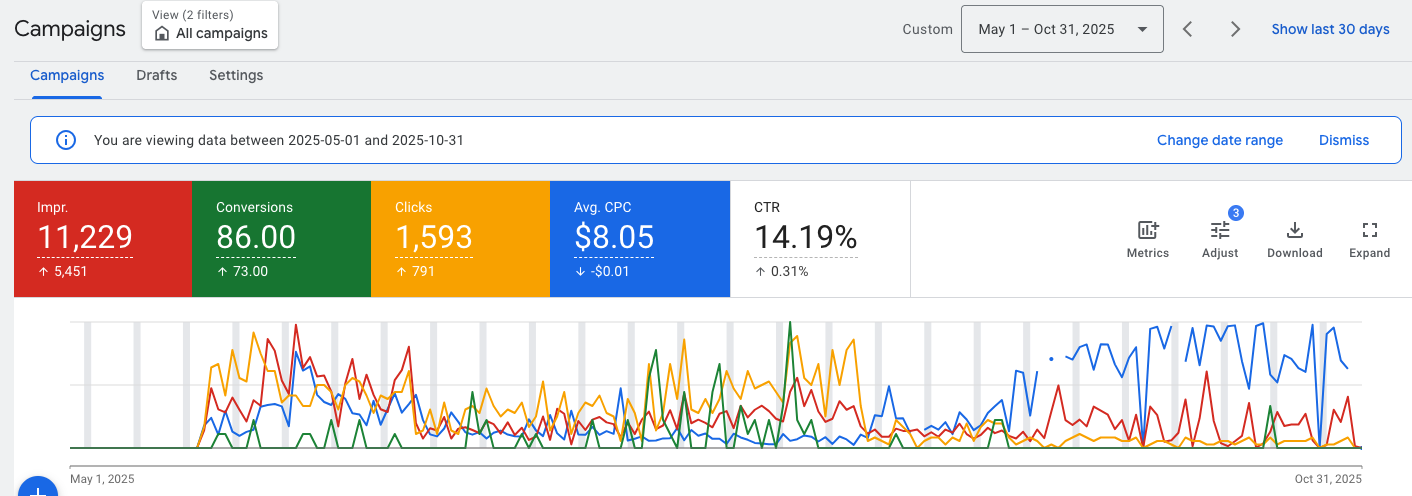
PPC is an excellent strategy to use in several cases:
- **Seasonal campaigns**: Home service businesses often experience seasonal demand for specific services, such as HVAC maintenance in the summer or gutter cleaning in the fall. Adjusting your PPC campaigns according to seasonal demand can optimize your ad spend and enhance marketing effectiveness.
- **Emergency services**: If your business offers emergency services, consider running PPC ads that target urgent, time-sensitive keywords, such as “24/7 plumber” or “emergency HVAC repair.” This can help capture leads from customers who need immediate assistance.
In addition to lead generation, PPC offers home service businesses highly targeted advertising for increased conversions, greater control over the advertising budget, measurable results, local targeting, and flexibility for quick and efficient changes when necessary.
### 6. Google’s Local Service Ads (LSAs)
[Google Local Service Ads](https://www.wearetg.com/blog/google-local-service-ads/) (LSAs) have emerged as a game-changer in the home services industry. These ads appear above organic listings and traditional Google ads on search results, providing premium visibility to local businesses, home services companies, home service businesses, and other services. Over 55% of consumers look for home services online before making a booking, highlighting the importance of being visible in this space.
Some benefits of Google LSAs for home service businesses include:
- **Top-of-page visibility**: LSAs are displayed at the top of Google search results, ensuring your business is one of the first things potential customers see. This prime placement can lead to higher click-through rates and more inquiries, especially from users who are ready to book services immediately.
- **Pay-per-lead model**: Unlike traditional PPC ads, where you pay for each click, LSAs operate on a pay-per-lead model, meaning you only pay when a customer contacts you directly through the ad, either by phone call or message. This model ensures you’re investing in actual leads rather than just clicks.
- **Google Guarantee**: Businesses running LSAs can earn the Google Guarantee badge that is prominently displayed on the ad. This badge reassures potential customers that your business has been vetted by Google, providing an added layer of trust and credibility.
- **Qualified leads**: LSAs are designed to generate highly qualified leads by allowing customers to search for specific services in their area and directly connect with businesses that meet their needs. The leads generated through LSAs are often ready to hire, making them more likely to convert into paying customers.
For home services businesses looking to stay competitive, embracing LSAs can provide a significant advantage, increasing your visibility to gain more qualified leads. By investing in these ads, you can ensure that your business is front and center when potential customers search for the services you offer.
### 7. Design & Maintain a Professional Website
A professional website is essential for any home services business. It’s often the first interaction potential customers have with your brand, and it plays a critical role in shaping their perception of your business. Developing a user-friendly website helps save time, attract more customers, and achieve higher conversion rates.
Key features of a strong home services website include:
- **Mobile Device Optimization**: A responsive design that adapts to various devices ensures a seamless user experience.
- **Easy-to-Understand, Organized Copy**: Getting a head start with concise, easily understandable content is vital, as most users skim rather than read every detail, focusing on key points.
- **Fast Website Load Times**: Fast loading times are crucial; waiting over three seconds can lead to increased bounce rates.
- **Clear, Straightforward Navigation**: Clear navigation helps users quickly find all the information and services they need, enhancing their overall experience and establishing you as the go-to home service pros.
- **Using Quality, Consistent Visuals**: Visual appeal is crucial for capturing and retaining visitors’ attention. High-quality images and graphics enhance the aesthetic and professional appeal of your website.
- **Testimonials & Case Studies**: Customer testimonials and case studies build credibility and trust, showcasing your successes and satisfied customers.
- **Clear CTAs for Higher Conversion Rates**: Clear calls to action guide visitors towards booking services or contacting your team, making it easy for them to engage with your business.
- **Regular Content Updates**: Regular updates to your website’s content that keep it relevant and engaging, improving your rankings and showcasing your expertise. For instance, a blog can enhance your SEO efforts and provide valuable information to visitors, positioning you as a thought leader in the home services sector.
### 8. Video Marketing
Video marketing is a powerful tool for enhancing user engagement and delivering information quickly. It fosters emotional connections with viewers, making your marketing efforts more impactful. Utilizing video marketing can enhance brand recall and recognition, leading to increased traffic and higher conversion rates.
Effective video marketing campaigns often include:
- Visually appealing content relevant to the target audience
- Incorporation of storytelling or humor
- Testimonials and product demos, which cater to specific audience segments
- Utilization of before-and-after photos to showcase work quality is a powerful marketing tool for home services.
Implementing video marketing helps create engaging content that resonates with your audience and drives conversions.
### 9. Email Marketing Campaigns
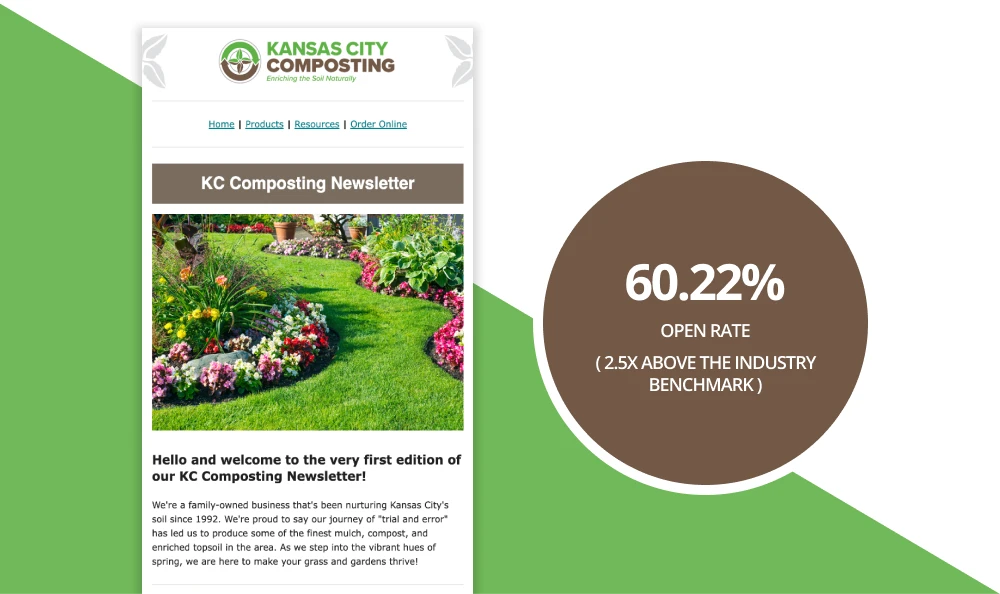
Email marketing is one of the most effective digital marketing strategies for home service businesses, helping nurture leads and retain customers. It offers a direct line to your customers, allowing you to deliver personalized messages that can drive engagement, build loyalty, and convert leads into paying customers.
Here are some additional tips to make email marketing work best for your home services company:
- **Segment Your Email Lists**: Tailor your messages to specific customer needs to improve engagement and reduce spam classifications.
- **Automate Email Campaigns**: Trigger timely follow-ups based on customer interactions, such as open estimates or approaching service renewals.
- **Personalize Email Messages**: Personalization based on customer history significantly increases open rates and engagement compared to generic messages.
These targeted email campaigns can effectively nurture leads and retain customers, keeping your home service business at the forefront of your audience’s minds. Easily promote your services, foster long-term relationships, and drive repeat business.
For [STL & KC Composting](https://www.wearetg.com/portfolio/stl-kc-composting/), a properly developed email campaign launch strategy with audience segmentation, engagement tactics, revenue tracking, and re-engagement tactics helped the business achieve click rates 2.5 times higher than the industry standard.
### 10. Social Media Marketing

[Social media marketing](https://www.wearetg.com/services/social-media-marketing/) is invaluable for home service businesses. Platforms like Facebook, Instagram, LinkedIn, and even Pinterest offer a unique opportunity to connect with your target audience, build brand loyalty, and attract new, prospective customers. Leveraging social media helps you showcase your expertise, share customer testimonials, and engage with customers in a personal and professional way.
Consumers are increasingly turning to social media for recommendations, reviews, and research before selecting a home services business. Building and maintaining a strong presence helps establish trust and credibility with those consumers, increasing the likelihood they’ll call you first.
Social media campaigns can create awareness and engagement at scale. For instance, RSI Kitchen & Bath’s October 2025 campaign reached 213,380 users, with an estimated ad recall lift of 10,700 people, demonstrating the power of consistent social media marketing to enhance brand visibility and recall.
 
Of course, not all social media platforms are created equal. Each serves a particular demographic, so you must choose those that best align with your business goals and target audience:
- **Facebook**: Ideal for achieving a broad reach, fostering community engagement, and running targeted ad campaigns. This is a must-have for most home service businesses.
- **Instagram**: Best for visual content, Instagram is perfect for showcasing your work through photos and videos. It’s particularly effective for businesses that focus on aesthetics, like landscaping, painting, and interior design.
- **LinkedIn**: While LinkedIn is more business-oriented, it remains a valuable platform for networking, particularly if your services cater to commercial clients. Sharing industry insights can also establish thought leadership.
- **Pinterest**: Much like Instagram, if your services have strong visual components, Pinterest can be a powerful platform to drive traffic to your website through visually appealing pins.
A home services marketing agency can help enhance these efforts by personalizing interactions, thereby enhancing trust and leading to more bookings. Additionally, posting regularly maintains visibility and signals to customers that your business is operational.
### 11. Enhance Customer Experience with Technology
Enhancing customer experience with technology can set your business apart from the competition. AI chatbots manage customer inquiries and appointment bookings around the clock, ensuring that needs are met at any time. AI enhances scheduling by predicting job requirements and optimizing dispatching, making operations more efficient.
AI tools troubleshoot customer issues before service visits by analyzing data, improving resolution times. Real-time insights about service appointments keep customers informed and reduce frustration, leading to higher satisfaction levels at the agency. Online booking systems enable customers to easily schedule appointments, thereby reducing missed bookings and enhancing the overall user experience.
Using an online appointment scheduling software, you can offer your customers:
- **Automated scheduling** so clients can book appointments online and view real-time availability
- **Automated reminders** via SMS or email to keep clients updated about appointments or scheduling changes
- **An online payment portal** to offer customers payment flexibility with PayPal, credit cards, or other payment options
- **Calendar integrations** that sync with Gmail, Outlook, or iCal
According to [research by GetApp](https://www.getapp.com/resources/research-online-booking-importance-of-appointment-scheduling/), 94% of consumers surveyed who have booked a service appointment in the past year stated they were more likely to choose a new service provider if that new provider offered online booking. If multiple booking options are available, such as phone, email, in-person, and online, 70% stated they would choose to book online over other options.
Leveraging technology enables home services businesses to deliver superior customer service, offering real-time updates and enhancing job engagement.
### 12. Consistently Track & Analyze Marketing Data
Tracking and analyzing marketing data is essential for making informed decisions and optimizing your marketing efforts. Measuring ROI helps determine how effectively marketing investment resources are utilized, providing significant advantages over competitors.
Consistently analyzing your marketing data is crucial for home service businesses for a variety of reasons, including:
- **Helps identify what works (and what doesn’t)**: Regularly reviewing marketing data helps you pinpoint which strategies are delivering results and which are falling short. Whether it’s a particular social media campaign, email marketing effort, or SEO tactic, understanding what works allows you to double down on successful strategies and eliminate or adjust underperforming ones.
- **Optimize campaign performance**: Data analysis provides valuable insights into the performance of your marketing campaigns, enabling you to make real-time adjustments for improved outcomes. For example, if a PPC ad isn’t generating the expected clicks, data analysis can reveal whether the issue lies in the ad copy, targeting, or bidding strategy.
- **Enhance customer targeting**: By analyzing your audience’s behavior and preferences through data, you can refine your targeting strategies. Whether it’s identifying the demographics that engage most with your content or the times of day when your audience is most active, these insights help you tailor your marketing efforts to meet your customers’ needs better.
- **Measure return on investment (ROI)**: For home service businesses, you must know which marketing efforts are driving revenue and which are not. By analyzing data, you can calculate the ROI of each campaign, helping you allocate your budget more effectively. This ensures your marketing dollars are spent on strategies that deliver the highest returns.
- **Stay competitive**: In the competitive home services market, staying ahead means constantly refining your approach based on the latest data. Regular data analysis keeps you informed about industry trends, competitor activities, and customer expectations, allowing you to adapt your strategies and maintain a competitive edge.
Tracking your campaigns allows you to replicate success across channels. For example, analyzing [Maplewood Plumbing](https://www.wearetg.com/portfolio/maplewood-plumbing/)‘s SEO, mobile, and PPC performance allowed our team to identify high-performing tactics, resulting in a 39% increase in overall traffic, a 56.4% increase in conversions, and a 75.8% increase in form submissions, showing the value of data-driven decision-making.
Adopting a data-driven approach ensures your marketing strategies are practical and continuously improving. Dynamic marketing environments necessitate swift data analysis to adjust strategies effectively. Identifying the most effective marketing channels enables optimized budget allocation.
### 13. Traditional Marketing Tactics
While digital marketing dominates, traditional marketing still plays a vital role for home service businesses, especially in terms of local visibility. Specific tactics keep your brand visible in the neighborhoods you serve, such as:
- **Billboards**: Large, visually impactful billboards placed in high-traffic areas can dramatically increase brand awareness. For home service businesses, billboards help ensure your company stays top-of-mind for residents and commuters in your target service area.
- **Vehicle Wraps**: Turning your service vehicles into mobile advertisements is a cost-effective way to promote your brand. Vehicle wraps build credibility and act as constant reminders of your services wherever your team travels.
- **Yard Signs**: Placing yard signs at active job sites or sponsoring local events helps establish community presence. Signs serve as proof of work in neighborhoods, and homeowners often notice your company when they see multiple signs in nearby areas.
- **Direct Mailers**: Targeted postcards, flyers, or brochures sent to local households can drive awareness and encourage customers to schedule services. Offering discounts or seasonal promotions via mailers can effectively prompt action from prospective clients.
- **Local Sponsorships & Partnerships**: Supporting local events, sports teams, or community initiatives demonstrates commitment to your community and provides exposure to a local audience. Sponsorships create goodwill and often include logo placement on materials, banners, and event programs.
- **Print Advertising (Newspapers & Magazines)**: Although digital is growing, local print publications still reach a dedicated readership. Advertising in neighborhood papers or trade magazines can help you reach specific demographics that align with your services.
- **Flyers & Door Hangers**: Especially effective for service areas with high foot traffic, these materials are inexpensive ways to share promotions, new services, or seasonal reminders directly with your target audience.
By combining these traditional tactics with your digital marketing efforts, you create a multi-channel approach that strengthens brand recognition, builds trust, and keeps your business top-of-mind in the local community.
## Get the Attention You Want & the Conversions You Need with Help from TG
In this guide, we’ve explored a diverse range of marketing strategies that can propel your home services business to new heights. From solidifying your brand identity to leveraging the latest digital marketing strategies, each approach plays a crucial role in attracting and retaining customers. By investing in a professional website, local SEO, LSAs, PPC ads, and more, you can ensure your business stands out in a competitive market.
Implementing these strategies requires dedication and a willingness to adapt to the ever-changing landscape of home services marketing. Embrace these tools and techniques to enhance your marketing efforts, drive more high-quality leads, and achieve higher conversion rates. The road to success is paved with effective marketing strategies, and with this guide, you’re well-equipped to navigate it.
Working with an experienced [home services marketing agency](https://www.wearetg.com/industry/home-services-marketing-agency/), such as Timmermann Group, can make all the difference. We specialize in crafting effective digital marketing strategies that drive results and help your business grow. [Schedule a conversation](https://www.wearetg.com/contact/) with us today to learn more and start running better advertising campaigns for your home services business.
---
## Frequently Asked Questions About Home Services Marketing
#### Why is branding important for home services businesses?
Branding is crucial for home services businesses as it fosters trust and recognition, helping to differentiate you from competitors while leaving a lasting impression on potential customers. This strategic approach enhances your visibility in a crowded market.
#### How can I improve my website’s effectiveness?
To improve your website’s effectiveness, prioritize a responsive design, intuitive navigation, and high-quality visuals. Additionally, incorporate customer testimonials, update content regularly, and include clear calls to action.
#### What are the benefits of local SEO?
Local SEO boosts your visibility in search results, helping you attract high-quality leads and improve conversion rates, all while offering measurable results. Prioritizing local SEO is essential for any business aiming to succeed in its community.
#### How do Local Services Ads work?
Local Services Ads offer businesses increased visibility by charging only for leads that result in direct interactions, while also enhancing trust through the Google Guarantee badge. This model ensures you only pay for genuine customer inquiries.
**Categories:** Social Media, SEO, PPC, LSO, Email Marketing, Content Marketing, Web Design, Strategy, Analytics, Branding
---
### [Search Engine Optimization: The Essential Guide](https://www.wearetg.com/blog/search-engine-optimization/)
**Published:** November 20, 2025
**Author:** Rob Timmermann
**Content:**
A website can look amazing and contain valuable information for users, but if it’s buried on page two of Google, most people will never find it. In fact, the vast majority of clicks go to the first few results on page one. [Search engine optimization](https://www.wearetg.com/services/seo/) (SEO) is the key to breaking through that barrier, attracting more site visitors, which in turn leads to increased sales and greater brand recognition. SEO is about providing real value, creating high-quality content, and building trust with both search engines and users.
Businesses that adopt modern SEO practices and stay current with algorithm updates are the ones that thrive online. In this guide, we’ll walk you through the essentials of SEO and how to implement them effectively to achieve the best results for your business.
## Key Takeaways
- SEO involves **optimizing a website’s visibility** through various techniques aimed at improving organic search rankings, ultimately driving more traffic and sales.
- Key components of SEO include **keyword research**, **on-page optimization**, **technical SEO**, and **off-site optimization**, all of which are essential for improving rankings.
- **User experience** has a significant impact on SEO success; improved usability leads to better engagement and lower bounce rates, while local SEO strategies enhance visibility in regional search results.
## Understanding Search Engine Optimization
Search engine optimization is the practice of improving your website’s visibility in search engine results to attract more organic traffic. Utilizing various techniques, like optimizing content and building backlinks, enhances your site’s ranking on major search engines like Google and Bing. Why is this so important? Higher rankings mean more visitors, which in turn can lead to more sales and greater brand recognition. Practical SEO work is essential for achieving these goals, and an experienced SEO agency can help with this process.
Starting in the early 1990s, website owners would manually submit URLs and use keyword-rich meta tags to gain visibility. Today, search engine marketing has evolved into a sophisticated discipline that considers search engines, algorithms, search queries, and user preferences to achieve desired results. No longer is SEO just about keywords; it’s about providing value and relevance to the users, and making the greatest impact requires a consistent eye on current best practices and strategy adjustments.
Ranking higher in search results looks excellent for your business, but it’s more than a vanity metric; it directly impacts your site’s traffic. The higher you rank on the search engine results page (SERP) for your industry, the greater your click-through-rate (CTR). In fact, [statistics have shown](https://backlinko.com/google-ctr-stats) that the top result generated an average CTR of 39.8%, while the second and third results dropped to 18.7% and 10.2%, respectively. (Of course, all of these CTRs are well above the desired 3%.)
Understanding how the CTRs perform based on ranking highlights the significance of SEO in generating organic search traffic to your website.
## How Search Engines Work
While you don’t need a PhD in search engines to effectively utilize SEO, it’s crucial to understand how they work so you can tailor your strategies to meet the requirements of these “digital gatekeepers.”
Think of search engines like the librarians of the internet. They constantly scour the web to index and organize content, making it easier for internet users to find what they’re looking for. Using web crawlers, also known as “spiders,” to collect data from web pages, search engines then analyze and store the information in their indexes. This process is crucial for generating search results, as it enables search engines to retrieve relevant information quickly when users input search queries.
Once the content is indexed, search engines use complex algorithms to rank pages based on various factors like relevance, quality, and user engagement. Google’s index, for example, considers hundreds of ranking factors to determine the most relevant results for a given query. These algorithms essentially comprise a set of rules that determine which pages are most likely to appear at the top of SERPs.
Just like a librarian selecting the best books for a particular topic, the search process culminates in presenting users with the most relevant results.
## Key Elements of SEO
SEO is a multifaceted discipline that can be broken down into three main components: technical optimization, content optimization, and off-site optimization. Together, these elements form the backbone of any effective SEO strategy.
Let’s explore how they contribute to improving your site’s search engine rankings.
#### Technical Optimization
Technical SEO focuses on the infrastructure of your website, including technical elements like URL structure and navigation, to ensure it supports search engine crawling and indexing. A site that is easily crawlable and indexable boosts overall SEO performance. Additionally, internal linking is important as it helps both users and search engines understand the relationships between different pages on the site. Implementing structured data improves how content is interpreted by search engines, which is increasingly important with the rise of AI and voice search.
You also want to ensure that Google sees the same view as an average user when crawling your site for accurate indexing. An XML sitemap can help search engines discover and crawl all of your site’s pages more efficiently. Descriptive URLs can also enhance user experience and search appearance by serving as breadcrumbs in search results.
Finally, some of the most critical technical factors to monitor and improve are page load times and mobile optimization. Slow-loading pages can deter users and negatively impact your search engine rankings on that page. With Google’s mobile-first indexing, not optimizing for mobile can hinder your site’s ranking.
#### Content Optimization
Creating high-quality, relevant website content is the cornerstone of any successful search engine optimization strategy, enabling your site to resonate with both your audience and search engines. Content optimization ensures every page on your website is structured, informative, and aligned with what your audience is searching for. This process involves understanding which topics and keywords resonate with your users and organizing your content so search engines can easily interpret and rank it.
To boost engagement and search optimization, consider the following:
- Use relevant and high-quality images.
- Create content that encourages social sharing to attract backlinks and enhance your site’s visibility.
- Regularly refresh your content to improve its performance and visibility in search results.
Let’s break down two key aspects of content optimization: keyword research and on-page optimization.
#### Keyword Research
Keyword research is the cornerstone of any successful SEO strategy. It involves identifying the search terms that users are likely to input when looking for information related to your business. These keywords help optimize both existing and new content, ensuring it aligns with user search queries and search marketing efforts.
Different keywords should be considered based on the knowledge level of your target audience. For instance, beginners may use broader terms, while experts might use more specific keywords. Tools like Google Ads Keyword Planner can provide valuable insights into search volume and keyword suggestions, making it easier to select the most suitable terms.
Writing content with relevant keywords increases the chances of your pages appearing in search results, driving more organic traffic to your site. However, it’s crucial to avoid keyword stuffing, as it can make your content less readable and user-friendly. Instead, focus on natural language processing to optimize for voice search and improve user engagement, ensuring your content is search engine-friendly.
#### On-Page Optimization
On-page optimization refers to the techniques used to enhance the performance of individual web pages in search engines. This includes optimizing the Title Tag, which serves as a clickable link in search results and should clearly indicate what the page is about. Anchor text, the clickable text in a hyperlink, is another crucial element that describes the content of the linked page.
Effective on-page optimization goes beyond just title tags and anchor text. It also involves ensuring your content is well-structured, easy to read, and relevant to the user’s search intent. Techniques such as optimizing content using internal links to connect related content within your site can enhance user engagement and help search engines better understand the site’s structure.
By focusing on your on-page SEO optimization, you can significantly enhance your site’s visibility and performance in search engine results pages. This will help you attract more organic traffic and improve the overall user experience on your site.
#### Off-Site Optimization
Off-site optimization, also referred to as off-page SEO, involves activities that occur outside your website but significantly impact your search engine rankings, including factors such as backlinks. Backlinks are hyperlinks that come from one website to another. In the context of SEO strategy, a quality backlink is a reliable, industry-related source that links to a page on your website as a reference. Building high-quality backlinks from authoritative websites is crucial for enhancing your site’s presence in search results.
Methods for obtaining backlinks include:
- Promoting content
- Outreach to other sites
- Submitting to directories
- Press outreach
Social media marketing, although it does not directly impact SEO, helps create networking opportunities for link building and guest posting on social media sites.
Tools like Ahrefs are invaluable for backlink analysis, enabling you to evaluate linking websites and identify new opportunities for link building. These metrics can gauge your site’s strength relative to competitors and the effectiveness of your link-building efforts.
## Measuring SEO Success with Website Analytics
Regularly tracking SEO performance is crucial for understanding the impact of your strategies and making informed decisions. Various SEO tools like Google Analytics and Google Search Console can help you track and analyze SEO performance, providing insights into metrics like organic traffic and conversion rates.
**Organic traffic** is a primary indicator of SEO success, showing how effectively your site attracts qualified traffic from search engines. Monitoring this metric can help you gauge the effectiveness of your SEO efforts and identify areas for improvement.
The **conversion rate** indicates how effectively your site turns visits into actionable outcomes, directly measuring the impact of your SEO strategy.
By regularly analyzing these metrics, you can refine your approach and continually improve your site’s performance.
## Common SEO Mistakes to Avoid
- **Failing to Consider the Search Intent Behind Keywords:** Creating content that fails to meet user needs can result in high bounce rates and poor engagement.
- **Duplicate Content:** This pitfall can confuse search engines, resulting in neither page ranking effectively. Ensure each piece of content, even when similar in context, is unique and provides value to the user.
- **Excessive Promotion:** This can lead to user fatigue and result in potential penalties from search engines due to perceived manipulation. Striking a balance between promotion and providing valuable content helps maintain a positive user experience and a good SEO standing.
## The Role of User Experience (UX) in SEO
A well-optimized website can offer a superior user experience, leading to increased engagement and reduced bounce rates. Websites that improve their content and usability often see better rankings and increased visibility in search results. Metrics like engagement rate measure the quality of user interactions on your site, reflecting how compelling your content is to visitors. Similarly, bounce rate can provide insights into user experience, indicating whether visitors find your content relevant or engaging.
Accessibility features, when implemented correctly, can enhance both user experience and SEO metrics. Clear navigation aids both UX and SEO by helping users navigate content quickly. Websites that adhere to accessibility standards tend to offer improved user experiences, which can lead to better SEO outcomes, especially for users of screen readers.
## Local SEO Strategies
Ignoring local SEO strategies can hinder your visibility in local search results, resulting in missed opportunities to attract potential customers. Local SEO focuses on enhancing your visibility when users nearby look for your services.
To rank effectively for local searches, businesses should incorporate location-specific keywords that reflect local intent. Monitoring local SEO performance helps identify visibility gaps and adjust strategies accordingly.
## The Future of SEO
The use of AI in SEO has led to a shift from simple keyword matching to understanding user intent and context in search queries. Traditional SEO concepts are evolving, moving from keyword density to semantic relevance, large language models, and topic authority.
AI search involves leveraging AI to understand queries and deliver nuanced results. Conversational AI enhances search by enabling natural, dialogue-based user interactions, which refine searches and enhance the user experience.
Voice search continues to grow as AI voice assistants become more innovative and prominent, so SEO strategies must adapt to accommodate this growing trend.
## Promoting Your Website
High-quality content increases the likelihood of being shared on social media and attracting links, thereby enhancing your site’s visibility. However, it’s crucial to avoid over-promotion, as it can lead to adverse reactions and penalties from search engines.
Offline promotional strategies, such as including your website URL on business cards, can effectively drive traffic to your site. Additionally, incorporating multiple URLs and external links from related pages can enhance your site’s authority and visibility for site owners in the context of website development.
## Summary
In summary, SEO is a vital component of any successful digital marketing strategy. By understanding and implementing key elements such as keyword research, on-page optimization, technical SEO, and off-site optimization, you can significantly enhance your website’s visibility and performance in search engine results. Creating SEO-friendly content, measuring your SEO success, and avoiding common mistakes further strengthen your strategy.
User experience plays a crucial role in SEO, with well-optimized websites offering better engagement and lower bounce rates. Local SEO strategies ensure that you capture potential customers in your vicinity, while staying ahead of future trends, like AI and voice search, will keep your SEO strategy relevant. Promoting your website through balanced content marketing and offline strategies helps build your site’s authority and attract more organic traffic.
As you move forward, remember that SEO is a continuous process of learning, adapting, and optimizing. Keep refining your approaches based on performance metrics and stay updated with the latest trends to maintain a competitive edge. Embrace the dynamic nature of SEO, and let it guide you to greater online success.
Because SEO is not a “set it and forget it” marketing tactic, it requires a lot of time and attention that many companies can’t spare in-house. [Schedule a conversation](https://www.wearetg.com/contact/) with our team to learn how we can ensure that your SEO is always prioritized and receives the attention it deserves.
---
## Frequently Asked Questions
#### Why is SEO important for my website?
SEO is crucial for enhancing your website’s visibility in search engine results, resulting in increased organic traffic and a higher likelihood of attracting potential customers. Prioritizing SEO can significantly impact your online success.
#### What are the key components of SEO?
The key components of SEO are keyword research, on-page optimization, technical SEO, and off-site optimization, all of which collaborate to improve your site’s search engine rankings. Focusing on these areas can significantly enhance your visibility online.
#### How do search engines determine rankings?
Search engines determine rankings through complex algorithms that evaluate factors such as relevance, content quality, and user engagement. Web crawlers index webpages, enabling algorithms to deliver the most relevant results for user queries.
#### What are some common SEO mistakes to avoid?
To enhance your SEO strategy, avoid mistakes such as neglecting search intent, creating duplicate content, and over-promoting your content, which can lead to user fatigue and penalties. Focusing on quality and relevance will yield better results.
#### How can I measure the success of my SEO efforts?
To effectively measure the success of your SEO efforts, focus on tracking organic traffic and conversion rates, and utilize tools like Google Analytics and Google Search Console for performance insights. These metrics provide a clear indication of your SEO effectiveness.
**Categories:** SEO
---
### [UX vs UI: What’s the Difference and Why Does It Matter?](https://www.wearetg.com/blog/ux-vs-ui/)
**Published:** November 19, 2025
**Author:** Rob Timmermann
**Content:**
Understanding the difference between UX vs. UI is essential for creating a successful [website design](https://www.wearetg.com/services/website-design/). **UX (user experience)** is about the overall feel and usability of a product, ensuring it meets user needs efficiently and pleasantly. **UI (user interface)** focuses on the look, layout, and interactive elements to make the product visually engaging and intuitive to use. While closely related, both play distinct roles in crafting meaningful user experiences.
In this article, we’ll explore the key differences, roles, and collaboration between UX and UI design, and why both are crucial for business success.
## Key Takeaways
- **UX Design**: Focuses on creating smooth, efficient, and meaningful user journeys through research, testing, and iteration.
- **UI Design**: Concentrates on the visual and interactive elements of a product, ensuring interfaces are intuitive, cohesive, and visually appealing.
- **Collaboration is Crucial**: UX and UI designers must work together to produce functional and aesthetically engaging digital experiences.
- **AI and Emerging Tech**: Tools like generative AI are shaping the future of UX/UI by enabling rapid prototyping, personalization, and real-time design adjustments.
## Defining UX Design: Creating Seamless User Experiences
User experience (UX) design is the practice of shaping the overall experience users have with a product. From discovery to ongoing use, UX ensures interactions are intuitive, efficient, and enjoyable. A well-designed UX balances functionality with user satisfaction, guiding people through clear, purposeful pathways.
Every step in the UX design process is crafted to ensure user interactions are well-designed and meet users’ needs, from wireframing to usability testing.
**The UX Design & Product Development Process**:
1. **User Research**: Gathering insights about behaviors, goals, and pain points through interviews, surveys, and analytics.
2. **Problem Definition**: Identifying challenges and opportunities in the user journey.
3. **Ideation & Solution Mapping**: Brainstorming potential solutions and creating user flows. User-centered design and UX designer maps can be crucial in visualizing user journeys.
4. **Prototyping & Testing**: Developing wireframes and prototypes to gather feedback.
Iteration: Refining the product based on usability testing and real-world interaction.
UX design is about solving user problems, creating enjoyable experiences that connect with users emotionally, and meeting business objectives.
### Why UX Matters in Web Design
A strong UX is crucial for customer engagement and business growth. Users are more likely to return, convert, and recommend products that are easy to use and visually intuitive. Positive UX builds trust through:
- Transparent policies and clear communication
- Accessible navigation and responsive design
- Feedback mechanisms like confirmations and error messages
Ultimately, a seamless user experience supports retention, loyalty, and long-term business success.
### The Role of Usability Testing in UX
Usability testing validates UX design decisions by observing real users interacting with the product. Designers identify friction points, confusion, and usability gaps, then refine solutions before launch.
## Understanding UI Design: Crafting Visually Engaging Interfaces
User interface (UI) design focuses on the visual and interactive elements of a product. While UX guides the journey, UI shapes the moments within that journey: the screens, buttons, toggles, icons, and menus users engage with.
UI design ensures that digital products are not only functional but also visually cohesive and brand-aligned.
### Key Components of UI Design
User interface designers focus on creating easy-to-use interfaces that facilitate seamless navigation.
- **Layout & Spacing**: Organizes content for clarity and responsiveness across devices.
- **Typography & Color**: Enhances readability and communicates hierarchy.
- **Icons & Buttons**: Serve as navigational cues and interaction points.
- **Visual Consistency**: Maintains brand identity and predictability through style guides.
Because there are various visual components and elements to adhere to, [following a UI style guide](https://www.wearetg.com/blog/ui-style-guide/) is essential for consistency.
### UI Prototyping and Interactivity
UI designers create interactive prototypes to test user engagement before final implementation. UI designers often have graphic design skills that allow them to create aesthetically pleasing layouts and elements. This iterative approach minimizes errors, improves usability, and ensures that visual design complements the UX journey.
## UX vs. UI Design: Core Differences
| **Aspects** | **UX Design** | **UI Design** |
|---|---|---|
| Focus | Overall user journey | Visual and interactive interface elements |
| Goal | Solve problems, ensure efficiency | Make interfaces appealing and intuitive |
| Methods | Research, wireframing, testing | Typography, color, layout, interactivity |
| Outcome | Seamless, user-centered experience | Engaging, cohesive, on-brand interface |
While UX focuses on how things work, UI focuses on how things look and feel. Together, they create products that are usable, delightful, and visually appealing.
### Focus Areas: User Journey vs. Visual Elements
Good UI without good UX can lead to user frustration and abandonment. Both UX and UI design are crucial for a cohesive user experience and achieving optimal results.
- **UX Design**: Focused on enhancing the user’s journey by creating intuitive paths that solve problems and meet user needs. This involves conducting user research, mapping the user’s journey, and creating wireframes to guide design.
- **UI Design**: Emphasizes the visual and interactive design elements that create an engaging user experience. This includes working with colors, icons, and typography to create a visually appealing interface.
### Tools and Resources of UI Designers
- **Artificial Intelligence (AI)**: Enhances the process from user research to ideation and creation through tools like automated user testing and predictive analytics for gathering insights and refining their designs based on real user behavior.
- **Grid Systems, Animations, & Text**: Create engaging and responsive interfaces, visually appealing digital design, and highly functional final products for visually appealing digital design and highly functional final products.
- **Graphic Designers & Illustrators**: When brought in as a separate entity, graphic designers and illustrators play a vital role throughout the process, creating engaging visual designs.
## How UX and UI Designers Collaborate
The collaboration between UX and UI designers is at the heart of effective product design. Both roles bring unique strengths to the process, but true success comes when they work together seamlessly from concept to launch.
The process typically begins with UX designers, who conduct user research to understand behaviors, motivations, and pain points. They use these insights to create wireframes and user flows that map out how people will move through a product. UI designers then build on that foundation, translating those wireframes into visual and interactive elements that make the experience engaging, intuitive, and on-brand.
To keep designs cohesive, UI designers often develop a comprehensive style guide, which is a “living” document that defines typography, color palettes, spacing, and interactive components. This ensures visual consistency across screens and helps developers maintain alignment throughout the build phase.
Collaboration also relies on strong communication. Product managers or design leads often bridge the gap between UX and UI, ensuring both teams stay aligned on project goals, timelines, and user needs.
**When UX and UI designers collaborate effectively, the results are powerful:**
- Improved user engagement
- Higher conversion rates
- Stronger brand trust
When UX and UI designers work together effectively, the result is a digital product that offers better user engagement, retention, and conversion. This partnership is vital for successful product outcomes, as good UX can be overshadowed by poor UI and poor UX.
### Balancing User Needs and Aesthetic Appeal
Balancing functional user needs with visual appeal is key to achieving a satisfying overall user experience. This balance ensures that users can navigate the interface effortlessly while enjoying a visually pleasing design. A positive user experience significantly contributes to customer loyalty, leading to long-term business growth, especially when considering user flows.
UI design prioritizes intuitive layouts that enhance usability and provide smooth navigation for users. Focusing on user needs and aesthetic appeal, designers create interfaces that are both functional and beautiful. UI design emphasizes how the user interacts with the user interface and its components.
## The Future of UX and UI Design
Emerging technologies like artificial intelligence (AI) and generative design are transforming UX/UI:
- **AI-Powered Personalization**: Interfaces adapt in real-time to user behavior.
- **Generative Design**: Rapid prototyping enables exploration of multiple visual solutions.
- **Inclusive & Accessible Design**: Accessibility and ethics are increasingly central to design decisions.
- **New Interfaces**: Voice, gesture, AR/VR, and wearable interfaces redefine interaction.
As AI evolves, UX designers must emphasize their critical thinking skills and empathy to maintain a human-centered design approach that is rooted in design thinking. These soft skills are essential for crafting meaningful, adaptive, inclusive, and visually engaging user experiences.
## Bringing UX and UI Together for Digital Success
UI and UX design are distinct but interdependent. UX focuses on the journey, ensuring usability and satisfaction, while UI focuses on the interface, creating visual appeal and interactivity. Both are essential for designing digital products that delight users and support business goals.
Ready to elevate your digital experience? [Schedule a conversation](https://www.wearetg.com/contact/) with Timmermann Group today to see how expert UX and UI design can transform your website and products.
---
## Frequently Asked Questions
#### What is the main focus of UX design?
The primary focus of UX design is to create intuitive and enjoyable experiences that guide users through every interaction efficiently.
#### How does UI design differ from UX design?
UI emphasizes visual and interactive elements, while UX focuses on the overall user journey and problem-solving.
#### Why is usability testing important in UX design?
Usability testing is crucial in UX design as it uncovers pain points and gathers user feedback, enabling designers to enhance their products based on actual user experiences for a more effective, user-friendly design.
#### How is AI transforming the future of UX and UI design?
AI is revolutionizing UX and UI design by enabling the rapid development of customized design elements and incorporating real-time user feedback, resulting in a more refined, responsive user experience and an accelerated design process that enhances overall usability.
**Categories:** UX, Web Design
---
### [Website Development: A Beginner's Guide](https://www.wearetg.com/blog/website-development/)
**Published:** November 17, 2025
**Author:** Rob Timmermann
**Content:**
Website development is about creating and maintaining websites. This guide will walk you through the essential steps and tools you’ll need, covering everything from coding to design and content creation.
## Key Takeaways
- [Website development](https://www.wearetg.com/services/website-development/) encompasses **a combination of design, coding, and functionality** to create and maintain effective online platforms.
- **Collaboration between web designers and developers is essential**, as designers focus on aesthetics and user experience while developers ensure functional integration.
- Core programming languages such as **HTML, CSS, and JavaScript**, along with proper planning and maintenance, are critical components in successful web development.
## Understanding Website Development
Website development is the comprehensive process of creating websites, incorporating various elements such as design, layout, coding, and functionality. It’s akin to constructing a building where web developers act as construction engineers, following blueprints to transform design concepts into functional building websites. This process goes beyond merely building the site; it also involves maintaining it to ensure ongoing functionality and user engagement. Various types of developers play crucial roles in this process, including front-end, back-end, and full-stack developers.
Grasping the web development process can significantly enhance an online store’s business presence or aid in creating enterprise-level web applications that align with business goals. Development platforms provide frameworks and tools that expedite the website creation process and enhance its functionality, including a free website builder, built in marketing tools, website builders, and can be effectively utilized in Google Chrome. Additionally, exploring various web development topics, including application programming interface, mobile applications, and additional resources, can further improve understanding and implementation. Web development teams can also play a crucial role in this process.
Web development integrates both design and coding to create visually appealing and functional websites. A web developer utilizes lines of code and a variety of programming languages in web programming to perform their work effectively, encompassing activities such as:
- Design
- Layout
- Coding
- Content creation
- Functionality
- Project Management
## Key Differences Between Web Development and Web Design
While web development and web design are often used interchangeably, they represent distinct aspects of creating a website. **Web designers primarily focus on enhancing the aesthetic appeal and usability of websites.** They create visual aspects and user interfaces, ensuring that the site is visually engaging and user-friendly.
On the other hand, **web developers are responsible for transforming these design concepts into functional code** that operates the website. Their main focus is on building and maintaining the site’s functionality.
Collaboration between web designers and developers is vital for successfully creating and maintaining websites. Front-end developers manage the visuals and behavior in the browser, while back-end developers handle server-side tasks. This synergy ensures that the website not only looks good but also performs efficiently, providing users with a seamless and engaging experience.
## Core Programming Languages in Web Development
Core programming languages form the backbone of web development. The most common languages used in this field are:
- **Hypertext markup language:** Provides structure to a website, allowing for the definition of elements like headings, paragraphs, images, and links.
- **CSS:** Used for styling the visual appearance of websites, enhancing how content is presented.
- **JavaScript:** Adds interactivity to websites, making them dynamic and engaging for users.
Beyond these foundational languages, other programming languages like Python, PHP, and Ruby also play significant roles in web development:
- **Python** is known for its readability and simplicity, making it a popular choice for back-end development.
- **PHP** is widely used for server-side scripting to create dynamic web content.
- **Ruby**, commonly associated with the Ruby on Rails framework, enhances productivity for web applications while learning programming languages and object oriented programming language.
Each of these languages brings unique advantages, contributing to the diverse landscape of web development.
## Front-End Development Essentials
Front-end development involves creating visually appealing elements and focuses on interactive features that users engage with directly. Key aspects include:
- **HTML:** the foundation of front-end web development.
- **CSS:** crucial for controlling the layout and visual presentation of web pages, allowing customization of colors, fonts, layouts, and other design elements to refine the user experience.
- **Creating responsive web pages:** ensures a good experience across different devices and screen sizes.
JavaScript is another essential tool for front-end development, enhancing interactivity and dynamic content on websites. Popular JavaScript frameworks and libraries such as jQuery and React further enhance development efficiency. Frameworks like Bootstrap and Tailwind CSS are important for efficient front-end development.
Using modern frameworks and libraries helps maintain productivity and code quality. Front-end developers build interfaces that help users reach their goals, focusing on the client-facing aspects of websites, programs, and software.
### Common Front-End Development Roles
The front-end development sector is rich with a variety of roles, each reflecting different components of skill sets and experience levels. Common roles include:
- **UI/UX designers** focus on the visual aspects and user interfaces.
- **Front-end developers** work on coding and implementing interactive elements.
- J**avaScript engineers** also work on coding and implementing interactive elements.
Job titles in front-end development may vary widely depending on company size and project requirements. Regardless of the specific title, each role plays a crucial part in creating a seamless and engaging user experience. The diversity of roles in front-end development ensures that there are opportunities for individuals with various expertise and skill proficiency.
## Back-End Development Fundamentals
Back-end development involves server-side logic, databases, and functionalities that operate behind the scenes of a web application. It is generally considered more complex than front-end development due to the need for strong database and server management skills. PHP is widely used for server-side scripting to create dynamic web content, while Python’s extensive libraries and frameworks like Django and Flask make it versatile for various applications in web development.
JavaScript and PHP are recommended for beginners in back-end web development, alongside Python. Back-End Developers are responsible for tasks such as database interactions, user authentication, and server configuration. They must focus on performance and optimization to ensure website functionality and responsiveness.
Choosing the right database management involves considering the nature of the data, scalability, and performance.
### Popular Back-End Development Jobs
Common roles in back-end development include database administrators, who manage data storage and retrieval, and server-side developers, who build the logic needed for web applications. Database administrators ensure that data is stored securely and can be efficiently accessed, while server-side developers focus on writing the code that powers the server-side functionalities.
These roles are critical for the seamless operation of web applications, ensuring that the front-end interface can effectively communicate with the server and database. The complexity and importance of back-end development make it a highly specialized field, with various opportunities for skilled professionals.
## Full-Stack Development: Bridging Front and Back End
Full-stack developers are those who can work on both front-end and back-end tasks, making them versatile and often placing them in leadership roles. One of the key benefits of full-stack development is the ability to seamlessly transition between different tasks, improving the efficiency of web development projects. The demand for full-stack developers is growing, with an expected job growth rate of 13% from 2020 to 2030.
However, full-stack developers face challenges such as managing a heavy workload that requires juggling multiple responsibilities across the development spectrum. They often collaborate with front-end teams to ensure seamless integration between client and server-side functionalities.
Successful full-stack developers need a solid foundation in both front end developer and back end developer and back-end development.
## The Website Development Process Explained
The website development process includes the following key steps:
- Planning
- Wireframing
- Frontend development
- Backend development
- Testing
- Launching
- Maintenance
This structured approach ensures that every aspect of the website is well-thought-out and executed efficiently. A typical web development process consists of seven steps: planning, design, coding, testing, launching, maintaining, and updating, including the web design process.
Planning involves defining the project scope, visual identity, and selecting tools. Wireframing acts as blueprints for webpage features and navigation, establishing a hierarchy of information within the page.
The development phase includes both front-end and back-end coding, followed by thorough testing to identify and rectify errors before the website goes live. Regular maintenance and updates are essential to ensure the website remains functional and relevant.
### Planning Your Website Project
The planning phase of a website project is critical for aligning all participants on project goals. This phase often requires a series of meetings and activities to ensure everyone is on the same page regarding objectives, scope, budget, timeline, responsibilities, and policies. Planning content is also crucial as it clarifies responsibilities for content creation and migration, helping identify the right content needs early.
A sitemap provides developers with the information needed to meet the project vision and goals. Defining the website layout and site structure is crucial during the planning process. Additionally, landing pages, product pages, and key conversion points should also be established.
Wireframes act as blueprints for webpage features and navigation, establishing a hierarchy of information on the page. Choosing a hosting provider early in the project is crucial. It will guide both development choices and budget planning.
### Designing User Interfaces and Experience
Designing user interfaces (UI) and user experience (UX) is a crucial part of web development. Web designers often include tasks related to user interface and UX in their roles. Front-end development requires a solid understanding of how users interact with websites. Prototyping tools like Figma and Sketch help create high-quality mockups and facilitate user experience design.
Responsive design ensures that websites function well on various devices. A well-optimized website improves user experience, reduces bounce rates, and encourages longer visits. User experience best practices focus on enhancing the quality of interactions between users and the website.
Seamless interaction, easy navigation, and accessibility are key to effective web design, particularly when considering user facing elements.
### Developing and Coding Your Website
After finalizing design concepts, developers translate them into functional web pages during the coding phase. The development phase starts with writing code to implement designs. Coding involves writing code with programming languages. This is done for servers and applications.
Developers use various programming languages like HTML, CSS, and JavaScript to bring the design to life. This phase involves meticulous attention to detail to ensure that the website functions as intended.
Content management systems (CMS) like WordPress can also be integrated during this phase to facilitate content creation and management.
### Testing and Launching Your Website
Testing a website is essential to check functionality and detect issues before launching. Quality assurance involves a thorough testing phase to identify and rectify errors before the website goes live. Unit testing, integration testing, functional testing, and user acceptance testing are essential processes in testing. Each plays a vital role in ensuring software quality. Functionality, speed, and responsiveness are critical aspects that must be tested before launching the website.
Making a website live involves uploading static websites files to the web server and pointing the domain. Ensure compliance with security, brand, and digital accessibility standards before you create a website.
Testing also involves debugging, which helps pinpoint and fix errors in the code. This comprehensive testing ensures that the final product is user-friendly and performs well across different platforms.
## Essential Tools for Web Developers
Various essential tools in web development enhance coding efficiency, improve collaboration, and support the design process. These tools include:
- **Visual Studio Code**, favored among developers for its lightweight and powerful features that enhance coding efficiency.
- **Notepad++**, a free and popular code editor among developers.
- **Atom**, a cross-platform editing tool that offers a variety of features.
Version control system, such as Git, are essential for managing code changes and collaborative development in back-end projects. Git and GitHub serve as foundational tools for version control, allowing developers to manage code changes and collaborate efficiently.
Prototyping and debugging tools include:
- **Bootstrap**: helps in designing responsive and mobile-friendly websites, contributing to improved user experience.
- **Jest and Cypress**: help ensure that web applications perform reliably under various conditions.
- **Chrome DevTools and Firefox Developer Tools:** critical for debugging and ensuring code quality in web applications.
## Importance of SEO in Website Development
Implementing SEO strategies significantly boosts your website’s visibility, making it easier for potential customers to find your business during online searches. Higher search engine rankings lead to increased web traffic; the first organic result on Google is ten times more likely to receive a click than the tenth result. SEO practices enhance site authority, crucial for trustworthiness and relevance, impacting how search engines evaluate your site.
Engaging content tailored for SEO can significantly enhance your site’s chances of appearing in Google’s Featured Snippets, leading to even higher click-through rates. Local SEO tactics are essential as they help businesses appear in searches for local services, significantly impacting consumer decisions.
Regular content updates are crucial for keeping a website relevant and improving search engine rankings. Strategic keyword optimization is important in content creation for SEO. SEO helps search engines understand and rank sites, expanding web presence and driving organic traffic.
## Maintaining and Updating Websites
Maintaining and updating websites is crucial in the web development process. Cybersecurity is a paramount concern, requiring regular security measures and audits for securing data and protecting websites and user data from various online threats. Ongoing maintenance includes updates, accuracy verification, user feedback adjustments, and regular support actions.
Best practices for managing website updates include:
- **Creating a complete backup** before updates to allow for reverting changes if issues arise.
- **Using a staging environment** to identify problems before changes go live.
- **Monitoring website analytics** post-update to assess the impact on user experience and performance.
- **Continuous monitoring** during updates to quickly catch and resolve any arising issues.
A well-maintained website typically lasts five to ten years with proper hosting, security, and routine maintenance. Ensuring regular maintenance and updates is vital for keeping the website functional, secure, and up-to-date with the latest industry trends.
## Summary
In summary, **website development is a multifaceted process** that involves planning, designing, coding, testing, launching, and maintaining websites. Each phase is crucial for creating a functional, visually appealing, and user-friendly website that meets business goals and user expectations. Understanding the differences between web development and web design, mastering core programming languages, and recognizing the importance of front-end, back-end, and full-stack development are essential for anyone looking to excel in this field.
By following a structured approach and utilizing essential tools, web developers can ensure efficient project execution and high-quality outcomes. **SEO, cybersecurity, and regular maintenance are integral to the long-term success of a website.** Embracing these practices will help you create a website that stands out, drives conversions, and fosters long-term customer relationships. As you embark on your web development journey, remember that continuous learning and adaptation are key to staying ahead in this dynamic and ever-evolving field. And if you need help, remember that an experienced website development partner can make all the difference. If you have questions about building a website, [schedule a conversation](https://www.wearetg.com/contact/) with a member of our team.
---
## Frequently Asked Questions
#### Why is a well-designed website essential in today’s marketplace?
A well-designed website is essential as it effectively creates a strong first impression, enhances conversion rates, and builds lasting customer relationships. In today’s competitive marketplace, these elements are crucial for business success.
#### What does a professional website signal to potential customers?
A professional website signals credibility and professionalism to potential customers, while a disorganized or outdated site may deter them. Thus, maintaining a polished online presence is crucial for attracting and retaining clients.
#### How does user experience (UX) contribute to effective web design?
User experience (UX) is essential for effective web design as it facilitates seamless interactions, enhances navigability, and ensures accessibility, ultimately leading to higher user satisfaction. Prioritizing UX design enables websites to engage users more effectively, resulting in better overall performance.
#### What role does search engine optimization (SEO) play in web design?
SEO is essential in web design as it enhances site visibility and helps search engines effectively index and rank content, ultimately driving organic traffic. Prioritizing SEO in design ensures a more successful online presence.
#### What is the expected lifespan of a well-maintained website?
A well-maintained website is expected to have a lifespan of five to ten years, provided it receives appropriate hosting, security, and regular maintenance. This proactive care is essential for longevity.
**Categories:** Web Development
---
### [UI Design: Essential Principles for Modern User Experience](https://www.wearetg.com/blog/ui-design/)
**Published:** October 23, 2025
**Author:** Rob Timmermann
**Content:**
First impressions happen within seconds of opening an app, visiting a website, or interacting with software. Every button, color choice, icon, and animation shapes how they perceive and experience that digital environment. UI design, or User Interface design, blends art, psychology, and technology to create digital experiences that are intuitive and visually engaging.
A strong user interface should have attractive visuals, but the focus of UI is on how a product communicates, guides, and empowers people to achieve their goals. As technology continues to evolve, UI and UX design have become essential components of any successful digital product. Together, they ensure that humans and computers connect seamlessly through clear, thoughtful, and emotionally intelligent design.
## What is UI Design?
**User interface design** is the process of designing the visual and interactive elements that are the foundation of a digital product. In other words, everything users will see and touch on a screen. This includes:
- Buttons, sliders, and other input controls
- Informational components, such as progress bars and notifications
- Navigational elements, including menus and breadcrumbs
At the core of UI design is a focus on how users interact with digital systems through graphical user interfaces, or GUIs. These GUIs are where product functionality is blended with design aesthetics, and where designers craft complex systems into accessible, human-centered experiences.
A well-designed interface bridges the gap between users and technology, making even the most sophisticated software feel intuitive and effortless. This bridge is the foundation of human-computer interaction, a field that explores how people communicate with digital systems and how those systems can respond more effectively to human behavior.
#### The Role of UI in Software Development
UI design is a key phase of software development and the broader user-centered design process. It transforms user needs and business goals into visual layouts and interaction patterns that make sense to real people.
From concept to launch, UI designers work closely with UX designers, developers, and stakeholders to create interfaces that are functional, accessible, and emotionally resonant. They use UI design tools such as Figma, Sketch, or Adobe XD to visualize ideas, build prototypes, and refine each pixel for clarity and performance.
Ultimately, UI design brings digital products to life. It ensures that every screen, button, and animation not only looks appealing but also helps users accomplish their goals without friction.
## UI Design vs. UX Design: What’s the Difference?
UI and UX design are often mentioned together, and for good reason. [They’re deeply connected](https://www.wearetg.com/blog/ux-vs-ui/), yet they play distinct roles in the product design process.
**UI design** is about the visual aspects of a product: the colors, typography, spacing, and interactive components users engage with directly. It focuses on how things look and behave —the aesthetic and tactile layers of digital experiences.
**UX design** (User Experience Design), on the other hand, is about the structure and flow that shape those interactions. It involves user research, mapping user flows, organizing information architecture, and ensuring the product solves real problems efficiently.
Here’s an easy way to think of it:
- UX defines the journey.
- UI designs the moments along that journey.
Both disciplines rely on collaboration and the design thinking process, a problem-solving approach centered around empathy, ideation, and iteration. UX designers uncover what users need, while UI designers express those insights visually and interactively.
### Does UI Design Require Coding?
While not all UI designers code, understanding how to build interfaces helps bridge the gap between design and development. Basic front-end knowledge (HTML, CSS, or design systems) can enhance collaboration during software development. However, modern UI design tools enable designers to prototype interactive experiences without writing code, making collaboration across teams smoother.
## Why UI Design Matters
A product can have innovative functionality, but if the user interface feels confusing or cluttered, users won’t stick around. UI design makes technology approachable and trustworthy, playing a critical role in how people perceive and interact with a product.
A well-designed user interface delivers measurable benefits:
- **Increases usability:** Users can intuitively navigate and complete tasks.
- **Builds brand credibility:** Consistent, high-quality visual design communicates professionalism and reliability.
- **Improves accessibility:** Inclusive design ensures all users, including those with disabilities, can engage equally.
- **Reduces friction:** Clear layouts, feedback states, and predictable interactions minimize frustration.
- **Supports retention:** Products that look and feel good keep users coming back.
UI designers rely on usability testing to ensure their designs perform as intended. By observing real users interact with prototypes, designers identify pain points and refine visual or interactive patterns.
As technology evolves, UI design also adapts to new interfaces (such as voice-controlled, gesture-based, and smart-assistant interfaces), expanding what it means to “design for interaction.” Whether users are tapping a button, swiping a screen, or speaking a command, excellent UI design ensures the experience feels natural.
## Core Principles of Effective UI Design
A strong UI design balances creativity with structure. The following ten principles, drawn from leading frameworks and interaction design foundation best practices, define what makes an interface intuitive, cohesive, and user-focused.
#### 1. Clarity
Every visual decision in UI design should make the interface more straightforward to use, not more complex. A user should immediately understand what’s clickable, where they are, and what happens next.
Designers achieve clarity through hierarchy, contrast, and recognizable patterns. Precise input controls, descriptive labels, and logical layouts help users stay oriented and confident as they navigate.
#### 2. Consistency
Consistency allows users to transfer knowledge from one part of the interface to another. Whether it’s a button shape, icon style, or color palette, consistent UI elements make products more predictable and easier to learn.
Modern design systems, like those built in Figma or maintained across development teams, ensure visual and behavioral consistency across platforms and devices. Additionally, maintaining a comprehensive[ UI style guide](https://www.wearetg.com/blog/ui-style-guide/) will help with consistency across all platforms for your business.
#### 3. User Feedback & Error Handling
Interfaces should always keep users informed about what’s happening. From loading states to confirmation messages, feedback builds trust and reduces uncertainty.
When something goes wrong, error messages should be clear, helpful, and human, guiding users to fix the problem rather than making them feel at fault. Even micro-interactions, like a button changing color after a click, can provide reassurance that the system is working as expected.
#### 4. Visual Hierarchy & Contrast
Good UI directs attention purposefully. Visual hierarchy uses typography, color, size, and spacing to show what’s most important. Contrast not only enhances readability but also helps users distinguish interactive components from static content.
Designers apply hierarchy principles to prioritize calls to action, simplify scanning, and make complex interfaces feel intuitive.
#### 5. Accessibility & Inclusivity
Inclusive UI design ensures everyone can interact with your product, regardless of ability, device, or context.
Maintain color contrast, provide keyboard navigation, add alternative text for images, and avoid relying solely on color to convey meaning.
Also, consider the user’s screen size. Responsive layouts must adapt seamlessly across desktops, tablets, and mobile devices.
#### 6. Proximity & Grouping
Elements that belong together should appear close together, while unrelated items should be visually separated. This principle, rooted in Gestalt psychology, helps users quickly interpret relationships and understand structure.
Grouping related fields in forms or organizing dashboard data into logical sections makes content easier to digest and navigate.
#### 7. Alignment & Layout
Alignment gives structure and rhythm. Grids and consistent spacing make a design feel intentional and polished.
Proper alignment not only improves aesthetics but also supports accessibility by creating predictable scanning patterns.
#### 8. Simplicity & Minimalism
A well-designed user interface doesn’t overwhelm users with unnecessary options or decoration. Every element should serve a purpose.
Simplicity comes from focusing on the essentials: clear labels, intuitive navigation, and uncluttered layouts.
#### 9. Adaptability
Modern interfaces must scale and adapt. A layout that looks perfect on a large monitor should remain intuitive on a phone.
Consider screen orientation, pixel density, and input methods (mouse, touch, gesture). Adaptability also applies to context: think dark mode, offline states, and accessibility modes.
#### 10. Delight & Motion
Micro-interactions and animations add personality and responsiveness. A button that subtly reacts to a tap or a loading icon that animates smoothly signals to users that the interface is alive and attentive.
When used thoughtfully, motion design enhances engagement without distraction.
## Tools & Techniques UI Designers Use
Behind every sleek interface is a toolkit of powerful platforms and processes. Modern UI designers rely on collaborative, cloud-based UI design tools such as Figma, Sketch, and Adobe XD to create interactive prototypes and hand them off to developers.
The process often involves:
- **User research** to understand goals, motivations, and frustrations.
- **Wireframing and prototyping** to visualize user flows and test interactions early.
- **Usability testing** to validate that designs function as intended in real-world contexts.
- **Developer collaboration** during software development, ensuring that designs translate seamlessly into code.
While UI designers may not always code, understanding technical limitations and possibilities helps them design practical, scalable solutions. Their close collaboration with UX designers ensures every interface supports both usability and emotion.
## The Future of UI Design
The world of user interface design is expanding beyond traditional screens. As technology continues to evolve, human-computer interaction is taking new forms, through gesture-based, voice-controlled, wearable, and smart-assistant interfaces.
Tomorrow’s UI designers will create experiences that adapt to the user, not the other way around. Interfaces will adjust dynamically based on behavior, context, and even emotion—becoming more conversational and anticipatory.
At the same time, accessibility and ethics will increasingly shape design choices. As designers, we must ensure these innovations remain inclusive and transparent, grounded in empathy and user-centered design principles.
## Design That Connects: See the Value of Exceptional UI with TG
At its best, UI design is invisible, guiding without distracting, informing without overwhelming, and connecting people to technology seamlessly. Whether you’re designing a complex dashboard or a minimalist mobile app, the goal remains the same: to create interfaces that empower, inform, and delight.
By combining strategic UX design, thoughtful user research, and consistent visual elements, UI designers transform digital products into meaningful experiences. Digital interactions define how brands are perceived, meaning UI design is an essential piece in building successful, long-term solutions.
Ready to elevate your digital experience through thoughtful UI design?[ Schedule a conversation](https://www.wearetg.com/contact/) with the Timmermann Group team today to see how we can transform your brand’s online experience.
---
## Frequently Asked Questions About UI Design
##### What Does UI Design Refer To?
UI design is the process of designing the elements of a digital interface that users interact with, such as buttons, icons, menus, and typography. It’s focused on creating a visually appealing, functional, and intuitive experience across devices and screen sizes.
#### What’s the Difference Between UI and UX Design?
UI design focuses on how a digital product looks and feels, while UX design focuses on how it works. UI designers create the visual interface and interactive components; UX designers map out user flows, conduct user research, and ensure a seamless overall experience.
#### Does UI Design Require Coding?
While UI designers don’t typically write production-level code, having a basic understanding of front-end development (such as HTML, CSS, and responsive design principles) helps them design interfaces that developers can build.
#### What Are the Best UI Design Tools?
Some of the most popular UI design tools today include Figma, Sketch, and Adobe XD. These platforms allow designers to create interfaces, prototypes, and user flows, and collaborate with developers and stakeholders in real time.
#### How Does UI Design Fit Into the Software Development Process?
UI design is a crucial part of the software development lifecycle. It bridges the gap between functionality and user experience—translating user needs and UX research into interaction, accessible, and visually cohesive digital interfaces.
**Categories:** UX, Web Design
---
### [Google Reviews for Law Firms: Why You Need Them Now, More Than Ever](https://www.wearetg.com/blog/law-firm-google-reviews/)
**Published:** September 18, 2024
**Author:** Rob Timmermann
**Content:**
You just won a great case for your client. They’re thrilled with the outcome and thanked you profusely. But when you check your Google reviews six months later… nothing.
Sound familiar?
If you’re frustrated by the lack of online reviews despite delivering excellent legal services, you’re not alone. Most law firms struggle with this exact problem, and it’s costing them clients every single day.
Here’s what you need to know about getting more Google reviews, why they matter more than you think, and exactly how to fix this problem for good.
## Why Your Practice Probably Needs More Google Reviews
84% of people trust online reviews as much as personal recommendations. Search engines know this. Here’s what happens when potential clients google lawyers in your area:
- They see the Google “Map Pack” (those 3 businesses that show up with map pins)
- 42% of clicks go to these top 3 results
- The firms with more recent, positive reviews almost always rank higherx
- Firms without reviews get ignored, even if they’re excellent lawyers
This plays out in real practice every day. Take two personal injury firms in the same city: Firm A has 50+ five-star reviews, while Firm B has just 3 reviews. Despite Firm B having more experience and better credentials, Firm A gets three times more inquiries. The difference? Social proof that builds instant trust with their [ideal client profile](https://www.wearetg.com/blog/lawyer-client-profile/).

## What Google Reviews Actually Do for Your Practice
1. **They Get You Found**: Google’s algorithm loves reviews because they signal that your business is active and trusted. More reviews translate to [higher rankings in local searches](https://www.wearetg.com/blog/local-seo-for-lawyers/). It’s that simple.
2. **They Build Instant Trust**: When someone’s facing a legal problem, they’re scared and overwhelmed. Seeing dozens of reviews from people who were in similar situations makes them feel confident choosing you.
3. **They Overcome Price Objections**: Clients rarely choose the cheapest lawyer, they choose the one they trust most. Strong reviews justify your fees and position you as worth the investment.
## Why Clients Don’t Leave Reviews & What You Can Do About It
Tough, right? But the problem isn’t that clients don’t want to help you. The problem is that leaving a Google review feels complicated and time-consuming to them.
Think about it from their perspective:
- Their legal matter is resolved, so you’re not top-of-mind anymore
- They don’t know how to leave a Google review
- They’re not sure what to write
- They forget, even if they intended to help
## Step-by-Step Guide to Get More Reviews for Your Law Firm in 2025

### Step 1: Ask at the Perfect Moment
- **Wrong way**: Sending a generic email three months after their case closed asking for a review.
- **Right way**: Having this conversation while you’re delivering good news.
- **Script to use**: “I’m so glad we got you this result. Quick question, if someone you cared about needed help with \[type of case\], would you feel comfortable recommending our firm?”
When they say yes: “That means a lot. The best way to help other people find us is through Google reviews. Would you mind taking two minutes to share your experience?”
### Step 2: Make It Ridiculously Easy
Not sure what to write? Just share what it was like working with us and how things turned out. Other people in your situation will really appreciate hearing your story.”
Or, you can even send them this exact text: “Thanks again for letting us help you with \[specific case detail\]. If you have 2 minutes, here’s the direct link to leave a review: \[your Google Business Profile link\]
**Pro tip**: Test the link yourself first. Make sure it takes them directly to the review section, not just your business listing.
### Step 3: Follow Up (But Don’t Be Annoying)
**Week one**, send the initial request.
**Week two**, send a friendly follow-up: “Hi \[Name\], I know you’re busy. If you get a chance, we’d really appreciate that Google review. Here’s the link again: \[link\]”
**Stop there**. Two requests maximum. More than that damages the relationship.
### Step 4: Respond to Every Review
For 5-star reviews, thank them by name, mention something specific about their case, and reinforce why other clients should choose you.
- **Example**: “Thank you, Sarah! It was our pleasure helping you with your estate planning. I’m so glad we could give you peace of mind about your family’s future. We’re here if you need anything else.”
For negative reviews, stay professional, take responsibility where appropriate, and offer to discuss privately.
- **Example**: “Thank you for the feedback, John. I’m sorry your experience didn’t meet expectations. Please call me at \[number\] so we can discuss how to make this right.”
### Other Effective Ways to Get More Google Reviews for Your Law Office
#### The “Thank You Package” Approach
Along with your final documents, include a handwritten note thanking them for their trust, plus a small card with your Google review link and simple instructions.
#### The “Case Closed” Call
Instead of just mailing final paperwork, make a quick phone call to check in. During this call, naturally ask for the review.
#### The “Referral Conversation”
When clients refer someone to you, that’s the perfect time to ask for a review: “Since you’re comfortable referring us, would you mind leaving a quick review to help other people find us too?”
#### The Charity Tie-In
“For every review we receive this month, we’re donating $25 to \[local charity\]. Would you like to help us support this cause?”
### What to Do When Reviews Slow Down
- **Set a goal**: Aim for 2-4 new reviews per month. This keeps your profile active and fresh.
- **Track it**: Put someone in charge of monitoring your review count weekly.
- **Systematize it**: Make asking for reviews part of your standard case-closing process.
- **Stay consistent**: The firms that succeed get steady reviews over time, not big batches followed by months of nothing.
## The Bottom Line about Google Reviews for Law Firms
The truth is, getting reviews isn’t nearly as hard as most think. What makes it challenging is a skill many firms struggle with—asking for help.
But here’s where that reluctance costs you: every month without new reviews, potential clients are choosing competitors with better social proof. And the fix? It’s embarrassingly simple. Pick five recent clients who were happy with your results and send them a review request like the ones we outlined above.
Of course, if staying on top of this while running your practice feels impossible, that’s where we come in. From review management and local SEO to [lead generation strategies](https://www.wearetg.com/blog/lead-generation-for-lawyers/) that actually convert, Timmermann Group helps law firms get results fast.
**Categories:** LSO
---
### [ADA Compliance and Accessibility for Websites](https://www.wearetg.com/blog/ada-website-compliance/)
**Published:** May 20, 2025
**Author:** Rob Timmermann
**Content:**
The Internet and the World Wide Web are perhaps the most important and influential tools of the modern era, making accessibility and ADA website compliance essential. It has provided access to unprecedented quantities of human knowledge and information to almost 4.4 billion people, or more than half of the world’s population. The internet has revolutionized how humans communicate, interact, and connect with each other. Access to the internet is so vital that the UN considers it a universal human right.
However, many users with disabilities cannot access the internet or have difficulties using it. This is mainly because many websites are not constructed with the Americans with Disabilities Act (ADA) in mind. Non-compliant [website design](https://www.wearetg.com/services/website-design/) can prevent millions of people from accessing the internet and all of the benefits it has to offer. Making websites accessible for everyone should be of utmost importance for developers and anyone else with a website.
This guide to ADA website accessibility will explain what ADA compliance looks like online and why accessibility matters, in addition to providing a checklist you can use to ensure your website is ADA-compliant and as accessible as possible. This information is especially pertinent to people with disabilities and web designers, but it’s also relevant to anyone using the site or the internet. Website accessibility is an issue that affects the internet and all of its users, not just users with disabilities or those with websites. Creating compliant and universally accessible websites ensures that everyone can access and use the internet to its fullest extent.
## Table of Contents
- [What Is ADA Compliance for Websites?](#what-is-ada-compliance-for-websites)
- [The Three Levels of Compliance](#three-levels)
- [What Is 508 Compliance?](#what-is-508-compliance)
- [Why Does ADA Website Compliance Matter?](#why-does-ada-website-compliance-matter)
- [ADA Compliant Website Checklist](#ada-compliant-website-checklist)
- [ADA Compliance in Website Development](#ada-compliance-in-website-development)
- [ADA Compliance in UX/UI Design](#ada-compliance-in-ux-ui-design)
- [ADA Compliance in Web Content](#ada-compliance-in-web-content)
- [ADA Compliance in Graphic Design](#ada-compliance-in-graphic-design)
- [Additional ADA Compliance Suggestions](#additional-ada-compliance-suggestions)
- [ADA Compliance and Section 508 Website Checker](#ada-compliance-and-section-508-website-checker)
- [Additional Resources for Website ADA Compliance](#additional-resources-for-website-ada-compliance)
## What Is ADA Compliance and Accessibility for Websites?

An ADA-compliant website meets the criteria set by the Americans with Disabilities Act to allow the disabled the same level of accessibility to technology as others. Passed in 1990, the [Americans with Disabilities Act](https://www.ada.gov/) prohibits discrimination based on disability in public life, including employment, education, transportation, and all public and private places that are open to the general public.1 The Americans with Disabilities Act also requires employers to make accommodations for employees with disabilities and mandates certain requirements that make public places more accessible. This has led to huge advancements in accessibility for people with disabilities in everyday life.
However, these same kinds of website accessibility requirements have not been implemented across the internet, as lawmakers have yet to adjust to this new virtual “public place.” Despite the ADA Amendments of 2008, no federal laws currently require the internet to be ADA website compliant. And though Google has significantly encouraged websites to [prioritize accessibility](https://belonging.google/in-products/disability-innovation/) by featuring ADA-compliant sites higher in search results, there is still a long way to go before the entirety of the web is accessible.2
### The Three Levels of Compliance
Compliance for accessibility is generally measured against **three conformance levels** designed to provide increasing degrees of accessibility and inclusion. Think of these levels—**A, AA, and AAA**—as cumulative tiers of commitment: each subsequent level includes all the requirements of the one before it.
Understanding this tiered structure is essential because it informs both your legal risk and your strategic goals. While **Level A** sets the absolute minimum baseline for usability, **Level AA** is the widely accepted standard for comprehensive, practical, and legally compliant web accessibility. **Level AAA** represents the gold standard for specialized or highly-focused content.
#### Level A: The Minimum Foundation
Level A addresses the most critical and basic barriers to accessing content. Every website must start here; failure at this level means the site is fundamentally inaccessible.
- **Non-Text Alternatives:** All meaningful images, charts, and non-text elements must have text alternatives (alt text).
- **Media Transcripts:** Provide captions or transcripts for pre-recorded audio-only content (like a podcast).
- **Color Is Not Sole Indicator:** **Color** can never be the *only* way information is conveyed (e.g., use an asterisk \* and color for required fields).
- **Avoid Flashing Content:** Avoid content that flashes or flickers more than three times per second.
- **Keyboard Accessibility:** The entire site must be operable using only a keyboard (no mouse needed).
- **Semantic Structure:** Use a valid, logical HTML structure, including correctly nested headings (`
`, `
`, etc.).
- **Form Labels:** Form fields must have programmatically associated labels (linking `